
Client Retention Strategy – WDP3 (Executive Strategy)

The Appleton Greene Corporate Training Program (CTP) for Client Retention Strategy is provided by Mr. Weimer Certified Learning Provider (CLP). Program Specifications: Monthly cost USD$2,500.00; Monthly Workshops 6 hours; Monthly Support 4 hours; Program Duration 12 months; Program orders subject to ongoing availability.
If you would like to view the Client Information Hub (CIH) for this program, please Click Here
Learning Provider Profile

Mr. Weimer is an approved Certified Learning Provider (CLP) at Appleton Greene and has experience in Client Retention, Sales and Management. He received his Bachelor’s of Business Administration from Duquesne University and his Masters of Health Service Administration from Gannon University. Having been trained in sales and account management within the pharmaceutical industry he started to focus on his passion around strong client retention. While the Director of Client Retention for Syneos Health he was able to increase retained revenue by implementing the Clients for Life® client retention process by over $300,000,000.
In 2017 Mr. Weimer became a Partner in a leading client retention company, and as Partner, he expanded his knowledge base. Mr. Weimer has successfully retained revenue for his many clients in the following industry sectors, Pharmacy Benefit Management, Revenue Cycle Management, Specialty Pharmacy, Advertisement, Facilities Management, Information Technology and Healthcare suppliers.
Following his success as a Partner, he later became the Principal Partner and Chairman. Today Mr. Weimer Overseas the companies work in the United States, Canada and Europe. His goal is to continue to provide the same outcomes he has achieved for Tenacity’s Clients by enhancing the principles he first used as the Client Retention Director and Principal Partner of the firm by incorporating his learning, research and experience to create a world class client retention process.

MOST Analysis

Mission Statement
Once there is a clear understanding of the impact of client retention on your company and your strengths and weaknesses, it is time to create a strategy specific to your company. This starts by forming your Partner Success Team. This will be a cross-functional group of individuals who oversee the implementation of the Client for Life® client retention process. Key individuals from Operations, Sales, Information Technology Finance, and Analytics should be assigned to the team. The team will also have an executive sponsor to ensure success. This team will also show the executive team’s commitment to client retention. In addition to a Partner Success Team, companies often assign a Client Retention Executive with a direct line to the CEO. It is incumbent on leadership to set the tone, guidance, and mentorship as well as structure. This will be accomplished by defining the Right Clients/Right Terms, lessons learned, warning signs, and client journey. The executive strategy session moves from concept to action. The Partner Success Team will establish the right clients for your company to have as clients under what terms. Too often companies accept all clients on almost any terms causing resources to be pulled from the clients that have the potential to grow your revenue far into the future. It is also the responsibility of leadership to share the experiences from the past. Future losses can be prevented by sharing how and why past losses occurred. There are usually a handful of reasons that if highlighted can avoid losses in the future. The Lessons Learned will be accompanied by the warning signs. Finally, it is the responsibility of the Partner Success Team to review the current client journey and ensure that the process is well-defined and supports the client from the verbal agreement forward. The Executive Strategy session is the executive team’s opportunity to put their imprint on the client retention strategy through the Patient Success Team and the creation of key guidelines and learnings from the past.

Objectives
01. Creating Strategy: departmental SWOT analysis; strategy research & development. Time Allocated: 1 Month
02. Understanding Right Clients/Right Terms®: departmental SWOT analysis; strategy research & development. Time Allocated: 1 Month
03. Right Client/Right Terms Workshop: departmental SWOT analysis; strategy research & development. Time Allocated: 1 Month
04. Right Client/Right Terms the Workshop Understanding Right Clients/Right Terms®: departmental SWOT analysis; strategy research & development. Time Allocated: 1 Month
05. The Importance of Mentorship: departmental SWOT analysis; strategy research & development. Time Allocated: 1 Month
06. Lessons Learned Concept: departmental SWOT analysis; strategy research & development. Time Allocated: 1 Month
07. Lessons Learned Workshop: departmental SWOT analysis; strategy research & development. 1 Month
08. Lessons Learned Finalization : departmental SWOT analysis; strategy research & development. Time Allocated: 1 Month
09. The Communication Plan : departmental SWOT analysis; strategy research & development. Time Allocated: 1 Month
10. Getting Specific: departmental SWOT analysis; strategy research & development. Time Allocated: 1 Month
11. Creating Strategy1: departmental SWOT analysis; strategy research & development. Time Allocated: 1 Month
12. Creating Strategy2: departmental SWOT analysis; strategy research & development. Time Allocated: 1 Month

Strategies
01. Creating Strategy: Each individual department head to undertake departmental SWOT analysis; strategy research & development.
02. Understanding Right Clients/Right Terms®: Each individual department head to undertake departmental SWOT analysis; strategy research & development.
03. Right Client/Right Terms Workshop: Each individual department head to undertake departmental SWOT analysis; strategy research & development.
04. Right Client/Right Terms the Workshop Understanding Right Clients/Right Terms®: Each individual department head to undertake departmental SWOT analysis; strategy research & development.
05. The Importance of Mentorship: Each individual department head to undertake departmental SWOT analysis; strategy research & development.
06. Lessons Learned Concept: Each individual department head to undertake departmental SWOT analysis; strategy research & development.
07. Lessons Learned Workshop: Each individual department head to undertake departmental SWOT analysis; strategy research & development.
08. Lessons Learned Finalization : Each individual department head to undertake departmental SWOT analysis; strategy research & development.
09. The Communication Plan : Each individual department head to undertake departmental SWOT analysis; strategy research & development.
10. Getting Specific: Each individual department head to undertake departmental SWOT analysis; strategy research & development.
11. Creating Strategy1: Each individual department head to undertake departmental SWOT analysis; strategy research & development.
12. Creating Strategy2: Each individual department head to undertake departmental SWOT analysis; strategy research & development.

Tasks
01. Create a task on your calendar, to be completed within the next month, to analyze Creating Strategy.
02. Create a task on your calendar, to be completed within the next month, to analyze Understanding Right Clients/Right Terms®.
03. Create a task on your calendar, to be completed within the next month, to analyze Right Client/Right Terms Workshop.
04. Create a task on your calendar, to be completed within the next month, to analyze Right Client/Right Terms the Workshop Understanding Right Clients/Right Terms®.
05. Create a task on your calendar, to be completed within the next month, to analyze The Importance of Mentorship.
06. Create a task on your calendar, to be completed within the next month, to analyze Lessons Learned Concept.
07. Create a task on your calendar, to be completed within the next month, to analyze Lessons Learned Workshop.
08. Create a task on your calendar, to be completed within the next month, to analyze Lessons Learned Finalization .
09. Create a task on your calendar, to be completed within the next month, to analyze The Communication Plan .
10. Create a task on your calendar, to be completed within the next month, to analyze Getting Specific.
11. Create a task on your calendar, to be completed within the next month, to analyze Creating Strategy1.
12. Create a task on your calendar, to be completed within the next month, to analyze Creating Strategy2.
Introduction

You’ve done the hard work of looking inward. The Assess phase challenged you to surface uncomfortable truths, uncover inefficiencies, and collect feedback that wasn’t always easy to hear. It also led you to see the company strengths, opportunities and competitive advantages where they exist. You’ve gathered FreshEyes® Review input, reflected on account performance, tracked early patterns, and started seeing where things align—and where they don’t. It was never about perfection. It was about starting with honesty. That’s exactly what you did. And that work now sets the stage for the most critical move in this process: creating something that lasts. We know you still have more work to do around Assess but you are well on your way.
However, you can build something without a blueprint. Your company benefits by charting a clear path forward.
This workshop is where things begin to shift. What was previously fragmented starts to take shape. You’re no longer just identifying what’s working or not working. You’re here to decide, as a team, what “right” actually looks like. You’re here to build something durable. That means getting out of the mindset of patching holes or reacting to noise. It means elevating your thinking to the level of strategy—where every choice is intentional, grounded, and aligned across the organization. That’s what the Create principle demands. And that’s what we’re here to do together. It is a mindset shift as much as anything else. It moves everyone from a reactive approach to a proactive approach.
Client retention doesn’t happen by default. It doesn’t emerge from good intentions, friendly account managers, or a well-written mission statement. All that is helpful and important a strong corporation needs more. It happens because a team makes hard decisions early—about who they serve, how they serve, who they serve and under what terms they operate. That’s why this workshop matters. Most organizations don’t take the time to define those terms. They chase revenue, take whatever business walks in the door, and convince themselves that alignment can be figured out later. You’ve seen where that leads: mismanaged expectations, high churn, operational drag, employee burnout, and the slow erosion of profitability. The cost of misalignment is real—and you’ve lived it.
It is not done intentionally. Rather it is done when stress of the moment out weights the long term benefit. This happens when a decision needs to be made and there are no binding agreements or clear standards in place. It is then that poor decisions can be made.
But here’s the good news. You now have the chance to define the alternative. That’s what Right Clients/Right Terms® is all about. It’s not a theory. It’s a standard. And if you get it right, it will change how your company works from the inside out. You will start to create strong alignment throughout the company.
This is the point in the process where clarity becomes power. For too long, companies have treated client retention like a passive outcome. If the work was good, if the service was friendly, if the relationship felt easy, then the client would stay. But easy isn’t the same as strategic. A good relationship isn’t a plan. And “we hope they renew” isn’t a strategy. Client retention requires structure. It requires you to decide, very clearly, who you’re built to serve—and who you’re not. That’s not exclusionary. It’s foundational. You can’t deliver exceptional results to everyone. Not because you do not want to do so or unable. It is because there are only so many resources to go around. There are only so many hours in the day. But you can to the right ones. And that begins with defining fit.
Fit isn’t just about industry or revenue. It’s about behavior, alignment, attitude, and readiness. It’s about whether a client respects the partnership, honors the process, and brings the same level of commitment to the table that you do. It’s about whether they want a vendor or a partner. It’s about whether your best people walk away from meetings with energy—or exhaustion. Right clients elevate your organization. Wrong clients drain it. The difference is never neutral.
That’s why the work you’re about to do matters so much. Over the next few hours, you’ll go beyond anecdotes and assumptions. You’ll move past vague impressions of “good” or “bad” clients. You’ll study the patterns. You’ll pull from experience. You’ll challenge each other. And you’ll put words to what’s likely been felt for years but never formalized. This workshop is where those patterns become policy. Where instinct becomes strategy. Where culture becomes codified.
This happens because the Partnership Success Team will facilitate a workshop that will align the entire leadership team from the CEO on through. This is where leadership and the Partnership Success Team rolls up its sleeves and puts pen to paper.
But there’s more at stake here than just getting better at client selection. What you create in this room will have ripple effects throughout the business. Sales will become sharper, faster, and more confident when they know exactly who they’re pursuing—and why. Marketing will craft more targeted messaging that actually lands with the right audience. Finance will reduce risk by focusing resources where margins are strongest and retention is most likely. Delivery teams will operate with clarity because the clients they’re supporting are set up for success. And leaders across every department will finally be aligned—not just in theory, but in practice—about what kind of business you’re here to build. Too use a somewhat tired analogy everyone will be rowing together.
Don’t underestimate the power of that alignment. Most internal tension stems from one source: ambiguity and ambiguity can be deadly. When sales closes deals that operations can’t deliver, when client expectations exceed scope, when one team’s definition of success clashes with another’s, the system suffers. And the client feels it. They might not voice it right away but trust us when we say they feel it. What Right Clients/Right Terms® gives you is a common language. It puts everyone on the same page before the contract is even signed. That clarity builds trust—internally and externally. It enables consistency. It strengthens culture. And it protects the people who make the business work day in and day out.
This isn’t just about clients. It’s about your people. The most talented individuals inside any organization don’t need to be micromanaged. They need direction. They need clarity. They need to know the company has their back and won’t throw them into chaotic engagements with no support or structure. Defining your client strategy isn’t just a business move. It’s a cultural one. It tells your team, “We know who we are. We know what we stand for. And we’re not compromising on it.” That message is powerful. It fosters loyalty, accountability, and pride. And it gives your best people the freedom to do their best work.
So what will this workshop require of you? First, presence. Show up fully. This is not the kind of session where you can coast. Your input matters—because what we’re building has to be built together. Second, honesty. You’re going to be asked to share real experiences—both wins and frustrations. Don’t sugarcoat them. This is the space to name what hasn’t worked, to call out the patterns that drain energy, and to speak the truths that often go unspoken. That candor is essential to building a strategy that actually works. Third, commitment. The draft you create today isn’t the final version—but it’s the beginning. It’s a starting point that will shape how decisions are made, how teams are structured, and how resources are allocated. Treat it with the weight it deserves.
As the Partnership Success Team you will need to be ready to facilitate the workshop. We will work with you on the skills needed to ensure the Executive Team also bring that same candor and honestly to the process.
As you move through the day, you’ll explore both sides of the client relationship. You’ll define the attributes of a great client—the ones who make the work feel meaningful and impactful. You’ll also name the warning signs of poor fit—the early indicators that tell you, “This one might cost more than it’s worth.” You’ll look at client relationships not just through a financial lens, but through a cultural, strategic, and operational lens. Because every bad fit you avoid isn’t just a win for the bottom line. It’s a win for your people, your process, and your reputation.
You’ll also work on codifying the “terms” side of the equation. Because even the right client, under the wrong terms, becomes a problem. If scope is unclear, pricing is off, expectations aren’t aligned, or decision rights aren’t established, the relationship starts to erode. That’s where Right Terms comes in. It’s the guardrail that protects both sides. It ensures mutual accountability. And it gives your team the confidence to say yes to the right deals—and no to the ones that don’t meet the standard.
We won’t pretend this work is easy. Alignment is often messy. Debates will happen. Definitions will be challenged. Language will evolve. But that’s the point. Strategy that’s too smooth too early usually isn’t real. If there’s no friction, there’s probably no depth. This session is designed to surface what’s been left unsaid, to test assumptions, and to force a level of clarity that becomes useful in the real world. Don’t rush through that discomfort. Lean into it. It’s where the breakthroughs happen.
This workshop isn’t about creating a shiny document to stick in a drawer. It’s about building a reference point for real decisions. It’s about shaping who you pursue, how you serve, and what kind of business you’re building—on purpose. And when done well, it becomes something more than a workshop. It becomes a turning point.
So take a breath. Look around the room. This is your team. Your voice matters. Your experience matters. Your perspective is part of the solution. Over the next few hours, you’ll co-create a foundation that defines not just how you work, but who you work with, why you do what you do, and what kind of company you’re shaping together.
This workshop is more than a meeting. It is a decisive step in designing the future of how your business engages, serves, and grows with its clients. The objective isn’t to have a “productive conversation” or another well-meaning brainstorm. The objective is precision. You’re here to define the standards that will shape your client portfolio for years to come. By the end of this workshop, you will have the first working draft of your company’s Right Clients/Right Terms® framework—a tool that will inform decisions across sales, marketing, operations, and leadership.
But that’s only the surface. What you’re really building is a filter—one that allows you to say yes and no with intention. A filter that removes ambiguity. A filter that protects your people, your time, and your mission. This filter isn’t meant to restrict opportunity. It’s meant to elevate the quality of every opportunity you pursue. Once you’ve clarified what the “right” client looks like, what “right” terms include, and how you expect those to play out across the life of a relationship, every single part of the business becomes more focused, more effective, and more confident.
You will walk away with several concrete outcomes. First, you’ll have alignment. Today, people across your organization operate with their own definitions of what makes a good client, a profitable client, or a growth-ready client. Some go with instinct. Others rely on history. Still others just follow whatever target the quarter dictates. This inconsistency leads to friction—between departments, between leaders, and sometimes with clients themselves. In this workshop, you will replace that fragmentation with clarity. You’ll define together who fits and who doesn’t, what terms are required, and what boundaries must be enforced. That alignment is what turns chaos into rhythm.
Second, you’ll develop language. One of the most powerful tools an organization can have is a shared vocabulary. Right Clients/Right Terms® becomes more than a framework—it becomes shorthand. When someone says, “This deal doesn’t align with Right Terms,” they’re not just stating a preference. They’re pointing to a standard. When a client is flagged as not matching the Right Client profile, that’s not a hunch—it’s a strategic assessment. This language becomes part of how your company operates. It informs onboarding, sales enablement, marketing copy, customer success training, even legal and contracting conversations. The more precise your language, the more consistent your execution.
Third, you’ll build discipline. Strategy without follow-through is useless. What this workshop begins, your organization must continue. That means holding deals accountable to the standard you set. It means empowering teams to walk away from misaligned opportunities—even when they’re tempting. It means revisiting and refining the framework as conditions shift. The discipline you begin here creates a culture of intentionality. Instead of reacting to the market, you’ll shape how you meet it.
Fourth, you’ll reduce noise. One of the most consistent complaints across growing companies is the feeling of being pulled in too many directions. When you lack a client strategy, everything feels urgent. Every lead seems like a maybe. Every request feels like it needs a meeting. This leads to distraction, burnout, and diluted results. But when you have a clear definition of who you’re here to serve and how, decisions become easier. Energy becomes focused. Priorities become obvious. You stop chasing. You start choosing.
Fifth, you’ll elevate your client experience. The best client relationships aren’t one-sided. They’re not about over-delivering to keep someone happy. They’re about building mutual value, shared success, and long-term loyalty. Right Clients/Right Terms® ensures you’re entering relationships with the kind of alignment that supports all of that. Clients who fit your strategy are more likely to stay, refer others, expand their business with you, and become champions for your brand. They’ll also be more collaborative, more trusting, and more engaged. That translates directly into better outcomes—for them and for you.
Sixth, you’ll protect your team. Misaligned clients take a toll. Not just financially, but emotionally. They create friction that erodes morale. They introduce confusion that wastes time. They generate tension that shows up in emails, meetings, and performance reviews. Over time, poor fit clients don’t just hurt your numbers—they hurt your people. When you implement the Right Clients/Right Terms® framework, you send a clear signal: we protect our people from preventable pain. That message increases loyalty, improves retention, and fosters pride in the work. Your best people want to do their best work—and that starts with creating an environment where they can.
Seventh, you’ll enable growth—real growth. Not the kind that’s built on stretch deals, desperate sprints, or last-minute saves. But the kind that’s strategic, repeatable, and sustainable. Right Clients/Right Terms® lets you scale with confidence. It helps you identify the accounts that lead to long-term value, structure your services around predictable delivery, and build pricing and process models that hold up under pressure. It’s not just about saying no to bad clients. It’s about saying yes to the right ones, faster, with more conviction and less waste. That’s how strong companies grow—with clarity, not chaos.
You’ll also start to transform how departments interact. One of the most valuable byproducts of this process is how it connects different teams. Sales, operations, finance, marketing, and leadership often live in different realities. Each one has their own pressures, timelines, and success metrics. But in this room, in this workshop, they come together around one shared truth: client fit matters. You’ll see salespeople asking operations for input on delivery capacity. You’ll hear finance asking marketing to describe who’s being targeted and why. You’ll notice leaders slowing down to ask whether a deal makes sense—not just this month, but in twelve months. These aren’t hypotheticals. These are real changes you’ll start to notice once this framework is in place.
And let’s be honest: it won’t all happen today. This workshop is the launchpad. Not the finish line. You’ll leave with a working draft—but it will take continued dialogue, reinforcement, and iteration to bring it fully to life. That’s normal. That’s healthy. Strategy isn’t something you write once and laminate. It’s something you return to, refine, and recommit to as new data emerges. What matters is that you’ve begun—and that the beginning is rooted in shared ownership.
This shared ownership is critical. You will not succeed if this becomes a “document from the top.” It must be co-authored by the people in the room. It must reflect real experiences, real observations, real convictions. If people see themselves in it, they’ll champion it. If it feels imposed, they’ll quietly ignore it. That’s why this workshop was designed with full participation in mind. The energy you bring, the honesty you offer, and the commitment you show will determine how useful this framework becomes in the months ahead.
The benefits, in the end, are measurable. Companies who implement and enforce a strategic client framework see higher margins, lower churn, shorter sales cycles, and improved team satisfaction. They make faster hiring decisions. They create more consistent onboarding processes. They forecast more accurately. They serve with greater confidence. These are not soft wins. They’re bottom-line results. And they start with doing the work—this work.
But let’s be clear: this is also about courage. Because creating a framework like this forces you to say no to certain things. It means walking away from clients who don’t meet the standard. It means holding yourself to the structure you’ve built. That’s not always comfortable. But it’s necessary. Companies don’t become great by pleasing everyone. They become great by knowing who they are, who they serve, and how they operate—and by standing behind that, even when it’s inconvenient. That’s what this workshop is about. And that’s what you’re building.
This clarity will also influence how you market. When you know your Right Clients, you don’t have to shout louder than your competitors. You can speak directly to the people who are already looking for what you offer. Your messaging gets sharper. Your targeting gets smarter. You stop chasing likes and start generating leads that convert. The entire marketing engine becomes more efficient and more effective because it’s working from a focused foundation.
Your hiring improves, too. When the company has a clear sense of its ideal client and service model, you can attract people who are aligned with that direction. New hires ramp faster. They understand the mission. They understand the rules of engagement. They know what kind of clients to expect—and how to serve them well. That alignment creates better culture, faster execution, and more cohesion across teams.
Even your client relationships improve. When a client fits the Right Clients profile and signs under the Right Terms, everything changes. Projects move faster. Communication improves. Escalations decrease. Trust builds. And that trust becomes the bedrock of expanded services, stronger referrals, and increased revenue. When you consistently serve the right clients, your entire brand becomes known for value—not just in what you deliver, but in how you deliver it.
This is the flywheel effect. One right decision leads to another. Good clients bring good results. Good results build your reputation. Your reputation brings better opportunities. Better opportunities attract stronger talent. And stronger talent brings you full circle—right back to great execution. That cycle is how companies go from surviving to scaling. And that cycle starts with what you create in this room.
You’re not just building a framework. You’re building a foundation.
In any organization seeking to implement the Right Clients/Right Terms® framework, the most lasting transformation comes not only from setting new standards, but from reflecting deeply on past experiences. Lessons learned, strong mentorship, early opportunity signals, and clear warning signs form the foundation of that transformation. These elements elevate a good strategy into a sustainable cultural shift.
Lessons Learned
The path toward retention maturity begins with honest reflection. Lessons learned are not simply recollections of past success or failure; they are active learning loops that allow an organization to evolve with purpose. The best lessons are those drawn from firsthand experience: botched transitions, vague scopes, over-promised capabilities, and clients that were misaligned from the outset. These moments carry value, not shame. They help identify patterns, reinforce team awareness, and prevent history from repeating itself. Organizations that take the time to unpack past engagements—both the rewarding and the regrettable—equip themselves with insight that improves future decisions.
But the key is documentation and discussion. Lessons must be captured, shared, and integrated into onboarding, client qualification processes, and training. If lessons only live in individual memory, they are at risk of being lost the moment that employee moves on. Creating space to discuss “what we got right” and “what we would do differently” institutionalizes wisdom. And when this is tied directly into the Right Clients/Right Terms® work, it brings relevance and immediacy to those strategic choices. It reminds every employee: this framework isn’t hypothetical—it’s rooted in our lived experience.
Mentorship as an Accelerator
Mentorship is what turns lessons into leverage. The knowledge stored in experienced team members accelerates the development of those newer to the organization. Rather than learning only through trial and error, mentorship compresses the learning curve. It transforms informal wisdom into shared capability. Companies that formalize mentorship as part of their account management and client retention model foster environments of collaboration, growth, and trust.
Mentors do more than share anecdotes. They help emerging leaders spot patterns, navigate ambiguity, and act with greater confidence. A seasoned account lead can help a new team member recognize when a prospective client is waving red flags—not just based on the numbers, but on subtle behavioral cues. They can help model how to have hard conversations about scope or expectations. They can pass on not just what to do, but how to think.
Within the Right Clients/Right Terms® framework, mentorship reinforces standards. When everyone is operating from the same principles and language, mentorship becomes a vehicle for consistency. Junior team members don’t have to guess at what “good fit” means or how to apply it—they are coached in real time. And mentors, in turn, are held accountable for reinforcing and modeling the agreed-upon standards. This makes mentorship not just an accelerant for learning, but a guardrail for alignment.
Opportunity Signaling
One of the most undervalued skills in client retention is the ability to spot early signs of opportunity. Just as we learn to recognize red flags, we must also learn to notice the green ones. These can appear in many forms: a client stakeholder asking for more insight, a collaborative tone in meetings, the mention of an internal challenge the organization may be able to solve. Too often, these early cues are missed or dismissed as noise.
Opportunity signals must be actively taught, discussed, and reinforced. Team members need to be equipped to not only recognize them, but to pursue them constructively. That requires curiosity, preparation, and alignment with the Right Clients/Right Terms® framework. Are these opportunities with clients who align with your definition of “right”? Are they asking for work that fits within your delivery capacity and strategic direction? Opportunity is only valuable if it is also viable.
Teams that learn to spot, discuss, and act on opportunity signals early often grow deeper, longer-lasting client relationships. They expand services not by pushing products, but by responding to real needs. They position themselves as problem-solvers, not just vendors. And critically, they do this without compromising fit or over-extending the organization. They grow with intention.
Recognizing and Responding to Warning Signs
Every failed client relationship starts with an ignored warning sign. These signals often appear early: delayed responses, unclear priorities, tension in kickoff meetings, or constant negotiation over scope and pricing. They may seem small in isolation. But together, they form a pattern—and a story. A story that, if left unaddressed, often ends with burnout, disappointment, and churn.
Recognizing warning signs is a discipline. It requires slowing down and paying attention to patterns, not just incidents. It means training the team to document concerns, share observations across functions, and speak up before misalignment escalates. And it requires organizational courage—the willingness to address these signs directly with clients, to reset expectations, or even to walk away.
The Right Clients/Right Terms® framework depends on this vigilance. It is not a static document; it is a living filter that should inform every stage of the client lifecycle. When warning signs emerge, they should trigger discussion: does this client still align? Are we operating under the right terms? Do we need to revisit the agreement, adjust resources, or requalify the opportunity?
In organizations where lessons, mentorship, opportunity signals, and warning signs are openly discussed, a culture of accountability and clarity begins to take hold. Teams stop working in isolation and start collaborating across departments. Sales stops chasing unqualified leads. Operations stops absorbing misfit clients. Finance stops forecasting based on hope. Everyone begins pulling in the same direction—because everyone is seeing and speaking from the same playbook.
In the end, the ability to grow and retain the right clients is not just about smarter strategy—it’s about organizational maturity. That maturity comes from the humility to learn, the generosity to mentor, the awareness to spot opportunity, and the courage to heed the warnings. When these four elements come together, Right Clients/Right Terms® becomes more than a framework. It becomes part of the DNA of a high-performing, resilient, and intentional company.
By the time you walk out of this workshop, you will have taken a major step toward building a business that operates with discipline, intention, and integrity. A business that knows who it is. A business that protects its people. A business that delivers better, because it chooses better. That’s what’s possible when you do this work. That’s the opportunity in front of you.
Implementing the Right Clients/Right Terms® framework doesn’t just address current misalignments—it defines how the company will evolve. Direction isn’t a passive asset. It’s a multiplier. When a business moves with clarity, its speed increases. Its choices sharpen. Its teams gain confidence not from motivational rhetoric, but from knowing exactly what matters and where to focus. This framework introduces that clarity, and with it, a more deliberate, more resilient path forward.
A company’s growth, if not guided, can become a trap. It might appear successful on paper—revenue climbing, client lists expanding—but underneath, cracks begin to form. Operational stress accumulates. Employee fatigue increases. Culture gets diluted. The right direction doesn’t just help avoid that outcome. It changes the growth equation entirely. Instead of saying yes to everything, the company starts choosing what fits. It scales with purpose. It protects what makes it good while building what makes it great.
Perhaps most importantly, the internal culture begins to solidify. With direction comes unity. When teams across departments start speaking the same language, making choices through the same lens, friction declines. Misunderstandings don’t turn into conflicts. Decisions don’t get lost in translation. People stop wondering if leadership sees what they see—because now there’s a shared standard. A decision made in sales is reinforced in delivery. A hard call in client success is backed by leadership. There’s alignment not just in theory, but in practice.
This cultural shift isn’t abstract. It’s deeply tangible. Talented employees are more likely to stay, not because of perks or surface-level benefits, but because they feel protected. They know they won’t be asked to salvage impossible relationships or compromise on quality. They trust that the business they’re building is one they can be proud of. That loyalty translates directly into better execution, lower turnover, and stronger collaboration. It creates an environment where people don’t just survive the chaos—they thrive in the clarity.
Clients feel the shift too. The experience improves from day one. They’re onboarded into a system that knows exactly how to serve them, because the decision to work together was based on fit, not desperation. There’s less friction, more trust. Projects run more smoothly. Communication is clearer. And that alignment pays off—through renewals, referrals, and expanded partnerships. The right clients become long-term assets, not short-term revenue hits. They stick around. They advocate. They grow with you.
This kind of growth—measured, intentional, values-aligned—is what builds legacy. It’s not just about hitting the next milestone. It’s about setting the organization on a path that compounds in value, reputation, and impact over time. The more consistently the framework is used, the more ingrained it becomes. What starts as a shared document becomes second nature. It becomes a lens applied to every major decision. And it becomes the standard by which future strategy is assessed and refined.
That standard becomes especially critical during inflection points—when new markets open, when leadership shifts, when investor expectations change. In those moments, many companies lose their footing. They stretch too far, chase too fast, compromise on the very principles that brought them success. But a company grounded in Right Clients/Right Terms® doesn’t panic. It pivots with purpose. It has a foundation strong enough to absorb change without losing its identity.
As market conditions fluctuate—as competition intensifies, technologies shift, and client demands evolve—companies with strong internal direction hold their ground. They don’t react to everything. They respond with discernment. They adjust not to survive, but to reinforce what works. That’s the power of strategy built from the inside out. It’s not fragile. It’s adaptable. And it’s scalable.
In the long run, this framework doesn’t just help the business grow. It helps it grow well. It ensures that expansion isn’t undermined by burnout, that profitability isn’t sacrificed for volume, and that innovation isn’t drowned in operational noise. It makes sure that every new hire, every new deal, every new initiative moves the company in the same direction—forward, with intention.
This is the difference between a company that builds success on momentum and one that builds it on mastery. Momentum can fade. Markets shift. But a company with a clear identity, a defined client profile, and shared standards doesn’t just weather those shifts. It uses them. It gets stronger. Smarter. More focused.
That’s the future this work creates. Not a company chasing growth, but a company choosing it. A company where direction isn’t just a strategy—it’s a safeguard, a differentiator, and a long-term advantage. A company where people don’t wonder where they’re headed, because the answer is clear. They’re headed toward something they believe in. Something built to last. And that makes all the difference.
So stay present. Stay engaged. Ask the tough questions. Offer the real stories. Push for the language that fits your reality. Because the more authentic this work is, the more powerful its impact will be.
Executive Summary

Chapter 1: Creating Strategy
Chapter 1 introduces the “Create Principle” as the next major phase following the assessment of current practices in client engagement and retention. It begins by reassuring teams that progress in the Assess Principle will vary by individual, and emphasizes that sharing partial results fosters responsiveness and momentum—two qualities critical to any successful implementation.
The core message of the Create Principle is that activity is not the same as strategy. Many companies mistakenly believe they have a client retention strategy when all they’ve really done is assign account managers, host quarterly business reviews, or send out client satisfaction surveys. While these steps are useful, they’re incomplete without an overarching plan that connects them into a coherent, long-term vision. The document asserts that what’s needed is a deliberate, process-driven framework built around people, performance, and partnership.
The goal of this phase is to collaborate with executive leadership to build a true strategic foundation for client retention—one that equips teams with the tools, knowledge, and structure to excel. A successful client retention program doesn’t just maintain relationships; it creates value and embeds long-term loyalty into the DNA of the organization.
A critical part of the Create Principle is rethinking how process functions inside an organization. Instead of using process to manage underperformers, the idea is to design systems that empower high performers. Streamlined processes reduce friction, eliminate ambiguity, and increase confidence and autonomy among skilled team members. Done right, process doesn’t restrict—it frees people to focus on what really matters.
The chapter also dives into concepts like Right Clients/Right Terms®, situational coaching, the importance of clear direction, and the role of standard operating procedures (SOPs) in maintaining consistency. SOPs are highlighted not as bureaucratic tools, but as enablers of clarity, productivity, and continuous improvement—particularly vital in scaling client retention strategies across teams.
Mentorship is presented as another underused but powerful mechanism for developing excellence. Drawing on examples from business, sports, and the arts, the curriculum argues that coaching and structured learning are essential, not optional. Similarly, leaders are urged to identify early warning signs—subtle indicators of misalignment—before they evolve into larger issues.
The chapter concludes with a case study on Adobe’s transition to a subscription model, showing how client retention became a driving force behind a complete organizational transformation. By embedding retention into every layer of operations—from product development and sales to support and marketing—Adobe achieved massive growth, agility, and customer loyalty.
Ultimately, the Create Principle is about more than implementing new tools or procedures. It’s about shifting mindset and culture to value long-term partnership over short-term transactions. This chapter sets the foundation for that shift, laying out a roadmap to build retention into the fabric of the business—so it becomes not just a strategy, but a competitive advantage.

Chapter 2: Understanding Right Clients/Right Terms®
This chapter of the curriculum introduces the core concept of “Right Clients/Right Terms®” as a foundation for sustainable growth, operational focus, and client success. The idea is simple: long-term performance improves when businesses are intentional not just about who they work with, but also how they work with them. When companies focus their resources on clients who align with their capabilities, values, and strategy—and when those relationships are governed by clear, healthy terms—the result is less friction, stronger results, and greater resilience.
“Right Clients” are those who fit naturally into a company’s operational strengths. They are aligned with the business’s service model, team capabilities, and internal processes. Serving them doesn’t require bending over backward or inventing new systems—it’s a seamless fit. These clients energize the team, produce consistent results, and stay longer. In contrast, taking on clients that don’t align—even if they appear profitable at first—often leads to burnout, inefficiency, and financial strain. The lesson is clear: not all revenue is worth it.
Equally important are the “Right Terms.” While the right client might fit the business, the relationship can still go off course if expectations, scope, and value exchange aren’t well-defined. Right Terms is the operational safeguard. It defines how work gets done, what’s acceptable, and what boundaries need to be enforced to ensure profitability, consistency, and morale. Without clear terms, businesses find themselves over-delivering, under-charging, or constantly adjusting to unclear client needs. Right Terms bring structure and predictability, protecting both the business and the team.
The chapter includes a hands-on exercise, “Client Island,” to help participants experience the challenge of client selection in a creative way. In this scenario, teams must choose who to allow onto their metaphorical island—a stand-in for the business itself—based on client profiles and potential impact. As the game progresses and new twists are introduced, it forces participants to confront the real implications of taking on misaligned clients or failing to set boundaries. It sparks practical conversations and helps embed the concepts through active learning.
The chapter also outlines a growth framework for segmenting current clients. It helps participants assess which clients to prioritize, which relationships to optimize, and where internal improvements could increase client value. It encourages companies to expand from a strong core rather than chase growth at any cost.
Finally, the chapter lays out five steps to embedding Right Client/Right Terms® into the business: understanding, producing, implementing, monitoring, and updating. It emphasizes that this is not a one-time strategy, but an ongoing discipline. When done well, the approach aligns departments, empowers sales, increases operational focus, and creates a more engaged workforce.
By anchoring client relationships in alignment and clarity, companies create the conditions for predictable growth, long-term client retention, and employee satisfaction. The message is straightforward: when you stop trying to be everything to everyone, you create the space to become exceptional at what you do best—and build a business you can sustain and scale with confidence.

Chapter 3: Right Client/Right Terms Workshop
Chapter 3 of the curriculum focuses on translating the concept of Right Clients/Right Terms® into action through a structured workshop. This chapter outlines how to produce and lead a session that helps executive and implementation teams define and commit to a shared understanding of ideal client partnerships. The session is designed not as a theoretical exercise, but as a practical working session that produces a first draft of a Right Clients/Right Terms® document—something tangible and usable across departments.
The workshop will be led eventually by the Client Retention Executive who will be trained in the methodology. For now, it is meant to enlighten the Partnership Success Team on the process.
Two key groups are required in attendance: the Executive Team, responsible for creating and approving the framework, and the Partnership Success Team, responsible for applying and reinforcing it. The session is structured to run live when possible but may be adapted for hybrid delivery. The recommended timeframe is three to four hours in a single sitting, though flexibility is allowed depending on the availability of leadership.
The structure begins with a reintroduction to the concept and a strong emphasis on why the workshop matters. It sets the tone with open discussion and moves into a working session that uncovers the real cost of a poor client fit. Participants reflect on past engagements and identify keyways in which misaligned clients have harmed financial performance, operational capacity, team morale, and brand reputation. These insights create emotional and practical urgency and form the groundwork for the rest of the session.
Once the cost of poor fit is clear, the workshop shifts toward identifying great clients. The team recalls specific client relationships that felt aligned and successful. A live word cloud exercise helps surface attributes across emotional, financial, strategic, and operational dimensions. The same process is then applied to poor-fit clients, using color-coded visual cues to draw distinctions and patterns. These dual exercises make the attributes of both ideal and misaligned clients visible, tangible, and actionable.
The next step is synthesis. The facilitator leads the Executive Team in drafting the Right Clients/Right Terms® document, focusing first on client attributes, then on engagement terms. The goal is not to produce a final version, but to create a usable first draft. The emphasis throughout is on clarity, simplicity, and ownership. The facilitator acts as a guide and scribe, encouraging team input and shaping their language into a format that is both aspirational and operational. The team is advised to keep the document short—no more than one or two pages—to ensure it is referenced and used regularly, not filed away.
By the end of the workshop, participants should walk away with a clear draft definition of their ideal client profile, agreed-upon engagement terms, and a shared language for discussing fit. This document becomes a filter for sales, delivery, and strategic decisions. It also supports cultural alignment and gives teams permission to say no when needed. The Right Clients/Right Terms® process is not just a workshop—it’s a long-term discipline that sharpens focus, protects resources, and drives sustainable growth.

Chapter 4: Right Client/Right Terms the Workshop Understanding Right Clients/Right Terms®
Chapter 4 of the curriculum explores the second phase of facilitating organizational alignment through the Right Clients/Right Terms® process—a pivotal stage where leadership teams move from raw dialogue to near-final definitions of the clients they best serve and the terms that drive sustainable, profitable partnerships. This chapter outlines not only the structured methodology for capturing consensus, but also the underlying behaviors and cultural cues that create lasting ownership and adoption.
At this point in the workshop, the room is expected to show the signs of real engagement—scribbled notes, cross-outs, and open gaps awaiting resolution. This visual “mess” is not a problem, but a marker of authentic contribution and critical thinking. Alternatively, if the board remains light or feedback has been limited, facilitators are reminded that some groups take more time to warm up. What matters most is framing this process as iterative, not absolute. Participants are encouraged to see the working draft as a living document—something to be reviewed, revised, and co-authored as clarity emerges.
Following this, facilitators are directed to invite a brief transition. A short, well-timed break not only resets the energy in the room but creates space for informal conversations and fresh reflections to emerge. Before the break, participants are told that upon return, focus will shift from defining the “Right Clients” to exploring the “Right Terms.” This intentional transition ensures clarity and psychological separation between two equally critical dimensions of strategic alignment.
Once the group reconvenes, the Right Terms process begins. The facilitator posts a clean sheet labeled “Right Terms” and guides the team through rapid-fire brainstorming. Participants are prompted with open questions: Which terms confuse clients? Which create friction? Which are missing? The responses are gathered without filtering—capturing raw language and unpolished input on a whiteboard or digital board in real time. This is not about critique or editing; it’s about surfacing language that reflects real experience and identifies points of misalignment.
Breakouts then follow. Participants are placed into intentional small groups based on role synergy (e.g., Sales and Marketing; Finance and Legal). Each group is tasked with identifying specific terms that should govern the client relationship across its full lifecycle—from prospecting and onboarding to growth, renewal, and even separation. The intent is not to invent jargon but to surface terms that are clear, actionable, and embedded with meaning.
The chapter then turns to consolidation. Groups present their key terms, and the facilitator captures them without judgment. At this stage, input is more important than perfection. The final act is alignment. An internal executive, not the CEO, takes the floor to guide the group toward consensus—pressuring each term for clarity and combining like concepts. The goal is 90% agreement, a shared language that earns buy-in from all.
The session concludes with a clear plan for post-meeting follow-up. Within 24 hours, the working document is circulated for final redlines. After resolving any open issues, leadership communicates that this version will serve as the operating standard moving forward. The Right Clients/Right Terms® document is more than a framework—it’s a commitment to clarity, discipline, and collective responsibility.

Chapter 5: The Importance of Mentorship
Mentorship is no longer a soft skill reserved for personal development programs—it is a strategic necessity in today’s complex, fast-moving corporate environment. Chapter 5 of this curriculum lays out a compelling argument for why mentorship must be revitalized, championed, and embedded into organizational culture, especially starting at the executive level. It explores mentorship not just as an exchange of information, but as a transfer of experience, judgment, and values—the true building blocks of leadership and legacy.
The chapter begins by underscoring that mentorship is both knowledge and wisdom in motion. While knowledge consists of facts, techniques, and procedures, wisdom is the application of that knowledge with discernment, emotional intelligence, and timing. A great mentor doesn’t just explain how to do something; they share why timing matters, when to pause, when to speak up, and what lessons were hard-earned. These are insights that do not appear in manuals or onboarding sessions. They are passed from person to person, leader to leader.
Historically, mentorship began as apprenticeship. Knowledge was handed down through immersive experience—an apprentice learning directly from a master over time. This model ensured not only skill development but cultural continuity and pride in craftsmanship. Over time, especially through the 20th century, mentorship evolved in corporate America through executive grooming, coaching models, and succession planning. However, in the last few decades, the rise of lean organizations, short-term shareholder pressure, and digital-only learning formats have diluted the richness of mentorship. In many companies today, true mentorship has been replaced by impersonal training modules or underfunded programs that lack depth, consistency, and leadership participation.
Despite this erosion, companies that intentionally build mentorship into their DNA stand to benefit enormously. Mentorship accelerates talent development, enhances employee engagement, strengthens succession pipelines, and preserves institutional knowledge that would otherwise be lost with turnover. It encourages cross-functional collaboration, flattens hierarchies, and builds trust. It is particularly impactful in developing the judgment, agility, and human-centered decision-making that today’s complex client relationships demand.
Perhaps most critically, the chapter argues that real mentorship starts at the top. When executives model mentoring behavior—by sharing their own failures, lifting others, and investing time in meaningful development—they send a powerful cultural signal. At Microsoft, for example, CEO Satya Nadella transformed the company not just through strategy, but through humility and mentorship. By sharing stories of failure and creating open spaces for learning, he and his leadership team helped rebuild Microsoft’s culture into one of growth, empathy, and inclusion.
Mentorship is not a side conversation. It is a cultural current that shapes who stays, who rises, and how organizations endure. The chapter closes with a call to action: mentorship must be revived not as a checklist, but as a value. It must be seen not as a personal favor, but a professional responsibility. It must be led by those with the greatest experience—and passed to those with the greatest potential. In doing so, companies will not only retain talent—they will shape the leaders who carry the mission forward.
Chapter 6: Lessons Learned Concept
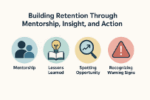
In today’s competitive service landscape, client retention is not the byproduct of good intentions or responsive teams—it is the outcome of deliberate leadership, shared wisdom, and cultural clarity. At the core of that clarity lies a connected system of development practices that enable companies not only to serve clients more effectively, but to anticipate their needs and retain them for the long haul. Chapter 6 of this curriculum explores four integrated concepts that fuel high retention organizations: mentorship, lessons learned, opportunity spotting, and early warning signals. While each is powerful on its own, together they build a resilient foundation for client success.
Mentorship is often misunderstood as a one-on-one developmental tool. In reality, it is a leadership function that strengthens judgment, builds context, and equips employees to navigate the gray areas of client relationships. Clients don’t leave because someone missed a step. They leave when service feels shallow, when concerns are overlooked, and when relationships become transactional. Mentorship ensures that employees grow in discernment, not just in skills. It closes the gap between knowledge and understanding—an essential distinction when working with high-value clients whose expectations extend far beyond the basics.
Lessons Learned complements mentorship by scaling insight. While mentorship is intimate and ongoing, Lessons Learned is structured and expansive. It formalizes the process of sharing what worked, what didn’t, and what changed as a result. Companies often make the mistake of assuming their best people will organically pass down their wisdom. In reality, much of that insight remains siloed, unspoken, and eventually lost. By institutionalizing Lessons Learned sessions—particularly at the leadership level—organizations ensure that wisdom becomes a reusable asset. Not only does this help account teams avoid repeating mistakes, it accelerates onboarding, reduces service inconsistencies, and elevates the quality of execution across the board.
But knowledge alone is not enough. Organizations must also train their teams to identify and elevate opportunity when it appears. The most promising signals don’t arrive in formal RFPs—they emerge in hallway conversations, stakeholder changes, or passing mentions of future initiatives. The ability to hear these signals, and the confidence to act on them, turns ordinary account managers into strategic advisors. Leadership plays a key role here by clearly defining what opportunity looks like in their industry and organization. They must equip teams with observable cues, create pathways for those cues to be shared, and reinforce a culture where proactive listening is the norm.
On the other side of opportunity is risk. The same attentiveness that helps companies grow also prevents them from losing what they’ve built. Client departures rarely come out of nowhere. They are almost always preceded by identifiable patterns: delayed responses, disengaged decision-makers, declining usage, or new procurement contacts. When these signs go unrecognized, the result is not just a lost client—it’s a missed opportunity to course-correct. Leaders must formalize how their organizations track and act on early warning signs. This requires more than accountability—it demands a cultural shift where speaking up about a concern is seen as strategic foresight, not pessimism.
The good news is that none of this requires radical reinvention. It requires intention. Mentorship, Lessons Learned, opportunity recognition, and risk vigilance are not separate programs. They are interlocking practices that reflect a company’s values and leadership priorities. When aligned and reinforced, they form the backbone of a high-retention culture—one that evolves faster than the problems it faces.
Companies that commit to learning forward—through mentorship, shared insight, and structured responsiveness—don’t just retain more clients. They build more capable teams, more engaged cultures, and more enduring value. That’s the kind of growth that lasts.

Chapter 7: Lessons Learned Workshop
Chapter 7 marks the transition from theory to action, guiding teams through the execution of the Lessons Learned workshop. This workshop is designed to capture and document critical experiences—both wins and failures—so the organization can stop repeating avoidable mistakes and begin scaling what works. The output is not only a list of lessons and client signals but also a living framework to improve decision-making and foster proactive engagement.
The session includes participation from both the Executive Team and the Partnership Success Team to ensure a full-spectrum view of client and internal dynamics. Participants are encouraged to share firsthand stories of missed opportunities and regrettable losses. Through storytelling and reflection, the team begins to surface patterns, warning signs, and overlooked signals. These insights form the foundation of a Lessons Framework that helps guide future actions and prevent the loss of valuable knowledge.
The workshop can be held either back-to-back with the Right Clients/Right Terms® session or separately, depending on logistics. Regardless of timing, the priority is full participation and strategic focus. While live sessions bring energy and connection, virtual formats also offer advantages, such as broader participation and digital documentation.
A critical part of the workshop involves transforming stories into signals—indicators that something is going right or wrong, often long before outcomes are finalized. The session trains participants to recognize subtle cues like behavioral shifts, stakeholder changes, or client curiosity, which may point to risks or opportunities. This pivot from hindsight to foresight is essential for organizational maturity.
The chapter culminates with the creation of a Lessons Dashboard and the foundation of a formal process for capturing and acting on insights. A supporting case study shows how a SaaS company used this framework to improve stakeholder management and signal tracking, resulting in a 28% increase in expansion revenue.
The goal is lasting change—not folklore or postmortems, but repeatable systems that drive clarity, alignment, and smarter client decisions across the organization. This is how companies stop relearning the same lessons—and start building on them.

Chapter 8: Lessons Learned Finalization
Chapter 8 of the curriculum marks a pivotal moment in shifting from reactive client management to proactive relationship preservation. The central theme is risk and warning sign mapping, with an emphasis on early detection of client dissatisfaction to prevent future losses. The process begins with the collaborative development of three detailed case studies where clients were lost. These real-world examples serve not only as lessons but as the basis for building a common language and shared framework around client risk.
Participants are tasked with reflecting on the past three years of business to identify key wins and losses. From this inventory, they select three complex client losses that merit deep analysis. These stories are not chosen for their simplicity but for the insight they offer into how and why relationships fail. This preparation culminates in a workshop where participants are reorganized into diverse, cross-functional teams. Each team investigates their assigned case studies through four suggested categories of warning signs: disengagement, tone shift, new procurement barriers, and missed meetings. These categories are starting points, and teams are encouraged to expand on them using their own experience.
The analysis is not only about categorizing what went wrong but also about understanding how and why early signals were missed. The workshop’s goal is to generate a collective understanding of client erosion patterns and begin forming an organizational “risk radar.” This radar is composed of observable signals and the behaviors that precede client loss, allowing future teams to intervene early.
From the workshop, an interim report is generated. It captures general lessons learned, key opportunity and warning signals, and lays the groundwork for future action planning. This document is collaborative and provisional—it is sent out for participant feedback to ensure accuracy, clarity, and completeness. The feedback process is tightly managed to maintain momentum and ensure the final document is practical and widely accepted.
Once refined, the final report will feed directly into an action plan. Here, the Partnership Success Team steps in to translate signals into steps—what to do when a red flag appears. These actions will be documented in two formats: straightforward step-by-step guides and illustrative stories. The combination ensures both clarity and engagement. These will form a strategic playbook for use across the organization.
The chapter concludes with a call to embed this new system into the organization’s culture. It emphasizes that learning alone is insufficient unless it leads to shared action. Communication plans and future integrations are set in motion to ensure these lessons aren’t forgotten but become fundamental to how the company operates. Through collective reflection, analysis, and action, the organization transforms the pain of past client losses into a blueprint for sustained relationship success.

Chapter 9: The Communication Plan
Effective internal communication is not a luxury—it’s a necessity, especially when executing culture-shaping strategies like Right Clients/Right Terms® and Lessons Learned. Without clear, intentional messaging, even the best strategic work can go unnoticed, misunderstood, or worse, misapplied. This chapter emphasizes that communication must be planned as deliberately as any other business initiative if it’s to drive engagement, alignment, and results.
An internal communication plan is a strategic tool used to deliver focused, consistent, and actionable messages across the organization. It ensures employees understand the company’s direction, their role in it, and the behaviors required to achieve shared outcomes. Yet, despite its importance, communication is often treated as an afterthought. Messages are too frequently vague, one-off, or disconnected from broader company goals, leading to confusion, mistrust, and stagnation.
The chapter outlines the danger of assuming employees “just get it.” Poorly targeted communication can lead to misinterpretation, resistance, and disengagement. Employees fill in gaps with their own assumptions—often incorrect. To combat this, communication must be outcome-driven: every message should reinforce the desired end-state, provide clear context, and connect individual action to company-wide goals.
Collaboration across departments is essential. Client retention, while critical, is just one of many initiatives competing for employee attention. Without alignment, various messages become noise. The solution lies in identifying a central communication coordinator—whether it’s HR, a communications team, or a key administrator—to ensure integration across functions and campaigns. Early collaboration helps reduce message conflict and ensures strategic clarity.
Audience targeting is also vital. Not every message needs to go to everyone, and sharing complex strategic documents without context can backfire. For instance, communicating the Right Clients/Right Terms® framework too broadly without guidance led some employees to misuse it, disengaging from clients they deemed unfit. Messages must be tailored, contextualized, and delivered only to those who will act on or influence the outcome.
The chapter identifies six communication plan types, focusing on the four most relevant to client retention: High-Level, Leadership, Change Management, and Employee Engagement & Culture plans. Each serves a unique purpose—from defining strategic intent to reinforcing leadership voice, guiding change, and shaping workplace culture. The remaining two, Strategic Communication Plans and Crisis Communication Plans, provide supporting structure and contingency for high-pressure scenarios.
Each plan includes actionable elements: clear objectives, defined audiences, selected channels, and built-in feedback loops. Leadership must communicate regularly and credibly, not as a one-time event but as an ongoing rhythm. Culture change, in particular, requires reinforcement, recognition, and shared stories to drive behavior and belief.
Finally, the communication plan must be measurable. Metrics—such as retention rates, engagement surveys, and feedback loops—ensure communication isn’t just noise but a driver of tangible business outcomes. Most importantly, messaging must resonate. It should be seen through the lens of the employee: how it affects their role, their experience, and their contribution.
This chapter provides both a call to action and a blueprint: treat communication with the weight it deserves, and use it to unify, mobilize, and transform.

Chapter 10: Getting Specific
Chapter 10 marks a turning point—from setting the vision to activating the strategy. With the executive team having introduced the importance of client retention, it’s now time to focus on execution through clear, purposeful communication that brings the Clients for Life® process to life across the organization.
This chapter lays out a structured approach to internal communication, rooted in the three core principles of the client retention strategy: Assess, Create, and Execute. The goal is not just to share information, but to shape understanding, inspire engagement, and drive meaningful change in behavior. Communication must connect to the day-to-day work of employees, helping them see how retaining clients reduces friction, builds trust, and leads to better outcomes for all.
A key theme is message customization. Not everyone needs the same message, and a one-size-fits-all approach won’t land. Client-facing staff need clarity on how to apply the process in real situations. Operational and support teams need awareness of how their work supports the larger goal. Executives want to see how it ties into long-term business growth. By tailoring the message to each audience and speaking to their concerns, motivations, and role in the strategy, the communication becomes relevant and actionable.
The chapter emphasizes the importance of consistency—identifying a few strong, repeatable messages that reflect company values and resonate with the culture. These messages should be pressure-tested, refined, and used across all formats, from casual conversations to formal presentations.
To make the strategy stick, the chapter outlines the need for a thoughtful cadence of communication using trusted channels—emails, videos, meetings, or forums. Feedback loops and ongoing measurement ensure the message is not only heard but understood and acted upon. Leadership alignment and clear responsibilities help reinforce the message throughout the company.
Ultimately, this chapter serves as a blueprint for building a communication plan that is clear, credible, and impactful—setting the stage for lasting organizational change and a stronger client experience.
Curriculum

Client Retention Strategy – WDP3 – Executive Strategy
- Creating Strategy
- Understanding Right Clients/Right Terms®
- Right Client/Right Terms Workshop
- Right Client/Right Terms the Workshop Understanding Right Clients/Right Terms®
- The Importance of Mentorship
- Lessons Learned Concept
- Lessons Learned Workshop
- Lessons Learned Finalization
- The Communication Plan
- Getting Specific
- Creating Strategy1
- Creating Strategy2
Distance Learning

Introduction
Welcome to Appleton Greene and thank you for enrolling on the Client Retention Strategy corporate training program. You will be learning through our unique facilitation via distance-learning method, which will enable you to practically implement everything that you learn academically. The methods and materials used in your program have been designed and developed to ensure that you derive the maximum benefits and enjoyment possible. We hope that you find the program challenging and fun to do. However, if you have never been a distance-learner before, you may be experiencing some trepidation at the task before you. So we will get you started by giving you some basic information and guidance on how you can make the best use of the modules, how you should manage the materials and what you should be doing as you work through them. This guide is designed to point you in the right direction and help you to become an effective distance-learner. Take a few hours or so to study this guide and your guide to tutorial support for students, while making notes, before you start to study in earnest.
Study environment
You will need to locate a quiet and private place to study, preferably a room where you can easily be isolated from external disturbances or distractions. Make sure the room is well-lit and incorporates a relaxed, pleasant feel. If you can spoil yourself within your study environment, you will have much more of a chance to ensure that you are always in the right frame of mind when you do devote time to study. For example, a nice fire, the ability to play soft soothing background music, soft but effective lighting, perhaps a nice view if possible and a good size desk with a comfortable chair. Make sure that your family know when you are studying and understand your study rules. Your study environment is very important. The ideal situation, if at all possible, is to have a separate study, which can be devoted to you. If this is not possible then you will need to pay a lot more attention to developing and managing your study schedule, because it will affect other people as well as yourself. The better your study environment, the more productive you will be.
Study tools & rules
Try and make sure that your study tools are sufficient and in good working order. You will need to have access to a computer, scanner and printer, with access to the internet. You will need a very comfortable chair, which supports your lower back, and you will need a good filing system. It can be very frustrating if you are spending valuable study time trying to fix study tools that are unreliable, or unsuitable for the task. Make sure that your study tools are up to date. You will also need to consider some study rules. Some of these rules will apply to you and will be intended to help you to be more disciplined about when and how you study. This distance-learning guide will help you and after you have read it you can put some thought into what your study rules should be. You will also need to negotiate some study rules for your family, friends or anyone who lives with you. They too will need to be disciplined in order to ensure that they can support you while you study. It is important to ensure that your family and friends are an integral part of your study team. Having their support and encouragement can prove to be a crucial contribution to your successful completion of the program. Involve them in as much as you can.
Successful distance-learning
Distance-learners are freed from the necessity of attending regular classes or workshops, since they can study in their own way, at their own pace and for their own purposes. But unlike traditional internal training courses, it is the student’s responsibility, with a distance-learning program, to ensure that they manage their own study contribution. This requires strong self-discipline and self-motivation skills and there must be a clear will to succeed. Those students who are used to managing themselves, are good at managing others and who enjoy working in isolation, are more likely to be good distance-learners. It is also important to be aware of the main reasons why you are studying and of the main objectives that you are hoping to achieve as a result. You will need to remind yourself of these objectives at times when you need to motivate yourself. Never lose sight of your long-term goals and your short-term objectives. There is nobody available here to pamper you, or to look after you, or to spoon-feed you with information, so you will need to find ways to encourage and appreciate yourself while you are studying. Make sure that you chart your study progress, so that you can be sure of your achievements and re-evaluate your goals and objectives regularly.
Self-assessment
Appleton Greene training programs are in all cases post-graduate programs. Consequently, you should already have obtained a business-related degree and be an experienced learner. You should therefore already be aware of your study strengths and weaknesses. For example, which time of the day are you at your most productive? Are you a lark or an owl? What study methods do you respond to the most? Are you a consistent learner? How do you discipline yourself? How do you ensure that you enjoy yourself while studying? It is important to understand yourself as a learner and so some self-assessment early on will be necessary if you are to apply yourself correctly. Perform a SWOT analysis on yourself as a student. List your internal strengths and weaknesses as a student and your external opportunities and threats. This will help you later on when you are creating a study plan. You can then incorporate features within your study plan that can ensure that you are playing to your strengths, while compensating for your weaknesses. You can also ensure that you make the most of your opportunities, while avoiding the potential threats to your success.
Accepting responsibility as a student
Training programs invariably require a significant investment, both in terms of what they cost and in the time that you need to contribute to study and the responsibility for successful completion of training programs rests entirely with the student. This is never more apparent than when a student is learning via distance-learning. Accepting responsibility as a student is an important step towards ensuring that you can successfully complete your training program. It is easy to instantly blame other people or factors when things go wrong. But the fact of the matter is that if a failure is your failure, then you have the power to do something about it, it is entirely in your own hands. If it is always someone else’s failure, then you are powerless to do anything about it. All students study in entirely different ways, this is because we are all individuals and what is right for one student, is not necessarily right for another. In order to succeed, you will have to accept personal responsibility for finding a way to plan, implement and manage a personal study plan that works for you. If you do not succeed, you only have yourself to blame.
Planning
By far the most critical contribution to stress, is the feeling of not being in control. In the absence of planning we tend to be reactive and can stumble from pillar to post in the hope that things will turn out fine in the end. Invariably they don’t! In order to be in control, we need to have firm ideas about how and when we want to do things. We also need to consider as many possible eventualities as we can, so that we are prepared for them when they happen. Prescriptive Change, is far easier to manage and control, than Emergent Change. The same is true with distance-learning. It is much easier and much more enjoyable, if you feel that you are in control and that things are going to plan. Even when things do go wrong, you are prepared for them and can act accordingly without any unnecessary stress. It is important therefore that you do take time to plan your studies properly.
Management
Once you have developed a clear study plan, it is of equal importance to ensure that you manage the implementation of it. Most of us usually enjoy planning, but it is usually during implementation when things go wrong. Targets are not met and we do not understand why. Sometimes we do not even know if targets are being met. It is not enough for us to conclude that the study plan just failed. If it is failing, you will need to understand what you can do about it. Similarly if your study plan is succeeding, it is still important to understand why, so that you can improve upon your success. You therefore need to have guidelines for self-assessment so that you can be consistent with performance improvement throughout the program. If you manage things correctly, then your performance should constantly improve throughout the program.
Study objectives & tasks
The first place to start is developing your program objectives. These should feature your reasons for undertaking the training program in order of priority. Keep them succinct and to the point in order to avoid confusion. Do not just write the first things that come into your head because they are likely to be too similar to each other. Make a list of possible departmental headings, such as: Customer Service; E-business; Finance; Globalization; Human Resources; Technology; Legal; Management; Marketing and Production. Then brainstorm for ideas by listing as many things that you want to achieve under each heading and later re-arrange these things in order of priority. Finally, select the top item from each department heading and choose these as your program objectives. Try and restrict yourself to five because it will enable you to focus clearly. It is likely that the other things that you listed will be achieved if each of the top objectives are achieved. If this does not prove to be the case, then simply work through the process again.
Study forecast
As a guide, the Appleton Greene Client Retention Strategy corporate training program should take 12-18 months to complete, depending upon your availability and current commitments. The reason why there is such a variance in time estimates is because every student is an individual, with differing productivity levels and different commitments. These differentiations are then exaggerated by the fact that this is a distance-learning program, which incorporates the practical integration of academic theory as an as a part of the training program. Consequently all of the project studies are real, which means that important decisions and compromises need to be made. You will want to get things right and will need to be patient with your expectations in order to ensure that they are. We would always recommend that you are prudent with your own task and time forecasts, but you still need to develop them and have a clear indication of what are realistic expectations in your case. With reference to your time planning: consider the time that you can realistically dedicate towards study with the program every week; calculate how long it should take you to complete the program, using the guidelines featured here; then break the program down into logical modules and allocate a suitable proportion of time to each of them, these will be your milestones; you can create a time plan by using a spreadsheet on your computer, or a personal organizer such as MS Outlook, you could also use a financial forecasting software; break your time forecasts down into manageable chunks of time, the more specific you can be, the more productive and accurate your time management will be; finally, use formulas where possible to do your time calculations for you, because this will help later on when your forecasts need to change in line with actual performance. With reference to your task planning: refer to your list of tasks that need to be undertaken in order to achieve your program objectives; with reference to your time plan, calculate when each task should be implemented; remember that you are not estimating when your objectives will be achieved, but when you will need to focus upon implementing the corresponding tasks; you also need to ensure that each task is implemented in conjunction with the associated training modules which are relevant; then break each single task down into a list of specific to do’s, say approximately ten to do’s for each task and enter these into your study plan; once again you could use MS Outlook to incorporate both your time and task planning and this could constitute your study plan; you could also use a project management software like MS Project. You should now have a clear and realistic forecast detailing when you can expect to be able to do something about undertaking the tasks to achieve your program objectives.
Performance management
It is one thing to develop your study forecast, it is quite another to monitor your progress. Ultimately it is less important whether you achieve your original study forecast and more important that you update it so that it constantly remains realistic in line with your performance. As you begin to work through the program, you will begin to have more of an idea about your own personal performance and productivity levels as a distance-learner. Once you have completed your first study module, you should re-evaluate your study forecast for both time and tasks, so that they reflect your actual performance level achieved. In order to achieve this you must first time yourself while training by using an alarm clock. Set the alarm for hourly intervals and make a note of how far you have come within that time. You can then make a note of your actual performance on your study plan and then compare your performance against your forecast. Then consider the reasons that have contributed towards your performance level, whether they are positive or negative and make a considered adjustment to your future forecasts as a result. Given time, you should start achieving your forecasts regularly.
With reference to time management: time yourself while you are studying and make a note of the actual time taken in your study plan; consider your successes with time-efficiency and the reasons for the success in each case and take this into consideration when reviewing future time planning; consider your failures with time-efficiency and the reasons for the failures in each case and take this into consideration when reviewing future time planning; re-evaluate your study forecast in relation to time planning for the remainder of your training program to ensure that you continue to be realistic about your time expectations. You need to be consistent with your time management, otherwise you will never complete your studies. This will either be because you are not contributing enough time to your studies, or you will become less efficient with the time that you do allocate to your studies. Remember, if you are not in control of your studies, they can just become yet another cause of stress for you.
With reference to your task management: time yourself while you are studying and make a note of the actual tasks that you have undertaken in your study plan; consider your successes with task-efficiency and the reasons for the success in each case; take this into consideration when reviewing future task planning; consider your failures with task-efficiency and the reasons for the failures in each case and take this into consideration when reviewing future task planning; re-evaluate your study forecast in relation to task planning for the remainder of your training program to ensure that you continue to be realistic about your task expectations. You need to be consistent with your task management, otherwise you will never know whether you are achieving your program objectives or not.
Keeping in touch
You will have access to qualified and experienced professors and tutors who are responsible for providing tutorial support for your particular training program. So don’t be shy about letting them know how you are getting on. We keep electronic records of all tutorial support emails so that professors and tutors can review previous correspondence before considering an individual response. It also means that there is a record of all communications between you and your professors and tutors and this helps to avoid any unnecessary duplication, misunderstanding, or misinterpretation. If you have a problem relating to the program, share it with them via email. It is likely that they have come across the same problem before and are usually able to make helpful suggestions and steer you in the right direction. To learn more about when and how to use tutorial support, please refer to the Tutorial Support section of this student information guide. This will help you to ensure that you are making the most of tutorial support that is available to you and will ultimately contribute towards your success and enjoyment with your training program.
Work colleagues and family
You should certainly discuss your program study progress with your colleagues, friends and your family. Appleton Greene training programs are very practical. They require you to seek information from other people, to plan, develop and implement processes with other people and to achieve feedback from other people in relation to viability and productivity. You will therefore have plenty of opportunities to test your ideas and enlist the views of others. People tend to be sympathetic towards distance-learners, so don’t bottle it all up in yourself. Get out there and share it! It is also likely that your family and colleagues are going to benefit from your labors with the program, so they are likely to be much more interested in being involved than you might think. Be bold about delegating work to those who might benefit themselves. This is a great way to achieve understanding and commitment from people who you may later rely upon for process implementation. Share your experiences with your friends and family.
Making it relevant
The key to successful learning is to make it relevant to your own individual circumstances. At all times you should be trying to make bridges between the content of the program and your own situation. Whether you achieve this through quiet reflection or through interactive discussion with your colleagues, client partners or your family, remember that it is the most important and rewarding aspect of translating your studies into real self-improvement. You should be clear about how you want the program to benefit you. This involves setting clear study objectives in relation to the content of the course in terms of understanding, concepts, completing research or reviewing activities and relating the content of the modules to your own situation. Your objectives may understandably change as you work through the program, in which case you should enter the revised objectives on your study plan so that you have a permanent reminder of what you are trying to achieve, when and why.
Distance-learning check-list
Prepare your study environment, your study tools and rules.
Undertake detailed self-assessment in terms of your ability as a learner.
Create a format for your study plan.
Consider your study objectives and tasks.
Create a study forecast.
Assess your study performance.
Re-evaluate your study forecast.
Be consistent when managing your study plan.
Use your Appleton Greene Certified Learning Provider (CLP) for tutorial support.
Make sure you keep in touch with those around you.
Tutorial Support

Programs
Appleton Greene uses standard and bespoke corporate training programs as vessels to transfer business process improvement knowledge into the heart of our clients’ organizations. Each individual program focuses upon the implementation of a specific business process, which enables clients to easily quantify their return on investment. There are hundreds of established Appleton Greene corporate training products now available to clients within customer services, e-business, finance, globalization, human resources, information technology, legal, management, marketing and production. It does not matter whether a client’s employees are located within one office, or an unlimited number of international offices, we can still bring them together to learn and implement specific business processes collectively. Our approach to global localization enables us to provide clients with a truly international service with that all important personal touch. Appleton Greene corporate training programs can be provided virtually or locally and they are all unique in that they individually focus upon a specific business function. They are implemented over a sustainable period of time and professional support is consistently provided by qualified learning providers and specialist consultants.
Support available
You will have a designated Certified Learning Provider (CLP) and an Accredited Consultant and we encourage you to communicate with them as much as possible. In all cases tutorial support is provided online because we can then keep a record of all communications to ensure that tutorial support remains consistent. You would also be forwarding your work to the tutorial support unit for evaluation and assessment. You will receive individual feedback on all of the work that you undertake on a one-to-one basis, together with specific recommendations for anything that may need to be changed in order to achieve a pass with merit or a pass with distinction and you then have as many opportunities as you may need to re-submit project studies until they meet with the required standard. Consequently the only reason that you should really fail (CLP) is if you do not do the work. It makes no difference to us whether a student takes 12 months or 18 months to complete the program, what matters is that in all cases the same quality standard will have been achieved.
Support Process
Please forward all of your future emails to the designated (CLP) Tutorial Support Unit email address that has been provided and please do not duplicate or copy your emails to other AGC email accounts as this will just cause unnecessary administration. Please note that emails are always answered as quickly as possible but you will need to allow a period of up to 20 business days for responses to general tutorial support emails during busy periods, because emails are answered strictly within the order in which they are received. You will also need to allow a period of up to 30 business days for the evaluation and assessment of project studies. This does not include weekends or public holidays. Please therefore kindly allow for this within your time planning. All communications are managed online via email because it enables tutorial service support managers to review other communications which have been received before responding and it ensures that there is a copy of all communications retained on file for future reference. All communications will be stored within your personal (CLP) study file here at Appleton Greene throughout your designated study period. If you need any assistance or clarification at any time, please do not hesitate to contact us by forwarding an email and remember that we are here to help. If you have any questions, please list and number your questions succinctly and you can then be sure of receiving specific answers to each and every query.
Time Management
It takes approximately 1 Year to complete the Client Retention Strategy corporate training program, incorporating 12 x 6-hour monthly workshops. Each student will also need to contribute approximately 4 hours per week over 1 Year of their personal time. Students can study from home or work at their own pace and are responsible for managing their own study plan. There are no formal examinations and students are evaluated and assessed based upon their project study submissions, together with the quality of their internal analysis and supporting documents. They can contribute more time towards study when they have the time to do so and can contribute less time when they are busy. All students tend to be in full time employment while studying and the Client Retention Strategy program is purposely designed to accommodate this, so there is plenty of flexibility in terms of time management. It makes no difference to us at Appleton Greene, whether individuals take 12-18 months to complete this program. What matters is that in all cases the same standard of quality will have been achieved with the standard and bespoke programs that have been developed.
Distance Learning Guide
The distance learning guide should be your first port of call when starting your training program. It will help you when you are planning how and when to study, how to create the right environment and how to establish the right frame of mind. If you can lay the foundations properly during the planning stage, then it will contribute to your enjoyment and productivity while training later. The guide helps to change your lifestyle in order to accommodate time for study and to cultivate good study habits. It helps you to chart your progress so that you can measure your performance and achieve your goals. It explains the tools that you will need for study and how to make them work. It also explains how to translate academic theory into practical reality. Spend some time now working through your distance learning guide and make sure that you have firm foundations in place so that you can make the most of your distance learning program. There is no requirement for you to attend training workshops or classes at Appleton Greene offices. The entire program is undertaken online, program course manuals and project studies are administered via the Appleton Greene web site and via email, so you are able to study at your own pace and in the comfort of your own home or office as long as you have a computer and access to the internet.
How To Study
The how to study guide provides students with a clear understanding of the Appleton Greene facilitation via distance learning training methods and enables students to obtain a clear overview of the training program content. It enables students to understand the step-by-step training methods used by Appleton Greene and how course manuals are integrated with project studies. It explains the research and development that is required and the need to provide evidence and references to support your statements. It also enables students to understand precisely what will be required of them in order to achieve a pass with merit and a pass with distinction for individual project studies and provides useful guidance on how to be innovative and creative when developing your Unique Program Proposition (UPP).
Tutorial Support
Tutorial support for the Appleton Greene Client Retention Strategy corporate training program is provided online either through the Appleton Greene Client Support Portal (CSP), or via email. All tutorial support requests are facilitated by a designated Program Administration Manager (PAM). They are responsible for deciding which professor or tutor is the most appropriate option relating to the support required and then the tutorial support request is forwarded onto them. Once the professor or tutor has completed the tutorial support request and answered any questions that have been asked, this communication is then returned to the student via email by the designated Program Administration Manager (PAM). This enables all tutorial support, between students, professors and tutors, to be facilitated by the designated Program Administration Manager (PAM) efficiently and securely through the email account. You will therefore need to allow a period of up to 20 business days for responses to general support queries and up to 30 business days for the evaluation and assessment of project studies, because all tutorial support requests are answered strictly within the order in which they are received. This does not include weekends or public holidays. Consequently you need to put some thought into the management of your tutorial support procedure in order to ensure that your study plan is feasible and to obtain the maximum possible benefit from tutorial support during your period of study. Please retain copies of your tutorial support emails for future reference. Please ensure that ALL of your tutorial support emails are set out using the format as suggested within your guide to tutorial support. Your tutorial support emails need to be referenced clearly to the specific part of the course manual or project study which you are working on at any given time. You also need to list and number any questions that you would like to ask, up to a maximum of five questions within each tutorial support email. Remember the more specific you can be with your questions the more specific your answers will be too and this will help you to avoid any unnecessary misunderstanding, misinterpretation, or duplication. The guide to tutorial support is intended to help you to understand how and when to use support in order to ensure that you get the most out of your training program. Appleton Greene training programs are designed to enable you to do things for yourself. They provide you with a structure or a framework and we use tutorial support to facilitate students while they practically implement what they learn. In other words, we are enabling students to do things for themselves. The benefits of distance learning via facilitation are considerable and are much more sustainable in the long-term than traditional short-term knowledge sharing programs. Consequently you should learn how and when to use tutorial support so that you can maximize the benefits from your learning experience with Appleton Greene. This guide describes the purpose of each training function and how to use them and how to use tutorial support in relation to each aspect of the training program. It also provides useful tips and guidance with regard to best practice.
Tutorial Support Tips
Students are often unsure about how and when to use tutorial support with Appleton Greene. This Tip List will help you to understand more about how to achieve the most from using tutorial support. Refer to it regularly to ensure that you are continuing to use the service properly. Tutorial support is critical to the success of your training experience, but it is important to understand when and how to use it in order to maximize the benefit that you receive. It is no coincidence that those students who succeed are those that learn how to be positive, proactive and productive when using tutorial support.
Be positive and friendly with your tutorial support emails
Remember that if you forward an email to the tutorial support unit, you are dealing with real people. “Do unto others as you would expect others to do unto you”. If you are positive, complimentary and generally friendly in your emails, you will generate a similar response in return. This will be more enjoyable, productive and rewarding for you in the long-term.
Think about the impression that you want to create
Every time that you communicate, you create an impression, which can be either positive or negative, so put some thought into the impression that you want to create. Remember that copies of all tutorial support emails are stored electronically and tutors will always refer to prior correspondence before responding to any current emails. Over a period of time, a general opinion will be arrived at in relation to your character, attitude and ability. Try to manage your own frustrations, mood swings and temperament professionally, without involving the tutorial support team. Demonstrating frustration or a lack of patience is a weakness and will be interpreted as such. The good thing about communicating in writing, is that you will have the time to consider your content carefully, you can review it and proof-read it before sending your email to Appleton Greene and this should help you to communicate more professionally, consistently and to avoid any unnecessary knee-jerk reactions to individual situations as and when they may arise. Please also remember that the CLP Tutorial Support Unit will not just be responsible for evaluating and assessing the quality of your work, they will also be responsible for providing recommendations to other learning providers and to client contacts within the Appleton Greene global client network, so do be in control of your own emotions and try to create a good impression.
Remember that quality is preferred to quantity
Please remember that when you send an email to the tutorial support team, you are not using Twitter or Text Messaging. Try not to forward an email every time that you have a thought. This will not prove to be productive either for you or for the tutorial support team. Take time to prepare your communications properly, as if you were writing a professional letter to a business colleague and make a list of queries that you are likely to have and then incorporate them within one email, say once every month, so that the tutorial support team can understand more about context, application and your methodology for study. Get yourself into a consistent routine with your tutorial support requests and use the tutorial support template provided with ALL of your emails. The (CLP) Tutorial Support Unit will not spoon-feed you with information. They need to be able to evaluate and assess your tutorial support requests carefully and professionally.
Be specific about your questions in order to receive specific answers
Try not to write essays by thinking as you are writing tutorial support emails. The tutorial support unit can be unclear about what in fact you are asking, or what you are looking to achieve. Be specific about asking questions that you want answers to. Number your questions. You will then receive specific answers to each and every question. This is the main purpose of tutorial support via email.
Keep a record of your tutorial support emails
It is important that you keep a record of all tutorial support emails that are forwarded to you. You can then refer to them when necessary and it avoids any unnecessary duplication, misunderstanding, or misinterpretation.
Individual training workshops or telephone support
Please be advised that Appleton Greene does not provide separate or individual tutorial support meetings, workshops, or provide telephone support for individual students. Appleton Greene is an equal opportunities learning and service provider and we are therefore understandably bound to treat all students equally. We cannot therefore broker special financial or study arrangements with individual students regardless of the circumstances. All tutorial support is provided online and this enables Appleton Greene to keep a record of all communications between students, professors and tutors on file for future reference, in accordance with our quality management procedure and your terms and conditions of enrolment. All tutorial support is provided online via email because it enables us to have time to consider support content carefully, it ensures that you receive a considered and detailed response to your queries. You can number questions that you would like to ask, which relate to things that you do not understand or where clarification may be required. You can then be sure of receiving specific answers to each individual query. You will also then have a record of these communications and of all tutorial support, which has been provided to you. This makes tutorial support administration more productive by avoiding any unnecessary duplication, misunderstanding, or misinterpretation.
Tutorial Support Email Format
You should use this tutorial support format if you need to request clarification or assistance while studying with your training program. Please note that ALL of your tutorial support request emails should use the same format. You should therefore set up a standard email template, which you can then use as and when you need to. Emails that are forwarded to Appleton Greene, which do not use the following format, may be rejected and returned to you by the (CLP) Program Administration Manager. A detailed response will then be forwarded to you via email usually within 20 business days of receipt for general support queries and 30 business days for the evaluation and assessment of project studies. This does not include weekends or public holidays. Your tutorial support request, together with the corresponding TSU reply, will then be saved and stored within your electronic TSU file at Appleton Greene for future reference.
Subject line of your email
Please insert: Appleton Greene (CLP) Tutorial Support Request: (Your Full Name) (Date), within the subject line of your email.
Main body of your email
Please insert:
1. Appleton Greene Certified Learning Provider (CLP) Tutorial Support Request
2. Your Full Name
3. Date of TS request
4. Preferred email address
5. Backup email address
6. Course manual page name or number (reference)
7. Project study page name or number (reference)
Subject of enquiry
Please insert a maximum of 50 words (please be succinct)
Briefly outline the subject matter of your inquiry, or what your questions relate to.
Question 1
Maximum of 50 words (please be succinct)
Maximum of 50 words (please be succinct)
Question 3
Maximum of 50 words (please be succinct)
Question 4
Maximum of 50 words (please be succinct)
Question 5
Maximum of 50 words (please be succinct)
Please note that a maximum of 5 questions is permitted with each individual tutorial support request email.
Procedure
* List the questions that you want to ask first, then re-arrange them in order of priority. Make sure that you reference them, where necessary, to the course manuals or project studies.
* Make sure that you are specific about your questions and number them. Try to plan the content within your emails to make sure that it is relevant.
* Make sure that your tutorial support emails are set out correctly, using the Tutorial Support Email Format provided here.
* Save a copy of your email and incorporate the date sent after the subject title. Keep your tutorial support emails within the same file and in date order for easy reference.
* Allow up to 20 business days for a response to general tutorial support emails and up to 30 business days for the evaluation and assessment of project studies, because detailed individual responses will be made in all cases and tutorial support emails are answered strictly within the order in which they are received.
* Emails can and do get lost. So if you have not received a reply within the appropriate time, forward another copy or a reminder to the tutorial support unit to be sure that it has been received but do not forward reminders unless the appropriate time has elapsed.
* When you receive a reply, save it immediately featuring the date of receipt after the subject heading for easy reference. In most cases the tutorial support unit replies to your questions individually, so you will have a record of the questions that you asked as well as the answers offered. With project studies however, separate emails are usually forwarded by the tutorial support unit, so do keep a record of your own original emails as well.
* Remember to be positive and friendly in your emails. You are dealing with real people who will respond to the same things that you respond to.
* Try not to repeat questions that have already been asked in previous emails. If this happens the tutorial support unit will probably just refer you to the appropriate answers that have already been provided within previous emails.
* If you lose your tutorial support email records you can write to Appleton Greene to receive a copy of your tutorial support file, but a separate administration charge may be levied for this service.
How To Study

Your Certified Learning Provider (CLP) and Accredited Consultant can help you to plan a task list for getting started so that you can be clear about your direction and your priorities in relation to your training program. It is also a good way to introduce yourself to the tutorial support team.
Planning your study environment
Your study conditions are of great importance and will have a direct effect on how much you enjoy your training program. Consider how much space you will have, whether it is comfortable and private and whether you are likely to be disturbed. The study tools and facilities at your disposal are also important to the success of your distance-learning experience. Your tutorial support unit can help with useful tips and guidance, regardless of your starting position. It is important to get this right before you start working on your training program.
Planning your program objectives
It is important that you have a clear list of study objectives, in order of priority, before you start working on your training program. Your tutorial support unit can offer assistance here to ensure that your study objectives have been afforded due consideration and priority.
Planning how and when to study
Distance-learners are freed from the necessity of attending regular classes, since they can study in their own way, at their own pace and for their own purposes. This approach is designed to let you study efficiently away from the traditional classroom environment. It is important however, that you plan how and when to study, so that you are making the most of your natural attributes, strengths and opportunities. Your tutorial support unit can offer assistance and useful tips to ensure that you are playing to your strengths.
Planning your study tasks
You should have a clear understanding of the study tasks that you should be undertaking and the priority associated with each task. These tasks should also be integrated with your program objectives. The distance learning guide and the guide to tutorial support for students should help you here, but if you need any clarification or assistance, please contact your tutorial support unit.
Planning your time
You will need to allocate specific times during your calendar when you intend to study if you are to have a realistic chance of completing your program on time. You are responsible for planning and managing your own study time, so it is important that you are successful with this. Your tutorial support unit can help you with this if your time plan is not working.
Keeping in touch
Consistency is the key here. If you communicate too frequently in short bursts, or too infrequently with no pattern, then your management ability with your studies will be questioned, both by you and by your tutorial support unit. It is obvious when a student is in control and when one is not and this will depend how able you are at sticking with your study plan. Inconsistency invariably leads to in-completion.
Charting your progress
Your tutorial support team can help you to chart your own study progress. Refer to your distance learning guide for further details.
Making it work
To succeed, all that you will need to do is apply yourself to undertaking your training program and interpreting it correctly. Success or failure lies in your hands and your hands alone, so be sure that you have a strategy for making it work. Your Certified Learning Provider (CLP) and Accredited Consultant can guide you through the process of program planning, development and implementation.
Reading methods
Interpretation is often unique to the individual but it can be improved and even quantified by implementing consistent interpretation methods. Interpretation can be affected by outside interference such as family members, TV, or the Internet, or simply by other thoughts which are demanding priority in our minds. One thing that can improve our productivity is using recognized reading methods. This helps us to focus and to be more structured when reading information for reasons of importance, rather than relaxation.
Speed reading
When reading through course manuals for the first time, subconsciously set your reading speed to be just fast enough that you cannot dwell on individual words or tables. With practice, you should be able to read an A4 sheet of paper in one minute. You will not achieve much in the way of a detailed understanding, but your brain will retain a useful overview. This overview will be important later on and will enable you to keep individual issues in perspective with a more generic picture because speed reading appeals to the memory part of the brain. Do not worry about what you do or do not remember at this stage.
Content reading
Once you have speed read everything, you can then start work in earnest. You now need to read a particular section of your course manual thoroughly, by making detailed notes while you read. This process is called Content Reading and it will help to consolidate your understanding and interpretation of the information that has been provided.
Making structured notes on the course manuals
When you are content reading, you should be making detailed notes, which are both structured and informative. Make these notes in a MS Word document on your computer, because you can then amend and update these as and when you deem it to be necessary. List your notes under three headings: 1. Interpretation – 2. Questions – 3. Tasks. The purpose of the 1st section is to clarify your interpretation by writing it down. The purpose of the 2nd section is to list any questions that the issue raises for you. The purpose of the 3rd section is to list any tasks that you should undertake as a result. Anyone who has graduated with a business-related degree should already be familiar with this process.
Organizing structured notes separately
You should then transfer your notes to a separate study notebook, preferably one that enables easy referencing, such as a MS Word Document, a MS Excel Spreadsheet, a MS Access Database, or a personal organizer on your cell phone. Transferring your notes allows you to have the opportunity of cross-checking and verifying them, which assists considerably with understanding and interpretation. You will also find that the better you are at doing this, the more chance you will have of ensuring that you achieve your study objectives.
Question your understanding
Do challenge your understanding. Explain things to yourself in your own words by writing things down.
Clarifying your understanding
If you are at all unsure, forward an email to your tutorial support unit and they will help to clarify your understanding.
Question your interpretation
Do challenge your interpretation. Qualify your interpretation by writing it down.
Clarifying your interpretation
If you are at all unsure, forward an email to your tutorial support unit and they will help to clarify your interpretation.
Qualification Requirements
The student will need to successfully complete the project study and all of the exercises relating to the Client Retention Strategy corporate training program, achieving a pass with merit or distinction in each case, in order to qualify as an Accredited Client Retention Strategy Specialist (ACRSS). All monthly workshops need to be tried and tested within your company. These project studies can be completed in your own time and at your own pace and in the comfort of your own home or office. There are no formal examinations, assessment is based upon the successful completion of the project studies. They are called project studies because, unlike case studies, these projects are not theoretical, they incorporate real program processes that need to be properly researched and developed. The project studies assist us in measuring your understanding and interpretation of the training program and enable us to assess qualification merits. All of the project studies are based entirely upon the content within the training program and they enable you to integrate what you have learnt into your corporate training practice.
Client Retention Strategy – Grading Contribution
Project Study – Grading Contribution
Customer Service – 10%
E-business – 05%
Finance – 10%
Globalization – 10%
Human Resources – 10%
Information Technology – 10%
Legal – 05%
Management – 10%
Marketing – 10%
Production – 10%
Education – 05%
Logistics – 05%
TOTAL GRADING – 100%
Qualification grades
A mark of 90% = Pass with Distinction.
A mark of 75% = Pass with Merit.
A mark of less than 75% = Fail.
If you fail to achieve a mark of 75% with a project study, you will receive detailed feedback from the Certified Learning Provider (CLP) and/or Accredited Consultant, together with a list of tasks which you will need to complete, in order to ensure that your project study meets with the minimum quality standard that is required by Appleton Greene. You can then re-submit your project study for further evaluation and assessment. Indeed you can re-submit as many drafts of your project studies as you need to, until such a time as they eventually meet with the required standard by Appleton Greene, so you need not worry about this, it is all part of the learning process.
When marking project studies, Appleton Greene is looking for sufficient evidence of the following:
Pass with merit
A satisfactory level of program understanding
A satisfactory level of program interpretation
A satisfactory level of project study content presentation
A satisfactory level of Unique Program Proposition (UPP) quality
A satisfactory level of the practical integration of academic theory
Pass with distinction
An exceptional level of program understanding
An exceptional level of program interpretation
An exceptional level of project study content presentation
An exceptional level of Unique Program Proposition (UPP) quality
An exceptional level of the practical integration of academic theory
Preliminary Analysis

Title: 7 Deadly Sins of B2B Customer Retention
Author: Alex Bitca, Senior Product Manager at Retently
Publication Date: May 9, 2024
Source: Retently Blog
In this piece, Bitca outlines common pitfalls that B2B companies face in customer retention strategies and offers actionable solutions to avoid them. The article emphasizes the importance of prioritizing customer retention alongside acquisition to ensure sustainable business growth.
Title: Why Good Clients Fire Great Companies
Author: John Gamble and Steve Wurzbacher
Publication Date: May 9, 2019
Good clients don’t leave great companies because of product failure or lack of competence—they leave because the relationship erodes. In his piece, John Gamble argues that the real culprit is often misaligned expectations and complacency. As companies grow, they tend to focus on scaling operations, acquiring new clients, and improving internal efficiencies. But in doing so, they risk losing sight of the evolving needs and expectations of their best clients.
Clients who were once highly satisfied begin to feel taken for granted, unheard, or underserved. They may experience slower response times, less proactive communication, or a loss of personalized attention. Meanwhile, new vendors are eager, attentive, and more in tune with what the client needs now—not what worked in the past.
Title: Master Account Management
Author: Dan Englander
Publication Date: 2015
Mastering Account Management is a practical guide for professionals responsible for retaining and growing client relationships. Dan Englander draws on his experience in sales and account management to offer straightforward strategies that help companies protect their current revenue while uncovering opportunities for upselling and expansion.
The book emphasizes proactive relationship-building, the importance of clear communication, and the need to continually demonstrate value beyond the initial sale. Englander breaks down the client lifecycle and explains how account managers can anticipate client needs, align with their business goals, and create growth opportunities by thinking strategically—not just reactively.
One of the book’s central messages is that sales don’t stop after the deal is closed. The best account managers act like strategic advisors, building trust and ensuring their clients’ success long after onboarding.
Title: Internal Communication Plan: 10 Steps to Optimize Your Process
Author: Penny Swift
Publication Date: March 28th, 2025
Effective internal communication is not just about passing along information—it’s about aligning teams, reinforcing priorities, and ensuring that everyone understands how their work connects to broader organizational goals. Especially in the context of client retention and operational excellence, a well-designed internal communication plan can be the difference between scattered execution and consistent performance. Below are ten critical steps to build and optimize your internal communication process.
Title: How to Communicate You Company’s Strategy Effectively
Author: David Lancefield
Publication Date: November 29th 2022
In his Harvard Business Review article, “How to Communicate Your Company’s Strategy Effectively,” David Lancefield outlines five key actions to enhance strategic communication within organizations:
Communicate Comprehensively: Tailor messages to different audiences using appropriate mediums, ensuring clarity and relevance.
Make It Personal: Leaders should embody the strategy, addressing concerns and facilitating necessary skill development among employees.
Match the Message to the Moment: Identify pivotal moments to deliver concise, impactful messages that resonate with the current context.
Empower Through Transparency: Share strategic information openly, fostering trust and enabling employees to contribute meaningfully.
Repeat, Listen, and Refresh: Continuously reinforce the strategy, solicit feedback, and adapt communications as needed.
These practices aim to align teams, instill confidence, and drive effective strategy execution.
Title: Internal Communications Plan: 7-Step Strategy and Template
Author: David Grossman
Publication Date: November 29th 2022
David Grossman’s 7-step internal communication plan provides a clear, strategic framework for aligning communication efforts with business goals. It begins by assessing the current situation and defining the desired outcomes, ensuring communications are purposeful and measurable. The plan emphasizes understanding your audience, crafting key messages that resonate, and selecting the most effective channels to reach them. Grossman also stresses the importance of creating a communication calendar for consistency and using metrics to measure success and continuously improve. Altogether, the approach transforms communication from a tactical activity into a powerful driver of organizational alignment and employee engagement.
Course Manuals 1-10

Course Manual 1: Creating Strategy
Before we move forward into the next Principle which is Create, we want to take a moment and look back over the last month and check in. You may be experiencing a little bit of apprehension or nervousness around all that you are in the midst of doing for the Assess Principle. There is no need to panic. You are right where you should be.
It will take time to get all the pieces into place for the Assess Principle. Nothing must be completed today. You are most likely at different phases of each one of the assessments. That is perfectly fine. These things take some time to complete. By the next time we meet you will be asked to report out what you have completed. We understand that not everything will be complete. However, we do not want you to wait until everything is completed in order to share your findings. As we have stated before everything has a shelf life and action should be taken in a timely manner. Therefore, if you have 3 of your FreshEyes® done and 5 more to go then present those 3.
In fact, do not wait for us. If they are finished prior to us meeting again, please present when appropriate. Progress is the priority here. Forward movement—no matter how incremental—is still momentum. We want to foster a mindset of responsiveness and adaptability. The more you share as you go, the more timely and meaningful the feedback can be. That helps everyone improve faster. So stay focused, stay engaged, and don’t let perfection slow you down.

Exercise 1
Create
With a sense of a proposed plan for the next month in place, we can now move forward and build upon what we started with Assess. It is now time to ensure there is a strategy in place that will guarantee a successful implementation of the client retention strategy. There are parts of the Create Principle that are key building blocks. These building blocks will allow you to work with the Executive Team in the coming months to put a plan in place all can be proud to share with the rest of the corporation.
Strategic Retention Strategies Have Been Overlooked—Until Now
Strategic client retention has been a neglected discipline for years. Only recently have companies started waking up to the fact that retaining clients requires more than a few surface-level tactics. It bears repeating: if you’re not taking the time to develop a strong, deliberate client retention strategy, you’re leaving long-term revenue and growth on the table.
In the past, companies would check three basic boxes and claim they had a retention strategy in place. But what they had was activity—not strategy. Let’s walk through these three common steps that many organizations mistake for a full retention plan.
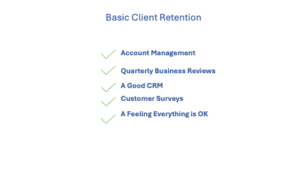
Step One: Appointing an Account Manager
Creating the role of an account manager is typically the first move. By “account manager,” we’re using the broadest sense of the term: a customer-facing individual or team responsible for maintaining and enhancing the client relationship post-sale. In some organizations, this is still the salesperson carrying the torch after the deal closes. In others, it may be a customer service rep, customer success manager, or relationship lead.
We’ve worked with organizations that use all sorts of titles. Some make the role sound more strategic; others water it down. What we suggest is simple—make sure the title reflects the work and responsibility being assigned. If the label undersells the role, it’s likely the work will be undervalued, too. But let’s be clear: assigning someone to a role, no matter how well-intentioned, is not a strategy. It’s a move—not a plan.
Step Two: Hosting Quarterly Business Reviews
The next move companies often make is to schedule a periodic meeting—usually a Quarterly Business Review (QBR). These meetings can be valuable, and we don’t mean to downplay them. In fact, we believe QBRs are essential to any partnership. But again, a meeting with a fancy title doesn’t equal strategy.
We’ve seen QBRs that are nothing more than a dull presentation of stats and charts that clients could have pulled themselves. On the other hand, we’ve also seen QBRs become dynamic working sessions—interactive, collaborative, and forward-thinking. The latter is what you should strive for. We’ll dive deeper into what makes an effective QBR when we explore the Execute Principle later in this process.
Step Three: Sending Out Client Surveys
Surveys is another staple companies lean on to gauge client satisfaction. With tools like SurveyMonkey or Typeform, it’s easier than ever to ask standardized questions and receive neat, quantifiable responses. But here’s the problem: many surveys are designed to confirm what the company already believes. The result? A feel-good report that says, “everything’s fine,” even when it’s not.
Surveys should be one input in your overall feedback ecosystem, not the end-all be-all. They can be valuable—but only if they’re well-designed, interpreted with context, and followed up with real action. Without that, you’re just collecting data for the sake of appearances.
Adding a CRM: Useful, but Not a Strategy
You may also throw a CRM into the mix. That’s good. A customer relationship management system is essential. It allows you to manage contact data, track interactions, send drip campaigns, and organize outreach. In fact, we will be spending a great deal of time to make sure your CRM aligns with the Clients for Life® process, so stayed tune. But again, this is a platform—not a plan. A CRM is a tool in the toolkit. Without a real strategy behind it, it’s just an expensive address book.
Activity ≠ Strategy
When these steps are taken without a bigger vision, they give the illusion of progress. There’s movement—emails are sent, meetings are held, roles are filled—but there’s no direction. Leadership checks the box and feels comforted by the noise. But noise isn’t signal. And it’s certainly not strategy.
What We Bring to the Table
This is where we come in. We’re not interested in helping you check boxes. We work with companies to implement a proven, tested, and dynamic client retention strategy. One that’s built around process, people, performance, and partnership. It’s a comprehensive approach that digs deeper than surface-level activity. It ensures that every touchpoint with your client has purpose, intention, and impact.
You’ll see how a real retention strategy transforms your company—from the inside out. We’ll help you build solid, enduring partnerships that are rooted in mutual growth and long-term value.
This isn’t about keeping clients happy in the short term. It’s about making them so invested in your success that they won’t want to go anywhere else. That’s the power of a true retention strategy. And we’re ready to build it with you.
Process

There is a great quote that states, “Don’t use process to elevate the weak people; rather use process to free the strong people.” This quote captures a powerful leadership principle often overlooked in systems-heavy organizations. Process should not be a crutch for mediocrity—it should be a launchpad for excellence.
When processes are designed merely to compensate for underperformance, they tend to become rigid, bloated, and bureaucratic. This can unintentionally frustrate high performers by limiting their autonomy, slowing down innovation, and anchoring the team to the pace of its weakest link. In contrast, when process is used to empower capable individuals—by removing unnecessary friction, clarifying roles, and streamlining communication—it enables the best people to operate at their highest potential.
Strong performers don’t need process to tell them what to do; they need it to remove obstacles that waste their time and energy. The right processes create alignment, efficiency, and scalability without stifling creativity or ownership.
Ultimately, great organizations don’t build their systems around their weakest people. They build for excellence, and in doing so, raise the bar for everyone. In this light, process becomes a tool not for control, but for freedom—the kind of freedom that unleashes high performance across the board.
Our intent is to do just that: to put best practices in place and create guidance that allows everyone to excel. This does not mean offering a pat on the back and simply winding people up to let them “go.” It means sharing knowledge and insights built up by leadership with those who are carrying out the work for the organization. The Client Retention Strategy program is designed to help account managers maneuver around the hills and valleys that lie ahead—while avoiding the wild goose chases that drain time, energy, and confidence. Their time is just too valuable.
The goal of the Create Principle is to equip the account team with the tools, frameworks, and situational guidance they need to thrive. It is more than a transfer of information, though that is part of it. It is about creating clarity—setting expectations, identifying the levers of success, and enabling decision-making at the right levels. It involves surfacing insights from the organization’s most successful practices and building those into a repeatable path forward.
When leaders provide this type of support, it doesn’t diminish accountability—it enhances it. It gives people the confidence to move decisively, the awareness to avoid common pitfalls, and the support structure to adapt quickly. The end result? A team that is not only aligned, but energized, enabled, and empowered to deliver exceptional results. That’s what the Create Principle is all about.
Let us take a moment to delve deeper into the overall Create Principle and then go into each one in brief. It will be the Partnership Success Team’s role then to ensure the output of each one is shared with everyone in the company that will be impacted. It will also be the Partnership Success Team’s role to implement and audit for success. With the intent of not using process to elevate the weak people; rather using process to free the strong people, let’s review each aspect of the Create Principle in a new light.
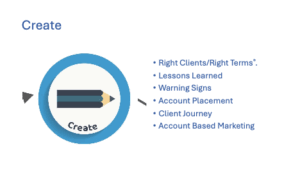
Right Clients/Right Terms®
Individuals are quick to shine when given a clear target. With a goal in sight, they align their energy, stay focused, and gain momentum. But take that target away, and they’re left rudderless—drifting without direction, unsure of where to go or why it matters. Without guidance, people default to their own course. At first, they try. But eventually, the lack of clarity wears them down. They grow discouraged and begin to languish, unable to see how their efforts contribute to anything meaningful.
Clarity creates purpose. It doesn’t mean control—it means alignment. When people know what’s expected, they can track progress, course-correct when needed, and take pride in moving forward. A clear goal becomes a rallying point. It gives people something to aim for, especially when challenges hit. Without it, motivation dries up. It’s like being set adrift at sea without a compass—how can you expect someone to reach land?
Lack of direction also leads to inconsistency. People make assumptions, often pulling in different directions. Momentum is lost. Frustration builds. Over time, morale takes a hit—not because people don’t care, but because they don’t see where they’re headed. Clear goals aren’t optional. They’re essential for progress, engagement, and meaningful work.
Leaders who fail to provide clear targets risk wasting their team’s potential. Even talented, driven individuals can’t operate effectively in a vacuum. Ambiguity breeds hesitation. People begin to second-guess their decisions, delay action, or stay in their comfort zones. But when the path is defined, confidence grows. Teams become more agile, more innovative, and more resilient. Direction breeds focus—and focus, over time, creates impact.
To move teams forward with purpose, leaders must invest time in communicating not just what needs to be done, but why it matters. Providing context turns tasks into missions. People will work harder, smarter, and with greater commitment when they understand the larger vision. It’s also important to revisit and realign goals as circumstances evolve. A static target can become obsolete—but an adaptive team can adjust course and maintain momentum.
Lessons Learned
Remember the first time you tried to do something complex like drive a car, perfect a golf swing, or play an instrument. Our guess was you did not become good at it just by turning on the ignition, watching a video or listening to an accomplished musician. It takes time. As author Malcolm Gladwell wrote in his book “Outliers: The Story of Success,” it can take 10,000 hours of deliberate practice to achieve success. Being successful is not something that just happens. It takes time, practice and also mentorship.
Even the greatest of all time individuals in their craft had mentors. LeBron James had coaches and confidantes. Tiger Woods had his father. Greatness doesn’t flourish in isolation—it grows in environments of support, feedback, and accountability. To prove the point further we thought we would list just a few.
Music- the Beatles Mentor: George Martin – Producer often called “the fifth Beatle,” he shaped their sound and helped bring their musical ideas to life. Mozart Mentor: Leopold Mozart (his father) – A renowned composer and strict teacher who started Mozart’s musical education at a very young age.
Science & Innovation -Albert Einstein Mentor: Max Talmud – A family friend who introduced Einstein to philosophy and advanced scientific texts at a young age. Marie Curie Mentor: Gabriel Lippmann – A Nobel Prize-winning physicist who supported her early research and gave her lab space. Bill Gates Mentor: Warren Buffett – Helped him think about philanthropy, leadership, and business on a higher level.
Business – Steve Jobs Mentor: Mike Markkula – An early investor and executive at Apple who taught Jobs about marketing, business strategy, and long-term thinking. Oprah Winfrey Mentor: Maya Angelou – The poet and author provided personal and philosophical guidance, influencing Oprah’s voice and perspective.
Sports – Serena Williams Mentor: Richard Williams (her father) – Trained both Venus and Serena from a young age with a vision of greatness. Michael Jordan Mentor: Dean Smith – His college coach at UNC who taught him discipline, team play, and the fundamentals. Tom Brady Mentor: Bill Belichick – The legendary coach helped Brady hone his mental game, preparation, and leadership over two decades.
Film & Theatre – Steven Spielberg Mentor: Sid Sheinberg – A Universal Studios exec who gave Spielberg his first big break with Jaws. Meryl Streep Mentor: Joseph Papp – Founder of the Public Theater, he gave her early opportunities and believed in her talent.
Yet when it comes to business the trend is to let them learn as they go. This needs to change and will change with strong direction from leadership. Companies need to normalize mentoring and coaching as part of their growth model. It is not a weakness to need guidance; it is a catalyst for achieving excellence.
Warning Signs
Lessons Learned and warning signs go hand in hand. What is the point of teaching lessons learned if you also do not take time to identify the actual dangers in the road? As you go on the journey it is important to watch the road signs. A good coach or mentor identifies areas of concern and then tells the athlete what to watch out for and on top of that how to chart a path when they run into a warning sign.
Sometimes, warning signs aren’t flashing lights—they are subtle patterns. Missed deadlines, repeated miscommunication, disengaged employees, or stalled client conversations. These are all signals that something is misaligned. Recognizing them early allows leaders to intervene, provide support, and redirect efforts before larger problems surface. It is far easier to course-correct early than to reverse long-standing issues.
Account Placement, Client Journey, and Account Based Marketing
Without belaboring the point much further, setting priorities to help individuals know where to achieve and put their efforts in is critical for Account Placement. Also, who is there to lend a hand on client journey? When is it time to bring in another piece of the puzzle, and how are you going to market to each different person?
Done correctly, a strong client retention strategy will elevate everyone by giving clear direction and freeing them to do the job they were asked to do. This empowers the individual and causes tremendous employee satisfaction. That said, there is an accountability piece to keep everyone honest and on track. That is why we highly suggest discussing and creating Standard Operating Procedures.
Standard Operating Procedures (SOPs)
Standard Operating Procedures (SOPs) are one of the most effective tools for maintaining productivity in any organization. At their core, SOPs provide clear, consistent guidelines for how to perform tasks, handle responsibilities, and respond to specific situations. When employees know exactly what’s expected of them, they spend less time guessing, less time fixing mistakes, and more time delivering results.
SOPs eliminate ambiguity. Without clear processes, individuals often interpret tasks differently, leading to inconsistency, duplicated efforts, and avoidable errors. SOPs streamline workflows, ensuring that best practices are followed and standards are upheld. This kind of consistency not only improves efficiency—it enhances quality and reliability across teams.
They also reduce ramp-up time for new employees. When someone new joins a team, SOPs serve as a step-by-step guide to get them up to speed quickly. They don’t have to rely solely on informal coaching or scattered documentation. Instead, they’re handed a blueprint for success from day one.
Moreover, SOPs free up leaders to focus on strategic work. Without them, managers spend more time answering repetitive questions, troubleshooting confusion, and micromanaging. But with SOPs in place, employees are empowered to make decisions within a clear framework—saving time and promoting accountability.
Finally, SOPs are key for continuous improvement. By documenting what works (and updating as needed), organizations can scale processes that deliver results. SOPs don’t stifle creativity—they create a foundation for smart, consistent execution, freeing people to focus on innovation and improvement.
In short, SOPs aren’t just about process—they’re about enabling productivity, clarity, and confidence across every level of the organization. This will go for every aspect of the Clients for Life®. We will provide some suggestions and direction for you to start communicating key expectations since you will not know all the different elements of the Execute Principle. However, we believe before you train everyone you should create some standard.
Exercise 2

Case Study: How Adobe’s Client Retention Strategy Transformed the Company
In the early 2010s, Adobe Systems found itself at a crossroads. For years, it had dominated the creative software market with popular tools like Photoshop, Illustrator, and InDesign, sold as boxed software through perpetual licenses. Clients would purchase the software once and might not engage with Adobe again for several years unless they chose to buy an upgrade. This model prioritized transactions over relationships and gave Adobe little insight into how or whether customers were using their products after purchase. Client retention wasn’t even a tracked metric—because it didn’t need to be.
That all changed in 2012 when Adobe made a bold strategic pivot. Rather than continuing to sell software outright, the company transitioned to a subscription model through what became known as Creative Cloud. This shift required Adobe to completely rethink how it approached customer value. No longer was success measured by the number of boxes sold in a quarter; instead, it depended on whether customers continued to subscribe month after month, year after year.
The change forced Adobe to embrace a truly customer-centric retention strategy. They began focusing on ongoing value delivery, ensuring that clients saw consistent improvements and new features that made their subscription worthwhile. Adobe invested heavily in customer analytics to understand usage behavior. If someone stopped using a tool or hadn’t logged in recently, that information triggered proactive outreach. Customer success teams were formed to help users get onboarded smoothly and get the most out of the tools they paid for.
As Adobe built its retention muscle, ripple effects spread across the entire company. Product and engineering teams, now closely tied to customer outcomes, started making roadmap decisions based on real usage data rather than hunches or marketing hype. The focus shifted from flashy new features to improved usability, performance, and solving the day-to-day problems users actually faced.
Sales, once primarily transactional, became more consultative. Teams were encouraged to focus not on closing deals but on identifying clients who would grow with the platform over time. They worked closely with success and product teams to ensure promises made in the sales process were delivered post-purchase.
In finance, the shift unlocked massive benefits. Rather than dealing with unpredictable spikes and slumps tied to product launches, Adobe’s revenue became steadier and more predictable through monthly subscriptions. This stability allowed better forecasting, improved investor confidence, and ultimately drove Adobe’s market valuation to new heights.
Marketing also evolved. Campaigns started focusing less on big, splashy product launches and more on lifecycle marketing—helping existing users explore advanced features, attend webinars, and stay engaged. Real success stories from long-time users were amplified and fed back into sales and product development.
Customer support transformed from a reactive function into a proactive one. Support teams began reaching out to customers who hadn’t activated certain tools or who appeared to be struggling based on usage patterns. Their goal wasn’t just to close tickets but to help clients get full value out of what they’d purchased—reducing churn before it started.
The results were dramatic. Adobe’s customer lifetime value grew significantly as more clients stayed, paid, and expanded. Net revenue retention surged as users added more seats, tools, and integrations. Stock analysts began to take notice, and Adobe’s market capitalization soared—growing more than eightfold in the years following the transition.
This shift didn’t just help Adobe hang on to customers—it fundamentally changed the company’s DNA. By prioritizing retention, Adobe became more agile, more customer-focused, and more sustainable in its growth. Their story is a powerful example of how a well-executed client retention strategy can impact every corner of a business and create long-term transformation well beyond the sales cycle.
Course Manual 2: Understanding Right Clients/Right Terms®
Definition
Right Clients are those that fit well with your services, strengths, resources, and overall business strategy. These are the clients your teams are equipped to serve exceptionally—those whose needs align with your core capabilities and whose expectations match what your organization is built to deliver. You can meet their needs efficiently, profitably, and at a high level of quality without stretching your people, systems, or budget. They’re not just a good match for what you offer—they’re a match for how you operate.
Right Clients tend to align with your values, your processes, and your long-term goals. Working with them feels productive, not forced. Communication flows smoothly, projects move forward with less friction, and your team feels confident and energized rather than overwhelmed. Pursuing the wrong clients—even those that seem lucrative or high-profile on paper—can lead to significant internal strain. Resources get diverted, operations get stretched, and morale takes a hit. Over time, the cost of misalignment can outweigh any short-term revenue gain. Right Clients aren’t just a revenue stream—they’re partners in success.
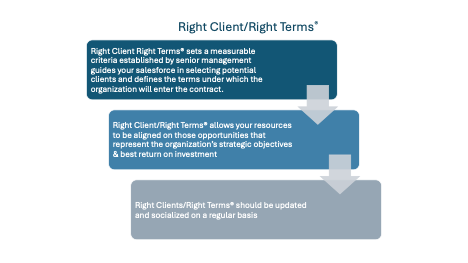
Right Client/Right Terms®: A Strategy That Drives Performance
As the graph shows, Right Client/Right Terms® begins before you ever select an account. It guides your salesforce to prospect the right types of clients and propose terms that are sustainable and mutually beneficial. This clarity at the front end aligns your resources, improves execution, and increases your ability to deliver on promises.
The key is to treat this as a living document. It’s not a one-time exercise. As your business evolves—new markets, shifting strategies, economic changes—your definition of the “right client” may also evolve. Updating this regularly ensures your sales, recruiting, training, and operations teams stay in sync and focused.
Right Clients Benefits
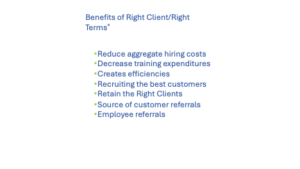
When you’re clear on who your ideal client is, your hiring becomes more targeted and efficient. Recruiting stops being reactive. Job roles are based on repeatable success, not constantly shifting client demands. This reduces time-to-hire, eliminates guesswork, and cuts unnecessary marketing and outreach costs. A focused recruiting strategy also strengthens your employer brand, helping you attract the talent that thrives in your environment.
Training becomes more impactful, too. Instead of rewriting materials and changing methods every time a new client comes on board, your training team can refine and optimize around a consistent set of client needs. That means better onboarding, faster ramp-up, and higher employee performance. You’re not just saving time—you’re building a smarter, more capable team.
Operational efficiency increases dramatically. With a consistent client base, your team can develop and stick to proven processes. You reduce rework, avoid one-off solutions, and eliminate confusion. When teams know what to expect, they can execute with precision. That leads to better service, faster turnaround, and more predictable results.
Sales may initially resist narrowing their focus, worrying it limits their opportunities. But in reality, focus empowers them. With clear direction, they can qualify leads faster, close stronger deals, and win accounts that stick. That confidence is contagious—it lifts morale and raises the bar for performance.
Right clients stay longer, buy more, and refer others. They also make your company a better place to work. Reduced chaos, less friction, and greater purpose all contribute to a more engaged workforce. When people know the company is focused and on a mission, they want to be part of it—and they tell others.
Over time, this strategic clarity builds your reputation. Clients come to know you as a company that delivers consistently and knows exactly who it serves best. That credibility leads to more referrals, inbound interest, and long-term loyalty. You don’t just grow—you grow on your terms.
When employee satisfaction rises, so does retention. And satisfied employees tend to recommend others, boosting employee referrals. Strong companies have clear identities. You can usually describe what they do and who they serve in a sentence. That clarity is a result of knowing their ideal client—and sticking to it.
The benefits of Right Client/Right Terms® compound over time. This isn’t just about who you sell to—it’s about how you build your business. It creates a ripple effect. Better clients lead to better experiences, which lead to better outcomes. That consistency allows you to invest, scale, and innovate with confidence. It reduces internal friction and creates a healthier, more focused culture. You’ll find that performance improves not by working harder, but by working smarter—with intention, alignment, and purpose.
Exercise 1
Selecting the Right Clients
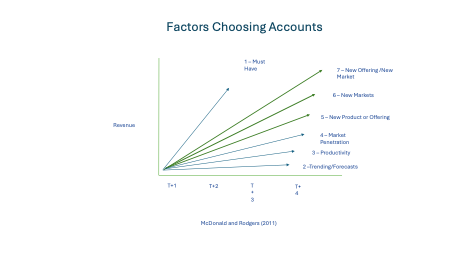
Once you clearly define who your right clients are—and just as importantly, who they aren’t—you can begin selecting the right criteria to guide decisions. Your current business strategy will play a big role in shaping that filter.
Let’s return to the graph to walk through this framework step by step. It all starts with taking care of the essentials: securing the revenue needed to sustain your business. These clients are represented in blue. They’re in your wheelhouse—core accounts that you simply can’t afford to lose. They often follow the 80/20 rule: a small portion of your accounts that generate the majority of your revenue. They fit you perfectly. You’re efficient at serving them, your resources line up well, margins are strong, and the cost to serve is low. These are the clients your team could list off without hesitation. Later, we’ll cover how to build a strategic plan around each of them.
The next layer includes clients that, based on trends and forecasts, are worth retaining because they align with your existing strategy. You could survive without them—but you’d lose momentum. These accounts help maintain growth and ensure you stay on your intended trajectory. They don’t stretch your resources. They keep your business moving forward. You’ve already built foundational trust and delivery capability with them. The path forward is clear. These clients deserve attention and planning to ensure continued alignment.
From there, we evaluate opportunities through a productivity lens. Some clients may become more viable if you make internal improvements—refining your product mix, targeting promotions more effectively, adjusting pricing, or optimizing the sales approach. It’s less about changing the client and more about tightening your own execution. These clients become stronger contributors as your internal capabilities improve. They’re not “bad clients”—they’re clients who could be much more valuable once a few strategic levers are pulled internally.
Next is market penetration—selling more to your existing clients. This is a critical step. If you’re not growing within your current accounts, you’re at risk of losing relevance. Expanding your footprint with existing clients also opens the door to pricing improvements and added value. Strong relationships naturally evolve into broader partnerships—if you take the initiative to offer more. This also creates more stability. A wider engagement across multiple products or services makes the relationship more durable and less likely to be disrupted by a single issue.
Once you’ve maximized your current client base, you move into new territory—literally or figuratively. This includes launching new products or services within your existing market. Often, this is a response to unmet needs or shifts in client demand. While it can drive growth, it comes with added costs: training, revised processes, and updated go-to-market strategies. Not every new idea takes off, so thoughtful planning and solid market research are essential before you commit resources. Before any launch, ask: does this innovation reinforce our core value, or pull us away from it?
After that, you may consider entering a new market altogether. This could mean expanding into a new region or demographic segment. For example, if you’ve saturated the East Coast and see opportunity in the Midwest, expanding westward may be your next step. Yes, it comes with higher costs—new logistics, compliance, market education—but the long-term payoff can justify the investment. The key is recognizing when the time is right. It also means carefully selecting where you test your entry—where success is most likely, and lessons can be learned quickly.
At the far edge of the spectrum is the boldest move: launching a new product in a new market. This double leap requires serious commitment. It’s the most resource-intensive, risk-heavy approach. You’re building from scratch in both directions. It’s not for every company—or every moment. But when the opportunity is big enough, the reward can be just as significant. Execution must be flawless. If you go this route, ensure your leadership, operations, and financial runway are aligned for the long game.
You’ll notice this framework moves from protecting your base to pushing your boundaries. It’s designed to help you assess where your efforts belong—and what the tradeoffs are. Later, we’ll explore Account Placement, a separate discipline that focuses on categorizing and managing your existing clients. For now, focus on aligning your strategy with the clients who give you the best chance to succeed—on your terms.
Right Terms
If Right Clients is about the who, then Right Terms is about the how. Right Clients is the process of identifying and selecting the clients you’re best equipped to serve—those you’ve worked well with in the past and those who align with your strategy moving forward. It’s about clarity on where you win and where you don’t. Once that’s defined, Right Terms becomes the next critical layer: how you work with those clients, the expectations you set, and the boundaries you enforce.
Right Terms defines what’s acceptable and what isn’t—pricing, service levels, communication expectations, timelines, scope, and more. It ensures that even the right client doesn’t become the wrong client due to unclear or unsustainable terms. It protects your team from overextension, prevents margin erosion, and sets the foundation for a healthy, productive relationship. Without the right terms, even the best-fit client can strain your business.
In other words, Right Clients filters the opportunity. Right Terms governs the relationship. Together, they shape your company’s ability to scale with consistency, profitability, and focus. One without the other creates imbalance. The goal isn’t just growth—it’s growth you can sustain, deliver on, and be proud of. That is why it is so critical to get this correct.
The Benefits of Right Terms®: Why the “How” Matters as Much as the “Who”
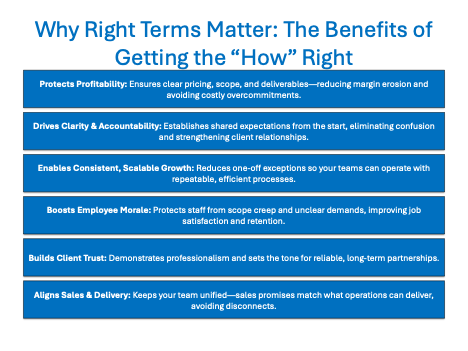
While Right Clients helps you focus on selecting the customers you’re best positioned to serve, Right Terms® ensures those relationships are set up for long-term success. It’s the framework that defines how you work with clients, what’s acceptable, what isn’t, and what it takes to build partnerships that are profitable and sustainable—not just in the short term, but over time.
When you define the right terms, you protect your business from erosion. This is especially important when it comes to profitability. Too often, companies win a great client but agree to weak terms—low pricing, vague deliverables, unclear service levels—and end up over-delivering for underwhelming returns. With the right terms in place, you preserve margin, control scope, and maintain a healthy balance between cost to serve and value delivered.
Right Terms also bring clarity, which is essential for accountability. When expectations are clearly laid out from the start, both your team and the client know what to expect. This reduces miscommunication, eliminates grey areas, and avoids surprises down the line. Strong client relationships are built on mutual understanding, not assumptions. Setting the terms early ensures both sides operate from the same foundation.
Another powerful benefit is consistency. Businesses that scale successfully do so because they have repeatable processes. If every client relationship requires a unique approach, your team ends up reinventing the wheel each time. That burns time, energy, and resources. By setting clear terms across all engagements, you create a structure that supports growth without sacrificing quality or exhausting your people.
This structure directly impacts morale. Employees who are constantly adjusting to client-specific exceptions or chasing after unclear commitments are more likely to feel overwhelmed and undervalued. Right Terms protects your people. It sets boundaries. It allows your team to work confidently, knowing leadership has their back and there’s a system in place to support them. That makes a major difference in both satisfaction and retention, particularly for those in delivery, operations, and client service roles.
Clients also benefit. It might feel counterintuitive, but setting boundaries actually increases trust. When you’re able to clearly communicate how the relationship will work—what’s included, how communication happens, how issues will be handled—it builds credibility. Clients aren’t left guessing. They know you’re serious, professional, and committed to delivering value in a predictable, reliable way. That’s the foundation of long-term loyalty.
There’s also a real risk-reduction element. When terms are vague or inconsistent, you leave yourself exposed—legally, operationally, and reputationally. Tightening up the terms of your client relationships reduces this exposure. It makes it easier to say no to risky work, to flag requests that fall outside the original scope, and to manage resources responsibly. The clearer your terms, the less likely you are to end up in reactive or crisis mode.
It also changes the sales dynamic. When your sales team has clear guidelines around what can and can’t be agreed to, they operate with more confidence. They aren’t negotiating from a place of desperation or uncertainty. They’re offering a well-defined partnership, backed by a proven delivery model. That kind of clarity builds respect with clients and reinforces the professionalism of your brand.
And perhaps most importantly, Right Terms keeps your business aligned. One of the most common sources of tension in growing companies is the disconnect between what sales sells and what operations can deliver. That misalignment causes friction, missed expectations, and burnout. With Right Terms clearly defined and enforced, both sales and delivery are on the same page. Handoffs are smoother. Client experiences are more consistent. Strategy and execution stay in sync.
Right Terms isn’t about saying “no” to clients—it’s about saying “yes” the right way. It’s about being intentional in how you work, honoring the value you provide, and setting up your team to deliver on what was promised. Combined with Right Clients, it forms the foundation for building a business that not only grows—but grows with clarity, purpose, and control.
There you have it. That is the conceptual explanation of Right Client/Right Terms®. You are good to go. Ok well not really. If all we had to do is provide the concepts to succeed there would be way more successful, but we know it is more than that. It is taking the time to actually implement and follow through.
Steps to a Successful Right Client/Right Terms®
There are five essential steps to successfully carrying out Right Client/Right Terms®: understanding, producing, implementing, monitoring, and updating.
We believe the groundwork has been laid. At this point, you should feel confident explaining what Right Client/Right Terms® means, how it benefits the organization, and how to communicate it to others. You should be able to explain not just the definitions, but also give examples and describe how this strategy supports long-term growth, improves internal alignment, and enhances the client experience.
But understanding isn’t just about being able to repeat definitions. It’s about being able to apply the principles in real-world situations, influence others, and use this lens to guide decisions across departments. When everyone shares a common understanding, it becomes easier to hold the line and operate with consistency.
Next comes the producing stage. This is where the ideas take shape in a concrete document. It won’t happen overnight. We begin by facilitating a workshop with key decision-makers from across the company. This helps surface diverse perspectives and starts the process of shaping your Right Client/Right Terms® framework. But the workshop is only the beginning. Afterward, the draft needs refinement. It must be socialized, edited, and stress-tested until you have full alignment across departments. This document is not just a sales tool—it touches operations, training, HR, marketing, and finance. Everyone needs a seat at the table. If progress slows, don’t hesitate to regroup with the core team. Difficult conversations early will prevent costly confusion later. Full buy-in is non-negotiable.
With agreement in place, it’s time to implement. Implementation is about embedding Right Client/Right Terms® into the rhythm of the business. First, you’ll engage leadership teams to ensure they understand the framework and can champion it. Without strong leadership alignment, rollout efforts will fall flat. From there, it becomes a core part of the Clients for Life® training—specifically within the “Create” principle. Customer-facing teams must understand what each part of the document means, how to apply it, and where to go for support. You’ll see a range of reactions. Some employees may resist guardrails, especially if they’ve operated independently for years. Others may misuse the framework to avoid effort or engagement. This is why training and leadership modeling are key. Set the tone early and reinforce it often.
Monitoring ensures the strategy doesn’t drift. This is where discipline kicks in. Without consistent follow-through, the document becomes just another file on a shared drive. Monitoring requires cross-functional ownership. Sales, operations, leadership, and client teams must all take responsibility. A clear governance process helps. Leadership should review all deals before entering negotiation, and operations should give final approval before contracts are signed. Post-signature, client teams must speak up if things drift. It’s not just a one-time checklist—it’s ongoing vigilance. Embedding these checks into your CRM or workflow platform will help track compliance and identify patterns before they become problems.
Finally, updating keeps the strategy alive. Business is not static. Market conditions shift, service offerings evolve, and client behavior changes. What made sense six months ago might no longer apply. Regular review cycles ensure your Right Client/Right Terms® document stays relevant. These updates are also an opportunity to reflect on lessons learned, celebrate wins, and adjust where needed. It keeps the strategy dynamic and responsive.
Ultimately, Right Client/Right Terms® isn’t a project—it’s a discipline. When embraced fully, it drives alignment, sharpens focus, and creates a culture of intentionality across the business. It gives your teams the confidence to say yes to the right opportunities and no to the wrong ones. And most importantly, it gives your company the structure it needs to grow with clarity and control.
Who would have thought that something so simple as selecting the right clients under the right terms could become so involved. It may be why so few companies do it much to their detriment. It takes time, alignment and commitment from everyone and definitely the support of leadership.
Case Study: How One B2B Marketing Firm Turned Things Around by Choosing the Right Clients on the Right Terms
Revvia, a mid-sized B2B marketing agency based in Chicago, had been struggling with inconsistent revenue and rising churn among its clients. While their team was strong and their work solid, they often found themselves stuck in underperforming engagements. Clients came in excited, but too often left frustrated within six to nine months. The problem wasn’t the work—it was the fit.
For years, Revvia had operated under a “take all comers” mindset. If a company could pay, they were in. But over time, this eroded morale and hurt the bottom line. Some clients demanded outcomes that didn’t match their budgets or timelines. Others lacked internal resources to implement Revvia’s strategies, so results lagged. Even worse, the team was constantly in reactive mode—over-servicing difficult accounts while the good ones didn’t get enough attention.
In early 2022, the leadership team made a hard pivot. They narrowed their ideal client profile to companies with at least $10M in revenue, a dedicated internal marketing lead, and a clear growth strategy. Just as importantly, they overhauled their engagement terms. No more month-to-month deals or vague scopes. They moved to 6- or 12-month retainer agreements with defined deliverables, review checkpoints, and clear mutual expectations.
At first, the shift was uncomfortable. They said no to several potential deals that would’ve meant fast cash. But within six months, the results were clear. Client satisfaction scores rose. Team burnout dropped. Their client retention rate jumped from 63% to over 85% in a year. Revenue stabilized and even grew modestly, but more importantly, it became predictable.
By focusing on the right clients under the right terms, Revvia stopped chasing quick wins and started building long-term partnerships. The work improved. So did the outcomes—for both the agency and their clients.
Course Manual 3: Right Client/Right Terms Workshop
Our focus will be on producing the actual Right Clients/Right Terms Workshop. We will review everything from who should attend, who will facilitate, what content to cover and the needed expected output.
You will provide the facilitation for this workshop. We will provide the instruction in this chapter and then conduct a mock Lessons Learned workshop a little later. Therefore, it is vital that you ask any questions you may have. We will ensure you get the practice needed but this is your time to really understand the process.
Who Should Attend:
There are two group that should be in attendance. The first is the Executive Team and the Second is the Partnership Success Team. The Executive Team should be in the room because they will be the individuals responsible to for creating and signing off on the Right Clients/Right Terms®. The Partnership Success Team will be participating mostly as observers because they will be vital in implementing the Right Clients/Right Terms and conveying the appropriate information with the rest of the company.
As you can imagine this will take the most time of anything else. Finding time on calendars of those in the C -Suite is not easy. We will allow two months from now to provide time to secure time on the calendars for both the Right Clients/Right Terms® workshop and the of Lessons Learned.
Who Should Facilitate:
The Client Retention Executive is the individual we suggest should act as the facilitator of the workshop. He or she should be already practiced in a certain level of being unbiased and neutral in the process.
Resources Needed:
A Flipchart or some form of white board will be needed along with a wide selection of multicolor markers.
Venue:
When at all possible, this should be done live. However, the Right Clients/Right Terms® workshop can be done in hybrid format or virtually if it must be.
How to Begin:
It has been a few months since The Executive Team was introduced to the Right Clients/Right Terms concept. Therefore, it is wise to give a synopsis of what is meant by the term. Take time to share not just the term but reiterate the why. What is the importance. Getting The Executive Team together is not easy to do and taking a moment to explain the why will help them engage.
You will then telegraph what the agenda of the workshop will be. We highly recommend conducting the workshop in one sitting. However, we also understand the needs of business and it might not be possible to secure the time needed for the meeting.
The meeting should take between 3 – 4 hours and will be broken up into these topics.
The first is Welcome and Introductions. This may be the first time the entire Partnership Success Team and The Executive Team will be in a room together.
The second is to discuss the cost of a wrong fit. We all know what a wrong fit feels like but what is really the impact.
The third is to create a summary of the best attributes in a client. This will come mostly from previous clients.
The fourth is then to create a summary of the worse attributes in a client. Again, this will come mostly from previous clients.
Fifth is then taking the best and worse attributes in a client and defining the Right Client. This will be the first draft and will not be completed in one day.
Sixth is the creating of the Right Terms. Finance and legal will have a strong role here but so should sales and operations.
Seventh is establishing a process for classifying clients that are not the right clients. These clients may be either in the sales process or existing clients.
Eighth is setting up a process to review new clients as right clients and possible steps for outliers.
Nineth is the final step for the workshop and that is creating the first draft. More iterations will take place until all sign off on the Right Clients/Right Terms Document.
The Wrong Fit’s Impact
We’ve all felt the strain of working with a client who simply wasn’t the right fit. It might have shown up in subtle friction or full-on breakdowns—but no matter how it manifests, the impact of misalignment is real and often more costly than we realize. Before we dive into setting guidelines for the right fit, we need to unpack what happens when we get it wrong.
To start this conversation, we’ll be evaluating the tangible and intangible costs of poor client alignment. This includes—but is not limited to—lost revenue, additional operating costs, misaligned expectations, impact on employee morale, talent attrition, damage to reputation, and the opportunity cost of people, time, and resources that could have been better invested elsewhere.
We’ll begin with a facilitated flipchart exercise. Choose three to four clients who, in hindsight, were a mismatch. Across the left-hand side of the flipchart, list the key areas of impact. At the top, label the clients you’re reviewing. Then work through each row, one area at a time, discussing how that client impacted the business in that specific way.
It should look something like this:
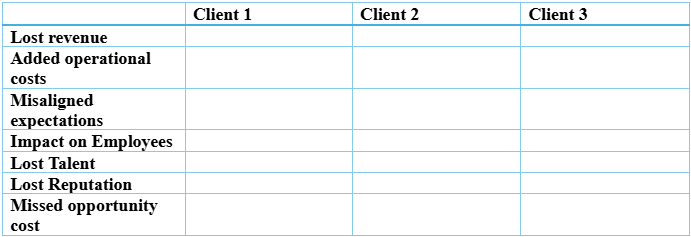
In fact, if using a template instead of working from a spreadsheet helps then print one out previous to the meeting starting. Just ensure it is big enough for everyone to read. This may require going to an outside printer for assistance.
This is the first of several group working sessions in the workshop, so give it space. People may be slow to share at first. That’s okay. Allow for silence, restate the questions when needed, and let the room settle into reflective discussion. The goal is not to rush to solutions, but to get everyone thinking clearly and collectively about what poor fit really costs.
This exercise should take around 20–30 minutes.
Exercise 1
Client Attributes
Great Clients!
In this session, we’ll shift our focus toward identifying the clients we do want—those who help our company thrive. We’re not just talking about profitable clients; we’re talking about true partners. To kick things off, ask the group to think of the clients they’ve genuinely enjoyed working with. These are the ones who made a positive impact across the board—financially, culturally, and operationally. Ask for real examples: specific companies or even individuals that stand out as model clients. Then ask, Why them? What made them such a great fit?
Start capturing keywords on a flipchart as people speak. Don’t worry about full sentences—this should be free-flowing. Use color coding to help categorize responses visually: green for financial terms (profitable, pays on time), purple for emotion (fun, energizing, respectful), blue for relationship (trust, collaborative, communicative), orange for expectations (clear goals, decisive, realistic), and brown for strategic (innovative, aligned vision, long-term growth). Think of this flipchart as a living word cloud. You’re not organizing yet—you’re collecting.
Keep the energy moving by asking open-ended questions like, What did working with them feel like? What did they do differently from other clients? How did they challenge us in a good way? Avoid getting stuck on any one point; instead, let the responses stack up and flow. The goal here is quantity and diversity of input—people will often build off each other’s comments, and that synergy is where the real insight comes from. Let the conversation shape the picture.
Once all the key words are up on the flipchart, it’s time to shift from gathering to grouping. Begin clustering similar terms together—this will help clarify the patterns. For example, group “pays on time,” “profitable,” and “low risk” under a financial theme. Cluster “aligned vision,” “innovative,” and “forward-thinking” under strategic. As you do this, the traits of an ideal client will start to come into focus.
You’ll likely see strong themes around financial stability, clear communication, mutual accountability, and strategic alignment. These are the clients who respect the process, challenge the company in healthy ways, and grow with it. Highlight and elevate these clusters—they’re the foundation of what your team should be seeking in every partnership.
Now, when it comes to the emotional terms—the ones in purple—pause. These might include words like “fun,” “friendly,” “likeable,” or “easygoing.” Don’t dismiss them outright, but don’t take them at face value either. Pressure test them. Ask the group: What specific value did this emotional connection bring to the work itself? Did it improve collaboration? Did it help us through a tough project? You’re looking for where emotional rapport overlaps with professional impact. If it doesn’t—if it’s just about social chemistry or likability—set it aside.
The point is to avoid confusing personal comfort with business value. A good client isn’t someone you enjoy a beer with—they’re someone who helps move the business forward in measurable, meaningful ways.
The energy in the room should start to be growing and you should start to see more engagement. This is going to be needed as we move to the tougher questions.
The Client You Never Want Again
Now that your team has come to an agreement on what constitutes the attributes and characteristics of a great client, it’s time to turn the conversation to the other side of the coin: What are the attributes and characteristics of a poor client?
This can be a delicate topic to facilitate. It will require agility, skill, and empathy to elicit honest participation while avoiding the session devolving into a complaint forum. Your goal is to guide the conversation in a way that’s constructive, respectful, and focused on behavior patterns or business misalignments, rather than allowing it to become personal or overly negative.
To do this effectively, you will want to acknowledge frustrations without allowing the group to stall on one particular experience or individual. The key is to let participants feel heard while still managing the energy and pace of the conversation. This ensures the group stays engaged and the session remains productive.
Here are a few tactful phrases and facilitation techniques you can use to keep the conversation flowing and professional:
Acknowledge & Redirect:
“That’s a really valid observation. Let’s capture that as a behavior we want to avoid, and hear from someone else—what’s another trait that tends to cause friction?”
“Thank you for sharing that—clearly that kind of situation has an impact. What’s another example of a poor-fit client behavior, maybe from a different perspective?”
“That sounds like it really stood out. Let’s note that down, and I’m curious—has anyone else experienced something different but equally challenging?”
Reframe Personal Complaints into General Traits:
“It sounds like that client lacked transparency in communication—would we agree that’s a broader red flag for poor fit?”
“What I’m hearing is a lack of respect for boundaries—would that be a fair summary? Let’s list that as a characteristic.”
Keep Momentum with Inclusion:
“Great input. Let’s keep going—who hasn’t had a chance to weigh in yet?”
“We’re building a really helpful picture here—what’s another behavior that tends to show up in clients that ultimately don’t work out well?”
Keep It Constructive:
“We’re not here to point fingers, but to identify patterns that help us avoid poor-fit relationships in the future.”
“Remember, the goal is to protect both our team and the client from misalignment—so every trait we name helps us do that better.”
When you notice that the group is starting to dig too deeply into one person’s story or veering off-track, it’s okay to gently interrupt with appreciation and pivot. Something like, “Let’s circle back to our list—we’ve captured a few great points already. What else should we be watching for?”
By maintaining a respectful tone and balancing validation with forward momentum, you’ll help the team stay focused and reflective, rather than reactive. At the end of this segment, you should have a clear, agreed-upon list of client behaviors, attitudes, or operational misalignments that are red flags or indicators of a poor fit.
The process will follow the same course as that of the great client. You will Start capturing keywords on a flipchart as people speak. Again, don’t worry about full sentences—this should also be free-flowing. Use color coding to help categorize responses visually: green for financial terms (profitable, pays on time), purple for emotion (fun, energizing, respectful), blue for relationship (trust, collaborative, communicative), orange for expectations (clear goals, decisive, realistic), and brown for strategic (innovative, aligned vision, long-term growth). We will add one more color though. We will insert red for poor financials.
Much like the great client you will start to see trends. However, these will be of a different flavor. Instead of “pays on time,” “profitable,” and “low risk” under a financial theme you are going to see “late payment”, “unprofitable”, and “high risk”. Cluster like traits together. As you do this, the traits of a not so ideal client will start to come into focus.
The process will follow the same course as that of the great client. You will start capturing keywords on a flipchart as people speak. Again, don’t worry about full sentences—this should also be free-flowing. Use color coding to help categorize responses visually: green for financial terms (profitable, pays on time), purple for emotion (fun, energizing, respectful), blue for relationship (trust, collaborative, communicative), orange for expectations (clear goals, decisive, realistic), brown for strategic (innovative, aligned vision, long-term growth), and red for poor financials (late payments, unprofitable, high risk).
Much like the great client, you will start to see trends. However, these will be of a different flavor. Instead of “pays on time,” “profitable,” and “low risk” under a financial theme, you are going to see “late payment,” “unprofitable,” and “high risk.” Cluster like traits together. As you do this, the traits of a not-so-ideal client will start to come into focus—disorganized, reactive, mismatched values, and draining to the team for example.
Creating the Right Clients
Now that you’ve captured the trends for both the Great Client and the Poor Client, you’re ready to move into the creation of the actual document—the Right Clients/Terms Document®. If time is limited, this is often a natural point to take a break. Give everyone space to reflect on what’s been captured and to absorb the key attributes that have emerged. Before they leave, assign one short task: ask each person to take a stab at writing their version of the “Right Clients” section. This primes them for the next step and ensures everyone comes back with ideas in hand.
If you’re staying together to complete the document in one session, your role shifts. You’re no longer gathering raw input—you’re now guiding the group through synthesis. You will act as a scribe, working closely with the Executive Team to shape the “Right Clients” portion of the document. Your job is not to write it for them. It’s to draw it from them. This is important to reinforce. The team must own the language and the direction of the document. It’s tempting to fill the silence with suggestions or shortcuts, but resist that urge unless the team is truly stuck.
If no one speaks up at first, gently nudge the conversation forward. Remind them: “This is your document. I’m just here to capture your thoughts clearly and cohesively.” Still no movement? Try calling on someone who was actively engaged earlier. For example:
“Earlier, you mentioned how important trust and alignment are in your best relationships. How might that show up in the Right Clients section?”
“You flagged ‘collaborative and decisive’ as key traits. How would you start describing a client who operates that way?”
“Would anyone like to take a first crack at a sentence? Even a rough draft will help us get started.”
You can also offer sentence stems to spark thinking:
“Right clients are those who…”
“We work best with clients who value…”
“Our ideal client relationships are built on…”
Encourage them to keep it simple, use their own language, and focus on what matters most. You’re not looking for polished prose—just honest, grounded input. Your role is to reflect their words back to them, organize themes, and gradually shape a shared definition. Once the team gets going, you’ll start to see strong alignment emerge naturally.
You are also not looking to create War and Peace. This should be no longer than a page or two, max. It’s important to communicate this upfront—before the team starts offering long-winded or overly detailed input. Remind them this is meant to be a clear, concise guideline that everyone can quickly reference and actually use in daily decision-making. If it becomes too long or too nuanced, people will lose focus and the document will collect dust. The goal is to create something memorable—simple enough that, over time, almost everyone can recite or discuss it without even looking. This isn’t a contract; it’s a philosophy, a filter for how you choose to do business with the clients that truly align. Keep it sharp, relevant, and reflective of what really matters.
A good way to set the tone is to avoid writing in paragraphs or full sentences. Instead, start by numbering each idea: 1, 2, 3, 4, etc. This gives the team permission to keep things simple and avoids the trap of trying to “complete” a sentence. It helps keep energy high and the conversation moving.
Also, remind the team this is just a first draft. Don’t aim for perfect. Messy is good. Cross things out. Circle and combine ideas. Leave space to adjust. This process should invite debate and require group input. Silence and fast agreement usually mean people aren’t fully engaged. Encourage honest discussion, different perspectives, and even a little friction—it’s all part of building a document that truly reflects the collective voice of the team.
Case Study: A Software Consultancy Reclaims Control by Redefining Its Client Strategy
Blueprint Logic, a boutique software consulting firm based in Austin, had built its reputation on solving complex technical problems for mid-sized companies. Their engineers were top-notch, and their portfolio included several recognizable names in fintech and healthcare. But behind the scenes, things were beginning to unravel. Project delays were stacking up. Team burnout was rising. Profitability was shrinking despite a growing client list.
The turning point came during a post-mortem on a failed implementation with a logistics client. The engagement had looked promising on paper—big brand, large budget, and lots of potential. But from day one, it was chaos. The client team had no internal product owner. Requirements shifted weekly. Expectations were sky-high, but timelines were unrealistic. Blueprint’s team worked nights and weekends trying to hold it together, but the relationship ended with missed deadlines, damaged morale, and a hard lesson: not every opportunity is worth it.
Leadership took a step back and examined their full client roster. The pattern was clear. Their strongest outcomes came from companies with a clear digital roadmap, internal decision-makers who understood tech, and a willingness to commit to structured engagement terms. The clients causing the most pain were those chasing digital transformation without the discipline or capacity to follow through.
Blueprint didn’t just refine their ideal client profile—they rebuilt their entire intake and scoping process. From that point on, every engagement started with a strategic fit review. If a company didn’t have an internal product lead, they weren’t accepted. If the client wouldn’t agree to a three-phase delivery model with defined milestones and decision gates, they were referred elsewhere. Project terms became non-negotiable: weekly syncs, scope sign-off, and executive alignment were required before any code was written.
At first, the sales team was skeptical. Turning down large accounts felt risky. But over the next twelve months, the impact was undeniable. Delivery speed improved. Margins rebounded. The engineering team went from burned out to highly engaged. Clients were getting better results, because expectations were aligned from the beginning. And referrals increased—not just from happy clients, but from industry peers who respected Blueprint’s clarity and professionalism.
Perhaps most importantly, the leadership team stopped feeling reactive. They weren’t scrambling to put out fires or explain missed deadlines. They were setting the terms, running a business with intention, and working with partners who treated them as equals.
By choosing the right clients under the right terms, Blueprint Logic didn’t just fix a project problem. They reset the trajectory of their company. They built a business where great work could actually get done—and done well.
Course Manual 4: Right Client/Right Terms the Workshop Understanding Right Clients/Right Terms®
By this time the flipchart or whiteboard should look a little messy but hopefully readable. There should be edits, cross-outs, different colors, and maybe even still some gaps waiting for alignment. If that’s the case, then you’ve had a strong, engaged meeting. A bit of chaos on the board often signals good collaboration and the fact that people are thinking critically, asking questions, and contributing honestly.

On the other hand, if there are only a few sentences and the engagement isn’t quite where you hoped, that’s okay too. Sometimes people need more time to process. Not every group is ready to jump in immediately. That doesn’t mean the input won’t come—it just means it might come later.
In both cases, remind the group this is an ongoing conversation. You’ll revisit it during the workshop and afterward. Share the work via wall posting, chat, or email. Ask participants to reflect and suggest additions, changes, or removals. Keep iterating until there’s alignment.
It’s also worth framing this as a drafting process—especially when working toward the right words or language that feel aligned with the group or client. Finding the right words takes time. The first version is just a starting point. Encourage participants to treat it like a rough draft: flexible, evolving, and open to revision. The goal isn’t to get it perfect right away but to move closer to clarity and shared understanding with each round of input. The more voices reflected in the language, the more ownership the group will feel.
Transition
Give the group a chance to take a short break. This serves two purposes. First, it helps release any tension—whether from intense discussion or from the quieter discomfort that can come when a conversation hasn’t quite taken off. Second, it creates space for informal socialization around the “right client” draft.
Let people know they’re welcome to chat during the break about what’s working and what could be improved in what’s been captured so far. Keep it light—just a subtle nudge: “If anything sparked a thought, feel free to bounce ideas off each other.”
Before breaking, mention that when you return, you’ll shift gears. The focus will move from “right client” to exploring the “right terms.” This shift allows fresh energy to enter the room and offers a natural transition. Sometimes a quick pause is all that’s needed to let new thoughts form. Also, encourage participants to note anything they want to revisit later. This keeps momentum going without forcing it.
This will also give you a natural opportunity to transition the workshop into the “right terms” portion. After the break, make sure to post the first draft of the “right terms” somewhere visible—on a wall, screen, or shared doc. People need to see it to respond to it.
If you’re in a live setting, use the break to walk around the room. Catch quick conversations, ask open questions, and listen for both catalysts and sticking points from the first session. You’re looking for patterns, insights, and anything that might not have been voiced publicly.
Try to gather as many perspectives as you can in that short window. These informal check-ins can surface key issues and guide how you frame the next part of the discussion. Even offhand comments can point to unspoken concerns or fresh ideas that may not come up in the larger group setting.
Keep the break to 15–20 minutes max. If you stretch it longer—especially with executives—you risk losing people to email, calls, or other urgent matters. Keep things moving, but intentional. The energy you bring post-break will set the tone for the rest of the workshop. Reinforce that this next phase is about clarity and alignment—defining the language everyone can stand behind and use confidently moving forward.
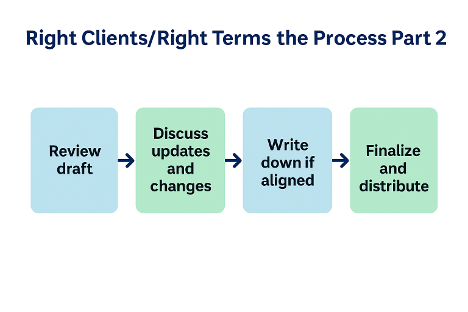
Right Terms
The front of the room should have a clean flip chart with the words Right Terms on the top. This will give every indication that we are moving on to a new topic for now. Take a moment to review the basic concepts and reasons again for discussing the Right Terms and go over the each benefit.
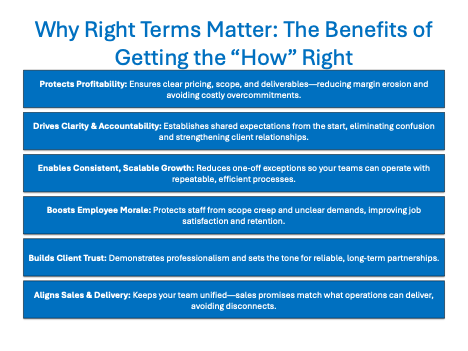
Take time to ask for any feedback on how these benefits can impact the company. Have the group expand the ones they see as the most valuable. You can start by asking Finance to share how the right terms positively and negatively affect them. You can then move on to operations and so on.
Share the goal of the session is to align on the terms all can agree upon and feel comfortable standing behind. In the end a set of terms will be developed that will be unique and customized to the company’s needs. They should protect the company from financial harm while setting the framework for lasting partnerships.
Exercise 1
Reflection on Terms
Take a moment to shift the group’s energy and attention fully to the idea of defining the “Right Terms.” Begin by speaking directly to the room with a few open questions that invite honest reflection. You might say something like, “What terms do we use that create confusion for our clients?” or “What language have we set that has left room for interpretation or even hurt the relationship?” Then go a step further and ask, “What terms are missing that might be keeping us from doing our best work?” and “How have we, as a company, suffered by not having the correct terms in place?”
Encourage participants to respond quickly and openly—rapid fire style. Let them shout out words, phrases, or examples. This is not the time for deep analysis or long explanations. It’s about surfacing as much raw input as possible to spark the next phase of thinking. Don’t stop the flow to ask for clarification or deeper context. That can come later. For now, just capture the responses as they come.
Write everything where the group can see it—on a whiteboard, flipchart, or digital board. Use your existing color-coding system for consistency and clarity. If new themes emerge, feel free to assign a new color, but keep it simple. Visual order helps create cognitive order. This process also gives participants a sense that their contributions are being valued and heard in real time. It’s a critical way to shift collective focus away from “Right Clients” and toward the internal alignment and precision that “Right Terms” demand. Momentum is key here—keep things moving, keep the tone open, and keep the board active.
Breakouts
Once the room has settled into the mindset of defining “Right Terms,” you can use that momentum to move into small-group work. This transition is important—it channels the group’s energy into focused dialogue and allows for deeper, more substantive contributions from every participant. Break everyone into smaller groups where they can workshop and refine the terms that matter most to them.
How you form these groups should be intentional. This isn’t a random shuffle. Pair department heads or teams with overlapping priorities or operational intersections. For example, Finance and Legal might share a risk-management lens, while Sales and Marketing might focus on brand consistency and client engagement. You want natural alignment to lead the conversation—not immediate conflict. That debate can come later in the consolidation phase.
The breakout session itself should be clear in its purpose. Each group gets 15 minutes to generate a set of terms that would benefit the company in how it engages, serves, and transitions clients. These terms should cover the full lifecycle of the relationship: before a client signs, during active engagement, when expanding the relationship, and even how things are handled if the partnership ends. Everything is fair game—language around expectations, values, communication styles, pricing principles, decision rights, transparency, roles, and more. Encourage each group to think expansively but stay practical.
Remind them this isn’t just about inventing new jargon. It’s about surfacing the language that can guide behavior, set clear expectations, and reduce misalignment over time. The goal is to capture not only what sounds good, but what can actually be used—language that feels true to the company and the work it wants to do. Each group should be prepared to present their terms to the larger team for discussion, refinement, and eventual alignment. This session lays the groundwork for a shared vocabulary that drives consistency, accountability, and trust—both internally and with clients.
Bringing it Together
Take a moment to bring the group back together and re-center the energy. If the room is still buzzing with relevant, productive conversation—meaning the dialogue is about terms, client relationships, or operational clarity and not just casual chatter about dinner plans or the game—go ahead and extend the breakout by five minutes. That extra time can make a real difference when the group is making progress. You don’t want to interrupt valuable thinking just because the clock says so. Let the work breathe a little if it’s headed in the right direction.
Once the room is back together, it’s time to start collecting the output from each group. Ask them to share their top terms and themes. This part of the session is about clarity and listening. Don’t rush to write everything down right away. Before you capture anything on the flip chart or shared screen, take a moment to confirm what each term means and what the group is trying to achieve with it. You want to be specific. If a term sounds vague or could mean multiple things, ask a follow-up: “What do you mean by that exactly?” or “Can you give an example of how this shows up in real life?”
In some cases, it may be helpful to test a term with a quick hypothetical. For instance, if a group offers “value alignment” as a key term, you might ask, “How would that impact our contracting or onboarding process?” That question isn’t about challenging them—it’s about grounding the language in real-world usage.
Different groups will bring different levels of energy. Some might want to explain every angle, while others may be brief and to the point. Keep things balanced. After a group has shared two or three solid terms, shift to the next one. The goal is to give everyone a chance to contribute without letting any single group dominate the floor.
It’s also important at this stage to hold off on inviting feedback or commentary from the rest of the room. You’re not facilitating a debate here. You’re capturing input, not deciding final language. Opening the floor too soon risks shutting people down, especially if dominant personalities start dismissing ideas before they’ve even been discussed. The goal is momentum and inclusion—not early judgment. You’ll have time to refine later. For now, just get everything visible and recorded.
As you document each term, do it clearly and consistently, keeping the tone neutral. You’re collecting building blocks for the next phase, not voting on the final product. Make sure everyone sees their ideas reflected, even if imperfectly. That visibility builds trust and sets the stage for deeper alignment later in the process.
Time for Alignment
Now is the moment to step back from the facilitator role and hand over leadership to someone in the room who can guide the group toward agreement. Choose an executive who has the respect of the group and a collaborative mindset—but avoid selecting the CEO or COO. While their leadership is critical, their presence in this moment as moderator might unintentionally shut down open conversation. You want someone who can build consensus while allowing healthy debate.
The group should be given permission—and encouragement—to question each term. This is the time for pressure-testing. Ask them to think about whether the term is clear, actionable, and relevant. What risks come with misinterpretation? What would this look like in practice? Encourage people to challenge and advocate. Real alignment doesn’t come from nodding heads—it comes from people pushing, probing, and ultimately agreeing because the term works, not just because it was already on the board.
Give the group 20 minutes to review the terms. Let them know the time limit upfront so they understand the pace required. If conversation is strong and moving in the right direction, add time as needed. Your job now is to observe, manage energy, and step in only to support process—not to influence content.
Also provide clear direction to consolidate. Ask them to look for duplication, overlap, or similar terms that can be merged. They should aim to produce a single, concise list of right terms. This is not the time for essays. Instruct them to keep each term in simple bullet point format—something that can be shared, remembered, and acted upon. The goal is to create a clear, working foundation—not a finished document. That can come later. What matters now is that the language is co-created and owned by the people in the room. Without that ownership, the terms will fade. With it, they’ll stick.
Most likely after this phase a break will needed again to socialize ideas and to lower the temperature in the room. Once more take the time to move around the room yourself if live and ask for input and feedback. Realtime feedback is invaluable.
Bringing it Together
Before reconvening the full group, bring the first draft of the “Right Clients” list to the front of the room and place it where everyone can easily see it. Right next to it, place a clean, blank sheet labeled “Final Draft – In Progress.” If the session is being conducted virtually, ensure the draft is shared on-screen or available in a shared document, and have a digital whiteboard or editable space ready to begin building the updated version.
Take a moment to slow the energy of the room. Begin reviewing the draft by reading each point aloud—clearly and deliberately. Do not skim or rush through. After reading each item, pause and ask the group if the statement reflects their current understanding of a right client. Ask if anything should be updated, adjusted, clarified, or enhanced. You want to challenge the group to look beyond just surface agreement. Instead of moving quickly from one item to the next, stay with each point long enough to draw out meaningful input. Ask follow-up questions that dig deeper into the thinking: Is this how our best clients really behave? Would this description help guide our decision-making? Are there examples that support or contradict what’s written?
Encourage honest debate, respectful disagreement, and collaborative refinement. Don’t settle for vague nods or polite silence—press each point until you feel confident that the room is aligned. If there is clear disagreement or you reach an impasse on a particular item, set it aside for now but make a visible note that it needs further discussion later. Otherwise, once strong alignment is achieved—roughly 90 percent agreement—transfer that point onto the blank “Final Draft” sheet. The goal is not perfection, but a strong and usable consensus.
This is a rare moment where everyone needed for alignment is present and fully engaged. Take full advantage of the collective insight and attention in the room. The energy may shift as people feel heard and see their thinking shape the final product. It’s a powerful moment of co-creation, and you want to preserve the momentum. Expect this process to take 15 to 20 minutes and know that the document you walk away with will not be final, but it will be close. It will still be socialized, reviewed, and redlined after this session—but you are laying the essential groundwork now, while the thinking is fresh and aligned.
Do the same exact things for Right Clients. If the room needs a quick break feel free to give it but try to keep the energy going. If you do take a break, please make it a quick. A training trick is to make it an odd number so everyone will remember. If you want to give a 10-minute break make it an odd number like 9 or 11. It will help everyone, remember. Also, when the time happens just close the door. This is a nonverbal that the meeting is starting.
Once you have finalized the Right Clients/Right Terms® ask the CEO or COO to please lead a discussion on the importance of correctly finalizing the document. This will allow everyone to see that this is something that is not going away.
Finally thank everyone for their time and let them know you will be sending the final document to everyone for their review. Set a timeline for when you will get out the Right Clients®/ Right Terms Document for everyone’s review.
After the Meeting: Solidifying the Right Clients/Right Terms® Framework
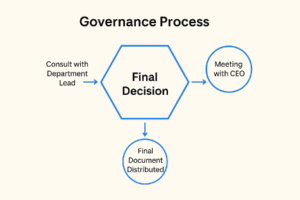
Within 24 hours of the session’s conclusion, send the working draft of the Right Clients/Right Terms® document to all participants. Make it clear that this version reflects the collective input from the meeting and is near-final. Invite everyone to review it carefully and submit any redlines or suggestions for changes—but emphasize that revisions should only be proposed if something is materially inaccurate or misrepresents what was agreed upon during the session. Include a specific deadline by which feedback must be returned to maintain momentum and avoid unnecessary delays.
If any discrepancies or unresolved issues still remain after this review period, take swift action to close the loop. Identify whether the concern affects a specific department, and if so, consult that department’s lead for insight. Once their input is gathered, schedule a brief follow-up with the CEO or designated senior leader to resolve the issue and approve the final language. This ensures the document reflects both frontline insight and executive alignment.
Once finalized, distribute the official Right Clients/Right Terms® document to the broader leadership team. Clearly communicate that this version is now complete and will serve as the active standard moving forward. While it will be revisited and refined on an annual basis to stay aligned with business needs, this current version is to be honored and operationalized without exception.
Set expectations that going forward, any instance where a prospective or existing client falls outside these agreed-upon guidelines must trigger a formal pause. Before proceeding, there must be full transparency and collective agreement—including appropriate sign-offs—before onboarding a new client or continuing with a misaligned account. This agreement is not just a document; it is a commitment to strategic discipline, shared accountability, and protecting the integrity of your business model.
Case Study: IBM’s Pivot to Cloud and AI Under Ginni Rometty
In the early 2010s, IBM—a technology giant with decades of dominance in hardware, enterprise software, and consulting—was facing existential pressures. The company’s traditional businesses, especially hardware and on-premises software, were declining rapidly. Meanwhile, cloud computing, open-source platforms, and artificial intelligence were reshaping the tech landscape. IBM’s executive team was deeply divided over how aggressively to pivot, with many fearing the potential consequences of alienating legacy clients, cannibalizing core revenues, and disrupting long-standing sales models.
The Dilemma
Ginni Rometty, then CEO, knew that IBM’s future couldn’t rest on its past strengths. However, internally, there was significant resistance. The CFO’s team was concerned about near-term revenue declines. The head of global sales feared backlash from key enterprise clients who weren’t ready for a shift to cloud. Technical leaders were split between investing in new technologies (like Watson AI and hybrid cloud) and maintaining legacy infrastructure. The board was watching closely, anxious about the company’s sliding stock performance.
The executive team had to come to terms with a hard reality: sticking with what they knew felt safer, but would ultimately lead to irrelevance. The future lay in reinventing the company.
The Turning Point
Rometty facilitated a high-stakes executive strategy retreat. Over several days, the leadership team participated in brutally honest conversations. They evaluated client behavior, long-term market trends, and financial forecasts. With outside facilitation, they assessed what success would truly require—and who they needed to be as leaders to get there.
At one point, a pivotal comment changed the energy in the room. The head of global technology services admitted, “If we don’t lead this transition, someone else will—and we’ll be left behind. I’d rather make less revenue now than lose relevance forever.”
That opened the door to alignment. Slowly, key leaders started voicing agreement—not because it was easy, but because they recognized the long-term necessity. They collectively agreed to phase out underperforming legacy businesses, invest in cloud platforms like Red Hat (later acquired for $34 billion), and double down on AI through Watson.
The Outcome
The transition was not without pain. IBM’s revenues declined for several consecutive quarters as the transformation took hold. Thousands of jobs were restructured. Some long-tenured executives left. However, the alignment of the core leadership team held firm.
In the long run, IBM repositioned itself as a leader in hybrid cloud and enterprise AI. The acquisition of Red Hat was a clear signal that IBM wasn’t just reacting—it was proactively shaping its next chapter. The company also began growing its cloud revenue again and regained credibility with a new generation of clients.
Reflection
What made this executive alignment remarkable wasn’t just the courage to change—it was the shared willingness to let go of their individual interests and historical turf. By facing reality together and prioritizing the company’s long-term health over short-term comfort, IBM’s leadership demonstrated what it means to align for the greater good.
Course Manual 5: The Importance of Mentorship
Mentorship
Before we move any further forward, we must pause to discuss a topic that is being overlooked—and that is the topic of mentorship. A great company is built and expanded upon by sharing with others the keys to success and failure so that those who follow will excel and not stumble. Mentorship is a professional relationship in which a more experienced or knowledgeable person (the mentor) provides guidance, support, and advice to a less experienced individual (the mentee) to help them grow personally, professionally, or both.
A strong mentor has some commonalities. First and foremost, he or she shares knowledge. This is more than providing a playbook or handbook. It is more than sitting someone down and showing videos to change culture. It is also not just done through training, no matter how good the trainer is. All these are important and should be done. They help build context and the structure needed. However, it is more than all these things. It is rolling up one’s sleeves and passing on the knowledge to others.
A mentor also tells stories and shares experiences. They bring the knowledge to life by taking the time to discuss the times things went well with certain clients and when things did not. It is bringing ideas and principles to life.
Knowledge and wisdom are both very important but also very different. Knowledge and wisdom are both vital parts of a strong mentorship relationship. A company cannot thrive with one without the other.
Knowledge is about what you know. It includes facts, information, theories, techniques, and skills that can be taught, learned, or acquired through study, training, or experience. A mentor uses knowledge to explain processes, give advice, or teach best practices.
Wisdom, on the other hand, is about how you use what you know. It’s the ability to apply knowledge with discernment, emotional intelligence, and perspective—especially in complex, ambiguous, or high-stakes situations. Wisdom often comes from experience, mistakes, and long-term observation. In mentorship, wisdom helps a mentor know when not to give advice, how to ask the right questions, or how to guide someone without solving the problem for them.
Think about the business you are in. It is more complex than just providing the “how to.” You must provide context and color to what you know. Your key clients are too big to get by with technical skills alone. These are business-to-business relationships with multiple personalities, influencers, detractors, and complex problems to solve. Technical steps will get you started, but wisdom gives you the discernment to navigate nuance.
Here’s how the two show up differently in mentorship:
Knowledge in mentorship might sound like, “Here’s how we typically approach that kind of project.” It may be the step-by-step process. It might sound like, “You should use this framework when presenting to leadership.” It might be the outline of a PowerPoint or how to start a process for gathering leadership support.
Wisdom in mentorship might sound a little different. It may be, “I’ve learned that sometimes what people say they want isn’t what they really need—pause before reacting.” This comes from experience. It comes from scrapes and bumps others may have taken and want to make sure others don’t repeat. It’s also taking the time to say, “This situation doesn’t need speed, it needs listening.” This likely comes from a time when the mentor did act too quickly and wants to spare someone else from making the same mistake.
In essence: A mentor gives knowledge to build capability—absolutely critical. Without knowledge, the individual may not be able to do the job they need to do. A mentor offers wisdom to build judgment and identify opportunities and possible risks.
Mentorship also means providing feedback. And not just once, but consistently. This feedback is not always correction—it can be encouragement, clarification, or reflection. It’s what allows mentees to find their own voice, refine their judgment, and expand their impact.
Mentorship can be formal (as part of a structured program) or informal (developed naturally over time), and it often focuses not just on skill development, but also on building confidence, expanding networks, and shaping leadership capacity. It is a powerful, long-view investment that shapes not only careers—but culture, client outcomes, and company legacy. The best companies cultivate mentorship intentionally—because they understand that talent can be hired, but wisdom must be shared.
The Evolution and Erosion of Mentorship: From Apprenticeship to Corporate America
Mentorship, at its origin, was not a “program”—it was a way of life. In ancient societies and early trades, mentorship was embodied in apprenticeship. A blacksmith, baker, or carpenter didn’t just teach skills; they passed on a way of thinking, a discipline, a craft. Young apprentices lived alongside masters for years, learning not just how to perform tasks, but how to embody a trade. It was immersive, relational, and deeply personal. There was a great deal of pride in making the mentee or apprentice as good or better than the mentor.
This system continued through the Middle Ages and into the Industrial Revolution. Formal apprenticeships were established in everything from masonry to shipbuilding to printing. Mentorship wasn’t optional—it was the structure through which knowledge, standards, and mastery were preserved and passed on. Learning was deeply interpersonal and experiential. It was more one to one. Masons, printers, and shipbuilders had pride in what they did because they ensured excellence was maintained.
As the 20th century unfolded and America transitioned from manufacturing to corporate structures, mentorship began to take a new form. In the post-WWII boom, large companies like IBM, GE, and AT&T institutionalized internal training, career paths, and “on-the-job” learning. Senior leaders took protégés under their wing—sometimes informally, sometimes through HR-led development programs. The idea was clear: to grow the business, you had to grow your people. A culture of coaching, succession, and development was embedded into the corporate hierarchy. You learned as you stepped up the ladder taking each step and each interaction.
But by the 1990s and early 2000s, this began to shift. The rise of downsizing, leaner organizations, mergers, and increasing shareholder pressure changed how companies viewed talent. Long-term development gave way to short-term performance. Roles turned more transactional. Leaders became busier. The unspoken contract of mentorship— “I’ll invest in you if you commit to us”—was fractured. Loyalty no longer guaranteed development, and development no longer guaranteed opportunity.
We have left mentorship in a way to Universities, Colleges and Trade Schools. It was no long the responsibility corporate leadership but was just stamped by others as ready for the role.
In today’s corporate environment, while some progressive companies invest in leadership development and coaching, true mentorship has become rare. It’s often replaced by online courses, group trainings, and mentorship programs that are passive or underfunded. Young professionals are often left to navigate their growth alone, relying on peers or trial-and-error rather than experienced guidance.
We have traded wisdom for efficiency. Relationships for speed. Long-term development for immediate output. And in doing so, companies have lost one of their most powerful tools for culture-building, leadership continuity, and institutional strength.
But there is hope. Organizations that recognize the value of real mentorship—where experience meets relationship, and wisdom is passed forward—are not just more human, they’re more resilient. Reclaiming mentorship isn’t about adding a new program. It’s about reviving a tradition that predates the modern company and has built every enduring institution in history. It’s about making sure the next generation isn’t just trained—they’re guided.
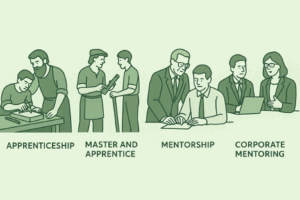
Mentorship in Today’s Companies: Strategic Asset or Missed Opportunity?
In a business environment where speed, complexity, and talent competition define the landscape, mentorship is quietly reemerging as a powerful, strategic differentiator. For decades, mentorship was either informal or relegated to the margins of professional development programs. But companies that truly invest in it—not as a checkbox, but as a cultural foundation—are beginning to realize its full potential. Strong mentorship programs build leaders, preserve institutional knowledge, accelerate learning, and shape cultures that retain top performers. Done well, mentorship is not merely an HR initiative; it becomes a central mechanism through which businesses grow people, deepen engagement, and safeguard the organization’s long-term strength.
The most obvious benefit of a robust mentorship program is the acceleration of talent development. While formal training and workshops provide structure, mentorship brings real-time context. It adds depth to what employees learn in sessions by translating theory into action. A mentor doesn’t just tell someone how to manage a client escalation—they walk them through one. They don’t just explain what stakeholder alignment means—they share the story of when it went wrong and what they learned. This type of experiential wisdom, layered with daily guidance, enables mentees to ramp up faster, make fewer mistakes, and take on greater responsibility with confidence.
Beyond developing individuals, mentorship builds a pipeline of leadership talent. This is particularly critical in organizations that want to promote from within and reduce the risk associated with leadership transitions. Strong mentors help future leaders see the full picture: not just the tactical mechanics of a job, but the strategic thinking, political navigation, and cultural awareness needed to lead effectively. Companies that invest in mentorship tend to have stronger succession plans, more continuity in key roles, and greater adaptability during times of change. When leaders retire or move on, there are others ready—not just in title or skill, but in mindset.
One of the most overlooked and yet powerful outcomes of mentorship is its impact on employee engagement and retention. In a world where workers are increasingly evaluating their jobs not just for pay, but for purpose, development, and support, having a mentor can be the difference between staying and leaving. A mentor provides a human tether to the organization—someone who sees your potential, invests in your success, and helps you navigate complexity. This type of relationship fosters a deep sense of belonging and value. Employees who are mentored are more likely to feel connected to the culture, more equipped to grow, and more optimistic about their future within the company. That optimism leads to loyalty, which leads to longer tenure and higher performance.
Mentorship also solves a problem that many organizations don’t realize they have until it’s too late: the loss of institutional knowledge. Veteran employees hold not just technical expertise but relational, cultural, and historical knowledge that doesn’t live in documents or databases. It lives in conversations, in lessons learned, and in the nuanced understanding of how things work and why. When these employees leave without transferring that knowledge, the company suffers. Mentorship is a bridge that preserves this invisible asset. It ensures that stories, strategies, and learned insights are handed down, rather than lost. This is especially important in industries where trust, nuance, and relationship capital play a critical role in long-term success.
In addition, mentorship enhances cross-functional collaboration. When mentees are paired with mentors from different parts of the business, they gain new perspectives. A marketing manager who learns from a supply chain leader starts to understand the downstream impact of messaging. A product analyst mentored by a client relationship executive learns to think not just about user data but about customer outcomes. These relationships broaden thinking, break down silos, and foster empathy across the business. Over time, this leads to better decisions and smoother execution, especially when teams must come together to solve complex challenges.
That said, the success of mentorship programs depends heavily on how they are structured and supported. Companies that build high-impact mentorship cultures tend to do a few key things very well. First, they ensure that participation is voluntary and meaningful. Forced pairings often lack the trust or chemistry needed for mentorship to thrive. Instead, great programs encourage matches based on shared goals, natural interest, or even self-selection. When both mentor and mentee choose to participate, the quality of the relationship improves dramatically.
Effective programs also invest in training mentors—not just assuming that being experienced makes someone capable of mentoring. Strong mentors are intentional. They listen more than they speak. They ask open-ended questions. They resist the urge to solve every problem and instead help their mentees develop critical thinking and confidence. Mentors in great organizations understand that their role isn’t to create clones of themselves—it’s to bring out the unique potential of someone else.
Another critical trait of successful programs is clarity. Everyone involved knows what the mentorship is designed to accomplish. There are check-ins and reflection points. Goals may range from technical growth to leadership development, but they are always defined. This doesn’t mean rigid scripts or forced milestones. It means intentionality. Participants understand why the relationship exists and how to measure its value over time.
Support matters, too. Mentorship needs to be protected and prioritized. If the company doesn’t create space for these conversations—through scheduling, visibility, or leadership encouragement—they won’t happen. Mentors need the time and incentive to engage. Mentees need permission to ask for help. And both need to see mentorship as a respected part of the company’s leadership culture, not something they do off the side of their desks.
Recognition plays a major role as well. When mentors are acknowledged for their contribution—whether through awards, public praise, or leadership development pathways—they are more likely to commit. It reinforces that mentorship is not only valuable but valued. When senior leaders speak openly about their own mentors and champion the practice, it sends a signal that resonates throughout the organization.
Despite these benefits, many companies fall into common traps that dilute the power of mentorship. One of the biggest is a lack of executive buy-in. When mentorship is viewed solely as an HR initiative rather than a strategic tool, it tends to lose momentum. If senior leaders aren’t actively participating, promoting, or reinforcing its importance, employees will eventually treat it as optional—or worse, performative.
Another trap is over-formalization. Well-intentioned programs sometimes become weighed down by excessive structure—checklists, surveys, documentation requirements—that stifle authenticity. Mentorship is, at its core, relational. It thrives on trust, conversation, and mutual investment. When programs try to industrialize the process too much, they risk making it impersonal and bureaucratic.
Diversity is also often overlooked. Without intentional effort, mentorship programs can replicate existing power structures, leaving underrepresented talent out of the loop. Great programs build inclusivity into their design—ensuring diverse representation in mentors, access for emerging leaders from all backgrounds, and a safe environment where differences are respected and explored. When done right, mentorship becomes a force for equity as well as excellence.
Finally, one of the most pervasive pitfalls is lack of follow-through. Many mentorship programs start strong—with kickoffs, matching exercises, and enthusiasm—but fail to sustain themselves. Without regular communication, celebration of success stories, and ongoing feedback loops, programs lose visibility and fade. Mentorship cannot be a “set it and forget it” system. It requires stewardship, iteration, and energy from all levels of the business.
At its best, mentorship is one of the most human—and therefore most impactful—investments a company can make. It honors experience by passing it forward. It empowers the next generation with wisdom, not just instruction. And it creates a culture where people don’t just work—they grow, they contribute, and they belong. In a world hungry for connection, purpose, and development, mentorship is not a soft skill. It is a business essential.
And for companies with the foresight to build it into their DNA, the return on that investment can be felt not just in performance metrics—but in the strength, resilience, and character of the organization itself.
Starts at the Top

A true culture of mentorship doesn’t begin in HR or in mid-level management. It begins at the top—with the Executive Team. When mentorship is modeled, prioritized, and practiced by those at the highest levels of leadership, it transcends being a “program” and becomes part of the organization’s identity. It sends a message that sharing wisdom, developing others, and building leadership capacity isn’t an optional activity—it’s part of what it means to lead.
Executives set the tone. When they mentor, they signal that experience isn’t meant to be hoarded—it’s meant to be handed down. They demonstrate that leadership is not about being the smartest person in the room, but about elevating those around you. And perhaps most powerfully, when executives share lessons from their own mentors or openly speak about the missteps that shaped their wisdom, they create space for humility and learning across the organization.
Organizations that truly embrace mentorship at the top often share a few key characteristics. First, their leaders don’t just mentor as a private act—they talk about it. They name the people who helped them get where they are. They tell stories of early stumbles, key conversations, and pivotal advice. This vulnerability opens doors for others to seek guidance without fear of judgment. When leaders speak about mentorship publicly and authentically, they de-stigmatize asking for help and normalize growth through others. They provide areas to be watchful for and those to optimize and capitalize upon.
Second, strong executive mentors understand the difference between delegating and developing. It’s easy for senior leaders to pass down responsibility, but mentorship demands more than that—it requires presence. A mentor takes time to understand the pressures their mentee is facing, not just the performance metrics. They offer insight not just into what to do, but how to think. Executives who take time to mentor often describe the experience as clarifying their own leadership philosophy. In mentoring others, they refine themselves.
A third key learning from executive-level mentorship is that wisdom isn’t found in perfection—it’s forged in complexity. The most valuable mentorship doesn’t come from textbook answers; it comes from lived experience. One executive might share the moment they lost a major client because they didn’t speak up early enough in a contract discussion. Another might recount how they almost burned out trying to prove themselves until a mentor taught them the power of “strategic no.” These aren’t just stories—they’re guideposts. And when shared, they equip others to lead with more nuance, resilience, and judgment.
Another lesson learned from executive mentors is the value of listening. The most effective mentors don’t treat the relationship like a one-way street. They know that today’s emerging leaders have fresh perspectives and new ways of working. By listening actively, executives not only help their mentees grow—they stay connected to the evolving realities of the business and the workforce. This mutual exchange fosters a culture of curiosity, agility, and empathy.
When mentorship is embedded at the executive level, it also scales across functions. Sales leaders begin coaching account managers not just on deals, but on how to think strategically about long-term client health. Operational leaders begin teaching team members how to influence, not just execute. Finance leaders begin mentoring with an eye toward cross-functional impact, not just reporting accuracy. The ripple effect is powerful, and it transforms mentorship from an isolated event to a cultural rhythm.
In this kind of culture, mentorship is not a luxury—it is a leadership expectation. High-potential talent comes to see that being mentored is not a sign of weakness, but of ambition. New leaders feel a sense of responsibility to mentor others as soon as they gain traction. It becomes a pay-it-forward ecosystem that multiplies capability across every layer of the organization.
Ultimately, the culture of mentorship led by executives becomes a competitive advantage. It ensures that when crisis hits or when growth surges, the organization is not scrambling for leadership. It has already been building it—quietly, relationally, and intentionally. That wisdom pipeline is not in a document or a database. It lives in people. And it travels through conversations that were made possible because someone at the top made the time to invest.
To build such a culture, companies must start with a simple, powerful question at the executive level: Who are you developing? If every senior leader can answer that with a name—and a story—you’re on the right path.
Exercise 1
What happened
What they did or didn’t do
What they learned
What they now do differently because of it
Did you hear more knowledge or more wisdom—or both?
How can we create more of these quick “mentor moments” in our culture?
Case Study: Microsoft’s Cultural Turnaround Through Executive Mentorship
When Satya Nadella stepped into the role of CEO at Microsoft in 2014, the company was facing a reputation of being bureaucratic, inward-facing, and siloed. Though financially sound, it had lost momentum. Internally, the culture had grown rigid. Leadership was often seen as combative rather than collaborative, and the organization rewarded individual achievement more than collective growth. Innovation had slowed, morale was strained, and Microsoft’s best talent was either disengaged or exiting. Nadella inherited a company that was strong on paper but fragile in spirit.
From the start, Nadella understood that turning around Microsoft’s future would require more than launching better products or reorganizing teams. It would require a fundamental shift in how people thought, led, and developed others. This meant reshaping not just Microsoft’s business strategy, but its internal operating culture. And one of the levers he pulled—quietly but powerfully—was mentorship.
Rather than introduce mentorship as a program or a policy, Nadella began by modeling it himself. He spoke openly in company town halls and leadership summits about the people who shaped his thinking over the years. He shared stories of failure, missteps, and learning moments—stories that executives at his level rarely told in public. He emphasized that the most powerful leaders weren’t those who always had the answers, but those who knew how to ask questions, listen deeply, and guide others through growth. He embraced and evangelized the concept of a “growth mindset,” encouraging everyone in the organization—from senior vice presidents to entry-level employees—to see mistakes as opportunities and learning as continuous.
This philosophy quickly began to influence how Microsoft’s senior executives approached their own leadership. Rather than staying behind layers of hierarchy, many began holding open mentoring sessions. They invited rising talent to “Ask Me Anything” meetings. They began sharing their own leadership development journeys not just as polished talking points but as raw, human stories of the lessons they wished they’d learned sooner. This kind of vulnerability was new for Microsoft. But it resonated. It gave others permission to be honest about what they didn’t know and to seek guidance without fear of appearing weak.
Executives began mentoring beyond their direct reports. Cross-functional mentoring relationships emerged. Reverse mentorships were encouraged, where junior team members mentored more senior ones to help them understand new ways of thinking, particularly in areas like emerging technology, customer expectations, and inclusive leadership. These were not mandated pairings—they were organic, authentic, and leader-led. Over time, mentorship at Microsoft stopped being an “extra” and became a leadership behavior.
The impact of this cultural shift was profound. Microsoft didn’t just begin collaborating more effectively—it began executing faster. Innovation picked up as silos broke down and diverse teams began co-creating rather than competing. Employees across levels reported higher engagement and a stronger sense of purpose. People started to feel not only that they had a future at Microsoft, but that someone was investing in helping them shape it. The leadership pipeline became stronger, and promotion readiness improved because employees were being groomed with more than skill—they were gaining context, judgment, and confidence.
This mentorship-driven culture was not a magic switch, but it became a key ingredient in Microsoft’s remarkable transformation. Over the next several years, Microsoft not only regained relevance but became a global leader in cloud, AI, and collaboration tools. Its market cap soared. Customer satisfaction improved. And internally, Microsoft was no longer seen as a place where brilliant people competed—it became a place where experienced leaders lifted others and invested in the next generation of thinkers.
What made this transformation possible was not a formal mentorship program alone. It was the decision, modeled at the very top, that mentorship mattered. That wisdom was meant to be shared. That leadership meant leaving others better than you found them. And that a company’s strength is not just measured by its earnings or product launches, but by its ability to build up people who will carry its mission forward long after the current leadership moves on.
Microsoft’s story shows that mentorship, when driven by example and embedded into the culture, does more than shape careers. It shapes companies.
Course Manual 6: Lessons Learned Concept
Why We Focus So Heavily on Mentorship—and the Role of “Lessons Learned”
You might be wondering why so much time and energy has been devoted to the topic of mentorship. After all, mentorship is a substantial topic in its own right—one that could easily stand alone in any conversation about professional development or company culture. So why emphasize it here, in the context of client retention, leadership development, and organizational growth?
Here’s why: mentorship isn’t just about individual growth. It’s about collective strength. When mentorship is embedded in a company’s DNA, it becomes one of the most powerful tools for preventing repeated mistakes, preserving institutional knowledge, and building deep, lasting client relationships. In the simplest terms, strong mentorship helps people stop making the same mistakes over and over again. That alone drives better performance and tighter retention.
We believe in this so strongly that we’ve formalized a mentorship process that begins with leadership and extends throughout the entire organization. This isn’t a generic HR initiative or a one-time program—it’s a commitment. A belief that wisdom should not be hoarded, but handed down. That experience, when shared, becomes a multiplier. And that leadership means leaving others better equipped than you found them.
Mentorship: A Direct Line to Client Retention

At first glance, mentorship might seem disconnected from something like client retention. But dig a little deeper, and the connection becomes clear. When team members are mentored, they gain not only knowledge but also context—judgment, discernment, and the ability to navigate nuance. That’s exactly what complex client relationships require.
Clients don’t leave because your team doesn’t know the steps of a process. They leave when execution lacks depth—when service feels generic, or missteps reveal a lack of understanding. Mentorship bridges that gap. It helps your people grow not just in skill, but in wisdom. It shortens the learning curve and reduces costly misfires. A well-mentored team delivers a better client experience, period.
But mentorship doesn’t stop at one-on-one coaching or informal guidance. To truly embed it into your culture, you need both personalized mentorship and scalable systems for sharing what your top people know.
That brings us to Lessons Learned.
Lessons Learned: Turning Experience into a Shared Asset
Let’s be clear—Lessons Learned is not a substitute for mentorship. It’s not meant to replace the power of two people sitting down, sharing a challenge, and walking through it together. That one-on-one exchange is critical, and we strongly recommend organizations formalize it. There is true value in the process.
What Lessons Learned offers is something complementary: a broader, structured process for sharing best practices and cautionary tales across the organization. It’s a mechanism for scaling wisdom. It gives leadership a chance to communicate what they’ve learned—both from wins and from mistakes—not just to one person, but to everyone.
Think of it as a knowledge amplifier. In every company, especially at the executive level, there’s an immense amount of experience—some of it tactical, some of it strategic, and much of it unspoken. Too often, it stays siloed. Leadership assumes that others already know what to look out for, or what to double down on. But that assumption is dangerous. Without a deliberate process to share those insights, companies repeat avoidable errors and miss opportunities that were right in front of them. Often account teams are new to their role or have not benefited from seeing all the possibilities, leadership has.
Lessons Learned creates space for leadership to say, “Here’s what we saw. Here’s what worked. Here’s where we missed the mark. And here’s how we’re thinking differently because of it.” These aren’t lectures. They’re reflections. And when delivered authentically, they help teams course-correct faster, grow more confidently, and innovate with fewer missteps.
Combining Mentorship and Lessons Learned
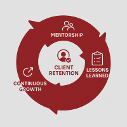
When mentorship and Lessons Learned work in tandem, the result is a culture of continuous growth. People don’t just do their jobs—they get better at them, together. They don’t just react to issues—they anticipate them. They understand the context behind decisions. They feel trusted with real insight.
This kind of culture builds resilience. It creates alignment between leadership and frontline execution. It empowers employees with perspective—not just instruction. And critically, it improves how your organization shows up for clients.
That’s why we don’t treat mentorship as a side note. And that’s why we don’t keep Lessons Learned as a hallway conversation or an afterthought in a slide deck. We’ve formalized both—because we believe experience only becomes valuable when it’s shared.
Mentorship and Lessons Learned aren’t just internal practices. They are expressions of your company’s values. They signal to employees that growth is expected—and supported. They show clients that your team isn’t just trained but guided. And they demonstrate to future leaders that you don’t just invest in performance—you invest in people.
If you want a company that learns fast, adapts well, and retains clients over the long term, this is how you build it.
Spotting Opportunity: What Great Teams Notice—and Great Leaders Amplify
Opportunities with existing clients rarely arrive with a loud announcement. More often, they slip into view quietly, disguised as casual comments, evolving needs, or subtle changes in behavior. The ability to recognize these signs—and act on them—is what separates teams that maintain the status quo from those that grow accounts and deepen partnerships.
Some of the clearest signs of opportunity come in everyday moments. A client might ask what else your team offers, hinting at interest beyond the current scope. They might start inviting new stakeholders to meetings—often a sign that something broader is being discussed internally. Other times, they’ll mention pain points that don’t fall under your current responsibilities, but clearly matter to them. These are doorways into deeper engagement, if someone is paying attention. Even offhand remarks about upcoming initiatives, budget changes, or internal restructuring can be powerful indicators. And when a client begins seeking your input not just on execution but on strategy, you’ve crossed into advisory territory—a place where real partnership and growth begin.
Despite this, many of these signals are missed. Not because teams don’t care, but because they don’t always know what to do with what they’ve heard. In the rush of day-to-day work, it’s easy to file away a client comment and move on. Team members may think someone else picked up on it. They might assume it wasn’t significant, or simply feel it’s not their place to elevate it. Too often, opportunities go unnoticed not for lack of insight, but for lack of structure and reinforcement around what to look for and how to respond.
This is where leadership becomes essential. Leaders shape the culture of curiosity. When leaders regularly ask team members after client interactions, “Did you hear anything that sounded like a possible opportunity?” it trains teams to listen differently. It communicates that this kind of attention matters. Leadership should also share real examples of how a small comment from a client turned into a much larger engagement—or how a missed cue became a missed opportunity. These stories aren’t just instructive; they show that being observant and proactive can have real impact.
More importantly, leaders need to give people permission to bring up things that are still unclear. Opportunity doesn’t always present itself fully formed. Sometimes it starts as a gut feeling, a vague comment, or a shift in tone. When team members feel safe saying, “This might be nothing, but I noticed…” they begin surfacing the kinds of insights that can lead to meaningful growth. It’s also helpful for leaders to create spaces where these observations can be shared, even if the person who hears it isn’t the one responsible for acting on it. Whether it’s a meeting, an internal message board, or a shared document, having a place to drop and discuss these signals helps ensure they don’t get lost.
Recognition plays a role as well. When someone catches something small that turns into something big, it’s important to acknowledge it—publicly and specifically. This reinforces the value of listening deeply and speaking up early, and it helps others in the organization see what’s possible when you pay attention.
Ultimately, clients are always giving you information. The difference between a static relationship and a growing one often lies in whether your team knows how to hear what’s really being said—and whether your leadership creates the environment where that information can be voiced, examined, and acted on. Organizations that grow with clients don’t just respond well to requests; they notice the unspoken needs and bring forward ideas before being asked. They make space for curiosity. And most of all, they empower people to connect the dots.
Leadership’s job isn’t to have all the answers. It’s to create a culture where people are encouraged to say, “I think there might be something here”—and know that someone will listen.
Exercise 1
Industry and Company Specific
Leadership plays a critical role in helping teams recognize and act on opportunity. While the ability to spot potential often rests with client-facing individuals, it’s leadership’s responsibility to define which opportunity signals are most relevant, actionable, and aligned with the company’s capabilities. Without that clarity, even the most well-intentioned observations can go unnoticed or unpursued.
There are countless ways to identify opportunities within existing accounts, but patterns tend to emerge. In nearly every industry, a few consistent signals pop up time and again—those moments that, when recognized by a customer-facing employee, can and should be elevated immediately. When leadership sets clear guidance on what these moments look like and empowers teams to surface them, the organization can act faster, smarter, and more effectively. It turns observation into action—and action into growth.

One company did this with striking simplicity. They had delivery drivers visiting clients every day, yet those visits had always been treated as operational touchpoints, not commercial ones. Leadership introduced a small change: train the drivers to visually check whether the client was using a specific logistics service the company also offered. If the service wasn’t present, the driver would casually ask, “Would you be interested in hearing more about a service that might help?” Nothing scripted. Just a natural question. From there, the driver would simply log that client’s interest in their daily report, which was routed to the sales team for follow-up. That single adjustment—adding a moment of awareness and a line of communication—led to a 10% increase in sales.
This example is powerful not because of its complexity, but because of its clarity. Leadership identified a specific, visible indicator of opportunity, gave the team a low-friction way to engage, and created a mechanism to act on it. No pitch decks. No cold calls. Just observation, curiosity, and follow-through.
The same principle applies across industries. In insurance, for instance, when discussing claims data or usage patterns with high-value employers, client-facing consultants should be trained to look for outliers that point to inefficiencies or cost exposure. If a particular category of claims is higher than average, or if usage trends reveal underutilized resources, those signals can spark a conversation about new solutions or strategies that reduce cost and improve outcomes. But again, this only happens if someone is looking—and if leadership has clearly defined what “worth looking for” means in their specific business context.
It’s not enough to say, “Keep your eyes open.” You have to equip your teams with the lens through which to see. Leadership should lay out the handful of repeatable cues—things clients say, behaviors they exhibit, data points that stand out—that are most likely to signal opportunity. These cues should be simple, observable, and closely tied to how the business adds value. Once those are defined, create space for those signals to be captured and passed along. This could be as simple as adding a field in a CRM tool, setting up a short weekly huddle for field teams to share what they’ve seen, or encouraging account managers to keep a rolling note on conversations that hint at emerging needs.
The key is consistency. One-off observations rarely lead to action. But a consistent system of identifying and sharing insights creates rhythm—and rhythm creates results.
Ultimately, opportunity spotting should not be a skill reserved for the sales team. It should be a shared responsibility, built into the culture of every customer-facing function. And it starts with leadership drawing the map. When leadership takes the time to define what opportunity looks like in their world, and when they reward those who raise their hands to say, “I think I saw something,” they build a culture that doesn’t just respond to client needs, but anticipates them.
That’s how organizations grow not just smarter, but more connected—inside and out.
It is often something very straight forward and commonplace. However, it must often start with the Executive Team. They are able to see things from a totally different point view.
Warning Signs, Spotting the Other Side of the Coin: Early Warnings of Client Loss

There’s another side to identifying opportunity—and it’s one we don’t talk about enough. It’s the ability to spot when a client might be slipping away.
No one likes to admit it, but client losses often follow patterns. What’s frustrating is that those patterns are rarely new. A client leaves, and someone in the room inevitably says, “How did that happen? That’s the fifth one in two years!” But the real question isn’t how it happened—it’s why we didn’t see it coming.
We’ve all seen this cycle before. Clients exit, for reasons that feel obvious in hindsight, and yet the same scenarios repeat themselves. Slow response times, declining engagement, unresolved frustrations, shifting priorities—these are not random occurrences. They are signals. And if no one is looking for them, they’re missed. Again and again.
The hard truth is that these warning signs were there. The problem is that they weren’t recognized, elevated, or acted on in time. This isn’t about blaming the account team or front-line staff. In fact, it’s often not something they can solve on their own. Many of these signals are subtle and emerge slowly. Others sit outside the line of sight of those closest to the day-to-day work. Which is why leadership has to take ownership—not of the symptoms, but of the system.
It’s time to break the cycle.
Just like organizations formalize the process of identifying and pursuing opportunities, they must also formalize how they spot, flag, and respond to signs of risk. This responsibility starts at the top. The executive team sits at a unique vantage point—one that account managers or even sales directors may not have. They can see the broader client patterns, the strategic shifts, the revenue trends, and the behaviors that tend to precede a loss. That insight needs to be translated into a framework.
Every company has its own warning signs. For some, it might be a sudden drop in utilization. For others, it’s the third rescheduled quarterly review. Maybe it’s a new procurement contact, or a client who used to be highly engaged suddenly going silent. The specifics vary, but the pattern is always there.
What’s needed is a clear, consistent process for surfacing and responding to those early indicators. Not once a year. Not after the client leaves. But in real-time. And that process must be communicated and owned at every level—from the executive team to the account team to the people on the front lines.
This isn’t just about reacting faster. It’s about building a culture of vigilance. A culture where it’s normal to say, “This feels off. Let’s look into it.” A culture where speaking up about a red flag is seen as being proactive—not pessimistic. It’s also about making sure those red flags aren’t left to individual interpretation. Leadership needs to define what specific behaviors, trends, or comments should trigger attention. And once those are defined, they need to be tracked, reviewed, and discussed regularly—not just when the contract is up for renewal.
Most importantly, there needs to be accountability. If a client leaves and no one saw it coming, the first question shouldn’t be “What did the account team miss?” It should be “What part of our system failed to raise the flag?” Because more often than not, the signs were there—they just didn’t have a place to land.
Losing a client always stings. But losing a client the same way you lost the last one—that’s a system problem, not a situational one. And that’s where leadership needs to lead—not just in celebrating wins, but in preventing unnecessary losses.
The bottom line: We can’t control every client decision. But we can control how alert, prepared, and responsive we are to the warning signs. And if we take that seriously, we can stop asking “how did we miss it?”—and start making sure we don’t.
The Good News
At the end of the day, mentorship, Lessons Learned, opportunity spotting, and early warning signs aren’t separate efforts. They’re parts of a connected system—one designed to help your organization learn faster than the challenges it faces.
Mentorship builds your people. It passes wisdom from those who have seen more to those who are just starting to shape their judgment. Lessons Learned scales that wisdom so the same mistake isn’t made twice. Opportunity spotting turns client insights into growth. And risk recognition ensures you don’t lose what you’ve worked so hard to build.
But none of this happens by accident. It takes leadership. Leadership that isn’t just focused on outcomes, but on the systems that produce them. Leadership that understands you don’t get resilience, trust, or loyalty from policies—you get them from people who are equipped, empowered, and heard.
This isn’t about complexity. It’s about intentionality.
If you build a culture where experience is shared, observations are acted on, and silence is examined as closely as enthusiasm, your business will evolve faster, serve smarter, and retain more. You’ll stop repeating the same errors. You’ll start spotting signals before they become problems. And you’ll create the kind of company that not only adapts—but leads.
It’s not flashy. But it works. And it lasts.
Because companies that learn forward don’t just grow. They endure.
Case Study
In the early 2000s, American Express noticed something unusual in their data: a subset of their small business customers were consistently spending more per transaction and showing higher engagement than their consumer counterparts. This wasn’t a huge spike, and it didn’t immediately trigger alarms. But a few curious analysts and client managers started raising the same question: Why are these business cardholders so active—and what else might they need that we aren’t offering?
Rather than dismiss these behaviors as statistical anomalies, American Express leaned in. They initiated qualitative interviews with a selection of small business clients, sent senior leaders to observe customer workflows, and reviewed service call transcripts to capture the kinds of questions these clients were asking. What emerged was clear: small businesses were hungry for more than just a credit card. They needed better cash flow solutions, more detailed spend tracking, and access to perks that matched their specific challenges—like employee spending controls and business-focused rewards.
Recognizing this as more than just a trend, the leadership team made a strategic shift. Instead of treating small businesses as an afterthought within their consumer division, American Express launched OPEN, a dedicated platform tailored specifically for the needs of small businesses. OPEN offered custom cards, cash management tools, targeted rewards, and personalized service—elements that weren’t previously bundled or branded for this audience.
The result was transformative. Within a few years, OPEN became one of the fastest-growing divisions within American Express. It captured significant market share in the small business segment, brought in billions in new revenue, and helped shift the company’s image from elite consumer brand to trusted business partner. Perhaps more importantly, it deepened loyalty among a previously underserved customer base—turning cardholders into advocates.
This success didn’t start with a sales pitch. It began with a pattern. A behavioral anomaly that sparked curiosity. And leadership that took the time to ask: Is there something more here?
That’s the power of spotting opportunity—not as a hunch, but as a practice. American Express didn’t just react to demand. They anticipated it, structured a response, and turned it into long-term growth.
Course Manual 7: Lessons Learned Workshop
You understand the concept—now it’s time to act. We’re moving from theory to execution as we facilitate the actual Lessons Learned workshop. This session will generate two key outputs: a clear list of Lessons Learned and the warning signs associated with poor-fit clients or decisions. These will become vital tools for improving future decision-making and client engagement.
This chapter provides everything you need to run the session effectively. We’ll also conduct a mock workshop later, giving you the hands-on experience to lead with confidence. If you have questions, ask them now—this is your opportunity to truly master the process.
Who Should Attend
Just like the Right Clients/Right Term workshop, the Lessons Learned session should include both the Executive Team and the Partnership Success Team. While the Executive Team holds the final say, the broader group brings valuable insight. You’ve had your own experiences—some that led to success, and others that didn’t go as planned. Your input matters.
You’re not just a passive observer. Speak up. Add context, share examples, and help steer the conversation. Your firsthand perspective is essential to uncovering the patterns, missteps, and successes that will shape smarter strategies moving forward.
When should it Occur
The Lessons Learned workshop should be conducted after the Right Clients/Right Terms® workshop. This can either happen as a one-day event with the Right Clients/Right Terms® workshop taking place in the morning and the Lessons Learned workshop taking place in the afternoon or on two separate dates.
If at all possible, we recommend conducting the workshops back-to-back. While we understand that scheduling conflicts can arise, running these two sessions on the same day ensures everyone is fully present and focused on two essential topics: choosing the right clients under the right terms and identifying the Lessons Learned and Warning Signs that will guide future decisions. These conversations naturally build on each other, so keeping them close together strengthens the overall outcomes.
There are distinct advantages to holding both workshops on the same day. It’s more efficient, minimizing context switching and setup time. Participants stay in a strategic mindset throughout, allowing insights from the first session to directly inform the second. There’s also a momentum that carries forward—discussions and decisions made in the first half of the day often spark valuable connections during the second.
However, there are trade-offs. Running two intensive sessions back-to-back can lead to fatigue, especially in the latter half of the day. If the first workshop runs long, it can compress or dilute the effectiveness of the second. Additionally, it can be difficult to align schedules for a full-day commitment from any participants not to mention an Executive Team.
Holding the workshops on separate days brings a different set of benefits. It gives participants more space to reflect, digest, and return fresh. Shorter sessions are easier to schedule and often come with sharper focus. Time in between can also allow for follow-up discussions or deeper preparation before the second session. On the downside, separating the workshops can disrupt continuity. The energy and connections built in the first session may weaken over time, and time may be lost reorienting the group when reconvening.
Ultimately, the decision will be yours, in consultation with the Executive Team and their administrative staff. Both approaches can work well—what matters most is ensuring full participation, honest dialogue, and a shared commitment to improving how you choose and support the right clients.
Where
When done live, this workshop brings a level of energy and connection that’s hard to replicate. You can read body language, sense the room’s mood, and respond in real time. People tend to open up more when they’re physically present, creating space for honest conversation and unexpected insight. The atmosphere of a shared space—using walls, sticky notes, markers—makes the work feel grounded and collaborative. There’s also a roll-up-your-sleeves feeling that encourages focus and full participation.
However, live workshops come with real challenges. Coordinating schedules for in-person attendance, especially across multiple offices or geographies, can be difficult. Travel takes time and resources, and not every team member may be able to join in the same location. There’s also the risk that more vocal participants dominate the conversation if facilitation isn’t tight.
Running the workshop virtually offers more flexibility. It’s easier to include people from different locations, and meetings can be spread out into smaller, more digestible sessions. Breakout rooms ensure everyone has a chance to speak, and shared digital tools can help track input and outcomes in real time. But virtual settings have limitations. It’s harder to pick up on nonverbal cues or emotional shifts, and people may disengage or multitask. The human connection, while possible, takes more effort to maintain.
The Process
Introduction
Participants are welcomed into the collaborative setting. Flip charts ready, markers are at the tables, and everyone is ready to start the workshop. To put it another way everyone’s sleeves are rolled up and they are ready to go. Be sure to frame the day as not a training day but as a strategic build session. The objective is clear: by the end of the day, the group will walk away with a usable framework that defines the most critical lessons, the Opportunity Signals worth acting on, and the early Warning Signs leadership must never ignore again.
Share with the group that “we all know that everyone already has insights. Today we formalize how they are shared”. We want to memorialize what everyone in the room already knows but have not be shared with others in the company. If we do not take the time to document and define what exactly they are they will as good sometimes as folk lore.
Let’s begin with a reality we often overlook stories that aren’t captured eventually lose their meaning. In traditional cultures, folklore passed on survival knowledge—warnings, values, insights. But over time, when those stories weren’t written down or actively taught, the lessons faded. The message blurred; the purpose was lost. What was once essential, became something people just used to say—until no one said it anymore.
The same thing happens in companies.
Every project, every launch, every misstep and breakthrough contains lessons. But unless we’re intentional about capturing and sharing them, they slip away. And when people move on, those insights move with them. What’s left behind? Gaps. Repetition. Reinventing the wheel.
Think about our last major win. We solved a major issue that took a lot of time and energy. But a year later, another team ran into the same issue—because that workaround lived only in someone’s memory, not in a documented process. (Please think of an actual issue here to bring to the concept to life).
We don’t lose lessons because we don’t learn—we lose them because we don’t lock them in.
This workshop is about changing that. We’re going to look at how to formalize what we’ve learned—so that knowledge becomes scalable, transferable, and part of how this company operates. Not folklore. Not stories whispered between veterans. But frameworks, guides, and systems that help every team start stronger and move faster.
Because lessons not captured aren’t just forgotten—they’re re-lived as costly mistakes. The same is true for Opportunities. If they are not captured others will miss out on what could have been possible.
Stories that Stick
Let’s shift into reflection. Share with the participants “I’d like each of you to take a few quiet minutes to write down two impactful moments from the last 12 to 24 months”. One should be a missed opportunity—like a chance to expand with a client, a deal that stalled, or something that slipped through the cracks. The other should be a regretful loss—a client who left, a promising relationship that broke down, or a strategic misstep. The more specific you are, the more valuable this exercise will be.
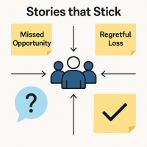
After that, we’ll break into small groups of three or four, with members of the Executive Team and the Partnership Success Team interwoven. Each person will share their stories. As a group, your role is to listen and help each other uncover what signs or patterns were present before things went wrong or were missed. Think about what was visible in hindsight—what could have been spotted earlier.
Next, identify what meaningful lesson could be shared with the broader company. Something that would genuinely help others avoid similar outcomes or seize similar chances. Finally, reflect together on what leadership could have done differently. What could have been formalized, structured, or supported to either prevent the loss or make sure that opportunity was captured?
Each group will then choose one key lesson and signal to write on a large sticky note and add it to our shared wall. That wall will become a visual of what we collectively know now, and what we won’t let slip through again.
Exercise 1
Building the Lessons Engine
After letting all the participants take some time to review the wall ask everyone to discuss their first thoughts. What was striking to them. Where there any commonalities? Was there any commonality?
After our general reflection and storytelling, we now move into a more focused conversation around three critical themes: Organizational Behaviors, Client Signals, and Leadership Blind Spots. Understanding these with clarity helps us turn hindsight into foresight.
Organizational behaviors are often the earliest indicators of change—yet they’re easy to dismiss. A stakeholder suddenly going quiet, meetings getting rescheduled repeatedly, or a shift in tone that feels off. These moments are often rationalized away as bad timing or stress, but they’re signals. Internally, the same applies. If an account team becomes reactive instead of proactive, or if internal coordination breaks down, these are not just operational hiccups—they’re warning signs.
Client signals tend to surface well before a problem—or an opportunity—becomes obvious. But they’re subtle. They whisper before they shout. A change in how a client asks questions, who joins meetings, or how decisions are framed may indicate shifts in priorities, satisfaction, or intent. By the time a client is clearly upset or walking away, it’s often too late.
Leadership blind spots are rarely intentional—they form because of the nature of executive roles. Leaders operate at high altitudes, often focused on strategy, growth, and risk. But in that altitude, there’s a cost: real-time clarity into what’s actually happening on the ground. The more layers between leadership and client-facing teams, the more likely it is that important signals are softened, delayed, or lost altogether.
These blind spots can show up in several ways. Sometimes it’s a lag in hearing about friction on an account. Other times, it’s a missed opportunity that front-line teams recognized but didn’t feel empowered or prioritized to escalate. Even cultural shifts inside the client organization—changes in decision-makers, new priorities, shifting budgets—may never fully surface at the leadership level unless a structure exists to consistently surface and act on them.
There’s also an emotional distance that can form. Executives may be told, “Everything is fine,” even when a team is burning out or a client is quietly withdrawing. Not out of malice, but because there isn’t always a system in place to translate those soft signals into actionable insight. That’s where discipline in capturing lessons learned becomes so valuable—not just for course correction, but for breaking through the fog of the day-to-day.
Once the room is comfortable that everything has been categorized divide the room into three working teams. Each team will then rotate through each section, Behaviors, Client Signal, and Leadership Blind Spots. The goal will build a working Lessons Framework, identifying the root lesson, defining how to surface it earlier and decide where or with whom the lesson needs to live. This will be flushed at out at this workshop and acted upon throughout the year.
We have a covered a lot, but we have just started. All in attendance should be getting a good feel of what has been accomplished and what is left to do. At this point we have a wall (or virtual whiteboard) filled with a large amount of information, a “Lessons Dashboard” if you will. This is not just a list of reflections. It is the beginning framework of what needs to be operationalized We are far from done; we are just getting started.
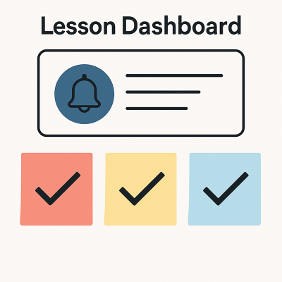
Working Break
Much like when you took a break with Right Clients/Right Terms® this break will not be a break to relax. It is a chance to socialize the ideas. Each group or table will be asked one question “Share a time your team did catch something early- what made the difference?”.
If you are conducting the meeting virtually this may be a good place to wrap up the session for the moment and return later in the day or another day.
This question will keep everyone focused. When all return provide some time for every to give their answer. Asking someone a question before break and not following up could leave everyone to disengage by feeling they were being asked to just do a busy exercise. It will also recenter the group on what works and how systems can make it repeatable.
Opportunity Signal Workshop

After the reflections and discussions on lessons learned, the energy in the room will begin to shift. This is the perfect moment to pivot from looking back to looking forward. It’s time to explore how opportunities often announce themselves—not loudly, but quietly, through signals that are easy to miss in the moment and only obvious in hindsight.
Begin this part of the session by introducing five common patterns that tend to emerge just before a client engagement deepens. These signals are subtle. They don’t arrive in formal emails or come with big headlines. Instead, they often appear as a small change in tone, a passing comment during a meeting, or a new person unexpectedly joining a call.
First, draw attention to the kinds of behaviors that often precede new opportunities. A client might start attending meetings more regularly, or show a deeper level of engagement than usual. They might start offering unsolicited feedback, or there could be a shift in the way they interact with your team—more openness, more follow-up, or more detailed questions.
Next, guide the group to think about language. Clients don’t always say what they want directly. Instead, they may hint at needs with phrases like, “We’ve been thinking about…” or “I wonder how this could work if…” These comments often come at the end of a meeting or during an informal check-in, and are easy to gloss over unless you’re actively listening for them.
Then, consider changes in stakeholder dynamics. When new people enter the conversation—whether it’s someone in procurement, a new department head, or an executive who hasn’t been involved before—it’s often a signal that priorities are shifting. New people bring new questions, new goals, and sometimes a new direction. It’s a moment that should trigger deeper attention.
Minor frustrations also carry valuable signals. These aren’t blowups or crises, but smaller expressions of tension—when a client notes that a process feels clunky, or that something “almost works.” Often, frustration isn’t a sign of dissatisfaction; it’s a sign they want more, and they believe you can deliver it. The challenge is interpreting the friction not as criticism, but as interest.
And finally, there’s curiosity. When a client starts asking questions that go beyond the current scope—like inquiries into other services, industry benchmarks, or how similar challenges are solved elsewhere—it often points to latent opportunity. They may not be ready to move immediately, but they are thinking ahead. That’s the earliest stage of expansion.
Once these five patterns have been laid out, pause and ask the room a question: which of these signals are we missing? Let the question sit. Invite everyone to reflect, not just on past projects, but on current relationships. The aim is to surface blind spots, to get the group thinking about what’s happening in their client portfolio right now that may deserve closer attention.
This is a great moment to reconfigure the energy in the room. Change up the groups. Create new small teams and give them a fresh task. Now, instead of telling stories about lessons from the past, they’ll work from real client situations to identify opportunity signals in reverse. Ask them to think back on actual client interactions. Was there a moment when the client might have been signaling openness to more? Or a time when they were quietly letting your team know something wasn’t working?
Encourage them to dissect those moments by focusing on five areas. First, the client’s behavior—what actions stood out, what shifted in their responsiveness, their engagement, their presence. Second, the language they used—were there specific words or turns of phrase that hinted at new thinking or dissatisfaction? Third, who was involved in the conversation—did someone new show up, or did a known person suddenly go silent? Fourth, were there any changes in data or activity trends—did volume spike, did meeting frequency change, did support tickets increase? And lastly, what emotional tone surrounded the interaction—was there increased energy, hesitation, or frustration?
Each group selects one story to bring back to the larger room. As they share, a new type of awareness begins to emerge. People start to realize that signals were present all along—they just weren’t looking for them. It becomes clear that opportunity is often visible, just not labeled.
To close this segment, ask a final question: if we had recognized those signals earlier, what would we have done differently? This is the pivot point from passive reflection to proactive readiness. The group now sees that the future isn’t just about doing more, but about seeing more—earlier, more clearly, and with the confidence to act.
We will have accomplished a lot by now. We are all most there the next step is to formalized the final document, conduct risk and warning mapping and communication. We will pick this all up in Chapter 8
Case Study: How a Mid-Market SaaS Firm Turned Insight into Opportunity
A mid-sized SaaS company specializing in HR automation tools had just come off a challenging year. While revenue remained steady, they had seen a noticeable decline in client expansion. Existing clients weren’t renewing at the rates they once were, and upsells had slowed significantly. Internally, sales blamed client success for lack of engagement, while client success pointed to misaligned expectations created during the sales process. Leadership was frustrated, but didn’t have clarity on what was actually going wrong.
The CEO decided it was time for a reset and brought in a facilitator to run a Lessons Learned and Opportunity Signal workshop. It wasn’t part of a turnaround effort—it was about realignment and making insight operational.
The workshop brought together members from Sales, Customer Success, Product, and the Executive Team. At first, the conversation followed a familiar path: people shared individual stories of lost deals, missed renewals, and promising pilots that went nowhere. But as the facilitator guided the group to surface the early signs that had been missed, a pattern emerged. In nearly every case of a failed renewal or stalled upsell, the same subtle signal had occurred: the client’s original champion had left, and the new stakeholder wasn’t engaged the same way.
These moments weren’t framed as warning signs at the time—they were treated like inconvenient HR changes or temporary communication delays. But during the workshop, it became clear that when a stakeholder changed, the relationship often reset. And when no formal re-introduction or discovery was done, momentum died.
In one breakout session, a Customer Success Manager recalled a client where the VP of HR left mid-contract. The new Director of Talent never received a clear onboarding to the relationship or the tool’s value. Three months later, the client churned—not because of dissatisfaction, but because the new stakeholder never saw the ROI.
That moment led to a breakthrough. The group realized they didn’t have a playbook for stakeholder transitions. A second insight followed: in multiple cases, clients had casually asked questions about additional features, integrations, or use cases—but those questions were seen as offhand, not opportunity signals.
Coming out of the workshop, the company developed two concrete systems:
A Stakeholder Change Protocol: Whenever a new contact appeared in a client org, it triggered a discovery call, a tailored product tour, and a re-introduction to the value story.
An Opportunity Signal Tracker: Client-facing teams were trained to flag key phrases and behavior shifts in their CRM—such as “curious about” or “who else uses this?”—so these signals could be escalated and evaluated in weekly pipeline reviews.
Within six months, the changes paid off. Expansion revenue increased by 28%. Several at-risk accounts were saved. More importantly, teams were no longer operating in silos. Everyone had a shared language for what opportunity looked like, and a process for what to do when it showed up.
When asked what made the biggest difference, the VP of Customer Success said: “We stopped waiting for clients to be clear. We started paying attention to when they were being subtle.”
Course Manual 8: Lessons Learned Finalization
Risk and Warning Sign Mapping – Client Loss Focus
This segment of the workshop is devoted to identifying the early warning signs that precede the loss of a client—signals that, while often missed in real time, become clear when viewed through the lens of hindsight. The goal is not simply to relive what went wrong but to create a shared organizational language around risk recognition and early intervention. By surfacing these patterns collectively, your team will be better prepared to anticipate client erosion and respond before relationships reach a point of no return.
To support this effort, each participant is asked to contribute to the development of three real-world case studies involving clients who were ultimately lost. These stories will form the foundation for a collaborative and thoughtful risk mapping session. The cases should be chosen what they were able to learn from them, not just their outcome. In some situations, the loss may have been gradual, others more abrupt. Some may have involved warning signs that were ignored; others may have seemed fine until they weren’t. All are useful—especially when their nuances are unpacked with care.
In some cases, relevant material already exists through recent or ongoing FreshEyes® Reviews or PostMortem® Audits. If so, these can be used directly to accelerate preparation. If not, participants should begin identifying three suitable cases ahead of the session. These do not require exhaustive research or formal documentation. Instead, each should provide enough context and specificity to support meaningful, practical discussion. Participants are encouraged to collaborate with those closest to each account—executive sponsors, account leads, or operations team members who were involved in the day-to-day relationship. The objective is to paint a clear, fact-based picture of what happened, what changed, and what clues were present before the loss occurred.
Exercise 1
Once the three case studies have been surfaced and shared, participants will be reorganized into cross-functional groups. This deliberate restructuring ensures a diverse range of viewpoints, helping challenge assumptions and draw richer insights. These teams will analyze the client loss cases through the lens of early-stage risk—searching not only for what went wrong, but for what could have been detected earlier. What signals were present that were dismissed, rationalized, or simply overlooked? Which ones emerged consistently across different stories?
To guide this analysis, four common categories of early warning signs are provided as a starting framework. It is important, however, to emphasize that these are not exhaustive. They are directional prompts—meant to stimulate thinking, not limit it. Each organization will have its own patterns, language, and behaviors. As such, participants should feel empowered to surface any additional signals they feel are relevant, based on their experience and industry knowledge.

The first area of focus is disengagement. This may manifest as a client pulling back from routine interaction—reduced meeting attendance, slower response times, or more superficial participation during collaborative efforts. They may begin delegating important conversations to more junior staff or limiting the scope of discussions to short-term or transactional matters. While disengagement is often subtle and cloaked in politeness, it can represent the earliest break in relational continuity. Importantly, disengagement rarely begins with silence—it begins with energy loss. Look for where enthusiasm fades.
The second signal is a shift of tone. Tone reflects emotional temperature, and even minor changes can carry major meaning. A client who once spoke openly and candidly may become more guarded, vague, or formal. The tone may move from proactive and collaborative to reactive and reserved. These shifts often occur before concrete changes in behavior and are easy to miss if teams are focused solely on metrics or deliverables. Listening with intention—especially in executive conversations—becomes a powerful tool for early detection.
The third category is new procurement barriers. Often, the earliest signal of internal reevaluation comes in the form of procedural change. The sudden involvement of procurement in renewal conversations, new documentation requirements, contract reinterpretations, or additional compliance reviews can all point to shifting priorities or cost sensitivity. Sometimes, these changes are just policy. But other times, they are used to slow down or stall vendor engagement while the organization considers alternatives. Don’t treat new procurement steps as red tape. Treat them as a signal to ask deeper questions.

The fourth category is missed meetings, or more precisely, patterns of avoidance. One canceled meeting means nothing. But when reschedules become frequent, when urgency disappears, or when agendas become less strategic and more transactional, it suggests the relationship is being deprioritized. Missed meetings often signal missed alignment—where what matters most to the client has changed, and the partnership hasn’t caught up.
Each small group will use these categories as an initial lens to examine their assigned case studies. However, they should also record any new signals or patterns that arise organically during their analysis. Sometimes, what’s most important doesn’t fit neatly into predefined categories—and those unique observations are where new insights are born.
The emphasis during this stage should be on repetition and relevance. Which signals show up across multiple cases? Which ones were dismissed as “one-offs” but now appear significant? What cultural or operational tendencies prevented the team from seeing these signs sooner? This is not just a diagnostic exercise—it is a self-awareness exercise. The most valuable outcome is not just a list of signals but a deeper understanding of why they were missed in the first place.
Once each group completes its analysis, the larger group will reconvene. Teams will present their findings, and together the group will begin to form a shared picture of what early-stage client risk looks like inside your organization. What emerges from this conversation should feel more than familiar—it should feel actionable. This collective understanding will serve as the beginning of your organization’s internal “risk radar”—a system of shared language, observable behaviors, and agreed-upon responses.
By the end of this exercise, participants will have done more than surface regrets. They will have helped build a lessons engine—a living, evolving framework that captures how the organization recognizes risk and how it intends to respond going forward. The insights gathered here will not only serve your current team—they will become tools for onboarding, coaching, and decision-making for years to come. Most importantly, this is how companies stop client loss from being a mystery—and start making it a solvable challenge.
Workshop Conclusion
As the session draws to a close, it’s important to take a moment and acknowledge both the ground that’s been covered and the work that lies ahead.
What has been accomplished today is not insignificant. Together, you have surfaced and examined three critical stories of client loss—not in isolation, but with intent, rigor, and honesty. You didn’t stop at identifying what happened; you went further. You asked why. You asked how it could have been seen earlier. And you began to form a shared language and framework for risk recognition that transcends any one department or role.
This wasn’t an armchair exercise. It wasn’t a theoretical review that ends in vague reflection. You took action. You explored uncomfortable territory. You began to draw connections between organizational behaviors, client-side signals, and leadership blind spots. And in doing so, you helped shift your company from reactive recovery to proactive retention.
By now, the wall or workspace should be full—colorful with ideas, inputs, observations, and patterns. It should reflect the collective intelligence of the group and stand as a testament to what’s possible when teams work together to build insight from experience. The workshop then zoomed in even further, concentrating on the precise signals that preceded losses and turning them into tools that others can use to avoid similar outcomes.
And this is where the real value lies. The work doesn’t end in the room. From here, everything captured should be documented, organized, and made available to the wider organization. Your job now is to preserve what has been learned—to ensure that it is not only shared but acted upon.
Close the session with genuine appreciation for each participant’s contributions. Remind the group that this effort is not just about avoiding past mistakes—it’s about building an organization that learns, adapts, and leads. The lessons and signals captured today will not only prevent others from hitting the same walls, but will also empower them to see and seize the opportunities in front of them.
This is what mentorship looks like in practice. Today, you’ve helped bring that mentorship back to life.
Also, let the participants know that you will be compiling all the information and sharing it with everyone who participated for their review and enhancements.
The Interim Report
Following the workshop, your next step is to consolidate everything that was shared, discussed, and documented into a clear, concise, and accessible interim report. This report should serve as a working draft—something practical, lightweight, and built for review and conversation. Its purpose is not just to document insights, but to create a shared, evolving artifact that can be circulated among participants, reflected on, and improved over time. Much like the output from the Right Clients/Right Terms® session, this report is designed to mature as ideas settle, informal conversations continue, and new connections are made across teams.
This kind of report is not just a summary—it is a reflection of group intelligence, a tangible record of the workshop’s momentum, and the first formal step toward embedding the lessons into everyday work. Done well, it becomes a living reference point for how your organization defines strong relationships, identifies risk, and executes improvement.
The interim report will be organized into three key sections, each serving a distinct and essential function.
The first section is dedicated to General Lessons Learned. This content will be drawn directly from two foundational activities: the “Stories That Stick” exercise and the building of the Lessons Engine. These exercises are essential because they unearth more than just data—they surface meaning. Together, they provide a collective snapshot of how your team understands the arc of client relationships: how they’re nurtured, where they falter, and what consistently leads to success or failure. In this section, the focus should be on recurring themes, organizational behaviors, and systems that either worked or didn’t. Think in terms of mentorship takeaways and patterns worth institutionalizing. The stories themselves matter, but what matters more is the connective tissue between them—the lessons that apply beyond one department or individual and across the company as a whole.
The second section focuses on Opportunity Signals and Warning Signs. This section requires both clarity and discipline. These indicators should be as specific and actionable as possible, pulled directly from the workshop’s conversations around client expansion and loss. It is vital that these signals go beyond abstract ideas like “lack of responsiveness” or “decreased engagement.” They should be translated into observable behaviors—things any member of the team could see and respond to. For example, instead of saying “the relationship was cooling,” articulate, “the client stopped inviting us to strategic planning sessions they once relied on us to support.” Specificity sharpens recognition. It also allows for early, shared understanding among teams—creating a common language that enables early intervention.
You should encourage participants to refine these signals as they review the interim report. Their goal should be to clarify, eliminate vagueness, and align each signal with real scenarios they’ve experienced. These signals will become essential ingredients in the final action plan, so their accuracy and specificity matter. Ask yourself: if someone new to the company read this list, would they know exactly what to watch for, what it looks like in practice, and what to do about it?
The third section is Action Steps. At this stage, it will remain blank. Participants should be informed that action planning will follow the finalization of the first two sections. Once there is broad alignment on lessons learned and clearly defined signals, the Partnership Success Team will use that foundation to develop a set of response strategies and behaviors. These will serve as both a playbook and a mentorship tool, offering guidance when signals appear and helping turn recognition into resolution.
With your three sections framed, you’re now ready to circulate the interim report. When sending it out, provide clear instructions. Emphasize that this is not a formality. The insights captured are only as strong as the collective feedback used to refine them. Ask participants to review each section carefully, reflect on its accuracy and clarity, and contribute edits or enhancements. A turnaround window of one week to ten days is ideal. Any longer, and the momentum of the workshop risks fading. During that window, plan to send one or two reminder messages encouraging completion.
Make it clear that this effort isn’t about documentation—it’s about building alignment, enabling shared understanding, and anchoring the organization in proactive client retention. As the group continues to learn and evolve, this report becomes the foundation for repeatable excellence. This is how dialogue becomes direction and insight becomes impact.
Once feedback has been received, the Partnership Success Team should review all submissions. If any suggestion is unclear, ambiguous, or contradictory, reach out to the participant for clarification. In cases where conflicts arise in the feedback, consider reconvening a small group discussion to resolve the issues. The integrity of this report depends on accuracy and consensus, so it’s worth the time to get it right.
Once the feedback is incorporated, the team should finalize the report. It should be practical in length and content—short enough to be consumed in one sitting but comprehensive enough to provide meaningful guidance. A good internal benchmark is this: if asked, could someone from outside the workshop explain the top three to five lessons and warning signs after reading the report? If yes, you’ve succeeded.
At this point, the final version should be shared with all workshop participants and leadership. While a broader communication plan will follow, early leadership visibility is important. Their awareness and eventual endorsement help reinforce the report’s significance, giving the findings the visibility and support needed to influence broader practices.
Course Manual 9: The Communication Plan
All the work you’ve done—on Right Clients/Right Terms® and through the Lessons Learned process—means nothing if it isn’t communicated effectively within the organization.
The progress you’ve made is significant. It has the power to shape the future of your company and begin shifting the culture. But if no one knows it happened, the impact is lost. It becomes like a tree falling in the forest—an important event that goes unnoticed.
Don’t let that happen. You and your team have invested too much time and energy to let it fade into silence. The executive team’s involvement has been critical, and that momentum must carry forward. Now is the time to pull everything through. Now is the time to act.
This is done by constructing a strong communication plan.
We will first take a look at the communication plan from a more general sense so when we are ready to share the Right Clients / Right Terms® and Lessons Learned we will have a plan that is focused, specific, clear, impactful, engaging, and received and acted upon by all.
That is a lot to accomplish so it must be something that is very well thought out and planned in advance.
What Is It?
To make sure we’re aligned, let’s step back and define what an internal communication plan actually is. It’s a strategy used to ensure clear, consistent, and purposeful communication within an organization. Done right, it drives engagement and action, helping employees understand and contribute to desired business outcomes.
Too often, we think we’re communicating clearly—but we’re not. What makes perfect sense in our heads can get distorted by the time it reaches others. Between the sender’s intention and the receiver’s interpretation, there are countless chances for the message to be misunderstood or lost entirely.
Internal communication—especially around strategy, culture change, structural shifts, or vision—is frequently treated as an afterthought. It shows up as a long-winded memo sent late on a Friday, sounding more like a lecture than a meaningful update. Leadership may come off as vague, wordy, or even patronizing. And worse, they may assume people just “get it.”
They often don’t.
The result? Confusion, not clarity. Anxiety, not alignment. People begin reading between the lines, wondering what’s really being said. Ambiguity breeds rumors. What was intended as encouragement or guidance gets misread as criticism or pressure. Instead of rallying support, the message stirs resistance and disengagement.
Over time, poor communication erodes trust. People stop paying attention. They fill in the blanks themselves—usually with worst-case assumptions. Teams work at cross-purposes. Morale drops. Productivity slows. And instead of moving forward together, the organization begins to drift. What could have been a powerful, unified shift in culture becomes a missed opportunity—and sometimes a step backward.
In fact, many employees can’t even recall the corporate strategy when asked. A recent study showed that only 28% of executives and managers could list their top three strategic priorities. These are the leaders tasked with driving the message. If they’re unclear, what happens when that message trickles further down the organization?
Poor messaging and poor client retention share a common flaw: lack of strategy. When pressed, companies often default to lofty, vague purpose statements. These feel safe because they lack specifics—nothing concrete to measure or commit to. But that safety is an illusion.
It’s like a coach yelling “run faster” or “try harder” during a game. The intent may be good, but the guidance is useless. It doesn’t change the outcome; it only frustrates the team. Over time, the noise blends in with everything else. The message disappears. Another tree falls in the forest.
Outcome Driven
A big part of an internal communication plan is its purpose: to drive employee behavior that creates a desired outcome. If we accept that strategy drives outcomes—and only 28% of leaders can clearly articulate that strategy—then communication must fill that gap. Every message should make the goal visible and repeatable. If people can’t recall what matters, they can’t act on it.
Outcomes must sit at the center of internal communication. Not just goals, but clear, tangible, strategic outcomes. When people know where the organization is going and what role they play in getting there, alignment becomes possible. And with alignment comes momentum.
But clarity alone isn’t enough—it must be reinforced consistently. A well-designed internal communication plan doesn’t just announce strategy once; it weaves it into the rhythm of the business. From leadership updates to team meetings to digital dashboards, the desired outcomes should be visible, relevant, and part of everyday conversations.
That also means being specific. “Be more client-focused” is vague. “Increase client retention by 15% by improving onboarding and reducing resolution times” is actionable. Employees need to know not just what success looks like—but how to contribute to it.
Effective internal communication also creates accountability. When outcomes are communicated clearly and repeatedly, it becomes easier to measure progress and hold people responsible—starting with leadership. If the outcomes shift, the messaging should shift with it. Otherwise, people continue working toward outdated goals, and the organization stalls.
Finally, when communication is outcome-driven, it fosters a results-based culture. People stop chasing activity and start focusing on impact. Effort matters, but results matter more. And the job of internal communication is to connect the two—so that people see how their effort moves the needle.
Collaboration
Client retention doesn’t stand alone. While it’s a top priority, it’s one among many—and that reality brings challenges. You’re not the only coach on the field. Picture multiple coaches shouting instructions at once: one raising their voice, another waving their arms, another trying smoke signals. Everyone is fighting to be heard, and as a result, no one is. The messages compete, overlap, and sometimes even contradict each other.
That’s why orchestration matters. In most organizations, someone plays the role of conductor or, to borrow another image, air traffic controller. This person or team manages the flow of communication so that it lands where and when it’s supposed to. In larger companies, it may be a formal Communications or PR department. In others, it might fall to HR, an executive assistant, or someone who’s simply become the go-to for internal messaging.
Whoever that person is, find them early. Let them know you’re building a communication plan focused on client retention. You don’t need a detailed rollout yet. A heads-up is enough. This helps your message avoid getting buried under competing initiatives. It also allows your work to align with larger corporate messaging, ensuring everything moves in the same direction.
Engaging early also opens the door to helpful advice. Someone with experience in internal communication can help you sidestep common mistakes and shape a plan that actually lands. They’ve seen what works—and what doesn’t—in your organization.
If there’s no single point of contact for messaging, that means you take on some of that coordination yourself. Start by alerting other departments that a communication plan is in the works. Let them know you’ll share the final version and would welcome alignment where possible.
This isn’t about being the loudest voice or waving the brightest flag. It’s about collaboration. It’s about working with others to create a shared, strategic message that’s strong enough to cut through the noise. When messages come together like instruments in a symphony, people pay attention—and that’s when real change begins.

The Right Audience
To ensure a message lands the way it’s intended, it must reach the right audience. Not every message is meant for everyone. When the wrong people hear the right message without context, they can easily misinterpret it. What’s clear and meaningful to one group may be confusing—or even damaging—to another.
This often happens when messages are shared broadly before they’re fully understood internally. Take, for example, something we’re deeply invested in: the Right Clients/Right Terms® framework. We’ve seen well-intentioned efforts to communicate this principle backfire. In one case, a company rolled out the entire framework to the entire organization, assuming transparency would lead to alignment. Instead, some employees misunderstood the intent completely.
Without proper framing, they believed the message gave them authority to choose who they would or wouldn’t serve. Some even saw it as permission to disengage from any client they personally considered the “wrong fit.” The result wasn’t strategic refinement—it was confusion, conflict, and blame. Employees began pointing fingers at leadership, weaponizing the framework to push back against direction. The real message—about long-term alignment and sustainable client partnerships—was lost.
This wasn’t malicious. It was a failure in communication and audience targeting. These employees weren’t given the full picture or the strategic reasoning behind the framework. What they heard was a distorted version of the message, interpreted without nuance or context.
Equally problematic is when messaging reaches those who will have no role in follow-through. It clutters their focus, pulls attention from their actual priorities, and often sows unnecessary doubt or distraction. Every communication should be intentional: who needs to know, when, and why?
That said, when a campaign affects the entire company—like a client retention strategy—it’s important to keep everyone in the loop. People don’t need all the details, but they do need to understand the mission and the intended outcomes. Silence creates gaps, and gaps get filled with speculation.
As momentum builds, word will naturally spread. That’s why clear, high-level updates are essential. They give people a shared understanding without overloading them with information they don’t need. Thoughtful targeting of your message doesn’t exclude people—it respects their roles and helps preserve clarity and purpose.
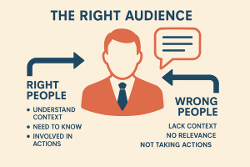
Types of Communication Plans
In general, there are six different types of internal communication plans. We will go through some in greater detail then others due to their relationship to the client retention strategy. You will see that some are relevant and some not as much.
The first to review is the High-Level Plan. This is used to define high-level goals that the organization wants to achieve. The second is the Leadership Communications Plan. Third is the Change management Communications Plan and fourth is the Employee Engagement and Culture Communication Plan. These four have a strong relevance to client retention as you can image.
We are needing to communication at a high level the overall plan. It should be communicated and reinforced by leadership and will require a certain degree of change management. Finally we will need a high degree of employee engagement in order to change the culture. More to come on the details of each.
However, to round out six there is also two more that you should be aware of and they are Strategic Communication Plans and Metrics. This one we will touch on to some extent but should be incorporated in the other four. Lastly is the Crisis Internal Communication Plan. Let us all hope we never need to invoke this plan!
Types of Communication Plans
Internal communication isn’t one-size-fits-all. In general, there are six types of internal communication plans, each designed for a specific purpose. Some of these will be directly relevant to your client retention strategy—others less so. We’ll focus more heavily on the plans that support long-term retention goals, cultural alignment, and behavioral change.
The first and most foundational is the High-Level Communication Plan. This plan defines the overarching goals the organization is aiming to achieve. It sets the tone and direction for everything that follows. It’s essential when you need to introduce a strategic initiative—like client retention—and make sure everyone understands the “why” behind it.
Next is the Leadership Communications Plan. This plan equips leaders with the messaging, timing, and delivery methods needed to communicate consistently and credibly. For client retention to succeed, leadership buy-in isn’t enough—they must be active communicators of the vision.
Third, the Change Management Communication Plan helps guide employees through transitions. Retention strategies almost always require some shift—in processes, standards, or mindset. Change communication ensures these shifts aren’t seen as threats, but as part of a forward-moving strategy.
The fourth is the Employee Engagement and Culture Communication Plan. This is where true culture shift happens. Retention isn’t just about policy—it’s about how people think, behave, and interact with clients every day. You’ll need a high degree of engagement to shape that mindset from the inside out.
To round out the six, the Strategic Communication Plan and Metrics Plan are also important. While we’ll touch on these briefly, many of their elements should be woven into the four core plans above. Strategy should guide the communication effort, and metrics should be built in to track whether messages are landing and actions are shifting.
And finally, there’s the Crisis Internal Communication Plan. While we hope this one remains unused, it’s essential to have in place. In moments of high pressure—like a major client issue or unexpected disruption—clear, calm, timely internal communication becomes critical. It’s not part of our focus here, but it deserves a spot on your radar.
Now let’s break down the four most relevant plans in more detail.
High Level Communication Plan
The Objective: Define clear, high-level goals that the company wants to achieve. These objectives must be in line with the overall business objectives and strategy.
Audience: You must decide if the message should reach the entire company or a segment such as the account team and sales or everyone.
Channel: What platform and tools are you going to use. Is it email, video, newsletter, town hall, or company board. It is probably a combination that will work best.
Resources: How are you going to allocate the company resources. The most obvious is financial but you must also think of time, personnel, and communication space to deliver message effectively.
Responsibilities: You must then assign who is responsible. All too often great plans have been created but with accountability and defining responsibility.
Evaluation: How will you know if the message was received effectively. In short create a simple feedback loop. This could be as simple as randomly asking individuals what they heard or remember about the message and how it was received. What is their overall outlook after receiving the message.
Leadership Communication Plan
Clarity: When the leader speaks people listen. That is why it is important to have a well defined message that is in align with the business objectives.
Channel: The best channel to kick off the client retention messaging is a town hall like event. If not think about a video or some other more direct avenue. You will know what is best for your company.
Two-way communication: Allow employees to feel heard and provide feedback and ask questions. They in the end need to own the process.
Cadence: The worst thing that can happen with Leadership Communication is a one and done. It will soon fade into the background. The Executive should create regular touchpoints to reenergize the company and move the message along.
Feedback: Make sure that you listen to see how the message landed and make any additional changes.
Change Management Communications Plan:
Clarity: Change can be everything from unsettling to exciting! It all depends on what the audience hears. That is why it is again important to clearly outline what the change is going to be and why. Everyone is going to want to know what they will be asked to do and what the benefit may be.
Stakeholders: All will want to know who will be affected. More importantly they will want to know if it is them. You will need to tailor the message according to who the audience is.
Transparency: It will be important to be as open as possible in the message and consistent in the process to reduce resistance.
Cadence: Ensure regular communications focused on key deliverable and milestones.
Feedback: With change people need to be heard and also have their questions answered. You should give an avenue for the stakeholders to do so.
Culture Communication Plan:
Values: Who you are should not drastically change. If the message does not align with the company’s core values, then the employees will feel like the vision of the company is not the same. They will start to wonder who the signed up to work for.
Recognition: It is so important to celebrate success and spotlight when individuals have taken on the ideas and change asked. Highlight their stories so others will resemble the same actions and follow in their success.
Regular Touchpoints: Employees are going to look back to make sure they are on the right track. Encourage and coach with regular communications.
Metrics:
Just a quick word about metrics. If you do all the communication in the world and do not have it tied to some very specific metrics it will be for not. It is important to know if and when the reached the goal or where they are on the journey.
We spoke a lot about this with retention rates and the like with The Partnership Success Team and the Success Team so we do not want to belabor the point, more than to say this needs to be a regular cadence and something all are aware of.
Messaging
Finally, it is critical that you make the message resonate and is something that is important to the audience. We have seen CEO’s give masterful performance on stage with graphs and well-practiced speeches only to land flat with the receiver of the message.
Take the time to do some work to see the message through the eyes of the receiver. Is it more important for them to see how something affects the bottom line or how the bottom line will affect their daily work or job satisfaction. We bet it is the later. What is important to you may not resonate the same to the receiver of the message so take the time to make it personal.
Next Steps
We have taken the needed time to really understand the internal communication planning process because we recognize the importance to the success of the overall client retention strategy. This overview will give you the opportunity to now take the key principles of a strong communication plat and adapt it to the communication plan you will create for your company.
To bring this home here is a quick fun exercise.
Exercise 1
Case Study
Microsoft’s Cultural Transformation Under Satya Nadella
When Satya Nadella stepped into the CEO role at Microsoft in 2014, he inherited a company with serious internal challenges. The culture was fragmented, siloed, and marked by internal competition rather than collaboration. Microsoft had fallen behind in key technology markets and was seen by many as a company that had lost its innovative edge. Nadella knew the strategy had to change—but more importantly, the culture had to transform.
To drive that change, Nadella made internal communication a cornerstone of his leadership. He didn’t just introduce a new mission—he made sure it was heard, understood, and lived by everyone in the organization. The message was simple but powerful: Microsoft’s mission was now “to empower every person and every organization on the planet to achieve more.” This wasn’t just a slogan. It became the backbone of how the company operated and communicated internally.
Rather than focusing on one-time announcements or traditional top-down memos, Nadella led with constant, intentional communication. He used stories—often personal ones—to connect with employees and share why the cultural shift mattered. His approach wasn’t about corporate spin. It was about authenticity. He encouraged learning, curiosity, and humility, signaling a shift from the company’s old “know-it-all” mindset to a “learn-it-all” culture.
Communication at Microsoft became more open and frequent. Employees were given direct ways to engage with leadership, share ideas, and provide feedback. Town halls, live Q&A sessions, and internal social platforms made it clear that leadership was listening. Communication wasn’t one-way. It was a dialogue. And that shift made a difference.
Over time, Microsoft’s internal culture began to shift. Cross-functional collaboration increased. Previously siloed teams started working together with greater transparency and trust. Innovation followed. The company launched new, integrated products like Microsoft Teams and made a massive leap in cloud computing through Azure. These weren’t just business wins—they were signals that the culture was moving in the right direction.
Employee engagement scores climbed. So did retention. And in the years following Nadella’s appointment, Microsoft’s market value more than tripled. The company regained its status not just as a tech leader, but as one of the most admired and forward-thinking employers in the world.
The heart of this transformation wasn’t a new product or business model—it was a new way of communicating internally. Nadella’s leadership showed that when communication is authentic, consistent, and tied directly to purpose, it doesn’t just inform people. It inspires them to change.
Course Manual 10: Getting Specific
Ok enough with generalities. We are sure you are starting to think all the generalities are great but what about what we are being tasked to do? How does everything mentioned fit in to our plans, and how will we get it all accomplished?
Now is the time. We will provide a specific plan that we will walk through with you, step by step. We will start broad and move specific. We will not accomplish everything today. You only take one bite out of the elephant at a time. So, that is what we will do.
The Executive Team has already sent out a general announcement around the importance of client retention to the organization. That was a few weeks ago and now the company is ready to learn more. This is where we will start. We will give the overview of the overall process and introduce the three principles, Assess, Create and Execute. This will give the overriding concept of the Clients for Life® client retention process. If you think of it the Executive Team started with the why and now we will follow up with the how and zero in on the importance to everyone’s day to day roles.
The Model
But, we are getting ahead of ourselves lets first focus on the model we will be using and then begin to fill it in.
Here is the model we will be using. It is worth going over because there is a lot to unpack. We will use the first general message around the three principles and benefit of the client retention strategy as a guide. After reviewing a few steps, we then take time to do an exercise so you can construct you plan.
That is all we will focus on for this workshop. Next month we will move to communicating out the Right Clients/Right Terms® and all the aspects of the Lessons Learned.
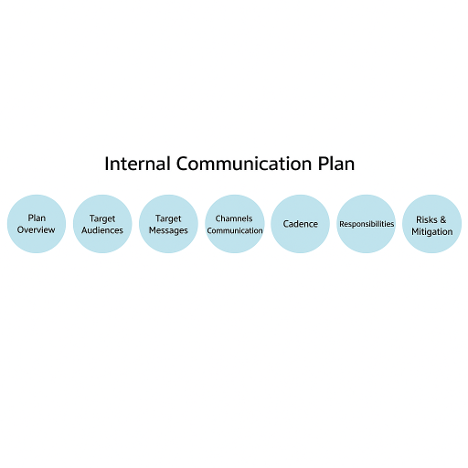
Plan Overview
This is the big picture. It explains why you’re communicating, what you’re communicating, and the outcome you hope to drive. It is crucial that you take the time to really explain the why. This will set the tone for all proceeding communications. What Challenge or opportunity will you be trying to address. Also, take the time to see how this communication will align on the rest of you company goals yet pertain to the individuals day to day life.
You what will be the three phases Assess, Create and Execute at a high level. You will need to shape it to be customized for you. Keep in mind everything we learned until now, while still thinking about the specific why behind the focus on client retention for you company. You will do well to intertwine the theme from the Executive communication.
Before you start crafting your message or building out presentations, you have to zoom in on your communication goals at a micro level. It’s not enough to just talk about the big picture of client retention—you have to make it personal and relevant. This is where the “what’s in it for me” factor becomes essential. People aren’t moved by charts or slogans. They’re moved when they understand how a process will make their job easier, reduce stress, increase success, or bring more meaning to what they do every day.
For example, if someone on the front lines hears, “client retention drives profitability,” that might sound important, but it doesn’t tell them how it changes their daily grind. But if they hear, “retaining clients means fewer emergency escalations, more predictable workflows, and better long term relationships,” that’s something they can relate to. It’s no longer abstract—it’s real.
So now comes the deeper question: how are you going to build awareness and understanding of the client retention strategy and the three principles—Assess, Create, Execute—in a way that people not only hear but internalize? You might start with team conversations where you break down each principle in plain terms, using examples that reflect your business. If your company uses weekly check-ins, use those. If you have a strong Slack culture, share client win stories there. Communication has to meet people where they already are.
But knowledge alone doesn’t drive change. You need to be clear about the behaviors you want to see shift. Maybe it’s about account managers making proactive check-ins part of their routine instead of only reacting when problems pop up. Maybe it’s helping operations staff document client insights better so those insights don’t vanish when someone moves to another role. Whatever it is, be concrete. Vague aspirations don’t create momentum—specific actions do.
Equally important is unity across leadership. You need to look aligned, sound aligned, and act aligned. That means no side commentary that undercuts the message and no mixed signals. If employees sense even a slight disconnect in leadership, it can derail the entire effort. Take the time to align talking points and lead by example. People watch more than they listen.
Finally, no communication plan is complete without a feedback loop. You have to know if what you’re saying is actually landing. That might mean setting up quick pulse surveys after team sessions, or simply creating space in meetings to ask, “What part of this resonated?” or “What doesn’t make sense yet?” This isn’t just about measurement—it’s about adaptation. If something isn’t clicking, change the approach. The goal isn’t to push out information. The goal is to create shared understanding.
We know we’re asking more questions than giving answers right now, but that’s by design. This can’t be a one-size-fits-all template. Your company, your culture, your people—these are unique. And the right answers will come from taking the time to pause and reflect, together. That’s the next step. Take a moment now. Think through your team, your structure, and what you want this strategy to actually look and feel like in motion.
Exercise 1
Key Audience

Let’s get into the heart of internal communication strategy: knowing your audience. One message will not work for everyone. It can’t. People across your organization experience the company—and your clients—through different lenses. If you want the Clients for Life® message to stick, you need to tailor it. That means understanding who you’re talking to, what they care about, and how this initiative affects them directly or indirectly.
Start with the people who will use the process every day. These are your client-facing teams—account managers, service leads, sales reps, support staff. For them, the message needs to be clear, direct, and action-oriented. They don’t just need to understand the concepts of Assess, Create, and Execute—they need to know how to apply them. What does “Assess” mean when a client is frustrated on a call? What does “Execute” look like when a deadline is slipping? This audience wants tools, structure, and confidence that the process will support them, not bog them down. But be mindful—this group may initially see the strategy as more work, more checklists, more oversight. You’ll need to make the case that this isn’t just process for process’s sake. It’s about making their job smoother, helping them build stronger client relationships, and reducing firefighting over the long term.
Then there’s the rest of the organization—teams that may not directly interact with clients but whose work still touches the client experience. Think finance, IT, legal, or HR. They don’t need to be trained on every detail, but they do need awareness. When they hear terms like “Assess” or “Right Clients/Right Terms®,” they should understand the intent behind them. The communication here should focus on context and purpose. This is about alignment, not tasking. It’s about helping them see how their work supports the larger strategy, even if they’re not on the front lines.
Executives are another distinct audience. They’re focused on big-picture outcomes—growth, retention, risk reduction, client satisfaction scores. The message here is strategic. It should connect the client retention framework to business metrics. Executives want to know how this ties into long-term value, what risks it mitigates, and how it helps retain high-value clients. They also need to be equipped to reinforce the message with their teams. When leaders echo the message with clarity and consistency, it reinforces buy-in.
You may also want to consider how support functions or administrative staff will perceive the initiative. If they’re left completely out of the loop, it creates confusion and silos. But if they’re brought in with the right level of clarity—knowing that while they may not use the process directly, they are part of a company that values consistency, quality, and client care—it helps them feel connected to the purpose.
This is also where perception matters. Will the account team feel overwhelmed? Will support functions feel forgotten? Will some employees wonder if this is just another passing initiative? Take time to game it out. Sit down with your team and ask: if I were in finance, how would this land? If I were a junior account manager, what would I worry about? What would get me excited? What would raise concerns?
That’s how you build messages that connect. Not by writing a one-size-fits-all memo, but by understanding the emotional and operational impact of the message across your organization. Communication isn’t just about getting information out. It’s about shaping how people understand, react to, and ultimately support a strategy.
Exercise 2
Core Messages
This is where clarity, consistency, and repetition come together to drive understanding and action. You’re not just trying to communicate information—you’re trying to build belief. That starts with identifying the few essential themes that everyone in the company should hear, understand, and be able to repeat with confidence. These are your anchor points. Think of them as the bedrock on which all other messages, training, presentations, and conversations are built.
Let’s break this down.
You don’t need twenty talking points. You need two or three strong ones—messages that are sharp, purposeful, and aligned with both your culture and the goals of your client retention strategy. These should answer the “why” behind the strategy, the “how” behind the process, and the “what” in terms of personal relevance.
For example, one anchor message might be: “Strong client relationships are everyone’s job—not just the account team’s.” This sends a signal across the organization that client retention is not a siloed initiative. It reinforces shared ownership. It also aligns with a culture that values cross-functional collaboration and accountability.
Another might be: “The Clients for Life® process is not extra work—it’s smarter work.” This addresses head-on the common fear that new processes mean more red tape. It reframes the initiative as a tool for simplifying, not complicating. When worded well, this message has the power to lower resistance before it even starts.
And a third anchor could be: “When we retain clients, everyone wins—more stability, more trust, more time for meaningful work.” That’s a value-based message with personal relevance baked in. It connects the strategy back to what people care about—less chaos, more predictability, better results.
These are not just slogans. They are repeatable truths that should show up everywhere—in emails, slide decks, kickoff sessions, casual conversations. They need to be short enough to remember, strong enough to stand on their own, and real enough to believe. If you stop someone in the hallway and ask, “Why does this client retention stuff matter?” they should be able to respond with something that reflects these anchor messages, without fumbling or fluff.
This is why it’s worth the time to wordsmith and pressure test. Share draft messages with a cross-section of employees. Ask: Does this make sense? Does it sound like us? Does it resonate? Would you say this to a peer? If the message sounds like it was written for a corporate brochure, it won’t stick. But if it feels like something you’d say in a team huddle or on a client call, you’re on the right track.
Lastly, make sure your tone matches your culture. If your company values directness and action, then avoid vague corporate jargon. If your culture is people-first, then lead with empathy and impact. Consistency matters, but so does authenticity. When you nail both, you’ve got a message that can move people.
Exercise 3
Channels

For this communication the formats and mediums through which messages will be delivered—email, meetings, town halls, intranet, etc. will be important to define. It should set up the routine for future communications. We suggest maybe launching a Client Retention Forum or newsletter. Maybe a month chat with leaderships or an expected email. The channel you use now will set the tone.
What channels are already trusted and well-used by each audience? Do the Account Mangers have a standing call that someone from the Partnership Success Team could take part in to follow up to the message sent via email, or the video that was released on the intranet? For your company is this message best delivered in writing, in person, or via video?
For this message we recommend using multiple channels to reinforce the same message? You might want to start with a Video from the CEO or Client Retention Executive to launch the process. You may then follow up with a detailed email and then in person Q&A on conference calls. You will want to make a significant impact.
Exercise 4
Cadence and Timing
The frequency and rhythm of communication ensures your messages aren’t one-and-done. This may be fine for something simple but not one that will last through out the year. This is about engagement. What is the right pace to keep people informed and aligned without overwhelming them? We recommend at least once a month but no more than once a week. You might want to frontload the message to build excitement then focus on key milestones.
You may want to focus on key milestones like sales meetings or when the sales numbers come out. As the sales numbers come out you can share your retention rates.
Just a reminder to make sure you work with the corporate communications calendar or schedule to guide timing. As we go through each workshop we will also add to the calendar with things like Common Threads/Common Threats, Training Dates, and key concepts around Execution and the like.
Messaging Responsibility:
Things are apt to fall between the cracks given the opportunity. Take the time to define who owns each part of the communication effort—who writes, who approves, who delivers. Who is responsible for crafting, delivering, and reinforcing the message? Are our senior leaders aligned on their role in communication? They should be. This is a high priority for the organization and senior leadership should be the face of it. At least periodically and then reinforced by the Client Retention Executive and The Partnership Success Team. Do managers know what their follow-up responsibility is? It cannot all be directed from the top. It must be supported by the managers. This is a total company effort. What will each person’s role be and how will the messaging and communication plan be crafted to support all those delivering the message.
Feedback Loop
There will be a lot of questions and opinions. What will be the Mechanisms for employees to respond, ask questions, or surface misunderstandings. You will have to be patient. We know you have started to live and breathe the client retention strategy but this is brand new to them. Take time to listen.
How will we know if the message was heard and understood? It is one thing to be there for them but another to ensure understanding. This cannot be just another message. It is too important.
Do people feel safe providing feedback—especially pushback or confusion? Change is not easy and there will be friction. Give everyone an opportunity to vent and share. Take time to adjust and adapt to the feedback without changing the key principles. Help them see the value.
What avenues will you use? Will it be a survey, a group forum, one on one discussions. Whatever it is make sure it is a formalized process.
Measurement and Evaluation
Define how you’ll track the effectiveness of your communication efforts. What metrics or indicators will tell us this plan is working (e.g., engagement, retention, clarity)? Does employ satisfaction improve. Has productivity increased. Are you measuring both outputs (e.g., messages sent) and outcomes (e.g., behavior change)? How often will we review and adjust the communication plan? We suggest immediately if there was big miss that is recognized and quarterly to ensure effectiveness.
Exercise 5
Case Study
The Message: “Smarter Planet”
IBM launched its “Smarter Planet” initiative in 2008. The central message was simple, clear, and compelling: the world is becoming more instrumented, interconnected, and intelligent, and IBM’s mission is to help build a smarter planet. This wasn’t just a tagline. It was a unifying narrative. It connected the dots between data, technology, and real-world outcomes in cities, energy, transportation, healthcare, and beyond.
But most importantly, it was tailored—for multiple audiences.
For clients, the message positioned IBM not as a product vendor, but as a strategic partner helping solve real-world problems.
For employees, it gave meaning to their work. Whether someone was coding software, selling services, or managing infrastructure, they could now see how their role contributed to smarter systems in the real world.
For executives, it became a strategic rallying point to reorient investments, shift marketing, and guide product development.
The Impact
Internally, the “Smarter Planet” message gave IBM a north star. It helped tens of thousands of employees understand how their work connected to a bigger purpose. That alignment enabled faster adoption of new services, more collaboration across divisions, and stronger internal momentum.
Externally, it transformed IBM’s reputation. The company became seen as a leader in complex systems and digital transformation. It helped open the door to major deals with governments and large enterprises that wanted to modernize infrastructure.
The results were real: new business growth in consulting and analytics, elevated brand perception, and a more agile workforce that understood where the company was going.
Key Lesson
IBM didn’t get there by launching a vague campaign. The “Smarter Planet” message was specific, meaningful, and tailored to resonate at every level of the company. It spoke to purpose, strategy, and practicality. It was wordsmith-crafted and pressure-tested. And because it was consistently reinforced in every format—from executive speeches to sales decks to hallway conversations—it stuck.
That’s the power of a message that’s not just communicated, but lived.
Risk and Contingency Planning
Do not wait until something fall off the rails. Anticipate challenges or misunderstandings that might derail the message. What are the possible points of resistance or confusion? How can you smooth them out ahead of time. Do you have a plan if the message is misinterpreted or goes sideways? What will you do. It is worth taking a moment now, so you are not caught off guard. Who is responsible for course-correcting if problems arise? Will it fall on the Client Retention Executive? Is there someone in PR that you can use as a resource?
A well-structured communication plan helps your team hear the right message, in the right way, at the right time. It prevents confusion, aligns priorities, and builds the internal trust required to retain clients, deliver consistent performance, and protect your reputation.
If client retention is a priority—your internal messaging better reflect it. This is the last thing we are covering because it should be how you hit the road over the next few weeks. We know there is more to do and we will go over all we asked you to do and the tasks that need to be accomplished.
Summary
We reviewed a lot, and you have a few action items to complete.
First, continue with the Assessments and have a goal of completion by next workshop. This is help us give great insight to the organization from an external, internal, subjective and objective point of view.
Second, conduct the Right Client/Right Terms workshop.
Third, conduct the Lessons Learned workshop.
We are starting to put the pieces in place for an effective client retention strategy! As always we appreciate you efforts and look to work with you.
Project Studies

Project Study (Part 1) – Customer Service
The Head of this Department is to provide a detailed report relating to the Executive Strategy process that has been implemented within their department, together with all key stakeholders, as a result of conducting this workshop, incorporating process: planning; development; implementation; management; and review. Your process should feature the following 10 parts:
01. Creating Strategy
02. Understanding Right Clients/Right Terms®
03. Right Client/Right Terms Workshop
04. Right Client/Right Terms the Workshop Understanding Right Clients/Right Terms®
05. The Importance of Mentorship
06. Lessons Learned Concept
07. Lessons Learned Workshop
08. Lessons Learned Finalization
09. The Communication Plan
10. Getting Specific
Please include the results of the initial evaluation and assessment.

Project Study (Part 2) – E-Business
The Head of this Department is to provide a detailed report relating to the Executive Strategy process that has been implemented within their department, together with all key stakeholders, as a result of conducting this workshop, incorporating process: planning; development; implementation; management; and review. Your process should feature the following 10 parts:
01. Creating Strategy
02. Understanding Right Clients/Right Terms®
03. Right Client/Right Terms Workshop
04. Right Client/Right Terms the Workshop Understanding Right Clients/Right Terms®
05. The Importance of Mentorship
06. Lessons Learned Concept
07. Lessons Learned Workshop
08. Lessons Learned Finalization
09. The Communication Plan
10. Getting Specific
Please include the results of the initial evaluation and assessment.

Project Study (Part 3) – Finance
The Head of this Department is to provide a detailed report relating to the Executive Strategy process that has been implemented within their department, together with all key stakeholders, as a result of conducting this workshop, incorporating process: planning; development; implementation; management; and review. Your process should feature the following 10 parts:
01. Creating Strategy
02. Understanding Right Clients/Right Terms®
03. Right Client/Right Terms Workshop
04. Right Client/Right Terms the Workshop Understanding Right Clients/Right Terms®
05. The Importance of Mentorship
06. Lessons Learned Concept
07. Lessons Learned Workshop
08. Lessons Learned Finalization
09. The Communication Plan
10. Getting Specific
Please include the results of the initial evaluation and assessment.

Project Study (Part 4) – Globalization
The Head of this Department is to provide a detailed report relating to the Executive Strategy process that has been implemented within their department, together with all key stakeholders, as a result of conducting this workshop, incorporating process: planning; development; implementation; management; and review. Your process should feature the following 10 parts:
01. Creating Strategy
02. Understanding Right Clients/Right Terms®
03. Right Client/Right Terms Workshop
04. Right Client/Right Terms the Workshop Understanding Right Clients/Right Terms®
05. The Importance of Mentorship
06. Lessons Learned Concept
07. Lessons Learned Workshop
08. Lessons Learned Finalization
09. The Communication Plan
10. Getting Specific
Please include the results of the initial evaluation and assessment.

Project Study (Part 5) – Human Resources
The Head of this Department is to provide a detailed report relating to the Executive Strategy process that has been implemented within their department, together with all key stakeholders, as a result of conducting this workshop, incorporating process: planning; development; implementation; management; and review. Your process should feature the following 10 parts:
01. Creating Strategy
02. Understanding Right Clients/Right Terms®
03. Right Client/Right Terms Workshop
04. Right Client/Right Terms the Workshop Understanding Right Clients/Right Terms®
05. The Importance of Mentorship
06. Lessons Learned Concept
07. Lessons Learned Workshop
08. Lessons Learned Finalization
09. The Communication Plan
10. Getting Specific
Please include the results of the initial evaluation and assessment.

Project Study (Part 6) – Information Technology
The Head of this Department is to provide a detailed report relating to the Executive Strategy process that has been implemented within their department, together with all key stakeholders, as a result of conducting this workshop, incorporating process: planning; development; implementation; management; and review. Your process should feature the following 10 parts:
01. Creating Strategy
02. Understanding Right Clients/Right Terms®
03. Right Client/Right Terms Workshop
04. Right Client/Right Terms the Workshop Understanding Right Clients/Right Terms®
05. The Importance of Mentorship
06. Lessons Learned Concept
07. Lessons Learned Workshop
08. Lessons Learned Finalization
09. The Communication Plan
10. Getting Specific
Please include the results of the initial evaluation and assessment.

Project Study (Part 7) – Legal
The Head of this Department is to provide a detailed report relating to the Executive Strategy process that has been implemented within their department, together with all key stakeholders, as a result of conducting this workshop, incorporating process: planning; development; implementation; management; and review. Your process should feature the following 10 parts:
01. Creating Strategy
02. Understanding Right Clients/Right Terms®
03. Right Client/Right Terms Workshop
04. Right Client/Right Terms the Workshop Understanding Right Clients/Right Terms®
05. The Importance of Mentorship
06. Lessons Learned Concept
07. Lessons Learned Workshop
08. Lessons Learned Finalization
09. The Communication Plan
10. Getting Specific
Please include the results of the initial evaluation and assessment.
Project Study (Part 8) – Management
The Head of this Department is to provide a detailed report relating to the Executive Strategy process that has been implemented within their department, together with all key stakeholders, as a result of conducting this workshop, incorporating process: planning; development; implementation; management; and review. Your process should feature the following 10 parts:
01. Creating Strategy
02. Understanding Right Clients/Right Terms®
03. Right Client/Right Terms Workshop
04. Right Client/Right Terms the Workshop Understanding Right Clients/Right Terms®
05. The Importance of Mentorship
06. Lessons Learned Concept
07. Lessons Learned Workshop
08. Lessons Learned Finalization
09. The Communication Plan
10. Getting Specific
Please include the results of the initial evaluation and assessment.

Project Study (Part 9) – Marketing
The Head of this Department is to provide a detailed report relating to the Executive Strategy process that has been implemented within their department, together with all key stakeholders, as a result of conducting this workshop, incorporating process: planning; development; implementation; management; and review. Your process should feature the following 10 parts:
01. Creating Strategy
02. Understanding Right Clients/Right Terms®
03. Right Client/Right Terms Workshop
04. Right Client/Right Terms the Workshop Understanding Right Clients/Right Terms®
05. The Importance of Mentorship
06. Lessons Learned Concept
07. Lessons Learned Workshop
08. Lessons Learned Finalization
09. The Communication Plan
10. Getting Specific
Please include the results of the initial evaluation and assessment.

Project Study (Part 10) – Production
The Head of this Department is to provide a detailed report relating to the Executive Strategy process that has been implemented within their department, together with all key stakeholders, as a result of conducting this workshop, incorporating process: planning; development; implementation; management; and review. Your process should feature the following 10 parts:
01. Creating Strategy
02. Understanding Right Clients/Right Terms®
03. Right Client/Right Terms Workshop
04. Right Client/Right Terms the Workshop Understanding Right Clients/Right Terms®
05. The Importance of Mentorship
06. Lessons Learned Concept
07. Lessons Learned Workshop
08. Lessons Learned Finalization
09. The Communication Plan
10. Getting Specific
Please include the results of the initial evaluation and assessment.

Project Study (Part 11) – Logistics
The Head of this Department is to provide a detailed report relating to the Executive Strategy process that has been implemented within their department, together with all key stakeholders, as a result of conducting this workshop, incorporating process: planning; development; implementation; management; and review. Your process should feature the following 10 parts:
01. Creating Strategy
02. Understanding Right Clients/Right Terms®
03. Right Client/Right Terms Workshop
04. Right Client/Right Terms the Workshop Understanding Right Clients/Right Terms®
05. The Importance of Mentorship
06. Lessons Learned Concept
07. Lessons Learned Workshop
08. Lessons Learned Finalization
09. The Communication Plan
10. Getting Specific
Please include the results of the initial evaluation and assessment.

Project Study (Part 12) – Education
The Head of this Department is to provide a detailed report relating to the Executive Strategy process that has been implemented within their department, together with all key stakeholders, as a result of conducting this workshop, incorporating process: planning; development; implementation; management; and review. Your process should feature the following 10 parts:
01. Creating Strategy
02. Understanding Right Clients/Right Terms®
03. Right Client/Right Terms Workshop
04. Right Client/Right Terms the Workshop Understanding Right Clients/Right Terms®
05. The Importance of Mentorship
06. Lessons Learned Concept
07. Lessons Learned Workshop
08. Lessons Learned Finalization
09. The Communication Plan
10. Getting Specific
Please include the results of the initial evaluation and assessment.
Program Benefits
Management
- Increased Profits
- Protected Revenue
- Improved Retention
- Directional Clarity
- Operational Efficiency
- Organic Growth
- Client Insights
- Problem Solving
- Increased Engagement
- Increased Productivity
Operations
- Increased Proactivity
- Employee Satisfaction
- Operational Efficiency
- Happier Clients
- Client Satisfaction
- Clear Expectations
- Improved Relationships
- Robust Collaboration
- Cost Efficiencies
- Innovative Solutions
Sales
- Improved Retention
- Increased Sales
- Better Networking
- Strong Referrals
- Organic Sales
- Clarity
- Collaborative Selling
- Client Feedback
- Competitive Advantage
- Strategic Planning
Client Telephone Conference (CTC)
If you have any questions or if you would like to arrange a Client Telephone Conference (CTC) to discuss this particular Unique Consulting Service Proposition (UCSP) in more detail, please CLICK HERE.