

Lean Transformation – Workshop 1 (Lean Basics)

The Appleton Greene Corporate Training Program (CTP) for Lean Transformation is provided by Dr. Oleinek Certified Learning Provider (CLP). Program Specifications: Monthly cost USD$2,500.00; Monthly Workshops 6 hours; Monthly Support 4 hours; Program Duration 12 months; Program orders subject to ongoing availability.
If you would like to view the Client Information Hub (CIH) for this program, please Click Here
Learning Provider Profile
Dr. Oleinek began his career in large electronics and automotive supply companies, where he gained hands-on industry experience in innovation, product development, technical sales and project management.
For the past 15 years, Dr. Oleinek has worked in management consulting with a focus on lean development and innovation. He has extensive expertise in optimizing product development processes and implementing lean development methods.
His industry experience includes automotive, aerospace, construction and industrial, energy, machinery and equipment, chemical, and medical. His clients range from small, specialized companies to global corporations.
Dr. Oleinek has conducted a large number of consulting projects to optimize his clients’ product development. Results have included a 30% reduction in development time, a 50% reduction in prototype costs, a significant reduction in quality issues during development and after product launch, and improved collaboration between cross-functional development teams.
To request further information about Dr. Oleinek through Appleton Greene, please Click Here.

MOST Analysis

Mission Statement
Workshop Mission Statement of Objective here…

Objectives
01. Lean Principles: departmental SWOT analysis; strategy research & development. Time Allocated: 1 Month
02. Lean Thinking; departmental SWOT analysis; strategy research & development. Time Allocated: 1 Month
03. Value Streams; departmental SWOT analysis; strategy research & development. Time Allocated: 1 Month
04. Reducing Waste; departmental SWOT analysis; strategy research & development. Time Allocated: 1 Month
05. Continuous Improvement; departmental SWOT analysis; strategy research & development. Time Allocated: 1 Month
06. Agile Lean; departmental SWOT analysis; strategy research & development. Time Allocated: 1 Month
07. Pull Principle: departmental SWOT analysis; strategy research & development. 1 Month
08. Problem Solving: departmental SWOT analysis; strategy research & development. Time Allocated: 1 Month
09. Error Prevention: departmental SWOT analysis; strategy research & development. Time Allocated: 1 Month
10. Lean Development: departmental SWOT analysis; strategy research & development. Time Allocated: 1 Month
11. Digital Lean: departmental SWOT analysis; strategy research & development. Time Allocated: 1 Month
12. Sustainable Implementation: departmental SWOT analysis; strategy research & development. Time Allocated: 1 Month

Strategies
01. Lean Principles Each individual department head to undertake departmental SWOT analysis; strategy research & development.
02. Lean Thinking: Each individual department head to undertake departmental SWOT analysis; strategy research & development.
03. Value Streams: Each individual department head to undertake departmental SWOT analysis; strategy research & development.
04. Reducing Waste: Each individual department head to undertake departmental SWOT analysis; strategy research & development.
05. Continuous Improvement: Each individual department head to undertake departmental SWOT analysis; strategy research & development.
06. Agile Lean: Each individual department head to undertake departmental SWOT analysis; strategy research & development.
07. Pull Principle: Each individual department head to undertake departmental SWOT analysis; strategy research & development.
08. Problem Solving: Each individual department head to undertake departmental SWOT analysis; strategy research & development.
09. Error Prevention: Each individual department head to undertake departmental SWOT analysis; strategy research & development.
10. Lean Development: Each individual department head to undertake departmental SWOT analysis; strategy research & development.
11. Digital Lean: Each individual department head to undertake departmental SWOT analysis; strategy research & development.
12. Sustainable Implementation: Each individual department head to undertake departmental SWOT analysis; strategy research & development.

Tasks
01. Create a task on your calendar, to be completed within the next month, to analyse Lean Principles.
02. Create a task on your calendar, to be completed within the next month, to analyse Lean Thinking.
03. Create a task on your calendar, to be completed within the next month, to analyse Value Streams.
04. Create a task on your calendar, to be completed within the next month, to analyse Reducing Waste.
05. Create a task on your calendar, to be completed within the next month, to analyze Continuous Improvement.
06. Create a task on your calendar, to be completed within the next month, to analyse Agile Lean.
07. Create a task on your calendar, to be completed within the next month, to analyse Pull Principle.
08. Create a task on your calendar, to be completed within the next month, to analyse Problem Solving.
09. Create a task on your calendar, to be completed within the next month, to analyze Error Prevention.
10. Create a task on your calendar, to be completed within the next month, to analyse Lean Development.
11. Create a task on your calendar, to be completed within the next month, to analyse Digital Lean.
12. Create a task on your calendar, to be completed within the next month, to analyse Sustainable Implementation.
Introduction

Introduction to section 1: Lean basics
The way of lean thinking
Lean management is a philosophy and a process that focuses on creating maximum customer value with minimal resource waste. Originally developed in the manufacturing sector, particularly through the Toyota Production System (TPS), it has since evolved into a broad management approach applicable across industries. Lean is based on five key principles: defining value from the customer’s perspective, mapping the value stream, creating flow, establishing pull, and pursuing perfection through continuous improvement. Elimination of waste is central to lean, with seven (sometimes eight) categories of waste – such as overproduction, waiting time, defects, and unused talent – being systematically targeted and reduced. Lean implementation tools such as 5s, kanban, value stream mapping, and kaizen support process optimisation by making processes visible, manageable, and continuously improvable.
In production environments, lean has transformed operations by reducing inventory levels, shortening lead times, and improving quality. It fosters a culture in which employees proactively contribute to identifying inefficiencies and proposing improvements. Rather than relying on large-scale production, lean methodology favours small-batch or one-piece flow processes. These systems reduce overproduction and enable a faster response to customer demands. This shift leads to more flexible, cost-effective, and resilient production systems. Lean is not a one-time initiative, but a long-term commitment to cultivating a mindset of learning and innovation throughout an organisation.
Lean development and enterprise-wide applications
Although lean is most commonly associated with manufacturing, its principles are equally applicable to areas such as product development, administration, healthcare, logistics and it. Lean development, for instance, adapts lean thinking to the unique nature of product and service innovation, where workflows are less repetitive and outcomes more uncertain. Rather than focusing on physical waste, lean development concentrates on reducing rework, misaligned features, unclear requirements and long cycle times. Processes and practices such as iterative design, early testing, cross-functional collaboration, and clear decision gates help ensure that customer needs are accurately captured and value is delivered faster. Popular agile methodologies in software engineering (e.g. scrum, kanban) draw heavily from lean principles.
Lean thinking can also transform support functions such as human resources, finance and customer service. In these areas, lean improves efficiency by streamlining information flows, standardising repetitive tasks, and reducing delays and handovers. In the healthcare sector, lean processes have been employed to reduce patient waiting times, optimise scheduling, and enhance care coordination. Across the enterprise, lean fosters a culture of continuous improvement and respect for people. Employees are encouraged to engage in problem-solving, propose ideas, and take ownership of process improvements. By focusing on value from the customer’s viewpoint and systematically reducing or removing non-value-adding activities, lean becomes not just a set of tools but a strategic process that enhances quality, responsiveness, and innovation across all parts of an organisation.
The challenges and success factors involved in lean transformation
Implementing lean in a primarily traditional organisation necessitates a robust commitment from leadership and a readiness to embrace change, even when the benefits are clear. One of the main challenges lies in overcoming resistance to change and ensuring that lean is not reduced to isolated tool usage without embracing its underlying mindset. A sustainable lean transformation will only be achieved by engaging employees at all levels, developing their problem-solving capabilities, and establishing clear metrics to track progress. Furthermore, lean must be tailored to the specific context and maturity of the organisation, as it is not a solution that can be universally applied. A comprehensive training and coaching programme, in conjunction with a meticulously designed rollout plan, will facilitate a seamless transition towards the lean process improvement. Ultimately, companies that succeed with lean view it as a long-term cultural journey rather than a quick efficiency fix. When applied holistically and with persistence, lean can be a powerful driver of value creation, adaptability, and competitive advantage in an increasingly dynamic business environment.
Introduction to section 2: Lean development
The principles and purpose of Lean Development
Lean Development is the application of Lean principles to the field of product and service development. The primary goal is to deliver maximum customer value with minimal waste, as is also the case in Lean Manufacturing. However, it is important to note that the nature of development work differs significantly from that of production. Development work is less repetitive, more uncertain, and knowledge-intensive, as opposed to being physically repetitive. In product development, the “product” is not a physical object being assembled in a factory, but rather a concept or design being transformed through stages of learning, decision-making, and testing. Consequently, Lean Development places less emphasis on physical flow and inventory management, and more on the elimination of knowledge loss, reduction of development cycle times, enhancement of cross-functional collaboration, and improvement of decision-making under uncertainty. Its fundamental principles include understanding customer needs in a timely and thorough manner, managing knowledge flow efficiently, ensuring quality in the design process, and deferring irreversible decisions until the last responsible moment.
The tools and techniques employed in Lean Development are tailored to reflect its unique context. Set-Based Concurrent Engineering, for instance, enables teams to explore multiple options simultaneously before selecting a final solution, thus avoiding premature commitment. Visual management tools such as A3 reports facilitate collaborative problem-solving and decision-making. Feedback loops are integral to the process, often facilitated by rapid prototyping, iterative testing, and direct customer interaction. In contrast to the manufacturing sector, where process variation is a problem to be eliminated, in the development sector, a certain degree of variation is essential and even desirable, i.e. a degree of creative exploration. Managing this variation intelligently – so that it leads to innovation rather than chaos – is a central concern in Lean Development.
The key differences between lean manufacturing and lean development
While Lean Manufacturing focuses on optimising the flow of material and eliminating waste in repetitive, well-understood processes, Lean Development addresses uncertainty, iteration and learning. A key distinction lies in the definition and management of “waste”. In the manufacturing sector, waste can be defined as excess inventory, waiting times and unnecessary motion. In the development process, waste can manifest in various forms, including features that are not aligned with the project’s objectives, unnecessary complexity, rework due to misunderstood requirements, or delays in decision-making. The objective is not merely to “build right”, but rather to “build the right thing”. Lean Development emphasises early validation of ideas and fast learning cycles.
Another distinction is the role of standardisation. In production, standardisation is used to ensure consistency and efficiency. In the development process, while certain standard procedures (e.g., design reviews or version control) are essential, excessive standardization can stifle creativity. Lean Development encourages flexible frameworks that promote knowledge capture and sharing across projects. Leadership plays a different role too: instead of enforcing compliance with rigid processes, leaders in Lean Development foster collaboration, enable experimentation, and facilitate learning. Metrics also differ; instead of measuring throughput or takt time, Lean Development focuses on time-to-market, number of design iterations, knowledge maturity, or customer satisfaction with prototypes and final outcomes.
Implementing Lean Development in a corporate context and the resultant organizational impact
Implementing Lean Development necessitates a cultural shift in how organisations view their innovation processes. Traditional development models, such as stage-gate systems, often emphasise predictability and control, which can hinder responsiveness and adaptability. Lean Development replaces rigid planning with adaptive learning cycles, enabling teams to respond to changing customer needs and emerging insights more effectively. This is of particular importance in industries that experience rapid technological change, such as software, automotive, and medical devices. Cross-functional teams, empowered by clear goals and minimal bureaucracy, work collaboratively to reduce handovers, accelerate feedback, and focus relentlessly on customer value.
Organisations that successfully adopt Lean Development often report faster innovation cycles, better alignment between customer needs and product features, and more engaged development teams. Lean Development is not just a toolbox, but a mindset. It requires organisations to tolerate a certain level of uncertainty, view failure as a source of learning, and invest in continuous capability building. Agile frameworks such as Scrum and SAFe are frequently employed to operationalise Lean principles, however, authentic Lean Development delves more profoundly by integrating strategy, product planning and technical execution into a cohesive value stream. When implemented thoughtfully, Lean Development enables companies to become more efficient and innovative, whilst also being.
Introduction to section 3: Lean principles
Understanding the five Lean Principles
The foundation of Lean thinking lies in five core principles, originally formulated by James Womack and Daniel Jones in Lean Thinking (1996). The following principles underpin our approach:
(1) Specify value from the customer’s perspective;
(2) Identify the value stream for each product or service and eliminate waste;
(3) Create flow by ensuring that value-creating steps occur in a continuous sequence;
(4) Establish pull so that nothing is produced until the customer needs it; and
(5) Pursue perfection through continuous improvement. These principles provide a structured way to rethink processes and design them for greater efficiency, flexibility, and responsiveness.
In practice, “value” refers to what the customer is willing to pay for, whether in terms of function, reliability, convenience, or other benefits. In the manufacturing sector, value is frequently tangible, i.e. a physical product made to specification. In the initial stages of development, however, it can be challenging to define value, as customer needs may be uncertain or evolving. The value stream in production is typically linear and well-mapped, involving procurement, assembly, and delivery. In the development process, intangible flows such as ideas, decisions and knowledge are involved, requiring various tools (e.g. knowledge maps or A3 reports) to facilitate visualisation and optimisation. In a production context, flow refers to the seamless movement of materials without interruption. In a development context, flow signifies the unencumbered progression of tasks, feedback cycles and learning processes.
The implementation of Pull Systems and Continuous Improvement in context
The fourth Lean principle, known as pull, ensures that work is only performed when there is demand for it, thereby helping to minimise overproduction and inventory. In the manufacturing sector, this is often characterised by the implementation of Kanban systems and just-in-time (JIT) logistics. In development environments, a pull system is a process that involves avoiding premature work on features or design elements before they are needed or validated. For instance, a development team might delay committing to a specific technology or architectural decision until sufficient customer data supports it. This approach helps to avoid costly rework and technical debt, which can be especially beneficial in software or hardware development.
The fifth principle, to pursue perfection, is often misunderstood as an unrealistic goal. In Lean thinking, it refers to the ongoing effort to improve processes, eliminate the root causes of problems, and refine value delivery. In manufacturing, the concept of continuous improvement (Kaizen) is commonly practised through standardisation, daily team huddles, and root cause analysis (e.g., 5 Whys). In the context of software development, the pursuit of perfection is less about eliminating variation and more about accelerating learning, enhancing knowledge sharing, and improving decision-making quality. Utilising tools such as retrospectives, technical reviews and iterative prototyping enables teams to align more closely with the customer’s requirements. Therefore, achieving perfection in development is not about eliminating uncertainty, but rather, it is about developing the ability to navigate it more effectively.
Interpreting Lean Principles across functions
While the five Lean principles provide a consistent conceptual foundation, their interpretation and implementation vary significantly between domains such as production, development, administration and service. In the field of manufacturing, these principles are generally implemented in physical processes with the objective of enhancing operational efficiency, reducing costs, and ensuring consistent quality. The focus is on optimising flow efficiency, ensuring that components move through the system without delay or excess. In contrast, product development prioritises learning efficiency, i.e. how quickly and reliably teams can validate assumptions and deliver relevant innovation. Consequently, the issue of waste in development is not measured in terms of scrap or downtime, but rather in unvalidated features, delayed decisions, or duplicated efforts due to inadequate knowledge sharing.
In administrative or transactional processes, the principles focus on streamlining approvals, reducing paperwork, and improving customer response times. In the healthcare sector, they focus on optimising patient flow, appointment scheduling and care coordination. Despite these differences, all contexts benefit from focusing on value, transparency, collaboration, and empowering people. It is important to note that Lean principles should not be viewed as a checklist, but rather as a mindset. They require organisations to adopt a systemic approach, experiment with new methods, and engage all personnel, from frontline workers to top executives, in the pursuit of enhancing customer service. Lean principles, when applied effectively, enable organisations to adapt more quickly, improve continuously, and thrive in changing environments.
Introduction to section 4: Lean versus traditional
Core philosophies: Value creation vs. control and efficiency
The fundamental difference between Lean Management and traditional management lies in their underlying philosophies. Traditional management, which has dominated industrial and administrative settings for decades, focuses primarily on hierarchical control, cost efficiency, and adherence to standardised procedures. Its goals are often internally focused, such as maximising asset utilisation, meeting output targets or adhering to budgets. Lean Management, on the other hand, is customer-centric, systems-oriented, and grounded in the continuous pursuit of value. Rather than focusing on the efficiency of individual resources, Lean aims to optimise the flow of value across the entire process or value stream.
In traditional management models, decisions are typically made at the top levels, with limited input from employees at lower levels. It is often the responsibility of management or specialist departments (e.g. quality assurance or engineering) to solve problems and implement improvements. In contrast, Lean decentralises problem-solving and emphasises respect for people. Operators and team members are expected to identify problems, propose solutions, and continuously improve their own processes. This change has not only encouraged greater engagement but also resulted in faster problem resolution and more practical solutions. Another key distinction is how the two systems approach change: traditional organisations often view change as disruptive and plan it in large, infrequent steps, whereas Lean organisations embrace continuous, incremental change as a source of learning and improvement.
Structures, Metrics, and Decision-Making Approaches
Traditional management structures are typically siloed into separate functions: production, engineering, marketing, finance and HR. These units operate independently, with minimal cross-functional integration. This can result in communication barriers, delays, and handovers, particularly in complex processes such as product development or customer service. Lean Management, on the other hand, emphasises cross-functional teams and end-to-end ownership. These teams are organised by value streams rather than departments, enhancing responsiveness and minimising friction during handover procedures. In Lean organisations, leadership is not about command-and-control; it is about enabling teams, coaching, and removing obstacles.
It should be noted that the metrics in question also differ significantly. In traditional management models, local, activity-based metrics such as utilisation rates, budget variance and number of hours worked tend to be given greater emphasis. It should be noted that these metrics have the potential to influence suboptimal behaviour, for instance by encouraging the maximisation of machine uptime, even in circumstances where overproduction has been achieved. Lean Management focuses on flow-based and customer-oriented metrics, including lead time, first-pass yield, on-time delivery and customer satisfaction. These indicators reflect system performance and are used not to punish, but to inform continuous improvement. Lean decision-making emphasises experimentation, real-time data, and front-line input. Conversely, Lean methodology advocates for agile planning and rapid feedback loops, which are particularly beneficial in dynamic environments such as R&D or rapidly evolving markets.
An exploration of the cultural and behavioural dimensions that extend across the enterprise
Perhaps the most significant difference between Lean and traditional management lies in their cultural assumptions about people and work. In traditional systems, workers are viewed as executors of predefined tasks. These systems rely heavily on external control mechanisms, such as supervision, procedures and performance reviews, to maintain discipline. Lean Management, however, is founded on the principle of respect for people. Employees are regarded as competent and knowledgeable contributors who, if provided with the appropriate resources and a supportive environment, will consistently enhance their performance. This commitment is reflected in practices such as daily stand-up meetings, Gemba walks (managers who go to the “real place” to observe work), and suggestion systems that are actually acted upon.
In areas such as administration, customer service, finance and product development, these differences become even more apparent. Traditional approaches often emphasise control through strict policies, approvals and handover processes. These methods can result in slower response times and diminished employee motivation. Lean methodology encourages simplification, flow, and autonomy. For instance, lean administrative teams may streamline processes by eliminating superfluous forms, automating routine approvals, or empowering frontline employees to resolve customer issues without escalation. In development, Lean replaces rigid stage-gate models with iterative development and collaborative learning cycles. Across the enterprise, Lean fosters an environment where experimentation is encouraged, failures are viewed as opportunities for learning, and all individuals are responsible for enhancing the delivery of value.
Introduction to section 5: Customer value
The definition of customer value in the context of lean thinking
At the core of Lean Management and Lean Development is the concept of customer value. In Lean terms, value is defined strictly from the customer’s point of view: it is anything the customer is willing to pay for because it meets their needs in terms of quality, functionality, cost, or timing. This approach necessitates that organisations shift away from internal assumptions about what is “important” and instead adopt a methodical approach involving deep listening and observation to gain a more nuanced understanding of the real customer problems. Value is not created by activities alone; it is only created when those activities result in something the customer perceives as beneficial. Lean emphasises value-creating activities and demands that all non-value-adding activities (waste) be scrutinised or eliminated.
In Lean Management, particularly in production settings, customer value is often associated with the physical characteristics and performance of the end product – its fit, form, and function. In Lean Development, value becomes more complex because it often must be anticipated or discovered. It is important to note that customer needs are not always clearly defined at the outset of a development process, and these needs may evolve as new possibilities or technologies emerge. Therefore, value in development is closely tied to learning: understanding what will create value and rapidly validating assumptions through testing, feedback and iteration. Lean Development encourages the creation of the right product rather than simply producing the correct product, and this requires a close connection between customer insight, design, and decision-making.
A comparison of Muda Type 1 and Muda Type 2 to facilitate understanding of waste in context
In order to refine the focus on customer value, Lean distinguishes between two types of waste, or Muda. Muda Type 1 refers to activities that do not add value but are currently necessary due to technical, regulatory or quality constraints. Examples include compliance-related documentation, equipment setup, or essential inspections. While these measures do not directly generate value, they support it and may not be avoidable in the short term. Conversely, Muda Type 2 represents a state of pure waste, involving activities that contribute no value and are deemed unnecessary under any circumstances. These include excessive waiting times, overproduction, rework due to miscommunication, and unnecessary complexity. In Lean, the elimination of Type 2 Muda is a priority, while the reduction of Type 1 Muda is approached more gradually through process improvement.
In product development, identifying Muda is more challenging than in production, where physical flow makes waste easier to spot. Development work is information-based, knowledge-driven and decision-oriented, as opposed to being material-object oriented. Unnecessary expenditure can take the form of ambiguous requirements, redundant meetings, rework due to unclear decisions, or features developed without customer validation. In this context, Muda Type 1 may encompass certain documentation requirements necessary for aligning stakeholders or meeting regulations, even if they do not directly generate customer value. Muda Type 2 in development could include coding features that are not utilised, repetitive problem solving due to inadequate knowledge management, or delays in decision-making that impede progress. It is vital for development teams to understand these forms of waste if they are to focus on the activities that truly contribute to value creation.
Customer value as a strategic compass for the entire organisation
In both Lean Management and Lean Development, the commitment to customer value functions not just as an operational principle, but as a strategic compass that guides decision-making, resource allocation, and cultural change. By continuously asking, “Does this activity contribute to customer value?”, organisations can break down internal silos, eliminate redundant processes, and better align cross-functional teams. In the manufacturing sector, this might entail streamlining production lines or prioritising quality assurance at the source. In development, it means investing in rapid prototyping, customer testing, and decision-making frameworks that give priority to user needs over internal preferences or technical elegance.
Furthermore, customer value is not static; it evolves with market shifts, emerging technologies and changing user expectations. Lean organisations regard value as something to be discovered, refined and revalidated over time. This dynamic view contrasts with traditional management approaches that often define value early and assume it remains fixed. Lean Development teams use this evolving definition of value to inform iterative cycles of learning, leveraging customer feedback, experiments, and data to guide their work. When customer value is clearly understood and all activities are judged by this principle, businesses can reduce waste and become more innovative, resilient, and competitive.
Introduction to section 6: Value streams
An explanation of value streams in the context of Lean Thinking
In Lean Management, the concept of the value stream is fundamental to identifying and eliminating waste. A value stream is defined as the set of activities, both value-adding and non-value-adding, necessary to deliver a product or service from start to finish. The process encompasses all aspects of the supply chain, from the procurement of raw materials to the manufacturing, assembly, delivery and after-sales service. The purpose of mapping a value stream is to visualise the entire end-to-end process, identify bottlenecks and waste (Muda), and redesign the flow to improve overall efficiency and responsiveness. In contrast to conventional methods that focus on individual departments or stages, value stream thinking emphasises system-wide optimisation, integrating all activities to deliver maximum value to the customer.
In a manufacturing context, value stream mapping (VSM) is a relatively straightforward process because processes are physical, linear and repetitive. Material moves through the system in a series of predictable steps, facilitating the tracking of delays, overproduction and excess inventory. A typical value stream map might include process times, queue times, batch sizes, and information flows. Lean practitioners use this information to create a “future state” map, which is a redesigned, streamlined process with reduced waste and improved flow. It is important to note that value stream mapping is not a one-time exercise in Lean Management; rather, it is part of an ongoing process of continuous improvement. This process empowers teams to regularly monitor and refine their systems.
Value Streams in Product Development: Beyond Physical Flow
Although the concept of value streams originated in production, it is equally critical, albeit more complex, in product development. In Lean Development, value streams refer to the flow of information, knowledge, decisions and deliverables involved in taking a product from concept to launch. In contrast to the predictable and repeatable nature of manufacturing processes, development processes are exploratory and non-linear. The “product” is not yet fully defined, and the goal is to reduce uncertainty, validate assumptions, and manage learning effectively. In such cases, value stream mapping can help identify issues such as delays, rework, and unclear responsibilities, which can disrupt progress and delay time-to-market.
Development value streams frequently involve collaboration between teams from different functional areas, such as engineering, marketing, design, finance and supply chain. Delays can occur for a number of reasons, including inefficiencies in execution, misaligned priorities, late decisions, or unclear handovers. Mapping these flows enables organisations to identify “knowledge queues” — places where information waits for decisions or validation before the next step can proceed. Lean Development employs this insight to streamline workflows, facilitating seamless information flow, enhanced team collaboration, and the integration of customer feedback at the earliest stages of the process. This makes value stream thinking not just a tool for reducing waste, but also a strategic asset for accelerating innovation and improving the quality of outcomes.
The planning and management of development work through value streams
Applying value stream thinking to planning and controlling development projects requires a shift from traditional project management approaches. Conventional methods often rely on phase-gate models, detailed upfront planning, and siloed responsibilities. These methods can lead to long cycle times, late problem detection, and poor responsiveness to change. Lean Development, on the other hand, treats value streams as dynamic learning systems. Rather than focusing on strict task completion, planning emphasises flow efficiency, timely feedback and decision quality. Teams are organised around value streams instead of functions, with shared responsibility for delivering value from idea to implementation.
Planning in this context involves visualising the end-to-end development process, identifying key decision points, integrating customer validation checkpoints, and managing constraints collaboratively. Visual planning boards, A3 project charters and cadence-based synchronisation (e.g. in the SAFe framework) are tools that help teams manage complexity while maintaining focus on flow. It is important to note that managing by value stream also allows organisations to prioritise initiatives by linking strategic goals to the actual work being done. For instance, portfolio-level decisions can be informed by understanding which value streams are delivering the most impact and which are constrained by systemic issues. Value stream thinking enables not just local process improvement, but enterprise-wide alignment, helping organizations to become more agile, customer-focused, and resilient in uncertain environments.
Introduction to section 7: Creating flow
The principle of creating flow in lean thinking
The third of the five core Lean principles is to create flow, and this plays a central role in enabling continuous, efficient, and customer-focused operations. In Lean Management, flow refers to the smooth, uninterrupted movement of work through a value stream, with minimal delays, bottlenecks, or rework. The ideal state of flow ensures that each task, process, or piece of material moves forward immediately upon completion of the preceding step—without queuing, waiting, or redundant handling. Achieving this requires close attention to process design, team coordination, equipment layout, and work standardisation. The overarching objective is to ensure the delivery of value to the customer in a timely and efficient manner, whilst minimising waste and maximising responsiveness.
In traditional batch-and-queue systems, work is often processed in large quantities, resulting in overproduction, long lead times, and hidden inefficiencies. In order to create a flow, it is necessary to move away from this mindset and adopt a small-batch or one-piece flow approach. This involves dividing work into manageable units, with immediate feedback and quality control. Tools such as takt time (the rate of customer demand), line balancing and visual controls (e.g. Kanban) are instrumental in facilitating this transformation. However, creating flow is not just about technical redesign; it also involves fostering a collaborative culture where everyone understands the value stream and takes ownership of maintaining a smooth process. Disruptions to flow are treated as learning opportunities, prompting root cause analysis and continuous improvement efforts.
Flow in Lean Development: Managing knowledge and reducing friction
In Lean Development, the focus shifts towards knowledge creation, decision-making and learning, as opposed to physical transformation. Development processes are typically non-linear, iterative, and filled with uncertainty, which makes creating flow more complex – but no less essential. In this context, ‘flow’ refers to the efficient progression of information, decisions, prototypes and customer feedback throughout the development process, ensuring minimal delay and friction. Barriers to flow might include long decision wait times, unclear priorities, frequent task switching, or redundant reviews. Disruptions to flow can have a detrimental effect on development teams, resulting in increased cycle times, wasted effort and misalignment between customer needs and final outcomes.
In order to improve the flow of development, Lean organisations adopt several key practices. These include the use of visual tools such as Kanban boards or digital workflow tools, which help teams track progress and identify potential bottlenecks early on. Cross-functional collaboration is key to reducing delays caused by handovers or siloed responsibilities. Cadence and synchronisation mechanisms, such as daily stand-up meetings or sprint planning meetings, ensure that teams maintain shared momentum and address issues promptly. It is important to note that Lean Development places significant emphasis on the limitation of Work in Progress (WIP), with the objective of reducing task switching and enhancing throughput. By focusing on fewer tasks at a time, teams are better able to complete work efficiently and respond quickly to changing requirements. In this way, flow in development is about managing cognitive and organisational friction to maintain continuous, value-driven progress.
Flow: An organisational capability and strategic lever
Creating flow is not just an operational concern; it is a strategic capability that enables organisations to become more responsive, efficient, and aligned with customer needs. In both production and development, organisations that achieve high levels of flow can reduce lead times, increase quality, and improve team morale. The advantages of flow extend beyond efficiency. When teams experience uninterrupted work, with clear goals, minimal distractions, and immediate feedback, they also enter a state of psychological engagement. This is often referred to as the “flow state”. This has been shown to enhance creativity, satisfaction and performance, especially in knowledge-intensive environments such as R&D, product design and software engineering.
At an enterprise level, effective flow management involves the creation of systems and leadership structures that support end-to-end value delivery, rather than isolated task completion. Leaders play a critical role by removing systemic obstacles, aligning priorities, and enabling decentralised decision-making. Organisations that adopt a flow-oriented mindset adopt a systems thinking mindset, treating delays or disruptions not as individual failings but as signals of structural improvement needs. By measuring key performance indicators such as lead time, throughput, and cycle time, and leveraging these insights to make informed decisions, businesses can enhance the efficiency of their processes and decision-making systems on a continuous basis. In essence, effective Lean Management and Lean Development is about establishing a resilient, adaptive organisation where people, processes and priorities are aligned to deliver maximum value with minimum friction.
Introduction to section 8: Pull principle
The Pull Principle in Lean Management:
We focus on producing only the essential items, ensuring efficiency and cost-effectiveness in our operations
The pull principle is a core concept in Lean Management that stands in direct contrast to traditional “push” systems. In a push system, production or work is scheduled in advance based on forecasts, regardless of whether there is immediate demand. This often results in overproduction, excess inventory, and wasted effort. In a pull system, work is only triggered in response to actual demand; nothing is produced or advanced unless there is a specific need for it. This approach has been shown to reduce waste, improve responsiveness, and align resource use more closely with customer requirements. The guiding principle is to enable customer demand to “pull” value through the system, as opposed to the more traditional approach of “pushing” resources forward based on assumptions.
In manufacturing, the pull principle is typically implemented through Kanban systems, where visual signals (e.g. cards or bins) indicate when a new item needs to be produced or replenished. This approach ensures that every part or product is created just-in-time and in the exact quantity needed, thereby eliminating the waste associated with overproduction and idle inventory. Furthermore, the pull approach enhances process transparency, as any interruption or bottleneck in the value stream becomes evident when downstream steps cease to issue pull signals. Pull systems also improve quality by limiting batch sizes and ensuring that defects are detected early and corrected before they propagate through the system.
The application of the Pull Principle in the context of Lean Development and Knowledge Work
Although the pull principle originated in manufacturing, it is highly applicable—and critically important—in Lean Development and other types of knowledge work, where the risks of waste are often hidden in the form of overengineering, rework, or premature decisions. In development, a pull system ensures that work is only initiated when the team has capacity and a validated reason to proceed. This approach prevents the overloading of teams and ensures that efforts are focused on features, designs, or concepts that have been validated as valuable. In software development, this is operationalised through Kanban boards, where new tasks are allocated to development only when space becomes available and when prerequisite steps (e.g. customer research, specification) have been completed.
In product development, the pull principle supports delayed commitment, with decisions and detailed work being postponed until the “last responsible moment,” when sufficient information is available to make a well-informed choice. This approach helps to manage uncertainty and complexity by avoiding premature convergence on solutions. In project environments, pull means that work packages or milestones are not forced forward on arbitrary schedules, but are triggered by readiness and need. It aligns work more closely with real-time project conditions and customer feedback, improving agility and reducing rework. Teams working under pull conditions tend to be more focused, less overloaded, and more capable of delivering high-quality outcomes that are genuinely aligned with customer needs.The Pull Principle in Lean Management: We focus on producing only the essential items, ensuring efficiency and cost-effectiveness in our operations.
The pull principle is a core concept in Lean Management that stands in direct contrast to traditional “push” systems. In a push system, production or work is scheduled in advance based on forecasts, regardless of whether there is immediate demand. This often results in overproduction, excess inventory, and wasted effort. In a pull system, work is only triggered in response to actual demand; nothing is produced or advanced unless there is a specific need for it. This approach has been shown to reduce waste, improve responsiveness, and align resource use more closely with customer requirements. The guiding principle is to enable customer demand to “pull” value through the system, as opposed to the more traditional approach of “pushing” resources forward based on assumptions.
In manufacturing, the pull principle is typically implemented through Kanban systems, where visual signals (e.g. cards or bins) indicate when a new item needs to be produced or replenished. This approach ensures that every part or product is created just-in-time and in the exact quantity needed, thereby eliminating the waste associated with overproduction and idle inventory. Furthermore, the pull approach enhances process transparency by ensuring visibility of any interruption or bottleneck in the value stream. This is achieved by ensuring that downstream steps stop issuing pull signals when necessary. Pull systems also improve quality by limiting batch sizes and ensuring that defects are detected early and corrected before they propagate through the system.
The strategic implications and organisational benefits of the pull system
Implementing the pull principle across an organisation necessitates a shift in mindset, management practices and planning structures. Traditional project and resource planning methods often rely on detailed, upfront schedules that push tasks forward regardless of their readiness for execution. These “push” systems create the illusion of progress, but often result in overburdened teams, bottlenecks and missed deadlines. In contrast, a pull-based system creates a self-regulating workflow, where progress reflects actual readiness and capacity. This approach fosters a healthier, more predictable pace of work and enables faster identification of system constraints.
The implementation of Pull also has implications for the manner in which leadership and planning functions are conducted. Rather than basing tasks on long-range forecasts or inflexible Gantt charts, leaders in pull systems prioritise enabling flow, removing obstacles, and assisting teams in maintaining focus. Pull systems promote work-in-progress (WIP) limits, which prevent overloading and make problems visible early. At a strategic level, pull principles support lean portfolio management by prioritising initiatives based on actual demand, strategic alignment, and team capacity rather than top-down mandates. This results in more sustainable project execution, faster time-to-market, and improved employee engagement. The pull principle ultimately enables organisations to operate more responsively and resiliently in dynamic environments, delivering real value without unnecessary waste.
Introduction to section 9: Continuous improvement
Lean Thinking is founded on the principle of continuous improvement
Continuous improvement, also known by its Japanese term Kaizen, is a foundational principle of Lean Management that emphasises the ongoing, incremental enhancement of processes, products and performance. In contrast to traditional management models, which rely on periodic, top-down improvement initiatives, Lean fosters a culture where improvement is embedded in daily work and driven by the people closest to the processes. The central idea is that small, consistent changes over time lead to significant long-term gains in efficiency, quality and customer satisfaction. This principle applies across all functions of an organisation, including manufacturing, logistics, administration, customer service and product development.
Lean organisations promote continuous improvement by encouraging all staff, from frontline to senior leadership, to identify problems, eliminate waste and test better ways of working. A variety of structured methods support this effort. These include the PDCA cycle (Plan-Do-Check-Act), which provides a systematic approach to experimenting with improvements; the 5 Whys technique for identifying root causes of problems; and the use of Kaizen events or workshops, where cross-functional teams collaborate intensively for a short period to improve a specific process. In the manufacturing sector, these tools are frequently employed to achieve key objectives, including reducing setup times, enhancing equipment reliability, and optimising material flows. In administrative functions, they might target reducing approval loops, simplifying workflows, or improving service responsiveness.
The continuous enhancement of lean development and knowledge work is of paramount importance
In the context of Lean Development, continuous improvement takes on a more exploratory and adaptive character. In the field of product development, the inherent uncertainty and variability of the process often renders it less repeatable than manufacturing. Consequently, enhancements are predominantly focused on accelerating learning, enhancing collaboration, and optimising decision-making processes, as opposed to solely focusing on process efficiency. In these settings, continuous improvement focuses on how teams generate, validate, and implement ideas. Practices such as retrospectives, held at the conclusion of development iterations (e.g., sprints), enable teams to reflect on successes, challenges, and areas for improvement. A3 problem-solving, knowledge capture templates and design reviews are tools that help teams identify gaps in understanding and refine their development process.
Lean Development encourages the improvement of technical processes, as well as team dynamics and communication flows. For instance, reducing the number of unnecessary handovers, clarifying roles and responsibilities, or improving feedback mechanisms can significantly enhance productivity and reduce rework. Agile methods, which are aligned with Lean principles, embed continuous improvement into their frameworks through time-boxed iterations and built-in review cycles. Beyond the team level, organisations practising Lean Development often adopt metrics dashboards to track lead times, cycle times, and defect rates, allowing them to monitor trends and guide broader improvements. This approach enables continuous improvement, which in turn fosters operational excellence and innovation.
Creating a culture and infrastructure for ongoing improvement
Sustaining continuous improvement over the long term requires more than just tools; it demands a supportive organisational culture, clear leadership commitment, and an infrastructure that enables experimentation and learning. In Lean organisations, leaders do not merely issue directives for improvement; they adopt a coaching and facilitative role, allocating time to the Gemba (the “real place” where value is created), engaging with employees, and proactively removing obstacles. Visual management systems, suggestion programmes and transparent performance boards help to create an environment in which progress is visible and shared. Empowering employees to take ownership of their processes is pivotal: when individuals feel responsible for improvement, they become more engaged, proactive and aligned with the organization’s goals.
In addition, successful Lean enterprises institutionalise continuous improvement through structured training, coaching, and feedback loops that develop problem-solving skills at all levels. In product development, this might mean coaching teams on how to run effective retrospectives or equipping product managers with tools for hypothesis-driven experimentation. In service and administrative areas, process improvement boards and regular Kaizen sessions can help maintain focus on customer needs and internal efficiency. The combination of leadership support, team autonomy, and methodical improvement practices creates a self-reinforcing system that not only adapts to change but actively drives it. Ultimately, continuous improvement is not a separate initiative; it is a way of thinking and working that enables organisations to evolve, learn, and thrive in complex and fast-changing environments.
Introduction to section 10: Lean processes
What is a Lean Process?
A Lean process is one that consistently delivers value to the customer with the least possible waste, friction, and delay. Rather than being defined solely by its efficiency or cost-effectiveness, a Lean process is purpose-built to serve customer needs while remaining flexible, adaptive, and continuously improvable. In contrast to conventional processes that are often characterised by rigidity, over-engineering, or a lack of alignment with actual usage patterns, Lean processes are streamlined, focused, and governed by a clear sense of purpose. A key attribute of any Lean process is its orientation towards flow and pull, with work progressing smoothly from one step to the next, only when it is needed and only in the necessary amount.
In Lean Management, designing and refining processes is not a one-time initiative, but an ongoing responsibility. A Lean process is typically visualised and analysed using tools such as value stream maps, process maps, or swimlane diagrams. These tools help to identify inefficiencies such as excessive handovers, unclear responsibilities, or redundant approval layers. The objective is twofold: to eliminate waste and to simplify complexity, thereby making processes easier to execute, manage, and improve. A well-designed Lean process incorporates built-in feedback loops, such as real-time monitoring, embedded quality checks or team-level performance huddles. These mechanisms facilitate the swift identification of deviations and the prompt implementation of corrective actions. This enhances the resilience and responsiveness of Lean processes, in comparison to traditional systems that rely on post-hoc controls and audits.
Implementing Lean Processes in Development and Innovation Settings
In Lean Development, processes serve a different function than in manufacturing: rather than transforming raw materials into finished goods, they guide the generation, validation and refinement of ideas. In order to achieve this, it is essential to implement processes that are both efficient and designed for learning, iteration and customer feedback. A Lean development process strikes the right balance between flexibility and structure; it should be defined enough to avoid chaos, but adaptable enough to accommodate changes in customer needs, technical feasibility, or market conditions. Standardised tools such as design thinking stages, hypothesis-driven development, or knowledge capture templates are often embedded in Lean development processes to ensure teams focus on the essential task of building the right thing, the right way, at the right time.
A key feature of Lean development processes is their reliance on cross-functional collaboration. Since product innovation encompasses design, engineering, marketing and operations, Lean processes eliminate siloed workflows in favour of collaborative, end-to-end value streams. This includes structured alignment points such as integrated planning sessions, joint prioritisation meetings, or synchronised release schedules. Lean development processes encourage the reduction of batch sizes, for example by working on smaller features or modules at a time. This speeds up feedback and reduces the risk of costly late-stage changes. Such processes also integrate regular reflection and adaptation, using retrospectives or process reviews to evolve team practices continuously based on real-world results and team input.
Maintaining and expanding lean processes throughout the company
Lean processes are not confined to production lines or development teams; they can be applied to any function or workflow across the enterprise. In areas such as procurement, HR, finance, or customer service, Lean processes help to reduce lead times, increase transparency, and free up capacity by removing non-essential steps. For instance, a Lean HR onboarding process has the potential to reduce waiting times between steps, eliminate unnecessary documentation, and provide clearer ownership for each activity, resulting in a better employee experience. A Lean finance process could streamline reporting by automating standard entries and focusing analyst time on exception handling rather than routine data collection.
In order to successfully scale Lean processes, it is essential that organisations invest in process literacy. This involves ensuring that employees at all levels understand how to analyse, question and improve the way work gets done. The programme includes training in process mapping, root cause analysis and Lean facilitation methods. Furthermore, Lean processes must be aligned with strategy, ensuring that efforts to improve processes directly contribute to business goals such as faster time-to-market, improved customer retention, or higher operational reliability. Digital tools and dashboards can support this alignment by tracking key performance indicators (KPIs) tied to value delivery. Lean processes are instrumental in helping organisations to embed operational excellence into their core. This enables them to not only execute their operations in the most effective manner, but also to continuously enhance their processes, across all functions, on a daily basis.
Introduction to section 11: Kaizen and kanban
Kaizen: Continuous improvement through everyday engagement
Kaizen, which translates as “change for the better” in Japanese, is a fundamental Lean concept that emphasises continuous, incremental improvement involving all members of the organisation. In contrast to large-scale transformation projects or top-down restructuring efforts, Kaizen focuses on small, daily improvements made by frontline employees, team leaders and managers. The philosophy behind Kaizen is that even minor process enhancements, when sustained over time, can lead to major performance gains in efficiency, quality and customer satisfaction. It is rooted in respect for people, encouraging individuals to take ownership of their work and to actively contribute to problem-solving and innovation.
In Lean Management, Kaizen is applied through both daily improvement routines and structured improvement events. Daily Kaizen may involve the identification and elimination of minor inefficiencies. These inefficiencies may be reduced motion waste or improved tool placement during normal operations. Structured approaches include Kaizen events (also known as “blitzes” or “rapid improvement workshops”), where cross-functional teams gather over several days to analyse a process, identify root causes, brainstorm solutions, and implement changes immediately. In the business world, a range of tools is employed to facilitate Kaizen, including the PDCA (Plan-Do-Check-Act) cycle, 5 Whys, Ishikawa (fishbone) diagrams and A3 problem-solving templates. These methods are used to systematically diagnose and address performance issues. In the field of product development, Kaizen can be implemented to optimise workflows, enhance team collaboration, and reduce feedback cycle times.
Kanban: Visualising work and managing flow
Kanban is another core Lean tool that originated in manufacturing and has since been widely adopted in development and knowledge work. The term “Kanban” originates from the Japanese words for “visual signal” or “card”, and the central principle of this system is to make work visible so that teams can manage flow, limit work in progress (WIP), and respond to capacity in real time. In Lean Management, Kanban boards present tasks as cards moving across columns that represent stages of a process (e.g., “To Do,” “In Progress,” “Done”). This visualisation tool assists teams in identifying bottlenecks, optimising workload distribution and enhancing predictability.
In Lean Development, Kanban is particularly effective for managing non-linear, knowledge-intensive work, such as software engineering, R&D, or product design. In the business world, development teams utilise the Kanban method to oversee tasks, coordinate dependencies, and ensure transparency. A key feature of the system is the implementation of work-in-progress (WIP) limits. These limits restrict the number of tasks that can be active in each stage of the project, ensuring that teams focus on completing work before starting new tasks. This approach minimises task-switching and contributes to reduced lead times. Kanban systems facilitate continuous delivery by enabling work to flow seamlessly through the system, unencumbered by the constraints of fixed-length iterations. Key performance indicators (KPIs) such as cycle time, throughput, and cumulative flow diagrams are utilised to effectively monitor and optimise system performance. When used in combination with Kaizen, Kanban becomes a powerful tool for enabling sustainable, incremental improvement in flow-based systems.
Complementary Power: A practical guide to Kaizen and Kanban
While Kaizen and Kanban can be used independently, their combined use creates a synergistic improvement system that drives both stability and adaptability. Kanban provides a transparent, real-time view of current work, allowing teams to identify inefficiencies and flow disruptions. Kaizen provides the mindset and methodology to address these issues systematically. The formation of a feedback loop is a collective endeavour. Kanban surfaces problems; Kaizen solves them. This makes them especially effective in environments that require continuous delivery, rapid learning, and cross-functional collaboration, such as agile development, lean product management, and DevOps teams.
In broader organisational settings, both methods can be applied beyond development or production. For instance, marketing, HR, finance and customer service teams can utilise Kanban boards to manage tasks and campaigns with greater transparency, while incorporating Kaizen practices to continuously enhance service delivery or internal processes. Leadership plays a crucial role in this regard. It is vital for managers to foster a culture where improvement is valued, experiments are encouraged, and feedback is acted upon. Daily stand-up meetings, retrospective meetings, Gemba walks, and visual management tools help to establish a cycle of reflection and refinement. In essence, Kaizen and Kanban enable teams to assume responsibility for their workflows, thereby reducing waste and delivering greater value with enhanced consistency and confidence.
Introduction to section 12: Value stream mapping
Value Stream Mapping in Lean Management: Visualising flow and waste
Value Stream Mapping (VSM) is a core analytical and improvement tool in Lean Management. It is used to visualize and optimize the end-to-end flow of materials and information needed to deliver a product or service. In contrast to conventional process mapping, which typically focuses on individual functions, VSM captures the entire value stream – from customer request to delivery – revealing how work actually flows across departments and systems. A standard value stream map includes key performance indicators such as cycle times, queue times, changeover times, inventory levels, and information flows. The objective is twofold: firstly, to comprehend the intricacies of each process stage, and secondly, to identify inefficiencies, delays and wastage (Muda) that are often obscured by conventional performance indicators.
In production environments, VSM is particularly effective for identifying systemic issues that affect throughput and lead time. For instance, a manufacturer might discover through mapping that while individual machining steps are fast and efficient, large batch sizes and excessive waiting between steps add significant non-value-adding time. VSM enables such organisations to visualise the gap between actual lead time and value-added time, often leading to changes such as cellular layouts, improved scheduling, or the implementation of pull systems. It also fosters cross-functional dialogue, since representatives from production, logistics, quality, and planning can jointly assess the full process and align around a “future state map” that represents the ideal streamlined flow. The outcome of this process is twofold: firstly, there is a technical optimisation, and secondly, there is improved alignment and ownership of process improvement initiatives.
Applying value stream mapping in lean development
In Lean Development, the use of Value Stream Mapping becomes more nuanced due to the intangible and iterative nature of development work. Rather than tracking the flow of physical parts, development VSM maps the flow of knowledge, decisions, documents, prototypes and validations. The objective is to identify delays caused by unclear requirements, approval bottlenecks, fragmented responsibilities, or repeated rework. A well-constructed development value stream map reveals how ideas move – or stall – on the journey from concept to customer-ready solution. This is particularly beneficial in contexts where lead times are extensive and feedback loops are unreliable, such as in hardware development, complex software systems, or cross-functional innovation projects.
In contrast to production VSM, which typically emphasises repeatable processes, development VSM tends to focus on project-based or episodic workflows. This includes mapping key activities such as requirements gathering, architectural design, prototyping, user testing, and release planning. Metrics may include decision latency, review durations, and knowledge transfer gaps, rather than takt times or inventory levels. The mapping process helps teams shift their focus from individual task completion to systemic flow efficiency. For instance, it can optimise team coordination or reduce the wait time between design and engineering handoff. It also highlights where information waits for approvals or iterations are started without sufficient clarity, allowing for smarter workflow design and earlier risk detection.
Cross-Functional Impact and Strategic Use of VSM
Beyond production and development, Value Stream Mapping can be applied across administrative and service-based functions, including HR, finance, procurement, marketing, and customer service. In these areas, VSM assists in identifying inefficiencies in workflows that are frequently characterised by the management of information, approvals processes, and interdepartmental coordination. For instance, mapping the employee onboarding process may reveal excessive handoffs between Human Resources, Information Technology and Facilities, which can lead to delayed equipment provisioning or inconsistent experiences for new hires. Similarly, a finance team might map its reporting process to identify repetitive data collection tasks or redundant sign-off loops. In such contexts, VSM facilitates process simplification, standardisation, and enhanced accountability.
From a strategic standpoint, VSM assists organisations in aligning their improvement initiatives with business priorities. By distinguishing between high-impact and low-impact value streams, leaders can prioritise improvement resources where they will deliver the greatest customer and financial benefit. Additionally, integrating VSM with digital tools allows for more dynamic, real-time process monitoring, transforming static maps into living systems. As organisations increasingly adopt agile and Lean practices, Value Stream Mapping becomes a critical bridge between strategy and execution. It supports not only local optimization but enterprise-wide transformation, helping businesses visualize complexity, eliminate systemic waste, and build cross-functional alignment around customer value delivery.
Executive Summary

Lean Transformation
Lean Development optimizes value creation by specifying and maximizing customer value, identifying the value stream, minimizing waste (Muda), focusing on flow, creating pull, fostering interdisciplinary collaboration and being a learning organization striving for perfection.
In this context, waste refers to activities that do not directly benefit the customer. This includes things that serve nobody and should be eliminated (Muda type I), for example overproduction, unnecessary waiting times or unplanned errors. But the term “waste” also refers to activities that are necessary for an organization to be able to do its work, but not necessary from the customer perspective, like internal meetings, process maintenance or documentation (Muda type II). Waste in product development processes is created and grows continuously if nothing is done about it.
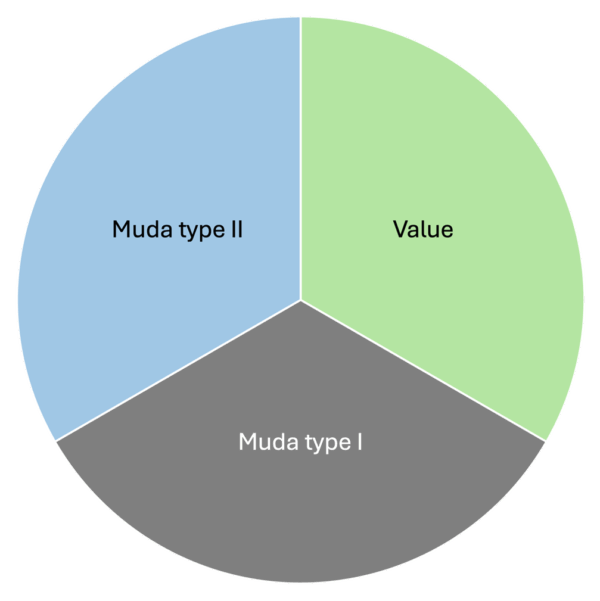
Fig. 1: The development work typically consists of value creating and non-value creating activities, where waste has the dominant share (Muda type I and II). Customers only benefit from the results of value creating activities (Value).
But before we can fight waste, we need to understand exactly what the value from customer perspective is and how we actually create this value. A large part of the lean development process deals with these two questions, and experience shows that many companies have difficulty providing concrete answers.
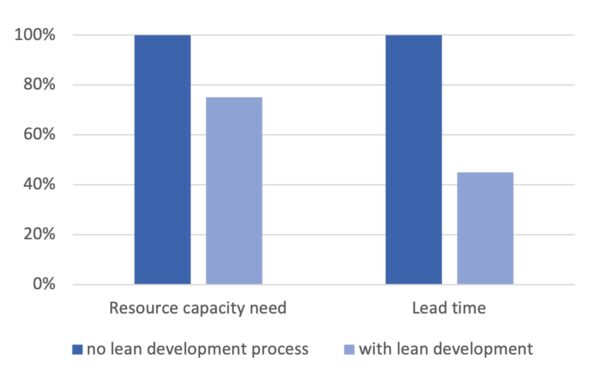
Fig. 2: Typical efficiency effects of the lean development process on the required capacity (-20% to -30%) and the development lead time (-90%).
The next step is to create a flow in the product development process that is as continuous as possible, avoiding strong fluctuations, increasing flexibility and thus also improving planning and resilience against unexpected changes.
The pull principle describes a decentralized, autonomous control of workflows. It was developed in the production area, but can be easily transferred to product development areas, for example, using Kanban boards.
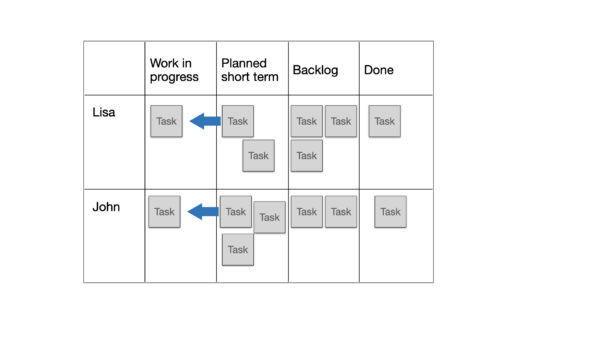
Fig. 3: In this version of Kanban board, team members can pull new tasks whenever free capacity is available. This makes the actual flow of work progress transparent and manageable.
In the course of value stream-oriented development, the people who work directly on the value stream should also work together directly. This necessarily leads to interdisciplinary teams in which members of different departments work together in a transparent and goal-oriented manner.
Since lean development is largely concerned with maximizing customer value and minimizing waste, there is always room for improvement, regardless of how much has already been achieved. That is why continuous improvement and a constant striving for perfection are integral parts of lean development.
As a company, you are likely to face several or even all of the following pain points, which pose a serious threat to the competitiveness of your products or services. You may be aware of some of them, while others may represent untapped potential that you are currently unaware of.
With Lean Development, you can mitigate or even get rid of these pain points and significantly increase your competitiveness.
1. Long development cycles: Long development cycles cause companies to miss market opportunities and prevent them from adapting their products to customer needs in a timely manner. Inefficient processes, excessive coordination loops, and additional design loops for corrective actions delay time to market and consume resources that can be dramatically reduced through lean development. Lean development focuses on eliminating waste by removing unnecessary steps from processes and setting clear priorities. With faster feedback loops and iterative development approaches, products can be brought to market much faster.
2. High development costs: Inefficient processes and unproductive activities unnecessarily drive up development costs and reduce profitability. Lean development systematically identifies and eliminates all non-value-added activities. With lean processes and a stronger focus on customer needs, costs can be sustainably reduced.
3. Low market orientation: Products often fail because they are not based on real customer needs and because market feedback comes too late. Lean development integrates customer feedback into the development process from the start, ensuring that products are better tailored to the market. Iterative testing and a systematic focus on customer value ensure better product acceptance.
4. Overworked teams: Multitasking and high work pressure lead to high error rates, low output, declining efficiency, dissatisfied customers, and high stress levels among managers and employees. Lean Development creates clear workflows and prioritizes tasks by limiting parallel work (work-in-progress limits). This frees up teams to work more productively and focus on their core tasks.
5. Quality defects: Defects discovered late in the development process result in costly rework and missed deadlines. Lean development relies on preventive approaches such as early testing, continuous improvement, and quality assurance throughout the process. This significantly reduces defects and improves product quality.
6. Poor collaboration: Silo mentality and lack of communication between teams lead to inefficient collaboration, delays, and duplication of effort. Lean Development promotes open communication and stronger collaboration through cross-functional teams, transparent processes and balanced capacity utilization. This increases efficiency and ensures that everyone is working toward a common goal.
7. Missed deadlines: Unrealistic deadlines are often based on wishful thinking rather than realistic assessments, leading to frustration and delays. Lean development establishes reliable planning based on customer feedback and actual capacity through takt times and pull systems. Teams can plan their work more reliably and meet deadlines more confidently.
8. Lack of innovation: Rigid processes and a risk-averse culture stifle innovation and lead to stagnant products and portfolios. Lean development creates an environment that fosters innovation through iterative experimentation and rapid feedback loops. Minimum Viable Products (MVPs) allow new ideas to be tested quickly and cost-effectively without taking too much risk.
9. High resource utilization: Inefficient processes and unnecessary waste of material and time significantly increase resource consumption. Lean development optimizes the use of resources by streamlining processes and eliminating overproduction. With just-in-time and a stronger focus on value creation, companies can significantly increase their efficiency.
10. Weak decision making: Decisions are often made based on assumptions or incomplete information, which can lead to undesirable outcomes. Lean development relies on data-driven decision-making processes that enable informed and objective assessments. With clearly defined decision paths and iterative validations, organizations can act with purpose and confidence.
A prominent case study is that of Daimler AG, Stuttgart, Germany.
Daimler AG has undergone a major transformation in recent years, integrating lean development and digital technologies into its corporate strategy. This transformation was characterized by a clear reorientation towards a software and service company. The transition from a pure carmaker to a software-driven company took place on several levels: both in internal product development and in interactions with customers.
As part of its lean development strategy, Daimler has introduced digital tools into its engineering and production processes. By utilizing big data models and computer-aided design (CAD) solutions, the company has been able to create digital prototypes of vehicles before building physical models. This has allowed for a significant reduction in development times and greater precision in vehicle design. Furthermore, Daimler has introduced augmented reality (AR) devices such as Google Glass to increase efficiency and safety in production. These measures led to a significant improvement in production processes and helped to reduce operating costs.
Daimler has also been working intensively on the digitalization of its vehicles and the interface with the customer. One example is the introduction of autonomous driving functions and the increased use of software solutions in vehicles. Over 100 electronic control units (ECUs) coordinate functions ranging from the drive system to safety mechanisms in Daimler’s modern vehicles. The digital transformation has enabled Daimler to develop new business models, such as the digital showroom concept, where customers can use virtual reality to experience vehicles without being physically in a dealership.
Daimler AG’s lean development transformation began in 2016 as part of the strategic project “Leadership 2020.” The goal of this initiative was to fundamentally change the work culture and processes to create more flexibility, speed, and creativity in the company. A central element of the transformation was the introduction of so-called “swarm organizations”, in which Daimler formed agile teams (swarms) that were able to work autonomously across departments.
These “swarms” were based on agile methods such as sprints and enabled simultaneous collaboration in different areas of the product development process. This enabled Daimler to shorten innovation cycles and bring projects to market faster. The transformation took several years, and the goal was to integrate 60,000 of the 300,000 employees into swarm organizations. The efficiency and speed of development were significantly increased by using these methods. For example, the planning time for new programs was reduced from eight to four weeks, and forecasts were created in four hours instead of six days.
The transformation faced challenges, particularly in terms of integrating the new structures into the existing hierarchical system. However, the new ways of working led to a significant improvement in cross-departmental collaboration and the speed of innovation. Proven improvements in several areas are:
• Development time: By using digital prototypes and agile working methods, the development time for new vehicle models was significantly reduced. This enabled Daimler to bring new technologies and products to market faster.
• Costs: The use of augmented reality and digital tools reduced production costs through better error prevention and optimized production planning.
• Quality: The improved integration of software solutions has increased vehicle quality, particularly with regard to safety and assistance systems, which can now draw on highly complex software.
These transformation steps have helped Daimler to position itself as a pioneer in the field of digitalization and lean development in the automotive industry and to successfully manage its transition to a technology company.
This program will guide you through the lean development change and implement the lean development process for future use in your organization.
You will learn the theoretical principles and how to apply them to your own organization. You will carry out a lean development transformation by installing a lean development process and learning how to use it properly, laying the foundation for future independent application of lean development. You will be able to autonomously and confidently carry out future product development using the lean development process and reap the benefits.
Curriculum

Lean Transformation – Workshop 1 – Lean Basics
- Lean basics
- Lean development
- Lean principles
- Lean versus traditional
- Customer value
- Value streams
- Creating flow
- Pull principle
- Continuous improvement
- Lean processes
- Kaizen and kanban
- Value stream mapping
Distance Learning

Introduction
Welcome to Appleton Greene and thank you for enrolling on the Lean Transformation corporate training program. You will be learning through our unique facilitation via distance-learning method, which will enable you to practically implement everything that you learn academically. The methods and materials used in your program have been designed and developed to ensure that you derive the maximum benefits and enjoyment possible. We hope that you find the program challenging and fun to do. However, if you have never been a distance-learner before, you may be experiencing some trepidation at the task before you. So we will get you started by giving you some basic information and guidance on how you can make the best use of the modules, how you should manage the materials and what you should be doing as you work through them. This guide is designed to point you in the right direction and help you to become an effective distance-learner. Take a few hours or so to study this guide and your guide to tutorial support for students, while making notes, before you start to study in earnest.
Study environment
You will need to locate a quiet and private place to study, preferably a room where you can easily be isolated from external disturbances or distractions. Make sure the room is well-lit and incorporates a relaxed, pleasant feel. If you can spoil yourself within your study environment, you will have much more of a chance to ensure that you are always in the right frame of mind when you do devote time to study. For example, a nice fire, the ability to play soft soothing background music, soft but effective lighting, perhaps a nice view if possible and a good size desk with a comfortable chair. Make sure that your family know when you are studying and understand your study rules. Your study environment is very important. The ideal situation, if at all possible, is to have a separate study, which can be devoted to you. If this is not possible then you will need to pay a lot more attention to developing and managing your study schedule, because it will affect other people as well as yourself. The better your study environment, the more productive you will be.
Study tools & rules
Try and make sure that your study tools are sufficient and in good working order. You will need to have access to a computer, scanner and printer, with access to the internet. You will need a very comfortable chair, which supports your lower back, and you will need a good filing system. It can be very frustrating if you are spending valuable study time trying to fix study tools that are unreliable, or unsuitable for the task. Make sure that your study tools are up to date. You will also need to consider some study rules. Some of these rules will apply to you and will be intended to help you to be more disciplined about when and how you study. This distance-learning guide will help you and after you have read it you can put some thought into what your study rules should be. You will also need to negotiate some study rules for your family, friends or anyone who lives with you. They too will need to be disciplined in order to ensure that they can support you while you study. It is important to ensure that your family and friends are an integral part of your study team. Having their support and encouragement can prove to be a crucial contribution to your successful completion of the program. Involve them in as much as you can.
Successful distance-learning
Distance-learners are freed from the necessity of attending regular classes or workshops, since they can study in their own way, at their own pace and for their own purposes. But unlike traditional internal training courses, it is the student’s responsibility, with a distance-learning program, to ensure that they manage their own study contribution. This requires strong self-discipline and self-motivation skills and there must be a clear will to succeed. Those students who are used to managing themselves, are good at managing others and who enjoy working in isolation, are more likely to be good distance-learners. It is also important to be aware of the main reasons why you are studying and of the main objectives that you are hoping to achieve as a result. You will need to remind yourself of these objectives at times when you need to motivate yourself. Never lose sight of your long-term goals and your short-term objectives. There is nobody available here to pamper you, or to look after you, or to spoon-feed you with information, so you will need to find ways to encourage and appreciate yourself while you are studying. Make sure that you chart your study progress, so that you can be sure of your achievements and re-evaluate your goals and objectives regularly.
Self-assessment
Appleton Greene training programs are in all cases post-graduate programs. Consequently, you should already have obtained a business-related degree and be an experienced learner. You should therefore already be aware of your study strengths and weaknesses. For example, which time of the day are you at your most productive? Are you a lark or an owl? What study methods do you respond to the most? Are you a consistent learner? How do you discipline yourself? How do you ensure that you enjoy yourself while studying? It is important to understand yourself as a learner and so some self-assessment early on will be necessary if you are to apply yourself correctly. Perform a SWOT analysis on yourself as a student. List your internal strengths and weaknesses as a student and your external opportunities and threats. This will help you later on when you are creating a study plan. You can then incorporate features within your study plan that can ensure that you are playing to your strengths, while compensating for your weaknesses. You can also ensure that you make the most of your opportunities, while avoiding the potential threats to your success.
Accepting responsibility as a student
Training programs invariably require a significant investment, both in terms of what they cost and in the time that you need to contribute to study and the responsibility for successful completion of training programs rests entirely with the student. This is never more apparent than when a student is learning via distance-learning. Accepting responsibility as a student is an important step towards ensuring that you can successfully complete your training program. It is easy to instantly blame other people or factors when things go wrong. But the fact of the matter is that if a failure is your failure, then you have the power to do something about it, it is entirely in your own hands. If it is always someone else’s failure, then you are powerless to do anything about it. All students study in entirely different ways, this is because we are all individuals and what is right for one student, is not necessarily right for another. In order to succeed, you will have to accept personal responsibility for finding a way to plan, implement and manage a personal study plan that works for you. If you do not succeed, you only have yourself to blame.
Planning
By far the most critical contribution to stress, is the feeling of not being in control. In the absence of planning we tend to be reactive and can stumble from pillar to post in the hope that things will turn out fine in the end. Invariably they don’t! In order to be in control, we need to have firm ideas about how and when we want to do things. We also need to consider as many possible eventualities as we can, so that we are prepared for them when they happen. Prescriptive Change, is far easier to manage and control, than Emergent Change. The same is true with distance-learning. It is much easier and much more enjoyable, if you feel that you are in control and that things are going to plan. Even when things do go wrong, you are prepared for them and can act accordingly without any unnecessary stress. It is important therefore that you do take time to plan your studies properly.
Management
Once you have developed a clear study plan, it is of equal importance to ensure that you manage the implementation of it. Most of us usually enjoy planning, but it is usually during implementation when things go wrong. Targets are not met and we do not understand why. Sometimes we do not even know if targets are being met. It is not enough for us to conclude that the study plan just failed. If it is failing, you will need to understand what you can do about it. Similarly if your study plan is succeeding, it is still important to understand why, so that you can improve upon your success. You therefore need to have guidelines for self-assessment so that you can be consistent with performance improvement throughout the program. If you manage things correctly, then your performance should constantly improve throughout the program.
Study objectives & tasks
The first place to start is developing your program objectives. These should feature your reasons for undertaking the training program in order of priority. Keep them succinct and to the point in order to avoid confusion. Do not just write the first things that come into your head because they are likely to be too similar to each other. Make a list of possible departmental headings, such as: Customer Service; E-business; Finance; Globalization; Human Resources; Technology; Legal; Management; Marketing and Production. Then brainstorm for ideas by listing as many things that you want to achieve under each heading and later re-arrange these things in order of priority. Finally, select the top item from each department heading and choose these as your program objectives. Try and restrict yourself to five because it will enable you to focus clearly. It is likely that the other things that you listed will be achieved if each of the top objectives are achieved. If this does not prove to be the case, then simply work through the process again.
Study forecast
As a guide, the Appleton Greene Lean Transformation corporate training program should take 12-18 months to complete, depending upon your availability and current commitments. The reason why there is such a variance in time estimates is because every student is an individual, with differing productivity levels and different commitments. These differentiations are then exaggerated by the fact that this is a distance-learning program, which incorporates the practical integration of academic theory as an as a part of the training program. Consequently all of the project studies are real, which means that important decisions and compromises need to be made. You will want to get things right and will need to be patient with your expectations in order to ensure that they are. We would always recommend that you are prudent with your own task and time forecasts, but you still need to develop them and have a clear indication of what are realistic expectations in your case. With reference to your time planning: consider the time that you can realistically dedicate towards study with the program every week; calculate how long it should take you to complete the program, using the guidelines featured here; then break the program down into logical modules and allocate a suitable proportion of time to each of them, these will be your milestones; you can create a time plan by using a spreadsheet on your computer, or a personal organizer such as MS Outlook, you could also use a financial forecasting software; break your time forecasts down into manageable chunks of time, the more specific you can be, the more productive and accurate your time management will be; finally, use formulas where possible to do your time calculations for you, because this will help later on when your forecasts need to change in line with actual performance. With reference to your task planning: refer to your list of tasks that need to be undertaken in order to achieve your program objectives; with reference to your time plan, calculate when each task should be implemented; remember that you are not estimating when your objectives will be achieved, but when you will need to focus upon implementing the corresponding tasks; you also need to ensure that each task is implemented in conjunction with the associated training modules which are relevant; then break each single task down into a list of specific to do’s, say approximately ten to do’s for each task and enter these into your study plan; once again you could use MS Outlook to incorporate both your time and task planning and this could constitute your study plan; you could also use a project management software like MS Project. You should now have a clear and realistic forecast detailing when you can expect to be able to do something about undertaking the tasks to achieve your program objectives.
Performance management
It is one thing to develop your study forecast, it is quite another to monitor your progress. Ultimately it is less important whether you achieve your original study forecast and more important that you update it so that it constantly remains realistic in line with your performance. As you begin to work through the program, you will begin to have more of an idea about your own personal performance and productivity levels as a distance-learner. Once you have completed your first study module, you should re-evaluate your study forecast for both time and tasks, so that they reflect your actual performance level achieved. In order to achieve this you must first time yourself while training by using an alarm clock. Set the alarm for hourly intervals and make a note of how far you have come within that time. You can then make a note of your actual performance on your study plan and then compare your performance against your forecast. Then consider the reasons that have contributed towards your performance level, whether they are positive or negative and make a considered adjustment to your future forecasts as a result. Given time, you should start achieving your forecasts regularly.
With reference to time management: time yourself while you are studying and make a note of the actual time taken in your study plan; consider your successes with time-efficiency and the reasons for the success in each case and take this into consideration when reviewing future time planning; consider your failures with time-efficiency and the reasons for the failures in each case and take this into consideration when reviewing future time planning; re-evaluate your study forecast in relation to time planning for the remainder of your training program to ensure that you continue to be realistic about your time expectations. You need to be consistent with your time management, otherwise you will never complete your studies. This will either be because you are not contributing enough time to your studies, or you will become less efficient with the time that you do allocate to your studies. Remember, if you are not in control of your studies, they can just become yet another cause of stress for you.
With reference to your task management: time yourself while you are studying and make a note of the actual tasks that you have undertaken in your study plan; consider your successes with task-efficiency and the reasons for the success in each case; take this into consideration when reviewing future task planning; consider your failures with task-efficiency and the reasons for the failures in each case and take this into consideration when reviewing future task planning; re-evaluate your study forecast in relation to task planning for the remainder of your training program to ensure that you continue to be realistic about your task expectations. You need to be consistent with your task management, otherwise you will never know whether you are achieving your program objectives or not.
Keeping in touch
You will have access to qualified and experienced professors and tutors who are responsible for providing tutorial support for your particular training program. So don’t be shy about letting them know how you are getting on. We keep electronic records of all tutorial support emails so that professors and tutors can review previous correspondence before considering an individual response. It also means that there is a record of all communications between you and your professors and tutors and this helps to avoid any unnecessary duplication, misunderstanding, or misinterpretation. If you have a problem relating to the program, share it with them via email. It is likely that they have come across the same problem before and are usually able to make helpful suggestions and steer you in the right direction. To learn more about when and how to use tutorial support, please refer to the Tutorial Support section of this student information guide. This will help you to ensure that you are making the most of tutorial support that is available to you and will ultimately contribute towards your success and enjoyment with your training program.
Work colleagues and family
You should certainly discuss your program study progress with your colleagues, friends and your family. Appleton Greene training programs are very practical. They require you to seek information from other people, to plan, develop and implement processes with other people and to achieve feedback from other people in relation to viability and productivity. You will therefore have plenty of opportunities to test your ideas and enlist the views of others. People tend to be sympathetic towards distance-learners, so don’t bottle it all up in yourself. Get out there and share it! It is also likely that your family and colleagues are going to benefit from your labors with the program, so they are likely to be much more interested in being involved than you might think. Be bold about delegating work to those who might benefit themselves. This is a great way to achieve understanding and commitment from people who you may later rely upon for process implementation. Share your experiences with your friends and family.
Making it relevant
The key to successful learning is to make it relevant to your own individual circumstances. At all times you should be trying to make bridges between the content of the program and your own situation. Whether you achieve this through quiet reflection or through interactive discussion with your colleagues, client partners or your family, remember that it is the most important and rewarding aspect of translating your studies into real self-improvement. You should be clear about how you want the program to benefit you. This involves setting clear study objectives in relation to the content of the course in terms of understanding, concepts, completing research or reviewing activities and relating the content of the modules to your own situation. Your objectives may understandably change as you work through the program, in which case you should enter the revised objectives on your study plan so that you have a permanent reminder of what you are trying to achieve, when and why.
Distance-learning check-list
Prepare your study environment, your study tools and rules.
Undertake detailed self-assessment in terms of your ability as a learner.
Create a format for your study plan.
Consider your study objectives and tasks.
Create a study forecast.
Assess your study performance.
Re-evaluate your study forecast.
Be consistent when managing your study plan.
Use your Appleton Greene Certified Learning Provider (CLP) for tutorial support.
Make sure you keep in touch with those around you.
Tutorial Support

Programs
Appleton Greene uses standard and bespoke corporate training programs as vessels to transfer business process improvement knowledge into the heart of our clients’ organizations. Each individual program focuses upon the implementation of a specific business process, which enables clients to easily quantify their return on investment. There are hundreds of established Appleton Greene corporate training products now available to clients within customer services, e-business, finance, globalization, human resources, information technology, legal, management, marketing and production. It does not matter whether a client’s employees are located within one office, or an unlimited number of international offices, we can still bring them together to learn and implement specific business processes collectively. Our approach to global localization enables us to provide clients with a truly international service with that all important personal touch. Appleton Greene corporate training programs can be provided virtually or locally and they are all unique in that they individually focus upon a specific business function. They are implemented over a sustainable period of time and professional support is consistently provided by qualified learning providers and specialist consultants.
Support available
You will have a designated Certified Learning Provider (CLP) and an Accredited Consultant and we encourage you to communicate with them as much as possible. In all cases tutorial support is provided online because we can then keep a record of all communications to ensure that tutorial support remains consistent. You would also be forwarding your work to the tutorial support unit for evaluation and assessment. You will receive individual feedback on all of the work that you undertake on a one-to-one basis, together with specific recommendations for anything that may need to be changed in order to achieve a pass with merit or a pass with distinction and you then have as many opportunities as you may need to re-submit project studies until they meet with the required standard. Consequently the only reason that you should really fail (CLP) is if you do not do the work. It makes no difference to us whether a student takes 12 months or 18 months to complete the program, what matters is that in all cases the same quality standard will have been achieved.
Support Process
Please forward all of your future emails to the designated (CLP) Tutorial Support Unit email address that has been provided and please do not duplicate or copy your emails to other AGC email accounts as this will just cause unnecessary administration. Please note that emails are always answered as quickly as possible but you will need to allow a period of up to 20 business days for responses to general tutorial support emails during busy periods, because emails are answered strictly within the order in which they are received. You will also need to allow a period of up to 30 business days for the evaluation and assessment of project studies. This does not include weekends or public holidays. Please therefore kindly allow for this within your time planning. All communications are managed online via email because it enables tutorial service support managers to review other communications which have been received before responding and it ensures that there is a copy of all communications retained on file for future reference. All communications will be stored within your personal (CLP) study file here at Appleton Greene throughout your designated study period. If you need any assistance or clarification at any time, please do not hesitate to contact us by forwarding an email and remember that we are here to help. If you have any questions, please list and number your questions succinctly and you can then be sure of receiving specific answers to each and every query.
Time Management
It takes approximately 1 Year to complete the Lean Transformation corporate training program, incorporating 12 x 6-hour monthly workshops. Each student will also need to contribute approximately 4 hours per week over 1 Year of their personal time. Students can study from home or work at their own pace and are responsible for managing their own study plan. There are no formal examinations and students are evaluated and assessed based upon their project study submissions, together with the quality of their internal analysis and supporting documents. They can contribute more time towards study when they have the time to do so and can contribute less time when they are busy. All students tend to be in full time employment while studying and the Lean Transformation program is purposely designed to accommodate this, so there is plenty of flexibility in terms of time management. It makes no difference to us at Appleton Greene, whether individuals take 12-18 months to complete this program. What matters is that in all cases the same standard of quality will have been achieved with the standard and bespoke programs that have been developed.
Distance Learning Guide
The distance learning guide should be your first port of call when starting your training program. It will help you when you are planning how and when to study, how to create the right environment and how to establish the right frame of mind. If you can lay the foundations properly during the planning stage, then it will contribute to your enjoyment and productivity while training later. The guide helps to change your lifestyle in order to accommodate time for study and to cultivate good study habits. It helps you to chart your progress so that you can measure your performance and achieve your goals. It explains the tools that you will need for study and how to make them work. It also explains how to translate academic theory into practical reality. Spend some time now working through your distance learning guide and make sure that you have firm foundations in place so that you can make the most of your distance learning program. There is no requirement for you to attend training workshops or classes at Appleton Greene offices. The entire program is undertaken online, program course manuals and project studies are administered via the Appleton Greene web site and via email, so you are able to study at your own pace and in the comfort of your own home or office as long as you have a computer and access to the internet.
How To Study
The how to study guide provides students with a clear understanding of the Appleton Greene facilitation via distance learning training methods and enables students to obtain a clear overview of the training program content. It enables students to understand the step-by-step training methods used by Appleton Greene and how course manuals are integrated with project studies. It explains the research and development that is required and the need to provide evidence and references to support your statements. It also enables students to understand precisely what will be required of them in order to achieve a pass with merit and a pass with distinction for individual project studies and provides useful guidance on how to be innovative and creative when developing your Unique Program Proposition (UPP).
Tutorial Support
Tutorial support for the Appleton Greene Lean Transformation corporate training program is provided online either through the Appleton Greene Client Support Portal (CSP), or via email. All tutorial support requests are facilitated by a designated Program Administration Manager (PAM). They are responsible for deciding which professor or tutor is the most appropriate option relating to the support required and then the tutorial support request is forwarded onto them. Once the professor or tutor has completed the tutorial support request and answered any questions that have been asked, this communication is then returned to the student via email by the designated Program Administration Manager (PAM). This enables all tutorial support, between students, professors and tutors, to be facilitated by the designated Program Administration Manager (PAM) efficiently and securely through the email account. You will therefore need to allow a period of up to 20 business days for responses to general support queries and up to 30 business days for the evaluation and assessment of project studies, because all tutorial support requests are answered strictly within the order in which they are received. This does not include weekends or public holidays. Consequently you need to put some thought into the management of your tutorial support procedure in order to ensure that your study plan is feasible and to obtain the maximum possible benefit from tutorial support during your period of study. Please retain copies of your tutorial support emails for future reference. Please ensure that ALL of your tutorial support emails are set out using the format as suggested within your guide to tutorial support. Your tutorial support emails need to be referenced clearly to the specific part of the course manual or project study which you are working on at any given time. You also need to list and number any questions that you would like to ask, up to a maximum of five questions within each tutorial support email. Remember the more specific you can be with your questions the more specific your answers will be too and this will help you to avoid any unnecessary misunderstanding, misinterpretation, or duplication. The guide to tutorial support is intended to help you to understand how and when to use support in order to ensure that you get the most out of your training program. Appleton Greene training programs are designed to enable you to do things for yourself. They provide you with a structure or a framework and we use tutorial support to facilitate students while they practically implement what they learn. In other words, we are enabling students to do things for themselves. The benefits of distance learning via facilitation are considerable and are much more sustainable in the long-term than traditional short-term knowledge sharing programs. Consequently you should learn how and when to use tutorial support so that you can maximize the benefits from your learning experience with Appleton Greene. This guide describes the purpose of each training function and how to use them and how to use tutorial support in relation to each aspect of the training program. It also provides useful tips and guidance with regard to best practice.
Tutorial Support Tips
Students are often unsure about how and when to use tutorial support with Appleton Greene. This Tip List will help you to understand more about how to achieve the most from using tutorial support. Refer to it regularly to ensure that you are continuing to use the service properly. Tutorial support is critical to the success of your training experience, but it is important to understand when and how to use it in order to maximize the benefit that you receive. It is no coincidence that those students who succeed are those that learn how to be positive, proactive and productive when using tutorial support.
Be positive and friendly with your tutorial support emails
Remember that if you forward an email to the tutorial support unit, you are dealing with real people. “Do unto others as you would expect others to do unto you”. If you are positive, complimentary and generally friendly in your emails, you will generate a similar response in return. This will be more enjoyable, productive and rewarding for you in the long-term.
Think about the impression that you want to create
Every time that you communicate, you create an impression, which can be either positive or negative, so put some thought into the impression that you want to create. Remember that copies of all tutorial support emails are stored electronically and tutors will always refer to prior correspondence before responding to any current emails. Over a period of time, a general opinion will be arrived at in relation to your character, attitude and ability. Try to manage your own frustrations, mood swings and temperament professionally, without involving the tutorial support team. Demonstrating frustration or a lack of patience is a weakness and will be interpreted as such. The good thing about communicating in writing, is that you will have the time to consider your content carefully, you can review it and proof-read it before sending your email to Appleton Greene and this should help you to communicate more professionally, consistently and to avoid any unnecessary knee-jerk reactions to individual situations as and when they may arise. Please also remember that the CLP Tutorial Support Unit will not just be responsible for evaluating and assessing the quality of your work, they will also be responsible for providing recommendations to other learning providers and to client contacts within the Appleton Greene global client network, so do be in control of your own emotions and try to create a good impression.
Remember that quality is preferred to quantity
Please remember that when you send an email to the tutorial support team, you are not using Twitter or Text Messaging. Try not to forward an email every time that you have a thought. This will not prove to be productive either for you or for the tutorial support team. Take time to prepare your communications properly, as if you were writing a professional letter to a business colleague and make a list of queries that you are likely to have and then incorporate them within one email, say once every month, so that the tutorial support team can understand more about context, application and your methodology for study. Get yourself into a consistent routine with your tutorial support requests and use the tutorial support template provided with ALL of your emails. The (CLP) Tutorial Support Unit will not spoon-feed you with information. They need to be able to evaluate and assess your tutorial support requests carefully and professionally.
Be specific about your questions in order to receive specific answers
Try not to write essays by thinking as you are writing tutorial support emails. The tutorial support unit can be unclear about what in fact you are asking, or what you are looking to achieve. Be specific about asking questions that you want answers to. Number your questions. You will then receive specific answers to each and every question. This is the main purpose of tutorial support via email.
Keep a record of your tutorial support emails
It is important that you keep a record of all tutorial support emails that are forwarded to you. You can then refer to them when necessary and it avoids any unnecessary duplication, misunderstanding, or misinterpretation.
Individual training workshops or telephone support
Tutorial Support Email Format
You should use this tutorial support format if you need to request clarification or assistance while studying with your training program. Please note that ALL of your tutorial support request emails should use the same format. You should therefore set up a standard email template, which you can then use as and when you need to. Emails that are forwarded to Appleton Greene, which do not use the following format, may be rejected and returned to you by the (CLP) Program Administration Manager. A detailed response will then be forwarded to you via email usually within 20 business days of receipt for general support queries and 30 business days for the evaluation and assessment of project studies. This does not include weekends or public holidays. Your tutorial support request, together with the corresponding TSU reply, will then be saved and stored within your electronic TSU file at Appleton Greene for future reference.
Subject line of your email
Please insert: Appleton Greene (CLP) Tutorial Support Request: (Your Full Name) (Date), within the subject line of your email.
Main body of your email
Please insert:
1. Appleton Greene Certified Learning Provider (CLP) Tutorial Support Request
2. Your Full Name
3. Date of TS request
4. Preferred email address
5. Backup email address
6. Course manual page name or number (reference)
7. Project study page name or number (reference)
Subject of enquiry
Please insert a maximum of 50 words (please be succinct)
Briefly outline the subject matter of your inquiry, or what your questions relate to.
Question 1
Maximum of 50 words (please be succinct)
Maximum of 50 words (please be succinct)
Question 3
Maximum of 50 words (please be succinct)
Question 4
Maximum of 50 words (please be succinct)
Question 5
Maximum of 50 words (please be succinct)
Please note that a maximum of 5 questions is permitted with each individual tutorial support request email.
Procedure
* List the questions that you want to ask first, then re-arrange them in order of priority. Make sure that you reference them, where necessary, to the course manuals or project studies.
* Make sure that you are specific about your questions and number them. Try to plan the content within your emails to make sure that it is relevant.
* Make sure that your tutorial support emails are set out correctly, using the Tutorial Support Email Format provided here.
* Save a copy of your email and incorporate the date sent after the subject title. Keep your tutorial support emails within the same file and in date order for easy reference.
* Allow up to 20 business days for a response to general tutorial support emails and up to 30 business days for the evaluation and assessment of project studies, because detailed individual responses will be made in all cases and tutorial support emails are answered strictly within the order in which they are received.
* Emails can and do get lost. So if you have not received a reply within the appropriate time, forward another copy or a reminder to the tutorial support unit to be sure that it has been received but do not forward reminders unless the appropriate time has elapsed.
* When you receive a reply, save it immediately featuring the date of receipt after the subject heading for easy reference. In most cases the tutorial support unit replies to your questions individually, so you will have a record of the questions that you asked as well as the answers offered. With project studies however, separate emails are usually forwarded by the tutorial support unit, so do keep a record of your own original emails as well.
* Remember to be positive and friendly in your emails. You are dealing with real people who will respond to the same things that you respond to.
* Try not to repeat questions that have already been asked in previous emails. If this happens the tutorial support unit will probably just refer you to the appropriate answers that have already been provided within previous emails.
* If you lose your tutorial support email records you can write to Appleton Greene to receive a copy of your tutorial support file, but a separate administration charge may be levied for this service.
How To Study

Your Certified Learning Provider (CLP) and Accredited Consultant can help you to plan a task list for getting started so that you can be clear about your direction and your priorities in relation to your training program. It is also a good way to introduce yourself to the tutorial support team.
Planning your study environment
Your study conditions are of great importance and will have a direct effect on how much you enjoy your training program. Consider how much space you will have, whether it is comfortable and private and whether you are likely to be disturbed. The study tools and facilities at your disposal are also important to the success of your distance-learning experience. Your tutorial support unit can help with useful tips and guidance, regardless of your starting position. It is important to get this right before you start working on your training program.
Planning your program objectives
It is important that you have a clear list of study objectives, in order of priority, before you start working on your training program. Your tutorial support unit can offer assistance here to ensure that your study objectives have been afforded due consideration and priority.
Planning how and when to study
Distance-learners are freed from the necessity of attending regular classes, since they can study in their own way, at their own pace and for their own purposes. This approach is designed to let you study efficiently away from the traditional classroom environment. It is important however, that you plan how and when to study, so that you are making the most of your natural attributes, strengths and opportunities. Your tutorial support unit can offer assistance and useful tips to ensure that you are playing to your strengths.
Planning your study tasks
You should have a clear understanding of the study tasks that you should be undertaking and the priority associated with each task. These tasks should also be integrated with your program objectives. The distance learning guide and the guide to tutorial support for students should help you here, but if you need any clarification or assistance, please contact your tutorial support unit.
Planning your time
You will need to allocate specific times during your calendar when you intend to study if you are to have a realistic chance of completing your program on time. You are responsible for planning and managing your own study time, so it is important that you are successful with this. Your tutorial support unit can help you with this if your time plan is not working.
Keeping in touch
Consistency is the key here. If you communicate too frequently in short bursts, or too infrequently with no pattern, then your management ability with your studies will be questioned, both by you and by your tutorial support unit. It is obvious when a student is in control and when one is not and this will depend how able you are at sticking with your study plan. Inconsistency invariably leads to in-completion.
Charting your progress
Your tutorial support team can help you to chart your own study progress. Refer to your distance learning guide for further details.
Making it work
To succeed, all that you will need to do is apply yourself to undertaking your training program and interpreting it correctly. Success or failure lies in your hands and your hands alone, so be sure that you have a strategy for making it work. Your Certified Learning Provider (CLP) and Accredited Consultant can guide you through the process of program planning, development and implementation.
Reading methods
Interpretation is often unique to the individual but it can be improved and even quantified by implementing consistent interpretation methods. Interpretation can be affected by outside interference such as family members, TV, or the Internet, or simply by other thoughts which are demanding priority in our minds. One thing that can improve our productivity is using recognized reading methods. This helps us to focus and to be more structured when reading information for reasons of importance, rather than relaxation.
Speed reading
When reading through course manuals for the first time, subconsciously set your reading speed to be just fast enough that you cannot dwell on individual words or tables. With practice, you should be able to read an A4 sheet of paper in one minute. You will not achieve much in the way of a detailed understanding, but your brain will retain a useful overview. This overview will be important later on and will enable you to keep individual issues in perspective with a more generic picture because speed reading appeals to the memory part of the brain. Do not worry about what you do or do not remember at this stage.
Content reading
Once you have speed read everything, you can then start work in earnest. You now need to read a particular section of your course manual thoroughly, by making detailed notes while you read. This process is called Content Reading and it will help to consolidate your understanding and interpretation of the information that has been provided.
Making structured notes on the course manuals
When you are content reading, you should be making detailed notes, which are both structured and informative. Make these notes in a MS Word document on your computer, because you can then amend and update these as and when you deem it to be necessary. List your notes under three headings: 1. Interpretation – 2. Questions – 3. Tasks. The purpose of the 1st section is to clarify your interpretation by writing it down. The purpose of the 2nd section is to list any questions that the issue raises for you. The purpose of the 3rd section is to list any tasks that you should undertake as a result. Anyone who has graduated with a business-related degree should already be familiar with this process.
Organizing structured notes separately
You should then transfer your notes to a separate study notebook, preferably one that enables easy referencing, such as a MS Word Document, a MS Excel Spreadsheet, a MS Access Database, or a personal organizer on your cell phone. Transferring your notes allows you to have the opportunity of cross-checking and verifying them, which assists considerably with understanding and interpretation. You will also find that the better you are at doing this, the more chance you will have of ensuring that you achieve your study objectives.
Question your understanding
Do challenge your understanding. Explain things to yourself in your own words by writing things down.
Clarifying your understanding
If you are at all unsure, forward an email to your tutorial support unit and they will help to clarify your understanding.
Question your interpretation
Do challenge your interpretation. Qualify your interpretation by writing it down.
Clarifying your interpretation
If you are at all unsure, forward an email to your tutorial support unit and they will help to clarify your interpretation.
Qualification Requirements
The student will need to successfully complete the project study and all of the exercises relating to the Lean Transformation corporate training program, achieving a pass with merit or distinction in each case, in order to qualify as an Accredited Lean Transformation Specialist (APTS). All monthly workshops need to be tried and tested within your company. These project studies can be completed in your own time and at your own pace and in the comfort of your own home or office. There are no formal examinations, assessment is based upon the successful completion of the project studies. They are called project studies because, unlike case studies, these projects are not theoretical, they incorporate real program processes that need to be properly researched and developed. The project studies assist us in measuring your understanding and interpretation of the training program and enable us to assess qualification merits. All of the project studies are based entirely upon the content within the training program and they enable you to integrate what you have learnt into your corporate training practice.
Lean Transformation – Grading Contribution
Project Study – Grading Contribution
Customer Service – 10%
E-business – 05%
Finance – 10%
Globalization – 10%
Human Resources – 10%
Information Technology – 10%
Legal – 05%
Management – 10%
Marketing – 10%
Production – 10%
Education – 05%
Logistics – 05%
TOTAL GRADING – 100%
Qualification grades
A mark of 90% = Pass with Distinction.
A mark of 75% = Pass with Merit.
A mark of less than 75% = Fail.
If you fail to achieve a mark of 75% with a project study, you will receive detailed feedback from the Certified Learning Provider (CLP) and/or Accredited Consultant, together with a list of tasks which you will need to complete, in order to ensure that your project study meets with the minimum quality standard that is required by Appleton Greene. You can then re-submit your project study for further evaluation and assessment. Indeed you can re-submit as many drafts of your project studies as you need to, until such a time as they eventually meet with the required standard by Appleton Greene, so you need not worry about this, it is all part of the learning process.
When marking project studies, Appleton Greene is looking for sufficient evidence of the following:
Pass with merit
A satisfactory level of program understanding
A satisfactory level of program interpretation
A satisfactory level of project study content presentation
A satisfactory level of Unique Program Proposition (UPP) quality
A satisfactory level of the practical integration of academic theory
Pass with distinction
An exceptional level of program understanding
An exceptional level of program interpretation
An exceptional level of project study content presentation
An exceptional level of Unique Program Proposition (UPP) quality
An exceptional level of the practical integration of academic theory
Preliminary Analysis

Content here…
Course Manuals 1-12

Course Manual 1: Lean basics
The way of lean thinking
Imagine walking through a busy company where machines hum, teams work at full speed, emails fly back and forth and meetings are scheduled back-to-back. At first glance, everything seems productive. But take a closer look and a different picture begins to emerge. In one corner, a machine is idle, waiting for a part. In another, a team is redoing something they completed last week. Elsewhere, a customer service agent is following a lengthy process that nobody questions, but which everyone finds frustrating. People are certainly working hard, but are they actually creating value?
This is the question at the heart of Lean Management.
Lean is not just a set of tools or methods. It’s a way of seeing things. It challenges us to look beyond the surface of activity and ask: what truly matters to the customer? Where does our effort actually make a difference? And in which areas are we simply doing things because ‘we’ve always done it this way’?
At its core, Lean invites us to rethink how work flows, how decisions are made and how teams contribute to meaningful outcomes. It shows us that the greatest gains don’t come from working harder or faster, but from working smarter by identifying what adds value and eliminating what doesn’t.
Over the next few sessions, we will explore this mindset in more depth. We will explore the difference between value and waste, not just in factories, but in all types of organisation. We’ll also examine the five Lean principles that offer a structured path towards more effective, responsive and resilient ways of working.
But for now, consider this: What if the biggest opportunity for improvement in your organisation isn’t hidden in complexity, but in simplicity?
Lean Management thrives on clarity. It reveals what is essential by removing what is unnecessary. By streamlining processes, clarifying roles and eliminating superfluous steps, Lean enables teams to concentrate on what truly matters. This simplicity isn’t about doing less; it’s about ensuring that every action counts. In the space that this simplicity creates, teams not only find efficiency, but also creativity, alignment and purpose. That’s where transformation begins.
Why understanding customer value and waste is crucial
For any company aiming to improve performance, increase competitiveness and enhance customer service, it is imperative to understand the concepts of customer value and waste. These two ideas are part of the foundation of lean thinking and provide a clear lens through which all business activities can be evaluated. When employees and leaders share a deep understanding of what truly creates value for the customer, they can make smarter decisions about where to focus time, energy, and resources. This helps prevent overengineering, costly mistakes and misaligned priorities.
Conversely, identifying waste enables organisations to pinpoint latent inefficiencies that impede delivery, escalate costs and exasperate both customers and employees. By learning to see and reduce waste, teams can become more agile, responsive, and focused. In Lean Management, ‘learning to see’ means developing the ability to recognise waste, inefficiencies and areas for improvement that are often hidden in everyday work routines. This involves shifting the focus from viewing activity as productivity to discerning which activities genuinely add value for the customer. For instance, a development team may realise that they spend weeks building features without customer feedback, only to later revise or discard them. In this case, ‘learning to see’ reveals the waste of unvalidated assumptions and the value of earlier user testing. When the principles of value and waste are embraced within a company, a culture of continuous improvement is established. This culture encourages individuals to ask whether an activity is adding value or merely keeping them busy. This mindset enables companies to become leaner, faster and more innovative over time.
Five principles form the basis for lean management
1. Defining value from the customer’s perspective
The fundamental principle of Lean is to define value by asking: what does the customer truly need and expect in order for us to provide the best possible service? Value is not defined by the company’s assumptions; it is determined by its ability to solve customer problems, enhance their experience, or address specific needs. This focus ensures that time and resources are spent on activities that directly contribute to customer value in the first place.
For instance, a customer purchasing a power drill is not primarily interested in the tool itself; they are interested in the holes it creates in walls. Should a manufacturer choose to incorporate features that ultimately prove to be of little use to the customer, this would be regarded as a lack of added value. Lean encourages organisations to focus on what truly matters to the customer, and remove anything that does not contribute to that value.
A comprehensive understanding of value is instrumental in enabling teams to establish clear priorities, streamline processes, and develop products or services with a higher probability of success in the market. Within the lean transformation process, defining customer value is the first step after the basic understanding of lean has been created in the organization.
2. Mapping the value stream
Once value has been defined, the next action to be taken is to identify, analyse and map all the steps involved in delivering that value. This is known as the value stream. It encompasses every action, person, and resource involved from the initial customer request to the final delivery. This includes specific information about these actions such as waiting and processing times, first-time right or batch and queue sizes. The objective is to gain full process visibility, identify the value-adding and the non-value adding steps and eliminate those that do not add value, and pinpoint areas where there is wastage, delay or inefficiency. To reduce complexity, value streams are often broken down into sub-value streams and examined step by step.
For instance, a company might discover that it takes three weeks to deliver a custom product, but only two days of that time actually involve meaningful work. The rest is spent waiting for approvals, searching for information, or reworking errors. Mapping the value stream is an effective method of identifying these hidden problems, allowing them to be addressed.
This approach enables teams to view the process holistically, identifying areas for enhancement.
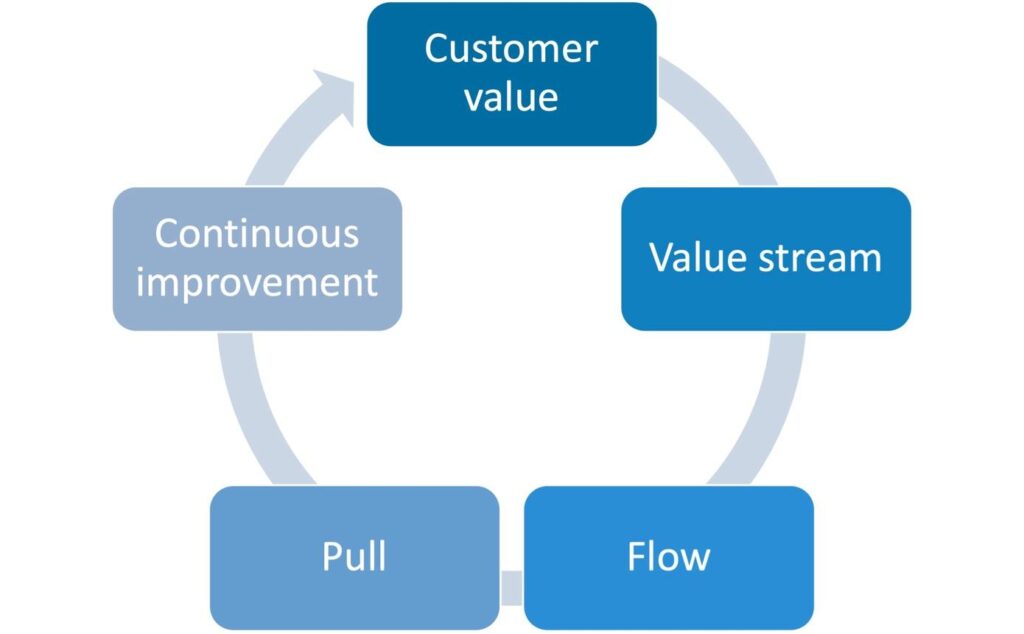
3. Creating flow
Following the identification and removal of waste from the value stream, the subsequent objective is to ensure that value-adding steps occur in a continuous flow. This involves minimising delays, handover times and interruptions to ensure seamless progress from start to finish. An uninterrupted process is faster and better predictable, resulting in a better delivery performance. On the other hand, process disruptions can be identified and resolved more quickly.
A prime example of this would be a hospital streamlining its patient intake process. Rather than patients having to wait in multiple queues for check-in, triage, and assessment, the hospital can redesign the layout and coordination of its services to ensure that patients move seamlessly from one step to the next. This enhancement in efficiency will lead to improved patient care and satisfaction.
Generating effective flow often necessitates a reorganisation of how people and resources are managed. It promotes the dissolution of departmental silos and the elimination of superfluous steps that impede delivery.
4. Establishing pull-based work
In traditional systems, work is “pushed” through the process based on plans and forecasts, regardless of actual demand. In lean, work is only undertaken when there is a genuine requirement — this is known as a pull system. By leveraging customer demand as a catalyst for action, businesses can avoid overproduction, streamline inventory management, and enhance responsiveness to market fluctuations.
For instance, a print shop will only initiate printing of posters upon receipt of a confirmed order, as opposed to printing large quantities in advance which may remain unsold. This approach serves to minimise waste and ensure that the product meets the customer’s current specifications.
Pull systems rely on effective communication and visual tools (e.g. Kanban boards) to indicate when new work should commence. These tools help teams to stay focused and avoid being overwhelmed by too many tasks at once.
5. The pursuit of perfection through continuous improvement
Lean is not a one-time fix; it is a continuous journey of improvement. The fifth principle encourages all individuals in the organisation to seek continuous improvement in their processes. This approach involves implementing incremental, consistent modifications to enhance quality, reduce effort, and increase efficiency, as opposed to awaiting substantial annual updates.
For instance, a team in a customer service department might hold a weekly meeting to discuss recent issues and suggest small process adjustments, such as improving email templates or reducing unnecessary steps in complaint handling. These types of minor adjustments can ultimately result in significant enhancements over time.
Pursuing perfection is also conducive to the establishment of a culture of learning, responsibility and respect. All employees are encouraged to contribute ideas, experiment, and learn from failures. This mindset will help the organisation to become more resilient, adaptable, and capable of delivering lasting value.
Lean development and enterprise-wide applications
Lean management can add value beyond the production process in many ways
Lean management is most commonly associated with manufacturing, where it was first introduced through the Toyota production system. However, the fundamental principles of lean — namely, focusing on customer value, eliminating waste, improving flow, enabling pull, and pursuing continuous improvement — are universally applicable. These principles apply not only to physical production processes but also to any activity where work flows through a series of steps to deliver value. These include administrative functions, product development, marketing, human resources, finance and customer service, for example.
In non-production areas, the “product” is typically information, decisions or services rather than physical goods. For instance, in the context of human resources, the onboarding process for new employees may encompass data collection, document approval, equipment allocation, and the scheduling of training. As with manufacturing processes, this one can suffer from delays, unclear responsibilities and unnecessary steps. The application of lean principles has been shown to streamline workflows, eliminate non-value-adding activities and reduce errors. The result is faster, smoother onboarding and a better employee experience.
In the field of finance, lean has been shown to streamline reporting processes, minimise rework caused by ambiguous data definitions, and accelerate budget cycles. In the field of marketing, lean has been shown to enhance the development of campaigns by facilitating the earlier alignment of cross-functional teams, preventing last-minute changes, and ensuring efforts are directed towards what customers respond to. In the field of product development, lean methodology has been shown to assist in the management of uncertainty, the alignment of teams around customer needs, and the reduction of time-to-market.
The benefits of lean in these areas are both tangible and cultural. Teams become more focused, lead times are reduced, and wasteful practices are identified and eliminated. Lean also fosters a mindset of ownership and continuous improvement. Employees are encouraged to view problems not as obstacles, but as opportunities for learning and innovation.
Lean management ultimately transforms the way work is done across the entire enterprise. It helps organisations to become more agile, customer-centred and efficient – not only on the shop floor, but in every meeting room, workflow and project team.
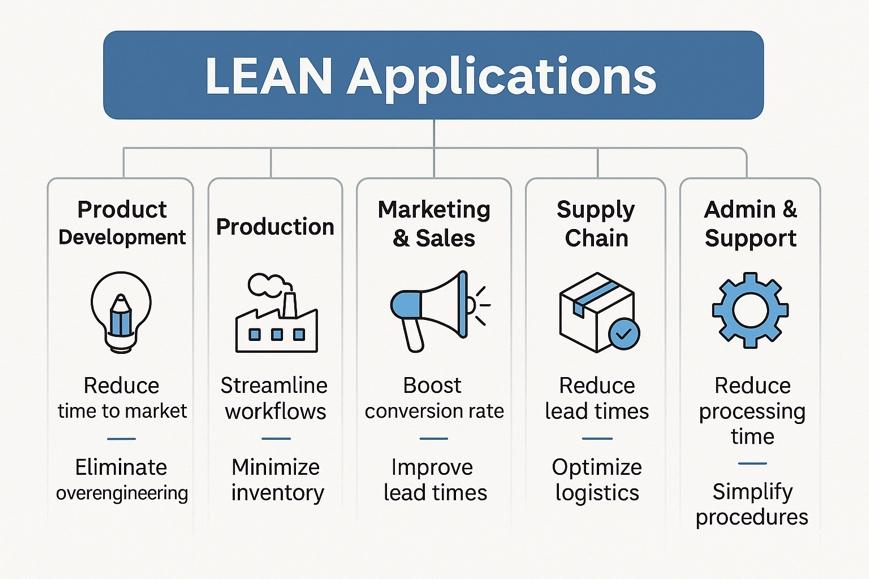
The challenges and success factors involved in lean transformation
Key steps in a successful lean transformation
A lean transformation is not merely the implementation of new tools; it is a comprehensive change in the way an organisation thinks, works, and evolves. For companies that have historically operated under traditional management systems, moving towards lean demands more than just process changes; it requires a deep cultural transformation and a long-term strategic commitment. The following steps outline the essential phases of a successful lean transformation and explain why each is necessary.
1. Obtain the commitment of the relevant leadership team
The first and most critical step is to gain a strong, visible commitment from top leadership. It is imperative that executives understand that lean transformation is not a short-term efficiency programme, but a long-term cultural journey. It is the responsibility of leaders to actively promote lean principles, demonstrate consistent behaviours, and allocate the necessary resources. In the absence of alignment at the highest levels, the efforts made in the lean programme run the risk of being viewed as optional or superficial, which would compromise the programme’s long-term impact.
2. Establish a shared understanding of lean
Prior to implementing any operational changes, it is essential that the organisation develops a shared understanding of the true meaning of lean. This includes a shift in perspective away from the common perception of lean as a toolbox (e.g., 5s, kanban, value stream mapping) towards an emphasis on its core philosophy: delivering value to the customer by eliminating waste and enabling continuous improvement. This mindset shift is necessary to avoid the common pitfall of applying lean tools in isolation, which leads to short-lived gains and fragmented efforts.
3. Engage and empower employees
A successful lean transformation is one in which all members of an organisation are involved. All employees must be engaged, empowered, and trained to identify problems, suggest improvements, and implement changes. In order to achieve this, a conscious investment in the development of problem-solving skills is necessary. This can be facilitated through coaching, workshops and structured learning formats such as a3 thinking or daily kaizen. Empowering employees is a key factor in reducing resistance to change and encouraging ownership of the transformation process.
4. Tailor the approach to the organizational context
Lean is not a “one size fits all” solution. It is important to note that each organisation has its own specific challenges, unique culture and varying levels of maturity. A lean transformation must be customised to align with the unique characteristics of each business environment. This includes understanding the current state, identifying the most critical value streams, and aligning lean practices with strategic objectives. A maturity-based approach ensures that the rollout is paced appropriately and that foundational capabilities are built before scaling more advanced practices.
5. Design a structured rollout and change management plan
A lean transformation should be implemented systematically, not reactively. In order to achieve this, a detailed transformation roadmap is required, clearly outlining the phases, milestones and communication plans. Initiating the process with pilot areas, often termed “model lines” or “lighthouse projects”, enables the organisation to assess and refine its methodology prior to a more extensive implementation. In order to address any scepticism, manage expectations and consolidate early successes, it is also essential to provide support with change management.
6. Track progress and measure success
Finally, clear metrics and performance indicators are needed to track progress and guide continuous improvement. These may include lead time reductions, customer satisfaction scores, quality metrics, or employee engagement indicators. Transparent tracking ensures that improvements are sustained, highlights areas needing attention, and reinforces accountability across the organisation.
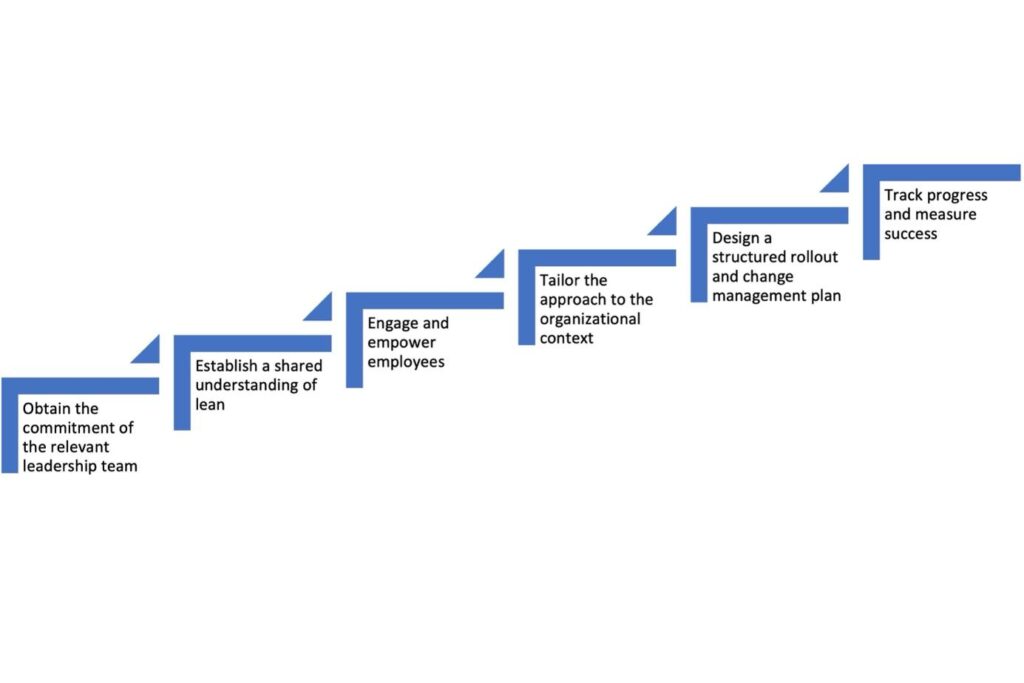
Case Study: Lean Transformation at RECARO Aircraft Seating
Headquartered in Schwäbisch Hall, Germany, RECARO Aircraft Seating is a global leader in the development and production of premium aircraft seats. With over 2,600 employees in Germany, the United States, Poland, China and South Africa, it is firmly established as one of the top three companies in the global aircraft seating market. Despite this success, the company faced significant operational challenges in the early 2010s, including long lead times, inefficient workflows and a lack of process transparency.
Prior to its lean transformation, the company’s production lines were characterised by cluttered assembly areas, disorganised parts storage and unnecessary movement of materials and personnel. These inefficiencies resulted in high operating costs, frequent delays and difficulties in meeting the increasingly dynamic expectations of global airline customers. Recognising the need for a fundamental shift, RECARO initiated a comprehensive Lean transformation in 2013. The programme was spearheaded by Esther Smart and aimed to develop a fully integrated Lean enterprise.
A central pillar of the transformation was the introduction of Shopfloor Management. This system involved regular stand-up meetings, visual management tools, and a more transparent flow of information between teams. Daily performance indicators were displayed on the shop floor, empowering employees to identify and solve problems at the point of origin. This approach fostered a culture of continuous improvement and created stronger engagement across all levels of the organisation.
Another milestone in RECARO’s Lean journey was the digitisation of production processes. The company introduced a paperless system that provided digital access to technical drawings, work instructions and process data at the workstation itself. This reduced errors, shortened changeover times and improved process stability overall. The transformation also included Lean Six Sigma initiatives, particularly at the company’s US site in Fort Worth, Texas. In collaboration with the Texas Manufacturing Assistance Center (TMAC), RECARO doubled its annual production capacity from 20,000 to 40,000 seats — without expanding its physical footprint. These gains were achieved through the rigorous application of DMAIC cycles, value stream mapping and waste elimination workshops.
Furthermore, RECARO involved its global supplier base in the Lean initiative. The company organised supplier conferences to align expectations and processes across the entire value chain. As a result, supplier lead times were reduced, cost structures became more transparent, and the quality of components delivered improved significantly.
The results of the Lean transformation were striking. Lead times were reduced by 46 per cent and the quality of RECARO’s seating systems improved through standardisation and real-time feedback loops. The company received several accolades for these achievements, including the Best Factory Award in 2015 and the TMAC Performance Excellence Award for its US operations.
Critical success factors in RECARO’s transformation included a holistic approach across departments, strong leadership commitment and active employee participation at all levels. Training programmes, kaizen events and Lean certifications further deepened understanding of Lean principles throughout the organisation.
In conclusion, RECARO Aircraft Seating’s Lean transformation is a prime example of how systemic change, driven by a clear strategic vision and executed with discipline, can deliver tangible improvements in productivity, quality and customer satisfaction. The company’s experience highlights the effectiveness of Lean thinking in creating lasting competitive advantages in high-precision manufacturing environments.
Exercise
Task:
Consider the following two questions, write down your answers on sticky notes and share and briefly discuss your thoughts:
1. What is the value that your customer anticipates?
2. Please make a guess: What percentage of the work performed by your organization directly contributes to the creation of this value?
Required equipment:
Flip chart board
Sticky notes
Pens
Approach:
Write the two questions on the flip chart, leave space between for the notes.
Hand out sticky notes and pens, and ask the participants to write their answers on sticky notes, one note per question (don’t discuss previous to or during writing the answers in order to avoid biasing). Time box: 2 minutes.
Ask participants one after the other to stick their notes to the board, next to the respective questions, and briefly explain their answers. Time box per participant approx. 45 seconds. The trainer is time keeper and moderator.
Course Manual 2: Lean development
6. Track progress and measure success
The principles and purpose of Lean Development
When a team begins work on a new product or service, there are often many questions to be answered. What are the requirements of our client base? Which ideas will prove to be effective? What measures can be implemented to ensure that time is not wasted, rework is avoided, and costly decisions are not made prematurely? These questions are central to Lean Development.
Lean Development is the application of the five Lean principles in office, design lab and project room environments, where ideas are born, tested and turned into value. The objective is clear: to create maximum customer benefit while avoiding and eliminating waste. However, the appearances of waste in development differs significantly from those in production.
In the manufacturing sector, waste often manifests in the form of excess inventory, waiting time of goods, or unnecessary motion of goods or workers. In contrast, development focuses on managing uncertainty and building knowledge. The work is rarely repetitive. Each product, service and challenge is new. Rather than assembling parts, teams are focusing on creating new knowledge. They progress from customer needs to preliminary concepts to substantiated solutions through a process of learning, experimentation and collaborative decision-making.
This discrepancy has significant ramifications. Lean Development does not mainly prioritise physical flow; rather, it is concerned with the flow of information and knowledge creation. Rather than aiming to reduce variation at all costs, it seeks to manage it effectively, ensuring that creativity and exploration lead to new knowledge, rather than confusion. Successful Lean Development aims to shorten development cycles, reduce development and product cost, improve product quality, strengthen collaboration across disciplines, and improve decision-making under uncertainty.
In order to understand how this is achieved, it is first necessary to explore the key approaches of Lean Development in following the five Lean principles. Each principle provides practical perspectives through which to assess and enhance your development work.
The first approach is the timely and thorough understanding of customer needs, according to the first principle. In many organisations, the development process commences with assumptions and hypotheses regarding market trends, potential features, and the suitability of the solution. Lean Development, however, does not rely on assumptions. It clarifies the real needs by using interviews, observations and early, mostly iterative customer engagement, even if this takes more time and resources. This entails attentive listening, repeated questioning to ensure understanding, and maintaining an openness to possibilities that are not yet apparent.

The second approach is linked to the value stream principle and focuses on the management of knowledge generation. Creating knowledge in development is a dynamic concept; it is not static. Lean Development encourages systems that support knowledge flow and long term knowledge building: structured and frequent communication, shared visual tools, regular alignment points and documentation in the form of updated standards. By ensuring that up-to-date knowledge is accessible, teams can respond faster and with greater confidence. When insights, lessons learnt or design decisions remain in the personal memory of individuals or in isolated documents, teams are likely to repeat mistakes or miss opportunities.
Another essential approach is to incorporate quality into the design process. This corresponds to the value stream, flow and continuous learning principles. In the manufacturing sector, quality is typically defined as the absence of defects in the final product. In the context of software development, for example, quality assurance involves making well-informed decisions, avoiding unexpected issues that may arise during the later stages of development, and ensuring that concepts are robust from the outset. This is not achieved by inspection but by preventing errors through clarity, early testing, iterative feedback and updating current knowledge. Teams use structured formats, such as A3 reports, to make problems, root causes, solutions and learning visible. These tools promote thoughtful decision-making over rushing and clarity over complexity.
One more important approach is to defer irreversible decisions until the last responsible moment. Traditional development models frequently require the project team to make early decisions, such as selecting a fixed platform, finalising a detailed specification or choosing a final concept. However, in reality, many of these decisions are made earlier than required and before the team has the necessary insight. Lean Development promotes a different timing. Teams are encouraged to utilize all the time until the last responsible moment, e.g. to explore multiple options in parallel, compare alternatives and make a concept decision only when the decision cannot be delayed any longer. The method in this example is known as Set-Based Concurrent Engineering and is a distinctive feature of Lean Development.
Image by lexamer on Freepik
Lean Development employs a range of tools and practices that have been adapted to suit the complexity of creative work. The A3 report is one of the most powerful tools available, and takes its name from the paper size it uses. A3 is not merely a form; it is a method for structuring thinking in terms of problem solving, but also strategy development. An A3 presents the background of a challenge, the current state, the root cause of the issue, and a thoughtful, step-by-step solution—all in a format that invites discussion and shared understanding.
Another vital approach is the use of feedback loops. In Lean Development, progress is not achieved through the execution of a perfect plan, but rather through rapid learning. Prototypes, whether digital or physical, are built to test assumptions. Customer interaction is used to validate ideas, and tests are designed not to impress but to inform. These loops transform the process of development into a dynamic dialogue between the team and the reality of the problem they are solving. Each cycle serves to reduce uncertainty and increase alignment with customer value.
Variation, which is often feared in production, also plays a different role in development. A certain level of variation is not only inevitable, but also essential. Teams are required to explore a range of concepts, conduct comparative analyses and experiment with alternative solutions. Rather than seeking to eradicate variation, the focus should be on directing it in a constructive manner. Lean Development instructs teams in the effective management of creative energy and even mistakes you make in order to learn. The result is not chaos but innovation with direction.
One effective way to initiate Lean development is to implement a pilot initiative. Select one development project, define a few Lean development approaches to implement – such as structured customer interviews or delayed concept decisions – and observe the resulting changes. Improvements in clarity, speed and collaboration are often evident within weeks. A pilot initiative can foster a sense of capability and ownership among team members and stakeholders and spark interest in further methods.
The key differences between lean manufacturing and lean development
When organisations start exploring Lean principles, many assume that Lean Development is simply an extension of Lean Manufacturing. At first glance, the two approaches follow the same five principles and appear to share the same ambition: to maximise customer value while minimising waste. However, the contexts in which they are applied could not be more different. It is vital for any team embarking on a Lean transformation, particularly in innovation-driven environments, to understand the distinction between Lean Manufacturing and Lean Development.
Lean Manufacturing is rooted in physical processes. It operates in environments where tasks are standardised, materials are tangible and workflows are predictable. The focus is on streamlining production lines, minimising delays and reducing inventory levels. A classic example is a car manufacturing plant, where each station along the assembly line has a clearly defined role and the flow of components is tightly synchronised to match customer demand. Waste is relatively easily identifiable: piles of unsold inventory, idle machinery or the unnecessary movement of materials all indicate that the system is not functioning optimally.
By contrast, Lean Development deals with intangible processes. It navigates ambiguity, incomplete information and evolving customer needs. In development, the product is not a finished item, but rather an evolving concept that takes shape through design iterations, simulations, prototypes and feedback loops. Waste is harder to identify in this context. It may manifest as late decisions, endless revisions, or impressive yet unused features.

Image by freepik
Another critical difference lies in the approach to standardisation. Manufacturing thrives on repetition. Standardised processes ensure consistent output, predictable quality and safe working conditions. Every second saved on an assembly task and every motion removed from a worker’s routine contributes to efficiency. However, in development, the emphasis shifts. Standardisation still plays a role in areas such as code versioning, documenting design choices and conducting technical reviews, but too much uniformity can hinder innovation. If engineers are forced to follow rigid templates or fixed workflows, they may stop experimenting. Lean Development therefore encourages structured flexibility: enough discipline to learn from experience, but enough freedom to explore new paths.
Let us consider a hypothetical example from the electronics industry. On the production line at a circuit board manufacturing company, workers use standardised checklists to inspect every board for defects before it moves to the next stage. In contrast, the R&D team developing a new board design must work with uncertainty. They explore several layout options simultaneously, consult customer feedback early on and adapt their plans as new requirements emerge. For them, the checklist is not a blueprint, but rather a guideline that evolves as they learn. This illustrates how standardisation in development is about learning and reuse, not just compliance.
The differences in value streams, waste and standardisation naturally lead to different management styles. In Lean Manufacturing, leadership is often focused on controlling variability. Line managers monitor takt times, analyse defect rates and intervene when the production line stops. Their role is to stabilise and sustain a reliable process. In Lean Development, however, leaders must deal with a different kind of variability: that of ideas, insights and evolving needs. Here, leadership is about enabling. Rather than enforcing solutions, Lean leaders encourage collaboration between disciplines, promote problem-solving at team level and foster an environment where learning is both safe and expected.
Another area where Lean Manufacturing and Lean Development diverge is metrics. Manufacturing metrics are usually operational, such as output per hour, scrap rates and machine uptime. They reflect the stability and efficiency of a physical system. Development metrics, on the other hand, are more abstract and learning-oriented. Successful Lean Development teams track things like knowledge maturity (‘How confident are we in our technical choices?’), the number of validated design options, customer response to early prototypes and even team engagement. These metrics serve to spark reflection and guide next steps, as well as reporting progress.
In a Lean Development environment, the focus is not on how many units were produced today, but on what was learnt that will help deliver customer value. This shift in mindset is perhaps the most profound difference between the two approaches. Lean Manufacturing mainly optimises what is already known, whereas Lean Development discovers what is not yet known.
For teams engaging in Lean transformation, these distinctions are more than academic. They determine which tools to use, how to structure teams, how to define success and how to support people through change. Applying Lean Manufacturing tools blindly to a development context can lead to frustration. For instance, using production-style Gantt charts to plan innovation projects can result in unrealistic expectations and hinder learning. Conversely, applying development-style practices to a mature production line can undermine stability. The art of Lean lies in understanding the context and apply the Lean principles accordingly.
Ultimately, Lean Manufacturing and Lean Development are two expressions of the same philosophy: delivering more value with less waste. However, to achieve this in practice, organisations must recognise the unique dynamics of development work. They must accept that ambiguity is a feature, not a flaw, and that learning is a continuous journey, not a phase. By embracing specific practices of Lean Development — set based engineering, early validation, iterative design, empowered teams and flexible frameworks — organisations can unlock their creative potential and bring better products to market faster.
The following table shows various aspects of lean management and compares their manifestations in lean manufacturing and lean development.
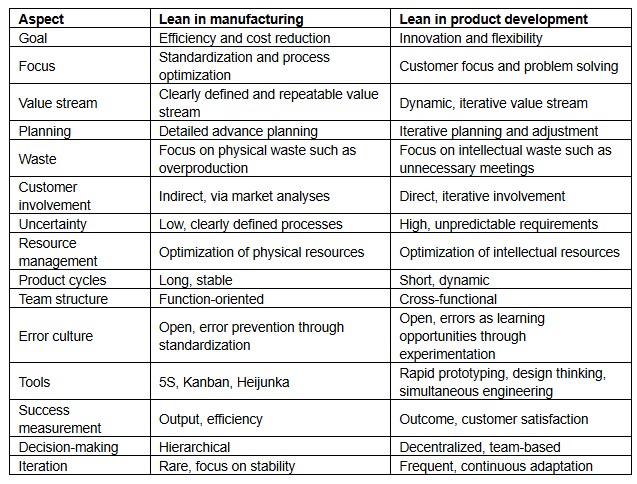
Implementing lean development in a corporate context
Integrating Lean Development into an organisation is not just a matter of applying a set of tools. It requires a fundamental shift in mindset on all levels of hierarchy that challenges the traditional management of innovation. In many companies, particularly those that have grown around established product lines or in regulated environments, development has long been governed by stage-gate models. These models have certainly brought structure and accountability, focusing on predictability and control. However, they often struggle in environments where customer preferences evolve rapidly and technological disruption is the norm. In such cases, rigid processes can hinder progress more than help it.
Lean Development offers an alternative approach, fostering adaptability through structured learning. It replaces long, inflexible planning cycles, e.g. phases and phase gates, with short, iterative feedback loops. These short cycles are designed not just to complete tasks, but also to validate assumptions early on, experiment with alternatives and incorporate customer insights into the development process. The feedback is based on intermediate results that can be compared to value definitions, not only on tasks performed. This adaptive rhythm makes Lean Development well-suited to industries where new market needs, regulatory shifts or technical breakthroughs can transform the landscape overnight.
To implement Lean Development effectively, organisations must first reimagine the structure and autonomy of their teams involved in creating the product or service. Cross-functional teams play a pivotal role. Unlike traditional, function-oriented structures, where responsibilities are strictly divided by discipline — engineering, marketing or manufacturing — Lean teams bring these competencies together from the outset. A shared objective replaces the handover mindset, and team members are empowered by their line managers to make decisions within clear strategic boundaries. When supported by lightweight governance and clearly defined priorities, this model dramatically reduces development lead times and increases responsiveness to market signals.
However, Lean Development is not just about achieving better and faster results; it’s also about fostering deeper engagement. Teams often report a stronger sense of ownership and motivation when they are trusted to make decisions and experiment responsibly. This cultural transformation, however, does not happen overnight. It requires leaders trained in lean management, who demonstrate tolerance of uncertainty, frame setbacks as learning opportunities and recognise that value creation begins with discovery, not just execution.
Agile frameworks such as Scrum or the Scaled Agile Framework (SAFe) are strongly designed based on the lean principles and are often used to implement Lean principles. They provide a concrete structure for iteration, prioritisation and team alignment. However, authentic Lean Development goes further. Rather than treating agility as a delivery tactic, it treats it as a philosophy that permeates the entire product lifecycle — from strategic planning to engineering execution. Companies that embrace this comprehensive approach find themselves better equipped to innovate sustainably, respond quickly to market changes, and grow their internal capabilities in the long term.
Ultimately, implementing Lean Development is a journey of continuous adaptation. It’s about cultivating a culture in which people on all hierarchical levels are curious, courageous and connected to the real problems that customers face.
Case Study: How John Deere reinvented its development process with lean thinking
For decades, John Deere has been synonymous with industrial reliability, renowned for manufacturing some of the world’s most trusted agricultural and construction machinery. However, as the company shifted towards offering more software-driven solutions, it became clear that traditional development methods could no longer keep pace with modern customer needs.
Software updates were slow, development cycles stretched on for months and innovation was hindered by rigid processes. Customers were demanding smarter, more connected machines, and John Deere knew it had to rethink its approach to product development.
In 2012, the company took a bold step and began to transform its development organisation using Lean principles. Over the course of five years, John Deere gradually rolled out Lean Development practices across multiple teams and business units, focusing first on its embedded software division.
At first, the change wasn’t easy. Engineers and project leads were accustomed to waterfall models involving long planning phases followed by inflexible execution. However, Lean Development introduced cross-functional collaboration, faster feedback and, above all, a clear focus on delivering real value to customers.
Teams started experimenting with Agile sprints and involving customers early on. They replaced long decision chains with lightweight visual tools such as A3 reports. Product ideas were quickly tested through prototyping, and unnecessary complexity was stripped away. Leaders stopped acting like supervisors and started acting like coaches, supporting team learning and helping to remove roadblocks.
The results were remarkable. Software delivery became faster and more predictable. Teams felt more empowered. Most importantly, customers noticed the difference: smarter machines, better usability and quicker responses to their needs.
Today, John Deere is known not only for building strong machines, but also for building innovation into its processes. Its Lean Development journey proves that large, traditional companies can become agile innovators if they are willing to learn, experiment and prioritise customer value.
Exercise
Task:
Please write down on sticky notes examples where you encountered waste in your daily work — not in the form of physical materials or idle machines, but in lost time, unnecessary complexity, or misaligned priorities. Share and discuss your examples. Please also state how you identified this waste.
Required equipment:
Flip chart or board
Sticky notes
Pens
Approach:
Write the task on the flip chart, leave space for the notes.
Hand out sticky notes and pens, and ask the participants to write their answers on sticky notes, one note per example (don’t discuss previous to or during writing the answers in order to avoid biasing). Time box: 2 minutes.
Ask participants one after the other to stick their notes to the board and briefly explain and discuss their answers. Time box per participant approx. 45 seconds. The trainer is time keeper and moderator.
Course manual 3: Lean principles
Understanding the five Lean Principles
The foundation of Lean thinking lies in five core principles, originally defined by James Womack and Daniel Jones in Lean Thinking (1996). These principles provide a practical framework for rethinking business processes and redesigning them for improved efficiency, quality, and responsiveness.
1. Principle: Specify value
Every Lean journey begins with a deceptively simple question: What is value? In Lean thinking, the answer does not lie within the organisation itself, but with the customer. ‘Specify value’ is the first and most fundamental principle because it defines the purpose of all activity. Without a clear understanding of what the customer truly values, even the most efficient processes risk creating waste.
Value is always defined from the customer’s point of view. This means that it is the customer, not the engineer, designer or manager, who decides what is worth paying for. While this idea seems intuitive, putting it into practice is far from easy. In development projects, customer needs are often ambiguous or subject to change. Teams may focus on features they assume are important, only to later discover that these features are barely used. Value can be found in unexpected places, such as simplicity, emotional resonance or seamless integration with other tools, not just functionality.
Unlike manufacturing, where value is usually tied to meeting technical specifications, product and service development must navigate a more dynamic landscape. Here, value cannot simply be defined once — it must be discovered, tested, refined and revalidated throughout the development process. This is why early and continuous customer engagement is essential. It helps teams avoid acting on assumptions and encourages them to ask, observe and learn directly from their target users.
Consider the case of a software company that realises that a large proportion of its features are not being used. Initially, these features were considered valuable additions. However, through user research and feedback, the team uncovers a different truth: users prioritise simplicity and speed over complexity. By focusing their efforts on improving the core functionalities that users truly depend on, the company enhances customer satisfaction and saves time and resources.
This principle invites a shift in mindset. Rather than asking, “What can we build?”, teams should ask, “What does the customer really need?” When organisations base their work around this question, they sharpen their focus and increase their impact. Unnecessary work is reduced, leaving only that which is more relevant, targeted and valuable.

2. Principle: Identify the value stream
Having specified what the customer truly values, the next logical step in Lean thinking is to uncover how that value is created. This is the essence of the second principle: identifying the value stream. This invites us to take a closer look at every step involved in turning an idea into a solution that is delivered to the customer, whether that solution is a physical product, a digital tool or a service.
In manufacturing, the value stream is often straightforward. Materials move from suppliers to production lines and eventually to customers. The flow is tangible, the steps are visible, and the waste is often physical, such as leftover materials, excess inventory, or idle machines. These processes can be observed, measured and mapped relatively easily.
In development, however, the value stream is far less obvious. Here, what flows is information in the form of ideas, requirements, specifications, test results, design decisions and customer feedback. These are harder to see and even harder to measure. In this context, waste is often hidden in long email threads, unnecessary meetings, unclear approvals, repeated work due to miscommunication, and lost knowledge when employees leave. Delays and inefficiencies can easily be overlooked because they are embedded in processes that feel routine.
This is why making the development value stream visible is such a crucial starting point. This may involve visualising decision-making processes, mapping out learning loops, or tracing the flow of information across teams. Simple tools such as swim lane diagrams, sticky notes or digital whiteboards can be highly effective in illuminating what would otherwise remain hidden. The aim is not to create more documentation, but to foster a shared understanding and reveal where time and energy are being spent.
Imagine a company that realises that a significant proportion of its project lead time is lost not during development itself, but during handovers — waiting for approvals, switching responsibilities or clarifying requirements, for example. By restructuring their workflow to enable more parallel work and clearer responsibilities, they can drastically reduce delays and improve transparency. As a result, their teams deliver faster and collaborate more effectively.
Identifying the value stream enables organisations to distinguish between activities that genuinely add value and those that merely consume resources. Once these are visible, teams can begin reducing or eliminating the unnecessary, whether that’s excessive documentation, repeated testing or approval loops that offer no additional insight. This principle lays the groundwork for flow, speed, and quality.
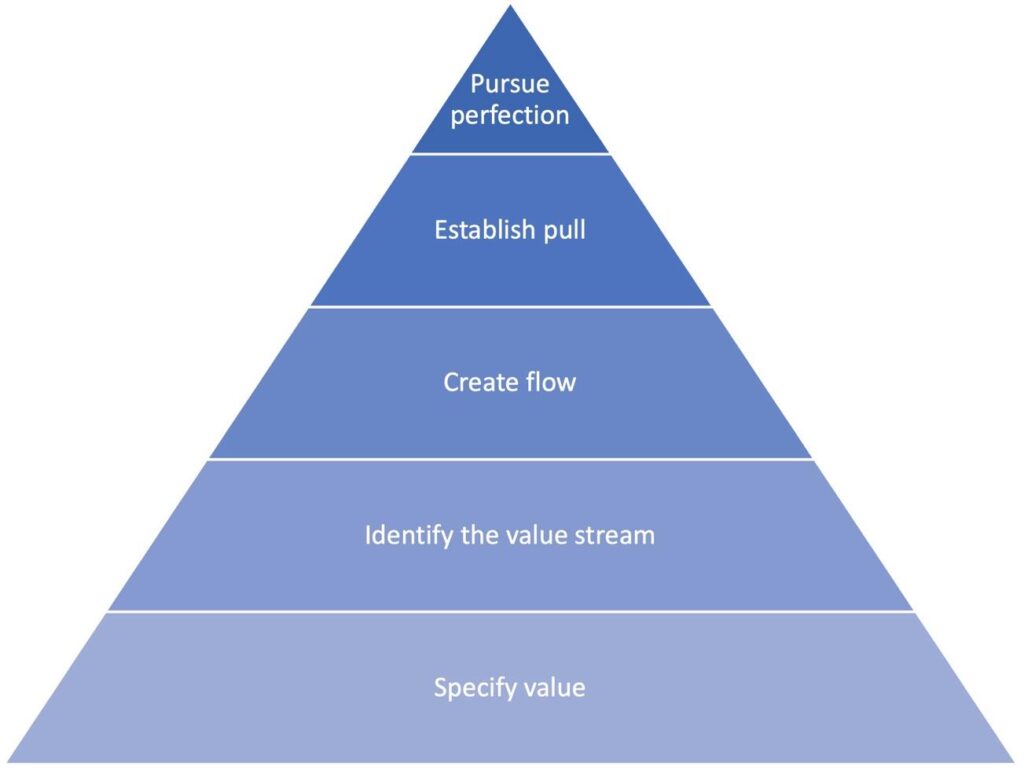
3. Principle: Create flow
Once the value stream has been identified, the third Lean principle comes into focus. Create flow. This principle ensures that work progresses smoothly and continuously without any unnecessary stops, delays or disruptions. In manufacturing, ‘flow’ refers to the steady movement of materials through the production line, with each station adding value without creating bottlenecks or queues. However, in development, flow takes on a broader and more nuanced meaning.
Here, it describes the uninterrupted advancement of meaningful work, such as problem solving, design iterations, code reviews, testing cycles, decision making and learning. When flow is achieved, teams can work with clarity and momentum. Tasks are completed in a logical order, feedback arrives in time to be useful and the next step is always clear. Work moves forward with rhythm, not in fits and starts.
However, flow in development is fragile. It can be disrupted by unclear responsibilities, delays in approvals, missing input or misaligned communication. As development work is highly interdependent and knowledge-intensive, even a minor disruption, such as the late delivery of a specification or an unanswered question, can halt progress for an entire team. Unlike in production, where a blocked machine is easily detectable, blocked thinking or stalled decisions often remain invisible until deadlines are missed.
To support better flow, teams must create structures and habits that reduce friction. This could involve shortening feedback loops, improving the availability of key stakeholders, or simplifying coordination across departments. It also involves designing digital or physical work environments that enable fast, transparent communication. Teams that visualise their workflow, for example using Kanban boards or task tracking tools, are often better equipped to detect and address flow interruptions early on.
Consider a team that routinely waits several days for design approvals. By redesigning the approval process — perhaps by introducing agreed design patterns or clearer delegation — they can eliminate waiting time and maintain development momentum. As a result, outcomes improve and team members experience less frustration and more progress. Smoother processes reduce stress, improve motivation and strengthen collaboration.
Flow is not about rushing or multitasking. It enables people to focus, contribute and move forward without unnecessary friction.
With a clearer view of the value stream, attention turns to the third principle: creating flow. In manufacturing, flow means that materials move continuously through the production process without stoppages or queues. Every station delivers value without waiting. In the context of development, the term ‘flow’ assumes a different significance. It refers to the smooth progression of meaningful work – design activities, reviews, experiments, decisions – without unnecessary interruptions or handovers. It is also important to note that this refers to the flow of feedback and learning. Delayed feedback disrupts workflow to the same extent as a blocked conveyor belt would in a production environment. The development process is characterised by its fragility due to the interdependence and knowledge-intensity of the tasks involved. Any late clarification or missing document can have a significant impact on the entire team. In order to improve flow, development teams must reduce waiting times between iterations, avoid unnecessary approvals, and design their workspaces – physical or digital – to support fast, informed communication. The benefits of improving flow are significant, including fewer handovers, faster feedback and more reliable outcomes. Improved employee satisfaction is also achieved through enhanced levels of flow, which in turn reduces stress and fosters a sense of progress within teams.
4. Principle: Establish pull
The fourth Lean principle, ‘Establish Pull’, encourages us to question the deeply ingrained tendency in many development environments to push work forward simply because it has been planned. In traditional settings, teams often attempt to plan every task in advance and execute them step by step, regardless of whether the conditions for value creation are in place. Lean thinking, by contrast, encourages a more adaptive, demand-driven approach that focuses on pulling rather than pushing.
In manufacturing, the concept of pull is straightforward. Production only begins when there is real demand, either from a customer or the next stage in the process. This keeps inventory levels low, reduces overproduction and ensures work in progress aligns with actual needs. There is no build-up of goods waiting to be used. Everything is purpose-driven.
In development, pull works differently, but the principle is the same. Rather than producing code, features or documents based on assumptions or internal pressure, teams should only act when there is a validated need — when the customer (internal or external) signals their readiness or interest. In other words, development work should be based on real feedback, current insights, and clear value. Pull discourages the development of features that ‘seem like a good idea’ but for which there is no proof of demand.
To achieve this, teams can use tools such as Kanban boards, clearly prioritised backlogs and limits on work in progress. These mechanisms help to visualise the current state of work and ensure that new tasks are only started when there is capacity and justified demand. By establishing pull, teams become more responsive and focused. They reduce rework, avoid overproducing features, and use their resources more effectively.
Consider a development team that frequently develops features before receiving customer feedback, only to later discover that many of these features are either unused or require redesign. By shifting to a pull-based approach, where ideas are tested early, feedback is gathered continuously and work is only advanced when necessary, they can begin to deliver more relevant solutions. This doesn’t mean reacting passively, but rather aligning effort with timing and purpose.
Ultimately, pull is about timing and relevance. It encourages teams to ask: is this the right thing to do right now? When applied consistently, this principle helps to reduce waste, increase agility and ensure that every step in the development process brings the team closer to delivering real value.
5. Principle: Pursue perfection
The final Lean principle, the pursuit of perfection, provides the necessary forward momentum. It acknowledges that there is no final state of efficiency or quality. Instead, improvement is a continuous and integral part of the work culture. In the manufacturing sector, this may entail refining a production cell, enhancing tool maintenance, or standardising a new best practice. In the field of development, the pursuit of perfection entails the acquisition of enhanced learning skills. It involves regularly reflecting on effective and ineffective practices, capturing insights for future projects, and encouraging experimentation without fear of failure. Continuous improvement in development is not just about speed or cost; it is about reducing the distance between customer need and solution, between question and answer. One effective method of instilling this mindset is to implement brief, structured retrospectives at key decision points. These sessions enable teams to identify areas of challenge, celebrate insights, and enhance their working practices while continuing to operate.
It is important to note that perfection in this context does not mean eliminating uncertainty. On the contrary, it signifies the establishment of systems and cultures that are able to navigate uncertainty more effectively. High-performing Lean teams embrace experimentation, use data to inform choices, and share knowledge openly. Leaders play a critical role by creating an environment where it is safe to identify problems, suggest improvements, and reflect on failures without fear of blame.
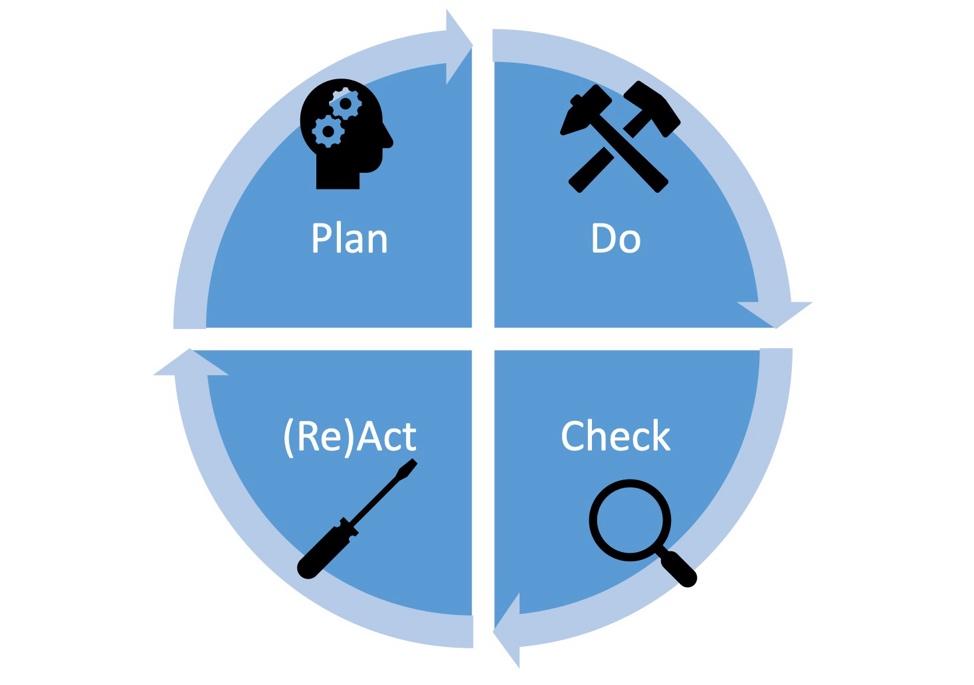
Interpreting Lean Principles Across Functions: Shared mindset is key to adapting effectively
The development of products and services is a collaborative process involving multiple departments, including engineering, production, marketing, logistics, finance, and customer service, among others. In order for Lean to be successfully implemented, its principles must be interpreted and applied across these boundaries. The objective is not to implement uniform processes across the board. The objective is to establish a shared understanding that can be adapted to suit each functional context.
Although the five Lean principles provide a common foundation, they do not apply uniformly across all domains. In the manufacturing sector, the emphasis is frequently placed on physical flow processes. Processes are visible, repetitive, and measurable. The interpretation of “value” is straightforward: delivering a defect-free product that meets specification. The value stream is mapped through machines, parts, and workstations. Flow is about synchronising production, minimising downtime, and reducing waste such as excess inventory or overproduction. Pull is implemented through just-in-time systems, and perfection is pursued by standardising best practices and reducing variability.
The next step is to shift the lens to product development. Here, the concept of value is less tangible and often uncertain at the outset. It must be clarified through exploration, feedback and experimentation. Waste does not stem from scrap or idle machines, but rather from untested features, misaligned assumptions, or repetitive discussions resulting from inadequate knowledge flow. In the context of software development, flow is defined as the rapid progression of teams from conceptualisation to substantiated insights. Pull becomes a discipline of withholding action until decisions are informed by data. Instead, perfection is about strengthening the team’s ability to deal with variation.
A further distinction becomes apparent when we examine administrative or transactional work. In functions such as HR, finance, procurement, or compliance, the principles take on a different form. The concept of ‘value’ can be understood in a variety of ways. For example, it can be internal, in which case it might support other teams, process requests or manage risk. The value stream encompasses approvals, documentation, and handover processes. The objective of flow is to reduce lead times, eliminate unnecessary steps, and ensure that tasks are processed efficiently. Waste can be less visible but no less real. For example, think of emails waiting for responses, duplicate entries, or missing context that causes back-and-forth. Pull here means not overloading teams with unprioritized requests. The pursuit of perfection entails enhancing clarity, transparency, and the responsiveness of our service.
In customer-facing roles such as service, support, or healthcare, an alternative interpretation emerges. The concept of value becomes deeply personalised. It is important to recognise that the preferences of one customer or patient may differ significantly from another. The value stream is dynamic, often built around conversations, appointments, or problem-solving steps. Flow is about delivering consistent, timely and coordinated experiences. Pull means responding to demand without overloading the system. This could be a service request, an appointment booking, or a critical care need. Continuous improvement is achieved by listening to feedback, identifying pain points, and enabling those closest to the work to suggest changes.
Across all these domains, one pattern becomes clear: while the expression of Lean differs, its spirit remains constant. The core principles of the company continue to be the delivery of value, the reduction of waste, the encouragement of transparency, and the creation of systems that empower people to improve their work.
Case Study: Toyota Motor Corporation — The application of Lean principles in product development at Toyota
Toyota Motor Corporation is widely recognised as the originator of Lean Thinking, and its influence extends far beyond manufacturing into the realm of product development. At the core of Toyota’s development system is a strong commitment to the five lean principles: defining value from the customer’s perspective, identifying the value stream, creating flow, establishing pull, and striving for perfection. Each of these principles is meticulously incorporated into Toyota’s approach to introducing new vehicles to the market.
The first principle, understanding value, is a cornerstone of Toyota’s product planning. Before the design process commences, cross-functional teams invest significant effort in ascertaining customers’ true requirements, not only in terms of features and price, but also in terms of driving experience, reliability, and long-term satisfaction. This customer-centric approach is integral to every stage of the design process, from the initial concept to the final specifications.
In order to identify the value stream in development, it is necessary to visualise knowledge, decisions and deliverables rather than physical materials. Toyota maps the progression of ideas and information from concept to launch. This includes technical feasibility assessments, design iterations and validation stages. By doing so, the company identifies knowledge gaps and potential sources of delay or rework, enabling teams to take targeted action.
The creation of flow in development is achieved through the implementation of structured yet flexible processes. Set-based concurrent engineering is a vital component of this process, as it enables teams to explore multiple alternatives in parallel rather than narrowing quickly to a single design solution. This approach prevents premature decisions and encourages learning from different possibilities, thereby reducing the likelihood of costly late-stage changes.
Systems under development function in a different manner to those in manufacturing. At Toyota, teams access knowledge when it is required and avoid overloading decisions too early. For instance, engineers generally defer final decisions on design parameters until sufficient customer data and simulation results are available. This approach helps to prevent unnecessary rework and ensures that efforts are aligned with actual requirements.
Finally, the principle of perfection is embedded in a culture of continuous improvement. Engineers are encouraged to reflect on each development project, document lessons learned, and apply them to future work. Leadership supports this by framing failures not as setbacks, but as valuable opportunities to refine methods and increase the organization’s learning capability.
Toyota’s success in impleme
Exercise
Task:
Please select the principle that feels most relevant to your current role, and describe a situation in which this principle was either present and powerful or absent and painful.
Required equipment:
Flip chart or board
Sticky notes
Pens
Approach:
Trainer: Prepare a flip chart or board showing the 5 lean principles and another flip chart with the task.
Trainer: Hand out sticky notes and pens, and ask the participants to write their answers on sticky notes, one note per participant (don’t discuss previous to or during writing the answers in order to avoid biasing). Time box: 2 minutes.
Participants: Silently write answers on notes, without discussing.
Trainer: Ask participants one after the other to stick their notes to the board and briefly explain their answers. Questions, short discussion. Time box per participant approx. 45 seconds. The trainer is time keeper and moderator.
Course Manual 4: Lean versus traditional
From Control and Efficiency to Value Creation — Understanding the Shift to Lean Development
This session will provide an insight into the fundamental shift from traditional product development to Lean Development.
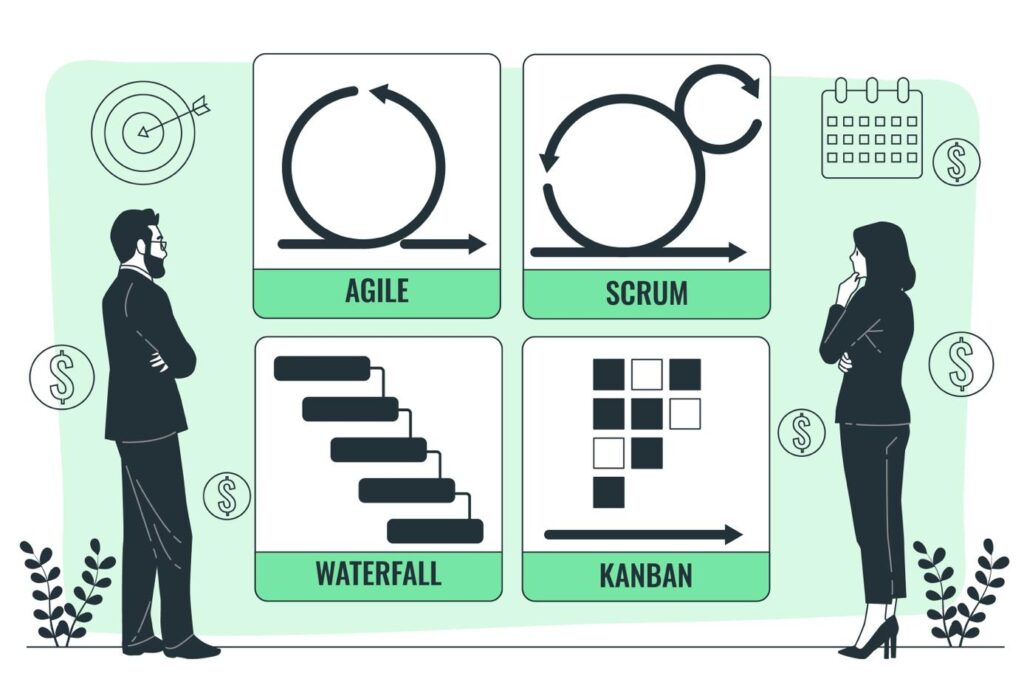
The Philosophical Divide
Please imagine two teams commencing the same project. The first team follows a classical product development approach. This means that roles are clearly defined, the goal is fully understood and established, planning is forward-looking and detailed, and progress is monitored using fixed milestones. The other team’s approach to Lean Development involves prioritising learning, maintaining close alignment with customer needs, and a flexible approach to change. The goal is assumed to be variable, and planning is frequently adjusted.
On initial observation, the classical team may appear to be more “professional”. Their project plans are carefully prepared. However, let us now consider the situation six months later. The Lean team has successfully completed three iterations of the prototype, with functionalities continually validated through real-time customer feedback. The team has demonstrated its ability to adjust course based on insights, ensuring the continuous improvement of the product towards the customers’ expectations. However, the classic team is busy preparing for the subsequent internal phase gate and has not yet build prototypes and received any customer feedback at this stage.
This example illustrates a fundamental difference in mindset. Classical development is grounded in control and efficiency. It is assumed that greater control over inputs and standardisation of processes will result in more predictable outcomes. In Lean Development, the objective is value creation. Rather than focusing on task efficiency, Lean emphasises learning, flow and the usefulness of outcomes.
Let us now consider how these differences manifest in practice.
Power and Participation
In traditional development, decision-making is centralized. Strategy and direction are determined by senior management, while the implementation of improvements is the responsibility of subject matter experts. This approach is founded on the principle that complexity must be managed through structure.
Lean Development recognises that individuals with close proximity to the work are pivotal to the enhancement process. Teams are encouraged to identify problems, run experiments, and develop better ways of working. This decentralised learning culture has been shown to increase engagement and frequently results in more effective solutions.
Change: Project or Process?
In classical systems, change is often planned like a renovation: expensive, disruptive, and carefully scheduled. Only a small number of employees are assigned to change projects, which means that they are no longer able to perform their normal duties.
Lean views change as a continuous activity that is carried out alongside normal tasks. Steady progress is achieved through the consistent implementation of minor, incremental steps, integrated into the daily operational rhythm. This approach ensures a safer, faster and less risky change process.
Success Metrics: Internal vs. External Focus
Conventional systems of measurement of success are based on the degree to which internal goals are met, such as budget, utilisation and timeliness. While these metrics are important, they can also be misleading. A team may successfully deliver a project “on time and on budget”, yet fail to meet the customer’s actual requirements.
Lean Development is a process that is outcome-focused. Success is defined by the successful fulfilment of customer requirements, the delivery of tangible value, and the acquisition of knowledge. The cost or effort involved in achieving a goal is important, but only if it serves to support that goal.
Processes vs. Systems Thinking
In traditional development projects, work is often divided into departments and stages. Each function is designed to optimise its specific tasks. For instance, engineering focuses on maximising technical performance, purchasing aims to minimise costs, and marketing determines the company’s narrative. However, this siloed approach to optimisation can result in global inefficiencies. While each component functions adequately, the overall system does not perform as intended.
Lean Development employs systems thinking methodologies. It examines the end-to-end flow of value, from customer need to delivered solution. Rather than focusing on local optimisation, it aims to maximise the value for the customer, enhance flow efficiency between departments, minimising handovers, and facilitating system-level learning.
A Culture of Learning
A learning-oriented mindset is at the heart of lean development. The classic approach aims to eliminate uncertainty. Lean is compatible with this. But instead of planning every detail in advance, lean assumes that we do not yet have all the necessary information.
In practice, this means shorter cycles, smaller batches and more feedback. Failure is not feared, but embraced to a certain extent. A prototype that does not function effectively can provide more valuable learning opportunities than a comprehensive report. Progress is derived from cycles of exploration, rather than from the pursuit of perfection.
Structures, Metrics and Decision-Making in Lean Development: A Rethinking of How Work Gets Done
Silos and specialisation can be both beneficial and detrimental to business success.
In many organisations, product development is typically divided into distinct departments. The core function of engineering is to solve technical problems. Marketing is the process of defining customer needs. The finance department is responsible for budgetary control. Each function operates within its own sphere, guided by its own priorities, goals and metrics. This structure reflects the industrial logic of the past: break complex work into parts, specialise, and manage each part to maximise efficiency. However, in complex development environments, this approach can present certain challenges.
Please imagine the following scenario: engineering completes a design, but marketing requires changes based on new customer insights. The design is informed by engineering principles. Due to the ambiguity of the scope, the finance team has delayed approval. Each handover has the potential to create friction. The system is not the cause of these delays, but it does create a situation in which frustration and rework are unavoidable.
This issue is more than just a question of communication. The issue is structural in nature. Each silo optimises its own work, but there is no one responsible for the flow of value across the system.
Lean structures are a key element of our business model, with a focus on organising around value. Lean Development breaks down silos. Instead of organising teams by department, it organises them by value streams – the full sequence of activities required to deliver a product or service.
In a Lean setup, a cross-functional team might include product managers, designers, engineers, quality experts and even customer support — all working together, aligned around a shared outcome. These teams do not merely collaborate; they co-own the result.
The change is both subtle and substantial.Rather than transferring work from one specialist group to the next, the team collaborates to learn, solve problems and progress as a cohesive unit. Leadership roles also change. Managers should adopt an enabling role, providing coaching and removing obstacles to help the team succeed. This approach should support rather than dictate.
Measuring key performance indicators to encourage effective conduct
Each system is engineered to yield specific outcomes, with metrics playing a pivotal role in this design. Traditional metrics primarily concentrate on activity-related aspects, such as machine uptime, utilisation rates, budget variance and the number of hours worked. The metrics indicate the system’s operational efficiency, though not necessarily its performance capability.
Consider a team that is rewarded for keeping machines running at all times. The unintended result? The issues that require our attention are overproduction, excess inventory and waste. The metric creates behaviour that appears efficient, but is not aligned with customer needs.
Lean Development replaces activity-based metrics with flow-based, customer-focused indicators. Metrics such as lead time, first-pass yield, on-time delivery, and customer satisfaction provide a system-level view. They inform us as follows: We are committed to delivering value in a timely, reliable and efficient manner, while also maintaining stringent waste management standards.
Decision-Making: From Control to Capability
In traditional development, decisions are centralised. Plans are approved at the highest levels, and any deviations are escalated accordingly. The system operates on the assumption that information flows upwards and decisions flow downwards.
This approach is effective, provided that the environments remain stable and predictable. However, in dynamic contexts such as R&D or rapidly evolving markets, the ability to learn quickly can give a company a significant competitive advantage. In such cases, centralised control can impede efficiency.
Lean Development flips the logic. Decisions are made at the point of sale, where real-time information is available. Teams are empowered to experiment, adjust, and act quickly. Leadership provides clear direction, but also trusts the team to find the best path.
Please imagine a scenario in which a team becomes aware of a quality issue during the testing process. In a traditional setup, they may write a report, escalate the issue, and wait for a decision. This will result in a loss of working days. In a Lean setup, they investigate immediately, run a test, adjust, and inform others. The loop is closed within hours.
Structures Shape Culture
Structures, metrics and decision-making approaches have a significant impact on behaviour, and, in turn, on shaping the culture of an organisation. A siloed, metric-driven, control-based system can result in teams that are cautious and reactive. A system that is flow-oriented, outcome-driven and empowering will create learning organisations.
The objective of Lean evelopment is not merely to adopt a different approach to work, but to adopt a different way of thinking. We should consider product development not as a series of steps to be managed, but as a system to be continuously improved.
Culture and Behaviour — The Human Dimension of Lean Development
Whenever we discuss processes, structures and metrics, it is important to remember that culture is the most significant enabler – or inhibitor – of change. Culture cannot be defined by a simple handbook. It is the way in which people think, behave and interact on a daily basis. It’s what happens when no one is watching. And in the context of Lean Development, it is the true lever for transformation.
Let us examine in greater detail how cultural and behavioural dimensions influence – and are influenced by – your development approach.
People as Executors vs. People as Contributors
In traditional systems, the dominant assumption is clear: people are there to execute. The process design is predetermined; the role of the employee is to adhere to the stipulated instructions. Control is maintained through a combination of rules, supervision, and compliance reviews. The result? A culture of caution, where improvement is the responsibility of others and deviation from the plan is often seen as failure.
In a Lean culture, people are not just resources — they are problem solvers, innovators, and agents of change. The fundamental principle is that when individuals are entrusted with responsibility, given adequate support and opportunities to contribute, they will enhance both their own work and the system in which they operate. Respect for people is not just a slogan. It is evident in the day-to-day operations of the company: in morning meetings where issues are addressed; during Gemba walks where managers observe and learn; and in suggestion systems that lead to tangible action.
Control vs. Autonomy in Everyday Work
Traditional administration and customer service processes often rely on policies and approvals. Should a customer have a complaint, the front-line worker may refer it to the relevant department. Should an exception be required, a form is submitted, a manager signs off, and a number of days pass. These controls are designed to prevent errors, but at times they can also hinder progress.
Lean cultures prioritise autonomy and flow. Rather than a complex system of authorisation, Lean poses the following question: How can we simplify this? Which decisions can be made directly by those with the most intimate knowledge of the situation? In which areas are we creating friction – and what can we do to remove it?
In practice, this might mean giving customer service teams the authority to resolve certain complaints immediately. Another option would be to allow administrative staff to bypass unnecessary approvals. In development, this might mean replacing rigid stage gates with rapid learning cycles and collaborative reviews.
From Blame to Learning
Culture is most evident in an organisation’s response to failure. In traditional systems, errors are often met with blame. The natural inclination in such cases is to identify the source of the error and implement measures to prevent its recurrence, often through the introduction of new regulations, forms, or reviews. However, this approach rarely addresses the root cause.
Lean organisations adopt a different perspective: problems are viewed as signals rather than as sources of shame. A defect or delay is an opportunity to understand the system better. The emphasis is on the process rather than the individual. What were the reasons for this? How can we make it visible? What measures should be implemented to prevent this issue from arising? The answer lies not in the application of punishment, but rather in the redesign of our processes and in learning.
Many Lean teams use simple techniques like “5 Whys” or root-cause diagrams during their retrospectives. Our primary objective is to facilitate learning, rather than engaging in judgement.
Leadership as Coaching, Not Commanding
In traditional business settings, leadership is often equated with authority. Managers decide the direction to be taken, while others execute the plans. Progress is reviewed in meetings, and any necessary corrections are issued from the top-down.

Lean leadership looks different. Leaders are coaches. Rather than being the most intelligent individual in the room, their role is to develop the capabilities of those around them. They go to the place where work happens (the Gemba), ask questions, remove barriers, and support improvement. They don’t just review results — they enable the system that creates them.
Building a Lean Culture: Where to Begin
One of the most challenging aspects of Lean transformation is effecting a change in organisational culture. The focus is not on introducing new slogans or posters, but rather on implementing thousands of small changes in behaviour, reinforced by trust and example.
This table summarizes the most important differences between traditional and lean management.
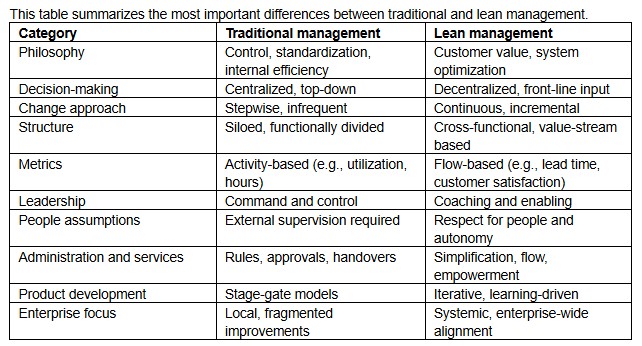
Case Study: A comparison of the management approaches adopted by Bosch and Continental AG
Bosch: Embracing Lean Management
Bosch, a global leader in automotive technology, has systematically implemented Lean Management principles across its operations. The Bosch Production System (BPS) was established in 2002 and serves as the foundation for continuous improvement and waste elimination. By focusing on customer value and streamlining processes, Bosch has enhanced efficiency and responsiveness. For instance, at the company’s Diesel Systems plant in China, Bosch applied Lean principles to optimise warehouse performance. This resulted in significant improvements in inventory management and delivery times.
Bosch-connected-industry.com is the official website for the Bosch Group.
Automotive Logistics
Continental AG: Traditional Management with Emerging Lean Initiatives
Another prominent automotive supplier, Continental AG, has traditionally operated with a more hierarchical and functionally siloed management structure. Decision-making processes have been centralised, and departments often work independently. However, in response to the need for greater agility, Continental has begun integrating Lean concepts into specific areas. For instance, at the Continental facility in Huntsville, Alabama, RFID technology was implemented to automate inventory management. This initiative successfully reduced receiving cycle times by 50% and incurred a 30% cost reduction.
A comparison and some valuable insights.
Bosch has fully embraced Lean Management, embedding it into their corporate culture and operations, while Continental is in the transitional phase, applying Lean tools selectively to enhance certain processes. Bosch’s comprehensive Lean approach has led to systemic improvements, whereas Continental’s targeted initiatives demonstrate the potential benefits of Lean principles even within traditionally managed organisations.
Exercise
Task:
Please write on sticky notes and explain to the team: If you had the opportunity to redesign your development process from the beginning, incorporating Lean principles, what changes would you implement and why? (Choose the three most important ones max.)
(Optional 2nd question: What steps could you take during the next quarter to improve the situation?)
Required equipment:
Flip chart or board
Sticky notes
Pens
Approach:
Trainer: Prepare a flip chart showing a simple development timeline from start to finish (arrow) and another flip chart with the task.
Trainer: Hand out sticky notes and pens, and ask the participants to write their answers on sticky notes, one note per change (don’t discuss previous to or during writing the answers in order to avoid biasing). Time box: 2 minutes.
Participants: Silently write answers on notes, without discussing.
Trainer: Ask participants one after the other to stick their notes to the timeline and briefly explain their answers. Questions, short discussion. Time box per participant approx. 45 seconds. The trainer is time keeper and moderator.
Course Manual 5: Customer value
Understanding Customer Value in Lean Thinking
When companies first encounter the phrase “create value for the customer”, it is often perceived as a simple concept. After all, is this not the modus operandi of every company? However, Lean Thinking takes this concept a step further. It challenges us to consider whether our actions align with the values of our customers, or if our actions are merely a continuation of past practices, hoping to have a positive impact.
In Lean Thinking, customer value is not a vague promise or a marketing slogan. This is a precise concept with real consequences. Value is defined as anything a customer is willing to pay for, whether in monetary terms or in other ways, such as attention, trust, loyalty or even time. It is essential that the product meets the customer’s requirements in terms of quality, functionality, cost and delivery time. It is important to note that value is defined solely from the customer’s perspective, not from within the company.
A Shift in Perspective
Lean Thinking demands a fundamental shift in our approach to work. Rather than asking “What are we delivering?”, we ask “What problem are we solving for the customer?”. Rather than basing value assessment on factors such as effort, features or complexity, we evaluate it based on its impact.
Picture a team of engineers presenting a new feature set to their colleagues. The code is elegant, the design is polished, and the effort was significant. But when tested with customers, the reaction is tepid – or worse, confused. What are the reasons for this? This may be because the feature did not solve a significant problem, or because the problem it sought to address was not deemed to be sufficiently important. In Lean terms, that entire effort, no matter how clever or technically impressive, added little or no customer value.
Observing, Listening, Learning
Therefore, it is essential to ascertain the customer’s values. Lean Thinking emphasises the importance of systematic observation and active listening. We do not make assumptions; we learn. We prioritise customer satisfaction and invest significant time in building strong relationships. We observe how they function, reside, determine, and respond. We utilise open-ended questions, actively listen for non-verbal cues, and seek to identify potential workarounds, frustrations, and moments of delight.
In manufacturing contexts, customer value can be relatively tangible – ensuring dimensions are correct, functions reliable and deliveries are made on time. However, in the field of product development, the creation of value can be challenging. It is often the case that customers do not know what they need until they see it. And needs can change rapidly with technology and context. Lean Development treats learning as the foundation of value creation.
From Discovery to Validation
In Lean Development, we do not presume to know what will work. We are responsible for its discovery. We formulate hypotheses regarding the potential customer values, then conduct rapid and cost-effective tests to validate or invalidate these hypotheses. We build prototypes. We show early concepts. We seek feedback. Most importantly, we are willing to be wrong – because being wrong early is far better than being wrong late.
This process of learning is not a one-time step. The process is uninterrupted. As teams acquire more knowledge, their understanding of customer value becomes more precise. Priorities shift. Designs are subject to change. Decisions are refined and improved.
Value Creation vs. Activity
One of the most critical messages of Lean is this: Value is not created by the activities themselves, but by their outcomes. A team may be working extremely hard, but if the output does not serve the customer, it is waste. This challenges deeply held beliefs in many organisations where effort is often equated with value.

Image by senivpetro on Freepik
Understanding Waste: Muda Type 1 and Muda Type 2 in the Context of Lean Thinking
Once a team has begun to see work through the lens of customer value, a natural next step is to ask: what stands in the way of delivering that value efficiently? Lean Thinking provides a clear and powerful answer: waste. However, it is important to note that Lean does not address all forms of waste equally. To act effectively, it is essential to learn to distinguish between two kinds of waste – Muda Type 1 and Muda Type 2 – and understand their implications for everyday decisions and long-term improvement.
The term Muda originates from Japanese and simply means “wastefulness” – any activity that consumes resources but does not create value. The fundamental principle of Lean is that while all waste should be examined, not all can (or should) be eliminated immediately. It is at this point that the distinction between the two types becomes essential.
Firstly, let us consider Muda Type 1. This kind of waste does not add direct value for the customer, yet it may be necessary due to external constraints or internal obligations. For instance, certain documentation may not meet customer expectations, but it may be legally required, essential for quality assurance, or needed to align multiple stakeholders in a complex development environment. Similarly, machine setups, safety protocols and regulatory compliance tasks are rarely value-generating in themselves, yet they form the scaffolding that enables value to be delivered reliably and safely.
Conversely, Muda Type 2 represents a state of pure waste, involving work that adds no value and has no justifiable reason to exist. These are the inefficiencies, redundancies and errors that persist because no one has yet taken the time to see them, name them and remove them. Consider the potential issues that may arise from unnecessary handovers, protracted decision-making processes, duplicated meetings with ambiguous outcomes, or rework caused by miscommunication. These activities often fail to create value, and in some cases can even have a negative impact by introducing frustration, cost and delay.
Making the distinction concrete
It is important to understand the difference between these two types, as this knowledge is not only of academic interest. It enables us to act strategically. It is vital that Muda Type 2 is eliminated as quickly and thoroughly as possible. It offers no discernible benefit and instead consumes energy, time and resources. It is important to approach Muda Type 1 with respect and caution. While it may still represent an opportunity for improvement, this will often require longer-term thinking, creativity and coordination to reduce or eliminate, without jeopardising compliance, safety or internal alignment.
The Hidden Nature of Waste in Development
In production settings, identifying Muda is often straightforward. Should a component be left unused on the shop floor for a number of hours, this would clearly be considered as waiting time. If a defective part must be reworked, this naturally results in costs. The physical materials and processes involved in the production of goods make waste visible.
Taiichi Ohno has enumerated seven types of waste that are commonly found in production areas:
Overproduction – producing ahead of demand
Waiting – waiting for the next processing step
Transport – unnecessary transport of materials
Overprocessing – doing more than is needed
Inventories – store more than absolutely necessary
Movement – more and longer traffic routes in the working area than required
Defects – production of defective parts and products
These types of waste can and have been transferred to other working areas like product development. The interpretation of the same types of waste in product development can be as follows:
Overproduction – creating information (e.g. concepts, tests, specifications) ahead of demand
Waiting – information or decisions waiting for the next processing step (e.g. simulation or test results, escalations, gate releases)
Transport – unnecessary transport of information or work results between locations, departments or IT systems (e.g. prototype build and test in different locations, sequential decision-making processes across different departments, data processing that runs sequentially through various IT systems and IT interfaces)
Overprocessing – creating more information, product features or prototypes than is needed (e.g. testing of parameters that are of no interest, more product features than the customer is willing to pay for, produce more or more expensive prototypes than needed)
Inventories – store more information than absolutely necessary (e.g. documentation of information no one needs, excessive meeting minutes, unstructured or redundant storage of data)
Movement – more movement of information, team members or work results than required (e.g. movement of data between different systems and across data interfaces, team members who work in different locations)
Defects – production of unintentional defective information and work results (e.g. faulty designs, wrong simulation parameters, misinterpretation of customer needs)
In the field of product development, waste can be more challenging to identify. Development work focuses on information, decisions and knowledge, rather than on components. As these are intangible, waste can be easily concealed within busy calendars, extensive email threads and well-intended but misaligned actions. The risk here is understated: without clear visibility, waste continues unchecked. Teams work diligently, but their efforts do not always result in tangible value for the customer.
Let us consider a few examples to illustrate this point. Imagine a product manager creating a comprehensive set of requirements that are never discussed with actual users. Or a development team creating features that the customer has not requested, with these being based on assumptions rather than on evidence. Another example would be a project team convening weekly status meetings that do not result in any tangible decisions. These are common examples of Muda Type 2 in development: activities that consume time and resources but do not contribute to the creation of the right product.
Not all seemingly unproductive activities are necessarily wasteful. Documentation is necessary for aligning multiple departments, satisfying legal requirements and maintaining traceability, even if it does not directly add value. These would be classified as Muda Type 1. Likewise, while risk assessments, safety validations and structured reviews may not delight customers in the short term, they are essential for protecting long-term value creation. The challenge lies in identifying these discrepancies and continuously seeking more efficient methods.

A Culture of Shared Observation
One of the most empowering aspects of Lean Thinking is that it places responsibility for identifying and reducing waste at the level of every individual in the organisation. This is not a task that can be delegated solely to management. Indeed, those closest to the work are often best positioned to identify inefficiencies. However, this requires a culture where it is safe to speak up, question traditions, and experiment with change.
Progress, not perfection
It is important to emphasise that identifying waste is not about perfection in the first place. No system is entirely free of inefficiency, even if it has been improved for many times. The key is to establish a routine of identifying, articulating and addressing these issues promptly and without recrimination and steadily work on their improvement, step by step.
In Lean, the continuous pursuit of improvement is known as Kaizen. Applied to Muda, this means constantly seeking ways to reduce or eliminate activities that do not serve the customer. With time, what was once considered “necessary” may become avoidable. A better tool, a clearer process, or a stronger cross-functional understanding can turn Muda Type 1 into something we can redesign – or remove entirely.
One might raise the concern: “But isn’t this just common sense?” The answer to this question is both yes and no. Yes, it is common sense to avoid waste. However, without a structured framework such as Lean Thinking, organisations often lack the shared language and discipline to pursue it consistently. They become accustomed to inefficiency, even proud of it – confusing busyness with productivity.
Embedding the Mindset
Lean does not guarantee zero waste. However, it provides a powerful means of identifying waste, understanding its nature, and acting on it with clarity and determination. Muda Type 1 and 2 are not merely technical labels. These tools are designed to facilitate reflection.
Customer value as a strategic compass for the entire organisation
In Lean organisations, the question “Does this create value for the customer?” is not an afterthought. It is a discipline, a repeated habit that shapes strategy just as much as it shapes everyday operations. It cuts through hierarchy, role boundaries and legacy thinking. When used consistently, this customer-value lens realigns organisations around what truly matters – delivering the right things, in the right way, for the right reasons.
Seeing Value Beyond the Product
Often, when people hear “customer value”, they think about the final product or service. However, the value of Lean Thinking extends far beyond this. It also includes how decisions are made, how resources are allocated, and how people collaborate across functions.
Picture a company where different departments work independently. The development team focuses on features, the marketing team on campaigns, the production team on efficiency, and the finance team on cost control. Each is optimising its own part, but the result may not serve the customer as a whole. Fragmented excellence does not guarantee value. Indeed, this frequently results in rework, misalignment and waste.
Now imagine a different organisation – one in which customer value is the shared reference point. Teams don’t just ask “How do we do this well?” but “Why are we doing it at all?” and “How will this help the customer?” This shift can change everything: how meetings are run, how projects are chosen, how conflicts are resolved, and how success is measured.
From Strategy to Daily Practice
Applying a customer value-based approach to strategy does not necessitate customer validation for every action. This means that every major decision – and many small ones – is guided by the intent to create, protect, or enhance value.
In manufacturing, this might lead to investing in source-level quality assurance instead of end-of-line inspections, because it prevents defects earlier. In development, it might mean spending more time on early prototypes and customer interviews, rather than rushing to finalise specifications. In leadership, it might mean saying no to certain investments – even promising ones – because they don’t clearly align with what customers truly need.
Navigating Change with Value in Mind
One of the most powerful effects of adopting customer value as a compass is how it helps organisations navigate change. Markets shift, technologies evolve, and customer expectations rise. Lean organisations embrace this approach, recognising its potential to streamline operations and enhance efficiency. They adopt a philosophy of continuous discovery, testing and refinement of value.
This dynamic understanding of value is in stark contrast to traditional planning approaches, where value is defined at the outset of a project and rarely revisited. Lean Development encourages iterative cycles of learning: test, validate, adjust. Feedback from real users is not a late-stage verification – it is a strategic asset.
Building a Culture Around the Customer
Using customer value as a strategic compass is a mindset – and over time, a culture. It becomes part of how people think, speak and act. Leaders model it. Teams adopt it. All new employees are taught this from day one. When this mindset becomes prevalent, it leads to a shift in conversations. Rather than debating personal preferences or departmental goals, teams begin to ask: “What does the customer need?” and “How do we know?” Decisions become less political and more purpose-driven. The various trade-offs become clearer. Innovation becomes more grounded – not in creativity alone, but in relevance.
Case Study: Dell Technologies — Pioneering Build-to-Order with Lean Principles
Dell Technologies offers a compelling example of how a large, complex organisation can use customer value as a guiding principle in Lean Development. Historically known for its build-to-order model in personal computers, Dell has long understood that value is created not simply through advanced technology, but through its relevance to customer needs. In the early 2000s, Dell began applying Lean principles more deliberately across its development and supply chain functions. A critical realisation emerged: much of their product complexity and internal development work was based on assumptions rather than verified customer preferences.
To address this, Dell shifted its development approach to focus more intensely on customer insights early in the process. Teams were encouraged to work cross-functionally, combining market research, customer interviews and usage data to uncover what features, configurations and services were truly valued. This allowed Dell to streamline product portfolios, eliminate redundant offerings, and focus on solutions that better matched customer environments, especially in enterprise and data centre segments.
An important turning point was the development of Dell’s server and storage systems, where a growing number of enterprise customers demanded not just performance, but rapid configurability, ease of integration, and support for evolving workloads. Dell responded by designing modular hardware and software platforms that could be adapted quickly to changing needs. This was not just a technical innovation—it was a direct response to the customer-defined value of flexibility and time-to-deployment.
Lean Development practices were also introduced to reduce internal waste and shorten development cycles. Product teams adopted iterative development frameworks that allowed faster testing and validation of ideas, reducing the risk of overengineering and rework. Decisions about new features or design changes were increasingly based on measured customer impact rather than technical enthusiasm. As a result, Dell was able to bring new products to market faster, with higher confidence in their value proposition.
The case of Dell illustrates how customer value can evolve from a marketing concept into a strategic compass that aligns development, design, and decision-making. By continuously asking what matters most to the customer—and validating that through real feedback—Dell has been able to reduce waste, accelerate innovation, and maintain relevance in a highly competitive and fast-changing industry.
In summary, by living customer value through Lean Development, Dell achieved:
– A reduction of inventory carrying costs by nearly 9 %, with production cycle times shortened to just four hours;
– A 10–20 % faster manufacturing cycle, combined with a 20 % productivity boost and 34 % quality improvement in factories;
– Customer support benchmarks of 90 % first-call resolution and an 8 % reduction in call duration;
– A dramatic drop in negative customer feedback—from 49 % to 22 %—thanks to proactive engagement and responsiveness.
Exercise
Task:
Each participant is invited to document one assumption their company makes about customers, and to consider how that assumption was formed. Was it based on actual customer data or experience? Or was it the result of an internal decision?
Required equipment:
Flip chart or board
Sticky notes
Pens
Approach:
Trainer: Prepare a flip chart showing the task and a table with three columns: 1) Assumption, 2) Customer data/experience, 3) Internal decision.
Trainer: Hand out sticky notes and pens, and ask the participants to write their answers on sticky notes, one note per assumption (don’t discuss previous to or during writing the answers in order to avoid biasing). Time box: 2 minutes.
Participants: Silently write answers on notes, without discussing.
Trainer: Ask participants one after the other to stick their notes to the table and briefly explain their answers. Questions, short discussion. Time box per participant approx. 45 seconds. The trainer is time keeper and moderator.
Course Manual 6: Value streams
Understanding Value Streams in Lean Thinking
A key moment in every Lean transformation is when the company realises that improving isolated departments or teams alone is not sufficient. True transformation occurs when we adopt a holistic approach, viewing the entire system—from customer needs to customer delivery—in its entirety. In Lean terms, this journey is known as the value stream.
A value stream is more than just a workflow. It is the complete set of activities – both those that add value and those that do not – that are required to bring a product or service to life in the given organization. Regardless of whether we are delivering a car, a software application, or a banking service, the value stream traces every step involved. This encompasses not only manufacturing and programming, but also understanding customer value, design, procurement, logistics, approvals, and even after-sales support. It is, quite simply, the most important aspect of delivering customer value.
Let us take a moment to consider this. Have you ever experienced a situation in your company where a delay in one area has had a significant impact on the overall delivery process? It is possible that the procurement process was initiated too late, or that an approval step was overlooked or not clearly defined. Such disruptions are not merely local issues; they are indicative of systemic issues within the value stream. Lean Thinking encourages us to adopt a holistic perspective, recognising the intricate connections between various elements. This approach enables us to design systems that are not only efficient but also deliver consistent, valuable results.
To provide a practical example, imagine a river. Water flows from the mountains to the ocean, sometimes at a rapid pace, sometimes more gently, and sometimes the flow is obstructed. Throughout the route, there are rocks, fallen trees and dams to be navigated, as well as other obstacles. At Lean, our role is to clear the riverbed by removing these barriers, thereby ensuring the smooth flow of value. This is the fundamental principle of value stream design.
In many companies, teams find that processes which appear to be “linear” are often in fact a series of interdepartmental jumps, with unclear ownership and duplicate tasks. Lean seeks to make these inefficiencies visible and then eliminate them.
In the manufacturing sector, mapping the value stream is a relatively straightforward process. The process is tangible: materials are ordered, shaped, assembled, and shipped. The physical nature of the steps and the ability to repeat them makes it easier to observe what is happening and when. Delays are reflected in the form of waiting inventory. Overproduction is evident in the presence of full shelves. Waste becomes visible as motion, transport, or rework.
A standard value stream map in the manufacturing sector typically assumes the form of a horizontal flowchart, with symbols representing each process step. Below each symbol, information is captured: cycle time, changeover time, queue time, batch size, and often the number of people involved. Arrows represent the flow of materials, while dashed lines or separate lanes track the flow of information, such as order processing, planning, or coordination. Lean teams use the map to understand the flow of material and information (value stream mapping) and to identify “waste”, whether that’s unnecessary movement, excessive waiting, or overprocessing (value stream analysis). Based on the understanding of actual state and waste, the Lean teams redesign the value stream by implementing improvements and eliminating waste to sketch the future state (value stream design).
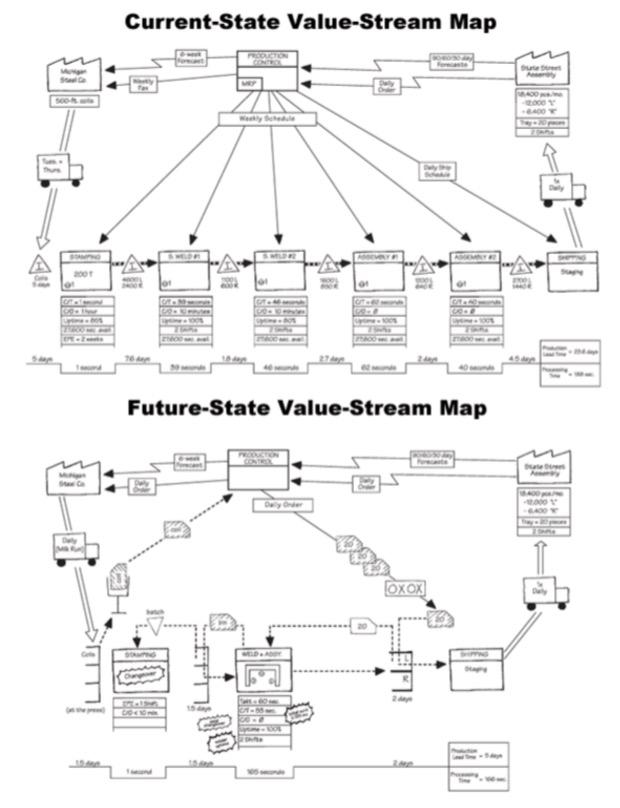
Examples of production value stream maps. Source: Lean Enterprise Institute
Once the current state has been visualised, analysed and understood, Lean teams will design a new version of the value stream that is simpler, faster, and more responsive to customer needs. This might involve reducing batch sizes, introducing pull systems, combining steps, or digitising parts of the flow. Here, the concept of the seven types of waste helps to identify waste in the value stream.
Participants frequently inquire about the optimal frequency for conducting this exercise.
The answer is straightforward: continuously. Value stream thinking encourages teams to regularly revise their value stream maps, update and improve them based on new insights, and make steady progress towards the ideal state. In this way, the value stream serves as both a mirror and a compass. It provides a clear indication of our current position and offers a structured plan to guide us towards our desired destination. A redesigned value stream is part of the implementation of improvement measures.
Here is a short story that shows how value streams can be applied in practice to solve problems. Imagine a medium-sized electronics manufacturer who previously encountered challenges with on-time delivery. Each department claimed that the issue was not attributable to them. Production cited late engineering changes, logistics cited planning errors, and sales cited poor forecasts. It was only when the company mapped the full value stream including all involved departments and their interfaces – from order intake to customer delivery – that the underlying issues became visible. It was discovered that there were redundant steps, unclear decision gates and hidden queues of work-in-progress. By redesigning the value stream and introducing visual management, they were able to reduce lead time and improve on-time delivery performance. The issue was not resolved by a single department; the system itself was the solution.
In Lean Thinking, value streams are not abstract concepts. They are practical tools to help you deliver more value, faster and with less friction.
Value Streams in Product Development – Navigating the Flow of Knowledge and Decisions
In Lean Development, the value stream does not consist of physical materials such as metal, plastic, or software code. It is made up of knowledge, decisions, assumptions and insights. The process we seek to enhance is not a physical conveyor belt, but rather the movement of understanding — how ideas are evaluated, enhanced, and converted into valuable products. In this case, however, the outcome is less predictable.
Let us begin with a straightforward observation: Development is generally not a linear process. It loops, jumps, questions itself, changes direction. A new product idea might be delayed for weeks not because of faulty execution, but because a critical decision is waiting on unclear information. Or a design might be iterated multiple times, not due to poor craftsmanship, but because customer needs were never properly explored. These are not necessarily indications of failure; they are inherent to the learning process. But unmanaged learning becomes waste.
Lean Thinking helps us distinguish between valuable exploration and avoidable failures. And this is where the concept of a development value stream comes in.
Please imagine a team working on a new medical device. Marketing has identified a need, engineering is exploring technical options, regulatory is flagging potential compliance risks, and purchasing is negotiating early supplier involvement. Each of these steps is associated with a certain degree of uncertainty. Each team is responsible for a specific part of the project. And none can move forward without clarity from the others. The development value stream illustrates the progression of ideas from discovery to definition, definition to design, and design to deployment.
In lean development, the goal of value stream mapping is to create a common understanding among team members and stakeholders. Who needs what from whom? Where are handovers unstructured? Where are criteria unclear? By working together to create a development value stream map, cross-functional teams begin to see the system that connects their work. This is often a powerful moment, during which people realise that they are not just working in parallel, but together, shaping a shared outcome.
To illustrate this point, let us consider a hypothetical, but realistic example. A global tech firm experienced recurrent delays in the launch of its consumer devices. Their teams were highly skilled, but siloed. Each department focused on optimising its own specific tasks and responsibilities. For instance, the engineering department concentrated on ensuring functionality, while the design department prioritised aesthetic considerations. Similarly, the supply chain department focused on minimising costs. But the integration was poor. A value stream mapping and analysis exercise revealed that final design reviews often led to rework because technical feasibility had not been validated early enough. By involving engineering earlier in the process, clarifying decision gates, and aligning customer needs across all functions, the company was able to reduce development time and significantly improve the first-pass success rate.
In the field of manufacturing, value stream improvements typically concentrate on enhancing flow efficiency, that is, optimising the rate at which materials and information move through the production process. In development, we focus on learning efficiency—how to learn the right things, as early as possible, at the lowest possible cost. This has a significant impact on our understanding of value. A prototype that disproves a flawed concept may be more valuable than a perfect design of the wrong solution. Mapping value streams enables us to design development processes that support fast, reliable learning through early testing, cross-functional review and iterative decision-making.
Imagine if knowledge flows were tracked like inventory. Unclear handovers would trigger a root cause analysis. Early alignment with customer needs would become a daily habit. Lean development is not about reducing creativity, but about protecting it from friction and delays caused by poor process design.
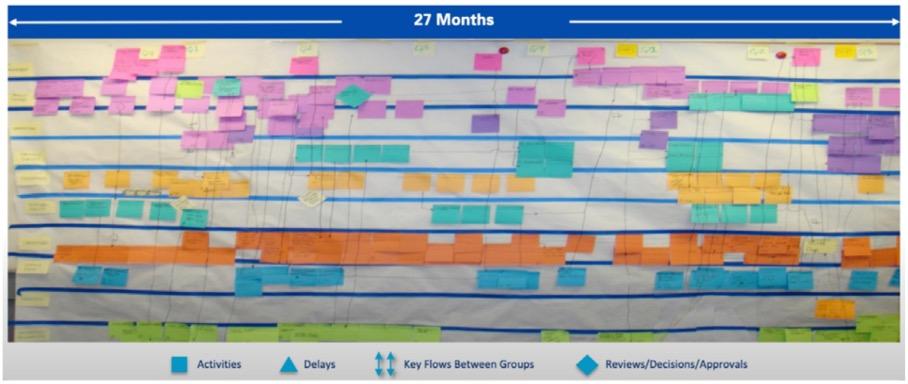
Example of a product development value stream map. Source: Lean Enterprise Institute
The planning and management of development work through value streams
Please imagine that you are planning a product launch using a traditional project management approach. You start with a Gantt chart, define milestones, assign tasks by department, and try to predict everything that might go wrong. Initially, the structure appears well-organised. But as soon as development begins, change creeps in. Requirements evolve. Customers provide feedback. Technical hurdles emerge. Suddenly, the plan becomes a source of friction rather than guidance.
Lean Development adopts a different approach in this regard. Rather than a rigid framework of phases and silos, it organises planning around value streams, which represent the actual paths through which ideas become reality. These value streams are not static, they are characterised by a dynamic nature and a commitment to continuous learning. In this mindset, planning becomes less about controlling output and more about enabling flow – of information, of decisions, of validated learning.
To recap from our previous discussion: if the development value stream helps us see how value is created, planning and managing by value stream helps us steer it with clarity and purpose.
In Lean organisations, teams are not grouped by function but aligned along value streams. This means that cross-functional teams take joint ownership of delivering value, from concept through to implementation. In this context, planning does not entail the creation of a detailed plan in advance; rather, it involves visualising the work, making dependencies transparent, setting clear goals, and creating systems that adapt as learning unfolds.
In Lean Development, visual management plays a central role. Teams use planning boards, often physical or digital, to display not only tasks but also states of knowledge, decision points, and customer validations. These boards are intended for all members of the team, not only project managers. The entire team has visibility over ongoing and blocked processes, pending decisions and open feedback loops. This visual structure enables real-time alignment and reduces the “coordination overhead” that often slows down traditional project models.
A comprehensive visual planning system should offer more than just task tracking capabilities. It also makes constraints and risks visible. For instance, if a prototype cannot be tested until a key decision is made, this dependency should be evident to the team. This approach fosters proactive planning, with teams working together to anticipate and remove potential issues before they arise.
Let us now examine a customary Lean Development artefact: the A3 project charter. This one-page format assists teams in articulating the purpose, scope, anticipated outcomes, key stakeholders, identified risks, and planned learning activities for a development initiative. The A3 differs from traditional project charters in that it is not a one-time document; it is a dynamic tool that is continually updated and referenced. It evolves in accordance with the project and the value stream. It encourages critical thinking. Most importantly, it connects daily work to strategic intent, ensuring the team always knows why they are doing what they are doing.
This brings us to another important concept: cadence-based planning and synchronisation. In dynamic environments, it is not always possible or advisable to plan every detail in advance. Instead, Lean organisations establish regular rhythms with relatively short takt times – or cadences – for planning, coordination, and reflection. These rhythms help teams to synchronise their efforts, manage their dependencies, and make corrections without having to wait for formal reviews or escalations. The higher the dynamics, the shorter the cycle time should be selected.
One widely used framework that builds on this idea is SAFe (Scaled Agile Framework). It utilises time-boxed intervals (termed Program Increments) in which teams collaborate to plan, execute and evaluate their work across value streams. While SAFe incorporates numerous structural elements, its core strength lies in connecting strategic goals with operational execution through clear, iterative planning cycles.
One of the most powerful aspects of managing through value streams is that it allows strategic alignment. At the portfolio level, organisations can see which value streams are performing well, where bottlenecks exist, and which initiatives are truly contributing to enterprise goals. This approach facilitates optimised resource allocation, accelerated feedback loops and enhanced decision-making confidence.
For instance, a company specialising in both software and hardware production may discover that while one value stream is delivering rapid innovation, another is consistently blocked by regulatory hurdles. Drawing on this insight, leaders can address root causes in a systematic manner. This may involve adjusting approval processes, investing in cross-training, or reallocating key expertise.
This kind of portfolio-level transparency is rarely possible in siloed structures. However, when work is managed through value streams, strategy and execution become more clearly defined. Teams have a clear understanding of both their individual contributions and the collective impact of their efforts. Leaders can make informed decisions based on data rather than assumptions.
It is important to note that planning through value streams does not necessitate a loss of control. It signifies the selection of a more target-oriented form of control – one that adapts, learns, and prioritises customer value.
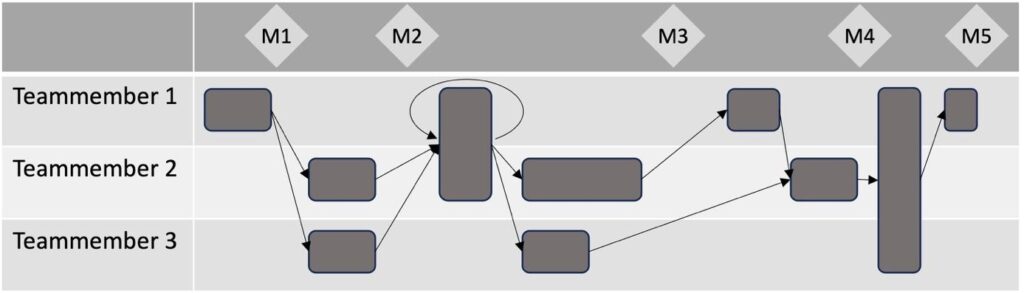
Value stream based planning is a combination of net plan technique and swim lane diagram. It helps to see and plan the interfaces and interdependencies between tasks, departments and team members.
Case Study: Saab Aeronautics – Streamlining Product Development through Value Streams
Saab Aeronautics, a business unit within the Swedish defense and aerospace company Saab AB, provides a compelling example of how value stream thinking can transform complex product development. With over 18,000 employees globally and a long history in advanced fighter aircraft such as the JAS 39 Gripen, Saab operates in a highly regulated, engineering-intensive environment where product development cycles span years and involve thousands of decisions across disciplines.
Around 2016, Saab Aeronautics began rethinking its development practices. Despite world-class engineering capabilities, the company faced growing pressure to reduce lead times, improve coordination across departments, and become more responsive to changing customer and defense authority requirements. Traditional project structures—based on phase-gates, documentation-heavy milestones, and siloed engineering functions—were proving too slow and rigid for an increasingly dynamic world.
Inspired by Lean principles and systems thinking, Saab initiated a transformation based on development value streams. The company mapped end-to-end flows from idea to system-level integration, uncovering critical inefficiencies: knowledge queues between disciplines, late integration issues, unclear decision ownership, and long feedback cycles. By restructuring teams around these value streams rather than functions, Saab was able to foster cross-functional collaboration from day one of a development effort.
Implementation included new governance models, lightweight coordination practices (such as cadence-based planning and system demos), and visual management tools that made work-in-progress, impediments, and dependencies transparent. A key change was shifting planning responsibility to the teams, enabling them to pull work when ready rather than being pushed by upstream project plans.
The results were significant. Development lead times on major subsystems were reduced by over 30%, and integration errors dropped sharply due to earlier and more frequent collaboration. Teams reported higher engagement and better alignment with customer needs, particularly as end-users were involved more frequently throughout development. The transformation also enhanced Saab’s ability to manage technical risk proactively and adapt to changing requirements mid-stream—an essential capability in defense projects.
Saab’s case illustrates that value streams are not just abstract models—they are practical mechanisms for aligning work with value delivery, especially in complex environments. By reorienting planning, roles, and governance around these streams, Saab turned a traditionally slow and segmented process into a more agile, learning-driven system that delivers faster, with fewer surprises.
Exercise
Task:
Take five minutes and list the steps your organisation follows from a first idea to a product launch. This can be rough—no need for detail. Try to identify major stages, such as concept generation, feasibility, prototyping, testing, approval, production ramp-up, market launch.
Now, ask yourselves and write “waste notes”:
Where do we wait for information? → “waiting”
Where do we go back and repeat steps? → “loop”
Where do misunderstandings or conflicting priorities arise? → “issue”
Required equipment:
Metaplan board
Flip chart or board
Sticky notes
Pens
Approach:
Trainer: Prepare a metaplan board showing a simple development timeline from start to finish (arrow) and a flip chart with the task.
Trainer: Hand out sticky notes and pens, and ask the participants to write the steps and “waste” types on sticky notes—one note per step or waste category (don’t discuss previous to or during writing the answers in order to avoid biasing). Time box: 5 minutes.
Participants: Silently write answers on notes, without discussing.
Trainer: Ask participants one after the other to stick their notes to the timeline and briefly explain their answers. Questions, short discussion. Time box per participant approx. 30 seconds. The trainer is time keeper and moderator.
Course Manual 7: Creating flow
Creating Flow – The Art of Making Work Move
Following the identification of value and mapping of the value stream, the subsequent step in Lean Thinking is to bring that stream to life by creating flow. While the concept may appear straightforward—ensuring that work progresses without unnecessary stops or detours—it challenges some of the most entrenched practices in how organisations develop products and manage work.
Please consider the following question. What happens in your organisation between the moment a task is ready (the work is done) and the moment it’s completed (the required outcome is available)? You may notice how often work pauses, waits, or needs to be redone. This unseen drag slows progress, inflates cost, and distances the team from the customer.
In Lean Management, flow means that each unit of work—be it an idea, a decision, a component, or a document—moves forward immediately, smoothly, and without interruption. Imagine a relay race, where the baton is passed without hesitation. The more fluid the transitions, the faster the team reaches the finish line. That’s flow.

However, most organisations do not function in the same way. Instead, they resemble a series of traffic jams. Workloads are accumulating between departments. Decisions often become bogged down in review cycles. Emails are repeatedly exchanged without reaching a resolution. The flow of the process is compromised, which has a detrimental effect on performance. Lean Thinking provides a comprehensive approach that goes beyond mere diagnosis, offering a practical solution to address these challenges.
Lean challenges us to redesign these patterns. One of its core shifts is the transition from batch-and-queue systems to flow-oriented systems. In a batch system, teams produce work in large chunks. For example, engineers complete entire specification documents before handing them over to another team. These chunks then sit in queues, waiting for the next department to start work. This approach can result in issues being concealed, feedback being delayed, and rework being generated when upstream assumptions prove to be inaccurate.
To create flow, it is necessary to break down the mentality of working in batches. Rather than transferring large work packages, teams share smaller, more manageable units of work as soon as they are ready. This concept is often referred to as “one-piece flow”. This approach has been shown to reduce waiting times, facilitate the early identification of quality issues, and enable downstream teams to respond more flexibly to changes.
Lean uses several tools to support this. One such is takt time, defined as the pace at which work must be completed to meet customer demand. Please imagine a customer who expects one new product concept on a monthly basis. Takt time becomes the rhythm that aligns all upstream activities towards that delivery cadence. When teams understand their takt time, they can better manage their pace and avoid overloading or idling resources.
Another essential tool is line balancing, which ensures that the work is distributed evenly across the different steps of the value stream. If one step takes twice as long as the others, it will become a bottleneck – much like a narrow bridge on an otherwise fast highway. By analysing and adjusting task assignments, teams can create more consistent flow.
Visual management tools, such as Kanban systems, facilitate transparency of workflow. A Kanban board makes it visible where work is flowing smoothly and where it is stuck. When something blocks the flow, it triggers action—not blame, but inquiry. Why is this task waiting? What factors are preventing it from moving forward? These moments become entry points for continuous improvement.
Yet it’s critical to understand: flow is not a purely technical problem. It’s a cultural challenge. Creating and maintaining flow depends on how people interact, how they prioritise, and how they feel responsible for the system they’re part of.
This is why one of the most important enablers of flow is shared understanding. It is imperative that all individuals involved in a process comprehend the entire value stream, not merely their own task. When teams understand how their work connects to the next stage and to the final customer, they naturally become more aligned. Cross-functional collaboration is strengthened. Silos dissolve.
Creating flow often starts with eliminating obvious disruptions. These might be ambiguous responsibilities, overloaded team members, unclear decision rights, or inadequate tools. However, to create flow, it is essential to adopt a holistic approach to thinking. It means asking, with every process change: Does this help work move? Does it bring us closer to the customer, faster and with fewer complications?

One practical example from Lean Development is the co-location of teams. When product developers, designers and testers share the same space – even virtually – they can reduce handover time dramatically. The result is immediate communication. Problems are solved in real time. The effectiveness of the team’s work improves not because people work harder, but because they work together better.
Standardisation is another powerful enabler. While this approach may appear counterintuitive in a creative environment, standardisation in Lean does not entail rigidity. It means agreeing on the best-known way to do a task—until a better way is found. By stabilising core processes, teams can reduce variability and create predictability. This approach fosters efficiency by minimising disruptions caused by unexpected events.
It is important to note that Lean does not prioritise flow, no matter what the cost. It is designed to generate value. If a task does not add value to the customer, the objective should be to eliminate it rather than streamline it. In this sense, creating flow is closely tied to the two earlier Lean principles of understanding customer values and designing the value stream accordingly.
Once you start to notice the flow, or the lack of it, it becomes impossible to ignore. You start asking different questions. The financial implications of waiting, batching and multitasking become apparent. And gradually, by resolving one minor issue after another, a novel form of performance is revealed. One that is faster, cleaner, more connected—and infinitely more satisfying.
Flow in Lean Development – Managing Knowledge and Reducing Friction
When was the last time a project in your organisation was delayed—not because of manufacturing, but because people didn’t know what decision to make? Or who should make it? Or what information was needed to move forward? These moments, though often overlooked, are examples of broken flow in development. These issues can incur significant costs, including rework, confusion, and lost time.
In Lean Development, the objective is not only to “do work,” but to learn and make decisions as effectively as possible. Development is a process of discovery and navigating uncertainty. Creating flow here means making that learning journey as smooth and fast as possible.
However, this is not a simple task. In contrast to production, development work is inherently non-linear in nature. Ideas are explored, tested and revised. Requirements change. Feedback loops emerge. This complexity necessitates a different kind of discipline — one that manages the flow of information rather than the flow of materials.
In Lean Development, flow means that knowledge and decisions move through the system without unnecessary pauses, confusion, or noise. This does not mean rushing. It means clarity. It means that the right people have the right information at the right time to make good decisions.
In order to achieve this objective, it is necessary to implement several Lean methods. One of the most fundamental aspects of this process is visualisation. When development work is not clearly documented, for example when it is buried in emails, meeting minutes or someone’s notebook, it is difficult to coordinate. Visual tools such as Kanban boards are effective in bringing work to the surface. They show what is in progress, what is blocked, and what is ready to start. By making the work visible, teams can gain control over it.
Another key concept to consider is the limitation of work in progress (WIP). In development, multitasking is a silent killer. It has been demonstrated that the greater the number of items to be managed, the slower each individual task progresses and the more failures occur. Consider the scenario of a motorway with excess traffic, where the flow of traffic slows down despite all vehicles being in motion. Lean teams manage this in a conscious manner. They agree on limits, start less, and finish more. The result is faster learning, better quality, and greater satisfaction.
Collaboration is also a crucial factor in knowledge flow. In traditional organisations, development often happens in silos: marketing defines needs, engineering builds solutions, testing validates outcomes—each in isolation. This can result in handover delays, misalignment, and rework. Lean Development is an approach that breaks down these walls. It encourages cross-functional teams that work together, from idea to delivery.
Such teams require a regular cadence and synchronisation – structured moments where they align, plan, and solve problems. Daily stand-up meetings, sprint reviews and iteration planning meetings for example help to ensure that all team members are working towards the same goals. These meetings are not status updates; they are control points for flow. When executed effectively, they facilitate the identification of issues at an early stage, enable rapid adjustments, and promote collective ownership.
However, effective flow management in development is not solely dependent on methods; it is also crucial to minimise cognitive and organisational friction. Development teams are comprised of knowledge workers. They utilise their cognitive abilities to solve complex problems. Unnecessary switches, unclear priorities, or blocked tasks can all have a detrimental effect on morale. This issue, if left unaddressed, will eventually result in fatigue, reduced quality and disengagement.
Lean responds by creating an environment where people can focus deeply, know what matters, and see progress. This represents a significant change, which is not only limited to the tools we use, but also to our culture as a whole.
In essence, the focus of Lean Development is on facilitating human creativity. The objective is not to compel people to work harder. The objective is to establish a system that facilitates focused work, rapid feedback and a shared purpose. The objective is to remove obstacles, both visible and invisible, to enable more efficient and effective progression of ideas.
As with any production process, improvements in flow are associated with enhancements in all other areas: speed, quality, morale and customer satisfaction.
Flow: An organisational capability and strategic lever
As we develop a deeper understanding of flow in Lean thinking, it becomes clear that flow is not merely a tool for managing tasks or accelerating delivery. It is a capability that reflects the maturity, agility and coherence of an entire organisation. When flow becomes a strategic priority, organisations can achieve levels of performance, creativity and resilience that far exceed operational efficiency.
Allow us to pause for a moment of reflection: What is the experience of working in flow? Many participants describe a state where all elements align seamlessly, distractions dissipate, progress is evident, collaboration feels effortless, and results materialise organically. In the field of psychology, this phenomenon is referred to as the “flow state”. It describes a state of focused engagement where individuals and teams are fully absorbed in purposeful activity.
Please imagine, if you will, that entire organisations could operate in that state – not constantly, but more often, and more intentionally. Lean flow promises to enhance workflows, allowing for the delivery of results with greater efficiency and agility.
The concept of flow evolves into a strategic framework when it transitions from local optimisation (e.g., accelerating the pace of one team) to end-to-end value delivery. In this context, the question changes from “How fast is this team working?” to “How quickly and reliably can we deliver value to our customers?” This shift in mindset has significant implications.
To address this, it is essential to manage flow as a systemic capability. This involves the creation of structures and habits that facilitate the continuous movement of work, knowledge and decisions across boundaries and over time. Lean organisations do not leave this to chance. Their designs are intended to facilitate seamless movement.
Leadership plays a central role in this. A team’s effectiveness is limited if its surrounding system does not facilitate effective flow. It is essential for leaders to take responsibility not only for setting direction, but also for creating the right conditions. This includes removing recurring bottlenecks, clarifying priorities, resolving conflicts of ownership, and empowering teams to act without waiting for top-down instructions.
In practice, this might involve simplifying governance processes, redefining roles to reduce overlap, or investing in collaborative tools. However, at its core, it is about shifting from control to enablement. In a Lean system, leaders do not have to make all the decisions; their role is to establish a system that allows for swift and effective decision-making close to the problem.
These discussions often reveal discrepancies between stated priorities (e.g. speed, customer focus) and actual practices (e.g. slow approvals, unclear handover processes). Flow-based leadership is designed to bridge that gap.
Another key enabler of flow as a strategic capability is systems thinking. In a traditional mindset, blame for delays or errors is often attributed to individuals. However, Lean encourages us to delve deeper. A late delivery may be indicative of unclear input, an overloaded system, or conflicting goals, rather than incompetence. When organisations adopt this perspective, they begin to treat disruptions not as personal failures, but as signals of systemic improvement needs.
This mindset fosters psychological safety and continuous improvement. Teams are more likely to raise issues, experiment with changes, and take ownership of the outcomes. The result is not just better processes, but stronger, more confident people.
Lean organisations invest in feedback systems to support this. The measurement of flow is achieved through the use of key performance indicators (KPIs), including lead time (the time it takes to deliver value), cycle time (the time taken for each task) and throughput (the number of tasks completed within a set timeframe). It is important to note that these metrics are not used for the purpose of individual surveillance; rather, they are employed to facilitate a comprehensive understanding of the system and to identify areas for enhancement.
Critically, flow is not just about moving faster—it’s about moving in the right direction. That’s why flow must be aligned with customer value. Lean organisations establish feedback loops from customers at every stage of development and delivery. When customer input flows smoothly, priorities are grounded in real needs. This approach has been shown to reduce waste, shorten loops, and maintain team motivation.
Ultimately, building flow as a capability means designing an organisation where people, processes, and goals are harmonised—where friction is reduced not only for speed, but for purpose. In such systems, teams are not just efficient, but also resilient. They can respond to change, seize new opportunities, and sustain high performance without burnout.
Flow, then, is not a side topic in Lean—it is the heartbeat of a learning, adaptive organisation.
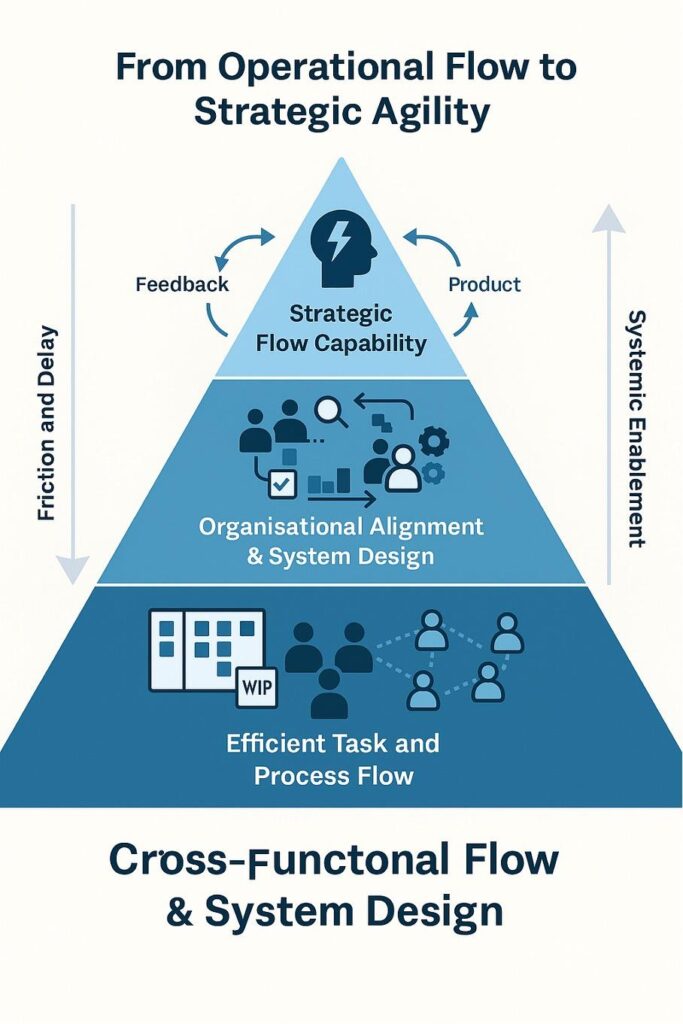
Case Study: Creating Flow at Siemens Healthineers
In the late 2010s, Siemens Healthineers, a global leader in diagnostic and therapeutic imaging systems with approximately 70,000 employees worldwide, faced growing complexity in its product development operations. As customer expectations for innovation and speed intensified, internal delays, handover friction, and long development cycles began to hinder performance. The organisation recognised that fragmented processes, departmental silos, and excessive coordination effort were preventing them from achieving true agility. This triggered a company-wide initiative to implement flow as a strategic capability, not just a local improvement project.
The transformation began in 2018 with a deep value stream analysis across development programmes—starting with their flagship CT and MRI product lines. The company mapped the end-to-end process from initial idea to market release and identified key barriers: long approval chains, excessive batch work, role confusion, and late integration of customer feedback. Flow was virtually non-existent between functions like marketing, systems engineering, hardware development, and software.
To address this, Siemens Healthineers introduced cross-functional value stream teams, each responsible for a complete product or platform. Work-in-progress limits were implemented across design stages. The teams adopted visual management through digital boards and daily huddles. Governance was decentralised to empower teams to make more decisions locally, reducing wait times. Leadership supported the shift by reorganising around customer value streams instead of departments.
The results were significant. By 2022, development cycle times for new diagnostic platforms were reduced by over 30%. Cross-functional alignment improved dramatically, and delays due to role ambiguity or escalation dropped by half. Employee satisfaction rose, particularly among R&D and engineering teams who experienced fewer interruptions and clearer priorities. Most notably, Siemens Healthineers could now test customer-facing features earlier and more frequently, leading to products that better matched clinical needs.
Flow became more than a process—it evolved into a capability embedded in the organisational culture. Siemens Healthineers continues to refine and scale this model across its divisions, leveraging flow not only for efficiency, but for faster innovation, improved quality, and greater responsiveness to a rapidly changing healthcare market.
Exercise
Task:
Multitasking exercise by Clarke Ching:
First, take a sheet of paper and draw three empty columns on each side of the paper. Each column represents a project, and the three projects have the following objectives:
– Column 1: Write the letters A to J, one below the other.
– Column 2: Write the numbers 1 to 10, one below the other.
– Column 3: Write the Roman numerals i to x, one below the other.
The end result should look something like this:
A | 1 | i
B | 2 | ii
C | 3 | iii
…and so on.
Fill in the columns twice, following this pattern:
First round — multitasking:
Start a stopwatch. Work from left to right: write A, then 1, then i. Then continue with the second row (B, 2, ii) and so on until the end.
Second round — singletasking:
Start a stopwatch again. First, fill the left column from A to J. Then fill the second column from 1 to 10. Finally fill the third column from i to x.
Compare the times and discuss differences and findings.
Required equipment:
Sheets of paper
Pens
Stopwatch
Approach:
Trainer hands out one sheet of paper to each participant.
Trainer shows and explains a filled version of the three columns.
Participants draw the three empty columns on each side of their paper sheets.
Trainer starts the first round and takes time (participants may also time individually).
Note the times.
Trainer starts the second round and takes time (participants may also time individually).
Compare times and discuss experiences.
Course Manual 8: Pull principle
The Pull Principle in Lean Management – Doing Only What is Needed, When it is Needed
Following a comprehensive understanding of the significance of flow as both a systemic and strategic capability, we now move on to another fundamental Lean principle: pull. If flow defines how work should move, pull defines when it should move – and most importantly, why. Together, they shape a system that is not just fast, but also deeply aligned with value creation.
In traditional organisations, work is usually managed using the ‘push’ logic model: plans are made, forecasts are projected and tasks are scheduled in advance. Everyone is expected to maintain consistent productivity, producing according to predefined schedules or their allocated capacity, irrespective of whether the subsequent stage of the process or the customer requires the result. This logic stems from a well-intentioned desire to maximise utilisation and control. However, this approach frequently results in unintended consequences, including overproduction, excessive inventory, protracted lead times, and work that ultimately adds no value.
Lean Management proposes a different logic: pull. In a pull-based system, no task is initiated, no product is constructed, and no resource is allocated unless there is a clear, validated requirement from the subsequent downstream step. In other words, value is not pushed into the system in the hope that it will be useful; rather, it is pulled through, precisely and purposefully, in response to real demand.
Imagine you are standing in a kitchen. A push system would ensure every ingredient is prepared for every possible dish. A pull system awaits the customer’s order, then meticulously prepares the precise items required. This approach has been shown to result in a significant reduction in waste, stress, and a notable enhancement in relevance.

The pull principle has long been used for reordering goods and restocking shelves in supermarkets. Supermarket employees only order and restock what has been sold. Push would be if they ordered certain planned quantities regardless of sales and placed them in the supermarket. The supermarket would soon be overflowing with some goods, while others would be unavailable.
In manufacturing, this principle is classically implemented through Kanban systems. These systems utilise visual signals, such as cards, bins, or digital tokens, to indicate when an item is required. An empty bin on the assembly line does not cause panic; it triggers the replenishment process. The moment downstream pulls, upstream acts. Not before. This is an example of a self-regulating system.
However, the power of pull extends far beyond the shop floor. In Lean Development, pull means that a design is not finalised until there is clarity about its use downstream. The coding of any feature is only carried out once it has been validated as a user need. No report is written unless it informs a decision. Lean is a process that eliminates the hidden waste of building the wrong thing, which is perhaps the most costly form of waste in development work.
Implementing pull requires more than just new tools. A change in mindset is essential. Management and teams must transition from a culture of “working ahead” to a culture of “working in response.” This does not imply a passive approach or a reduction in pace. This entails maintaining awareness of the system’s rhythm, initiating only when a significant signal is detected, and terminating when the desired value has been delivered.
There is a psychological challenge here. In many organisations, being busy is rewarded. Idle time is frowned upon. Under pull, however, being busy without demand is seen as risk or even muda—not performance. Starting the process early can require rework. Producing without a customer can result in a waste of effort. Pull is a system that encourages discipline, focus and trust in the system, rather than blind productivity.
In this sense, pull can be viewed as a self-regulating control mechanism for overcommitment. This approach is effective in limiting work in progress, as it ensures that upstream operations cannot proceed faster than downstream processes can absorb the output. It establishes inherent safeguards against overload, minimises multitasking, and enhances overall throughput. The result is a smoother flow of work, with teams regaining clarity and an improvement in quality because fewer items are in process at any given time.
Another advantage of pull is its effect on transparency. If a pull signal does not appear, this indicates a blockage. The issue could be attributed to a lack of capacity, clarity or actual demand. These moments highlight systemic weaknesses: Is the team downstream overloaded? Are there misalignments in priorities? Is customer feedback missing? In push systems, these issues are often overshadowed by the accumulation of ongoing work. In pull systems, they are exposed immediately and unavoidably.
Pull also enables faster problem detection and correction. Smaller batches move through the system more quickly, feedback is received earlier, and defects can be addressed before they spread. This is particularly relevant in knowledge work, where errors and misalignments are more difficult to identify and more costly to correct later.
Let us return to the fundamental idea of producing only the essentials, when they are required. Pull forces organisations to define what essential really means. This approach serves to highlight underlying assumptions. It prevents speculative work. It drives learning, because development cycles begin with real signals from the market, not imagined needs.
In software engineering, this is the difference between building a full-featured solution and releasing a minimum viable product that users can test. In service design, it is the difference between designing full processes in advance and co-creating them with customers based on demand. In product development, it’s the difference between frontloading investment and pacing development based on validated steps. Pull turns these distinctions into operating principles.
At the organisational level, this results in a re-evaluation of what success looks like. Rather than delivering more, the focus is on delivering relevant outcomes more quickly. Rather than focusing on increased effort, the approach is to work in better synchrony with real needs. Rather than inundating the system with an excessive number of options, we empower our customers to guide the direction of our business through feedback, choice, and demand.
Leadership plays a crucial role in enabling this. Leaders must avoid the pitfall of equating activity with value. It is important that they redesign governance and planning systems to support pull logic, which involves reducing batch sizes, breaking large projects into incremental deliveries, and encouraging feedback loops that replace assumptions with evidence.
When this happens, teams become more focused, less burdened by unnecessary tasks, and more motivated, because their work is clearly connected to a purpose. This approach has been shown to reduce waste, enhance responsiveness, and foster organisational agility.
The application of the Pull Principle in the context of Lean Development and Knowledge Work
Lean Development extends the pull principle into the domain of thinking and deciding. The commencement of work is not simply determined by the conception of the project or its scheduling on a Gantt chart. In a pull-based system, development only begins when three conditions are met: the team is ready (capacity), the prerequisites are clear (readiness), and there is a validated need (value). Rather than pushing work forward based on assumptions, the team waits for a clear signal from the system. This is not passive. This approach can be termed “strategic patience.” It is the discipline of delayed commitment.
This is especially powerful in environments of high uncertainty. In product development, decisions made too early often result in solutions that no longer match the customer’s needs by the time they are delivered. Pull-based development is a process in which decisions are deferred to the last responsible moment, i.e. the point at which further delay would risk outcomes, but not before. This approach enables teams to gather more information, explore options, and avoid premature convergence.
The concept of delayed commitment can initially cause feelings of discomfort. This approach challenges the perception of control that is often associated with early planning. However, in Lean Development, early planning without learning is not a realistic expectation. Pull allows learning to lead.
A key enabler of this approach is visual management, especially in the form of digital or physical Kanban boards. In contrast to push systems that are based on deadlines, Kanban makes work visible and moves it only when downstream demand exists and capacity is available. Each column on the board represents a stage of readiness, and each card is a signal that should only be pulled when the team is ready and the conditions are met. This limits work in progress (WIP), reveals bottlenecks, and promotes continuous flow—from a knowledge perspective.
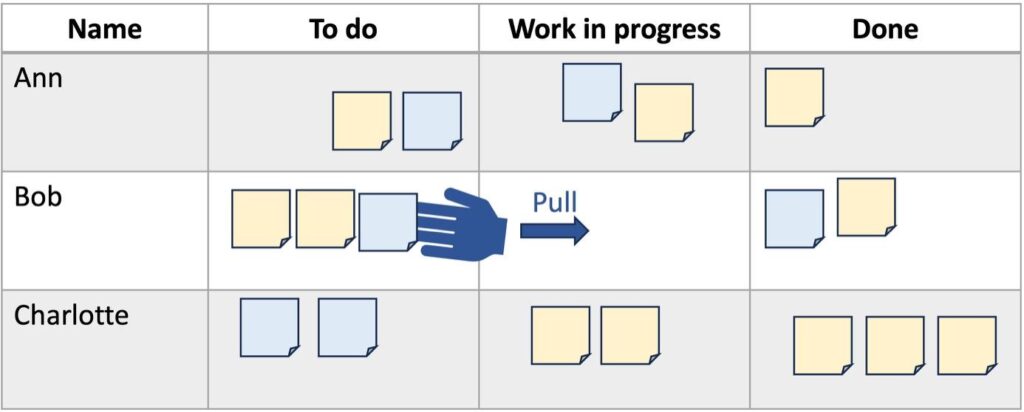
For instance, in the field of software development, a feature may not transition from design to coding until user research has validated the concept. The designer does not push it forward “because it’s done”—the developer pulls it when ready, when the context is understood, and when other work allows. This logic ensures that work doesn’t pile up or race ahead of feedback. It’s a rhythm of controlled, focused progress.
However, it should be noted that Kanban is merely a tool. The more significant change lies in the way teams and organisations structure their thinking. In the pull development model, the focus shifts from managing timelines to prioritising readiness and necessity. Teams ask: Do we have the capacity to do this work now? Have we obtained the correct information? Are we solving the right problem?
In project environments, this translates to triggering milestones and deliverables not because they’re on a calendar, but because earlier steps have yielded usable outcomes. This avoids wasting resources on activities that are not yet anchored in current context.
Importantly, pull is not about slowing down development. The key is to focus on the task at hand. A team that commits too early spends time chasing changing targets. A team that pulls work only when it matters, and only when it’s ready to act, progresses with fewer detours. Timelines still matter, but they are managed differently.
The strategic implications and organisational benefits of the pull system.
The pull principle can be a powerful tool for aligning resources, empowering individuals and enhancing the organisation’s responsiveness to real-world needs. In the majority of organisations, the logic of push remains the prevailing force. Projects are initiated based on ambitious roadmaps. Resource plans are drawn months in advance. Teams are tasked with delivering work regardless of the readiness of the system or the existence of actual demand. The outcome is a well-known scenario: overloaded teams, overloaded pipelines and expectations that are not met. Progress becomes a form of performance, with activity lacking tangible impact.
The pull principle offers a significant alternative. The following questions are posed: What if we only moved work forward when the system is truly ready? What if planning was not a top-down exercise in hope, but a dynamic response to readiness, capacity, and validated demand?
The strategic implications of such a shift are significant.
In a pull-based organisation, progress can be measured and managed effectively. It reflects the actual team capacity. It is an effective method of identifying true bottlenecks. When projects are no longer driven by artificial schedules, the inherent limitations of the system become apparent. These limitations may include a lack of clarity, skills, prioritisation, or coordination. It is only possible to improve that which is visible.
Leaders operating within a pull environment also demonstrate distinct behavioural patterns. The traditional approach to management, which involved the assignment and monitoring of tasks, is no longer in practice. Instead, they manage systems by enabling flow. Their focus shifts from controlling output to removing blockers. They facilitate capacity, clarity and focus. This is not a passive role; it requires active engagement with the structure and behaviour of the entire value stream.
Planning itself transforms under the pull principle. Traditional plans operate under the assumption that work will unfold in a linear fashion. However, complex development loops, learns, and adapts. Pull-based planning is an approach that recognises this reality. The decision-making process transitions from being date-driven to being readiness-driven, supported by a short cadence. Milestones are triggered not by calendars, but by conditions.
Lean Portfolio Management applies the pull logic at a strategic level. Rather than overloading the enterprise with too many concurrent initiatives, leaders prioritise based on strategic relevance, team capacity, and real market signals. Projects are initiated only when there is both demand and readiness. The portfolio system is designed to pull work forward, rather than pushing it down from the top.
The outcome of this approach is not only a reduction in the number of projects, but also an enhancement in the quality of those that remain. Projects that are initiated with clarity. Projects that flow. Projects that are completed. Organisations that implement pull in their portfolio practices report shorter time-to-market, less cross-functional conflict, and dramatically reduced levels of work-in-progress. They achieve more with less, because every effort is directed towards validated value.
At team level, the advantages of pull are equally evident. Work-in-Progress (WIP) limits are a key component of effective project management, ensuring that teams maintain concentration on the task at hand. They reduce task switching, minimise mental overload, and allow teams to experience progress in meaningful increments. When a team takes on a new task, they do so with full ownership. There is no backlog avalanche, no artificial urgency—just clear intent.
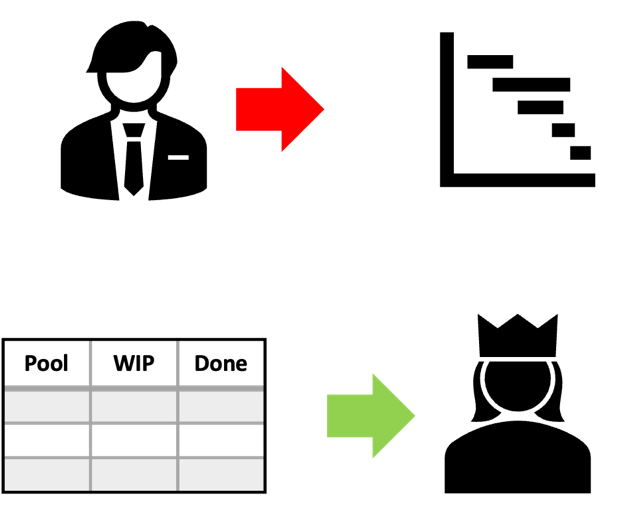
Manager pushes topics into the roadmap, customer pulls topics in a Kanban-like portfolio.
This creates a healthier pace of work. Pull prevents the burnout cycle so common in push-based organisations: overschedule → scramble → compromise → recover → repeat. Instead, pull sustains a predictable and sustainable delivery rhythm, which supports long-term productivity and team well-being.
One subtle yet significant change that occurs in pull systems is the relationship between urgency and importance. Push environments are characterised by a perpetual sense of urgency. All actions must be completed promptly, as this was the original plan. Pull environments enable organisations to distinguish what is genuinely important and to act accordingly. The focus has shifted from merely checking boxes to delivering value at the point when it is truly needed.
Another strategic benefit of pull is resilience. In dynamic environments where priorities shift, technologies evolve and customer expectations change rapidly, push systems often struggle to keep up. Plans become obsolete the moment they are finalised. In contrast, pull systems are designed to adapt continuously. Their ability to respond to demand in real time ensures their continued relevance, even in the face of changing conditions.
However, implementing pull is not without its challenges. It requires courage. It involves declining requests for early starts, even when there is pressure to “get moving”. This entails postponing commitments until there is readiness, even when others may prefer certainty. It involves having faith in the system to reveal what is truly required, rather than attempting to force it to deliver on paper.
Case Study: Scania – Managing complexity and reducing development lead times
Scania, a world-renowned manufacturer of heavy trucks and buses with approximately 50,000 employees worldwide, faced a growing challenge in the mid-2000s: how to manage increasing product complexity while staying responsive to customer needs and reducing development lead times. The company had long mastered lean principles in production, but the development organisation was still heavily driven by plan-based, “push-style” project management. Features and modules were engineered and released according to pre-set schedules, often resulting in late changes, overengineering, and strained cross-functional teams.
To address this, Scania initiated a transformation in 2008 to apply the pull principle systematically in its R&D and product development processes. The core idea was simple: engineering teams should only begin new work when there was actual readiness—technical, resource-based, and market-driven. Inspired by Lean Development models and Agile methods, Scania restructured its workflows to better reflect real demand signals, such as validated customer requirements, completed upstream modules, or unresolved technical dependencies.
This was operationalised through several measures. Engineering backlogs were visualised using Kanban-like boards, and work-in-progress (WIP) limits were introduced to reduce overload. Cross-functional teams were empowered to pull tasks based on their own capacity and maturity, rather than waiting for top-down assignments. A concept known as the “decoupling point” was introduced, allowing teams to delay detailed design decisions until the “last responsible moment” when critical information became available.
The results were impressive. Within a few years, development lead times were reduced by approximately 20%, and unnecessary rework fell sharply. Teams reported higher clarity, fewer context switches, and a greater sense of ownership. Most significantly, Scania became more responsive to changes in market demand and regulatory conditions, as engineering capacity was no longer tied up in projects with unclear value.
Today, Scania’s product development system is regarded as a benchmark for pull-based development in complex, modular engineering environments. The company’s success lies not only in its tools, but in its ability to connect pull principles to strategic clarity, system readiness, and team autonomy.
Exercise
Task:
Push vs. Pull Simulation — Participants experience the difference between push and pull through a physical simulation.
Required equipment:
Process description
Paper (for planes or similar) or Lego
Flip chart for debrief
Approach:
Divide the group into two teams: Team A (Push) and Team B (Pull). Each team simulates a basic process, such as folding paper airplanes or assembling a simple Lego model.
Team A works based on a predefined schedule — they start producing regardless of whether the next step is ready.
Team B produces only when the downstream person has free capacity (Kanban signal, e.g., fewer than 2 pieces in queue).
Run both simulations for 5 minutes.
Observe inventory buildup in Team A and discuss the effort wasted.
Highlight how Team B responds better to real-time capacity.
Connect the experience to Lean principles: less waste, faster feedback, improved flow.
Course Manual 9: Continuous improvement
Lean Thinking is Founded on the Principle of Continuous Improvement
Continuous improvement is not a project; it is an ongoing commitment. This is not merely a slogan. Lean initiatives are based on the fundamental belief that no process is ever perfect and that every person can contribute to making things better on a daily basis. In Lean Thinking, this concept is known as Kaizen, a Japanese word meaning “change for the better”, and it shapes how individuals, teams and entire organisations operate. The concept of continuous improvement is applicable to all aspects of our business, including problem-solving, leadership, collaboration and learning.
In contrast to conventional change initiatives, which are often sporadic, command-driven and characterised by the pressures of deadlines or crises, Lean fosters a continuous and consistent cycle of enhancement that is integrated into day-to-day operations. Rather, it is about implementing changes in a systematic way, without waiting for major breakthroughs or relying on expert-led restructuring efforts. The objective is to establish a working culture in which small changes are embraced and in which people closest to the work are empowered to improve it.
When this mindset becomes entrenched, enhancement becomes an integral part of the role, rather than an additional task. In the manufacturing sector, this might entail re-evaluating the storage method of tools to minimise wasted motion and time. In the field of administration, this might entail streamlining an approval workflow to eliminate superfluous steps. In product development, it can mean testing assumptions earlier to avoid costly rework later. What these examples have in common is the belief that the person doing the work is best placed to improve it, provided they are encouraged, trusted and equipped to do so.
In this sense, continuous improvement is both a technical and a social practice. The approach is founded on structured problem-solving methodologies, which facilitate team-wide improvements in a disciplined manner. From a social perspective, it establishes a culture of ownership, learning and respect. A Lean organisation does not merely implement tools such as PDCA or 5 Whys. It focuses on empowering individuals to observe their own processes, identify waste or inefficiency, and experiment with more effective work methods.
The PDCA cycle (Plan, Do, Check, Act) is frequently referred to as the engine of continuous improvement. It invites teams to formulate hypotheses about what might be improved, test them on a small scale, examine the results, and then standardise or adjust based on what they learn. This cycle of experimentation fosters a learning-oriented environment, where mistakes are viewed not as failures but as essential steps in determining what works. The logic of PDCA is a natural fit for all levels of an organisation, from the shopfloor to the executive suite. Rather than relying on perfect planning, Lean methodology favours a structured learning approach.
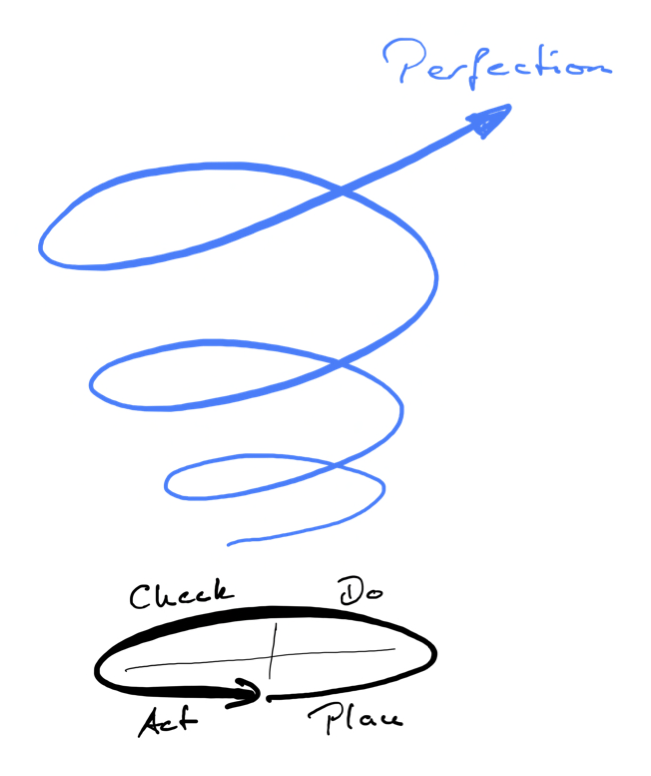
Another essential method is the 5 Whys technique, which helps teams avoid superficial solutions by tracing problems back to their root causes. By repeatedly asking “Why?”, teams can identify the underlying causes of a symptom. This process often uncovers latent issues in processes, policies or behaviours that would otherwise remain unaddressed. The objective is not to allocate blame, but rather to implement system improvements.
Kaizen workshops, also known as Kaizen events, are another format that supports rapid and focused improvement. These are time-boxed sessions where cross-functional teams work intensively on a well-defined challenge. Typically spanning one to five days, these workshops bring together individuals from diverse backgrounds to map current processes, identify issues, develop solutions and implement changes promptly. The impact is frequently both practical and cultural: teams not only improve a specific process, but also build trust, mutual understanding, and a shared sense of ownership. In many organisations, the inaugural Kaizen workshop marks a pivotal moment, offering a tangible illustration of the Lean principles.
The power of Kaizen lies in its cumulative effect. In the context of business operations, seemingly minor adjustments to tool positioning or enhancements in communication during process transitions might appear inconsequential in isolation. However, these subtle modifications can collectively contribute to significant gains in efficiency and effectiveness. In the long term, the workplace itself evolves to become more resilient, adaptive, and better aligned with customer needs.
Continuous improvement has the ability to scale down. When improvement becomes a daily habit rather than an occasional event, it has a positive impact on all levels and functions. A team leader who invites input at the end of each shift is practising Kaizen. A marketing assistant who simplifies a report template to save ten minutes every week is performing Kaizen. A development engineer who conducts early usability tests instead of waiting until final validation is applying Kaizen thinking.
However, cultivating a culture of continuous improvement necessitates more than just individual initiative. Again, leaders play a critical role. In a Lean organisation, leadership means enabling improvement. Managers are not merely distant reviewers of results; they are engaged coaches. They allocate time to the areas of the business where value is created, actively listen to staff, ask powerful questions and celebrate learning. They foster an environment of psychological safety, enabling individuals to voice their opinions, explore new ideas and, on occasion, make mistakes.
The culture of continuous improvement in an organisation can be observed at various occasions. Do meetings focus only on results, or do they include reflection on learning? Are failures discussed openly or hidden? Do managers ask questions or give answers? These signals shape whether a culture of continuous improvement can emerge and sustain itself.
A common misconception is that continuous improvement requires significant time or resources. In reality, the most impactful changes often come from frontline insights and require little investment. What is required is visibility and support. Organisations can foster this by creating simple mechanisms for teams to share improvements, track minor changes, and make them visible. Improvement boards, quick wins galleries, or five-minute daily stand-ups are useful practices in this regard, but their effectiveness depends on how consistently and respectfully they are applied.
It is also important to clarify that continuous improvement is not about perfectionism or constant change for its own sake. It is about purposeful evolution, driven by the customer’s needs and enabled by people’s creativity. In Lean Thinking, improvement is always linked to value creation. If a change can be shown to make the process faster, the product better, or the service more responsive, then it is valuable. If it merely adds complexity or activity, it is not improvement—it is waste.
The Continuous Enhancement of Lean Development and Knowledge Work is of Paramount Importance
Lean Development reframes improvement as an act of exploration. The objective is not only to reduce waste in the traditional sense, but also to accelerate learning, validate assumptions earlier, and enhance knowledge sharing. Development teams operate in a landscape where poor decision-making, delays or misunderstandings can have a significant impact on project outcomes. Continuous enhancement in this setting is therefore a strategic necessity. It determines how quickly teams can adapt, how effectively they collaborate, and how reliably they deliver value to the customer.
In development environments, improvement often commences with observation and reflection. It is for this reason that a significant number of Lean-aligned methods incorporate systematic practices for reflection prior to progressing with new initiatives. Retrospectives, for example, are a cornerstone of Agile frameworks. Conducted at the conclusion of a time-boxed iteration, these sessions provide a structured framework for the team to reflect on their performance, identify areas for improvement, and establish clear goals for the subsequent cycle. These regular moments of shared reflection build a rhythm of improvement into the way teams work — not just what they work on.
However, reflection alone is not sufficient. Development teams also require systematic tools for identifying problems, capturing insights and refining their practices. The A3 problem-solving method, which was originally developed within the context of Lean Manufacturing and has since been adapted for application in knowledge work, provides a clear and structured framework for analysing challenges, testing hypotheses and documenting lessons learned. Knowledge capture templates, including technical decision logs and design rationale documents, facilitate the transfer of learning across teams and over time. When conducted with the correct mindset, design reviews are not about critique, but about shared learning and quality assurance.
In order to achieve continuous improvement in this domain, it is essential to prioritise collaboration. These issues include, but are not limited to, communication gaps, unclear roles, delayed feedback and siloed expertise, which can lead to costly delays or misalignment. That is why Lean encourages not only the optimisation of technical processes, but also the deliberate improvement of team dynamics. Clarifying responsibilities, simplifying communication paths and creating routines for fast feedback are as essential as any engineering tool. A team that communicates openly, learns from each other and trusts one another is better able to solve complex problems, and this capability must be nurtured continuously.
This approach fosters a comprehensive understanding of waste in Lean Development. While traditional waste categories such as waiting, overproduction and excess motion still exist, additional forms of waste are becoming more relevant in knowledge work. These include unclear information, incomplete problem definitions, unnecessary meetings, or late validation of key assumptions. Frequently, the most costly waste is that which hinders effective decision-making. That is why continuous improvement efforts must address not only what is visible in the workflow, but also the invisible layers of understanding, assumptions and intent.
In order to make these dynamics visible, many Lean organisations adopt metrics that go beyond throughput or efficiency. Dashboards that track lead time, cycle time, cumulative flow or defect rates provide teams with data to identify patterns and guide discussions. However, the objective is not to pursue quantitative targets, but rather to foster transparency and facilitate learning. When used appropriately, metrics highlight areas for improvement, identify potential bottlenecks and indicate ways in which teams can enhance their predictability.
Lean Development and continuous improvement are not limited to team-level practices. Organisational structures, leadership behaviours and management systems must align with the principle of continuous learning. For instance, does the organisation allocate time for retrospectives and learning? Do leaders actively encourage feedback and problem-solving? Are improvement ideas welcomed from all levels of the organisation? These questions are critical, because continuous enhancement cannot thrive in an environment that rewards only short-term delivery while ignoring process health.
In practice, leading organisations create space for structured learning and improvement even under pressure. Some companies establish improvement boards or learning backlogs to track and prioritise improvement ideas. Some organisations establish communities of practice that facilitate the exchange of insights between teams. Some organisations allocate dedicated time in their development cycles to quality control and A3 investigations. All of these examples share the common characteristic of treating improvement as a genuine professional responsibility, rather than as a task to be undertaken only when time allows.
Creating a culture and infrastructure for ongoing improvement
A sustainable Lean transformation is not dependent solely on tools or methods, but rather on a deeper cultural and structural foundation that enables continuous improvement. The establishment of such a foundation is both a leadership task and a shared responsibility. The process entails the establishment of an organisational culture that fosters initiative, experimentation and learning. In addition, practical systems and routines are to be implemented to ensure that improvements can be made and monitored.
At the core of this initiative is the understanding that culture is not a vague concept. It is shaped by daily interactions, decisions and behaviours. In a Lean organisation, the culture clearly signals that improvement is valued, learning is encouraged, and all employees are encouraged to contribute. It is imperative that this message is consistently reinforced through leadership conduct, team rituals, communication habits and the way success is defined.
In order to cultivate this kind of culture, leaders must transition from a role that focuses on problem-solving to one that enables change. This does not imply a retreat, but rather a strategic adaptation in approach. Rather than issuing directives, Lean leaders focus on the value-creation process. They ask questions, listen carefully, and support team members in developing their own solutions. They make problems visible and treat them as opportunities for growth, not reasons for blame. By modelling curiosity and humility, leaders demonstrate that improvement is not about having all the answers in advance – it’s about learning faster together.
However, even the most dedicated team cannot guarantee continuous improvement in a system that lacks adequate support. That is why infrastructure matters. It establishes the framework necessary for ongoing enhancement. This infrastructure includes visual management boards, improvement routines, suggestion systems, reflection practices and space for learning. Each of these elements helps to transform the abstract idea of continuous improvement into tangible practice.
For instance, a daily team huddle that includes a brief review of successes and areas for improvement is a recommended practice. Another option would be to implement a weekly improvement hour, during which teams would work on minor adjustments to their processes. A visible board is a useful tool for collecting, prioritising and tracking improvement ideas. These mechanisms are straightforward, yet when implemented consistently, they convey a compelling message: enhancement requires dedicated effort, not merely an additional option.
Training also plays a critical role. It is essential that all employees, at all levels of the company, fully understand not only the Lean principles, but also how to apply them in their specific context. This includes practical problem-solving, root cause analysis, visual thinking, and how to run experiments. In addition, it encompasses the social aspect of improvement, including the provision of constructive feedback, facilitation of discussions, and the establishment of trust within teams. It is important to view the development of these skills not as a one-time activity, but as an ongoing investment.
Metrics and incentives also influence culture. When success is defined narrowly by output or compliance, teams may avoid experimentation out of fear. When improvement efforts are recognised, even if they don’t always deliver immediate results, people feel safe to try. A mature Lean system uses indicators not to control but to inform. It measures the health of the system, not just the speed of its output.
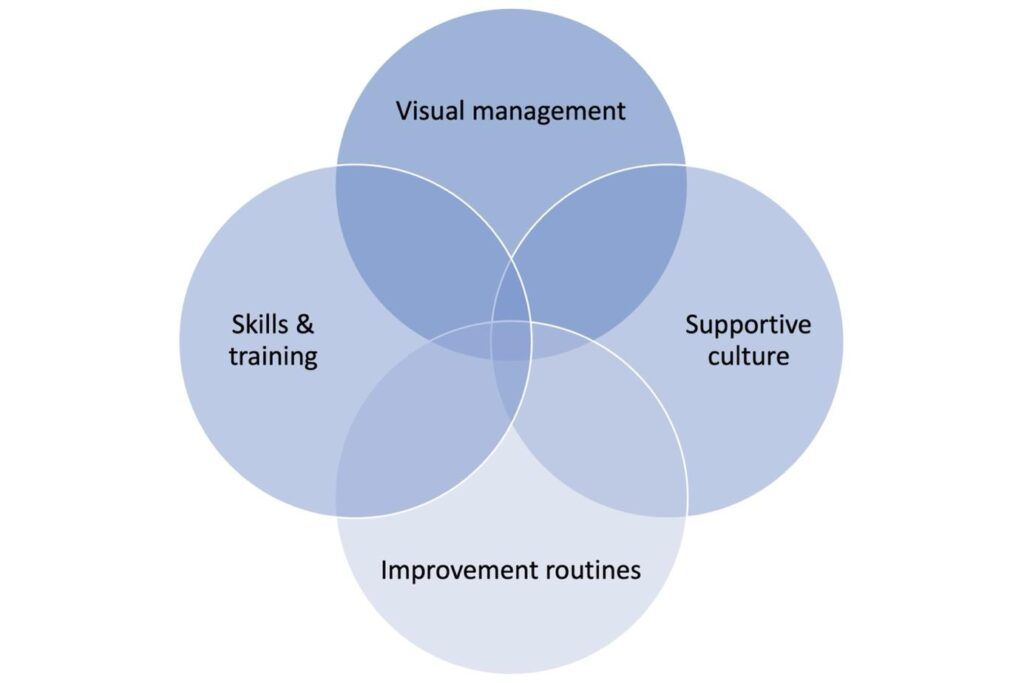
It is also advisable to consider the manner in which different departments interact. Silos can often hinder the dissemination of improvement ideas. Cross-functional forums, communities of practice, or improvement networks can facilitate the exchange of insights across teams and units. This approach fosters not only deeper learning within teams but also broader dissemination of knowledge across the organisation.
The ultimate objective is to embed continuous improvement so deeply into the daily work that it no longer feels like a separate initiative. It becomes integral to decision-making processes, meeting management, and problem-solving. This is to be expected.
This is the fundamental principle of Lean culture-building. Not a transformation event, but the steady shaping of norms, systems and habits that align people around a shared purpose of getting better—every day, in every role, together.
Case Study: Bosch Power Tools – Fostering a culture of continuous improvement in product development
Bosch Power Tools, a division of the German multinational Bosch Group, is a global leader in hand-held power tools, accessories, and measuring tools. With a global workforce of over 20,000, the division initiated a strategic transition around 2010 to enhance its Lean capabilities beyond manufacturing and integrate continuous improvement into product development and knowledge work.
At the time, Bosch Power Tools was facing significant challenges, including growing product complexity, shorter market cycles and rising expectations for innovation and speed. While Lean principles had already been well established in their production plants, the development units were still operating in traditional structures with sequential workflows, unclear feedback loops, and long decision-making processes.
The pivotal moment occurred when leadership recognised that to achieve and maintain excellence in product development, it was necessary to implement not only enhanced processes but also a cultural transformation. A dedicated Lean Development initiative was launched with the objective of cultivating a continuous improvement mindset across all development teams.
The implementation phase began with comprehensive training in Lean principles for engineers, product managers and team leaders. This was followed by the introduction of structured routines such as daily stand-ups, visual task boards, and retrospectives. A key enabler was the deployment of the A3 methodology across development teams, encouraging systematic problem-solving, root cause analysis and documentation of learnings.
Cross-functional collaboration was enhanced through the co-location of teams and the implementation of pull-based planning systems, allowing development work to flow more responsively based on team capacity and customer priorities. Feedback loops were tightened through regular design reviews and integrated testing during development sprints.
Over time, Bosch Power Tools has embedded continuous improvement as a management expectation. Leaders transitioned from directive roles to coaching roles, providing support to teams in identifying areas for improvement. A central Lean office facilitated knowledge sharing across business units and provided coaching for local Kaizen initiatives.
The impact was significant. Product development lead times were reduced by up to 30 percent in some areas. There has been a notable increase in employee engagement, primarily attributable to the enhancement of autonomy and ownership within teams. Most importantly, the development organisation became more adaptive and responsive to market signals, enabling faster innovation cycles.
This transformation demonstrated that a continuous improvement culture in product development is not only achievable in a large, established company, but also essential for maintaining long-term competitiveness in fast-moving markets.
Exercise
Task:
Participants take a closer look at their own development environment and write down answers to the following three questions:
1. What would it look like if continuous improvement were not a side activity, but a built-in element of daily work?
2. How would decision-making, collaboration and learning need to change?
3. What support would teams need from leadership and from each other?
Required equipment:
Flip chart or board
Sticky notes
Pens
Approach:
Trainer: Write the questions on the flip chart or board, leaving space for sticky notes.
Trainer: Hand out sticky notes and pens, and ask participants to write their answers on sticky notes—one note per example (don’t discuss prior to or during writing to avoid biasing). Time box: 2 minutes.
Participants: Silently write answers on notes, without discussing.
Trainer: Ask participants one after the other to stick their notes to the board and briefly explain their answers. Questions, short discussion. Time box per participant approx. 45 seconds. The trainer is time keeper and moderator.
Course Manual 10: Lean processes
What is a Lean Process?
It is vital to understand what defines a Lean process if we are to unlock the full potential of Lean Management. In essence, a Lean process represents more than a mere series of efficient steps; it is a deliberate, dynamic system meticulously designed to deliver tangible value to the customer, whilst minimising waste, friction and delay. In contrast to conventional methods that may be guided by internal policies, legacy systems or departmental convenience, Lean processes are purpose-built with the customer’s value as a key consideration. The company’s activities are aligned with the customer’s actual needs and budget, rather than with past practices or administrative convenience.
When examining a Lean process, our focus is not merely on the speed of task execution or the associated costs. The fundamental question is whether each activity adds value, and whether the process as a whole moves that value forward in the most effective way. A Lean process achieves this by focusing on flow. Work should progress smoothly and without interruption, step by step, from one part of the system to the next. Bottlenecks, rework, idle time, unnecessary approvals or waiting periods are all indicative of processes that are not truly Lean.
Another key characteristic of Lean processes is the pull principle, as we have seen earlier. Rather than basing work allocation on forecasts or departmental goals, Lean systems focus on meeting actual demand. Work is initiated only when it is required and in the precise amount needed. This approach is intended to reduce overproduction, inventory, and unnecessary resource consumption. It also compels the organisation to become more responsive and better connected to its customers.
However, the question remains: how can we transition from abstract principles to practical design? This is where tools such as value stream mapping, process mapping and swimlane diagrams come into play. These tools are not merely for specialists; they offer teams powerful ways to visualise, discuss and question how their work really happens. When used effectively, such tools facilitate the identification of inefficiencies, the detection of overlaps or gaps in responsibilities, and the uncovering of points of confusion or misalignment.
To illustrate, consider a product development process where each new design must be reviewed by three different departments in sequence. In theory, each review adds value. In practice, two of the reviews often duplicate the same concerns, while the third typically comes too late to influence the design meaningfully. A Lean analysis could result in the integration of these review steps into a single, cross-functional discussion held earlier in the process. This approach offers a number of benefits, including time savings and improved quality of feedback, as well as enhanced team alignment.
Another essential component of Lean processes is their built-in capacity for self-correction and continuous improvement. Rather than relying on end-of-process inspections or quarterly audits, Lean processes incorporate quality checks and feedback mechanisms directly into the workflow. Daily huddles, real-time dashboards, visual control boards and even simple checklists can help teams identify and address issues early on, preventing them from escalating. This creates a system that is not just more efficient, but more resilient and adaptive.
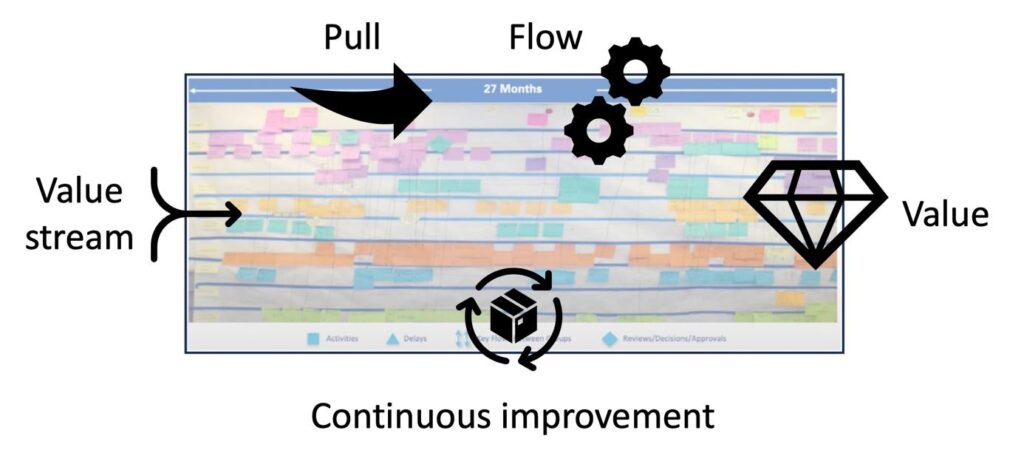
It is also important to recognise that Lean processes are never ‘finished’. Since they are designed to evolve with changing customer needs, market conditions or technological possibilities, they must be continuously refined. In a Lean organisation, process improvement is not regarded as a project, but as an ongoing, shared responsibility. All individuals involved in the process, including front-line staff, engineers, and managers, play a crucial role in identifying opportunities for improvement and making suggestions. This mindset shift can take time, but once established, it has been shown to be a powerful driver of long-term performance.
If you grasp Lean processes as living systems designed to deliver value with clarity, speed and minimal waste, rather than static routines, you will be laying the groundwork for a Lean culture. A business environment should be viewed as a space in which every process provides an opportunity for learning, and every improvement makes the organisation more agile, more customer-oriented, and more effective.
Implementing Lean Processes in Development and Innovation Settings
In development and innovation environments, the role of processes must be reimagined. Rather than aiming for uniform outputs, they facilitate navigation of ambiguity, promote risk mitigation through learning, and enable rapid identification of effective solutions. The overarching question that guides these processes is not “How can we optimise throughput?” but rather “How can we learn faster and make better decisions sooner?”
A Lean process in development is not a rigid sequence of steps to follow, but a carefully crafted framework that balances discipline and adaptability. It provides teams with a clear path for progressing from idea to validated solution, while allowing them the flexibility to pivot when assumptions prove invalid or opportunities shift. The focus is on efficiency and effectiveness: creating the right product, not just building it quickly.
One of the most effective strategies for implementing Lean processes in a development context is to integrate standardised thinking frameworks. These tools, including design thinking, hypothesis-driven development and iterative learning cycles, structure the innovation process around customer understanding, fast experimentation and validated learning. For example, by implementing a template that requires teams to define assumptions, success metrics and test methods prior to the commencement of development, the organisation transitions from speculative planning to evidence-based decision making.
Rather than planning large feature sets months in advance, Lean processes promote working in small, testable increments. These smaller units of work facilitate the collection of authentic feedback at regular intervals, thereby enabling more rapid learning and prompt course corrections. Rather than committing substantial resources at the outset, Lean development advocates a step-by-step approach, validating each assumption as it is encountered and continually refining the solution. This shift is especially powerful in uncertain or fast-moving markets, where being directionally correct early is more valuable than being precisely wrong later.
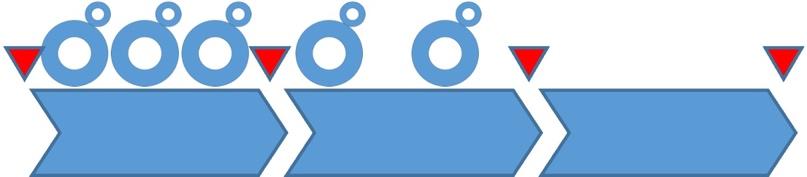
However, it is important to note that Lean processes do not materialise spontaneously. Deliberate design and commitment from teams and leadership are prerequisites for success. Cross-functional collaboration is a foundational element. In the majority of organisations, innovation is a multifaceted process involving a diverse range of stakeholders, including designers, engineers, marketers, legal advisors, and operations professionals, among others. If each of these actors operates in isolation, innovation can become fragmented and slow. Lean processes deliberately break down these silos by designing workflows and rituals that require cross-functional alignment. Shared planning sessions, joint decision-making checkpoints, and regular synchronisation events ensure that all relevant perspectives are heard and integrated early in the process.
Reducing batch sizes is another critical aspect of implementing Lean processes in development. Large batches, such as feature sets developed over months without validation, can lead to delays, mask issues, and increase the cost of change. Lean methodology encourages the development of small, coherent work packages that can be designed, built, and tested quickly. The faster these units cycle through development and validation, the quicker the organisation learns. This approach also mitigates the risk of developing large solutions that do not fully meet requirements.
It is also vital to consider the integration of built-in feedback and learning mechanisms. Lean processes are not linear journeys with a defined end; they are iterative loops that incorporate review, reflection and adjustment. Regular retrospectives, learning reviews, and lightweight process audits allow teams to adapt their working practices based on experience and outcomes. This approach of “learning as we go” is a defining trait of Lean organisations and is essential in complex innovation settings.
In order to make such learning cycles practical, teams can adopt short, structured rhythms. For example, they can use two-week development cycles that end with product demos and retrospectives. The duration of the cycles is fixed, no matter what the results are. During these sessions, teams evaluate the delivery, the learning outcomes, and ways to enhance the process for the subsequent cycle. Over time, these routines establish a culture in which continuous improvement is an integral part of day-to-day work practices rather than being a sporadic management initiative.
It is important to note that process standardisation in Lean development does not imply uniformity. While certain templates, checklists or coordination routines may be applied across teams, it is essential that each team is empowered to tailor the process to their specific context. Lean processes are standardised to enhance clarity and efficiency, while maintaining flexibility in areas requiring creativity and learning. This balance between standard work and local adaptation is often achieved through regular peer exchange and transparent knowledge sharing between teams.
A final success factor in implementing Lean development processes is leadership support. Teams are only able to adopt Lean behaviours if leaders demonstrate these behaviours and provide positive reinforcement. This entails prioritising learning outcomes over immediate output, fostering an environment that supports experimentation even when it may not be successful, and eliminating organisational barriers that hinder rapid feedback loops. It is essential for leaders to actively engage in process reviews, to inquire about the lessons learned by teams rather than merely their achievements, and to ensure the allocation of the necessary time and psychological safety for experimentation.
Implementing Lean processes in development and innovation settings is about creating intelligent systems that are not only efficient but also able to learn, adapt and improve in response to reality. By integrating customer insight, rapid feedback, small batches and cross-functional collaboration into daily operations, organisations transition from a planning approach to one that is more conducive to innovation and discovery. By following this approach, they will be able to unlock a range of benefits, including enhanced products, more engaged teams, faster decision-making, and a greater ability to respond to the unknown.
Maintaining and Expanding Lean Processes Throughout the Company
Sustaining Lean processes within a single department is a valuable achievement, but the real potential of Lean Management unfolds when its principles extend across the entire organisation. True transformation occurs when Lean thinking becomes a shared language, a consistent approach, and an everyday habit in all parts of the business, whether in operations, administration, development, or support functions. This requires more than the successful implementation of a few well-functioning Lean processes. In order to embed Lean in a deep and broad way that is both deliberate and enterprise-wide, it is necessary to turn isolated improvements into a continuous capability.
One of the first insights that participants gain is the realisation that Lean is not limited to factories or engineering teams. Every workflow, regardless of whether it occurs in procurement, HR, finance, marketing, legal, or customer service, is a potential candidate for Lean transformation. In any process where a sequence of activities is performed with a repeatable purpose, there is an opportunity to reduce waste, improve flow, and increase value.
In a Lean HR process, for example, the onboarding of new employees can be streamlined to reduce delays between steps, eliminate unnecessary paperwork, and clarify ownership of key tasks. The result is a more seamless experience for the employee and a reduction in administrative effort for the HR team. In the field of finance, the acceleration of monthly closing processes can be achieved through the automation of routine entries, the validation of data at the source, and the allocation of human resources to exceptions and value-adding analysis. In the field of customer service, Lean processes have been shown to enhance efficiency by standardising workflows, eliminating superfluous approvals, and equipping employees to resolve issues directly.
However, it is important to note that identifying improvement opportunities is only the first step in a process. In order to maintain and expand Lean processes, it is essential that organisations invest in what is known as process literacy. This involves developing the capacity among employees to observe, comprehend, and interrogate the processes of work. All employees, at all levels, should be able to map processes, identify root causes of inefficiency, and facilitate structured improvement activities. In the absence of this shared competence, Lean initiatives remain isolated and rely heavily on a small number of champions or external consultants.
Process literacy is cultivated through targeted training, hands-on practice, and internal coaching. Team members will learn how to visualise their workflows using simple tools such as process maps or value stream maps. The company’s procedures include the identification of waste and rework, as well as the exploration of how to redesign processes to improve flow and customer value. Facilitators learn how to guide teams through improvement workshops, not by giving answers, but by asking the right questions and enabling ownership.
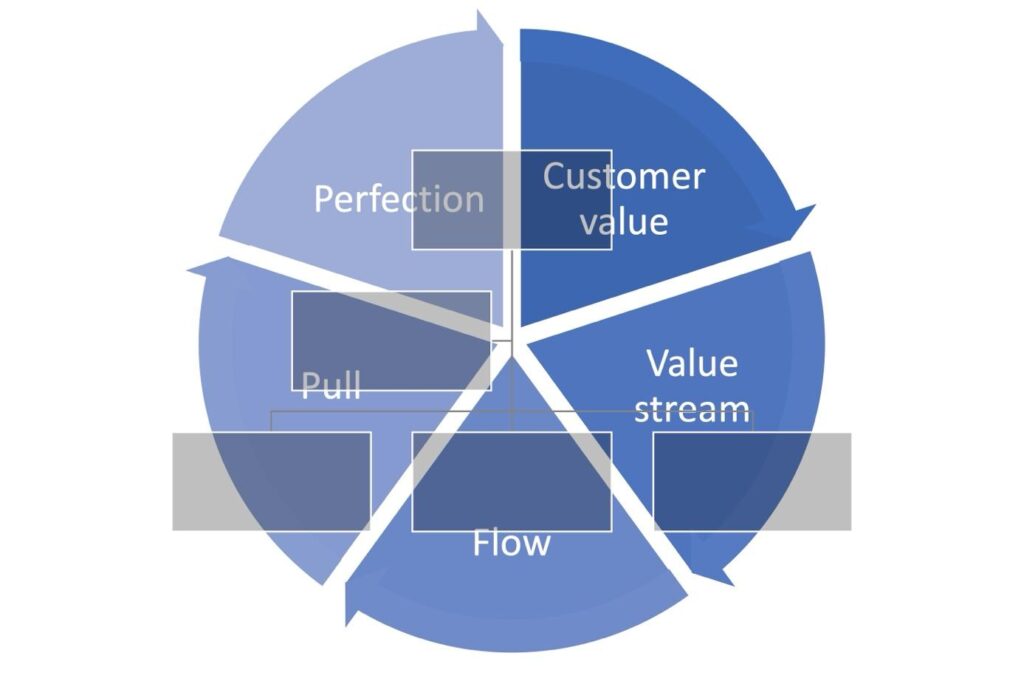
However, it should be noted that process understanding alone is not sufficient. In order for Lean to be successfully implemented across the company, it is essential that it is linked to the company’s strategy. All improvement initiatives, no matter how minor, should ultimately align with the overarching business goals. If a Lean process in procurement helps reduce the cycle time for supplier selection, this should not only reduce internal workload but also support faster product launches or improved responsiveness to customer needs. If Lean in customer service is found to shorten case resolution time, this should correlate with higher customer satisfaction or better retention.
It is vital to make these connections visible in order to maintain momentum. Digital tools and dashboards are instrumental in facilitating this process. By tracking key performance indicators (KPIs) that reflect the impact of Lean efforts, such as process lead times, first-time-right rates, customer satisfaction, or capacity gains, organisations can ensure alignment between operational improvement and strategic outcomes. This also makes success tangible, reinforcing the value of Lean practices and encouraging further adoption.
Another critical enabler of Lean expansion is leadership behaviour. It is imperative that leaders at all levels embody the mindset and habits that underpin Lean. This includes asking thoughtful questions about process performance, supporting cross-functional collaboration, and rewarding not just results but also learning and experimentation. Leaders should be visible participants in process reviews and improvement events, helping to break down resistance and maintain strategic clarity.
In order to further reinforce this culture, many companies are creating Lean communities of practice. These are internal networks of Lean practitioners, facilitators and champions, who share experiences, successes and lessons learned. These communities frequently function as catalysts for cross-functional learning, disseminating effective practices from one department to another and preventing the duplication of errors. They also help to normalise Lean language and methods, ensuring that they become part of the company’s DNA rather than a temporary initiative.
Sustaining Lean also requires daily management routines that keep the process in focus. Visual boards, daily stand-ups, standard work, and regular process audits are not just operational tools; they are cultural anchors. They facilitate the establishment of rhythm, clarity, and accountability. When used consistently, they help teams to maintain the gains achieved through improvement and to spot new opportunities before problems escalate.
However, even with all these elements in place, organisations must remain watchful against what can be called Lean drift – the tendency for processes to revert to old habits as priorities shift or pressure increases. Avoiding this requires vigilance and reinforcement. Successful Lean companies implement regular process health checks, refresh training on a periodic basis, and rotate team members through improvement roles to build resilience and shared ownership.
Finally, it is important to understand that expanding Lean is not about scaling a template. The key issue is scaling capability. Each team and each function will have its own constraints, opportunities, and rhythms. It is essential that the principles remain intact: prioritising customer value, reducing waste, focusing on flow rather than fragmentation, and learning before execution. When these principles are consistently applied, Lean becomes a way of working that is both scalable and sustainable.
By assisting teams across the business in the development of their own Lean processes, and by integrating these processes with a shared objective and quantifiable outcomes, organisations transition from a reactive and fragmented state to a responsive and aligned one. This transformation is not a one-time event; it is a journey of continuous improvement that becomes embedded in how the company thinks, decides, and acts.
Case Study: LINAK – Lean Product Development in Action
LINAK, a Danish manufacturer of electric linear actuators, serves various industries including healthcare, agriculture, and office furniture. With approximately 3,500 employees worldwide, the company operates in a high-mix, high-precision environment where product customisation and reliability are key success factors. In 2018, LINAK encountered a significant challenge as it experienced a growth period. The company’s product development cycles became less efficient, characterised by ambiguous decision-making processes, delays in handover procedures, and mounting coordination issues among departments.
To address this, LINAK launched a structured Lean Product Development (LPD) initiative. The aim of this initiative was to reduce lead times and improve cross-functional alignment. The project commenced with a comprehensive pilot on a strategically significant actuator product line. The company recognised that traditional development approaches, based on long planning phases and large batches of work, no longer met the demands of speed and adaptability. Instead, a Lean process model was introduced that prioritised small batch delivery, frequent feedback, and customer-focused learning loops.
Rather than attempting to transform the entire organisation in one go, LINAK began by training key teams on essential Lean development practices. This included the implementation of hypothesis-driven planning techniques, which required teams to explicitly articulate assumptions and define measurable criteria prior to commencing work. Development work was divided into smaller, more manageable increments that could be tested and validated quickly. This approach helped to reduce the risk of late-stage changes and rework. Regular planning meetings were held to bring engineers, procurement specialists, test engineers and market representatives together. The purpose of these meetings was to synchronise efforts and clarify responsibilities from the outset. The introduction of visualisation tools was intended to enhance workflow transparency and facilitate the early identification of blockers and handover delays.
The impact of these changes became evident within months. Milestone lead times improved by up to 40 percent, as projects encountered fewer delays and issues were surfaced earlier in the development cycle. Teams reported a significant reduction in unnecessary rework, since testing was now embedded earlier in the process and feedback loops were shorter. Cross-functional collaboration improved as the new process structure clarified expectations, reduced ambiguity, and encouraged proactive communication. Perhaps most importantly, teams began to see retrospectives and structured learning as normal components of development, not just afterthoughts or management formalities. This change supported a stronger culture of continuous improvement, with teams adapting their working methods based on real-world insights rather than rigid plans.
Following the pilot project’s demonstrable success, the company expanded Lean practices to other development streams. This transition was implemented in a phased manner, guided by internal Lean coaches and a growing community of practice. In order to ensure strategic alignment, leaders made sure that Lean improvements were directly linked to business objectives. These objectives included faster time-to-market and improved product reliability. Digital dashboards were introduced to track key performance indicators and maintain focus on value creation rather than just task completion.
LINAK’s experience demonstrates how a thoughtful application of Lean principles in a development context can result in operational improvements and cultural transformation. In order to successfully transition, it was necessary to exercise discipline, clarity of purpose and strong leadership support. It also demonstrated that Lean is not about doing more with less; rather, it is about learning faster, aligning better, and delivering real value with greater confidence and speed.
The LINAK case study demonstrates that a Lean transformation can be initiated by a single product team and scaled up progressively, provided that capabilities are developed, processes are made visible, and teams are empowered to adapt. In addition, it is evident that Lean is not confined to production efficiency; rather, it is a strategic enabler of innovation and responsiveness across the enterprise.
Exercise
Task:
Please describe: Which elements of your current development process are fixed, and which are flexible? Where and to what extent are teams empowered to shape their own way of working?
Required equipment:
Flip chart or board
Sticky notes
Pens
Approach:
Trainer: Write the questions on the flip chart or board, leaving space for the sticky notes.
Trainer: Hand out sticky notes and pens, and ask participants to write their answers on sticky notes — one note per example (don’t discuss prior to or during writing to avoid biasing). Time box: 2 minutes.
Participants: Silently write answers on notes, without discussing.
Trainer: Ask participants one after the other to stick their notes to the board and briefly explain their answers. Questions, short discussion. Time box per participant approx. 45 seconds. The trainer is time keeper and moderator.
Course Manual 11: Kaizen and kanban
Kaizen: Continuous improvement through everyday engagement
Kaizen is a mindset — a way of thinking and working that becomes part of the culture of an organisation. In Lean Management, Kaizen represents continuous improvement achieved through consistent, daily actions. Whilst other approaches may rely on isolated improvement initiatives driven by external consultants or senior executives,
In order to successfully implement Kaizen, it is essential that this philosophy is embedded into the organisation’s routines on a daily basis. Morning stand-up meetings, or daily huddles, provide a platform for employees to reflect on yesterday’s issues and propose improvements for today. Visual boards provide a transparent display of open issues and the tracking of improvement actions. Leaders do not merely review KPIs; they walk the floor, engage with teams, and ask purposeful questions such as: What factors contributed to the challenges you faced yesterday? What improvements can we make today to make your job easier? These routines are straightforward yet highly effective in promoting engagement.
Kaizen differs from systems such as suggestion-box mechanisms or annual feedback surveys in that it possesses a feedback loop that is characterised by its immediacy. When an idea is voiced in the morning and implemented before the end of the shift, the sense of agency grows. The worker becomes a problem-solver, rather than a passive participant in a system run by others. This is in line with one of the fundamental principles of Lean, namely respect for people. Kaizen thrives in an environment where individuals feel trusted, listened to, and responsible for improving their own work.
In the field of product development, Kaizen is a tool that can be used by developers to refine handover criteria between the concept and design stages. It can also be used to reduce the time between customer feedback and iteration, or to improve coordination between mechanical, electrical, and software teams. Frequently, the most significant gains are achieved through the clarification of responsibilities, the enhancement of knowledge visibility, and the reduction of feedback loops. For instance, a team might realise that ambiguity in design intent leads to repeated rework. A simple checklist or shared definition can reduce delays by days or even weeks. Such improvements are incremental, but their long-term impact is significant.
Kanban: Visualising work and managing flow
Within the Lean Management framework, Kanban offers a highly adaptable and practical approach to managing work as it flows through complex systems. Originally developed in the automotive industry to control inventory and signal replenishment needs, Kanban has evolved into a universal method for visualising work, limiting overburden, and fostering flow. Its extensive use in manufacturing, development and service environments demonstrates its flexibility and strategic value. At its core, Kanban is about transforming the invisible into the visible – creating a shared picture of what is being worked on, by whom, and where things may be getting stuck.
In its most common form, a Kanban system is represented by a board. In this board, individual tasks or work items are visualised as cards that move from one process step to another across columns. These columns reflect stages in a workflow, typically beginning with a backlog or “To Do” column, progressing through one or more stages of active work, and ending in “Done” or “Delivered”. The board thus becomes a live representation of the team’s workload and progress. It provides a comprehensive overview of the process’s status, identifies potential bottlenecks, and highlights areas where capacity may be excessively loaded or underutilised.
The power of Kanban lies not in the board itself but in the discipline it introduces. A key principle of the method is to minimise ongoing work. Rather than allowing unlimited tasks to build up in the system, teams agree on WIP limits for each process stage. This approach ensures that tasks are prioritised effectively and prevents overloading. When a column reaches its limit, the system does not allow any new tasks to be pulled into it until the existing tasks are completed. This rule fosters collaboration and problem-solving, as team members transition from initiating new projects to providing support for ongoing work. The result is faster cycle times, fewer errors, and a more balanced workflow.
This simple visual framework leads to profound behavioural changes. It has been shown to influence how teams communicate, how they prioritise, and how they respond to problems. A Kanban board is not merely a passive display; it is an active management tool. Teams convene around it during daily stand-up meetings to inspect current work, discuss any obstacles, and coordinate efforts. This ritual fosters rhythm, alignment, and accountability. It also shifts the focus from individual performance to system performance. Rather than focusing on individual tardiness, teams proactively inquire into the underlying causes of workflow delays, and subsequently take appropriate action.
In knowledge-based environments such as product development, Kanban provides a practical solution to the challenges of managing non-linear work. Development tasks frequently involve iterations, waiting times, feedback loops and unpredictable paths. It is evident that traditional planning and scheduling approaches are not always aligned with this reality. Kanban, on the other hand, is designed to accommodate variability and respond with flexibility. Work items progress at the system’s designated pace, with progress being clearly visible. This approach facilitates more effective coordination of dependencies, making it easier to track and enhance cross-functional work.
In order to operate effectively, it is essential that a Kanban system is supported by meaningful metrics. Cycle time, which measures the duration of a task from start to finish, is a key performance indicator of workflow efficiency. Throughput, defined as the number of tasks completed within a given time period, is a key performance indicator of productivity. Cumulative flow diagrams provide a time-based view of the volume of work in each process stage, facilitating the identification of patterns such as bottlenecks or variability in task arrival rates. These indicators enable teams to manage by data rather than opinion and to improve continuously.
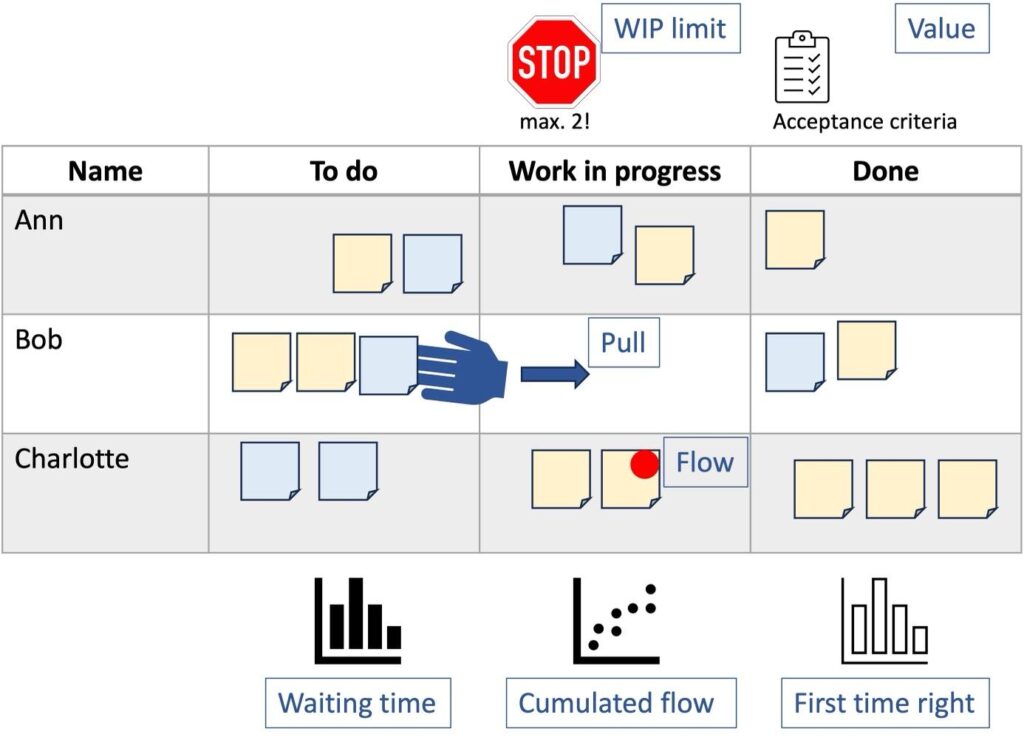
Kanban also serves as a foundation for more in-depth Lean practices. When combined with Kaizen, it becomes a vehicle for structured learning. Problems are identified early on, allowing for minor adjustments that enhance the overall system. Teams begin to understand cause and effect relationships within their workstreams and experiment with changes in workflow design, work-in-progress limits, or task definition. In contrast to large-scale process redesigns, Kanban-driven improvements are incremental and low risk, making them ideal for dynamic or uncertain environments.
A key strength of Kanban is that it does not require structural change or complex implementation. The initiative can be started small, on a whiteboard or wall, and evolve as the team learns. There is no requirement to overhaul existing systems or introduce new roles. Instead, the Kanban method is a flexible approach that adapts to local needs and improves with experience. Its lightweight nature makes it suitable not only for frontline teams but also for leadership levels, where strategic initiatives and portfolios can be visualised and aligned across departments.
Perhaps most importantly, Kanban changes the conversation. It encourages transparency regarding capacity, the disclosure of issues, and an emphasis on completion rather than mere activity. It encourages teams to see the bigger picture and to work together to manage the entire system. These cultural effects frequently have a greater impact than the operational ones. In this sense, Kanban is not just a workflow tool – it is a Lean mindset in action.
Finally, Kanban presents a straightforward yet revolutionary approach to work management. The process begins with visualisation, leading to enhanced flow, strengthened teamwork and a culture of continuous learning. By making work visible, limiting WIP, and managing by flow, organisations can reduce waste, increase responsiveness, and create systems that are both efficient and humane. For Lean practitioners, Kanban is not an optional extra – it is fundamental.
There is a common misconception, especially in organisations unfamiliar with Lean principles: “Kanban equals micromanagement”. I would like to briefly address this misconception.
Kanban is a tool that enables team members to take ownership of their work.
Contrary to a top-down approach, Kanban is a bottom-up system. Micromanagement is when decisions are centralised. Kanban decentralises control and puts it in the hands of those doing the work. Teams are responsible for defining the board structure, setting their own work-in-progress limits, and determining how to enhance their own workflow. This approach fosters autonomy rather than micromanagement. All team members are able to see the same picture and act accordingly, eliminating the need for any one person to wait for instructions. This takes some of the pressure off team leaders, as they don’t have to worry so much about managing tasks within their teams.
Complementary Power: A Practical Guide to Kaizen and Kanban
The true strength of Lean Management is realised through the interlocking nature of its individual tools and methods, which collectively form a continuous improvement system. It is evident that Kaizen and Kanban are two deeply complementary forces. While each component can be used on its own to good effect, their combined application creates a dynamic feedback system that aligns people, processes, and performance in a unified flow. Kanban provides a visual representation of the present, while Kaizen focuses on future-oriented transformation.
Kanban provides teams with a clear overview of their work. The tool provides a comprehensive view of all tasks, statuses and bottlenecks, facilitating a clear understanding of actual and potential workflow. However, it should be noted that visibility alone is not sufficient. Identifying a problem is only the first step in a process. Kaizen provides the mechanism to respond. It encourages everyone, from operators to executives, to reflect on inefficiencies and take action. When teams recognise that issues on the Kanban board are signals for improvement rather than obstacles to be tolerated, a shift in mindset occurs. Kanban provides a visual representation of the current state of affairs, while Kaizen identifies the underlying causes and explores potential improvements.
This interplay creates a self-correcting system. For instance, when work accumulates in a specific column on the Kanban board, it indicates an imbalance, which may be attributed to a lack of capacity, unclear task definitions, or excessive task switching. Adopting a Kaizen mindset enables teams to take ownership of their work, without having to wait for managerial intervention. They then pause to analyse the situation together and propose a small experiment, which might involve adjusting WIP limits, redefining task boundaries or clarifying acceptance criteria. These are not large-scale process changes. These improvements, born from frontline insight, are implemented quickly and evaluated through visible results on the same board. This cycle of observation and response builds resilience into the system.
One of the most pragmatic approaches to implementing this integration is the introduction of systematic improvement routines. The daily stand-up, already a key ritual in Kanban systems, becomes more powerful when infused with Kaizen thinking. Rather than simply reporting status, teams begin to ask: what are the factors hindering us, and what solutions can we implement today? Retrospective meetings have the potential to evolve from passive reflections into active Kaizen workshops, where patterns from the board are analysed and transformed into targeted experiments. Improvement is an integral part of day-to-day work, rather than a separate activity.
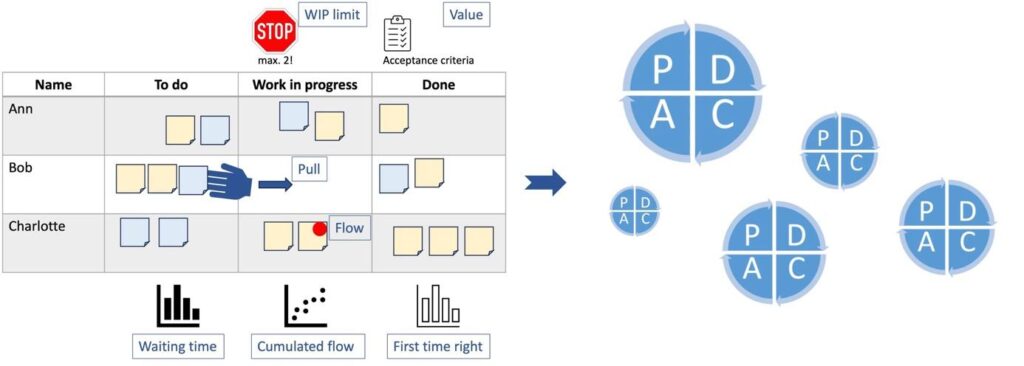
Cross-functional environments benefit particularly from this combination. In agile development teams, Kanban provides clarity across design, coding, testing and deployment. Kaizen enables these disciplines to improve handoffs, feedback cycles, and integration quality. In marketing or HR, Kanban helps to visualise campaign steps or recruitment processes, while Kaizen encourages teams to eliminate delays or redesign forms that cause confusion. In departments such as finance, legal, and customer service, where the flow of work is less visible and often reactive, the adoption of Kanban brings structure, while Kaizen fosters ownership.
Managers and team leads play a vital role in maintaining the rhythm of improvement. This approach does not entail a top-down implementation of change; rather, it facilitates a bottom-up process of learning and innovation. Leaders support the system by asking questions rather than giving answers, by recognising improvement efforts, and by providing time and resources for experimentation. Furthermore, they assist in the removal of systemic obstacles that are not able to be addressed at a team level. In this context, the practice of Gemba walks is of particular significance, as it establishes a connection between leadership and the actual work environment, emphasising that enhancement is a shared responsibility.
It is important to recognise that this combination also supports psychological safety. Kanban boards are a useful tool for externalising challenges, enabling objective discussion. Kaizen reframes problems as opportunities for learning rather than signs of failure. They work together to establish an environment in which there is a culture of innovation and risk-taking, with the capacity to learn from mistakes and adapt to new situations. This cultural foundation is what ultimately sustains Lean systems beyond initial implementation.
In practice, this approach can be implemented in a phased manner. One team will introduce a Kanban board. They have started to meet regularly to discuss ways to improve their flow. They experiment with a new definition of “done”, or reduce the number of parallel tasks. They then observe the effects. Following that, they attempt an alternative approach. The visual feedback loop created by the Kanban board and the structured reflection encouraged by Kaizen drive learning. Improvements become visible, owned, and repeatable. A team-level habit can rapidly be adopted across departments.
But what happens if you start with Kanban but don’t include Kaizen? Here is a simple example to help explain this:
In one organisation, a newly formed product development team introduced a Kanban board to visualise their work. Within days, patterns began to emerge: tasks frequently stalled in the “Review” column, feedback loops were slow, and some items sat untouched for over a week. The team could clearly see where the problems were — and so could everyone else. However, beyond noticing these issues, very little changed.
No structured conversations were held to ask why the problems occurred. No experiments were initiated to test new ways of working. Over time, frustration grew. The board, once a hopeful tool for alignment, became a visual reminder of dysfunction. Some team members stopped updating it altogether. Eventually, the board was abandoned — not because Kanban had failed, but because the second half of the loop — Kaizen — had never been activated.
This story illustrates a critical truth: visibility without action breeds resignation. Kanban reveals the truth of the current system, but without a Kaizen mindset, problems remain stuck — merely observed, never addressed. In Lean thinking, identifying waste is only the beginning. Improvement must follow, or the system will stagnate and trust in the tools will erode.
Case Study: BBC Worldwide – Kanban in Software Product Development
In the early 2010s, BBC Worldwide — a commercial arm of the BBC responsible for global software and digital products — was operating a nine-person software development team tasked with maintaining and evolving several customer-facing platforms. While the team had shifted toward agile, delivery cycles lacked consistency, work frequently stalled in progress, and visibility into task status was limited. Sarah and Peter, their delivery leads, decided to introduce Kanban over a 12-month period to address these challenges.
They began by physically placing two Kanban boards in a central space, complemented by four information radiators displaying metrics like work-in-progress (WIP), flow times, and blockers. The rules were simple yet powerful: every task needed to occupy a card on the board, and team members could not start work that wasn’t visible. Daily stand-up meetings were introduced, where each person answered three key questions: what they had started, what they were working on, and any impediments they faced. This simple ritual, tied to the board, brought clarity and accountability to the process.
Within weeks, the team began to notice meaningful changes. Bottlenecks became visible almost immediately as columns filled up and remained stalled. The WIP limits enforced by Kanban helped the team slow down, finish before starting new tasks, and reduce task switching. Tasks flowed more smoothly, and lead times shortened as delays became visible and easier to address. The daily stand-up evolved from standard status updates into targeted problem-solving sessions, where impediments were tackled collaboratively and unplanned work was rapidly assessed.
One of the most transformative outcomes was improved team cohesion. Visualizing work allowed individuals to gain a clear view of the overall workflow, fostering mutual understanding of who depended on whom. The transparency in task status and blockers also shifted the team culture: rather than pointing fingers, team members began asking how they could help each other to clear blockages and drive tasks to completion.
Over the 12-month period, delivery throughput doubled, average lead time dropped significantly, and team satisfaction scores improved markedly as developers felt less overwhelmed and more in control. The Kanban boards and rituals stayed central — daily stand-ups, WIP guidelines, and metrics reviews became the rhythm that sustained the gains.
Importantly, BBC Worldwide showed that Kanban in product development is not about drastic transformation; it’s about evolutionary change through clarity, flow, and collaborative problem-solving. By starting with visibility and WIP control, and embedding regular feedback rituals, they turned a struggling development process into a consistent, predictable, and human-centered system.
Exercise
Task:
To explore the relevance of Kanban for your own context, consider the following questions:
– How does work currently flow through your team or department?
– Where does work typically get stuck?
– How often do people switch between multiple tasks?
– If your Kanban board could provide feedback, what areas would it suggest your team should prioritise to optimise performance?
Required equipment:
Flip chart or board
Sticky notes
Pens
Approach:
Trainer: Write the questions on the flip chart or board, leaving space for the sticky notes.
Trainer: Hand out sticky notes and pens, and ask participants to write their answers on sticky notes — one note per example (don’t discuss prior to or during writing to avoid biasing). Time box: 2 minutes.
Participants: Silently write answers on notes, without discussing.
Trainer: Ask participants one after the other to stick their notes to the board and briefly explain their answers. Questions, short discussion. Time box per participant approx. 45 seconds. The trainer is time keeper and moderator.
Course Manual 12: Value stream mapping
Value Stream Mapping in Lean Management: Visualising Flow and Waste
When organisations embark on a Lean transformation, one of the first questions that arises is: What is the current position? In such cases, Value Stream Mapping (VSM) is an invaluable tool. It serves as both a diagnostic instrument and a strategic compass, helping teams see their processes not from the perspective of individual departments, but from the customer’s viewpoint – end to end. In Lean terms, this means tracing the value stream, i.e. the sequence of activities that transform a customer request into a delivered product or service, and making visible what is often hidden: delay, overprocessing, excess inventory, fragmented information flow—waste in its many forms.
VSM’s key strength lies in its capacity to translate the five Lean principles into a visual narrative. The first principle, which defines value from the customer’s perspective, is brought to life by distinguishing clearly between value-adding and non-value-adding steps. The second principle, identifying the value stream, is embedded in the core of the method itself. Mapping forces teams to ask: Which activities truly contribute to what the customer is willing to pay for? The third principle, flow, becomes important as the map shows handover points, waiting times and bottlenecks that disrupt continuity. The fourth, pull, is addressed by making inventory levels and trigger mechanisms explicit—allowing a move from forecast-driven to demand-driven processes. Finally, the fifth principle, perfection, is reflected in the iterative nature of mapping: each cycle aims not merely to improve, but to approach the ideal of zero waste.
In practice, a current-state value stream map uncovers the reality of how work is done. For instance, it may demonstrate that a product spends only 10 minutes in actual assembly, but sits idle for three days between steps. It has been noted that the necessity for multiple approvals can result in delays of several weeks in implementing engineering changes, despite the technical work requiring only a matter of hours. These insights regularly surprise even experienced managers. Rather than identifying individual errors, they identify system patterns. These are misalignments in timing, resource availability, or information clarity, which would be difficult to detect without the full picture.
VSM’s key strength lies in its ability to engage people effectively. It is not created by analysts in isolation, but in workshops that bring together those who live the process daily. Engineers, planners, operators and administrative staff walk through the steps together. They measure times, trace material paths, and analyse information flow, thereby facilitating a shared understanding. This social dimension is critical. Process change is more likely to succeed when those involved have co-created the diagnosis and the vision of a better future.
Once the current state is understood, the future-state map comes into play. It embodies hypotheses: What if we level the workload? What if we introduce pull instead of push? What if we remove this inspection step or reduce batch sizes? The process of developing this future vision stimulates creative problem-solving and invites participants to imagine what their work could look like. Frequently, the resulting map becomes a strategic plan for phased implementation, with short-term objectives and long-term transformation goals.
One of the most underestimated benefits of VSM is the way in which it fosters transparency. It has the capacity to transform abstract problems into visual facts. This is particularly beneficial in cross-functional contexts where departments might otherwise debate the root causes or responsibilities. When all parties have the same information, discussions shift from blame to collaboration. Suddenly, improving customer lead time is no longer just a goal of the sales team or production, but a shared challenge.
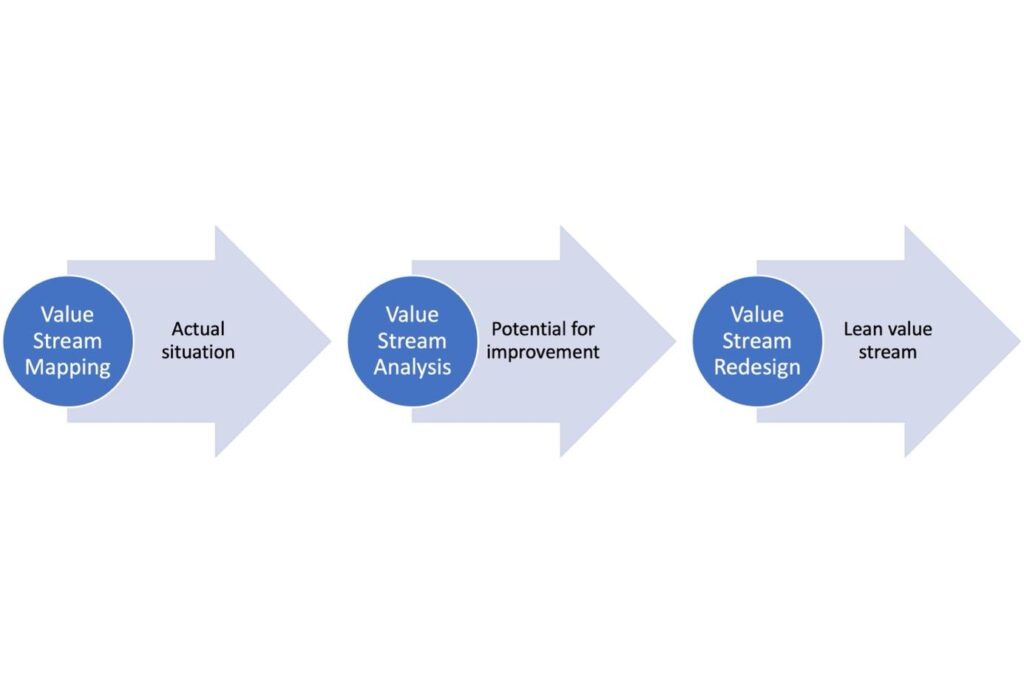
In the field of product development, VSM can be equally transformative, although the flow being mapped is one of information and decisions rather than materials. Mapping a development process reveals how customer requirements are translated into design, how many loops and iterations occur, and where approval bottlenecks or unclear interfaces delay progress. The effect is the same: waste becomes visible, flow becomes open to discussion, and improvement becomes actionable.
As you prepare to implement VSM in your own organisation, it is important to consider that this is not a one-time project, but a learning tool that should be integrated into your business processes. Each map has its own unique narrative, illustrating not only inefficiency, but also potential for opportunity. Ask yourself and your team: What does this map reveal that we didn’t know before? What patterns do we see? What would our ideal workflow look like, and what are the factors preventing us from achieving it? These questions form the foundation for effecting meaningful change.
This is not about drawing pretty diagrams. It is about learning to see. Value Stream Mapping gives Lean its eyes. Once you see flow and waste clearly, you can act with purpose. And when the whole organisation learns to see together, continuous improvement becomes not a project, but a habit.
Applying Value Stream Mapping in Lean Development
When applied to development work, Value Stream Mapping takes on a different character. Rather than tracking the movement of physical components across machines or workstations, the map now captures the less visible pathways of knowledge creation and decision-making. The objects in motion are not components, but information, documents, models, assumptions and feedback. In this environment, the flow is less predictable, the output less tangible, and the waste more difficult to see—yet the stakes are just as high, if not higher. Misalignment, rework and delays in product development can result in costly setbacks, delayed market entries and missed customer needs. In this context, Value Stream Mapping becomes a tool to expose hidden dysfunctions and to orchestrate learning with purpose.
The initial insight development teams often encounter is the fragmented nature of their work. In contrast to the well-defined, sequential tasks of production, the development process involves a dynamic interplay between discovery and delivery. It is common for requirements to be incomplete at the outset. Decisions evolve as more knowledge is gained. Stakeholders have been known to adjust their priorities during the course of a project. In order to map such a system, it is necessary to consider how work actually flows, rather than how it is documented in process manuals. A recommended initial step is to map a recent or ongoing development project and walk through the major phases: from initial concept or market signal to a validated product ready for launch.
One of the most beneficial aspects of development VSM is the emphasis placed on decision latency. In Lean Development, decisions are not just milestones; they are risk gates. It is important to make decisions quickly, as otherwise there is a risk that issues will not be addressed in a timely manner. By mapping when decisions are needed, when they are actually made, and what causes the delay, teams can identify opportunities to accelerate learning loops. This includes clarifying decision rights, improving access to data, and involving the relevant stakeholders at an early stage.
Another frequent source of waste in development is iteration without learning. This occurs when teams cycle through prototypes or design versions, but do so based on assumptions rather than verified knowledge. Value Stream Mapping is a useful tool that can help to identify these potential issues. It demonstrates instances where tests are conducted after the point of upstream work, or where the learning from one part of the organisation is not effectively communicated to others. This, in turn, creates opportunities to enhance feedback loops. Development teams are beginning to question whether they are learning at a sufficient rate. Are we validating the appropriate objectives? Are our cycles creating knowledge or just consuming time?
In contrast to production mapping, which benefits from relatively stable metrics, development VSM requires qualitative as well as quantitative data. Mapping teams often use sticky notes, brown paper, and collaborative sessions to reconstruct the actual workflow, including delays, handovers, and decision points. The focus is on understanding the current reality, rather than blaming individuals, and on examining the system. This collaborative exercise fosters enhanced cross-functional understanding. A systems engineer may realise how dependent their progress is on early inputs from UX. A test lead may gain visibility into upcoming features and plan resources accordingly. These conversations are frequently more impactful than the map itself.
The result of a development value stream map is not simply a visual representation. There is a shared commitment to enhance the efficiency of work processes. Teams generally create a “future state” map alongside the current state. This vision includes countermeasures for the most significant delays, such as the introduction of a common cadence for key decisions, synchronised interface definitions, and aligned milestones between mechanical, software, and systems engineering. In certain instances, this may result in the establishment of new roles, such as integration coordinators or knowledge brokers, to facilitate the seamless flow of information.
Lean Development does not strive for standardisation for its own sake. Unlike manufacturing, which benefits from consistency, development thrives on variation—provided that it is purposeful. Value Stream Mapping helps to distinguish between constructive variation (e.g. experimentation, innovation) and destructive variation (e.g. miscommunication, redundancy). It encourages teams to design processes that are robust, but also flexible enough to respond to changing conditions. This balance between structure and agility is a hallmark of successful Lean organisations.
In summary, the application of Value Stream Mapping in Lean Development does not entail the drawing of neat diagrams. The objective is to cultivate a shared understanding of how knowledge is created, transferred and applied. It instructs teams to adopt a holistic approach, eschewing the siloed thinking that can hinder productivity. It emphasises the value of rapid learning over impulsive action, and it encourages the application of empirical evidence to inform improvements rather than relying on assumptions. The map is not the end—it is the beginning of better collaboration and smarter design. When used effectively, development VSM can transform uncertainty into opportunity, and complex projects into manageable flows of learning and delivery.
Cross-Functional Impact and Strategic Use of VSM
As organisations progress along their Lean journey, the value of Value Stream Mapping becomes increasingly apparent. It evolves from a local improvement tool into a strategic lens through which complexity, misalignment and untapped potential can be viewed across the entire enterprise. This shift is particularly evident in product development, where successful outcomes depend on the fluid and coordinated movement of knowledge and decisions across diverse functions, rather than on isolated excellence within departments.
In the field of product development, value is not solely derived from engineering. Marketing defines market needs, product management shapes the offering, procurement sources key components, finance governs budgets, and operations ensures manufacturability. Each of these functions contributes to the flow of development, and any misalignment between them can have disproportionate consequences for the value stream. When Value Stream Mapping is used across different functions, it becomes a neutral ground where shared understanding replaces assumptions and improvement efforts are aligned with organisational goals rather than siloed initiatives.
Cross-functional VSM has the potential to reveal how fragmented the development system can be, even in companies that consider themselves to be collaborative. A mapping session may reveal that product specifications are handed over to engineering without a clear market justification, or that procurement is brought in only after key design decisions are locked in, leading to costly revisions or supplier limitations. Alternatively, it may become evident that product testing and validation are conducted in isolation from user feedback loops, delaying critical insights. These are not isolated incidents but rather systemic patterns. VSM provides the means to visualise and challenge them.
This increased visibility brings strategic benefits. Leaders begin to see their organisation not as a collection of departments, but as a series of interconnected value-creating flows. It is possible to trace strategic initiatives such as reducing time-to-market, increasing customer satisfaction, or improving product quality back to specific points in the value stream. Rather than initiating top-down programmes that are disconnected from operational realities, leaders can facilitate change efforts that are grounded in the actual flow of value and co-owned by those who execute it.
Furthermore, Value Stream Mapping becomes a key enabler of cross-functional learning. When teams from different domains map a product development stream together, they not only align on the steps and handovers – they begin to understand each other’s pressures, constraints, and information needs. This shared perspective is instrumental in dismantling the “over-the-wall” mentality that is often prevalent in development environments. A design engineer will start to anticipate procurement needs. A marketing lead must take into account any development constraints. A finance controller recognises the value of investing early in better risk evaluation. The resulting coordination is not enforced, but rather internalised.
This coordination is further strengthened by integrating VSM with strategic portfolio decisions. By comparing different product streams, leaders can assess which ones are overly complex, which are fast and lean, and which are chronically delayed. This allows them to make informed decisions about which products to prioritise, which to restructure, and where to allocate the most experienced resources. VSM provides insight into process performance and clarity for strategic resource planning.
It is crucial to note that the cross-functional and strategic use of VSM is not limited to mapping once and acting on static results. The dynamic nature of product development necessitates regular re-evaluations of value streams, particularly in response to technological advancements, evolving customer demands or organisational changes. When integrated with digital collaboration platforms, VSM can evolve into a living model, reflecting real-time data on work-in-progress, decision bottlenecks, or delivery forecasts. This dynamic mapping forms the basis for agile portfolio steering, enabling more responsive and informed governance.
An additional strategic dimension comes to the fore when organisations adopt VSM to integrate customer value into their internal language. Rather than considering functions in isolation (e.g. design, procurement, testing), the focus shifts to identifying where customers can experience value. In which areas does this value become compromised? This repositioning of VSM as a tool for customer-centric leadership is a key development. It elevates the role of development teams from executing projects to stewarding value creation.
In summary, the cross-functional impact and strategic use of Value Stream Mapping extends well beyond the confines of operations or development. It enables organisations to visualise their complexity, to align functional efforts with customer value, and to lead transformation from a position of systemic insight rather than functional bias. VSM is not merely a Lean tool; by adopting it, businesses can enhance their strategic capabilities.
Case Study: Value Stream Mapping at Scania – Improving Flow in Complex Product Development
One notable example of the successful implementation of Value Stream Mapping (VSM) in product development comes from Scania, the Swedish manufacturer of heavy trucks and buses. With over 50,000 employees and a strong global footprint, Scania is known for its modular product architecture and engineering excellence. Around 2010, Scania embarked on a Lean transformation that extended beyond production and into its R&D and product development departments, where increasing complexity and lead times had begun to hinder innovation and responsiveness to market needs.
The challenge Scania faced was common in complex engineering environments: although individual functions such as design, testing, and sourcing operated efficiently on their own, the end-to-end product development cycle suffered from misalignments, unclear handovers, and slow decision-making. As a response, Scania introduced Value Stream Mapping to better understand and optimise the flow of development activities, particularly for its engine platform projects.
Cross-functional teams, including engineers, project managers, purchasing and validation experts, were brought together to map the actual flow of work, starting from concept development and extending to launch readiness. The mapping process focused on identifying handoffs, decision points, rework loops and waiting times between phases. One surprising insight was the amount of time engineers spent waiting for test results or input from other departments — delays that had previously gone unnoticed because they were embedded in complex scheduling systems.
Using the current-state maps, teams were able to visualise inefficiencies and propose concrete improvements. One major change was the introduction of synchronised decision gates, allowing faster alignment between engineering and supply chain teams. Another was the redesign of test planning procedures, shifting from a linear to a more concurrent model, where simulations and physical testing could progress in parallel. In addition, clearer definitions of done and more structured feedback loops helped reduce unnecessary iterations.
The results were tangible. Development lead times for engine variants were reduced by 20 to 30 percent, while team engagement increased due to the transparency and shared ownership of the mapping process. Importantly, the initiative strengthened Scania’s ability to deliver complex, customisable products more predictably and in closer alignment with customer expectations.
This case illustrates how Value Stream Mapping, when applied strategically in product development, can reveal hidden waste and serve as a catalyst for cross-functional improvement and cultural change.
Exercise
Task:
Participants are encouraged to reflect on their own roles within the broader value stream. Consider the following questions:
– Where does your function contribute to or interrupt the flow?
– How can you redesign your own processes to be more anticipatory and less reactive?
– What conversations with other departments would help clarify interdependencies?
These questions help shift VSM from a tool of analysis to a catalyst for cultural change.
Required equipment:
Flip chart or board
Sticky notes
Pens
Approach:
Trainer: Prepare a simple, generic value stream on the board or flip chart. Write the questions on the flip chart.
Trainer: Hand out sticky notes and pens, and ask participants to write their answers on sticky notes — one note per example (don’t discuss prior to or during writing to avoid biasing). Time box: 2 minutes.
Participants: Silently write answers on notes, without discussing.
Trainer: Ask participants one after the other to stick their notes to the board and briefly explain their answers. Questions, short discussion. Time box per participant approx. 45 seconds. The trainer is time keeper and moderator.

SWOT & MOST Analysis Exercises
01. Undertake a detailed SWOT Analysis in order to identify your department’s internal strengths and weaknesses and external opportunities and threats in relation to each of the 12 Workshop Title processes featured above. Undertake this task together with your department’s stakeholders in order to encourage collaborative evaluation.
02. Develop a detailed MOST Analysis in order to establish your department’s: Mission; Objectives; Strategies and Tasks in relation to Workshop Title. Undertake this task together with all of your department’s stakeholders in order to encourage collaborative evaluation.
Project Studies

Project Study (Part 1) – Customer Service
The Head of this Department is to provide a detailed report relating to the Lean Transformation process that has been implemented within their department, together with all key stakeholders, as a result of conducting this workshop, incorporating process: planning; development; implementation; management; and review. Your process should feature the following 12 parts:
01. Lean basics
02. Lean development
03. Lean principles
04. Lean versus traditional
05. Customer value
06. Value streams
07. Creating flow
08. Pull principle
09. Continuous improvement
10. Lean processes
11. Kaizen and kanban
12. Value stream mapping
Please include the results of the initial evaluation and assessment.

Project Study (Part 2) – E-Business
The Head of this Department is to provide a detailed report relating to the Lean Transformation process that has been implemented within their department, together with all key stakeholders, as a result of conducting this workshop, incorporating process: planning; development; implementation; management; and review. Your process should feature the following 12 parts:
01. Lean basics
02. Lean development
03. Lean principles
04. Lean versus traditional
05. Customer value
06. Value streams
07. Creating flow
08. Pull principle
09. Continuous improvement
10. Lean processes
11. Kaizen and kanban
12. Value stream mapping
Please include the results of the initial evaluation and assessment.

Project Study (Part 3) – Finance
The Head of this Department is to provide a detailed report relating to the Lean Transformation process that has been implemented within their department, together with all key stakeholders, as a result of conducting this workshop, incorporating process: planning; development; implementation; management; and review. Your process should feature the following 12 parts:
01. Lean basics
02. Lean development
03. Lean principles
04. Lean versus traditional
05. Customer value
06. Value streams
07. Creating flow
08. Pull principle
09. Continuous improvement
10. Lean processes
11. Kaizen and kanban
12. Value stream mapping
Please include the results of the initial evaluation and assessment.

Project Study (Part 4) – Globalization
The Head of this Department is to provide a detailed report relating to the Lean Transformation process that has been implemented within their department, together with all key stakeholders, as a result of conducting this workshop, incorporating process: planning; development; implementation; management; and review. Your process should feature the following 12 parts:
01. Lean basics
02. Lean development
03. Lean principles
04. Lean versus traditional
05. Customer value
06. Value streams
07. Creating flow
08. Pull principle
09. Continuous improvement
10. Lean processes
11. Kaizen and kanban
12. Value stream mapping
Please include the results of the initial evaluation and assessment.

Project Study (Part 5) – Human Resources
The Head of this Department is to provide a detailed report relating to the Lean Transformation process that has been implemented within their department, together with all key stakeholders, as a result of conducting this workshop, incorporating process: planning; development; implementation; management; and review. Your process should feature the following 12 parts:
01. Lean basics
02. Lean development
03. Lean principles
04. Lean versus traditional
05. Customer value
06. Value streams
07. Creating flow
08. Pull principle
09. Continuous improvement
10. Lean processes
11. Kaizen and kanban
12. Value stream mapping
Please include the results of the initial evaluation and assessment.

Project Study (Part 6) – Information Technology
The Head of this Department is to provide a detailed report relating to the Lean Transformation process that has been implemented within their department, together with all key stakeholders, as a result of conducting this workshop, incorporating process: planning; development; implementation; management; and review. Your process should feature the following 12 parts:
01. Lean basics
02. Lean development
03. Lean principles
04. Lean versus traditional
05. Customer value
06. Value streams
07. Creating flow
08. Pull principle
09. Continuous improvement
10. Lean processes
11. Kaizen and kanban
12. Value stream mapping
Please include the results of the initial evaluation and assessment.

Project Study (Part 7) – Legal
The Head of this Department is to provide a detailed report relating to the Lean Transformation process that has been implemented within their department, together with all key stakeholders, as a result of conducting this workshop, incorporating process: planning; development; implementation; management; and review. Your process should feature the following 12 parts:
01. Lean basics
02. Lean development
03. Lean principles
04. Lean versus traditional
05. Customer value
06. Value streams
07. Creating flow
08. Pull principle
09. Continuous improvement
10. Lean processes
11. Kaizen and kanban
12. Value stream mapping
Please include the results of the initial evaluation and assessment.
Project Study (Part 8) – Management
The Head of this Department is to provide a detailed report relating to the Lean Transformation process that has been implemented within their department, together with all key stakeholders, as a result of conducting this workshop, incorporating process: planning; development; implementation; management; and review. Your process should feature the following 12 parts:
01. Lean basics
02. Lean development
03. Lean principles
04. Lean versus traditional
05. Customer value
06. Value streams
07. Creating flow
08. Pull principle
09. Continuous improvement
10. Lean processes
11. Kaizen and kanban
12. Value stream mapping
Please include the results of the initial evaluation and assessment.
Project Study (Part 9) – Marketing
The Head of this Department is to provide a detailed report relating to the Lean Transformation process that has been implemented within their department, together with all key stakeholders, as a result of conducting this workshop, incorporating process: planning; development; implementation; management; and review. Your process should feature the following 12 parts:
01. Lean basics
02. Lean development
03. Lean principles
04. Lean versus traditional
05. Customer value
06. Value streams
07. Creating flow
08. Pull principle
09. Continuous improvement
10. Lean processes
11. Kaizen and kanban
12. Value stream mapping
Please include the results of the initial evaluation and assessment.
Project Study (Part 10) – Production
The Head of this Department is to provide a detailed report relating to the Lean Transformation process that has been implemented within their department, together with all key stakeholders, as a result of conducting this workshop, incorporating process: planning; development; implementation; management; and review. Your process should feature the following 12 parts:
01. Lean basics
02. Lean development
03. Lean principles
04. Lean versus traditional
05. Customer value
06. Value streams
07. Creating flow
08. Pull principle
09. Continuous improvement
10. Lean processes
11. Kaizen and kanban
12. Value stream mapping
Please include the results of the initial evaluation and assessment.
Project Study (Part 11) – Logistics
The Head of this Department is to provide a detailed report relating to the Lean Transformation process that has been implemented within their department, together with all key stakeholders, as a result of conducting this workshop, incorporating process: planning; development; implementation; management; and review. Your process should feature the following 12 parts:
01. Lean basics
02. Lean development
03. Lean principles
04. Lean versus traditional
05. Customer value
06. Value streams
07. Creating flow
08. Pull principle
09. Continuous improvement
10. Lean processes
11. Kaizen and kanban
12. Value stream mapping
Please include the results of the initial evaluation and assessment.
Project Study (Part 12) – Education
The Head of this Department is to provide a detailed report relating to the Lean Transformation process that has been implemented within their department, together with all key stakeholders, as a result of conducting this workshop, incorporating process: planning; development; implementation; management; and review. Your process should feature the following 12 parts:
01. Lean basics
02. Lean development
03. Lean principles
04. Lean versus traditional
05. Customer value
06. Value streams
07. Creating flow
08. Pull principle
09. Continuous improvement
10. Lean processes
11. Kaizen and kanban
12. Value stream mapping
Please include the results of the initial evaluation and assessment.
Program Benefits
Customer Service
- Customer focus
- Customer value
- Customized solutions
- Lead times
- Response time
- Less escalations
- Reliable commitments
- Harmonized communication
- Customer satisfaction
- Customer rating
Operational Excellence
- Operational flow
- Waste reduction
- Resource efficiency
- Quality improvements
- Robust processes
- Continuous improvement
- Transparent operations
- Measurable results
- High adaptability
- Personal responsibility
Product Development
- Development cost
- Time-to-market
- Product features
- Modification flexibility
- Market testing
- Development risk
- Fast learning
- Transparent results
- Managed dependencies
- X-functional collaboration
Client Telephone Conference (CTC)
If you have any questions or if you would like to arrange a Client Telephone Conference (CTC) to discuss this particular Unique Consulting Service Proposition (UCSP) in more detail, please CLICK HERE.