
Transformative Inclusion

The Appleton Greene Corporate Training Program (CTP) for Transformative Inclusion is provided by Dr. Cummings Certified Learning Provider (CLP). Program Specifications: Monthly cost USD$2,500.00; Monthly Workshops 6 hours; Monthly Support 4 hours; Program Duration 48 months; Program orders subject to ongoing availability.

Personal Profile
Dr. Ayanna Rashida Cummings is an internationally recognized diversity executive, scholar-practitioner, and global strategist with a distinguished career at the intersection of equity, leadership, and systems transformation. With over two decades of experience—including tenure as an executive DEI leader for a Fortune 100 hospitality and food services corporation—Dr. Cummings has developed and implemented groundbreaking inclusion programs across diverse sectors. Her deep expertise in intercultural competence, inclusive leadership, and Industrial/Organizational psychology anchors the design and delivery of the Transformative Inclusion program.
Dr. Cummings holds both the Certified Diversity Executive (CDE®) and Senior Professional in Human Resources (SPHR) credentials. She is a Presidential Scholar and alumna of Hampton University, where she was recognized in the Forty Under 40 Honor Society. She has also been honored as a Top 100 Under 50 Executive by Diversity MBA Magazine (2021), awarded the Top DEI Officer by Atlanta Business Chronicle (2022), and recognized as one of The 10 Most Influential Women in DEI by The Chief Navigators (2023).
Her firm, Tapestry Consulting, LLC, has received national acclaim, including being named the Best DEI Consulting Firm – Southern USA by Corporate Vision (2023), and awarded the Best ED&I Consulting Firm in Georgia by The North America Business Awards (2024). These accolades reflect the measurable impact of Dr. Cummings’ proprietary frameworks and visionary leadership across business, government, and nonprofit sectors.
Her most recent book, Seated at the Table (2022), presents a practical framework for leading with equity and inclusion, synthesizing her fieldwork, scholarship, and innovative leadership frameworks into a compelling call-to-action for today’s business and civic leaders. Drawing from her lived experience as a woman of color in executive leadership and her scholarly research in adult education, DEI, and psychological safety, the book outlines transformative strategies for embedding inclusion across organizational systems. This publication forms a cornerstone of the Transformative Inclusion program, particularly through the operationalization of her proprietary Multi-Pronged Approach and RESPECT Framework.
Through keynote addresses, national fellowships, and thought leadership collaborations, Dr. Cummings continues to inspire leaders across industries to take measurable, courageous action toward equity and cultural transformation. Her work not only reflects the highest academic and professional standards—it empowers people and institutions to lead with purpose, dignity, and inclusion.
Dr. Cummings also serves as a Research Psychologist with the American Institute for Behavioral Research & Technology (AIBRT) in Vista, California. Under this appointment, she leads a research program focused on the codification of inclusive leadership behaviors across global and intercultural contexts. Her research investigates the ways in which cultural humility, bias mitigation, and emotional intelligence intersect with leadership outcomes in multinational organizations. Additionally, during her postdoctoral fellowship at the Georgia Institute of Technology, Dr. Cummings explored the use of artificial intelligence in mitigating racial bias through decision-support tools designed to address gaps in performance evaluation and recruiting systems, providing organizations with frameworks for identifying and reducing inequities embedded in algorithmic systems. These research programs directly inform the evidence-based methodologies embedded in the Transformative Inclusion program.
To request further information about Dr. Cummings through Appleton Greene, please Click Here.

(CLP) Programs

Appleton Greene corporate training programs are all process-driven. They are used as vehicles to implement tangible business processes within clients’ organizations, together with training, support and facilitation during the use of these processes. Corporate training programs are therefore implemented over a sustainable period of time, that is to say, between 1 year (incorporating 12 monthly workshops), and 4 years (incorporating 48 monthly workshops). Your program information guide will specify how long each program takes to complete. Each monthly workshop takes 6 hours to implement and can be undertaken either on the client’s premises, an Appleton Greene serviced office, or online via the internet. This enables clients to implement each part of their business process, before moving onto the next stage of the program and enables employees to plan their study time around their current work commitments. The result is far greater program benefit, over a more sustainable period of time and a significantly improved return on investment.

Appleton Greene uses standard and bespoke corporate training programs as vessels to transfer business process improvement knowledge into the heart of our clients’ organizations. Each individual program focuses upon the implementation of a specific business process, which enables clients to easily quantify their return on investment. There are hundreds of established Appleton Greene corporate training products now available to clients within customer services, e-business, finance, globalization, human resources, information technology, legal, management, marketing and production. It does not matter whether a client’s employees are located within one office, or an unlimited number of international offices, we can still bring them together to learn and implement specific business processes collectively. Our approach to global localization enables us to provide clients with a truly international service with that all important personal touch. Appleton Greene corporate training programs can be provided virtually or locally and they are all unique in that they individually focus upon a specific business function. All (CLP) programs are implemented over a sustainable period of time, usually between 1-4 years, incorporating 12-48 monthly workshops and professional support is consistently provided during this time by qualified learning providers and where appropriate, by Accredited Consultants.
Executive summary

Transformative Inclusion
In today’s multicultural business landscape, inclusive leadership is no longer a competitive advantage—it is a fundamental expectation. The Transformative Inclusion 48-Month Workshop Series is a first-of-its-kind learning architecture designed to cultivate culturally competent, emotionally agile, and globally inclusive leaders prepared to lead with clarity, authenticity, and equity.
As globalization reshapes the nature of work and workforce composition, our program provides the long-term process-oriented, measurable implementations organizations need to move beyond performative diversity measures toward enduring systemic change.
Rooted in scholarly research and organizational psychology, this program draws from the pioneering framework that espouses the necessity of inclusive leadership, examines leaders as integral to a cohesive and cyclical model of interpersonal communication and interdependencies that specifies followers’ perceptions as being critical to leaders’ overall success. Participative decision-making, mutual cooperation, and leaders’ ability to influence followers’ outcomes of peak performance and thriving are fundamental to our transformative inclusion paradigm .
Ultimately, we arrive at the assertion that inclusive leadership represents a shift from coercive compliance to earned trust and relational influence. This transcendence from obligatory compliance toward intentional inclusion among all organization members, guides our approach to transformative, people-centered leadership development.
Transformative Inclusion leverages four proprietary methodologies: the Multi-Pronged Approach to organizational assessment and change, the R.E.S.P.E.C.T. Framework (Reframe, Evaluate, Specify, Participate, Engage, Continue, Teach), the Equity Impact Framework, and the 4R Method, a scenario-driven conflict transformation process built on Response, Reaction, Reflection, and Reframing. These frameworks are implemented using a step-by-step model that supports pre-assessment, training design, facilitation, follow-through coaching, and post-program evaluation using quantitative and qualitative metrics.
Spanning four years of immersive learning, the Transformative Inclusion program includes 48 six-hour monthly sessions, each crafted around thematic competencies such as psychological safety, emotional and cultural intelligence, bias mitigation, equity-centered decision-making, inclusive talent management, and ethical global leadership.
The program is aligned with both Total Quality Management (TQM) principles and adult learning theory, ensuring measurable progress through such validated methods as pre- & post-assessments with multiple baselines, 360-degree feedback & coaching, reflective journaling, and Organizational Network [Communications] Analysis. Its design builds cumulative capacity, deepens intercultural empathy, and activates the behavioral shifts required to embed intercultural competencies into the core DNA of global institutions.
Amidst global social movements, workplace demographic shifts, and rising stakeholder expectations, organizations can no longer afford episodic interventions that amplify risk exposure. They must instead cultivate inclusion as a durable, measurable, and strategic asset.
Transformative Inclusion equips leaders with the awareness and practical tools to navigate conflict across high- and low-context cultures, address ableism, racial bias, generational bias, and other implicit and explicit biases that may erode the fabric of people-oriented organizational cultures. While reducing such risk exposure for organizational learning and sustainability, Transformative Inclusion effectively ensures the implementation of universal design and intersectional advocacy principles, among others, which ensure inclusion, amplify fairness, and attract the best and brightest employees whose professional successes drive organizational profits in perpetuity. More than a workshop series, it is a leadership evolution plan—with each month unlocking new layers of competency, consciousness, and cultural dexterity.
By integrating cutting-edge intercultural research with total quality management principles to ensure quantifiable and qualifiable leadership development and its intended impact, Transformative Inclusion positions participating organizations to future-proof their talent strategies, strengthen stakeholder trust, and build cultures where all people feel welcome, contribute, and thrive.
Multi-Pronged DEI Approach for Systemic Transformations
The DEI Multi-Pronged Approach is a comprehensive, enterprise-wide transformation strategy designed to catalyze inclusive excellence by embedding diversity, equity, inclusion, and justice (DEIJ) principles across every facet of organizational operations. It functions as a systems-level intervention grounded in organizational diagnostics, cultural audits, and data-informed implementation. The approach activates ten interdependent prongs: Targeted & Structured Recruiting; Assessment, Training & Development; Redesign of the Performance Appraisal System; Community Development Among Associates; Cultural Assessment & Systems Analysis; Vendor & Supplier Diversity; Community Outreach Execution Plan; Employee Engagement, Recognition & Retention; Career & Professional Development; and Communications & Governance. Each element strategically disrupts legacy systems within the organizational ecosystem, targeting points of cultural friction, systemic exclusion, and bias with scalable, data-driven interventions designed for global application.
This methodology leaps beyond diagnostic, reactive measures and assessments, catapulting DEI organizational strategies toward proactive and prescriptive data-driven methods that transcend time, space, and geographical boundaries. We draw on both qualitative insights and quantitative metrics to define baselines, scan environments, chart progress, and activate cultural transformation, while charting and evaluating progress for continuous learning and growth. Implemented across an 18-month horizon the core 48-Month Transformative Inclusion series, the Multi-Pronged Approach model ensures sequential alignment with corporate goals, stakeholder priorities, and global compliance standards. Drawing from empirical research and lived practitioner experience, the prongs are deliberately structured to be cross-sector agnostic to maximize their ecological application and validity by addressing foundational behaviors and operational gaps common across industries. The result is a replicable and scalable DEI framework that enhances workforce performance, drives innovation, and solidifies organizational resilience through inclusive systems change.
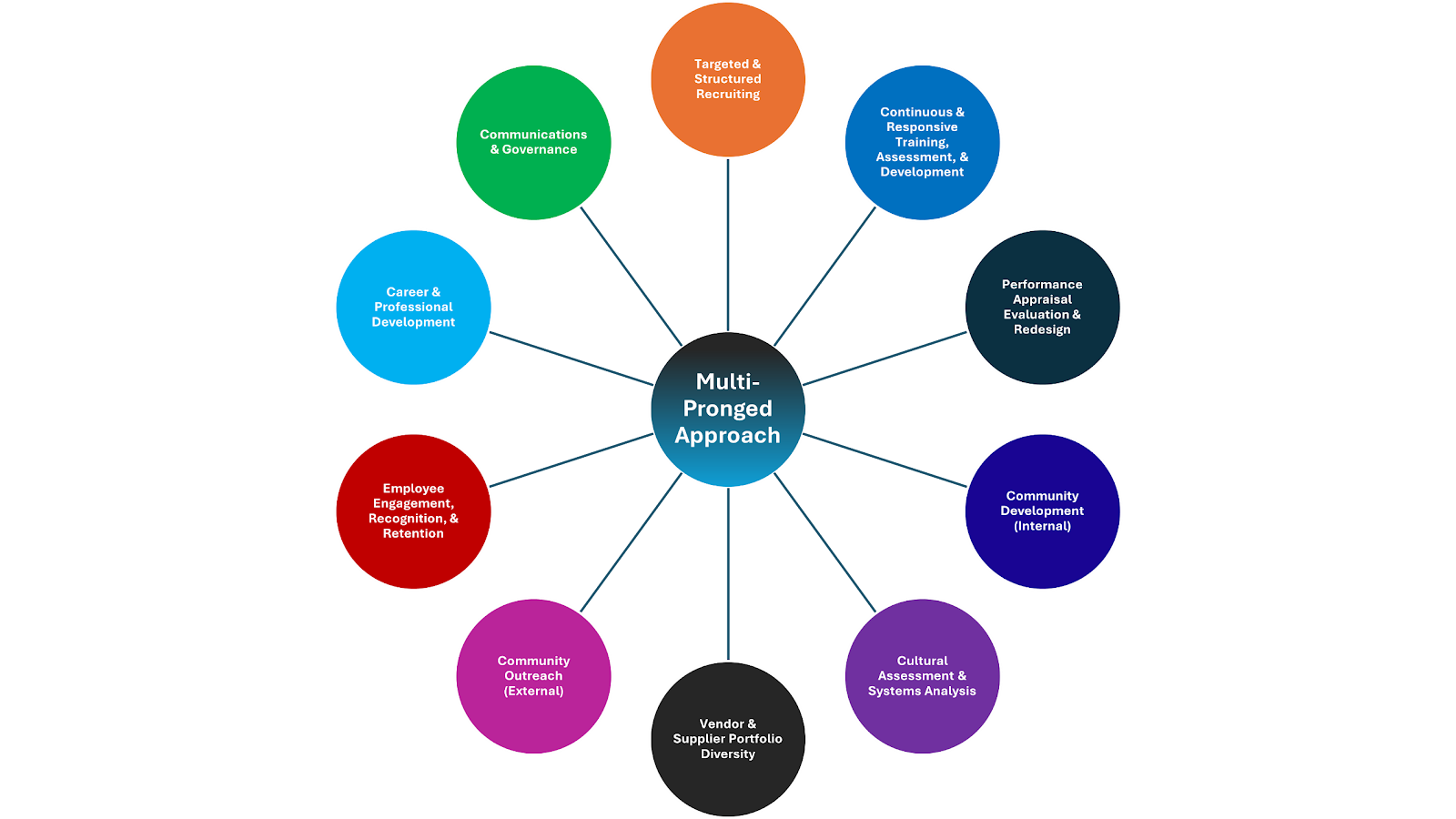
Figure 1. Multi-Pronged Approach
4R Model (Response, Reaction, Reflection, Reframing)
Our 4R Model may be leveraged as clients work to interrupt and mitigate implicit and explicit interpersonal biases. Our goal in providing this tool is to equip leaders and decision makers with resources that enable platforms for employee dialogue, particularly those regarding issues that impact the manner and quality of the work they do each day.
The 4R Method chart exemplifies the outcome of this framework by offering a structured process for diagnosing team behaviors and reframing them with constructive, user-friendly engagement strategies in global teams:
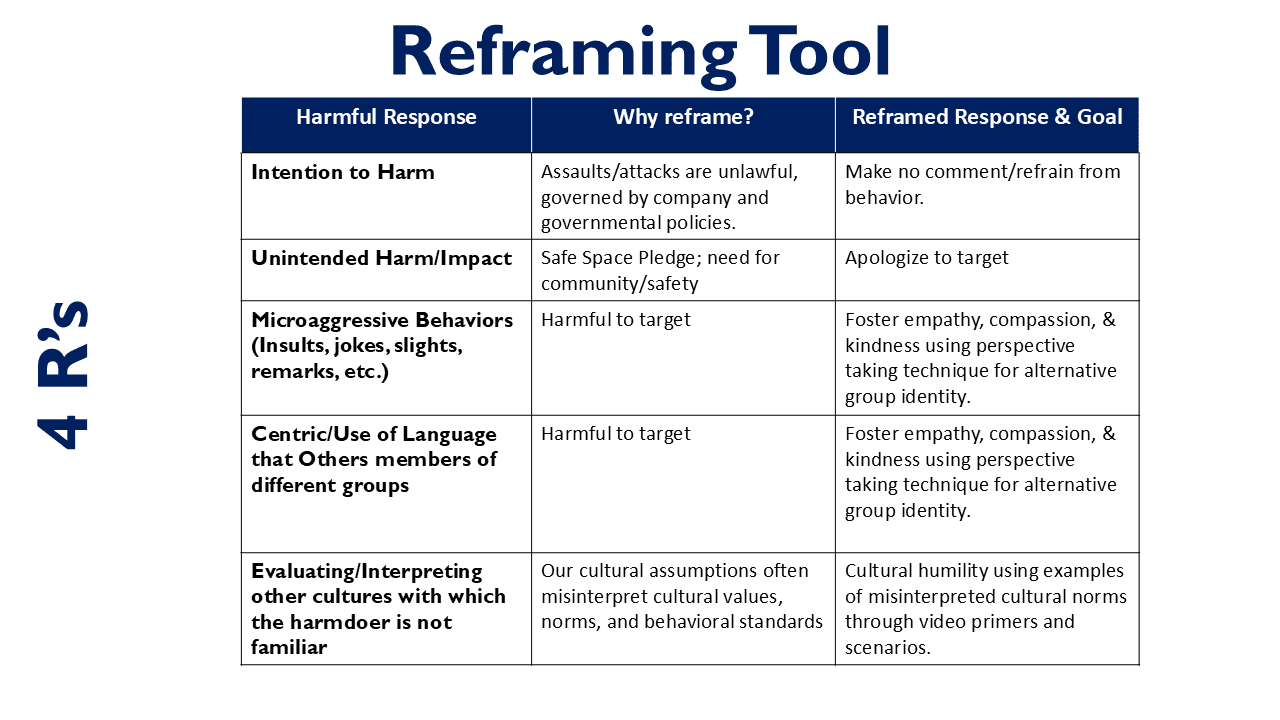
Chart 1. 4R Reframing Tool
The R.E.S.P.E.C.T. Framework: 7 Action Steps to Inclusive Leadership
The R.E.S.P.E.C.T. Framework is a proprietary, actionable methodology designed to systematically embed inclusive leadership practices into organizational culture. It follows a continuous, stepwise process that supports leaders in reimagining decision-making, fostering equity, and cultivating psychological safety.
Each step builds on the previous, creating a dynamic loop of growth, reflection, and sustained behavioral change.
This model recognizes that inclusion is not achieved through one-off training sessions or diversity statements—it must be operationalized daily through mindful leadership behaviors.
By following the R.E.S.P.E.C.T. cycle, leaders drive measurable transformation, enhance engagement, and unlock innovation across multinational, multicultural, and multigenerational teams.
7 Steps of R.E.S.P.E.C.T. Framework
Reframe: Challenge traditional norms and reimagine leadership through an inclusive lens.
Evaluate: Continuously assess policies, behaviors, and outcomes for equity gaps.
Specify: Set clear, measurable inclusion goals tied directly to leadership accountability.
Participate: Lead by example through active engagement in inclusion initiatives.
Engage: Foster authentic dialogue and build trust across all organizational levels.
Continue: Sustain momentum through regular check-ins, recalibrations, and celebrations.
Teach:Develop future leaders by embedding inclusive practices into mentorship and training.
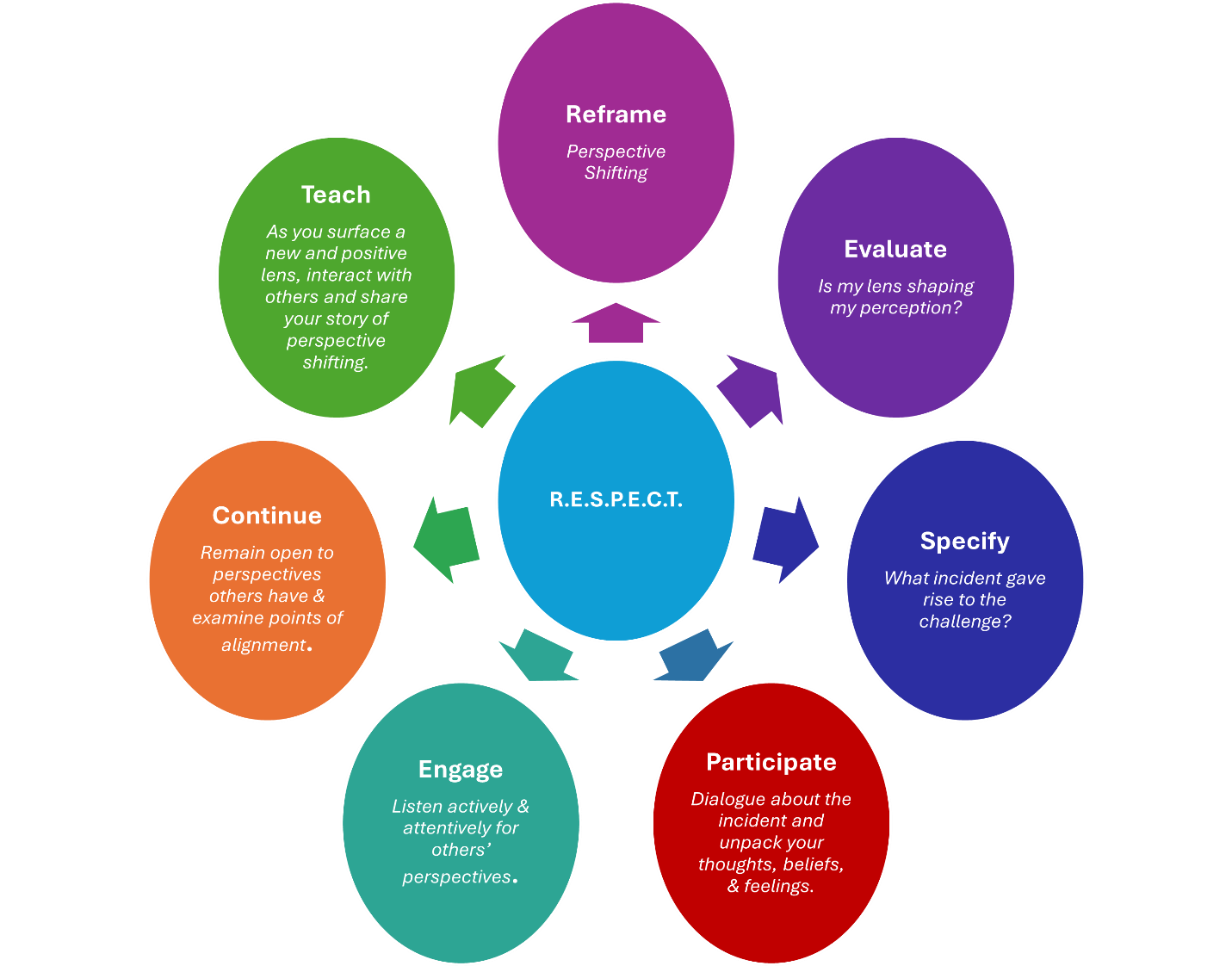
Figure 2. R.E.S.P.E.C.T. Framework
Equity Impact Toolkit Framework
The Equity Impact Toolkit Framework is a strategic, iterative process designed to embed equity-centered thinking into every stage of organizational planning, policy development, and decision-making. Grounded in applied equity analysis, the framework empowers leaders to move beyond performative inclusion efforts by equipping them with the tools to identify gaps, engage stakeholders, and co-create transformative change. Through five interlocking phases—Identify & Engage, Listen & Understand, React & Include, Integrate & Transform, and Evaluate & Measure—organizations gain a clear pathway for continuously addressing inequities and dismantling structural barriers.
Each stage of the framework is action-oriented, reinforcing a cycle of learning, reflection, adaptation, and measurable impact. For example, “Identify & Engage” prompts cross-functional engagement and demographic analysis, while “Listen & Understand” gathers experiential input through focus groups, climate assessments, and data disaggregation. As organizations advance toward “React & Include” and “Integrate & Transform,” equity becomes operationalized into systems, culture, and service delivery. Finally, the “Evaluate & Measure” phase holds the system accountable with data-informed progress indicators and equity audits. This framework will be fully unpacked in a dedicated workshop within the Transformative Inclusion series, helping leaders apply equity impact logic to drive system-wide change across global, multicultural contexts.
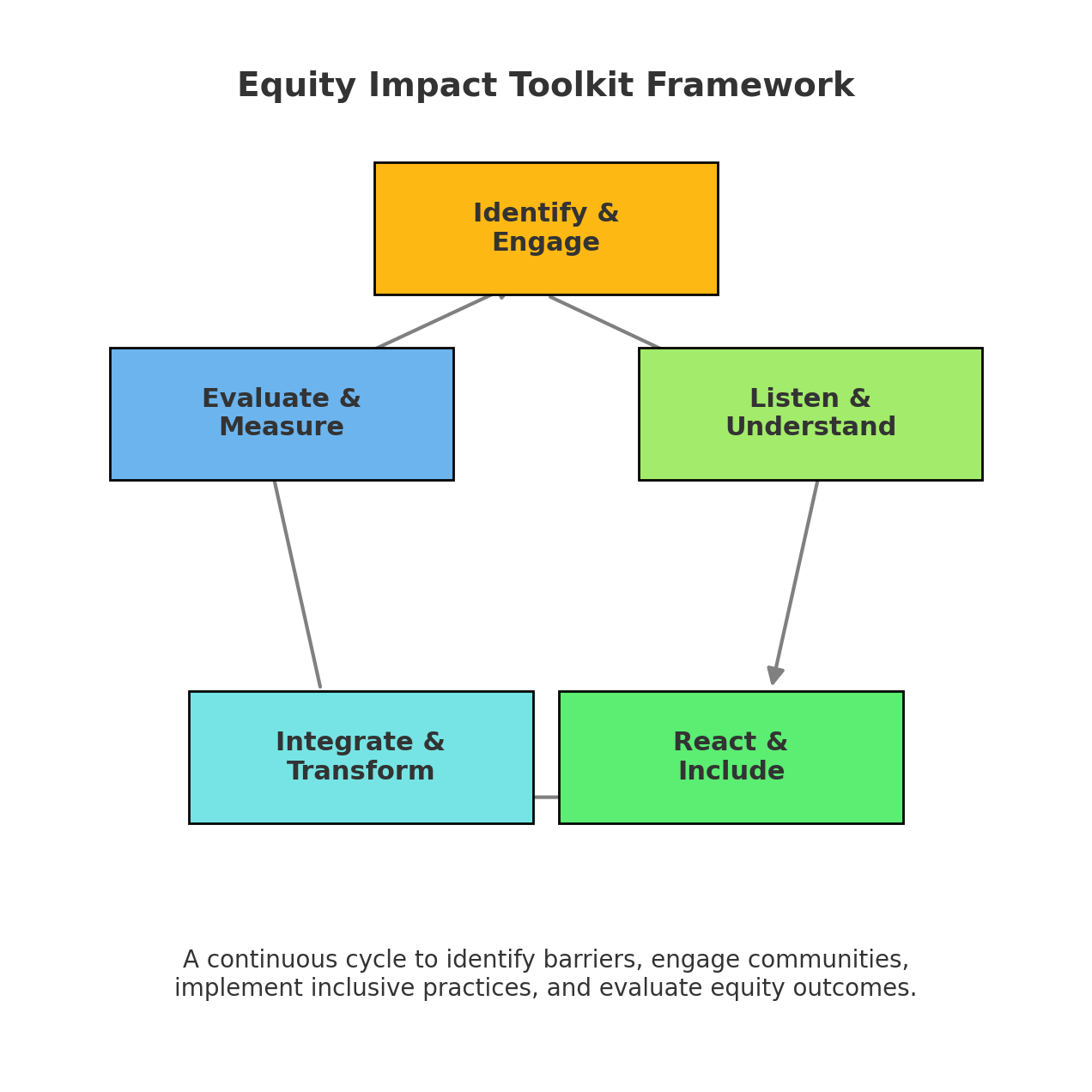
Figure 3. Equity Impact Toolkit Framework

Transformative Inclusion: Strategic Insights for Global Workforce Development
This case study explores how Amazon, as a global leader, can harness inclusive strategies to drive sustained corporate growth and impact. Central to this approach is understanding workforce demographic trends, advancing intercultural training, leveraging accessible technologies, and strengthening labor relations in multinational contexts.
Diversity & Representation Trends
Amazon has made measurable progress in increasing gender and ethnic representation across its workforce. Between 2018 and 2021, women and ethnically diverse employees-particularly Black, Hispanic/Latinx, and Indigenous groups-gained ground in representation, especially in managerial ranks. However, some declines (e.g., among Asian and multiracial categories) highlight the need for tailored, ongoing interventions. U.S.-based representation continues to outpace global trends, despite broader international mandates for gender equity, such as the EU’s requirement of 40% female board representation.
Training for Inclusion & Leadership Development
Amazon’s internal goal to provide company-wide inclusion training is a promising foundation. However, deeper approaches can enhance leadership competency and global impact. Recommended programs include:
Immersive Leadership Simulations using VR and holograms to mirror diverse workplace scenarios. Platforms like Equal Reality and holographic learning systems (e.g., Recourse) offer scalable, engaging modalities for this transformation.
Emotional Intelligence (EI) Development, particularly around empathy, regulation, and social competence.
Belonging & Psychological Safety Training, addressing the marginalization felt by underrepresented groups, especially in cross-cultural settings.
Labor Relations Across Cultures
Labor relations remain a complex, region-specific challenge. While Amazon’s Global Employee Relations team works to navigate these tensions, events like U.S.-based unionization efforts and European limitations on race-based workforce data reflect how global diversity goals must adapt to local contexts. Companies like Microsoft are setting the tone by embracing open dialogue on unionization and transparency in labor relations.
Cultural Adaptability and Inclusive Organizational Design
An adhocracy culture-marked by creativity, risk-taking, and participatory decision-making-is ideal for nurturing global inclusion. When paired with a geocentric orientation, where national identities are secondary to global unity, organizations can effectively balance customer and employee voices worldwide. To enable this, training must emphasize intercultural agility, global mindset cultivation, and dynamic leadership.
Competencies for Global Practice
Key competencies for international leaders include:
Emotional Intelligence: The ability to manage emotions and foster empathetic communication.
Intercultural Competence: Deep curiosity about other cultures, coupled with cultural intelligence (CQ).
Multilingual & Communication Skills: Proficiency in additional languages and communication patterns aligned with local customs.
Developing these skills requires scenario-based simulations, iterative learning, and experiential immersion over several months. On-the-job language acquisition further ensures sustained skill through reinforcement.
Conclusion
Amazon’s sustained global leadership hinges on deepening its inclusive strategies through robust workforce training, proactive labor relations, and culturally adaptive leadership. Embracing these practices equips Amazon-and similarly situated multinationals-to remain resilient, agile, and authentically inclusive in an increasingly complex global environment.
Substantive Rationale
The development and implementation of the Transformative Inclusion 48-Month Workshop Series responds to an emergent need for culturally adaptive leadership in increasingly complex global environments. Applied and empirical research in organizational psychology and intercultural studies reveals a widening gap between leadership ideals and inclusive practice, often due to the limitations of one-time trainings or surface-level cognition and awareness-based interventions. Extending our ability to agree upon and remember definitions, demonstrating understanding and change of our attitudes and behaviors over extended time periods reveal deep and lasting impressions we engrain through the development of intercultural competencies and cooperation, even in the midst of dynamic ecosystemic conflicts and environmental uncertainties on the global stage.
Practitioner insights illuminate the imperative of transitioning from coercive or positional leadership to influence rooted in trust, mutual respect, and participatory engagement. These principles serve as the intellectual cornerstone of this program.
The rationale for a longitudinal learning experience is clear: transformative leadership and cultural change require consistent reinforcement, assessment, and reflection. The program’s design leverages the Multi-Pronged Approach, 4R Method, R.E.S.P.E.C.T. Framework, and the Equity Impact Toolkit Framework, to ensure that inclusion is embedded not just as a value, but as a practiced competency. Each monthly session addresses a distinct but interconnected facet of leadership, progressing from foundational topics like psychological safety to advanced competencies such as ethical leadership and ROI-driven learning strategies.
Moreover, the curriculum reflects a commitment to adaptive learning, incorporating industry-specific use cases, generational differences, and the bounding realities of remote/hybrid work. These considerations align the series with current labor force dynamics and future-of-work predictions. By engaging leaders in scenario-based simulations, intersectional dialogue, and critical reflection, this initiative fosters empathy and elevates inclusive decision-making across sectors.
Ultimately, this program aims not only to educate but to shift culture. Its structure provides the time and methodological rigor necessary to embed inclusive behavior into leadership identities and organizational systems. This substantive rationale grounds the program as an essential strategy for building trust, accountability, and intercultural synergies in modern enterprises, ultimately advancing our ability to empower leaders and followers while maximizing stakeholder returns.
Across the 48-month arc, participants are equipped with the analytical tools and operational discipline needed to lead inclusively, drive innovation, and cultivate sustainable performance in multicultural, high-stakes business environments.
Curriculum
Transformative Inclusion – Part 1- Year 1
- Part 1 Month 1 Foundational Inclusion
- Part 1 Month 2 Intercultural Competence
- Part 1 Month 3 Cultural Intelligence
- Part 1 Month 4 Bias Awareness
- Part 1 Month 5 Reflective Leadership
- Part 1 Month 6 Psychological Safety
- Part 1 Month 7 Inclusive Decision-Making
- Part 1 Month 8 Cultural Conflict
- Part 1 Month 9 Trust Building
- Part 1 Month 10 Empathy Activation
- Part 1 Month 11 Respect Practices
- Part 1 Month 12 Active Allyship
Transformative Inclusion – Part 2- Year 2
- Part 2 Month 1 Conflict Management
- Part 2 Month 2 Inclusive Communication
- Part 2 Month 3 LGBTQ+ Inclusion
- Part 2 Month 4 Accessibility Design
- Part 2 Month 5 R.E.S.P.E.C.T. Framework
- Part 2 Month 6 Anti-Racism Strategy
- Part 2 Month 7 Talent Inclusion
- Part 2 Month 8 Emotional Agility
- Part 2 Month 9 Sustainable Inclusion
- Part 2 Month 10 Intersectional Leadership
- Part 2 Month 11 Inclusion Metrics
- Part 2 Month 12 Privilege vs. Advocacy
Transformative Inclusion – Part 3- Year 3
- Part 3 Month 1 Remote Inclusion
- Part 3 Month 2 Resistance Reframing
- Part 3 Month 3 Inclusive Innovation
- Part 3 Month 4 Ethical Leadership
- Part 3 Month 5 Generational Inclusion
- Part 3 Month 6 ERG Empowerment
- Part 3 Month 7 Inclusive Storytelling
- Part 3 Month 8 Onboarding Equity
- Part 3 Month 9 Leadership Benchmarks
- Part 3 Month 10 Global Inclusion
- Part 3 Month 11 Crisis Leadership
- Part 3 Month 12 Scaling Allyship
Transformative Inclusion – Part 4- Year 4
- Part 4 Month 1 High Stakes Safety
- Part 4 Month 2 Inclusive Succession
- Part 4 Month 3 Inclusion ROI
- Part 4 Month 4 Power Dynamics
- Part 4 Month 5 Cross-Cultural Empathy
- Part 4 Month 6 AI Inclusion
- Part 4 Month 7 Community Engagement
- Part 4 Month 8 Equity Advocacy
- Part 4 Month 9 Career Mobility
- Part 4 Month 10 Futureproof Inclusion
- Part 4 Month 11 Enduring Cultures
- Part 4 Month 12 Legacy Roadmap
Program Objectives
The following list represents the Key Program Objectives (KPO) for the Appleton Greene Transformative Inclusion corporate training program.
Transformative Inclusion – Part 1- Year 1
- Part 1 Month 1 Foundational Inclusion – Define the principles and goals of transformative inclusion. This session serves as the bedrock for the entire program, introducing a forward-thinking model where inclusion is not an initiative but a core operational value. Participants will unpack the ideological, strategic, and cultural pillars that form transformative inclusion, moving beyond compliance to innovation.
The session draws upon the rich tradition of intercultural theory and liberatory praxis to inspire leaders to co-create environments rooted in dignity, unity, and multiculturalism. Through immersive dialogue and collaborative exercises, attendees will explore how cultural harmony can become a strategic advantage in the global marketplace.
By aligning our shared visions, values, and strategies with intercultural fluency and dexterity, this session ignites a shift in mindset—setting a tone of courageous leadership and equity-driven transformation that echoes throughout all subsequent modules.
Participants will use dyadic interactions to ideate upon methods that have previously been employed to achieve inclusion and equity in the workplace.
We will reconvene to unpack pitfalls and uncertainties surrounding prior implementations using mixed method pre-assessment anonymous surveys and Safe Space listening sessions.We will create a training environment where collaboration and active listening are encouraged and expected, so that we may glean insights about what works, what needs to be revisited, reevaluated, and redesigned, and to suggest methods that demonstrate content, criterion, and ecological validity over time, space, distance, and delivery modalities.
- Part 1 Month 2 Intercultural Competence – Delve into the INCA Framework and activate core dimensions of intercultural competence. Participants will explore cognitive flexibility, behavioral agility, and emotional openness in navigating cross-cultural dynamics.
Through self-assessment, reflective dialogue, and simulation-based practice, this Workshop will offer fun and insightful ways for us to identify the many cognitive biases we hold as humans whose limited time and attention may lead to heuristic assumptions.
Serious game simulations, interactive games such as C’est Le Vie: The Game of Social Life, dyadic and small group reflection sessions, leaders will identify blind spots and surface developmental goals that align with today’s global realities.
This session moves the conversation beyond cultural awareness to mastery—instilling leaders with the tools to decode and respond to cultural cues with nuance and effectiveness. We will begin to create toolkits for participant reference using our proprietary 4R Method Reframing Tool, and invite participants to explore additions to the frameworks presented given contextual nuances that may expand the scope of relevance and increase the ecological validity of our solutions.Participants will also examine the intersections of identity, authority, and power, learning to lead multicultural teams with respect, insight, and strategy. As organizations become more borderless, this competency is a non-negotiable for sustainable leadership.
- Part 1 Month 3 Cultural Intelligence – Examine the powerful fusion of emotional intelligence (EI) and cultural intelligence (CQ) as essential assets for next-generation leadership. Participants will explore how these intelligences impact decision-making, team cohesion, and inclusive strategy in complex, high-stakes environments.
Real-world case studies will illustrate how emotionally intelligent leaders foster psychological safety, while culturally intelligent leaders shape inclusive environments that elevate engagement and innovation. Through practical exercises, attendees will strengthen their ability to recognize, regulate, and respond to emotions within culturally diverse teams.
This session positions EI and CQ not just as personal competencies, but as strategic imperatives for organizations seeking to drive equity-centered growth and resilience.
This workshop will bridge foundational principles of emotional agility, decision making under uncertainty during VUCA and dynamic ecosystemic uncertainties, expand upon EI and CQ applied to environmental scanning procedures (e.g., technology’s impact on global and multinational organizational operations, supply chain and logistical production uncertainties) to amplify values-based decision making in global organizational contexts, and provide a S.M.A.R.T. and F.A.S.T.-goal based framework within which participants may innovate new and fresh approaches to modern complex challenges facing traditional organizational structures.
- Part 1 Month 4 Bias Awareness – This session equips leaders with the vision and tools to unearth and neutralize unconscious bias as a structural barrier to inclusion. Rather than merely acknowledging bias, participants will gain tactical fluency in interrupting its effects in recruitment, decision making, team dynamics, and policy design.
We will explore the neuroscience behind implicit assumptions and dissect real-time examples where unchecked bias impedes equity and innovation in multicultural and dynamic global organizational contexts.
Through immersive role-plays, cognitive bias mapping, and reflection exercises, leaders will learn to anticipate bias triggers, implement systems that correct skewed outcomes, affirm inclusion and equity in their own actions, and develop them in their team dynamics using a multi-pronged and layered integration approach that drives innovative solutions to empower all team members’ thriving.
Participants will also draft a personalized ‘Bias Interruption Blueprint’ to guide their inclusive decision-making future forward.
By session’s end, they will not only recognize the hidden influence of bias but also surface actionable inclusive leadership behaviors and consistently embody the courage to challenge exclusion and inequities openly and constructively—turning awareness into an action verb.
- Part 1 Month 5 Reflective Leadership – Leaders often face high-stakes intercultural dilemmas without a structured method to respond with empathy and equity. This workshop introduces the 4R Method—Response, Reaction, Reflection, and Reframing—as a powerful decision support tool.
Participants will engage in simulated dyadic and group-based workplace tensions drawn from real-world and fictitious cross-cultural case studies, applying each ‘R’ step to de-escalate conflict and promote trust.
Beyond technique, the method cultivates metacognitive agility—the ability to pause, unpack cultural context, and respond inclusively by understanding, applying, and reflecting on cultural dexterity and emotional agility constructs.
By session close, each leader will customize the 4R Method and its related Decision Support tool for their own multicultural leadership environment, and develop a proactive scenario plan for its application across geographies and contexts.This session turns moments of friction into gateways for breakthrough collaboration, cohesion, and team building, thereby positioning the 4R Method as a core pillar of their inclusive leadership toolkit.
- Part 1 Month 6 Psychological Safety – Inclusion without psychological safety is performative. This session centers psychological safety as the foundation for unlocking courageous dialogue, risk-taking, and authentic contribution. Concepts such as mistake tolerance and organizational learning are used as fundamental building blocks upon which psychologically safe work spaces are developed and refined so that all organizational members are enabled to thrive and perform optimally.
Participants will explore how cultural, racial, generational, and a gamut of multidimensional identifying characteristics and workplace dynamics shape perceptions of safety at the psychological and emotional levels, drawing from both organizational science and self-report participant survey data.
Leaders will audit their current team climates using a proprietary Psychological Safety Index and practice evidence-based interventions to foster a culture of trust. Interactive segments will allow participants to respond to and reframe microaggressions, microinsults, and microassaults using microaffirmations and the 4R method. Participants will engage in focus group-style dialogue regarding perceptions of silence in meetings using disaggregated contextual factors, and explore intercultural variations in subtle and culturally distinct signals of what characterizes unsafe versus safe organizational environments.
By the end of this session, leaders will leave with a co-created ‘Psychological Safety Action Plan’ designed to recalibrate team attitudinal and behavioral norms, increase participation equity using multimodal meeting and team engagement practices, and hardwire inclusion into everyday business conversations.
- Part 1 Month 7 Inclusive Decision-Making – Design inclusive decision-making systems that draw strength from diverse perspectives and actively dismantle hierarchical silos so that all organizational stakeholders are integral in producing beneficial organizational outcomes.
This workshop empowers leaders to transform their decision frameworks by embedding equity checkpoints, collaborative structures, and build sense of community among employees, as infrastructure that foster co-creation, outcome ownership, and transparency.
Participants will explore the risks of groupthink and the innovation deficits caused by homogenous perspectives, then counter these with tools like inclusion charters, anonymous input pipelines, and consensus mapping strategies.
We will build upon principles of psychological safety from Workshop #6 to deep-dive further into organizational learning that overcomes the blindspots of groupthink processes that stymie organizational growth.Through interactive simulations, participants will learn to elevate voices across legitimate positional power lines and ensure that historically excluded perspectives have influence that integrates into strategy development and implementation.
Leaders will walk away equipped to champion agile, inclusive processes that accelerate team buy-in and enhance cultural credibility, ultimately generating more resilient, creative, and ethically sound outcomes.
- Part 1 Month 8 Cultural Conflict – Navigate the nuanced terrain of intercultural communication by mastering conflict resolution strategies tailored to both high- and low-context cultures. In this module, participants will decode the silent signals embedded in implicit communication and gain clarity on direct discourse preferences across diverse cultural frameworks.
Through guided role-plays and reflection, participants will examine real-world tensions stemming from misinterpreted intent and value clashes. Leaders will practice adaptive communication techniques that foster clarity without compromising cultural respect.
Leader trust and verbiage-action alignment will be explored as integral to team cohesion, cross-cultural organizational communications, goal alignment and achievement, organizational growth, and vision clarity using self-reflection and systems evaluation tools that aide in cross-checking employee policy compliance with leaders’ leadership abilities demonstrated through codified inclusive leadership performance behaviors.
Differences in time and spatial orientations will also be explored for relevance in global and multinational organizational contexts. Constructs such as linguistic relativism in intercultural dialogue and communications, mindful reflexivity versus reflective practices, and values based intercultural conflict resolution techniques will be integrated into our intercultural competence foundational toolkits as a basis for refinement and discussion using dyads, small group, and focus group learning formats.
The session equips participants to identify conflict escalation triggers and de-escalate with culturally responsive empathy. With a focus on contextual intelligence, participants will leave prepared to mediate, bridge, and harmonize global teams with deft intercultural sensitivity.
- Part 1 Month 9 Trust Building – We will constructively redefine trust not as a universal concept, but as a culturally contingent leadership imperative. This session challenges participants to unpack their assumptions about how trust is built, maintained, and repaired across cultures.
We will integrate employee values and cultural belief systems into an emergent values-based organizational framework that combines employee values into an aggregate organizational value system upon which all organizational members may build trust and authentic connections with leaders beyond performative meetings and business interactions. This extends the concept of water cooler conversations and good old boy networks to a broader, more inclusive, equity-based sense of community among all organizational members, regardless of their demographic differences.
Through exploration of Hofstede’s and GLOBE’s dimensions of trust and relational orientation, participants will gain clarity on the diverse expectations that influence collaboration, adhocracy, leader vulnerability, and authenticity.
Interactive case studies and team-based simulations will reveal how trust collapses when intentions are misread through a monocultural lens. Leaders will emerge with culturally dexterous strategies to build bridges across difference, establishing psychological contracts grounded in transparency, follow-through, cultural resonance, and adaptability.
The session culminates in the co-creation of trust-building blueprints tailored to each participant’s team environment and geographic scope.
- Part 1 Month 10 Empathy Activation – This session repositions empathy from a passive emotion to a dynamic leadership competency. Participants will explore empathy as a strategic tool for navigating complex workplace relationships and driving inclusive engagement.
Through scenario-based simulations, leaders will learn to decode emotional cues, bridge perspective gaps, and constructively respond to the lived experiences of others by overcoming sameness bias, compassion fatigue, and fundamental attributions that erode bridges thereby preventing them from building authentic connections with their teams and units.
This module emphasizes the neurobiological and psychological roots of empathy, framing it as a teachable and measurable leadership capability that directly impacts organizational culture.
By embedding situationally relevant empathetic responses into elaborative decision justifications and team communication practices, participants will cultivate climates of psychological safety, foster collaboration, and reduce emotional labor for marginalized employees. Ultimately, this session helps leaders transform empathy into an engine of authenticity, equity, and allyship thereby maximizing team cohesion, innovation, and organizational learning for the benefit of all stakeholders.
- Part 1 Month 11 Respect Practices – Respect is more than politeness—it is a cultural and operational imperative for inclusive leadership. This session explores how everyday micro-behaviors and tone-setting practices define team dynamics, influence trust, and impact engagement. Leaders will assess how power, positionality, and organizational cultures shape how respect is received and expressed across dimensions of identity.
Through reflective exercises, participants will uncover unconscious behaviors that may undermine respect, and learn to replace them with affirming, dignity- driven actions. Participants will practice respect using scenario based interventions in dyads and small groups. We will reconvene in focus group format to reframe our experiences in practice exercises as opportunities for learning, growth, and intentional behavioral modification.
Participants will transform their learned perceptions of cultural humility, ubuntu human dignities, and respect into those that abide by a platinum rule – that is, we should treat others the way they wish and deserve to be treated. Given the cultural relativism of this concept, we will explore cultural dynamics from a nuanced perspective, applying national cultural dimensions such as individualism versus collectivism, masculinity versus femininity, and power distance differences, in an effort to employ a multidimensional paradigm for appropriate behavior in global organizational contexts.
This session provides tools for embedding respect into everyday team practices, performance evaluations, and feedback loops. In organizations seeking sustainable transformation, respectful leadership becomes the connective tissue between inclusive values, vision alignment with leader behaviors, and workplace outcomes.
- Part 1 Month 12 Active Allyship – Active allyship is an action verb. Beyond mere performative altruism that may temporarily benefit historically marginalized groups, active allyship is a learned pattern of behaviors that require that we extend our affiliations beyond awareness into bold action, structural, team-based, and individual leader-level accountability, and moral imagination that remains positive about the possibilities of integrating equity and inclusion into the fabric of the organization’s cultural and structural systems.
In this session, participants will operationalize active allyship initially using a self-report individual reflection exercise. Then, we will form dyads to explore active allyship as a leadership practice that engages multicultural teams and multidimensional perspective taking through critical incident recall techniques. As a small group, we will then examine the emergent themes in the scenarios we recalled from our own lived and professional experiences, using a proprietary guided self-assessment tool, applying a continuum model of ally development as a phasic and learned growth experience in global organizational leadership contexts.
This module explores how effective allies navigate their privilege or lived experiences with marginality, as they relate to and respond to microaggressions. We will then explore the responsibilities and spheres of influence leaders have to interrupt exclusionary systems.Participants will draft individualized active allyship plans that include measurable behaviors, areas for learning and modification of exclusionary practices that may unintentionally preclude active role-based cultural transformation modeled by leaders and mirrored among organizational members, cross-functional collaboration strategies, and long-term impact metrics.
By situating allyship as both a personal commitment and an organizational strategy, this session empowers leaders to become catalysts for equity and systemic change.
Transformative Inclusion – Part 2- Year 2
- Part 2 Month 1 Conflict Management – Explore conflict resolution strategies, such as active listening, multidirectional communication channels, and cultural humility, to address disputes in diverse teams.
Participants will examine real-world examples of workplace disputes caused by cultural misunderstandings, learning methods to resolve them effectively. This session provides tools to enhance collaboration and build cohesion in global teams.
In increasingly diverse workplaces, conflict rooted in cultural misunderstanding is inevitable—but not insurmountable. This module builds upon Module # 8 regarding cultural conflict, to equip leaders with the tools to anticipate, navigate, and resolve conflict across multicultural environments using a collaborative and restorative lens that connects perceptions of situational conflicts so that misunderstandings are resolved to yield cooperation, mutual empathy, and respect for differences.
We will use a perspective taking exercise to engage in dialogue about how our own cultural values shape our conflict styles and learn how to adapt these styles to foster inclusion.
These practical tools require reflective inquiry; restorative circles will be applied to case-based simulations to build community, instill harmony, and create a foundation for unity among group members, so that participants are enabled to extend the learnings in this Module to the global stage in which they operate each day.
By modeling conflict as a learning and growth opportunity for intercultural communication and cooperation, rather than a breakdown, leaders will leave with a proactive strategy for addressing interpersonal and organizational disputes. This module positions inclusion as a force for healing, alignment, and forward motion in a polarized world.
- Part 2 Month 2 Inclusive Communication – Develop skills for inclusive communication, including active listening, language adaptation, multimodal information dissemination, and understanding contextual cues as a culturally relative nuance in interpersonal dialogue.
Participants will analyze case studies of successful intercultural communication across diverse cultural and multinational contexts, gaining effective and culturally appropriate techniques to ensure clarity and mutual respect.
This workshop highlights the importance of creating spaces where everyone’s voice is heard, welcomed, and valued.
Communication is at the heart of inclusion—and miscommunication is often the root of exclusion.
This workshop unpacks the complexities of linguistics, tone, and body language through an equity lens. Participants will explore how bias, cultural norms, and communication preferences shape the way messages are delivered and received.
Through hands-on exercises, leaders will practice crafting interpersonal intercultural communications that are inclusive, responsive, and culturally attuned.
Special focus is placed on inclusive facilitation, language equity, accessibility, and digital body language in hybrid and remote teams. Participants will also explore the impact of silence, courage and trust in leaders, storytelling, and affirmation in creating psychological safety.Ultimately, this module equips leaders to communicate in ways that make everyone feel seen, heard, and respected—no matter their background or communication style.
- Part 2 Month 3 LGBTQ+ Inclusion – Address barriers and create equitable environments for LGBTQIA+ employees. Participants will explore inclusive policies and practices, such as creating safe spaces, employing the proper use of pronouns, and using inclusive language.
Case studies will demonstrate the business and cultural benefits of LGBTQIA+ inclusion in the workplace.
With the appreciation for representation and visibility as a foundational blueprint from which to extract learnings and growth, this session dives further into the systemic changes required to foster true equity for LGBTQIA+ individuals at work.
Participants will examine how gender identity, sexual orientation, and intersectionality shape experiences of inclusion and exclusion. Key focus areas include inclusive benefits and policies, transgender inclusion, pronoun normalization, and eradicating microaggressions.
Leaders will develop skills to foster belonging, safety, community, and allyship, especially for nonbinary and trans employees. Practical tools for policy audits, ERG collaboration, and bias interruption are explored through interactive learning experiences.
The module also addresses how inclusive environments impact recruitment, innovation, and retention. By the end of this session, participants will be equipped to lead workplaces where LGBTQIA+ team members can thrive without compromising their values, core identities, and lived experiences.
- Part 2 Month 4 Accessibility Design – Addressing ableism requires more than compliance—it demands a radical commitment to inclusive design that anticipates the needs of all individuals, not just the majority.
This session explores Universal Design principles as strategic imperatives for building equitable systems from recruitment, to human factors engineering of work spaces, to performance management.
Participants will assess physical, digital, and procedural access barriers within their organizations for individuals with physical, psychological, emotional, and behavioral divergence needs, and develop an accessibility action map with which to collaborate with their HR Teams as they work together to integrate inclusivity into every employee and leader touchpoint.
Through interactive blueprints and equity audits, this workshop empowers leaders to reimagine workplace environments that reflect dignity, agency, sense of community, and belonging for all employees.
By positioning principles of universal design, this workshop will extend our understanding of the traditional construct of accommodations that emerged through compliance with local, state, and federal legal requirements.
Building upon this foundational concept, we will examine universal design as a lever for innovation, unlocking new approaches for transforming systemic barriers to inclusion into structural equity that enables broad accessibility, invites virtual and face to face connections beyond borders, and serves as a blueprint that ultimately meets the needs of all organizational members.
This workshop is an opportunity for inclusive excellence through collaboration, analysis, and insightful redesign of extant structures that have become obsolete in our shrinking global society.
- Part 2 Month 5 R.E.S.P.E.C.T. Framework – This high-impact session underscores the value of integrating the components of the proprietary R.E.S.P.E.C.T. Framework—Reframe, Evaluate, Specify, Participate, Engage, Continue, and Teach—as an agile model for embedding inclusion across organizational ecosystems.
Beyond disjointed, disaggregated phasic approaches to cultural transformation implementations, this Module will extend our understanding of organizational change to one in which gestalt, holistic principles of unification of elements that operate cohesively, rather than in silos, yield beneficial outcomes consistently and over sustained periods of monitoring, evaluation, and measurement.
We will bridge connections by layers the concepts of the proprietary R.E.S.P.E.C.T. framework, leveraging the intercultural competence tree as a model of integration and cohesion in our broad understanding of cooperation and intercultural harmony at the organizational and structural levels.
Participants will deconstruct leadership case studies and simulate real-world challenges using this seven-step cycle, surfacing new pathways for cultural transformation at each juncture in the R.E.S.P.E.C.T. paradigm.
The framework enables leaders to operationalize inclusion with precision, moving beyond statements and performative allyship into sustained action and measurable impact that demonstrates cultural humility, respect for global and intercultural dynamics, awareness of differences, and fundamental appreciation for universal human virtues.
This session empowers leaders to drive equity, trust, and psychological safety in diverse, global teams through a process that is iterative, human-centered, and results-oriented.
By the close of this session, participants will have a fully articulated implementation roadmap that scales inclusion through behavioral accountability and continuous innovation.
- Part 2 Month 6 Anti-Racism Strategy – Dismantling systemic racism requires courage, assessment, clarity, strategic planning, and sustained strategic intent. This session equips leaders to analyze and interrupt racial inequities within organizational policies, practices, and power structures.
Participants will explore real-world examples of institutional racism using case study evaluations, small- and large-group discussion formats, and reflective practice using critical incident techniques that leverage free recall of prior workplace experiences.
Participants will then adapt these stimuli into group design labs as they work collectively to hack their own actionable anti-racism strategies tailored to contextually relevant workplace realities. We will present our strategic designs to the larger group and offer an opportunity for constructive feedback and suggestions using a guided facilitation format and safe space guidelines.
This session guides participants through the pillars of anti-racist leadership—historical awareness, cultural humility, structural change, and transformational equity—culminating in the co-creation of impact-driven initiatives that promote racial and social justice.
Rather than viewing anti-racism as a compliance issue, this session frames it as a cornerstone of ethical, inclusive, and future-ready leadership.
- Part 2 Month 7 Talent Inclusion – Participants in the Talent Inclusion workshop will reimagine inclusive talent strategies through an equity-centered lens. We will explore and evaluate the utility of broad sourcing, targeted recruiting, structured interviewing, behavioral elaborations and justifications, 360-performance feedback, continuous performance feedback, leader and manager structured coaching, community development among existing employees, exit interview analysis, and community outreach, as integral to the talent inclusion strategies employed in global and multinational organizations.
This session invites leaders to interrogate and interrupt systemic biases embedded in traditional recruitment, hiring, engagement, performance appraisal, and talent management systems that evaluate and promote organizational members.
Participants will explore new methods for cultivating fair, inclusive talent pipelines that ensure individuals from underrepresented backgrounds can access growth, visibility, and leadership opportunities.
Through the lens of inclusive data analytics and intersectional equity models, the workshop will introduce practices that mitigate bias, improve transparency, normalize accountability mechanisms, and expand access across the full talent lifecycle.
By examining real-world case studies and innovative hiring models, participants will assess how to embed equity into succession planning, promotions, and leadership development.
Interactive exercises will challenge leaders to audit and adapt their current approaches to build evidence-based solutions that reflect the organization’s DEI commitments.
This session empowers decision-makers to move from performative to transformative inclusion, equipping them with a future-forward talent management strategy rooted in dignity and fairness.
- Part 2 Month 8 Emotional Agility – This workshop aims to refine and build resilient and emotionally agile leadership in the face of workplace complexity, volatility, uncertainty, multinational growth, globalization, rapidly emerging technological advancements, and change.
In today’s rapidly shifting environments, leaders must navigate ambiguity, stress, and resistance to change without compromising inclusion.
This workshop provides the tools to develop emotional agility—the capacity to remain open, grounded, and values- aligned while making critical business decisions and adapting to evolving challenges.
Participants will explore the interplay between emotional intelligence, cultural intelligence, reactance, psychological resilience, and cultural humility. Through immersive reflection, participants will assess their emotional default settings using values exploration and alignment exercises. Participants will cultivate a toolkit for effective and situationally adaptive responses that foster connection rather than conflict.
Case-based learning will demonstrate how emotionally agile leaders de-escalate tension among teams, departments, and units, manage positive and negative upward feedback constructively, and promote psychological safety even under pressure.
This session emphasizes how emotional agility strengthens inclusive leadership, allowing practitioners to engage deeply with their teams, honor diverse perspectives, and respond rather than react.
Participants will leave with personal agility maps and actionable tools to model empathy, curiosity, and clarity in varied contexts.
- Part 2 Month 9 Sustainable Inclusion – This workshop underscores foundational work in creating infrastructure that galvanizes inclusion in the workplace – at the individual, team, and structural levels. We draw upon concepts of lasting cultural change and resilience to reconceptualize inclusion as a long-term strategy rather than a momentary initiative.
In this session, participants explore sustainable approaches to embedding equity and inclusion into systemic actions, beyond performative statements and perfunctory events, to reach every organizational stratum across all functional levels.
The emphasis will shift participants’ lens from compliance gestures of obligatory & instinctual survival toward structural change that is measurable, iterative, and aligned with the organization’s mission, while drawing upon concepts of intrapersonal unity, growth, interculturalism, and peace that sustains organizational generations well into the perpetual future.
Through stakeholder mapping that gleans insights from social network analysis, legacy planning that draws from lessons learned in leader succession strategies, and DEI maturity assessments, participants will identify, compare, contrast, and analyze systems and behaviors that either reinforce or erode inclusion over time, adding their own contextually relevant insights and lived experiences in professional environments to create a holistic and evidence-based model of sustainable organizational inclusion.
Case examples will illustrate how organizations can drive and curate ripple effects that ignite inclusion within all organizational units and functions, even amidst leadership transitions, economic uncertainty, and political resistance.
Leaders will be equipped to adapt inclusion initiatives into self-sustaining cultural frameworks powered by metrics, storytelling, and community engagement. Participants will craft long-term inclusion strategies that move beyond slogans into systemic, purpose- driven transformation.
- Part 2 Month 10 Intersectional Leadership – Explore the multidimensional nature of identity and its profound impact on leadership efficacy and workplace equity. This session goes beyond surface-level DEI training to help leaders recognize how race, gender, sexuality, ability, age, class, and other dimensions of identity intersect to shape unique employee experiences.
Through interactive frameworks and case study analyses, participants will uncover systemic gaps often overlooked by single-axis linear approaches to inclusion. Phased implementations that fail to root out core problems, and which ignore blind spots in inequitable and exclusive organizational policies, practices, systems, and procedures, lack sustainability and holistic implementation benefits. Conversely, evidence-based, data-driven, collaborative systemic cultural transformation approaches that embed equity and inclusion into the fabric of the organization’s culture and systems, yield positive measurable benefits over time, space, distance, implementation modality, geographies, national culture, and despite other nuances in organizational contextual approaches.
Leaders will learn how to design their own contextually relevant intersectional policies and practices that prioritize individuals whose own identities are historically marginalized, while cultivating empathy and fairness across all levels of the organization.
This session empowers leaders to dismantle outdated frameworks of representation and reimagine inclusive leadership rooted in nuanced understanding, structural equity, and holistic team engagement.
- Part 2 Month 11 Inclusion Metrics – This session will equip leaders with innovative, data-informed tools to quantify the impact of inclusion in real time. This session redefines how success in DEI is measured—moving beyond compliance checklists and representation quotas toward dynamic quantitative and qualitative metrics that reflect cultural dexterity and authentic employee experiences.
Participants will explore tools such as Organizational Network Analysis (ONA), bias auditing self-reflecting procedures, visualization dashboards, and equity-centered KPIs to assess engagement, trust, and access to the benefits and promotional opportunities the organization offers its highest potential and most talented professionals.
Leaders will learn how to integrate these insights into decision-making and organizational strategy, monitor metrics regularly to improve upon tracking, assessment, evaluation, and core challenges in the implementation’s design and execution, thereby enabling them to track progress transparently and adjust in real time.
Emphasizing accountability, agility, and continuous improvement, this session ensures that inclusion becomes a measurable, mission-critical component of organizational excellence.
- Part 2 Month 12 Privilege vs. Advocacy – In this session, we will move leaders from passive awareness to active engagement by transforming participants’ schemas regarding individual and organizational privilege into purpose-driven advocacy.
Session participants will interrogate and analyze the roots and functions of privilege in dyads and small group formats to engage in purposeful and authentic dialogue about their own privileges and spheres of influence as organizational leaders.
We will examine how invisible and visible advantages in our professional experiences, including education, wages and income, neighborhood, healthcare access, benefits packages, and other indirect benefits we receive as global business leaders, shape the professional dynamics in our interpersonal and team-based interactions, and influence the access we have to products, services, and intangible benefits such as promotions bonuses, and salary increases.
Through guided self-reflection and peer-to-peer dialogue, leaders will map their spheres of influence and create strategic active allyship plans that uplift and exhort marginalized voices, shift power dynamics toward collaboration and participative input from all team members, and catalyze institutional change.
Beyond performative gestures such as pay transparency and local regulatory compliance, this workshop cultivates brave and safe spaces for leader accountability, equipping leaders to act with clarity, integrity, and courage. The result is an empowered, equity-driven leadership culture that uses influence not to dominate, but to dismantle barriers.
Transformative Inclusion – Part 3- Year 3
- Part 3 Month 1 Remote Inclusion – In this session, we will explore strategies to foster inclusivity and collaboration in remote and hybrid work environments that characterize modern global and multinational businesses. As the future of work continues to evolve, inclusive leadership must adapt to the dynamics of distributed teams that must create cooperative and mutually fulfilling work products and foster meaningful team connections beyond borders, time, space, time zones, and geographies.
This session challenges leaders to reimagine employee engagement through digital equity, accessibility, time-zone awareness, communication etiquette, and virtual presence that engages rather than ostracizes organizational members who may be working remotely or via expatriate location assignments.
Participants will gain tools for their growing transformative inclusion toolkits that work cohesively to build psychological safety, sense of community, connectedness, and a sense of belonging, even across digital screens.
Through real-world simulations and technology-integrated activities, leaders will examine successful digital inclusion models that span continents and cultures.
Leaders will also learn to mitigate remote work fatigue and foster sustained collaboration and employee productivity despite nonexistent or outdated coworking building structures.
By mastering inclusive digital facilitation, participants ensure all voices are heard—no matter the location— establishing cultures of trust and innovation in virtual settings. - Part 3 Month 2 Resistance Reframing – Participants will work in focus groups to identify common forms of resistance to organizational inclusion initiatives with guided facilitation, active listening tools, observation, and note taking.
We will leverage qualitative analysis tools to develop resources that transform resistance into opportunities for growth and resilience. We will ideate methods that work and those that require refinement to be effective in varied settings.
Resistance and reactance to transformation is often a sign of discomfort, anxiety about unknowns in the change process, and lack of trust in change drivers, leaders’ ability to effectively implement change, and pejorative outcomes that derail existing employee bases such as large scale reductions in force, role changes, and restructuring.
When change and uncertainty are met with frequent, loud, broad, and consistent messaging, and reframed through training activities that reinforce professional development and upskill teams to cultivate efficacy and confidence in leaders, powerful shifts in resistance and reactance instead become motivated coalition builders and empowered teams who evangelize the vision and goals of transformations to other members.
This session provides participants with insight into the psychology of resistance, from passive disengagement to active pushback. Leaders will practice applying reframing strategies that transform skepticism into collaboration, using storytelling, data, and transparent communication.
Through diagnostic instruments and scenario-based planning exercises, participants will develop their own roadmaps for converting resistance into momentum. This approach centers on leading through compassion and confidence—turning barriers into bridges for inclusive transformation.
- Part 3 Month 3 Inclusive Innovation – Participants will engage in methods that harness the power of perspective-taking to drive innovation and creativity in organizational problem-solving.
Inclusion is a strategic imperative. When different voices are actively welcomed, innovation flourishes. Participants will explore inclusive design thinking models and learn to facilitate ideation spaces that elevate non-dominant narratives using storytelling, data-driven processes for organizational learning and growth, and internal structures that build community and foster employee thriving.
This session empowers leaders to embed inclusion into every stage of innovation—from identifying unmet needs to designing equitable solutions. Leaders will engage in dynamic guided brainstorming exercises with facilitation that nurtures out-of-the-box schemas and steers participants toward reflection and salience regarding emergent themes and areas that require further refinement.
We will analyze the traditional S-curve model of product innovation in consumer goods and services to create an iterative and open-ended model that cultivates infinite ideas gleaned from an investigation into the universe of possible solutions to modern global organizations’ most complex and pressing challenges for sustainable advantage and lasting prosperity.
We will review case studies that link inclusive practices to successful product, policy, and service innovations. This module demonstrates that the future belongs to organizations who are bold enough to innovate inclusively—and equipped to lead that charge.
This session introduces models like Equity-Centered Innovation to help leaders deconstruct outdated norms and rebuild systems with equity at the core. By fostering a culture of curiosity, flexibility, and co-creation, this module prepares organizations to outpace disruption and become champions of inclusive excellence.
- Part 3 Month 4 Ethical Leadership – In this session, participants will learn and employ methods to navigate complex ethical dilemmas in multicultural environments using inclusive, context-sensitive frameworks.
This module empowers participants to recognize how cultural backgrounds, lived experiences, and organizational pressures can influence perceptions of right and wrong.
Through immersive case studies and critical dialogue, participants will analyze how inclusive leaders uphold ethical standards while respecting diverse cultural norms. We will explore real-world dilemmas—such as balancing transparency with confidentiality across cultures, or resolving ethical conflicts when global values collide.
Participants will also be introduced to tools and develop contextually relevant resources that center ethical reasoning on values such as equity, integrity, and procedural and distributive justice.
This session reinforces the concept that inclusive leadership does not avoid difficult decisions; instead, it embraces complexity with integrity, compassion, curiosity, humility, and courage.
Leaders will leave equipped to guide their teams through ambiguity and uphold ethical global organizational cultures that are both inclusive and fiscally responsible.
- Part 3 Month 5 Generational Inclusion – This session will explore strategies to engage, motivate, and lead multigenerational teams by embracing age diversity as a strength in modern organizational contexts.
We will unpack the differing values, learning styles, communication styles, and workplace expectations of Gen Z, Millennials, Gen X, and Baby Boomers. We will also build generational maps to forecast changes in generational business needs over time, space, distance, geography, and national culture.
Participants will learn how to decode generational preferences, and explore cultural differences in generational diversity, such as cultures that embrace or steer away from traditionalism, to avoid stereotypical cultural assumptions while fostering intergenerational respect, cultural humility and dexterity, and harmonious collaboration.
Real-world organizational examples will highlight both the friction and fusion that can occur when generational perspectives intersect and align on shared values, goals, and vision.
Participants will examine leadership blind spots and uncover untapped potential across generations, developing action plans that bridge experience with innovation. Inclusive leaders who champion generational diversity can accelerate knowledge transfer, boost engagement, and future-proof their teams.
- Part 3 Month 6 ERG Empowerment – We will explore the benefits and ideal structures that enable Employee Resource Groups (ERGs) as catalysts for equity-centered culture change and innovation.
Participants will analyze the strategic role ERGs play in addressing systemic inequities, amplifying employee voices, building safe and brave communities that explore and evangelize identities rather than cover them, and influencing internal policies, practices, and leader development.Drawing from cross-sector case studies and critical incident free recall across participants’ professional experiences, participants will identify conditions that make ERGs flourish—such as executive sponsorship, psychological safety, and adequate funding.
This session challenges leaders to move beyond performative ERG support and into transformative partnerships with ERGs at the helm of institutional transformational change as a guiding coalition for message dissemination, values alignment, and employee engagement.
Attendees will craft ERG Strategic Blueprint strategies for aligning ERG goals & objectives with organizational goals, while maintaining authenticity and grassroots momentum.
Whether participants are launching new ERGs or revitalizing existing affinity group structures, leaders will gain tools to ensure ERGs are not just affinity groups for shared identities that serve as sounding boards; rather, they are transformed and empowered as engines for systemic, inclusive progress.
- Part 3 Month 7 Inclusive Storytelling – In this workshop, participants will develop storytelling skills to inspire, connect, and lead inclusively. In an era where data often takes center stage, the power of narrative remains a timeless force for transformation. This session equips leaders with the tools to craft compelling, values-driven stories that connect across identities, bridge divides, and activate change.
Participants will explore storytelling as a strategy for building inclusive cultures—infusing transparency, trust, and shared purpose into leadership communications. We will examine frameworks that amplify marginalized voices, disrupt harmful narratives, and cultivate community.
Through interactive exercises, qualitative data analysis and exploration of investigatory data gathering procedures such as focus groups, listening sessions, mixed methods surveys that allow for open-ended response item generation and participant free response, leaders will build storytelling processes that reflect their organization’s stated missions, visions, and aspirations, and that will align organizational values with demonstrable intentionality, thereby humanizing workplace strategic projects that seek to amplify multicultural inclusion on the global stage.
By the end of this session, participants will gain the practical skills they will use in their personal and organizational storytelling projects as catalysts for belonging, vision alignment, and cultural transformation.
- Part 3 Month 8 Onboarding Equity – Onboarding procedures are opportunities for inclusion in modern organizational cultures from Day One. Talent acquisition, development, and management require that we broaden recruiting and hiring strategies beyond mere compliance & performative trainings, toward onboarding that serves as a signal of welcome into the fabric of the business upon completion. In such paradigms, inclusive onboarding cultivates a sense of community and belonging.
Participants will learn to design transformative onboarding processes that reflect the organization’s commitment to equity. This workshop explores how inclusive messaging, mentorship and sponsorship, socialization systems (e.g., buddy pairing systems) bridge cultural divides and create safe spaces for new organizational members.
We will use case studies to showcase prototypical onboarding practices, contrasting these with those that fail to adequately engage employees, reduce early- and mid-career attrition, and that may diminish cultural immersion in the global enterprise.
Participants will recall examples from their professional experiences and identify barriers to inclusive onboarding, pinpointing new and innovative practices that facilitate inclusion from Day One. We will leverage a dyadic interaction model to learn good practices and use peer feedback to soundboard ideas, consider accessibility and delivery modality needs, and contrast these among multigenerational, neurodiverse, and other unique demographic dimensions.
Such between groups comparisons provide an opportunity to differentiate implementation procedures upon the basis of individualized needs, intersectional identities, and remote or hybrid work dynamics.
Upon completion, leaders are empowered to reframe onboarding as a strategic inclusion lever, embedding trust and connection into the launchpad employees’ need to grow their global careers exponentially.
- Part 3 Month 9 Leadership Benchmarks – In this session, we will define and measure the long-term impact of inclusive leadership practices. Legacy isn’t about titles or tenure—it’s about the systems, values, and cultural norms leaders leave behind. This session challenges participants to be the architects of a sustainable legacy of inclusion, using meaningful benchmarks to anchor impact beyond their organizational presence.
Participants will explore methods for evaluating inclusive leadership outcomes through both qualitative narratives and quantitative metrics. We will identify legacy levers—such as inclusive policy changes, equitable talent pipelines, or psychological safety indicators, connecting these with leader behaviors and language so that we align leaders with the organizational culture and structure that perpetuates its profitability, growth, and enables employee thriving in perpetuity.
We will explore inclusive benchmarks as structural factors that may outlast individual leadership behaviors but which may simultaneously be impacted by such behaviors.
Interactive reflection activities will guide participants in aligning their leadership philosophy with broader social impact. This workshop culminates in the drafting of an Inclusion Legacy Plan—a personal and organizational roadmap that outlines what equity-centered success will look like in the years that proceed their organizational tenure.
- Part 3 Month 10 Global Inclusion – This session explores the dynamic nature of inclusive leadership on a global stage. Participants will examine how cultural values, societal norms, and regional policies influence leadership styles and organizational practices worldwide.
Using comparative case studies from multinational corporations, NGOs, and governmental bodies, this workshop emphasizes the adaptability required for cross-cultural effectiveness. Examples will include interactive scenarios that require participants to brainstorm effective niche techniques that reach local cultures effectively; simulations requiring adaptation amidst dynamic ecosystemic uncertainties in global supply chains; and case studies that address national cultural nuances and provide participants with answers to complex questions regarding intercultural negotiations and solutions orientations that include rather than exclude varying demographies.
Leaders will learn how to align inclusion strategies with hyperlocalized expectations while maintaining global standards. Participants will also engage in reflective exercises that challenge ethnocentric assumptions and foster cultural humility.
By the end of the session, participants will be equipped with actionable tools to tailor their leadership approach to different cultural contexts, enabling them to drive inclusion with nuance and authenticity across geographies.
- Part 3 Month 11 Crisis Leadership – This workshop focuses on the intersection of crisis management and inclusive leadership. In today’s volatile environment—ranging from global pandemics to sociopolitical upheaval— leaders must act with agility, empathy, and clarity.
Participants will analyze real-time case studies of organizations that navigated crises while upholding inclusive values. They will learn frameworks for values-based decision-making under pressure, managing broad and nuanced stakeholder expectations, and strategically communicating with authenticity during emergency situations and ambiguities.
This session emphasizes how inclusive leadership provides a safe and brave space for the expression of uncertainty while overcoming employee fear, preserves trust, ensures compliance while maintaining morale, and galvanizes teams to finish strong in the face of complex obstacles.
Through scenario planning, environmental scanning, and simulation exercises, participants will develop inclusive crisis response plans that balance immediate action with proactive and long-term resilience.
By fostering a culture of psychological safety during uncertain times, leaders ensure that no voice is left unheard— even in the most critical moments.
- Part 3 Month 12 Scaling Allyship – This session transforms allyship from an individual intention into organizational impact by reimagining allyship as an action verb.
Participants will move beyond performative gestures of emotional concern toward build inclusive systems that bridge empathy with active and intervention-based solutions that scale.
Through advanced allyship strategies—including sponsorship, institutional advocacy, and structural intervention—leaders will learn how to activate their spheres of influence for systemic change.
This workshop includes a roadmap for embedding allyship into policies, performance metrics, and leadership development initiatives. Participants will create customized allyship blueprints that align with their roles and teams’ responsibilities to maximize the stakeholder group engagement in large-scale cultural transformations.
Real-world examples will highlight the impact of sustained allyship at scale, from shifting hiring, engagement, and promotional practices to reallocating tangible and intangible organizational resources so that inclusion and equity are demonstrable and transparent.
By the end of this workshop, participants will emerge as architects of cultural transformation, empowered to champion inclusion not just in words, but in action and infrastructure.
Transformative Inclusion – Part 4- Year 4
- Part 4 Month 1 High Stakes Safety – Cultivating psychological safety in high-pressure environments requires more than open-door policies—it demands courageous leadership, nuanced communication, and intentional trust-building.
This session equips leaders to nurture environments where people feel safe taking interpersonal risks, especially under high-stakes conditions such as crisis response, fast-paced innovation, or organizational transformation.
Participants will explore the neuroscience of psychological safety, courage, and fear as emotional drivers that motivate us to take action or remain stagnant in the face of change and uncertainty.
We will explore and apply actionable techniques—like intentional check-ins, appreciative inquiry, and stress-resilient feedback models—to amplify their team’s psychological well-being.
Leaders will engage in scenario-based simulations that test their ability to lead under pressure while sustaining inclusivity and trust. By modeling vulnerability, de-escalating tension, and affirming divergent viewpoints, leaders not only strengthen psychological safety but also spark enhanced collaboration and innovation.
Our goal is to create an environment where high performance thrives without fear and where every voice is valued and heard —even when the stakes are highest.
- Part 4 Month 2 Inclusive Succession – Inclusive succession planning is more than identifying high performers—it’s about disrupting legacy biases that limit leadership diversity and cultivating future-ready leaders across all identities.
In this session, participants will assess current succession strategies through an equity lens, identifying barriers that prevent underrepresented and nontraditional employees from advancing into critical leadership pipelines that embrace archetypes of homogeneity, stymieing the future of inclusive innovation in organizational governance, structure, and culture.
Using future-focused models and inclusive talent mapping, participants will design succession plans that elevate diverse leadership potential at every level.
Case studies will illuminate how organizations have successfully leveraged inclusive succession planning to drive innovation, cultural agility, and business resilience. Participants will also learn how to embed mentorship, sponsorship, and transparent, substantive evaluation criteria into talent advancement processes.
By embracing a broader definition of leadership potential, organizations can future-proof their workforce and build cultures of belonging at every level of the organization, eliminating the broken staircase to inclusive advancement where each employee is enabled to reach their full potential.
- Part 4 Month 3 Inclusion ROI – Inclusion must be as measurable as it is meaningful. This session empowers leaders to connect DEI efforts with quantifiable business outcomes by introducing a strategic approach to ROI measurement.
Participants will explore methods to capture tangible and intangible impact and cost benefits of inclusive systems—from reduced attrition rates and improved team performance to increased innovation and brand reputation.
The Inclusion ROI session introduces inclusive KPIs, impact dashboards, and stakeholder-centered feedback tools that bring clarity and credibility to inclusion work. We will leverage such classical approaches as Lean Six Sigma, Social Network Analysis, and Total Quality Management principles to discuss the myriad operationalizations of “inclusive” organizational structures and systems, how they may be quantified and qualified, in which contexts they are more likely to be sustained, and ultimately, how to control them so that they last in perpetuity.
Using real-world case studies, participants will practice articulating the financial and cultural value of DEI programs to executive stakeholders. They’ll also explore how to leverage inclusion metrics to secure long-term investment and guide strategic decisions. By aligning values with value, this session ensures inclusion is not just the right thing to do—it’s a measurable, strategic imperative.
- Part 4 Month 4 Power Dynamics – In the Power Dynamics workshop, we will unpack the myriad ways in which power and privilege influence workplace interactions, socially and in formal ways such as the exercise of legitimate authority in hiring decisions and performance evaluations.
Participants will learn tools to dismantle inequities and foster inclusion by identifying and solving for power imbalances in organizational structures. We will leverage brainstorming and focus group dialogue techniques to erect solutions for inclusion and equity that center rather than alienate the voices and experiences of marginalized groups, while providing a safe space for all organizational members to feel empowered to mitigate potential barriers to inclusion and equity that permeate organizational cultures in individual, team, and structural level dynamics.
This workshop analyzes the layered influence of power and privilege embedded in organizational cultures using imagery, client-facing statements and policies, practices, procedures, and hidden cultural nuances.
Participants will explore how traditional power structures can reinforce inequity, even when unintentional. Through role-based simulations and reflective inquiry, leaders will gain insight into how privilege manifests in decision-making, team dynamics, and access to opportunity.
This session introduces counter-power strategies that affirm inclusion and equity systematically, such as shared governance, employee voice mechanisms, and equitable delegation practices.
Participants will also learn to engage in power awareness as they exercise authority and influence in leadership, which cultivates inclusion by intentionally redistributing impact, elevating underrepresented voices, and challenging the status quo. This workshop equips leaders to move from passive awareness of privilege to active disruption of inequitable systems.
- Part 4 Month 5 Cross-Cultural Empathy – This workshop aims to strengthen leaders’ exercise of empathy across cultural divides through immersive activities and case studies. Participants will build skills to navigate cultural differences with compassion, strengthening team cohesion and trust.
In today’s globalized workforce, cross-cultural empathy is a strategic advantage. This workshop invites leaders into an immersive experience designed to develop authentic understanding across differences.
Participants will engage with real-world case studies, narrative exchanges, and empathy mapping exercises to uncover the emotional nuances of intercultural interactions. We will enrich participants’ experiences with tools and resources that help navigate compassion fatigue, resistance to change, and maximize leaders’ self-care while providing safe and brave spaces that offer shouldering behaviors and support for those who most need it within their organizational teams.
By practicing cultural perspective-taking, participants will learn to identify and navigate invisible barriers that can fragment teams and hinder trust. This session highlights empathy as a muscle that can be strengthened through intentional practice, feedback, and self-care.
Ultimately, this workshop empowers leaders to build inclusive environments where empathy becomes a catalyst for innovation, connection, and collective performance.
- Part 4 Month 6 AI Inclusion – This workshop will address the challenges and opportunities of automation and generative AI tools through an inclusive lens. Participants will explore equitable approaches to workforce transformation, ensuring that technological advancements do not perpetuate inequities with myopic algorithmic data sets that alienate rather than amplify historically marginalized group members.
As artificial intelligence reshapes global industries, reduces decision times, creates anxiety and uncertainty among employees, and disrupts the systems upon which organizations have historically relied, we will explore methods that provide grounded algorithmic constraints to maximize inclusion and equity in the use of AI tools, such as recruiting and hiring decision support tools, performance evaluation tools, etc.
Organizational leaders are simultaneously responsible for creating structures and systems that provide employees with opportunities while fostering business bottom line performance indicators with sustainable competitive advantages.
This session explores the intersection of automation, equity, and ethical responsibility. Participants will assess how AI-driven tools impact hiring, promotion, and performance evaluation processes—and whether these technologies mitigate or magnify existing biases within data sets.Through scenario analyses and group dialogue, participants will identify strategies to embed equity into algorithm design, data collection, and implementation.
Leaders will also learn to champion inclusive reskilling initiatives, ensuring marginalized groups are not left behind in digital transformation.This session ultimately reframes AI not as a threat, but as an opportunity to democratize access, uplift overlooked talent, and build future-ready organizations with inclusion at their core.
- Part 4 Month 7 Community Engagement – In this session, we will strengthen our understanding of organizational culture by building community and belonging using among cross-sectional functions and roles. In an era where employee connections define retention and belonging, this session explores how internal community-development becomes the bedrock of inclusive leadership.
Participants will learn to transform the workplace into a living ecosystem of collaboration, mutual respect, and shared identity. Through hands-on employee engagement strategies—like inclusion and solidarity circles, active listening sessions, peer-cohort models, active allyship workshops, and shared storytelling for empathy building and compassion—leaders will design spaces where every voice matters.
We’ll investigate how rituals of recognition and informal networks can amplify belonging and how intentional structures for engagement drive team cohesion and innovation.
Participants will co-create community blueprints rooted in empathy, cultural fluency, and equity-centered design thinking. This session reframes inclusion as not only a practice, but a culture-building imperative that scales from teams to enterprise.
By the end of the module, leaders will walk away with a robust toolkit for sustaining community connections among employee stakeholders, even in remote or hybrid contexts, with inclusion as the guiding compass and unity as the value proposition.
- Part 4 Month 8 Equity Advocacy – In the Equity Advocacy session, participants will work in dyads to design and critique their own strategies for advancing global equity through inclusive leadership practices. Leadership without advocacy is incomplete and inadequate to sustain lasting cultural transformation.
In this bold session, participants elevate their roles as changemakers by learning how to translate inclusive values into powerful advocacy. Grounded in intersectional identity and experientially-based equity frameworks, this module equips leaders to analyze global disparities through both macro and micro lenses—uncovering how systems of exclusion show up in policies, practices, processes, procedures, and behaviors.
Using real-world policy audits and inclusive leadership case studies, participants will develop action plans to champion equity from the boardroom to the break room. Whether mobilizing around racial and social justice, gender parity, pay equity, disability access, or socioeconomic inclusion, leaders will explore tools to create systemic impact—including stakeholder mapping, storytelling for change, and coalition-building strategies. Systematic frameworks to devise and implement infrastructure-level transformations will be explored and scenarios will be used to digest the challenges and opportunities leaders face in executing transformational plans on the global stage.
This session culminates in an immersive advocacy lab where participants refine bold proposals for internal and external change. Authentic equity becomes a daily practice, not a periodic campaign, and is best leveraged when all organizational members understand the roles they play in fostering a culture of equity and inclusion in their cognitions, attitudes, and behaviors.
- Part 4 Month 9 Career Mobility – The Career Mobility session offers support frameworks for employees who are navigating intercultural career development pathways so that inclusive access to advancement remains a business imperative and practice in the sustainable future.
This forward-looking session empowers leaders to dismantle glass ceilings and pave equitable pathways for all talent. Participants will uncover how culture, race, gender identity, and neurodiversity, among other demographies, impact recruitment, hiring, professional development opportunities, promotion, recognition, and mentorship—and learn how to interrupt these barriers through inclusive career architecture.
The Career Mobility session explores mentorship and sponsorship strategies tailored for multicultural teams, including inclusive stretch assignments, visibility strategies that offer leadership skills development and exposure to broad platforms that display the breadth of employees’ skills, talents, and abilities (e.g., ERG Leadership Development & Events, Employee Community Outreach opportunities, Recognition mechanisms, etc.) and cross-functional career navigation tools that provide both ladder-based and lattice-based developmental approaches to employee career navigation.
By using data-informed approaches to advancement, participants will design equitable systems of recognition and reward that nurture diverse leadership pipelines. Through collaborative career mapping exercises and case-based learning, leaders will co-create frameworks for inclusive succession planning and talent development.
This session closes with a “mobility equity audit,” empowering organizations to advance talent through a culturally conscious lens that’s both visionary and measurable.
- Part 4 Month 10 Futureproof Inclusion – Participants will explore emerging trends in DEI and inclusive leadership to prepare for the evolving multicultural workplace of tomorrow. As the pace of change accelerates—driven by technology, generational shifts, and global challenges—DEI leaders must become architects of the future.
This session empowers participants to think beyond current practices, examining trends in inclusive automation, global mobility, decentralized workforces, neurodiversity, and ethical AI.
Participants will use predictive analytics forecasting global data trends on population growth, job availability in the face of automation, and workforce preparedness to anticipate how inclusive practices, policies, procedures, processes, and design mechanisms will need to evolve over the next decade.
We will further explore how inclusive design intersects with climate and environmental justice, social innovation and community impact, and workforce automation. Leaders will engage in scenario analyses and speculative design exercises to futureproof their inclusion strategies using environmental scanning procedures, including SWOT, Porter’s Five Forces, SPELIT (Social, Political, Economic, Legal, Intercultural, and Technological), GAP, VRIO, and other strategic planning analyses to determine the dynamic ecosystemic constraints of their operational plans and to devise contingency-based plans that afford every organizational member the opportunities they deserve to thrive in perpetuity.
The goal of the Futureproof Inclusion workshop is to build a mindset of continuous foresight, adaptability, and agility—where inclusion is not reactive, but proactively designed into every system, policy, and cultural shift. Participants will walk away with a personalized “Foresight Inclusion Manifesto” that aligns their leadership legacy with the world of tomorrow.
- Part 4 Month 11 Enduring Cultures – Participants in this workshop will develop sustainable strategies to embed cultural transformation across organizational systems, functional areas, departments, and units, so that all organizational members and strata have access to participative and equitable input in the transformation process.
We envision organizational members as key stakeholders who, as changemakers who are agentic in sustaining inclusive transformations, have the capacity to guide efforts toward inclusion, equity, and community development in their everyday work.
Inclusion is not a moment—it’s a movement. This penultimate capstone session equips participants to build enduring cultures of belonging by engineering inclusion into the DNA of organizational systems. Using systems-thinking frameworks, participants will audit their environments for both visible and invisible inclusion drivers—from onboarding to innovation labs to talent reviews.
Our focus in this session will be on building agile, adaptive cultures that weather leadership transitions, economic shifts, and global disruptions. We will collaboratively examine case studies of organizations that sustained inclusive cultures over decades, distilling their models into actionable insights.
Participants will co-design “Cultural Sustainability Roadmaps,” outlining the rituals, feedback loops, and accountability mechanisms required to keep inclusion alive. By embedding DEI into strategy, structure, and storytelling, leaders ensure that inclusive culture isn’t a compliance box—it’s the soul of the enterprise.
- Part 4 Month 12 Legacy Roadmap – Participants in the final Transformative Inclusion session will finalize their personalized inclusion roadmaps and define their own leadership legacies in driving systemic equity.
Participants will reflect on their transformative growth over the 48-month Transformative Inclusion workshop experience, reflecting upon their learnings, growth, challenges, and opportunities.
We will offer multimodal feedback sessions including focus group and anonymous post-workshop survey methods to capture sentiments and ratings of the overall Transformative Inclusion participant journey, providing an option for suggestions and improvements in future implementations.
We will crystalize our unique visions for our own ongoing leadership impact as agents of transformative inclusion who leverage our spheres of influence to embed equity and inclusion into organizational fabrics across the globe.
Through guided active listening and storytelling sessions, legacy mapping, and intention-setting rituals, we will craft personalized Inclusion Legacy Roadmaps that define our own unique contributions to equity and justice that reverberate to others in our environments.
Participants will share capstone reflections, document key takeaways, and identify opportunities to mentor the next generation of inclusive leaders. The session serves as a powerful close to the series, reinforcing that inclusion isn’t a phase—it’s a lifelong ethos.
With sharpened tools and resources at our fingertips, cultural intelligence and agility as our compass, and clear strategic visions as our guiding principles, graduates of the program leave not just as inclusive leaders—but as architects of belonging.
Our roadmaps become both a beacon and call to action, ensuring that our leadership legacies leaves a measurable, sustainable, global imprints.
Methodology

Transformative Inclusion
The Transformative Inclusion Workshop Series applies a rigorous, mixed-methods learning design that prioritizes psychological safety, cultural immersion, and inclusive behavior change across organizational systems. Each workshop engages learners through a multimodal delivery structure, combining evidence-based adult learning techniques with culturally responsive facilitation.
Core Methods & Instructional Design
Serious Game Simulations
Workshops deploy interactive simulations such as Missing and The Game of Social Life, immersing participants in scenario-based activities that mirror real dilemmas to reveal our cognitive biases and arm participants with strategies to interrupt and mitigate them. We also expound upon our reflections using ethical quandaries. These games activate moral reasoning, stimulate empathy, and help learners visualize the outcomes of inclusive versus non-inclusive decisions.
Critical Incident Techniques (Free Recall)
Participants are prompted to recall lived workplace experiences involving inclusion or exclusion. These free recall exercises, when coupled with journaling and reflection, allow learners to process prior events and build metacognitive awareness of their own role in organizational culture.
Mixed Stimuli + Multi-Modal Techniques
Each session blends a variety of stimuli—audio-visual media, live facilitator-led dialogue, breakout discussions, cultural case studies, and hands-on activities. This dynamic structure supports differentiated learning styles and enhances learner retention and relevance across multiple competency domains.\
4. Pre- & Post-Testing with Multiple Baselines, Continuous Feedback, & Coaching
All modules employ a pre-test/post-test multiple baseline design with embedded reflection points and formative feedback. This structure reinforces knowledge retention and allows participants and facilitators to measure growth in emotional and cultural intelligences, cultural humility and dexterity, and applied inclusive behaviors.
The continuous feedback component of the model is then leveraged to provide coaching and support to team members throughout the duration of each project, and offering deep insights into project- and team-based performance outcomes.
5. Evidence-Driven Action Planning
Workshops conclude with facilitated action planning using customized frameworks such as the R.E.S.P.E.C.T. paradigm and Listening Circle methods that employ our 4R Method and its accompanying Reframing Tool. These tools guide each participant in aligning personal values with organizational inclusion goals while enabling ongoing accountability.
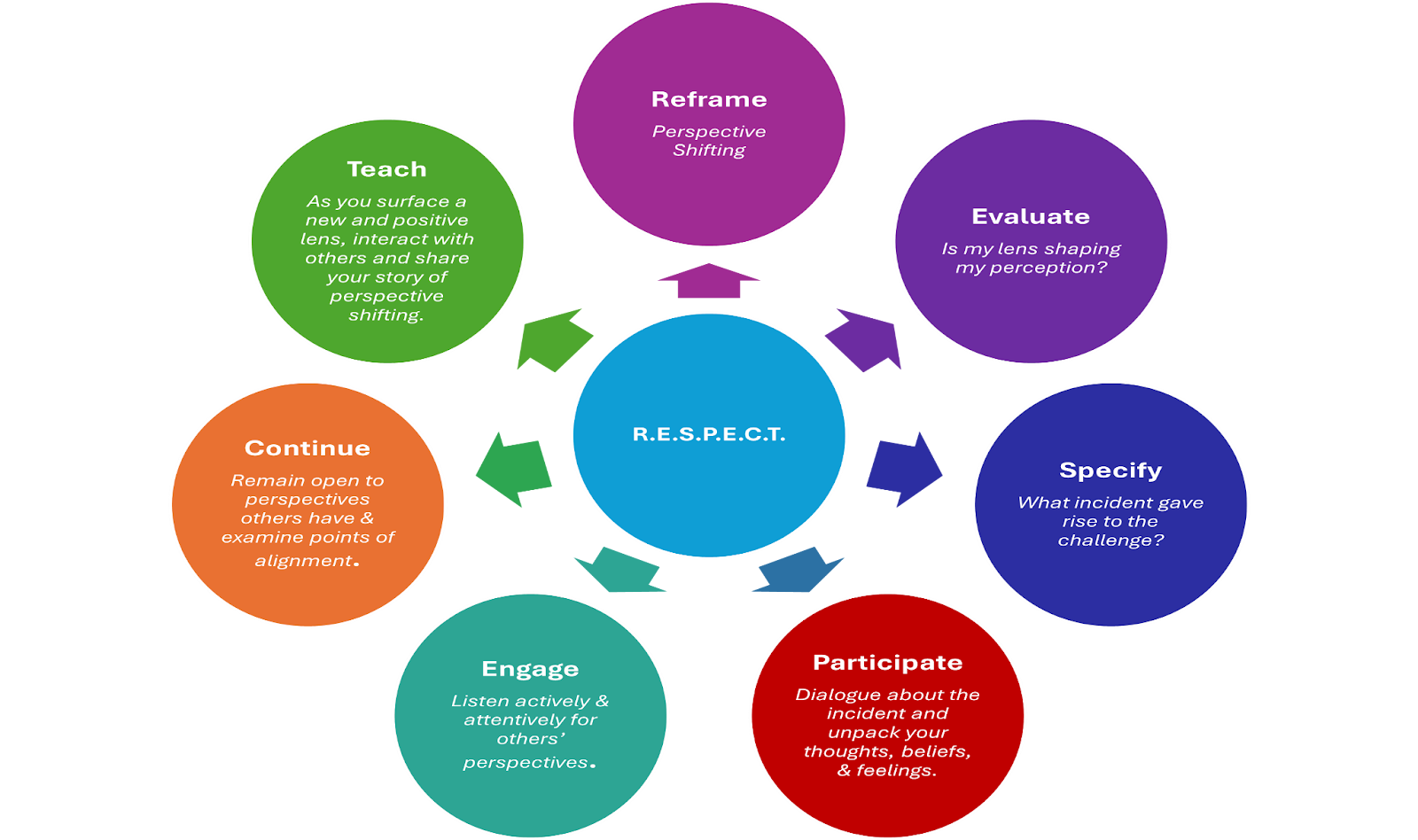
Figure 4. R.E.S.P.E.C.T. FRAMEWORK
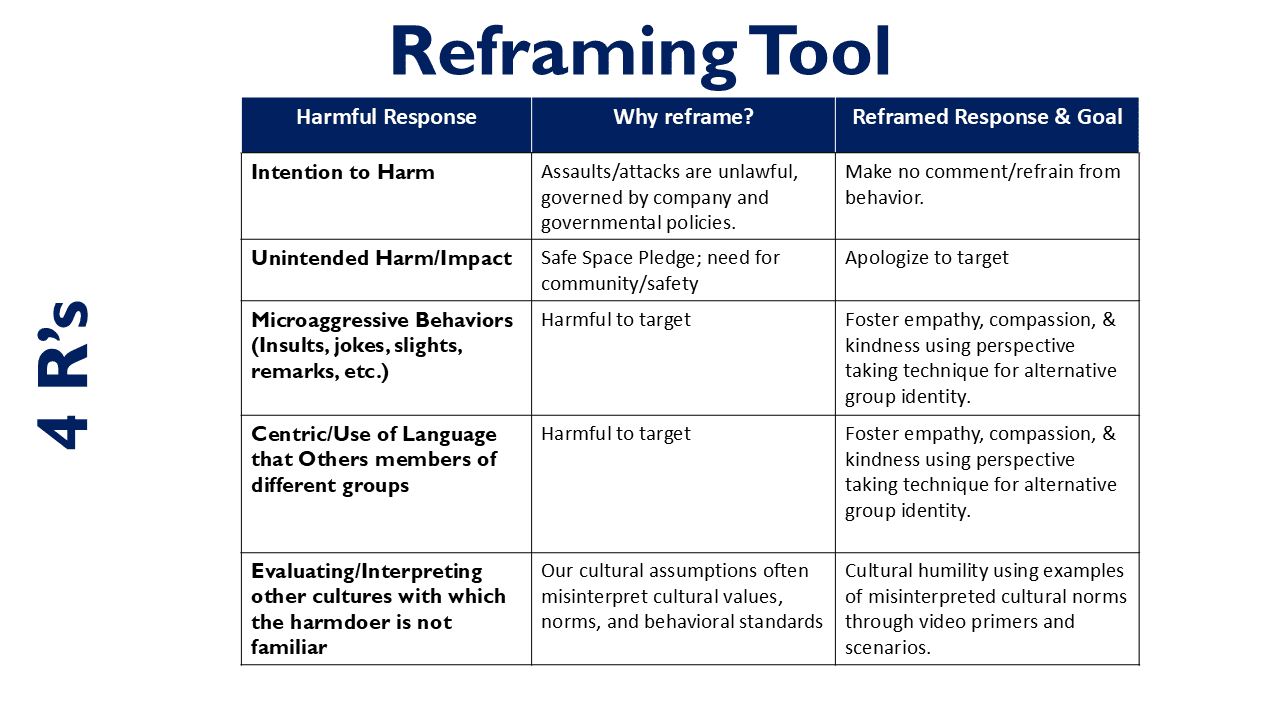
Figure 5. 4R REFRAMING TOOL
Integration into Organizational Practices
We conceptualize inclusive leadership not as unilateral power but as a relationship between leaders and organizational members that is grounded in trust, mutuality, and understanding. Our curriculum is thus designed not only to shift knowledge but also to transform decision-making patterns across the leadership pipeline.
In total, the design ensures that learning is not only transmitted but experienced, evaluated, and enacted across a 48-month continuum, with modules building upon each other to reinforce cultural transformation that is measurable, sustainable, and equitable.
Transformative Inclusion: Strategic Insights for Global Workforce Development
This case study explores how Amazon, as a global leader, can harness inclusive strategies to drive sustained corporate growth and impact. Central to this approach is understanding workforce demographic trends, advancing intercultural training, leveraging accessible technologies, and strengthening labor relations in multinational contexts.
Diversity & Representation Trends
Amazon has made measurable progress in increasing gender and ethnic representation across its workforce. Between 2018 and 2021, women and ethnically diverse employees-particularly Black, Hispanic/Latinx, and Indigenous groups-gained ground in representation, especially in managerial ranks. However, some declines (e.g., among Asian and multiracial categories) highlight the need for tailored, ongoing interventions. U.S.-based representation continues to outpace global trends, despite broader international mandates for gender equity, such as the EU’s requirement of 40% female board representation.
Training for Inclusion & Leadership Development
Amazon’s internal goal to provide company-wide inclusion training is a promising foundation. However, deeper approaches can enhance leadership competency and global impact. Recommended programs include:
Immersive Leadership Simulations using VR and holograms to mirror diverse workplace scenarios. Platforms like Equal Reality and holographic learning systems (e.g., Recourse) offer scalable, engaging modalities for this transformation.
Emotional Intelligence (EI) Development, particularly around empathy, regulation, and social competence.
Belonging & Psychological Safety Training, addressing the marginalization felt by underrepresented groups, especially in cross-cultural settings.
Labor Relations Across Cultures
Labor relations remain a complex, region-specific challenge. While Amazon’s Global Employee Relations team works to navigate these tensions, events like U.S.-based unionization efforts and European limitations on race-based workforce data reflect how global diversity goals must adapt to local contexts. Companies like Microsoft are setting the tone by embracing open dialogue on unionization and transparency in labor relations.
Cultural Adaptability and Inclusive Organizational Design
An adhocracy culture-marked by creativity, risk-taking, and participatory decision-making-is ideal for nurturing global inclusion. When paired with a geocentric orientation, where national identities are secondary to global unity, organizations can effectively balance customer and employee voices worldwide. To enable this, training must emphasize intercultural agility, global mindset cultivation, and dynamic leadership.
Competencies for Global Practice
Key competencies for international leaders include:
Emotional Intelligence: The ability to manage emotions and foster empathetic communication.
Intercultural Competence: Deep curiosity about other cultures, coupled with cultural intelligence (CQ).
Multilingual & Communication Skills: Proficiency in additional languages and communication patterns aligned with local customs.
Developing these skills requires scenario-based simulations, iterative learning, and experiential immersion over several months. On-the-job language acquisition further ensures sustained skill through reinforcement.
Conclusion
Amazon’s sustained global leadership hinges on deepening its inclusive strategies through robust workforce training, proactive labor relations, and culturally adaptive leadership. Embracing these practices equips Amazon-and similarly situated multinationals-to remain resilient, agile, and authentically inclusive in an increasingly complex global environment.
Industries
This service is primarily available to the following industry sectors:

Food & Beverage
The Food & Beverage industry, characterized by its high-volume labor force, complex supply chains, and dynamic consumer base, stands at a pivotal intersection of operational efficiency and cultural responsiveness. Transformative Inclusion addresses longstanding gaps in representation, workforce equity, and intercultural leadership that continue to impact frontline and executive teams alike. Drawing upon the Multi-Pronged Approach developed and deployed by Dr. Ayanna R. Cummings—whose leadership in a Fortune 100 Hospitality & Food Services company catalyzed systemic change—this 48-month program equips leaders at all levels with the tools to drive measurable transformation.
This sector faces persistent challenges such as high turnover, limited advancement pipelines for underrepresented groups, language and cultural barriers in service delivery, and a historic lack of DEI integration at the leadership level. The Transformative Inclusion program targets these issues by building leadership capacity, embedding equity in performance management systems, and fostering culturally responsive customer and employee experiences. Through targeted initiatives such as inclusive performance evaluations, strategic talent development, and intercultural communication training, the program reduces attrition and enhances operational effectiveness.
The sector’s customer-facing nature also makes it uniquely sensitive to evolving cultural trends, expectations, and consumer demographics. By aligning inclusion practices with branding, employee engagement, and service design, Transformative Inclusion strengthens brand loyalty while enhancing employee morale and retention. Furthermore, using diagnostic tools such as organizational climate assessments and engagement surveys, organizations in the Food & Beverage space gain real-time insight into cultural dynamics, enabling leaders to make data-driven decisions that enhance performance, customer satisfaction, and profitability.

Education
The Education sector, spanning adult learning, K–12 systems, and higher education institutions, continues to grapple with longstanding disparities in access, representation, and cultural responsiveness. Transformative Inclusion offers a strategic, research-informed framework for addressing these gaps across diverse learning environments. With a foundation in intercultural competency, inclusive pedagogy, and equity-centered leadership, this 48-month program equips educators, administrators, and institutional leaders with tools to address systemic inequities at scale.
Many educational organizations struggle to operationalize equity goals beyond aspirational mission statements. Transformative Inclusion bridges that divide through the Multi-Pronged Approach—applying systems-level diagnostics, omnichannel stakeholder engagement and communications, and differentiated professional development plans.
School and university leaders will gain tools to embed inclusion in curriculum design, faculty training, hiring practices, and student success models. Moreover, the program’s emphasis on psychological safety ensures inclusive learning environments where every student feels empowered to succeed.
As education systems worldwide face increasing scrutiny around equity, belonging, and access, Transformative Inclusion provides a sustainable, data-driven roadmap for embedding systemic change. The integration of the RESPECT Framework encourages inclusive behaviors and reflection across student and staff interactions, while implementation tools such as cultural audits and learner-centered assessments offer institutions practical levers for change. This empowers educators to cultivate inclusive classrooms that reflect and affirm the diverse lived experiences of their students.

Professional Services
The Professional Services sector—including consulting, finance, legal, marketing, and client advisory industries—operates in high-pressure, client-centric environments where innovation, trust, and relationship-building are paramount. Despite sector-wide recognition of the need for diversity and inclusion, efforts often remain fragmented or symbolic. The Transformative Inclusion program delivers a robust, long-term strategy that embeds equity into business operations, client service models, and talent pipelines.
Using a systematized model rooted in the Multi-Pronged Approach, the program delivers sector-specific interventions such as inclusive leadership development, equitable feedback loops, and DEI-integrated business development practices. Professionals in this space are empowered to build inclusive work environments that enhance psychological safety, reduce attrition among underrepresented talent, and support ethical client advisement. The program also equips partners and firm leaders to adopt equity-driven models that align organizational values with stakeholder expectations.
The global footprint of professional services demands cultural agility, cross-border collaboration, and an inclusive mindset to attract and retain top talent and clients alike. Through its 48-month curriculum, Transformative Inclusion enhances the capacity of professionals to engage across lines of difference, respond to rapidly evolving social expectations, and drive value for both internal and external stakeholders. By embedding inclusive behaviors into decision-making processes, the program strengthens trust, innovation, and accountability throughout the organization.

Production
The Production industry—encompassing manufacturing, logistics, and supply chain operations—has traditionally been driven by efficiency, standardization, and technical skill. However, workforce diversity and inclusion have emerged as strategic imperatives, especially as the industry seeks to future-proof operations, reduce turnover, and meet global compliance standards. Transformative Inclusion provides a long-range, actionable blueprint for embedding equity into operational and managerial frameworks that have historically overlooked cultural competence.
Production environments often feature culturally diverse frontline workforces, yet inclusive leadership practices remain underdeveloped at supervisory and middle-management levels. The 48-month Transformative Inclusion program addresses this disconnect by equipping managers with tools to support intercultural teams, mitigate communication barriers, and cultivate belonging in high-pressure environments. By incorporating immersive scenario-based training and system-level engagement metrics, the program ensures both behavioral and structural shifts are reinforced over time.
Operational excellence in production increasingly depends on cohesive team dynamics, psychological safety, and continuous improvement. Transformative Inclusion aligns with these goals by integrating DEI metrics into performance review processes, elevating employee voice, and embedding inclusive behaviors into quality management systems. The Multi-Pronged Approach further supports leadership in driving plant-level innovation, workplace safety, and accountability through inclusive policy refinement and transparent data utilization.

Legal
The Legal sector, rooted in tradition and precedent, is increasingly challenged to adapt to contemporary expectations around workplace equity, ethical governance, and cultural responsiveness. Law firms, corporate legal departments, and public interest organizations are all experiencing pressure to address implicit bias, diversify leadership, and respond proactively to evolving global DEI compliance standards. Transformative Inclusion offers a systems-level solution that integrates inclusive practices into legal culture and operations, equipping legal professionals to lead with clarity, integrity, and strategic foresight.
This 48-month program supports legal professionals by embedding equity into recruitment pipelines, mentorship and sponsorship frameworks, and case management procedures. Legal departments often serve as both internal compliance watchdogs and external representatives of institutional values. Through the RESPECT Framework and Multi-Pronged Approach, the program enhances legal team capacity to lead by example in fostering psychological safety, inclusive language in contracts and policy, and equitably resolving internal disputes.
Given the regulatory weight and social influence of the legal profession, Transformative Inclusion positions legal departments as change agents within broader organizational systems. The program emphasizes data-informed diagnostics, inclusive policy audits, and equity-centered training simulations to ensure legal teams are not only mitigating risk but driving systemic fairness. Legal professionals are uniquely poised to model inclusion as a legal, ethical, and business imperative, aligning justice with equity in both internal culture and external advocacy.

Healthcare
The Healthcare industry, encompassing hospitals, mental health centers, long-term care facilities, and public health agencies, is uniquely positioned to benefit from the Transformative Inclusion program. Healthcare environments are often shaped by high-stress demands, workforce shortages, and rapidly shifting patient demographics—factors that underscore the urgency of inclusive leadership. At the intersection of human dignity and medical ethics, Transformative Inclusion enables providers, administrators, and support staff to embed equity into both patient care and employee well-being, advancing a more just, responsive, and human-centered system.
The 48-month program equips healthcare leaders to address disparities in patient outcomes, unconscious bias in diagnosis and treatment, and burnout among underrepresented healthcare professionals. By leveraging the Multi-Pronged Approach and the RESPECT Framework, institutions can integrate psychological safety, inclusive hiring, and equity-driven performance management into clinical and non-clinical settings. Customized modules in cultural humility, inclusive communication, and mental wellness support the dual imperative to care for both patients and care providers in equitable ways.
Transformative Inclusion responds to the growing demand for trauma-informed leadership, anti-stigma practices, and community-based engagement in public health. Whether in urban health systems serving multilingual populations or rural clinics grappling with structural inequities, the program delivers tailored strategies to create more inclusive, high-performing teams. It also equips executive leadership with the tools to meet national accreditation standards, address health disparities, and foster inclusive innovation across the continuum of care.
Locations
This service is primarily available within the following locations:

Atlanta, GA
Atlanta, Georgia—often referred to as the ‘cradle of the Civil Rights Movement’—offers a powerful backdrop for the Transformative Inclusion workshop series. As a hub for corporate headquarters, higher education institutions, and nonprofit leadership, Atlanta presents both deep historical significance and contemporary opportunity for equity-centered transformation. The city’s racially diverse population and complex socioeconomic landscape make it an ideal location to operationalize DEI strategy across sectors that are both culturally dynamic and economically vital.
Transformative Inclusion will support Atlanta’s food & beverage, legal, and educational sectors by cultivating inclusive leadership in culturally responsive environments. Through initiatives such as inclusive onboarding, talent development pipelines, and psychological safety training, the program responds to Atlanta’s evolving business and civic needs. Organizations across the metro area—from Fortune 500 companies to educational consortia—stand to benefit from structured intercultural learning and impactful organizational diagnostics.
The city’s dynamic role in shaping national dialogue on race, equity, and justice means that Atlanta-based leaders often serve as national and international DEI influencers. Transformative Inclusion accelerates this legacy by equipping decision-makers with actionable tools, cultural humility, and accountability frameworks to expand impact locally and on the global stage. Grounded in the Multi-Pronged Approach and RESPECT Framework, this program provides Atlanta’s public and private institutions with a strategic model to institutionalize equity and belonging at scale.

New York, NY
New York City, one of the most diverse and influential metropolitan areas in the world, offers a dynamic landscape for Transformative Inclusion’s 48-month workshop series. As a financial, cultural, and media capital, the city is home to a dense concentration of multinational corporations, academic institutions, nonprofit coalitions, and government agencies. This diversity presents both immense opportunity and deep systemic complexity. With its layered histories of migration, economic disparity, and cultural vibrancy, New York demands DEI solutions that are not only thoughtful and inclusive but highly scalable and sustainable.
Transformative Inclusion is uniquely positioned to address these challenges through a strategic, multi-level implementation approach. By engaging human capital leaders, corporate DEI strategists, and legal and policy influencers, the program enables organizations to recalibrate internal systems and cultures to reflect equity and belonging. The city’s high expectations for innovation, regulatory compliance, and global visibility make it an ideal proving ground for leading-edge inclusion work. From Wall Street to public universities, Transformative Inclusion brings cultural competency and inclusive leadership principles into alignment with performance, compliance, and growth.
New York’s influence on national and international policy means that DEI advancements here often serve as a bellwether for industry-wide change. By embedding the Multi-Pronged Approach and the RESPECT Framework, the program strengthens the ability of leaders across sectors—from finance and law to education and healthcare—to deliver impact that reverberates across cities and borders. Transformative Inclusion supports organizations in navigating cultural complexity while elevating shared purpose, dignity, and innovation across every level of leadership.

London, UK
London stands as a global crossroads of commerce, governance, and multicultural life—making it a prime location for the implementation of the Transformative Inclusion program. As one of the most ethnically and culturally diverse cities in Europe, London’s institutions—from financial services and education to media and public policy—face increasing pressure to model inclusive leadership and equitable systems. The city’s colonial legacy and current socioeconomic stratification create a compelling imperative to move beyond performative DEI practices toward systemic transformation rooted in accountability and cultural responsiveness.
Transformative Inclusion provides a scalable, stepwise approach to cultural transformation across multinational headquarters, universities, local councils, and NHS systems alike. The program supports cross-sector leaders in embedding psychological safety, inclusive hiring, and employee development into the core of daily operations. Its emphasis on pre-assessment diagnostics, organizational listening, and intersectional frameworks helps London-based organizations align with both local policy mandates and global ESG benchmarks.
Given London’s global reach and policy-setting influence in the Commonwealth, lessons learned and models piloted here can ripple across continents. The integration of the Multi-Pronged Approach and RESPECT Framework provides organizations with structured tools to tackle legacy inequities and engage communities in co-creating equitable futures. Whether in legal firms navigating Brexit-era labor shifts or education providers welcoming diverse student bodies, Transformative Inclusion ensures London is equipped to lead with cultural humility and inclusive excellence.

Toronto, ON
Toronto, Ontario—Canada’s largest and most diverse city—is an ideal environment for Transformative Inclusion’s evidence-based, intercultural workshop series. As a multicultural metropolis where over 50% of residents identify as part of a visible minority, Toronto offers both a compelling demographic case for inclusive leadership and a progressive civic culture that welcomes systemic equity initiatives. The city’s booming sectors—from finance and education to public service, health, and tech—require culturally agile leaders equipped to drive innovation, navigate difference, and foster belonging within increasingly complex workforces.
Transformative Inclusion’s strategic 48-month design will enable Toronto-based organizations to translate values of equity and multiculturalism into measurable outcomes. Using the Multi-Pronged Approach and RESPECT Framework, the program offers tailored pathways to embed inclusive hiring, cross-cultural leadership development, mental wellness strategies, and organizational culture audits. These tools empower employers to assess and refine their internal systems while engaging employees in psychologically safe, responsive learning environments.
Toronto’s status as a global immigration hub, coupled with Canada’s national commitments to Truth and Reconciliation and multicultural inclusion, positions the city to lead by example. Transformative Inclusion enhances this leadership role by equipping public and private sector organizations with models for sustainable transformation that center equity, representation, and cultural humility. Whether serving newcomer populations, navigating Indigenous engagement, or developing diverse leadership pipelines, Toronto organizations will gain lasting value through this impactful program.

Sydney, AU
Sydney, Australia, known for its economic vitality and cultural diversity, presents a strategic opportunity for the Transformative Inclusion program to address equity across sectors undergoing rapid demographic and organizational change. As Australia’s largest city and a key Asia-Pacific business hub, Sydney faces rising expectations for culturally competent leadership, workplace inclusion, and reconciliation with Aboriginal and Torres Strait Islander communities. Transformative Inclusion is well-positioned to support organizations in Sydney through an actionable roadmap that aligns with both local cultural nuances and global DEI best practices.
Through the 48-month framework grounded in the Multi-Pronged Approach and RESPECT Framework, the program will help employers in Sydney embed equity into talent management, intercultural communication, and employee development. Industries including professional services, education, and public administration will benefit from diagnostic assessments, inclusive policy audits, and leadership development initiatives that promote cohesion, belonging, and innovation within increasingly diverse teams.
Sydney’s business climate, supported by national inclusion policies and progressive human rights frameworks, positions it as a leader in global equity innovation. Transformative Inclusion enhances this positioning by equipping organizations to address bias, advance reconciliation goals, and build psychologically safe environments that embrace cultural difference. Whether navigating immigration-driven workforce shifts or working to ensure justice for Indigenous communities, Sydney’s organizations will gain strategic capacity and measurable outcomes through this tailored DEI engagement.

San Francisco, CA
San Francisco, California, known globally for its innovation economy, social progressivism, and cultural diversity, is an ideal city to implement the Transformative Inclusion workshop series. As the heart of Silicon Valley and a leader in tech, healthcare, education, and progressive governance, the city is at the forefront of shaping inclusive workplace culture in the United States and abroad. However, it also faces widening disparities related to gentrification, racial inequity, and access to opportunity—making it a high-impact environment for systemic DEI transformation.
Transformative Inclusion meets these challenges through a structured, research-based approach that bridges visionary thinking with operational integration. San Francisco-based organizations will benefit from the program’s emphasis on equity-centered leadership, algorithmic fairness in digital tools, mental health in high-performance settings, and building inclusive pipelines in industries often criticized for their lack of diversity. The program also fosters responsible innovation by incorporating the RESPECT Framework into policy design, team dynamics, and executive decision-making.
With its global influence on innovation and social change, San Francisco’s successful implementation of Transformative Inclusion will model scalable solutions for inclusive excellence. Whether advancing diverse talent in venture-backed firms or institutionalizing equity in public health and higher education, the program equips leaders to turn aspiration into action. As the city continues to set national and global precedents, Transformative Inclusion ensures San Francisco’s organizations are future-ready, values-driven, and authentically inclusive.
Program Benefits
Human Resources (HR)
- Culture Architecture
- Equity Integration
- Talent Optimization
- Inclusive Retention
- Strategic Onboarding
- Bias Disruption
- Performance Equity
- Psychological Safety
- Metrics Accountability
- Leadership Pipeline
Information Technology (IT)
- Inclusive Engineering
- Algorithmic Justice
- Digital Equity
- Accessibility Innovation
- Ethical Coding
- UX Inclusivity
- Bias Auditing
- Tech Empowerment
- Data Integrity
- Systems Alignment
Legal
- Equity Jurisprudence
- Compliance Innovation
- Policy Transformation
- Risk Anticipation
- Governance Foresight
- Justice Advocacy
- Ethical Alignment
- Regulatory Strategy
- Institutional Accountability
- Inclusion Mandates
Testimonials

Testimonial 1
To Be Provided.

Testimonial 2
To Be Provided.

Testimonial 3
To Be Provided.

Testimonial 4
To Be Provided.

Testimonial 5
To Be Provided.
More detailed achievements, references and testimonials are confidentially available to clients upon request.
Client Telephone Conference (CTC)
If you have any questions or if you would like to arrange a Client Telephone Conference (CTC) to discuss this particular Unique Consulting Service Proposition (UCSP) in more detail, please CLICK HERE.