

Process Advantage Blueprint

The Appleton Greene Corporate Training Program (CTP) for Process Advantage Blueprint is provided by Dr. Struwe Certified Learning Provider (CLP). Program Specifications: Monthly cost USD$2,500.00; Monthly Workshops 6 hours; Monthly Support 4 hours; Program Duration 12 months; Program orders subject to ongoing availability.

Personal Profile
Dr. Struwe brings more than three decades of international experience at the intersection of high-precision engineering, business development, and organizational transformation. Originally trained as a Diplom-Ingenieur in Nuclear Power Engineering at TU Dresden, with research residencies at the Moscow Energy Institute and Imperial College London, Dr. Struwe went on to earn a PhD in Nuclear Physics in 1997. His early career in the UK nuclear sector quickly evolved from R&D into consulting and project management, including senior roles in major international initiatives such as the Chernobyl New Safe Confinement project.
Across roles in technical consulting, sales, and marketing leadership – notably at BNFL Instruments, Rados Technology, and Mirion Technologies – he developed a strong interest in aligning business operations with strategic goals through structured, scalable process design. Known for bridging commercial objectives with operational execution, he led cross-regional teams and internal process improvement initiatives long before “process thinking” became mainstream.
In 2013, Dr. Struwe stepped into entrepreneurship, founding and later selling a private education center focused on learning disabilities – a venture that deepened his practical experience in building systems from the ground up. Since 2020, he has led a business consulting and training firm, guiding SMEs and multinational organizations toward more adaptive, process-oriented models of growth.
Dr. Struwe is a TÜV-certified Process Manager and Sustainability Manager and is trained in the Systemology™ methodology for building process-driven businesses. His approach combines technical rigor, system-level thinking, and a commitment to practical results – helping organizations turn complexity into clarity and strategy into structured execution.
To request further information about Dr. Struwe through Appleton Greene, please Click Here.

(CLP) Programs

Appleton Greene corporate training programs are all process-driven. They are used as vehicles to implement tangible business processes within clients’ organizations, together with training, support and facilitation during the use of these processes. Corporate training programs are therefore implemented over a sustainable period of time, that is to say, between 1 year (incorporating 12 monthly workshops), and 4 years (incorporating 48 monthly workshops). Your program information guide will specify how long each program takes to complete. Each monthly workshop takes 6 hours to implement and can be undertaken either on the client’s premises, an Appleton Greene serviced office, or online via the internet. This enables clients to implement each part of their business process, before moving onto the next stage of the program and enables employees to plan their study time around their current work commitments. The result is far greater program benefit, over a more sustainable period of time and a significantly improved return on investment.

Appleton Greene uses standard and bespoke corporate training programs as vessels to transfer business process improvement knowledge into the heart of our clients’ organizations. Each individual program focuses upon the implementation of a specific business process, which enables clients to easily quantify their return on investment. There are hundreds of established Appleton Greene corporate training products now available to clients within customer services, e-business, finance, globalization, human resources, information technology, legal, management, marketing and production. It does not matter whether a client’s employees are located within one office, or an unlimited number of international offices, we can still bring them together to learn and implement specific business processes collectively. Our approach to global localization enables us to provide clients with a truly international service with that all important personal touch. Appleton Greene corporate training programs can be provided virtually or locally and they are all unique in that they individually focus upon a specific business function. All (CLP) programs are implemented over a sustainable period of time, usually between 1-4 years, incorporating 12-48 monthly workshops and professional support is consistently provided during this time by qualified learning providers and where appropriate, by Accredited Consultants.
Executive summary
Process Advantage Blueprint
Why Organizations Choose The Process Advantage Blueprint
 In fast-evolving industries like manufacturing, logistics, and services, even well-resourced operations can suffer when underlying process challenges are left unaddressed. Many organizations make big investments in systems or talent yet still find themselves wrestling with inefficiencies, inconsistencies, and an execution gap between strategic ambition and daily reality. These issues rarely exist in isolation – they are deeply interconnected: lack of standardization fuels inefficiencies, poor visibility makes performance hard to manage, rigid processes limit adaptability, and ultimately, strategy remains misaligned with what teams actually deliver on the ground. The Process Advantage Blueprint recognizes this connection and gives Operations Managers and Regional or Division Managers a structured, practical way to tackle these root causes holistically, rather than through scattered quick fixes.
From Operational Inefficiencies to Efficient Flows
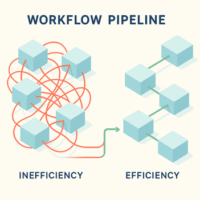 When day-to-day operations are clogged with redundant tasks, unclear hand-offs, and time-consuming workarounds, valuable resources get wasted and frontline teams lose morale. Small gaps accumulate into big costs, but these hidden inefficiencies often go unchallenged because they are accepted as “the way we do things.” For an Operations Manager under pressure to deliver more with less, these invisible drains on time and productivity can feel impossible to tackle alone. The Process Advantage Blueprint gives managers a structured way to surface, measure, and fix inefficiencies in real workflows, not just through theory. By learning how to map processes end-to-end, involve frontline staff, and test improvements in the real work environment, participants gain the practical skills to recover lost capacity and reinvest it in more strategic work. This practical approach means that operational improvements aren’t a one-time cost-saving initiative but become part of how the organization thinks and acts every day.
Addressing a Lack of Standardization
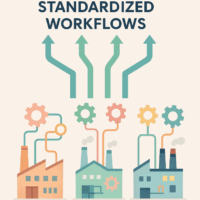 Organizations with multiple plants, service centers, or regional hubs often struggle with processes that vary dramatically between teams, sites, or even shifts. While local flexibility is important, uncontrolled variation breeds confusion, quality issues, and unnecessary costs. For Regional or Division Managers, this means spending valuable time firefighting issues that should be routine. The program directly addresses this by helping managers analyze where standardization drives value and where local adaptations still make sense. Participants test draft standards in real conditions, using input from operators and local leads, so new practices are both practical and accepted. This pragmatic approach breaks the usual tension between headquarters and local teams: it shows that standards can be adaptable, shaped by those who do the work, and used as a platform for consistent quality and performance. The result is more predictable output and a stronger foundation for scaling or replicating good practices across sites.
From Low Process Visibility to Practical Metrics
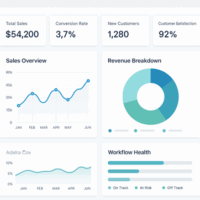 Many senior managers find that they cannot get a clear picture of how work really happens on the ground. Information sits in silos, KPIs do not match reality, and decisions get made with incomplete or outdated data. This lack of process visibility weakens trust between levels of the organization and slows down problem-solving. The Process Advantage Blueprint ensures managers learn how to build practical dashboards that connect process performance to business outcomes in real time. Participants learn to develop metrics that show not just outputs but the health of the process itself, helping them catch problems early, diagnose root causes, and act quickly. Crucially, the training ties this data back to team routines, so the change team and frontline staff are part of interpreting and responding to what the numbers show. Over time, this means less guesswork, more informed decisions, and greater confidence that day-to-day operations support strategic goals.
From Limited Adaptability to Flexible Implementation
 Today’s operating environment demands that organizations respond quickly to supply chain disruptions, customer demands, and evolving market conditions. However, rigid, outdated processes can make it difficult to pivot without creating chaos downstream. For Operations Managers, limited adaptability means missing opportunities or over-relying on ad-hoc heroics to deliver under pressure. The Process Advantage Blueprint helps participants embed flexibility where it adds value. By understanding the interfaces between stakeholders, mapping where bottlenecks occur, and designing processes with clear ownership and review cycles, managers develop systems that can adjust without constant escalation or rework. The inclusion of digital enablers, no matter how small, means that teams can automate simple tasks or use collaborative tools to adapt in real time. This blend of practical process design, tested pilots, and clear governance ensures that improvements can evolve naturally, without depending on each manager reinventing the wheel when conditions change.
Connecting Strategy and Execution
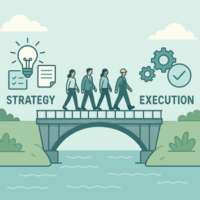 Perhaps the greatest frustration for capable managers is watching well-crafted strategies fall apart in implementation. When business units, sites, or teams operate in silos, the link between what executives want to achieve and what frontline staff deliver gets lost in translation.
This gap leads to competing priorities, wasted resources, and initiatives that don’t stick. The Process Advantage Blueprint makes strategy actionable by training managers to translate high-level objectives into daily workflows and clear performance indicators. Participants learn how to communicate the “why” behind process improvements in a way that resonates at all levels, building trust and accountability through their local change teams.
Over twelve months, this means strategy is no longer a PowerPoint slide shared at an annual conference but becomes something that shapes decisions and behaviors every day.
Conclusion
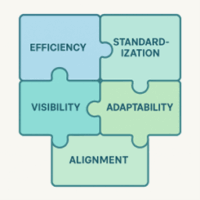 When these five issues – inefficiency, lack of standardization, low visibility, limited adaptability, and strategic misalignment – are addressed in silos, improvements rarely last. This program brings them together in a coherent roadmap, ensuring that the solution for one does not create new gaps elsewhere. By helping managers strengthen process thinking, build capable local teams, and embed clear ownership, the training fosters a practical process-oriented culture that makes the whole organization stronger. For companies that want results they can measure – and sustain – The Process Advantage Blueprint delivers more than a one-off project: it creates the conditions for continuous improvement to become part of how the business competes and grows.
Case Study: Transforming Order Fulfillment Through Business Process Optimization in the Construction Materials Sector
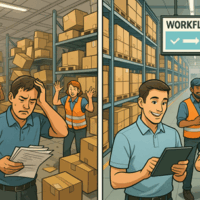 A company in the construction materials distribution sector was facing persistent inefficiencies in both its warehouse and administrative operations. Order delays, data mismatches, and a lack of standardized procedures led to diminished service levels and inconsistent inventory control. To address these issues, the organization implemented a structured business process improvement initiative focused on warehouse standardization and administrative process optimization. The approach introduced process documentation, synchronized data systems, and performance monitoring mechanisms aimed at streamlining the flow of materials and information.
Following the intervention, the company achieved a 12% increase in fully delivered orders. Inventory record accuracy improved by 16%, location registration accuracy by 32%, and operational coverage by 57%. Productivity increased by 24%, while warehouse cycle time was reduced by 3%. A weekly inventory inspection was introduced without adding time overhead, thanks to better work standardization. Total order time in the warehouse dropped by 63 minutes – an 8% improvement – despite the integration of new control steps. On the administrative side, restructuring and digitizing key workflows led to a time reduction of 63 minutes (8%), eliminating delays in warehouse communication and removing tasks like manual invoice verification. These improvements, both in physical operations and administrative processes, demonstrate how targeted process improvement efforts can deliver measurable impact across an organization.
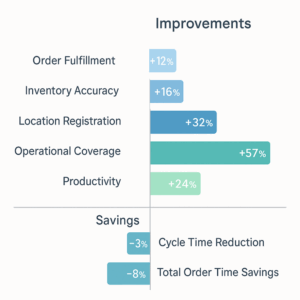 The initiative not only improved service quality and responsiveness but also embedded a more process-aware culture across departments.
Source: Warehouse Management Model Integrating BPM-Lean Warehousing
Curriculum
Process Advantage Blueprint – Part 1- Year 1
- Part 1 Month 1 BPM Foundations
- Part 1 Month 2 Strategy Process
- Part 1 Month 3 Process Mapping
- Part 1 Month 4 Stakeholder Interfaces
- Part 1 Month 5 Standardization
- Part 1 Month 6 Silos to Systems
- Part 1 Month 7 Engaging Frontline
- Part 1 Month 8 Data-Driven Process
- Part 1 Month 9 Digital Enablers
- Part 1 Month 10 Leading Change
- Part 1 Month 11 Governance Ownership
- Part 1 Month 12 Continuous Improvement
Program Objectives
The following list represents the Key Program Objectives (KPO) for the Appleton Greene Process Advantage Blueprint corporate training program.
Process Advantage Blueprint- Part 1- Year 1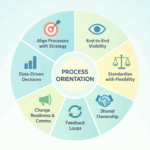
- Part 1 Month 1 BPM Foundations – Focus: Establish a shared language and mindset for process-oriented leadership. Equip participants to select a meaningful process and form their local change team. Core Learning Format: Interactive workshop on BPM principles, maturity levels, and why process orientation is a leadership capability that aligns strategy with day-to-day operations. In-Session Exercise: Stakeholder & change team mapping. Participants identify key people whose support, knowledge, or buy-in is crucial for their selected process. They practice mapping influence, interest, and potential resistance. Take-Away Assignment: Hold a short kick-off meeting with the change team and immediate stakeholders. Confirm the chosen core process for improvement, gather early insights on pain points, and set shared expectations for collaboration. Document initial roles (e.g. process champion, data owner). Project Progression: Participants begin their “living lab” project: they now have a defined process, an initial stakeholder map, and a working team to build momentum.
- Part 1 Month 2 Strategy Process – Focus: Translate strategy into clear, practical outcomes that the chosen process must deliver. Core Learning Format: Case study analysis and practical frameworks on connecting corporate strategy to process KPIs. Participants see how global companies align top-level goals with real workflows. In-Session Exercise: Draft a simple strategy-to-process map for their chosen process: identify key objectives, break them into measurable sub-goals, and link them to daily activities. Take-Away Assignment: Facilitate a working session with the change team to test the draft. Invite the team to challenge assumptions, refine the KPIs, and co-create early performance targets. Identify what data is needed to baseline the current state. Project Progression: Participants now have a documented “why” for the project, agreed KPIs, and an engaged team that understands how their work supports broader goals.
- Part 1 Month 3 Process Mapping – Focus: Visualize the current process as it really happens. Bring hidden steps, handoffs, and duplications into the open. Core Learning Format: Hands-on mapping session covering SIPOC, swimlanes, and value stream mapping, with best-practice examples. In-Session Exercise: Draft the “as-is” process map for the chosen process with peers. Identify where stakeholder interactions, bottlenecks, or variations exist. Take-Away Assignment: Run a practical mapping workshop with the change team and relevant frontline people. Validate the draft, add local details, and mark where data must be collected for baselining. Project Progression: Participants have a clear, validated “as-is” map they can use as the starting point for analysis and improvement. The team now shares a common view of how work actually flows.
- Part 1 Month 4 Stakeholder Interfaces – Focus: Deepen awareness of how the process interacts with other functions, suppliers, customers, and users. Core Learning Format: Tools for stakeholder interface analysis: impact matrix, touchpoint mapping, and customer journey moments. In-Session Exercise: Build a stakeholder interface map for the process. Identify which touchpoints most affect performance and relationships. Take-Away Assignment: Conduct at least two short structured conversations with key stakeholders (e.g. supplier, internal partner, or customer rep). Bring these insights back to the change team. Update the process map and KPI assumptions accordingly. Project Progression: By the end of Month 04, each participant has: A fully documented “as-is” process with real stakeholder input; A committed change team aligned to strategy’ A living baseline of where they are today – ready for deeper analysis and prioritization in the months to come.
- Part 1 Month 5 Standardization – Focus: Define which process steps should be consistent across teams and where flexibility makes sense. Balance global standards with local realities. Core Learning Format: Practical frameworks and examples of adaptable standardization in complex organizations. In-Session Exercise: Draft a “core vs. local” standard operating framework for the chosen process. Identify non-negotiable elements and adaptable ones. Take-Away Assignment: Test the draft with the change team in at least two real contexts (e.g., two shifts, branches, or functions). Gather insights on what works and where local conditions matter. Capture lessons learned to refine the standard. Project Progression: Participants now move from “as-is” to “should-be”: they have a baseline process with early standardization proposals, validated by the people who will use them.
- Part 1 Month 6 Silos to Systems – Focus: Tackle cross-functional breakdowns and handoff challenges that block smooth execution. Core Learning Format: Systems thinking tools for analyzing value streams and interdependencies. In-Session Exercise: Select one critical handoff in the process. Map it in detail, highlighting who owns what, where delays occur, and what information must flow. Take-Away Assignment: Bring together both sides of the handoff (e.g., different departments) for a working session. Agree on improvements and pilot an updated handoff protocol. Project Progression: Participants have now closed at least one major gap between teams or functions, making the process more robust and joined-up.
- Part 1 Month 7 Engaging Frontline – Focus: Make frontline teams active co-owners of improvement, not just recipients. Core Learning Format: Methods for structured feedback loops and quick-win pilots. In-Session Exercise: Design a simple, repeatable feedback channel (e.g., improvement huddle, suggestion board). Take-Away Assignment: Pilot the feedback loop in the real work environment. Capture frontline suggestions for tweaks to the standard or handoffs. Project Progression: Participants expand the change team’s perspective, tapping practical frontline insights to make the new process credible and workable.
- Part 1 Month 8 Data-Driven Process – Focus: Move from anecdotal improvement to measurable impact. Core Learning Format: KPI development and practical dashboard design using real baseline data. In-Session Exercise: Draft a simple dashboard to monitor the chosen process. Include key measures for cost, quality, and cycle time. Take-Away Assignment: Test the dashboard with the change team. Run at least one mini-review session to interpret results and plan corrective actions. Project Progression: By the end of Month 08, each project has clear standards, better inter-team flow, engaged frontline teams, and the first signs of measurable performance improvements.
- Part 1 Month 9 Digital Enablers – Focus: Identify practical digital tools or simple automation steps that can strengthen the new process. Core Learning Format: Examples of how organizations digitize routine tasks without overcomplicating operations. In-Session Exercise: Complete a digital readiness checklist for the chosen process: where can low-hanging digital tools add value? Take-Away Assignment: Pilot one small digital improvement with the change team – e.g., a shared tracker, form automation, or workflow notification. Project Progression: Participants start to lock in efficiency gains and test digital support in a low-risk, controlled way.
- Part 1 Month 10 Leading Change – Focus: Build confidence and skill in overcoming resistance and turning improvements into lasting new ways of working. Core Learning Format: Change leadership case studies and resistance-handling techniques. In-Session Exercise: Draft a real communication plan for a specific process change rollout, tailored to different stakeholder groups. Take-Away Assignment: Run a real communication or engagement activity (e.g., town hall, team Q&A) to reinforce the improvement and gather final feedback. Project Progression: Participants actively manage the transition, shifting mindsets and clarifying what success looks like for their teams.
- Part 1 Month 11 Governance Ownership – Focus: Secure long-term accountability so the process improvement sticks. Core Learning Format: Frameworks for process ownership, review cycles, and continuous monitoring. In-Session Exercise: Create a draft governance model for the improved process: who owns performance, who escalates issues, and how improvements are sustained. Take-Away Assignment: Present the governance plan to a senior sponsor or relevant function head, and refine it with the change team’s input. Project Progression: Participants move from “pilot mode” to business-as-usual by embedding structures that make the improvements sustainable.
- Part 1 Month 12 Continuous Improvement – Focus: Consolidate lessons learned, show results, and scale. Core Learning Format: Storytelling and benefit realization frameworks. In-Session Exercise: Develop a presentation or short report that showcases the process transformation story: from baseline to measurable outcomes. Take-Away Assignment: Host a lessons-learned workshop with the change team and immediate stakeholders. Finalize a BPM roadmap for scaling, integrating the process into ongoing reviews. Project Progression: Each participant finishes with a credible, documented process improvement – tested, adopted, governed, and positioned for continuous refinement.
Methodology
Process Advantage Blueprint
Laying the Foundation and Building Strategic Alignment
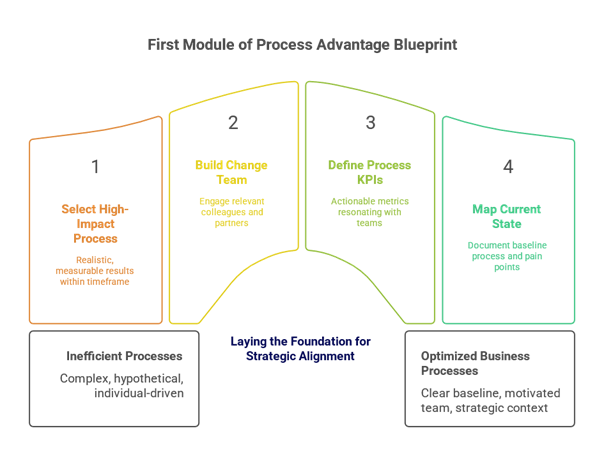
In the first module, comprising Workshops 1 – 4, the program sets the groundwork for a successful transformation by equipping each participant with a practical, process-focused mindset and the tools to translate theory into meaningful action from day one. The methodology begins by guiding managers to select a single, high-impact process within their area of responsibility — one that is complex enough to benefit from improvement yet realistic enough to deliver measurable results within the program’s timeframe. From the outset, the focus is on implementation in the real working environment rather than hypothetical scenarios. Participants are introduced to the principles of Business Process Management and process maturity models in an interactive format that encourages reflection on their own operating context.
Crucially, the program emphasizes that transformation cannot be driven by the individual alone. Participants learn how to identify key stakeholders and assemble a local change team that brings together relevant colleagues, direct reports, and cross-functional partners. Early modules provide structured exercises and practical templates for mapping influence, interest, and potential sources of resistance. The learning process reinforces that every improvement is more likely to succeed when those affected by the change are engaged in shaping it.
As the module progresses, managers link the selected process directly to broader business strategy, translating high-level goals into actionable process KPIs that resonate with both executives and operational teams. They engage their change teams to test and refine these metrics, ensuring that the performance measures are both meaningful and practical. The final weeks of this first stage equip participants with the tools to map the current state of their process using established frameworks such as SIPOC and swimlane diagrams. They build an “as-is” view that captures not only workflows but also stakeholder touchpoints and operational pain points. By the end of the module, each participant has a clearly documented baseline process, a motivated team ready to contribute ideas, and a strategic context that connects day-to-day operations with the bigger picture.
Deep Analysis, Standardization, and Cross-Functional Integration
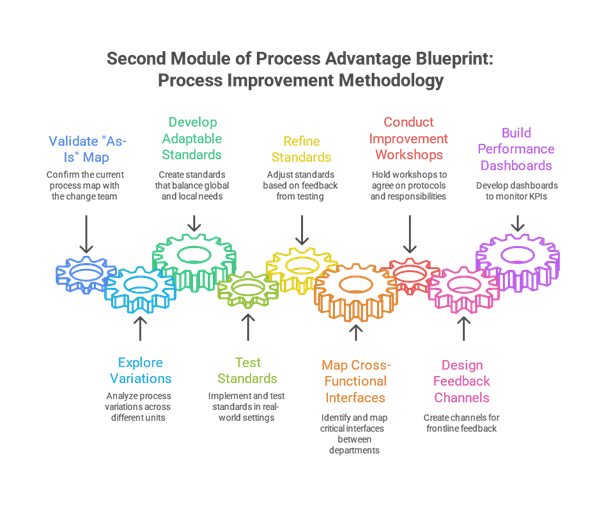
Module two, comprising Workshops 5-8, deepens the program’s focus on turning awareness into structured improvement. The methodology shifts from simply describing how work happens to rigorously analyzing why processes perform as they do and where bottlenecks or inconsistencies arise. With their “as-is” map validated by the change team, participants now explore variations across units, shifts, or regions, examining what can be standardized to promote stability and where flexibility supports local realities. Rather than imposing uniformity for its own sake, the training emphasizes the importance of adaptable standards that balance global requirements with the nuances of local operations.
The teaching approach blends live case discussions, real-world frameworks, and group feedback sessions to help managers make practical decisions about standardization. Participants test early versions of their proposed standards in the real working environment with their change team, using structured feedback to refine and adapt the approach before broader implementation.
This module also addresses the common barriers posed by organizational silos and unclear hand-offs. Participants learn to map critical cross-functional interfaces, engaging with colleagues on both sides of key hand-offs to analyze risks and co-design solutions. They run focused improvement workshops to agree on protocols and responsibilities, ensuring that the process flows smoothly between departments. The methodology reinforces the idea that process improvement is not just a technical redesign but a trust-building exercise that clarifies roles and expectations across teams.
To strengthen adoption, the training introduces practical ways to tap into frontline knowledge. Participants design structured feedback channels that give operators and supervisors a clear voice in highlighting inefficiencies and proposing solutions. In parallel, they learn to build simple performance dashboards that translate their baseline KPIs into practical, day-to-day monitoring tools. Each participant tests these early dashboards with their teams, ensuring the data collected is not just a report but an actionable guide for improvement. By the close of module two, participants have moved beyond analysis to practical, validated ideas for how their process should work and an engaged team ready to support the shift.
Optimisation, Enabling Technologies, and Leading Change
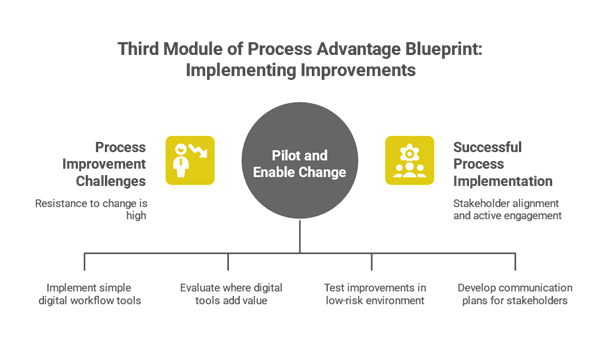
In module three, comprising Workshops 9 – 11, the methodology pivots towards piloting improvements and tackling the human side of change. With documented standards, stronger cross-functional connections, and performance data in hand, participants now focus on testing how new ideas hold up under real-world conditions. They explore how simple digital enablers — such as low-cost workflow tools, collaborative dashboards, or basic automation — can remove manual inefficiencies and reduce the likelihood of error without creating unnecessary complexity. The program’s emphasis is not on large-scale system rollouts but on identifying practical, fit-for-purpose digital support that strengthens the improved process.
Through structured readiness checklists and team assessments, participants evaluate where digital tools can add real value. They pilot these changes in small, manageable steps with the change team, gathering evidence of what works and what needs further refinement. This pilot approach ensures that improvements are tested in a low-risk environment before they are scaled more broadly.
Recognizing that even well-designed process changes can fail if poorly communicated, this stage builds participants’ change leadership skills in a pragmatic, action-oriented way. Using change management simulations, case studies, and peer coaching, managers develop communication plans that speak directly to different stakeholder groups’ needs and concerns. They identify champions within their teams, anticipate sources of resistance, and practice holding the honest conversations that drive buy-in. Crucially, the methodology requires participants to put these plans into action during the module, not just to design them on paper. They run real engagement activities — such as briefings, town halls, or one-on-one meetings — to reinforce the rationale behind the process changes and address questions transparently.
By the end of this module, each participant’s process has moved through testing, digital enablement, and active stakeholder alignment. The change team’s role evolves from an informal group of helpers into a credible coalition capable of advocating for the new way of working. This practical exposure to real barriers and real solutions builds confidence and credibility, ensuring that improvements do not lose momentum when the program ends.
Sustaining Impact, Governance, and Continuous Improvement
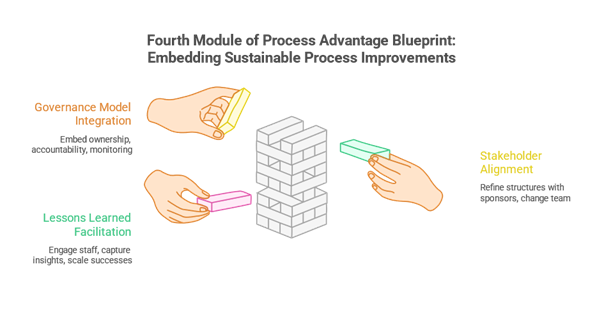
The final module focuses on turning pilot improvements into an integrated, sustainable way of working. This stage reinforces that true process orientation is not a one-time project but an ongoing discipline. Participants revisit governance models, exploring how to embed process ownership, accountability, and performance monitoring into regular business rhythms. Using tested governance frameworks, they map out clear roles for process owners, escalation paths for resolving issues, and review cycles that keep the process alive long after the training finishes.
The methodology ensures this is not done in isolation: participants test their governance proposals with senior sponsors and the change team, refining structures to reflect real organizational dynamics and ensuring the process remains both robust and adaptable. Managers also learn to facilitate lessons-learned discussions that engage frontline staff, peers, and cross-functional partners. This reflection helps capture what worked, what should be improved further, and how successes can be scaled to other processes or locations.
To bring all these elements together, participants prepare a final presentation that tells the story of their process transformation from baseline to measured impact. This narrative reinforces the tangible business value achieved — whether in improved cycle times, higher quality, or stronger stakeholder satisfaction — and gives each participant a concrete example of their ability to lead meaningful change.
The final module ensures that the change team leaves with a roadmap for continuous improvement, practical next steps, and the confidence to act as stewards of a process-oriented culture. By the end of the program, what began as an individual learning experience becomes a practical, tested, and visible improvement embedded within the organization, backed by a manager who can lead with process clarity and purpose.
Industries
This service is primarily available to the following industry sectors:

Energy
Over the last hundred years, the energy industry has powered the remarkable expansion of modern economies. From the early dominance of coal fueling industrialization to the post-war boom of oil and gas, energy’s evolution has always hinged on the ability to extract, refine, and distribute vast quantities of fuel across borders. The discovery of major oil fields in the Middle East and the rapid build-out of national grids in Europe and North America transformed not just how societies consumed energy, but how they were organized around it. Less visible yet fundamental were the processes that allowed these energy flows to scale reliably – pipelines stretching thousands of miles, refineries handling ever more complex hydrocarbons, and grid systems synchronizing generation and consumption for millions.
By the late twentieth century, nuclear energy emerged as a symbol of technological promise and risk, adding another layer of operational sophistication. Meanwhile, the environmental consequences of fossil fuels began to reshape public expectations and policy debates, pushing the industry to test new processes for efficiency and cleaner production. Even so, for decades, fossil fuels remained at the center of the world’s economic engine, their abundance and the refinements of extraction and distribution processes keeping them firmly entrenched.
Today, the energy landscape is under historic pressure to transform. Climate change targets, technological innovation, and shifting consumer expectations have pushed renewables from niche experiments to major contributors in the global mix. Wind and solar farms now stretch across landscapes once dominated by coal mines and oil rigs, but integrating these intermittent sources depends on new grid-balancing technologies and smarter distribution systems. In North America, shale gas and renewables compete for investment, while Europe’s commitment to net-zero targets is testing energy security and the resilience of older grids. In Asia-Pacific, rapid industrial growth collides with decarbonization ambitions, nowhere more starkly than in China, which leads in both coal consumption and renewable installations.
Despite all this progress, traditional fuels persist, especially where energy access remains limited and older infrastructure locks in established patterns. The processes that once made fossil fuels so efficient now pose challenges for decarbonization, requiring retooling and reinvention. Emerging technologies like battery storage, smart grids, and hydrogen promise greater flexibility, but scaling them means building new operational models that can match the reliability people expect.
Looking forward, the industry faces a future that could split along uneven lines. One path envisions renewables, storage, and digital networks dominating, with households and businesses acting as active nodes in decentralized energy systems. Another sees fossil fuels retaining a role where governance is weak or demand for petrochemicals stays high, propped up by carbon capture and storage if it becomes affordable at scale. Turbulence remains likely – geopolitical tensions, policy swings, and cost barriers could delay or fragment progress. Yet signs of deep transformation are already visible in the rise of virtual power plants, local microgrids, and data-driven grid management, all hinting that future competitiveness will depend as much on how energy is produced as on the processes that keep it flowing safely and efficiently. However the balance unfolds, one lesson from the last century holds true: the hidden machinery of processes will continue to shape who has power – and how they use it.

Utilities
Over the past century, utilities have grown from patchwork local services into the backbone of modern life, delivering electricity, gas, water, and sewage management through networks so embedded in cities and communities that they often go unnoticed until they fail. In the early decades of the twentieth century, private and municipal utilities raced to expand electrification, piped water, and reliable sewage systems, particularly in North America and Europe. This expansion depended not only on capital-intensive infrastructure but on the careful design of processes to maintain and coordinate vast networks of pipes, lines, and treatment facilities. The need for consistent service shaped regulatory regimes: utilities became natural monopolies in many regions, with public oversight ensuring that operational processes balanced profit motives with public interest.
As urbanization accelerated after World War II, utilities faced the challenge of serving swelling populations and rising industrial demand. The processes behind the scenes – from water purification and sewage treatment to power grid management – became more sophisticated, integrating new technologies to ensure reliability and efficiency. In many parts of the world, particularly Europe and Japan, rebuilding and modernizing infrastructure fostered innovations in automation and network management. Yet even as utilities became more technologically capable, they remained labor-intensive, with workforces skilled in maintaining aging assets while navigating political expectations around pricing and access.
Today, the global utilities industry stands at a delicate inflection point. In mature economies, aging grids, water mains, and pipelines pose an urgent threat of breakdowns, driving huge costs for maintenance and replacement. Meanwhile, decarbonization goals and climate resilience demand upgrades that traditional utility models were not designed to deliver swiftly. The processes that once kept networks stable now struggle to adapt to distributed generation, fluctuating demand, and extreme weather events. In the United States, regulated monopolies are under pressure to invest in smarter grids and leak-proof water systems, but the pace often lags behind what environmental realities demand. Europe remains a leader in modernizing utilities, integrating renewable sources into grids and using advanced data to detect leaks or inefficiencies, yet here too, the challenge of retrofitting old infrastructure persists.
Asia-Pacific is emerging as the most dynamic region for utilities growth. Economic expansion and population growth in China, India, and Southeast Asia are driving surging demand for electricity, clean water, and reliable sewage treatment. Yet new capacity must be built alongside resilient, efficient operational frameworks, to avoid repeating the problems of older systems in the West. Aging workforces add another layer of difficulty worldwide; as experienced engineers and technicians retire, utilities must transfer process knowledge while embracing automation, AI, and predictive maintenance to keep services flowing.
Looking ahead, the industry’s future will likely be shaped by how well it can modernize the underlying processes that keep utilities stable and affordable. One scenario sees utilities evolving into smart service networks, where digital monitoring, AI-driven grid balancing, and advanced leak detection make systems more adaptive and less prone to costly failures. Early signs of this shift are visible in Europe’s smart water metering and North America’s push for grid modernization funds. Another scenario warns of uneven progress, where underinvestment in maintenance and skills leaves some regions vulnerable to blackouts, water shortages, or sewage overflows, especially as climate events intensify. The gap between well-managed and neglected utilities could widen, making resilience as much a question of process innovation and governance as of hardware.
For all their invisibility, utilities remain one of the clearest examples of how deeply our daily lives depend on robust, responsive processes – and how the quiet work of maintaining and renewing them will determine whether societies can meet the demands of a growing, warming, and increasingly urbanized world.

Manufacturing
Over the past century, manufacturing has been both a symbol of prosperity and a source of profound transformation for economies around the world. In the early twentieth century, the rise of assembly line production in the United States redefined what was possible: standardization, scale, and efficiency became the cornerstones of industrial growth. Cities like Detroit, Pittsburgh, and later regions across Germany and Japan, grew into manufacturing powerhouses by refining the processes that turned raw materials into affordable, mass-produced goods. These methods – rooted in principles of workflow design, quality control, and continuous improvement – created the bedrock for consumer societies and the expansion of middle-class livelihoods.
As the decades passed, manufacturing became deeply entwined with engineering and industrial design, pushing boundaries in chemicals, steel, electronics, and automotive sectors. In the postwar era, Japan’s embrace of lean production and just-in-time logistics reshaped global competitiveness, showing that how you organize work on the factory floor can be as decisive as technological breakthroughs themselves. Meanwhile, large-scale offshoring in the late twentieth century shifted much of the world’s industrial base to Asia, especially China, as companies sought to leverage lower labor costs and increasingly sophisticated supply chain processes. These global networks made production more efficient but also introduced new vulnerabilities, as became clear during economic shocks and, more recently, pandemic-related disruptions.
Today, manufacturing sits at a turning point once again. Automation, robotics, and advanced digital tools have begun to redefine what modern factories look like. From smart sensors that monitor equipment health to AI-driven quality control, the processes behind production are becoming more connected and intelligent, promising gains in efficiency and flexibility. At the same time, rising environmental and social concerns are reshaping expectations. Industries that once focused narrowly on output and cost now face pressure to cut emissions, reduce waste, and protect workers from harmful chemicals and repetitive strain. This shift is pushing many manufacturers to revisit their process designs, incorporating circular economy principles, industrial symbiosis, and clean technologies that make production not only leaner but also less harmful.
Regionally, the landscape is evolving in uneven ways. The United States and parts of Europe are trying to revive or reshore critical manufacturing sectors, often through advanced manufacturing and high-value goods like semiconductors and aerospace components. China remains the world’s largest manufacturing hub, but rising wages, environmental rules, and geopolitical friction are encouraging some diversification across Southeast Asia and India. These changes demand supply chains that are both resilient and adaptable, relying on sophisticated process management to navigate disruptions and regulatory shifts.
Looking ahead, manufacturing’s future may hinge on how well firms adapt to new technologies without losing sight of the human and environmental dimensions. One scenario sees highly distributed, local production enabled by 3D printing and digital fabrication, reducing transport costs and emissions while responding more nimbly to demand shifts. Another envisions large, hyper-automated smart factories, where processes are continuously optimized through data analytics and real-time feedback. There is also a scenario where firms that fail to modernize or address sustainability demands find themselves squeezed out by more agile, greener competitors. The early signs of these futures are already here – in pilot projects that close material loops, digital twins that simulate production lines before they exist, and upskilled workforces blending traditional craft with advanced tech.
Beneath it all, the quiet work of rethinking and refining manufacturing processes remains decisive. For an industry built on turning raw resources into useful things, the way work is organized – from the smallest production cell to sprawling global supply chains – will continue to determine who thrives in the next industrial age.

Technology
Over the last several decades, information technology has grown from a back-office support function into a primary driver of global economic growth. In the early years, mainframe computers and rudimentary data networks transformed how businesses stored and processed information, but their true power lay in the ability to automate repetitive tasks and standardize workflows that once demanded extensive manual effort. As personal computers emerged in the 1980s and internet connectivity spread in the 1990s, technology’s role expanded from automating processes to reimagining them entirely, enabling new ways of working, collaborating, and delivering services.
What began as local, on-premise IT evolved into vast global networks of hardware, software, and data centers that increasingly blurred the line between a company’s core operations and its digital infrastructure. The outsourcing boom that took off in the 1990s and early 2000s built on this logic, moving software development, support, and maintenance to countries like India and the Philippines. These locations offered not just lower costs but well-developed processes for handling complex, large-scale IT projects with consistency and speed. This wave of outsourcing demonstrated how the orchestration of people, tools, and workflows across continents could deliver massive efficiencies – and how deeply IT services would come to depend on managing these invisible operational frameworks.
Today, the IT services industry is more integral than ever, connecting sectors from finance and healthcare to retail and transportation. Spending continues to grow, driven by the digital transformation that organizations of all sizes now see as essential for competitiveness. Cloud computing, once an emerging trend, is now reshaping how businesses think about storing data, building applications, and scaling operations. This shift is as much about changing processes as it is about technology – moving from fixed, siloed systems to flexible, integrated platforms that allow real-time collaboration and decision-making. North America remains the largest market, but Asia-Pacific is the most dynamic, with governments in countries like India and Vietnam promoting investment and talent pipelines that keep their outsourcing sectors vibrant.
Yet the industry faces clear challenges. Currency fluctuations, talent shortages, and rising labor costs in mature markets threaten the cost advantages that once drove the outsourcing model. At the same time, the push toward automation, artificial intelligence, and low-code development platforms is reshaping what kinds of tasks human IT professionals handle – and how they add value. Many firms now see process redesign as critical: it’s no longer enough to simply maintain legacy systems; they must rethink how workflows can be digitized, made more resilient to cyber threats, and streamlined to respond to unpredictable demand.
Looking ahead, the future of the technology and IT services industry will likely be shaped by how well it balances human expertise with smart automation. One scenario sees the rise of more self-service platforms and AI-powered solutions that allow even small firms to harness enterprise-level capabilities. Another envisions complex hybrid delivery models where global teams use real-time collaboration tools to work across time zones with seamless hand-offs, blending efficiency with local responsiveness. These trends are already visible in the rapid growth of remote development teams, the rise of managed services for cloud and cybersecurity, and the spread of agile methods that replace rigid project plans with iterative, customer-focused cycles.
Amid all these changes, the core remains the same: IT’s real value lies in how well it transforms and connects processes behind the scenes. For all the new hardware, software, and networks, the industry’s future will belong to those who can design the invisible systems that let data, people, and decisions flow securely and intelligently in a world that never stands still.

Aerospace
Over the past century, aerospace has embodied humankind’s ambition to transcend boundaries, whether in the skies above or in the vast reaches of space. In the early decades of the twentieth century, breakthroughs in aeronautics transformed fragile wood-and-fabric planes into robust metal aircraft that carried passengers and cargo across continents and oceans. This rapid evolution depended not just on daring designs, but on the painstaking development of manufacturing processes capable of producing complex parts with high precision and safety standards. Assembly lines for aircraft components, rigorous testing protocols, and tightly controlled supply chains became the backbone of an industry where even the smallest flaw could have catastrophic consequences.
As World War II and the Cold War spurred investment, the aerospace sector grew into a complex ecosystem of public and private collaboration. Civilian aviation boomed alongside military and defense projects, with companies like Boeing, Lockheed Martin, and Airbus leading the charge. Governments backed national champions through procurement contracts and large-scale R&D, while the birth of space programs in the US, USSR, and later Europe and Asia pushed the frontier even further. Rocketry, satellite communications, and human spaceflight each demanded new processes – from mission control operations to intricate integration of systems spanning continents. The marriage of scientific rigor and industrial discipline became a defining trait of aerospace, shaping how projects were planned, tested, and executed with layers of redundancy and oversight.
Today, aerospace remains a pillar of national pride and strategic influence but faces fresh challenges and opportunities. Civil aviation, the industry’s largest segment, is recovering from the turbulence of global pandemics while grappling with climate imperatives. Airlines and manufacturers alike are under pressure to reduce carbon emissions, driving innovation in lightweight materials, fuel efficiency, and the prospect of sustainable aviation fuels. Meanwhile, the commercial space race has opened new chapters, as private companies like SpaceX and Blue Origin build reusable launch systems and satellite constellations. These ventures are fundamentally changing the processes that once belonged only to state-run agencies, with faster development cycles, iterative testing, and leaner supply chains.
Regionally, North America and Europe remain the core markets, supported by well-established infrastructure and clusters of skilled aerospace engineers. But the landscape is diversifying: China’s rapidly advancing aerospace capabilities, India’s ambitious satellite and launch vehicle programs, and emerging players in Latin America are beginning to reshape global supply and demand. With these new entrants, competition will increasingly hinge on mastering complex processes that balance innovation with cost control, safety, and environmental impact.
Looking forward, aerospace’s future will likely follow multiple flight paths. One scenario envisions cleaner, more efficient aircraft powered by hybrid-electric propulsion or hydrogen fuel, transforming manufacturing lines to accommodate new materials and engine designs. Another sees a flourishing commercial space economy, with satellite launches, lunar missions, and orbital tourism becoming routine, sustained by robust processes that ensure reliability and reuse. Yet risks remain: talent shortages in highly specialized roles, volatile defense budgets, and supply chain fragility could constrain progress if not addressed through smarter, more resilient operations.
The industry’s enduring lesson is that audacious goals are only as achievable as the processes that support them – from the factory floor that crafts a turbine blade to the mission team that guides a probe beyond Earth’s orbit. As aerospace redefines what it means to take flight, its greatest leaps will continue to rely on the quiet mastery of how work is done behind the scenes, ensuring that ambition can soar safely into ever more challenging skies.
Locations
This service is primarily available within the following locations:

Hamburg (Germany
Hamburg has long stood as one of Germany’s great trading gateways, shaped by centuries of maritime commerce and a cosmopolitan spirit that comes with being Europe’s third-largest port. From its days as a member of the Hanseatic League to its postwar revival as a logistics and shipping powerhouse, Hamburg’s economy has always revolved around moving people and goods efficiently. This legacy of connectivity laid the groundwork for the city’s emergence as one of Europe’s key centers for aerospace. With Airbus’s major production site and countless suppliers clustered around the city, Hamburg’s aerospace sector now supports tens of thousands of jobs, blending advanced manufacturing with high-level engineering.
Yet Hamburg’s story is not defined by any one industry alone. Its strong maritime, media, and renewable energy sectors reveal a city that has learned to adapt while maintaining its open international outlook. In recent years, Hamburg has invested heavily in digital infrastructure, smart mobility projects, and sustainable urban planning, seeking to balance its industrial base with ambitious climate targets. The Port of Hamburg remains a vital link to global trade routes, but it is also experimenting with cleaner logistics and greener shipping fuels.
Looking ahead, Hamburg’s success will depend on how well it can orchestrate the complex processes that bind its diverse sectors together. Whether producing next-generation aircraft cabins or piloting smart city technologies, the city’s knack for combining tradition with innovation gives it a strong foundation to navigate the twin pressures of economic competitiveness and environmental responsibility.

Tallinn (Estonia)
Tallinn’s evolution is a testament to how a small capital can reinvent itself through strategic openness and digital ambition. Once part of the Hanseatic League like Hamburg, Tallinn’s medieval old town still hints at its historic role as a trading port on the Baltic Sea. After decades behind the Iron Curtain, Estonia’s independence in the early 1990s unleashed a wave of innovation and state-building that would make Tallinn a poster child for digital transformation. This was not just about new hardware or flashy start-ups; it was a deliberate rethinking of how processes – from government services to business transactions – could be streamlined using technology.
Today, Tallinn is widely recognized as one of Europe’s leading centers for IT services, cybersecurity, and digital governance. It is home to thriving start-ups, incubators, and R&D labs that serve clients far beyond Estonia’s borders. The city’s advanced e-residency program and secure digital infrastructure have attracted talent and investment, turning Tallinn into a testbed for ideas that other countries now emulate. But its success is not just about innovation for its own sake – it is rooted in how digital systems connect people, businesses, and the state in efficient, transparent ways.
Looking forward, Tallinn faces the challenge of staying ahead as larger tech hubs ramp up their competitiveness. Its future will likely hinge on nurturing local talent, strengthening ties with Nordic and EU partners, and ensuring that its smart digital processes remain secure and resilient in a more unpredictable world. Small but globally connected, Tallinn continues to punch above its weight.

Birmingham (United Kingdom)
Birmingham’s story is deeply entwined with Britain’s industrial rise and reinvention. Once dubbed the “Workshop of the World,” the city became famous in the nineteenth century for its dense network of metalworking shops and small factories, producing everything from jewelry and guns to steam engines. This culture of practical innovation and skilled craftsmanship laid the foundation for Birmingham’s manufacturing legacy, which endures today in advanced engineering, automotive production, and high-tech components.
Though heavy industry declined in the late twentieth century, Birmingham has continually adapted, positioning itself as a hub for advanced manufacturing within the UK’s evolving economy. The city and its wider West Midlands region are home to major automotive players and a dynamic supply chain that serves aerospace, precision engineering, and emerging sectors like battery technology. It is this quiet resilience – rooted in generations of tinkering and process improvement – that has helped Birmingham navigate economic shifts while retaining its reputation for making things well.
Today, Birmingham is also emerging as a magnet for financial services, creative industries, and technology start-ups. Massive investment in rail infrastructure, like the HS2 project, is set to strengthen its role as a bridge between London and the rest of the country. Meanwhile, a young and diverse population is driving a push for greener, more inclusive urban growth.
Looking ahead, Birmingham’s future will hinge on whether it can continue to modernize its manufacturing base while fostering innovation and sustainability. Its enduring knack for engineering and process excellence suggests that this “workshop” still has plenty to make – and remake.

Tokyo (Japan)
Tokyo’s story is one of remarkable reinvention and resilience, rising from devastation more than once to become one of the world’s most dynamic megacities. After World War II, Tokyo’s rapid postwar rebuilding set the stage for Japan’s economic miracle, as manufacturing, electronics, and automotive giants established headquarters and R&D centers throughout the capital region. Yet less visible – but equally vital – was the modernization of its utilities and infrastructure. Supplying clean water, reliable electricity, and sophisticated sewage systems to tens of millions of residents required meticulous planning and world-leading process efficiency, embedding Tokyo’s reputation for meticulous urban management.
Today, Tokyo remains a global showcase for how utilities and smart city infrastructure can evolve together. Its electric grid, gas networks, and water systems are among the most reliable on Earth, supported by advanced technologies for earthquake resilience and disaster recovery. The city has become a living laboratory for next-generation smart grids, energy storage, and demand-side management, setting examples for urban centers facing similar challenges. Tokyo’s leadership extends beyond hardware; its integrated approach to process design, community engagement, and public-private collaboration has kept it at the forefront of urban utility innovation.
Looking ahead, Tokyo faces the dual pressures of an aging population and the need to decarbonize. The city is investing in renewable energy integration, hydrogen experiments, and digital technologies that can make its utility processes more adaptive and efficient. As it navigates these shifts, Tokyo’s quiet mastery of the systems that keep a vast metropolis running will remain central to its identity – and to how cities worldwide learn to balance density, resilience, and sustainability.

Chicago (United States of America)
Chicago’s evolution has always been tied to the currents of water, power, and people flowing through its heart. Rising from the swampland by Lake Michigan, Chicago’s explosive growth in the late nineteenth and early twentieth centuries made it an icon of industrial America – a hub for railroads, steel, and stockyards. Behind this energy and ambition lay the need for robust utilities: clean water to fight disease, electric power to light the skyscrapers that defined its skyline, and massive sewage and stormwater systems to manage the challenges of its geography. The reversal of the Chicago River at the turn of the twentieth century remains one of the era’s most striking feats of urban engineering, emblematic of the city’s willingness to tackle infrastructural challenges with bold solutions.
Today, Chicago sits at the center of one of North America’s largest utility networks, home to major electricity and water providers that serve millions across the Midwest. The region’s aging grids and pipelines pose complex challenges, but they have also driven Chicago to pioneer upgrades in smart grid technology, energy efficiency programs, and water infrastructure renewal. The city’s universities and research centers contribute expertise in clean energy and climate resilience, helping the utilities sector adapt to changing demands.
Looking ahead, Chicago’s future will hinge on how well it modernizes these foundational systems while balancing affordability, sustainability, and equity. As climate pressures grow and extreme weather tests urban infrastructure, the processes that manage Chicago’s vast utilities will remain as critical as the iconic skyline they help sustain.
Program Benefits
Executive Leadership
- Strategic coherence
- ROI transparency
- Process accountability
- Risk mitigation
- Governance readiness
- Transformation clarity
- Policy consistency
- Operational trust
- Stakeholder assurance
- Change sponsership
Multi-Departmental Operations
- Shared language
- Process visibility
- Workflow alignment
- Reduced friction
- Joint ownership
- Synchronized KPIs
- Faster coordination
- Role awareness
- Mutual trust
- Common priorities
Regional Divisions
- Local flexibility
- Process comparability
- Operational benchmarking
- Performance alignment
- Shared practices
- Cost efficiency
- Visibility upstream
- Customer reliability
- Local autonomy
- Scalable systems
Achievements

BNFL Instruments Ltd
In response to increasing complexity and the need for cross-functional alignment, BNFL Instruments Ltd. undertook a full mapping of its core business processes – from R&D to delivery. These maps were used to align workflows with business strategy, and performance indicators were introduced to measure progress toward strategic objectives. The process work improved transparency, helped clarify interdependencies, and ensured that departmental outputs aligned with broader business goals. This early integration of business process management helped set a culture of operational accountability that supported future growth and responsiveness in a highly regulated industry.

Rados Technology GmbH
Faced with increasing sales volume and growing project complexity, Rados Technology GmbH restructured its sales back-office and marketing operations without increasing headcount. End-to-end process mapping revealed coordination gaps and inefficiencies that were addressed through clearer role definitions, standardized procedures, and the introduction of actionable KPIs. The resulting structure enabled the team to manage larger tenders and support cross-regional initiatives more effectively. What emerged was not just operational efficiency but a scalable commercial function that supported the company’s strategic growth across markets.
SnyOdys
During its international expansion, SynOdys faced the challenge of coordinating marketing activities across multiple regional teams. A corporate marketing steering group was formed to align local teams with global objectives, supported by clear processes and shared deliverables. The group successfully delivered a unified online presence, consistent event branding for international conferences, and standardized product communication. These early process improvements brought cohesion to a fast-growing organization and laid the foundation for scalable global marketing practices. This alignment would later serve the company well as it evolved into Mirion Technologies, a global industry leader

Lernwerk Hamburg
To achieve profitability from day one, the Lernwerk – a private learning center for children with learning difficulties – had to operate with a slim, high-functioning structure. Early investments in process mapping allowed for automation of administrative workflows, seamless coordination among instructors, and a consistent client intake and scheduling system. The result was a lean but scalable service business that achieved financial stability quickly without sacrificing quality or flexibility. Strong operational processes enabled the team to focus on instructional delivery while minimizing overhead, demonstrating that process design can drive both mission delivery and commercial viability.
More detailed achievements, references and testimonials are confidentially available to clients upon request.
Client Telephone Conference (CTC)
If you have any questions or if you would like to arrange a Client Telephone Conference (CTC) to discuss this particular Unique Consulting Service Proposition (UCSP) in more detail, please CLICK HERE.