

Executive Performance

The Appleton Greene Corporate Training Program (CTP) for Executive Performance is provided by Mr. Di Bon MBA BSc Certified Learning Provider (CLP). Program Specifications: Monthly cost USD$2,500.00; Monthly Workshops 6 hours; Monthly Support 4 hours; Program Duration 12 months; Program orders subject to ongoing availability.


Personal Profile
Mr. Di Bon is an accomplished executive and advisor with over 30 years of leadership experience across global financial markets, high-growth ventures and innovation-driven sectors. His international career spans Europe, North America and Asia, where he has partnered with visionary founders, corporate boards and executive teams to lead complex change, drive strategic growth and elevate performance in high-stakes environments.
Having served as Head of Global Equities at Fidelity International and Alliance Trust, Mr. Di Bon has led multi-billion-dollar investment teams, restructured underperforming business units and launched global platforms in institutional asset management. His senior roles at UBS Asset Management and leadership in thematic equity portfolios reflect a deep understanding of both operational execution and long-term value creation.
Mr. Di Bon is the managing partner of an independent advisory and coaching practice, where he works at the intersection of innovation, leadership and organizational transformation. He has advised startups and mid-market companies in healthtech, consumer goods, fintech and manufacturing – guiding strategic planning, succession and international expansion.
As an executive and performance coach, Mr. Di Bon has supported senior leaders from Allianz, HSBC, Toyota, Uber, Pirelli, UBS, and Carlyle. His approach integrates executive psychology, systems thinking and real-world boardroom insight to deliver measurable, sustainable impact.
Fluent in multiple business cultures, Mr. Di Bon brings a distinctive combination of intellectual rigor, emotional intelligence and practical wisdom to his advisory work. He holds advanced qualifications from UCL, Harvard Medical School, Cambridge University, Imperial College and Manchester Business School – spanning strategic management, executive coaching, digital transformation, lifestyle medicine and sustainability.
With a rare blend of strategic insight and hands-on execution, Mr. Di Bon helps high-performing leaders navigate stress, complexity and change – while staying true to their values and vision.
To request further information about Mr. Di Bon through Appleton Greene, please Click Here.

(CLP) Programs

Appleton Greene corporate training programs are all process-driven. They are used as vehicles to implement tangible business processes within clients’ organizations, together with training, support and facilitation during the use of these processes. Corporate training programs are therefore implemented over a sustainable period of time, that is to say, between 1 year (incorporating 12 monthly workshops), and 4 years (incorporating 48 monthly workshops). Your program information guide will specify how long each program takes to complete. Each monthly workshop takes 6 hours to implement and can be undertaken either on the client’s premises, an Appleton Greene serviced office, or online via the internet. This enables clients to implement each part of their business process, before moving onto the next stage of the program and enables employees to plan their study time around their current work commitments. The result is far greater program benefit, over a more sustainable period of time and a significantly improved return on investment.

Appleton Greene uses standard and bespoke corporate training programs as vessels to transfer business process improvement knowledge into the heart of our clients’ organizations. Each individual program focuses upon the implementation of a specific business process, which enables clients to easily quantify their return on investment. There are hundreds of established Appleton Greene corporate training products now available to clients within customer services, e-business, finance, globalization, human resources, information technology, legal, management, marketing and production. It does not matter whether a client’s employees are located within one office, or an unlimited number of international offices, we can still bring them together to learn and implement specific business processes collectively. Our approach to global localization enables us to provide clients with a truly international service with that all important personal touch. Appleton Greene corporate training programs can be provided virtually or locally and they are all unique in that they individually focus upon a specific business function. All (CLP) programs are implemented over a sustainable period of time, usually between 1-4 years, incorporating 12-48 monthly workshops and professional support is consistently provided during this time by qualified learning providers and where appropriate, by Accredited Consultants.
Executive summary

Executive Performance
In today’s world of relentless change, senior leaders and ambitious professionals are expected to do more, faster, with less margin for error. They must deliver results quarter after quarter, inspire teams across cultures and steer through disruption – often while their own energy and focus are under siege.
The modern boardroom has become a high‑stakes environment where complexity, volatility and unrelenting pace are constants. For many leaders, the tension between performance and health, transformation and stability, strategy and personal bandwidth is becoming harder to balance. Burnout, decision fatigue and strategic blind spots are no longer the exception – they are the norm.
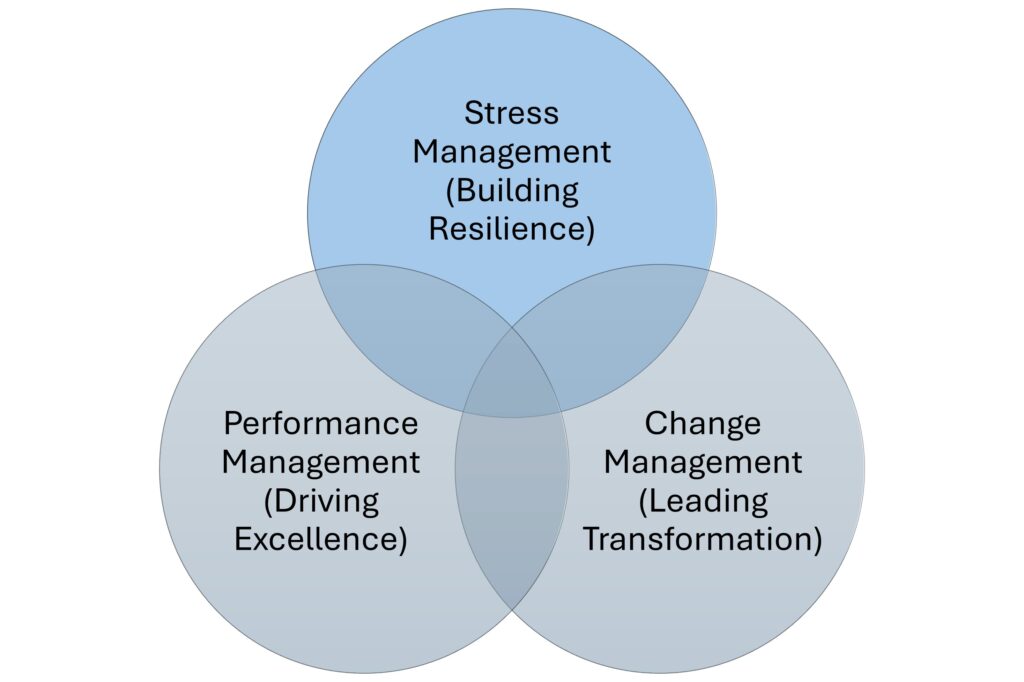
Executive Performance Management was designed to tackle this challenge. This one‑year, high‑impact program is a practical roadmap for leaders who must manage themselves as effectively as they manage their organizations. Over twelve carefully structured workshops, the program systematically develops three essential leadership capabilities: Stress Management, Performance Management and Change Management.
Executive Performance Framework
The Pain Points Leaders Face
At the start of this program, many executives share similar struggles. They talk about a loss of clarity, where urgent demands constantly eclipse the time for strategic thinking. They describe the strain of always being “on”, with no time or tools for genuine recovery. Even successful leaders admit to moments of doubt and isolation, where self-belief wavers, and their ability to influence and inspire begins to erode.
Then there is the challenge of change itself. Markets shift, structures evolve, crises erupt – and the very people responsible for leading transformation often feel least equipped to sustain it. These pain points are as personal as they are organizational: stress and energy depletion lead to burnout, poor decisions, and reduced impact. Erosion of team trust and performance makes even the strongest leaders feel like they are pulling alone. Uncertainty and constant change create hesitation, slow decisions and reactive cultures.
This program begins with these realities. Rather than offering generic content, it equips leaders with practical tools to meet these challenges head‑on, with a clear plan for growth.
How Executive Performance Management Tackles These Challenges
The first four months are dedicated to Stress Management, helping participants build the resilience that today’s environment demands. Leaders learn to reset their personal energy systems, recognize the science of stress, and construct daily renewal practices that protect mental sharpness. They gain emotional agility – the ability to step back from reactivity and respond with calm, clarity, and impact.
The next phase focuses on Performance Management, the architecture of elite leadership. Here, participants sharpen their focus, develop a high‑performance mindset, and learn evidence‑based tools for complex decision-making. They also discover how to build cultures of trust and accountability, turning teams from groups of individuals into cohesive, high‑performing units.
Stress–Performance Curve
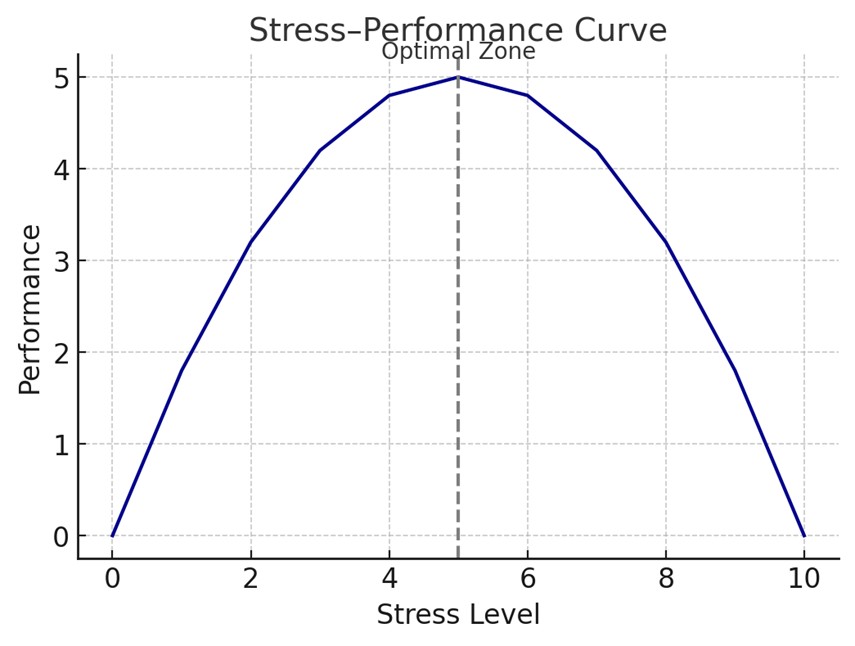
Figure 1. The Stress–Performance Curve illustrates how performance increases with manageable stress but declines when pressure exceeds an individual’s coping capacity. It underpins the program’s emphasis on operating at personal performance peak without crossing into burnout.
The final phase, Change Management, gives leaders the confidence and methods to lead transformation. From crisis management to driving innovation and setting a long-term leadership legacy, this phase equips participants to lead through uncertainty with vision and adaptability.
A Structured, Measurable Leadership Journey
Unlike short workshops or motivational keynotes, Executive Performance Management is an immersive, year‑long journey. Each module builds on the last, creating cumulative progress rather than isolated insights. Participants leave with a personalized leadership playbook that integrates practical frameworks, stress‑management routines, and organizational transformation tools that can be applied immediately.
Real-World Impact: A Case Study
One of the clearest demonstrations of the value of supporting executives in this way comes from Ernst & Young (EY). EY’s “Better You” program – a global initiative focused on the physical, mental, and emotional health of its people – was created in response to a clear pattern: burnout and attrition were eroding both performance and morale. By introducing executive coaching, mindfulness programs, and structured support, EY saw a marked improvement in resilience and engagement at the leadership level.
What EY discovered is precisely what Executive Performance Management delivers: leaders who are supported, balanced, and purposeful perform better, inspire others, and drive lasting change.
Designed for Lasting Change
This program offers more than content: it offers transformation. Delivered in a corporate, results‑focused format, but grounded in human understanding, Executive Performance Management provides the clarity and resilience leaders need to excel in a rapidly changing world.
For executives, founders, and senior professionals, this program represents a structured path to greater resilience, smarter execution, and enduring impact. The outcomes are measurable. The transformation is personal.
To lead others, we must first master ourselves. Executive Performance Management is where that journey begins.
Curriculum
Executive Performance – Part 1- Year 1
- Part 1 Month 1 Executive Wellbeing
- Part 1 Month 2 Emotional Agility
- Part 1 Month 3 Energy Management
- Part 1 Month 4 Sustainable Productivity
- Part 1 Month 5 High-Performance Mindset
- Part 1 Month 6 Decision Mastery
- Part 1 Month 7 Team Performance
- Part 1 Month 8 Team Performance
- Part 1 Month 9 Influence & Presence
- Part 1 Month 10 Crisis Readiness
- Part 1 Month 11 Innovation Agility
- Part 1 Month 12 Leadership Legacy
Program Objectives
The following represents the Key Program Objectives (KPO) for the Appleton Greene Executive Performance corporate training program.
I. Stress Management (Months 1–4)
Build the psychological resilience, physical renewal and emotional agility needed to perform under pressure.
1. Executive Wellbeing
This foundational session explores the critical link between wellbeing and sustainable leadership. Drawing from neuroscience, lifestyle medicine and behavioural psychology, participants assess their current physical and emotional resilience levels. The session introduces the Executive Resilience Matrix – covering sleep, nutrition, movement, recovery and mindset. Leaders will map their stress cycles, identify burnout signals, and develop a personal “performance health plan” that integrates daily renewal rituals. The goal is to establish the baseline capacity to lead from a place of clarity, strength and long-term stamina.
2. Emotional Agility
In today’s high-stakes environments, emotional regulation is a defining leadership skill. This session provides evidence-based techniques to manage reactivity, shift mindset under pressure, and use stress as fuel for creativity and focus. Participants will learn to decode emotional triggers, create distance between stimulus and response, and communicate more effectively under strain. This workshop trains leaders to transform difficult emotions into intelligent action and stronger executive presence.
3. Energy Management
High performance is not about time management – it’s about energy mastery. This workshop introduces the Four Dimensions of Energy (physical, emotional, mental, spiritual) and helps leaders design work-life rhythms that prevent depletion. Participants will assess their personal energy curve, explore peak performance windows, and learn techniques such as ultradian recovery cycles, boundary-setting and digital detox protocols. The goal is to maintain performance without sacrificing health, ensuring that energy is renewed and deployed intentionally for strategic impact.
4. Sustainable Productivity
This session dives deep into productivity systems that don’t burn people out. Drawing on the science of flow, prioritization, and focused execution, participants will learn to distinguish high-value activities from reactive busyness. Tools include “cognitive uncluttering,” deep work blocks, and adaptive planning under uncertainty. Leaders will build a sustainable workflow that aligns their attention with strategic objectives, prevents overload, and protects space for long-term thinking – even in demanding operational roles.
II. Performance Management (Months 5–8)
Develop the clarity, discipline and leadership behaviours that drive consistent high performance.
5. High-Performance Mindset
This session explores the psychology of elite performance – from athletes to CEOs. Participants will learn to build mental toughness, cultivate grit, and overcome performance plateaus. Through practical exercises and cognitive reframing, leaders will learn to shift from fixed to growth mindsets, build self-accountability systems, and align inner narratives with external goals. We’ll also explore how performance under pressure is trained—not inherited—and provide mental strategies to rewire stress into focus, persistence and self-belief.
6. Decision Mastery
Strong leadership hinges on smart decision-making under uncertainty. This workshop explores the neuroscience and psychology behind strategic judgment, including cognitive bias, intuition, heuristics, and slow/fast thinking models. Participants will dissect recent decisions they’ve made, map their cognitive blind spots, and practice tools like decision trees, scenario planning, and red-teaming. The result is a more deliberate, de-biased approach to leadership decisions – especially when stakes are high and data is incomplete.
7. Team Performance
High-performing teams don’t happen by chance. This session focuses on building psychological safety, trust and clear standards of accountability. Using proven models from Google’s Project Aristotle, Lencioni’s “Five Dysfunctions,” and systems thinking, participants will learn to identify team dysfunctions, lead difficult conversations, and embed a performance culture that empowers people to do their best work. Tools will include team charters, feedback loops, and conflict-to-growth frameworks that enable trust without sacrificing results.
8. Influence & Presence
Today’s leaders must inspire across cultures, functions and platforms. This workshop strengthens executive presence, storytelling ability, and persuasive communication. Leaders will assess their impact style, build audience-centric messaging, and learn to command the room with gravitas and authenticity. The session also addresses cross-cultural communication, managing up, and influence without authority. Participants will leave with sharpened tools to lead with clarity and mobilize stakeholders across the organization.
III. Change Management (Months 9–12)
Build the foresight, agility and leadership tools to drive transformation and adapt to complexity.
9. Leading Change
Change leadership is no longer optional – it’s a core skill. This workshop introduces the Adaptive Leadership model alongside Kotter’s 8-Step Framework to help executives navigate resistance, ambiguity and transformation fatigue. Participants will learn to manage both the emotional and strategic dimensions of change, including stakeholder mapping, narrative framing, and identifying adaptive vs. technical challenges. This session builds the muscle to lead with calm in times of upheaval – and to bring others with you.
10. Crisis Readiness
When a crisis hits, leaders must act decisively, communicate clearly and remain grounded. This session trains participants in crisis scenario planning, reputational risk management, and emergency decision-making. Drawing on military, aviation, and corporate case studies, we’ll simulate fast-moving challenges to strengthen poise and precision under pressure. Tools include crisis playbooks, media response protocols, and psychological support strategies to protect both people and performance in stormy times.
11. Innovation Agility
Disruption demands agility—from business models to mindset. This workshop equips leaders with tools for rapid experimentation, customer-driven innovation, and continuous learning. Participants will explore design thinking, lean startup principles, and how to lead innovation when legacy systems resist. We’ll also examine AI, digital transformation, and sustainability as key domains for future-fit leadership. The focus is not just innovation—it’s on scaling what works, quickly and responsibly.
12. Leadership Legacy
The final session shifts focus from short-term performance to long-term impact. What kind of leader do you want to be remembered as? Participants will reflect on their personal leadership story, clarify their cultural imprint, and define their growth trajectory beyond the program. The goal is to craft a legacy vision that integrates values, people development, and systems change – ensuring that leadership excellence endures beyond the next quarter.
Methodology

Executive Performance
Structure of Each Monthly Workshop
Every monthly workshop within the program follows a consistent six-step framework designed to maximize impact, retention, and behavioural change. This structure creates a rhythm of exploration, practice and application that ensures each session translates into measurable outcomes:
Initial Survey
Participants complete a short diagnostic survey related to the monthly topic (e.g., stress levels, energy management practices, decision-making confidence). This baseline captures both subjective perceptions and measurable indicators, enabling participants to track their own progress over time and allowing the program to aggregate anonymized data for group-level insights.
Setting Individual Goals
At the start of the session, participants define their personal goals for learning and transformation, aligned with the workshop theme. These goals anchor the learning process and ensure relevance to their immediate leadership context.
Principles
The facilitator introduces the core principles underpinning the session. These draw on the latest research in neuroscience, behavioural psychology and executive leadership, translated into clear, actionable concepts. The aim is to provide participants with a conceptual framework they can relate to real-world challenges.
Practical Application
Through case studies, role plays and scenario exercises, participants immediately apply the principles to real or simulated leadership challenges. This bridges theory and practice, ensuring that insights are not left at an intellectual level but embedded through experience.
Reflection
Participants reflect first individually, then in structured group discussions, on what they learned, how they felt, and what surprised them. This reflective cycle reinforces learning, builds peer connection, and surfaces diverse perspectives that enrich the group’s collective wisdom.
Action Plan
Each workshop concludes with the development of a personal action plan. This includes concrete commitments, specific behavioural changes and milestones to be reviewed in subsequent sessions. Participants leave with a roadmap to embed insights into daily leadership practice.
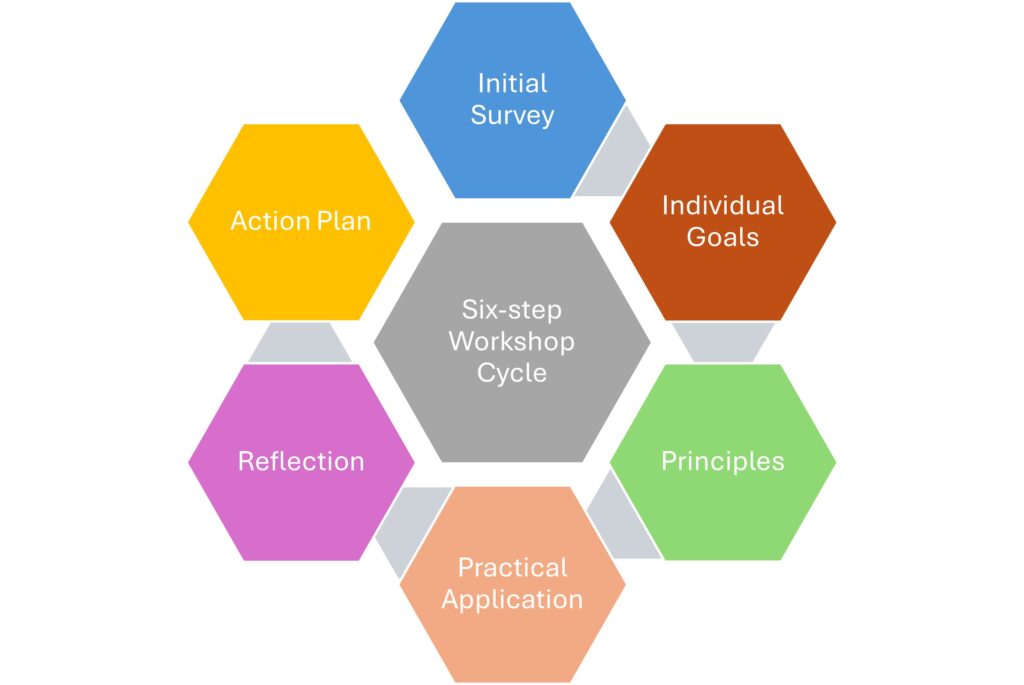
Figure 2. The Six-step Workshop Cycle illustrates the consistent learning structure applied across all monthly sessions – from initial assessment to personal action. The Cycle ensures that each module moves from insight to behavioural change through guided reflection, application, and measurable follow-up.
Design Principles of the Program
The design and execution of the Executive Performance Management program are rooted in three foundational disciplines: experiential learning, neuroscience and data analytics. These pillars ensure the program is evidence-based, impactful and measurable.
Experiential Learning
Drawing on Kolb’s learning cycle and adult learning principles, the program is built on the premise that leaders learn best by doing. Each module integrates real-life scenarios, active experimentation and reflective dialogue. By moving beyond passive knowledge transfer to active engagement, participants internalize lessons more deeply and are able to apply them immediately within their organizational contexts.
Neuroscience
The program is informed by cutting-edge research in cognitive neuroscience and stress psychology. Workshops emphasize how the brain responds under stress, how leaders can regulate emotional states, and how decision-making processes are shaped by cognitive biases. By grounding leadership development in neuroscience, participants gain both scientific validation and practical techniques to optimize mental performance.
Data Analytics
Data is embedded at every stage of the program. From the initial diagnostic surveys to ongoing pulse checks and post-workshop evaluations, data provides both individuals and organizations with insights into progress and impact. Participants track their personal development against their goals, while organizations receive aggregated, anonymized reports highlighting shifts in resilience, performance behaviours and change readiness across the cohort. This evidence-based feedback loop ensures accountability and demonstrates ROI for clients.
Three Pillars of Program Design
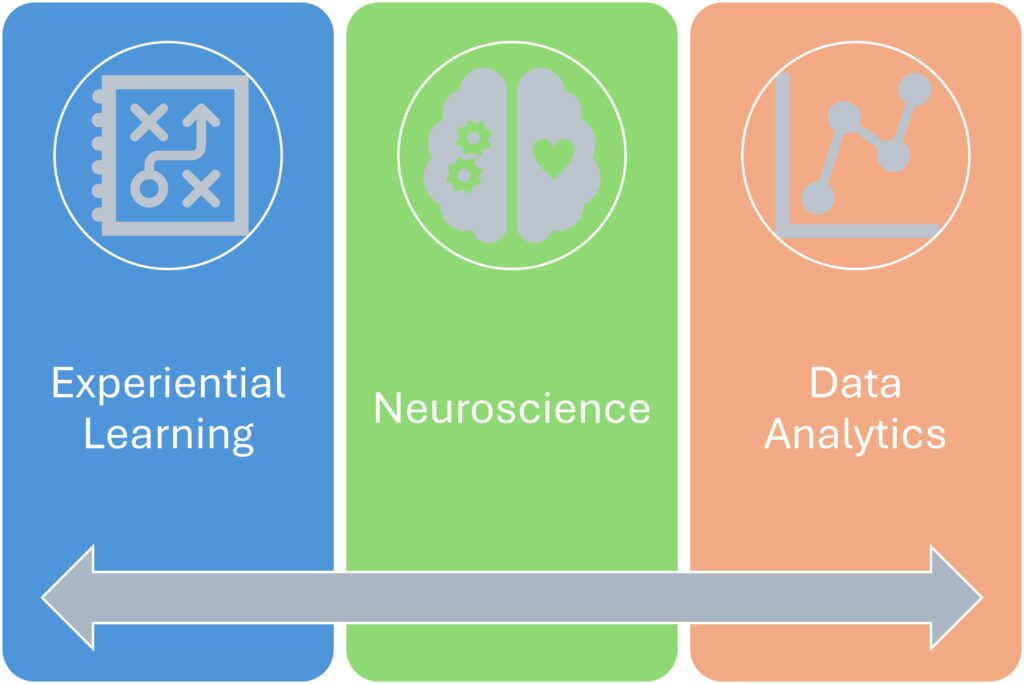
Figure 3. This diagram shows the program’s foundation in experiential learning, neuroscience, and data analytics. Together, these pillars ensure that the Executive Performance Management methodology integrates hands-on experience, scientific rigor, and measurable outcomes.
Conclusion
The Executive Performance Management methodology is designed not just to inform but to transform. By combining a structured workshop model with experiential practice, neuroscience-based insights and data-driven feedback, the program creates lasting behavioural change in leaders. The approach ensures participants leave each session with clarity, actionable tools and the confidence to lead themselves and their organizations more effectively in complex, high-stakes environments.
Program Outcomes Flow
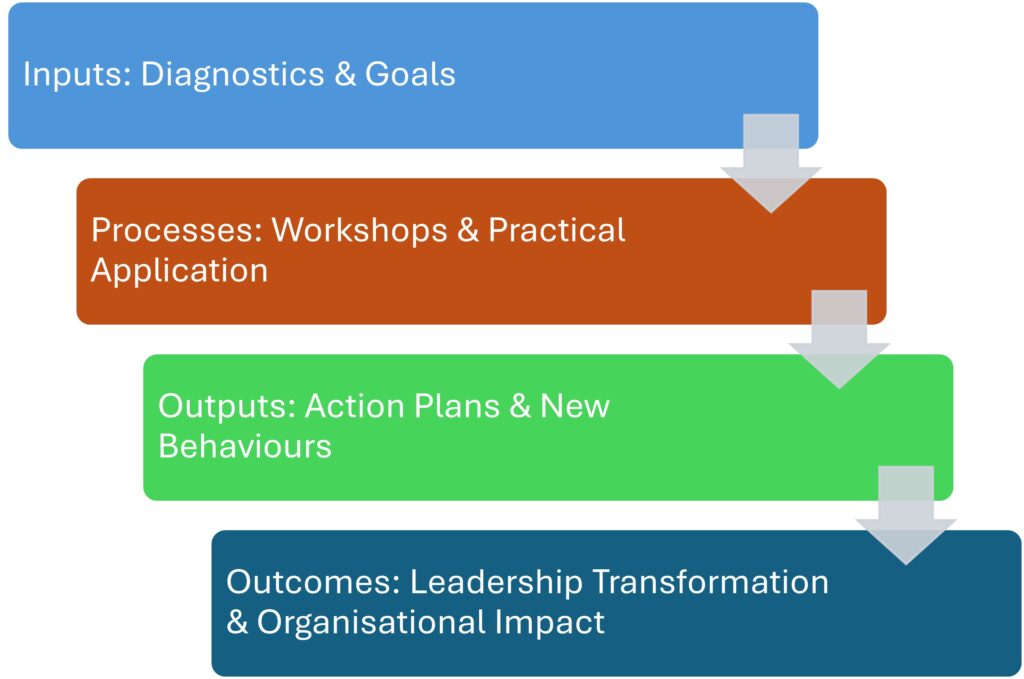
Figure 4. The Program Outcomes Flow depicts how participants progress from self-awareness and resilience to measurable improvements in performance and leadership impact. It highlights the cumulative, compounding nature of behavioural transformation achieved through the program’s structure.
Industries
This service is primarily available to the following industry sectors:

Financial Services
History
The financial services industry has long been at the heart of global commerce, enabling trade, investment and economic growth. Its origins stretch back to ancient civilizations, where moneylenders and early forms of banking supported merchants. The Medici family in Renaissance Florence pioneered double-entry bookkeeping and international banking networks, setting the stage for the modern system. By the 18th and 19th centuries, the rise of joint-stock companies and stock exchanges institutionalized capital markets, while insurance emerged to underwrite risk for shipping, trade and industry.
In the 20th century, financial services became more structured, regulated and globalized. The aftermath of the Great Depression led to stronger banking regulations in the United States (e.g., the Glass-Steagall Act) and more conservative lending practices worldwide. Post–World War II, the Bretton Woods system and the creation of the IMF and World Bank underpinned global economic stability. Deregulation in the 1970s and 1980s, particularly in the U.S. and U.K., spurred financial innovation, the growth of investment banking and the globalization of capital flows.
The late 20th century also saw the emergence of electronic trading, securitization and derivatives markets, which vastly increased both efficiency and complexity. The Global Financial Crisis of 2007–2008 exposed systemic vulnerabilities, leading to sweeping regulatory reforms (e.g., Dodd-Frank, Basel III) and a renewed emphasis on risk management.
Current Position
Today, the financial services industry is vast, diverse and indispensable to the global economy. It encompasses retail and commercial banking, investment banking, asset and wealth management, insurance, payments, and fintech. Global banks like JPMorgan Chase, HSBC, and Goldman Sachs coexist alongside asset managers such as BlackRock and Vanguard, and insurance giants like Allianz and Prudential. In parallel, technology-driven entrants (PayPal, Stripe, Revolut, Robinhood) are reshaping customer expectations.
The industry is marked by three defining features today: digital transformation, regulatory oversight, and customer-centric innovation. Digital platforms, AI, and big data are changing how institutions deliver products, assess risk, and engage with clients. Regulators continue to exert strong influence, balancing stability with innovation, particularly around capital adequacy, anti-money laundering, and cybersecurity. At the same time, client expectations have shifted: consumers demand seamless, mobile-first experiences, and corporations seek integrated global solutions; and institutional investors push for sustainable finance.
Financial services also operate in a fragile macroeconomic context. Rising interest rates have improved margins for traditional banks but increased credit risk exposure. Geopolitical tensions, inflation and fragmented supply chains present both risks and opportunities for global finance. Meanwhile, sustainability considerations are no longer peripheral: green bonds, impact investing, and climate-risk disclosures are now mainstream requirements.
Future Outlook
The financial services industry faces a future defined by disruption, reinvention and heightened expectations. Technology will continue to be the most profound driver of change. Artificial intelligence, blockchain and digital assets are reshaping infrastructure, enabling faster settlement, smarter risk management and innovative products such as tokenized assets and decentralized finance. While some incumbents will successfully integrate these technologies, others may be displaced by more agile challengers.
Regulatory complexity will deepen as policymakers grapple with balancing innovation and consumer protection. Expect tighter scrutiny on cybersecurity, data privacy, and climate-related risk. Leaders will need to navigate not just compliance but the reputational risks of mismanaging these issues.
Sustainability and purpose are also central to the industry’s future. Capital allocation increasingly reflects these priorities, and institutions that fail to embed sustainability into strategy risk losing relevance. Similarly, diversity, equity and inclusion will remain a leadership imperative, both as a source of talent advantage and as a regulatory expectation.
Finally, the human dimension of leadership will grow more important. While automation will replace many back- and mid-office roles, the demand for judgment, trust-building, and ethical leadership at the top will intensify. Executives will need resilience to manage disruption, vision to anticipate shifts and adaptability to guide teams through constant change.

Consumer
History
The consumer sector has always been a mirror of broader economic and social change. In its earliest form, it revolved around local trade and small-scale retail, with family-run shops and artisans serving basic needs. The Industrial Revolution transformed this landscape, ushering in mass production, standardized goods and the rise of department stores in Europe and North America. By the late 19th and early 20th centuries, consumer goods companies like Procter & Gamble, Nestlé and Unilever were building global brands around soap, food and household products.
The mid-20th century saw the rise of suburban shopping malls, supermarkets and modern advertising. Television became a powerful driver of consumer culture, cementing the idea of aspirational brands. The post-war economic boom expanded the middle class and accelerated demand for fast-moving consumer goods (FMCG). The 1980s and 1990s introduced further globalization, with Western brands entering emerging markets and luxury players expanding worldwide. The emergence of Walmart, Carrefour and Tesco represented the dominance of scale and efficiency in retail.
The advent of the internet at the turn of the 21st century marked a new chapter. E-commerce pioneers like Amazon and Alibaba redefined shopping convenience, while digital marketing and data analytics transformed how companies understood and engaged with consumers. This period also saw the fragmentation of consumer markets: niche brands, health-conscious products, and ethical consumption gained traction alongside traditional mass-market players.
Current Position
Today, the consumer sector is vast and multifaceted, spanning FMCG, retail, luxury goods, e-commerce, and consumer services. It is shaped by four defining dynamics: digital commerce, shifting demographics, evolving consumer values, and supply chain disruption.
Digital commerce dominates growth. E-commerce accounts for over 20% of global retail sales and continues to expand, with omnichannel strategies becoming standard. Companies integrate physical and digital experiences, offering click-and-collect, direct-to-consumer models, and personalized online journeys. Data-driven insights are now central to understanding consumer behaviour.
Shifting demographics are transforming demand. Millennials and Gen Z prioritize sustainability, transparency, and experiences over possessions. They are less brand-loyal than previous generations and heavily influenced by social media. In contrast, ageing populations in developed economies fuel demand for health-related and convenience products.
Consumer values are evolving. Sustainability is no longer a niche concern but a mainstream expectation. Consumers increasingly demand products that are ethically sourced, environmentally friendly, and socially responsible. These pressures, along with regulatory shifts such as extended producer responsibility laws, are forcing companies to rethink packaging, supply chains and product lifecycles.
Meanwhile, supply chain fragility remains a pressing challenge. Geopolitical tensions, trade restrictions, and pandemic disruptions have exposed vulnerabilities. Leaders in the sector are reconfiguring supply chains for resilience, diversifying sourcing and investing in nearshoring and digital logistics.
Future Outlook
The consumer sector faces a future shaped by technology, values-driven consumption, and new business models.
Technology will continue to redefine retail and FMCG. Artificial intelligence, augmented reality, and predictive analytics will personalize shopping at scale. Smart packaging, digital wallets and virtual storefronts will blur the lines between online and offline commerce. Brands that fail to integrate technology seamlessly risk losing relevance.
Values-driven consumption will intensify. Consumers will increasingly hold companies accountable for sustainability claims and ethical practices. Circular economy models—recycling, reuse, and product-as-a-service—will gain ground. Luxury brands, in particular, will need to reconcile exclusivity with sustainability, as younger consumers value authenticity and social impact.
New business models will emerge. Subscription services, social commerce, and direct-to-avatar digital products in the metaverse illustrate how consumer interaction with brands is expanding beyond traditional channels. Market leaders will combine operational scale with agility, leveraging partnerships, ecosystems and innovation hubs.
The implications for leadership are profound. Executives must balance efficiency with agility, integrate sustainability into core strategy, and nurture a culture of innovation that can respond to rapidly changing consumer expectations. Teams will need adaptability and cross-functional collaboration to respond to new demands, while leaders must embody resilience and purpose to maintain trust with increasingly values-driven customers.

Healthcare
History
Healthcare has evolved from rudimentary practices focused on survival to one of the most sophisticated and heavily regulated industries in the world. In ancient civilizations, care was primarily delivered through religious institutions, herbal remedies and community healers. The classical era introduced early medical theories from figures like Hippocrates and Galen, which remained influential for centuries.
The 18th and 19th centuries marked a turning point. The Industrial Revolution not only created urban centers with new health challenges but also enabled advances in sanitation, vaccination and medical instrumentation. The discovery of germ theory by Louis Pasteur and the introduction of antiseptic surgery by Joseph Lister transformed medicine from tradition to science. In parallel, the establishment of hospitals as formal institutions laid the foundation for modern healthcare systems.
The 20th century brought exponential progress. Breakthroughs in antibiotics, vaccines, imaging technologies, and surgical techniques extended life expectancy dramatically. Public health systems expanded, particularly after World War II, with models like the UK’s National Health Service setting precedents for universal access. Pharmaceutical giants such as Pfizer, Roche and Merck emerged, alongside medical device companies like Medtronic and GE Healthcare. By the late 20th century, healthcare was a global industry defined by specialization, technology and rising costs.
Current Position
Today, healthcare is a complex ecosystem encompassing pharmaceuticals, biotechnology, medical devices, hospitals, insurers, and digital health platforms. It accounts for nearly 10% of global GDP and employs millions worldwide. The sector is defined by three central dynamics: innovation, accessibility, and cost.
Innovation continues to accelerate. Advances in genomics, precision medicine, immunotherapy, and medical robotics are transforming patient outcomes. The COVID-19 pandemic fast-tracked telehealth adoption and vaccine innovation, showcasing the industry’s ability to mobilize at scale. Artificial intelligence is now applied to diagnostics, drug discovery and hospital management, with potential to reshape the sector entirely.
Accessibility remains uneven. In developed economies, healthcare is often advanced but expensive, with inequities in access based on insurance or socioeconomic status. In emerging markets, infrastructure gaps and shortages of skilled professionals persist. Global organizations, NGOs, and private partnerships are increasingly focused on reducing disparities, but progress is uneven.
Cost pressures dominate executive agendas. Ageing populations, chronic disease burdens and technological adoption have driven costs higher, straining public systems and insurers alike. Payers are demanding evidence of value, accelerating the shift toward outcomes-based care and integrated delivery models. Meanwhile, sustainability concerns—ranging from pharmaceutical supply chains to ethical pricing—are rising in prominence.
Future Outlook
The healthcare sector faces a future defined by digitalization, personalization, and systemic transformation.
Digitalization will deepen. Telehealth, wearable devices and AI-driven diagnostics will become routine, enabling continuous monitoring and proactive interventions. Hospitals may shift toward specialized acute-care hubs, while routine monitoring and consultations migrate into homes and community settings. Data interoperability and cybersecurity will be critical leadership challenges.
Personalization will reshape care delivery. Genomic sequencing and personalized medicine will allow treatments tailored to individual patients, improving efficacy while raising questions around cost, equity and ethics. The integration of patient data from multiple sources—genetics, lifestyle, digital monitoring—will redefine both preventive and curative approaches.
Systemic transformation will be unavoidable. Ageing populations in developed markets and growing middle classes in emerging economies will push demand to unprecedented levels. Leaders must manage the paradox of rising expectations and constrained budgets. Value-based care, risk-sharing payment models, and partnerships between public and private sectors will become standard.
At the same time, sustainability and resilience will grow in importance. Healthcare systems must adapt to climate risks, supply chain vulnerabilities, and geopolitical instability. Ethical debates—around data ownership, AI in decision-making, and equitable access to advanced therapies—will require careful navigation.
For leaders, the challenge will be to align innovation with accessibility, balancing financial sustainability with social responsibility. Healthcare executives will need resilience to navigate complexity, strategic acumen to balance stakeholders, and empathy to lead teams in a sector where human lives remain the ultimate measure of success.

Technology
History
The technology sector has its roots in the scientific and industrial advances of the 19th and early 20th centuries. Telegraphs and telephones revolutionized communication, while the invention of the transistor in 1947 and the subsequent rise of semiconductors laid the foundation for the modern digital age. The mid-20th century saw the development of mainframe computers and, by the 1970s, the rise of personal computing with pioneers such as IBM, Apple and Microsoft.
The 1980s and 1990s ushered in a new era defined by software, networking, and the internet. The emergence of companies like Cisco, Oracle and Intel supported the infrastructure of the digital revolution. The dot-com boom of the late 1990s highlighted the promise—and pitfalls—of internet-driven business models. While many early players failed, giants like Amazon, eBay and Google emerged and reshaped commerce, search and advertising.
The 2000s and 2010s were characterized by mobile computing, cloud services and social media. Apple’s iPhone (2007) marked the start of the smartphone era, while Facebook, Twitter and LinkedIn transformed communication and community. Meanwhile, cloud providers like Amazon Web Services, Microsoft Azure and Google Cloud redefined how companies deploy technology, enabling scalable, flexible and cost-efficient operations. Artificial intelligence, machine learning and big data analytics began to move from theory to practical application.
Current Position
Today, technology is not just a sector but the backbone of virtually every industry. It encompasses hardware, software, semiconductors, platforms, cloud services, artificial intelligence and cybersecurity. Global giants such as Apple, Alphabet, Microsoft, Amazon, Meta and Tencent dominate market capitalization rankings, reflecting technology’s central role in shaping global economies and societies.
The sector is defined by platform dominance, digital transformation, and regulatory scrutiny.
Platform dominance is concentrated among a few mega-cap firms whose ecosystems span devices, operating systems, cloud services, advertising, and payments. Their reach and influence are unprecedented, shaping consumer behaviour and enterprise IT alike.
Digital transformation has made technology a necessity for all organizations. Cloud migration, data analytics, and AI are central to competitive advantage, while cybersecurity has become a board-level issue as threats escalate in scale and sophistication. The pandemic accelerated adoption of remote work tools, e-commerce and digital health, embedding technology deeper into everyday life.
Regulatory scrutiny is intensifying. Governments worldwide are challenging monopolistic practices, data privacy standards, and content moderation responsibilities. Europe’s GDPR, the U.S.’s antitrust cases, and China’s tech sector crackdowns highlight a global consensus: technology must be both enabler and accountable actor.
Meanwhile, semiconductor supply chains remain a geopolitical flashpoint. The concentration of advanced chip manufacturing in East Asia underscores the vulnerability of critical infrastructure. Governments are investing heavily in reshoring and national resilience strategies.
Future Outlook
The future of technology will be defined by AI, decentralization, and sustainability.
Artificial intelligence is poised to transform industries at scale, moving beyond automation to augment human decision-making. Generative AI, predictive analytics, and robotics will revolutionize sectors ranging from finance to healthcare to manufacturing. The ethical and societal implications—bias, transparency, employment displacement—will place new responsibilities on leaders.
Decentralization will disrupt existing models. Blockchain, digital assets and decentralized applications have the potential to reshape financial services, supply chains, and governance. While regulatory uncertainty remains, the long-term trajectory points toward distributed systems that reduce reliance on centralized intermediaries.
Sustainability will become a defining agenda. Technology firms are under pressure to reduce their carbon footprint, from data centers to hardware manufacturing. Green tech, renewable energy integration and circular economy models for devices will gain traction. Moreover, technology is both a contributor to climate challenges and a potential solution—through innovations in energy management, mobility and agriculture.
Looking ahead, geopolitics and security will remain intertwined with technology. Nations will compete for leadership in semiconductors, AI and quantum computing, framing these as strategic assets. Cybersecurity threats will escalate, targeting both infrastructure and individuals.
For executives, the leadership challenge is profound. They must embrace innovation while ensuring ethical deployment, navigate regulatory complexity while sustaining growth, and balance global reach with resilience. In short, success in the technology sector will depend not only on technical excellence but also on trust, governance and adaptability.

Professional Services
History
The professional services sector has long been central to business, governance and society, evolving from ancient guilds and advisory roles into today’s complex global networks. Early forms included scribes, accountants and legal advisers supporting trade and governance in Mesopotamia, Rome and medieval Europe. The 19th century industrial revolution fuelled demand for specialized services in law, finance, engineering, and consulting, creating a new professional class.
By the early 20th century, professional services had become more formalized, with the founding of leading law firms, engineering consultancies, and the “Big Four” audit firms (PwC, Deloitte, EY and KPMG, which trace their roots back to the mid-1800s). These organizations established global standards for accounting, audit and professional conduct. Management consulting also emerged in the early 20th century, with pioneers such as McKinsey & Company (1926) and Boston Consulting Group (1963) developing analytical frameworks that shaped corporate strategy.
In the post-war era, globalization and corporate expansion spurred professional services growth. Consulting firms guided organizational restructuring, IT integration and global expansion strategies. Law firms supported cross-border transactions, while accounting networks standardized global reporting. By the late 20th century, the sector had become deeply embedded in the functioning of modern economies, shaping not only corporate performance but also public policy.
Current Position
Today, professional services is a diverse and dynamic sector spanning consulting, legal, accounting, engineering, HR advisory, and IT services. It is characterized by three defining dynamics: globalization, specialization, and client expectations.
Globalization has produced large international firms with footprints in virtually every major market. The Big Four dominate accounting and audit globally, while consulting giants like McKinsey, BCG, Bain, and Accenture lead strategic and operational advisory. Global law firms handle complex cross-border litigation and transactions, reflecting the interconnectedness of business and regulation.
Specialization has become a necessity. Clients demand expertise in niche areas—from digital transformation and cybersecurity to sustainability strategy and regulatory compliance. Professional services firms now blend deep sector expertise with functional capabilities, often leveraging multidisciplinary teams.
Client expectations have shifted. Organizations no longer seek only technical expertise but also partnership, agility, and measurable outcomes. The rise of in-house capabilities has forced professional services providers to differentiate through innovation, proprietary tools, and thought leadership. Digital tools, analytics and AI increasingly support service delivery, while alternative fee models are challenging traditional billable-hour structures.
At the same time, the sector faces pressures on trust and reputation. High-profile audit failures, consulting controversies, and conflicts of interest have led regulators and clients to demand greater transparency and accountability.
Future Outlook
The professional services industry faces a future defined by technology integration, talent transformation, and purpose-driven impact.
Technology integration will reshape service delivery. AI, automation, and advanced analytics will streamline audit processes, accelerate legal research, and enhance consulting insights. Firms will move toward hybrid service models, blending human expertise with digital tools. Cybersecurity, data ethics and intellectual property will become core advisory areas as clients face escalating digital risks.
Talent transformation will be equally critical. As automation reduces demand for routine work, professional services firms must attract, develop and retain individuals with creativity, problem-solving and leadership skills. Flexible work models, global collaboration and diversity will define the workforce of the future. Firms that fail to evolve their cultures risk losing top talent to technology companies, startups, or in-house corporate teams.
Purpose-driven impact will shape client and employee choices alike. Sustainability advisory and reporting, and ethical business practices will become mainstream. Professional services providers will increasingly be judged not just on technical outcomes but on their contribution to societal and environmental goals. Thought leadership, independence and trust will remain vital assets.
Leadership in this sector will demand resilience and credibility. Executives must balance growth with ethics, integrate technology without losing human touch, and build client relationships that extend beyond transactions to long-term partnerships. The winners will be those who combine deep expertise with adaptability, innovation with integrity, and global reach with local relevance.
Locations
This service is primarily available within the following locations:

London UK
History
London’s role as a global hub has been centuries in the making, rooted in its geographic location and shaped by waves of commerce, empire, and innovation. Founded by the Romans in the 1st century AD, London quickly grew into a key trading port on the River Thames. The medieval period cemented its role as a mercantile center, with the City of London guilds creating early systems of professional governance and trust.
The 16th and 17th centuries were transformative. The growth of maritime trade, the emergence of the Royal Exchange (1571), and the creation of the Bank of England (1694) positioned London as Europe’s financial heart. The Industrial Revolution in the 18th and 19th centuries accelerated its growth, with railways, shipping and manufacturing fuelling population booms.
London became the command center of the British Empire, administering trade routes, colonies, and capital flows that extended across the globe.
The 20th century tested London’s resilience. The Blitz devastated the city during World War II, yet its rebuilding reinforced London’s adaptability. In the post-war era, the city transitioned from heavy industry to a knowledge-based economy centered on finance, law, culture and professional services.
The liberalization of financial markets in 1986 (the “Big Bang”) marked another turning point, establishing London as one of the world’s two dominant financial centers alongside New York.
By the 21st century, London had established itself as a truly global city — an engine of commerce, culture, and connectivity. Its history is one of constant reinvention, with each challenge catalyzing a new phase of leadership on the global stage.
Current Position
London today is a city of paradoxes: a magnet for global talent and capital, yet grappling with economic, political and social pressures. It contributes nearly a quarter of the UK’s GDP and remains Europe’s largest metropolitan economy.
Financial and professional services remain the city’s anchor industries. The City and Canary Wharf host global banks, insurers, law firms and consultancies, making London a leader in capital markets, foreign exchange, and asset management. Post-Brexit, some operations have shifted to European cities like Frankfurt and Paris, but London retains unrivalled depth in legal, financial and advisory services. The English legal system, widespread use of English language, and global reputation for impartiality underpin London’s continued appeal.
Technology and innovation are growing engines. The “Silicon Roundabout” around Old Street and hubs like King’s Cross (home to Google’s London HQ and DeepMind) illustrate London’s strength in AI, fintech and life sciences. The city is also a leader in green finance and sustainability-linked investment, aligning with the global sustainability agenda.
Culture and education reinforce London’s global reach. World-class universities (LSE, UCL, Imperial, King’s College) attract international students and research funding. Creative industries — from fashion to film — give London cultural soft power unmatched by most global peers. Heathrow and Gatwick provide international connectivity, although infrastructure strains remain.
At the same time, challenges are acute. Housing affordability, rising inequality and infrastructure gaps are pressing issues. Brexit has reduced EU-linked labour mobility, while regulatory divergence poses risks to London’s status as Europe’s financial gateway. The cost-of-living crisis and transport disruptions also strain London’s competitiveness relative to other global cities.
Nonetheless, London remains a city with unmatched international networks. Its blend of financial strength, cultural influence, and innovation makes it a crucial hub for global executives and investors.
Future Outlook
The future of London will be defined by adaptation, diversification and resilience.
Adaptation to geopolitical and regulatory realities is critical. Post-Brexit, London will continue to pivot toward global markets beyond Europe, strengthening ties with North America, the Middle East and Asia. The UK’s regulatory independence may become an advantage if London can strike the right balance between innovation and oversight in areas such as fintech, green finance and digital assets.
Diversification is already under way. London’s growth increasingly depends on technology, life sciences and creative industries alongside finance. Investment in AI, biotech and sustainability positions London to become a leader in the industries of the future. The expansion of research clusters around universities and hospitals — particularly in King’s Cross, White City and the South Bank — supports this transformation.
Resilience will remain London’s defining trait. The city has survived wars, crises and structural shocks, and each time has emerged stronger. Addressing housing shortages, infrastructure upgrades and inequality will be essential to sustain long-term competitiveness. Initiatives such as Crossrail (Elizabeth Line) demonstrate London’s commitment to modernizing transport, while ongoing regeneration projects aim to make the city more inclusive and liveable.

Milan IT
History
Milan’s importance as a European hub dates back more than two millennia. Founded by Celtic tribes and later absorbed into the Roman Empire, Milan quickly emerged as a center of administration and commerce in northern Italy. By the 4th century AD, it briefly served as the capital of the Western Roman Empire, cementing its reputation as a seat of power and influence.
During the Middle Ages and Renaissance, Milan flourished as a city-state and later under the Visconti and Sforza dynasties. These rulers transformed Milan into one of Europe’s leading cultural and economic centers, commissioning works by Leonardo da Vinci and Bramante while fostering advances in trade, textiles, and finance. Its strategic location on north–south trade routes made it a key player in the growth of early banking and mercantile activity.
In the 19th century, Milan became a focal point of the Italian unification movement and an industrial powerhouse. It attracted investment in textiles, chemicals and machinery, positioning itself as Italy’s most dynamic industrial region. The devastation of World War II was followed by rapid reconstruction and the “Italian economic miracle” of the 1950s and 1960s, during which Milan consolidated its role as the nation’s financial, commercial and cultural capital.
Today, Milan’s history is inseparable from its dual identity as both Italy’s business engine and a global cultural trendsetter. Its legacy of design, finance and entrepreneurship continues to underpin its global standing.
Current Position
Milan today is the undisputed economic capital of Italy and one of Europe’s most influential cities. It contributes around 10% of Italy’s GDP and serves as headquarters for many of the country’s largest corporations, banks and media companies.
Finance and business services form the backbone of Milan’s economy. The city is home to Borsa Italiana (Italy’s stock exchange, now part of Euronext), Intesa Sanpaolo, UniCredit, and a host of private equity and asset management firms. Professional services — legal, consulting, and accounting — cluster in Milan, supporting both Italian firms and multinationals operating across southern Europe.
Fashion and design are global calling cards. Milan is widely regarded as the world’s fashion capital, hosting biannual Fashion Weeks and housing the headquarters of brands like Prada, Armani and Versace. Its design and architecture industries, celebrated at the Salone del Mobile fair, set global trends and anchor Milan’s cultural influence.
Innovation and technology are gaining momentum. Milan is the heart of Italy’s startup ecosystem, with initiatives like MIND (Milan Innovation District) and PoliHub (linked to Politecnico di Milano) fostering entrepreneurship in life sciences, biotech, AI and green technologies. This growing ecosystem is helping diversify Milan’s economy beyond traditional finance and fashion.
Challenges persist. Milan struggles with housing affordability, infrastructure bottlenecks, and uneven social development compared to Italy’s north–south divide. Bureaucracy and slower national growth weigh on the city’s potential. Nevertheless, Milan’s dynamism, international appeal, and concentration of talent make it an essential hub for executives in southern Europe.
Future Outlook
Milan’s trajectory will be shaped by globalization, innovation and sustainability.
Globalization will reinforce Milan’s role as Italy’s international gateway. The city’s strong ties with European financial and business networks — especially in Paris, Frankfurt and London — will deepen as Italy integrates further into EU capital markets. Milan’s hosting of the 2026 Winter Olympics is expected to showcase its infrastructure, hospitality and cultural strengths on a global stage.
Innovation is poised to expand. The Milan Innovation District, located on the former Expo 2015 site, is designed to become a European hub for research in life sciences, biotech and data-driven technologies. Coupled with Politecnico di Milano’s excellence in engineering and design, this will make Milan a testbed for interdisciplinary innovation. The city is also positioning itself as a leader in fintech and sustainable finance, aligning with EU priorities.
Sustainability will become increasingly central. Milan faces challenges in air quality, congestion and climate resilience, but its leaders are investing in green infrastructure, renewable energy, and circular economy initiatives. Its fashion industry, under pressure to become more sustainable, is driving global conversations about ethical production and supply chain transparency.
Looking ahead, Milan’s combination of financial power, cultural leadership and growing innovation ecosystem will ensure it remains at the forefront of southern Europe. For executives, Milan offers both opportunities and challenges: access to Italy’s most advanced market, connectivity to European networks, and a cosmopolitan cultural environment — but also the need to navigate bureaucracy, high costs and uneven national growth.
Milan’s story has always been one of reinvention — from Roman capital to Renaissance court, from industrial hub to fashion and finance leader. Its next chapter is likely to be written at the intersection of design, technology and sustainability, keeping it highly relevant for global leaders and organizations.

New York NY
History
New York’s rise as one of the world’s leading cities is a story of migration, commerce, and relentless reinvention. Originally settled by the Dutch as New Amsterdam in the early 17th century, the city passed into English control in 1664 and quickly became a vital Atlantic port. Its deep natural harbour and strategic location positioned it as a gateway for goods and people, laying the foundations for its economic significance.
The 19th century was transformative. Waves of immigration — Irish, German, Italian, Jewish, among others — made New York the quintessential melting pot. Ellis Island became a symbol of opportunity, with millions of new arrivals fuelling industrial growth. The opening of the Erie Canal in 1825 linked New York to the American interior, cementing its dominance in trade. Wall Street emerged as the financial nerve center, with the New York Stock Exchange (founded in 1792) anchoring the city’s economic might.
In the 20th century, New York became a global capital of finance, culture and diplomacy. Skyscrapers such as the Empire State Building symbolized modernity, while the city’s cultural institutions — Broadway, the Metropolitan Museum of Art, and jazz clubs in Harlem — made it a global cultural beacon. After World War II, the United Nations established its headquarters in Manhattan, underscoring New York’s international role. The 1970s brought fiscal crisis and crime, but the city rebounded in the 1980s and 1990s as finance, media and real estate surged.
By the early 21st century, New York had established itself as one of the most powerful global cities, embodying both opportunity and inequality, innovation and tradition. Its history is a narrative of resilience and ambition.
Current Position
New York today is the United States’ largest city and one of the most influential hubs in the world. With over 8.5 million residents and a metropolitan population exceeding 20 million, it contributes around 8% of US GDP. Its global influence rests on three pillars: finance, culture, and innovation.
Finance remains the cornerstone. Wall Street is the world’s largest financial center, home to the New York Stock Exchange and NASDAQ, and headquarters for major investment banks, asset managers, hedge funds and private equity firms. New York dominates global capital flows, investment banking and securities trading.
Culture and media reinforce its global identity. The city is home to leading media companies (The New York Times, Bloomberg, NBC), fashion houses and advertising firms. Broadway and world-class museums maintain its cultural leadership, while sports franchises extend its influence globally. Its diversity — with more than a third of residents foreign-born — ensures New York reflects global demographics.
Innovation and technology are expanding rapidly. Silicon Alley, centered in Manhattan and Brooklyn, has become a major US tech cluster, particularly in fintech, media tech, health tech and AI startups. Cornell Tech on Roosevelt Island and research institutions like NYU and Columbia fuel entrepreneurship. New York is also a leader in life sciences, supported by major hospitals and biotech investment.
Challenges persist. New York faces acute housing shortages, high costs of living, income inequality and strained infrastructure. Climate risk — particularly flooding and hurricanes — poses long-term threats. The COVID-19 pandemic exposed vulnerabilities in public health and urban density, leading to debates about the city’s resilience and future direction.
Yet New York’s scale, talent pool, and networks remain unparalleled. It continues to attract global capital, entrepreneurs and cultural talent, maintaining its position as one of the world’s preeminent urban economies.
Future Outlook
New York’s future will be shaped by its ability to manage resilience, reinvention and inclusion.
Resilience will be tested by climate change and infrastructure. Investments in climate adaptation — from seawalls to green infrastructure — will determine the city’s long-term viability. Transportation upgrades, particularly to the subway system and airports, will be critical for sustaining economic activity.
Reinvention is underway in the city’s economy. Finance remains dominant, but technology, life sciences and green industries will increasingly drive growth. Fintech startups are challenging traditional banks, while health tech and biotech are expanding around institutions like Mount Sinai and Weill Cornell. New York is also positioning itself as a hub for climate finance and sustainable investment, aligning with global trends.
Inclusion is both a challenge and an imperative. Rising inequality threatens the city’s cohesion. Policy efforts in affordable housing, education, and workforce development will shape whether New York continues to attract diverse talent. Diversity has always been its greatest asset and maintaining openness will be essential in an era of rising populism and competition from other cities.
Looking forward, New York will remain one of the world’s most important cities — not only because of its size and financial might, but because of its unmatched global connectivity, cultural dynamism, and capacity for reinvention. For executives, it offers unparalleled access to capital, talent, and networks, but also demands navigation of complexity, cost, and risk.
In many ways, New York’s identity is defined by its contradictions: opportunity and inequality, wealth and struggle, chaos and creativity. Its future success will depend on balancing these tensions while building on its historic role as a beacon of ambition, resilience, and innovation.

Boston MA
History
Boston’s story is deeply entwined with the history of the United States itself. Founded in 1630 by Puritan settlers, it quickly became one of the most important colonial ports, a hub of trade, shipping, and ideas. Its role in the American Revolution was pivotal: events such as the Boston Tea Party (1773) and the Battle of Bunker Hill (1775) cemented its place as a symbol of independence and civic engagement.
In the 19th century, Boston evolved into an intellectual and cultural capital. It became the “Athens of America,” home to writers, philosophers and reformers who shaped US thought on abolition, education and democracy. Its maritime and manufacturing industries thrived, with textiles, shipbuilding, and trade fuelling economic growth. Immigrant communities, particularly Irish, Italian, and later Eastern European, transformed Boston’s demographics and politics.
By the late 19th and early 20th centuries, Boston’s economy was diversifying. While manufacturing declined in the mid-century, higher education and healthcare began to define the city’s new trajectory. The founding and growth of world-class institutions such as Harvard University and MIT across the Charles River in Cambridge, combined with hospitals like Massachusetts General, laid the foundation for Boston’s transformation into a knowledge-driven economy.
Boston’s history is one of reinvention — from revolutionary capital to industrial hub, to global leader in education, healthcare and innovation.
Current Position
Today, Boston is a mid-sized city with outsized influence, combining historic character with cutting-edge innovation. It is a metropolitan area of nearly 5 million people, producing one of the highest GDPs per capita in the United States. Its strength lies in the interplay between education, healthcare, finance and technology.
Education and research are Boston’s crown jewels. Harvard, MIT, Boston University, and dozens of other institutions attract students and researchers from around the world. This dense concentration of talent drives breakthroughs in science, technology and policy, and acts as a magnet for global investment.
Healthcare and life sciences are equally central. Boston is the world’s leading biotech cluster, anchored by Kendall Square in Cambridge, home to hundreds of startups and multinational firms like Moderna, Biogen, and Novartis. Its hospitals are renowned globally, driving advances in medicine and clinical research. Venture capital flows heavily into life sciences, reinforcing Boston’s dominance in this sector.
Finance and professional services also play a major role. Boston is home to large asset managers such as Fidelity and State Street, and has a reputation for conservative, research-driven investment. Professional services firms, legal practices and consultancies provide critical support to the region’s industries.
Technology is expanding rapidly. Boston’s innovation ecosystem extends beyond biotech into robotics, AI, and clean energy, leveraging the city’s engineering and research expertise. The city’s startup scene benefits from access to both venture funding and top-tier talent pipelines from universities.
Challenges remain. Boston faces high housing costs, infrastructure constraints, and racial and economic inequality. The cost of living is among the highest in the US, and transportation systems struggle to keep pace with growth. Yet its knowledge economy, talent base and concentration of research and innovation make it one of the world’s most influential mid-sized cities.
Future Outlook
Boston’s future will be defined by leadership in knowledge industries, investment in infrastructure, and inclusive growth.
Knowledge industries will continue to drive the city’s success. Life sciences and biotech will remain Boston’s strongest global advantage, supported by research universities and hospital networks. The city is also emerging as a leader in AI, robotics and quantum computing, benefiting from close collaboration between academia and industry. The potential for Boston to lead the next wave of technological transformation is substantial.
Infrastructure investment is critical. Transportation upgrades, including modernization of the MBTA transit system, airport expansions, and improved housing supply, will be necessary to sustain growth. Without addressing these structural challenges, Boston risks losing competitiveness to lower-cost, better-connected cities.
Inclusive growth is a pressing issue. Economic inequality and racial disparities persist and addressing them will be essential to maintaining social cohesion. Initiatives in affordable housing, education access, and workforce development will shape the city’s ability to retain diverse talent. Boston’s identity as a city of ideas gives it both the platform and responsibility to lead in inclusive economic strategies.
Climate resilience will also shape Boston’s trajectory. Rising sea levels threaten its waterfront neighbourhoods and innovation districts. Major adaptation projects are being planned, including flood defences and green infrastructure, to protect the city’s economic assets.
Looking forward, Boston will likely remain a global leader in science, innovation and education. Its relatively small size is offset by its concentration of world-class institutions, talent and capital. For executives, Boston offers opportunities in biotech, finance and technology that few other cities can match. The challenge will be balancing growth with inclusivity and sustainability, ensuring the city’s next chapter is as innovative and resilient as its past.

Chicago IL
History
Chicago’s origins lie in its unique geography — a natural junction between the Great Lakes and the Mississippi River system. Founded in the early 19th century and incorporated as a city in 1837, Chicago rapidly grew as a hub for trade, transport, and migration. The opening of the Illinois and Michigan Canal in 1848 connected the Great Lakes to the Mississippi, cementing the city’s role as the gateway between East and West.
The late 19th century was transformative. The Great Chicago Fire of 1871 destroyed much of the city, but its rebuilding became a symbol of resilience and ambition. Chicago pioneered architectural innovation with the rise of the skyscraper, setting global precedents in urban design. Its stockyards and grain markets made it the agricultural and food processing capital of America, while its railroads positioned it as the nation’s transportation crossroads.
By the early 20th century, Chicago was a global industrial powerhouse. Steel, manufacturing, finance and trade all flourished, supported by an influx of immigrants from Europe and migrants from the American South. The city also became a cultural center, birthing jazz, blues, and influential literature.
Deindustrialization in the mid-20th century brought economic decline, population loss, and social unrest. Yet Chicago reinvented itself, diversifying into services, finance and logistics while leveraging its central location. Today, its history is remembered as one of cycles of challenge and renewal, with resilience at the core of its identity.
Current Position
Chicago today is the third-largest city in the United States, with a metropolitan population of nearly 10 million and a GDP that ranks among the world’s top 20 urban economies. It is distinguished by its diverse economy, strategic location and cultural influence.
Economic diversity is Chicago’s greatest strength. Unlike cities dominated by a single sector, Chicago’s economy is balanced across finance, professional services, logistics, healthcare, manufacturing, education and technology. It is home to major corporations such as Boeing, McDonald’s, United Airlines and Mondelez, as well as the CME Group, the world’s largest futures and derivatives exchange. This diversity provides resilience against economic shocks.
Strategic location reinforces its role as America’s crossroads. O’Hare International Airport is one of the busiest in the world, connecting Chicago globally, while its rail and trucking infrastructure make it a central logistics hub for North America. This makes Chicago indispensable for supply chain management and distribution networks.
Culture and education add further weight. The University of Chicago and Northwestern University are globally renowned, anchoring strength in research, economics and policy. Chicago’s cultural assets — from its architecture to its music and sports — make it one of the most recognizable American cities worldwide.
However, challenges persist. Chicago grapples with fiscal deficits, pension obligations, crime and inequality. Its population growth has been slower than coastal peers, and concerns about public safety affect perceptions. Nevertheless, its economic base, connectivity and talent pool remain formidable.
Future Outlook
Chicago’s future will be shaped by logistics leadership, innovation growth and urban renewal.
Logistics leadership is set to strengthen. Chicago will remain North America’s premier logistics hub, benefiting from its unmatched rail and air infrastructure. The city is well-placed to capitalize on the rise of e-commerce and global supply chain restructuring, offering opportunities in distribution, warehousing and freight technology.
Innovation growth is gaining traction. Chicago is building momentum as a technology hub, particularly in fintech, food tech, and advanced manufacturing. Research centers around the University of Chicago and Northwestern are driving innovation in quantum computing, biotech and data science. Venture capital activity is growing, though still smaller than in New York or Silicon Valley. Chicago’s affordability relative to coastal cities could attract more startups and talent.
Urban renewal will determine long-term competitiveness. Addressing fiscal challenges, improving public safety and investing in infrastructure are critical priorities. Initiatives to modernize public transit, redevelop industrial zones and expand green space will shape the city’s appeal. If successful, these efforts could reposition Chicago as a more inclusive, liveable and sustainable metropolis.
Climate resilience is also emerging as a concern, with Lake Michigan’s fluctuating water levels posing risks to infrastructure. Investments in sustainable urban planning will be necessary to protect the city’s assets.
Looking forward, Chicago is unlikely to match the global dominance of New York or the innovation intensity of Silicon Valley, but its diverse economy, logistical importance, and deep institutional strength ensure it will remain a cornerstone of the American urban landscape. For executives, Chicago offers stability, connectivity and affordability — but requires navigation of fiscal, social and governance complexities.
Chicago’s history of resilience suggests it will continue to reinvent itself, balancing tradition with innovation as it shapes its role in the global economy.
Program Benefits
Management
- Stress regulation
- Emotional agility
- Energy renewal
- Burnout prevention
- Mental clarity
- Cognitive stamina
- Focused mindset
- Recovery routines
- Balanced lifestyle
- Sustainable performance
Finance
- Executive presence
- Decisive judgment
- Clear vision
- Persuasive communication
- Authentic influence
- Strategic focus
- Self-assurance
- Gravitas under pressure
- Inspiring direction
- Trusted authority
Human Resouces
- Psychological safety
- Trust building
- Agile Mindset
- Cohesive culture
- Conflict resolution
- Collaborative spirit
- Cross-functional unity
- Change readiness
- Shared accountability
- Innovative thinking
Achievements

Turnaround of $5bn Equity Portfolio at Alliance Trust
When Mr Di Bon joined Alliance Trust, the portfolio faced declining performance, inefficient structures, and rising pressure from shareholders. The challenge was not only technical but human: to restore confidence, cut through complexity, and lead under scrutiny. He restructured the investment team, introduced sustainability frameworks that anticipated market shifts, and streamlined processes, cutting costs by 40%. The performance turnaround placed the fund in the 2nd quartile, reversing a cycle of underperformance. Beyond numbers, this achievement demonstrated how leaders must manage stress—focusing on clarity of vision and resilience when expectations are high. It also underscored that true performance management requires decisiveness and adaptability in challenging environments.

Scaling Global Opportunities Fund at Fidelity
At Fidelity, Mr Di Bon managed the Global Opportunities Fund during a period of global volatility. Starting with $250m in assets under management, he applied a disciplined strategy, focusing on fundamentals while remaining agile to shifting macro conditions. Over several years, the fund grew fourfold to $1bn and achieved top-decile performance, earning “Global Equity Fund of the Year” by Asian Investor in 2010. Success rested not only on analytical skill but on cultivating a performance mindset across the team, staying calm under pressure, and making decisions with conviction in uncertain markets. This experience translates directly into Executive Performance Management: leaders thrive when they align discipline with adaptability and inspire their teams to believe in a shared strategy.

Leadership of $26bn Global Strategies at UBS
Mr Di Bon’s role at UBS required leading multiple global equity research teams, including rebuilding the Japan research unit in Tokyo. With $26bn in global strategies under management, the scale was immense, and the challenges were both technical and cultural. He had to navigate diverse regulatory regimes, coordinate cross-border teams, and instill cohesion among professionals with differing perspectives. Success was achieved through adaptive leadership—listening, unifying and empowering individuals in high-pressure contexts. The turnaround of the Tokyo unit, in particular, required trust-building and cultural sensitivity. These lessons are central to Executive Performance Management: resilient leaders succeed not by imposing authority, but by aligning people across boundaries with clarity and empathy.

Executive Coaching for Global Corporates
Over the last decade, Mr Di Bon has worked with executives and CEOs from Allianz, Uber, HSBC, UBS, Pirelli, Carlyle, Fidelity, Toyota, and more. These leaders often came with common challenges: stress overload, the weight of decision-making, and the need to inspire in uncertain contexts. Through structured coaching, he helped them develop resilience, sharpen focus, and enhance their executive presence. Many faced moments of transformation—crises, restructures, or growth pivots—and discovered that leadership strength lies not in avoiding stress but in managing it intelligently. These engagements reinforced his conviction that stress management, performance focus and adaptability are universal skills, regardless of industry or geography.

Healthtech Venture Creation(The Zebra Club, Moovlite)
Founding The Zebra Club and later Moovlite was a departure from traditional finance into healthtech entrepreneurship. Both ventures addressed pressing needs: supporting people with chronic conditions and helping professionals manage stress and performance in everyday life. Building these startups required Mr Di Bon to demonstrate personal resilience, creativity under constraints, and the ability to adapt rapidly to market realities. From securing subscribers and designing user-friendly programs to navigating technical partnerships, the journey mirrored the themes of Executive Performance Management—sustaining performance without burnout, making clear decisions under uncertainty, and guiding change with purpose. These ventures represent both entrepreneurial achievement and a lived embodiment of the principles he now teaches.

Strategic Advisory and IPO Readiness (Analytical Srl, P.E.S. Technologies)
As a strategic advisor, Mr Di Bon supported Analytical Srl and P.E.S. Technologies through major transformations, including succession planning, fundraising, and IPO preparation. For Analytical, this meant guiding leadership through a delicate succession while ensuring strategic continuity. For P.E.S., it involved helping raise over £3m in funding to accelerate its growth in soil health diagnostics. In both cases, his role was to help leaders manage performance while embracing change—balancing vision with pragmatic steps and managing investor expectations under stress. These advisory projects reinforced a core lesson: leadership transformation requires both resilience and structure. It is not enough to innovate; one must also instill trust and confidence in stakeholders.
Global Strategic Advisory & Pro Bono Impact
Throughout his career, Mr Di Bon has dedicated time to supporting mission-driven organizations including Virgin StartUp, TechItalia, MyBnk, LA Goal, StandOut and San Patrignano. These initiatives often involved advising under-resourced leadership teams, guiding strategy in uncertain environments, and fostering resilience where resources were scarce. Whether supporting social entrepreneurs or mentoring young professionals, the focus was on unlocking potential, building confidence and enabling sustainable change. Pro bono work reinforced a truth that transcends sectors: the principles of stress management, performance focus and adaptive leadership are universal. Achievements here are measured not in financial metrics, but in empowerment and legacy—the same values embedded in Executive Performance Management.
More detailed achievements, references and testimonials are confidentially available to clients upon request.
Client Telephone Conference (CTC)
If you have any questions or if you would like to arrange a Client Telephone Conference (CTC) to discuss this particular Unique Consulting Service Proposition (UCSP) in more detail, please CLICK HERE.