


XR-AI Accelerator
The Appleton Greene Corporate Training Program (CTP) for XR-AI Accelerator is provided by Mr. Proto Certified Learning Provider (CLP). Program Specifications: Monthly cost USD$2,500.00; Monthly Workshops 6 hours; Monthly Support 4 hours; Program Duration 12 months; Program orders subject to ongoing availability.

Personal Profile
Mr. Proto is a Certified Learning Provider (CLP) with Appleton Greene. He has over 25 years of experience in 3D technology, immersive media and business strategy across gaming, advertising and spatial computing. He specializes in XR-AI strategy, go-to-market development and helping organizations deploy influential immersive use cases. He is passionate about connecting visionary companies with talented XR creators and accelerating the adoption of spatial computing across industries. He has industry experience in the following sectors: Gaming, Advertising, Automotive, Luxury, Entertainment, Healthcare, Education and Enterprise. He has commercial experience in the following countries: United States, France, United Kingdom, Germany, and across Europe as well as Singapore.
His personal achievements include co-founding an independent video game development company that worked with leading game publishers in the early 2000s and co-founding a digital imaging agency that created award-winning interactive 3D campaigns for blue-chip clients including luxury brands, automotive companies and major advertising agencies. He is now CEO and Co-Founder of the largest showcase and community of XR/Spatial creators with 3,500+ companies, 850+ case studies and strategic consulting services for enterprise clients. He has consulted with more than 40 XR CEOs on strategy, marketing and sales. He has founded the largest LinkedIn group focused on XR-AI innovation with over 90,000 members. And finally, he’s a recognized thought leader who regularly speaks at industry events and podcasts and has been featured as a Top Metaverse Innovator and early-stage presence establishment partner nominee.
His service skills include: XR-AI strategy development, spatial computing implementation, immersive technology consulting, go-to-market strategy, community building, content creation expertise, business development, and strategic planning. Mr. Proto has extensive experience in business education and mentoring, helping organizations understand and adopt spatial computing technologies while avoiding costly implementation mistakes.
To request further information about Mr. Proto through Appleton Greene, please Click Here.

(CLP) Programs

Appleton Greene corporate training programs are all process-driven. They are used as vehicles to implement tangible business processes within clients’ organizations, together with training, support and facilitation during the use of these processes. Corporate training programs are therefore implemented over a sustainable period of time, that is to say, between 1 year (incorporating 12 monthly workshops), and 4 years (incorporating 48 monthly workshops). Your program information guide will specify how long each program takes to complete. Each monthly workshop takes 6 hours to implement and can be undertaken either on the client’s premises, an Appleton Greene serviced office, or online via the internet. This enables clients to implement each part of their business process, before moving onto the next stage of the program and enables employees to plan their study time around their current work commitments. The result is far greater program benefit, over a more sustainable period of time and a significantly improved return on investment.

Appleton Greene uses standard and bespoke corporate training programs as vessels to transfer business process improvement knowledge into the heart of our clients’ organizations. Each individual program focuses upon the implementation of a specific business process, which enables clients to easily quantify their return on investment. There are hundreds of established Appleton Greene corporate training products now available to clients within customer services, e-business, finance, globalization, human resources, information technology, legal, management, marketing and production. It does not matter whether a client’s employees are located within one office, or an unlimited number of international offices, we can still bring them together to learn and implement specific business processes collectively. Our approach to global localization enables us to provide clients with a truly international service with that all important personal touch. Appleton Greene corporate training programs can be provided virtually or locally and they are all unique in that they individually focus upon a specific business function. All (CLP) programs are implemented over a sustainable period of time, usually between 1-4 years, incorporating 12-48 monthly workshops and professional support is consistently provided during this time by qualified learning providers and where appropriate, by Accredited Consultants.
Executive summary

XR-AI Accelerator
Market Opportunity
The XR-AI industry offers unprecedented opportunities across multiple business verticals, each demonstrating measurable returns and transformative potential:

Enterprise Training & Simulation Organizations like Toyota and Walmart have revolutionized workforce development through VR training programs, seeing 75% improvement in learning retention compared to traditional methods. Boeing reports 50% reduction in training costs while improving skill retention by 80% through AR-assisted pilot and astronaut training programs.

Industrial Operations & Manufacturing Companies such as BMW and Ford are leveraging AR to enhance manufacturing and assembly processes, reducing errors by 30% and increasing production efficiency by 25%. DHL has streamlined maintenance and training through immersive technologies, cutting downtime by 25% and improving worker productivity by 32%.

Healthcare & Medical Training Medical institutions are adopting VR for surgical training and patient treatment, with studies showing 230% improvement in surgeon performance after VR training. Digital therapeutics using XR technologies are gaining FDA approval and demonstrating measurable patient outcomes.

Retail & Customer Experience Forward-thinking retailers like Overstock and Home Depot report AR implementations increasing conversion rates by up to 200%, reducing return rates by 40%, and tripling purchase likelihood. QReal’s AR restaurant menus have delivered average sales growth of 22% while enhancing customer satisfaction.

Real Estate & Architecture Real estate firms using immersive 3D experiences report faster sales cycles and higher customer satisfaction. Architectural visualization through XR reduces design revision cycles and improves client approval rates significantly.

Automotive Innovation Leading automotive manufacturers are deploying VR for design reviews, reducing global review time from days to hours while enabling more effective collaboration. Lucid Motors’ immersive car configurator achieved 47% higher engagement and 51% increase in revenue per session.

Energy & Infrastructure Companies like Holis are using digital twins for offshore installations, providing 24/7 access to dangerous, remote, and expensive-to-visit sites, resulting in massive gains in safety, efficiency, and cost reduction.
A diverse and ever-growing list of product and service providers are finding exceptional opportunities in the XR-AI industry. Those who find an opportunity – and they are many and various – will be armed with an entry playbook and implementation plan which will help you rapidly capitalize on this transformative technology shift.
Together we will follow a 12-month learning program where you will acquire all the knowledge you need to succeed in this lucrative and rapidly expanding sector.
Bridging the Trillion Dollar Opportunity While Avoiding Million Dollar Mistakes
The Challenge
Extended Reality (XR) and Artificial Intelligence (AI) represent a trillion-dollar market opportunity, yet businesses consistently face million-dollar implementation failures. Despite XR’s potential to transform industries from healthcare to manufacturing, 84% of organizations struggle with their first implementations due to overwhelming technology choices, unrealistic expectations, and fundamental knowledge gaps.
The root problem is clear: XR is built on 30 years of hardcore 3D video game technology evolution, but clients and immersive suppliers often don’t speak the same language.
This communication disconnect leads to immersive technology overwhelm with unclear ROI expectations, difficulty finding trusted XR-AI partners who understand business needs, misunderstanding of true costs and complexity, and scope creep resulting in project failures.
We’ve witnessed real-world consequences including 12-18 month project delays, budget overruns from $1.5M to $4M, and executive teams losing confidence in XR initiatives entirely.
The Solution
The XR-AI Accelerator Program addresses the fundamental disconnect between immersive technology potential and business implementation reality. Drawing from over 25 years of experience in games, 3D development and spatial computing, we’ve developed a comprehensive 12-month corporate training initiative that transforms how organizations approach XR-AI adoption.
Our program bridges the cultural and technical gap between traditional business practices and the specialized world of immersive technology development. We provide the frameworks, vocabulary and strategic understanding necessary to navigate this complex ecosystem successfully, while avoiding the costly mistakes that derail unprepared organizations.
Unlike generic technology training programs, our curriculum addresses the unique challenges of XR-AI implementation. We help you develop internal competencies across all relevant departments and provide continuous assessment to ensure your organization builds the right capabilities at the right pace.
Program Architecture
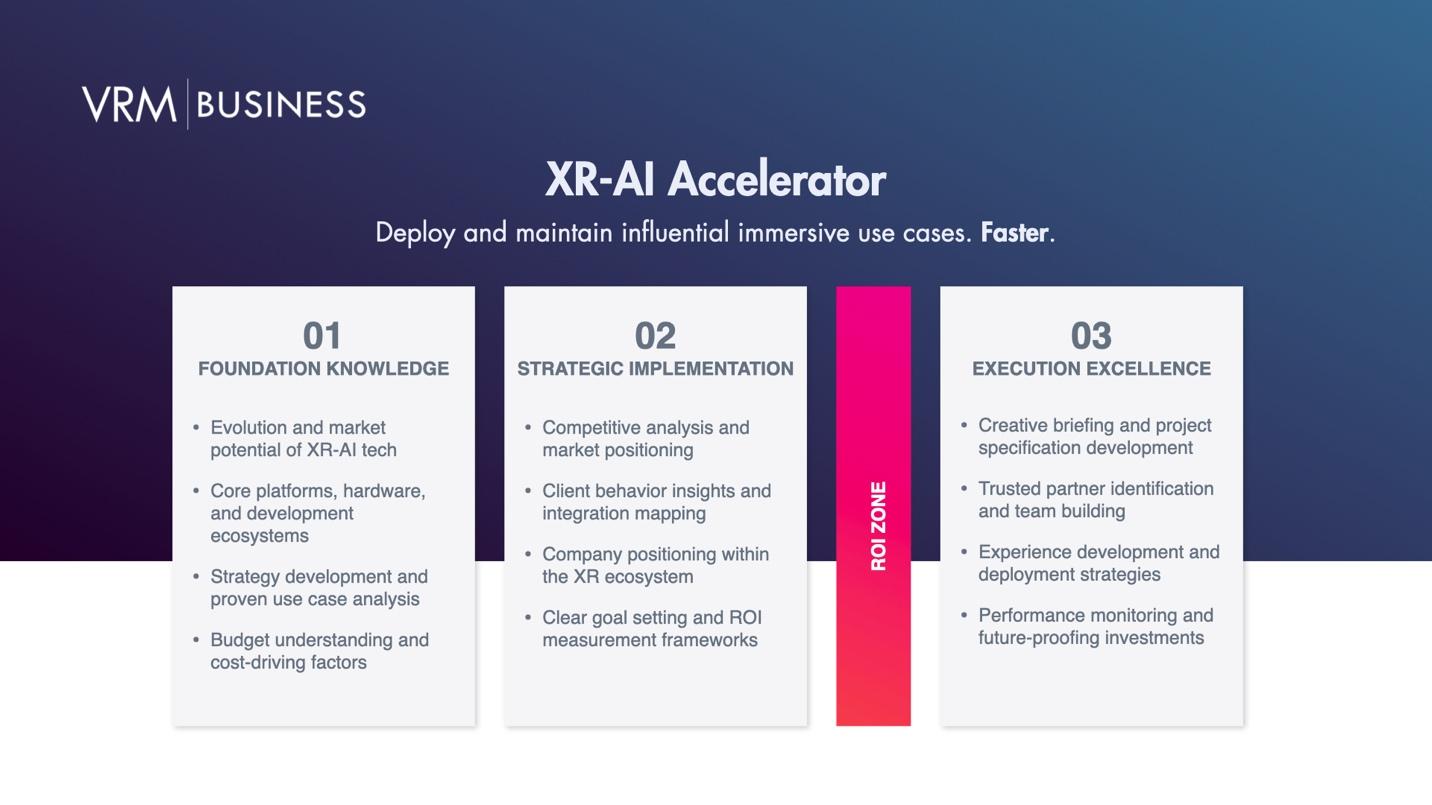
The XR-AI Accelerator Program is structured across three distinct phases:
Part 1: Foundation Knowledge (Months 1-4) establishes comprehensive understanding of the XR-AI ecosystem, core platforms, and development frameworks. Participants explore proven use cases while building essential knowledge of budget frameworks and cost drivers.
Part 2: Strategic Implementation (Months 5-8) focuses on competitive intelligence and market positioning. Organizations learn to identify their unique value proposition, analyze competitors, and develop clear goal-setting methodologies with ROI measurement frameworks.
Part 3: Execution Excellence (Months 9-12) transforms strategic understanding into operational capability through creative briefing, partner identification, and deployment strategies. Organizations emerge with comprehensive implementation strategies and internal expertise to scale successful pilots.
Target Outcomes
Organizations completing the program achieve immediate benefits including educated decision-making capabilities for XR technology selection, clear understanding of realistic budgets and timelines, and proven risk mitigation strategies.
Strategic advantages include positioning to capitalize on the trillion-dollar XR-AI opportunity, enhanced operational efficiency, new revenue streams through immersive content, and competitive edge through next-level customer engagement.
The program delivers future-proofed XR strategy frameworks, internal expertise to scale across the entire organization, and measurable ROI from XR investments—ultimately achieving sustainable competitive advantage in an increasingly spatial world.
Curriculum
XR-AI Accelerator – Part 1- Year 1
- Part 1 Month 1 What is XR-AI?
- Part 1 Month 2 XR-AI Core Technologies
- Part 1 Month 3 Strategy & Use Cases
- Part 1 Month 4 Understand XR Budgets
- Part 1 Month 5 Competitive Analysis
- Part 1 Month 6 Client Insight
- Part 1 Month 7 Positioning
- Part 1 Month 8 Goals & ROI
- Part 1 Month 9 Your XR-AI Solution
- Part 1 Month 10 Find an XR Partner
- Part 1 Month 11 Develop Your Next XR-AI Experience
- Part 1 Month 12 Monitor Metrics & Future-Proof
Program Objectives
The following list represents the Key Program Objectives (KPO) for the Appleton Greene XR-AI Accelerator corporate training program.
XR-AI Accelerator – Part 1- Year 1
- Part 1 Month 1 What is XR-AI? – Discover the Evolution of XR: Trace XR’s journey from early concepts to today’s sophisticated immersive technologies transforming how we work, learn, and interact with digital content across industries. Learn About Key Players: Examine companies and entrepreneurs driving XR innovation, from tech giants investing in spatial computing to startups creating breakthrough solutions. Understand Market Potential: Explore opportunities as industries adopt XR technologies to solve complex problems, create revenue streams, and transform customer experiences. Future Trends to Watch: Stay ahead of developments shaping XR-AI integration, ensuring your organization remains competitive in this rapidly changing landscape.
- Part 1 Month 2 XR-AI Core Technologies – Explore XR Hardware: Examine essential devices powering immersive experiences, including headsets, controllers, sensors, and wearables enabling seamless physical-digital interaction. Discover Leading Platforms: Investigate tools driving XR creation, from game engines to development ecosystems that streamline processes for creators worldwide. Understand XR & AI Convergence: Learn how AI revolutionizes XR through intuitive interfaces, personalized experiences, and adaptive systems responding to user behavior. Growth & Opportunities: Analyze business potential within XR technologies and identify industries leading adoption, creating markets through immersive solutions.
- Part 1 Month 3 Strategy & Use Cases – Learn Proven Research Processes: Master approaches for gathering intelligence about XR technologies, trends, and stakeholders to inform strategic decision-making. Identify Game-Changing Use Cases: Study real-world examples of XR revolutionizing enterprise operations, marketing, training, and customer experiences across industries. Strategize for Success: Develop implementation roadmaps integrating immersive technologies while maximizing ROI and minimizing risks for sustainable growth.
- Part 1 Month 4 Understand XR Budgets – Origins of XR Budgets: Understand how XR costs stem from video game production and economic factors driving pricing across immersive experiences. Compare Production Models: Analyze budget structures across video games, films, and XR projects to establish realistic financial planning frameworks. Focus on What Matters: Identify key budget areas like interactive graphics and platform optimization for strategic resource allocation decisions. Budget-Driving Factors: Learn parameters shaping costs including complexity, platforms, team size, and timelines with practical estimation tools.
- Part 1 Month 5 Competitive Analysis – Identify Key Competitors: Discover competitors in XR space, including emerging rivals that could impact your market position and strategy. Analyze Strengths & Weaknesses: Learn methods for assessing competitors’ strategies and capabilities to uncover differentiation opportunities and advantages. Define Your Niche: Use insights to carve unique XR industry positions highlighting strengths and creating compelling value propositions. Stay Ahead of Trends: Combine competitive analysis with industry knowledge to adapt proactively and maintain advantages in evolving markets.
- Part 1 Month 6 Client Insight – Understand Your Client Behavior: Gain insights into how businesses adopt XR-AI technologies, including decision processes and implementation challenges. Map Integration Opportunities: Analyze existing operations to identify where XR adds value, improves efficiency, and creates growth opportunities. Tailor Solutions to Needs: Develop customized XR strategies aligning with company goals, budgets, and capabilities while addressing unique challenges. Craft Actionable Plans: Design targeted roadmaps with clear milestones and success metrics ensuring seamless integration and project success.
- Part 1 Month 7 Positioning -Define Your Place in XR: Identify your unique value proposition by analyzing competencies, opportunities, and areas for strategic differentiation. Streamline Operations: Determine how XR enhances workflows, collaboration, and productivity while reducing costs and creating operational efficiencies. Position for Success: Craft positioning highlighting strengths, addressing audience needs, and differentiating from competitors meaningfully.
- Part 1 Month 8 Goals & ROI – Align XR-AI with Goals: Explore how immersive tech and AI support business objectives and strategic initiatives while creating competitive advantages. Set Achievable Targets: Define realistic XR goals across departments with clear success criteria and timelines aligned with organizational capabilities. Measure Success Effectively: Establish metrics linking to ROI and growth while tracking quantitative and qualitative success indicators.
- Part 1 Month 9 Your XR-AI Solution – Craft a Winning Creative Brief: Define project elements including objectives, audience, features, and platforms to align vision with goals. Detail Project Specifications: Provide teams with guidelines covering mechanics, design, audio, and technical requirements for cohesive execution. Streamline Collaboration: Ensure departments have tools and communication channels needed for efficient teamwork and successful delivery. Create a Unified Action Plan: Assign budgets, deadlines, and responsibilities ensuring seamless execution and proper resource allocation.
- Part 1 Month 10 Find an XR Partner – Align with Your Vision: Partner with XR creators who understand your business goals, culture, and long-term vision for success. Ensure Strategic Fit: Find experts delivering within budget and timeline constraints while maintaining flexibility for changing needs. Build a Cohesive Team: Assemble reliable professionals with complementary skills enhancing your team’s strengths and expertise. Foster Long-Term Relationships: Choose partners evolving with your business and providing ongoing support as XR needs grow.
- Part 1 Month 11 Develop Your Next XR-AI Experience – Assess and Define Use Case: Identify XR use cases delivering highest ROI by analyzing impact, requirements, and strategic alignment. Develop the XR Experience: Focus on quality asset creation, development processes, and testing for smooth immersive experiences. Deploy and Gather Feedback: Launch with stakeholder involvement and systematic feedback collection for continuous improvement and optimization.
- Part 1 Month 12 Monitor Metrics & Future-Proof – Evaluate Stakeholder Support: Assess user and stakeholder responses measuring adoption, satisfaction, and engagement for solution effectiveness. Track Broad ROI Metrics: Consider engagement, brand positioning, and efficiency gains beyond traditional ROI when measuring success. Plan for Tomorrow: Continuously improve and expand XR use cases to stay competitive and keep solutions fresh and valuable. Expand XR-AI Initiatives: Use feedback to enhance solutions and scale implementations across additional business areas systematically.
Methodology

XR-AI Accelerator
Context
With over 25 years in games, 3D and immersive technology, we’ve seen the XR-AI industry evolve from gaming roots into a sophisticated ecosystem spanning enterprise, industrial and consumer applications. However, it retains unique cultural practices, specialized vocabulary, and technical protocols that create significant barriers for traditional businesses.
Without understanding terms like “game engines,” “real-time rendering,” and “spatial computing,” organizations make costly assumptions leading to project failures. Success requires both technical knowledge and cultural awareness to build trust within this specialized sector.
Development & Implementation
Our 12-module accelerator transforms organizational XR-AI capability through systematic learning and strategic framework development. The structured approach builds lasting change rather than superficial technology awareness.
Foundation – Comprehensive XR-AI ecosystem introduction covering technical foundations, industry evolution, and market developments.
Research & Analysis – Establish methodologies for evaluating immersive technology, identifying reliable sources, and assessing emerging trends aligned with business objectives.
Competitive Intelligence – Examine obvious and hidden competitors, including traditional rivals adopting immersive technologies and tech companies expanding into your vertical.
Strategic Positioning – Align technical capabilities with market opportunities while understanding development practices and key industry stakeholders.
Implementation Planning – Consolidate learning into actionable roadmaps with realistic deployment timelines and coordinated action plans.
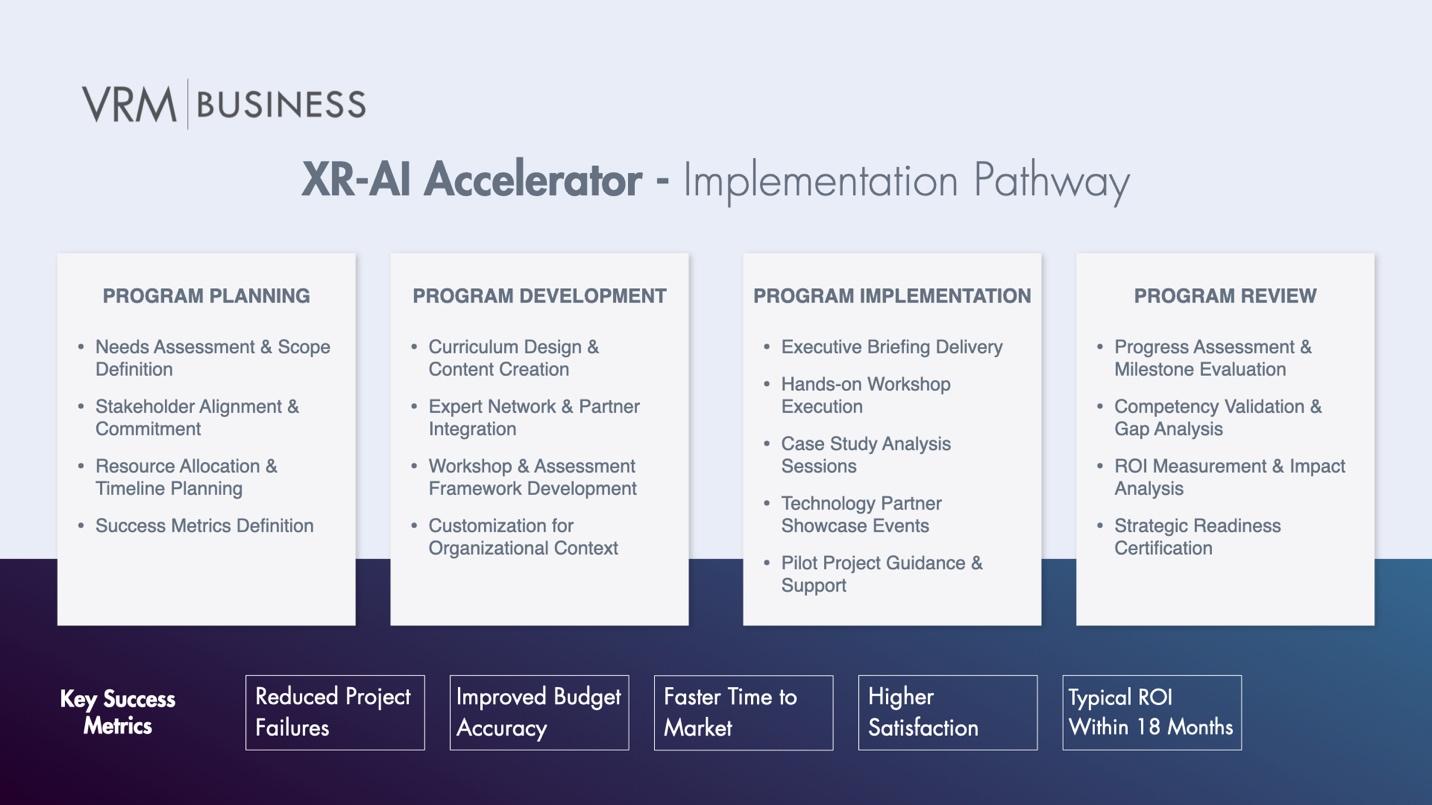
The program includes executive briefings, hands-on workshops, case study analysis, technology partner showcases, and pilot project guidance.
Success Metrics & ROI
Program effectiveness delivers:
Reduced project failure rates (down from 40% industry average)
Improved budget accuracy with minimal variance from estimates
Faster time-to-market through streamlined vendor selection
Higher stakeholder satisfaction via realistic expectation management
Measurable ROI achievement within 18 months
Investment and Value Proposition
The program cost represents a fraction of typical project overrun expenses. Most organizations recover their investment through avoided mistakes on their first major implementation, positioning them to capture value from the trillion-dollar XR-AI opportunity while avoiding million-dollar pitfalls that derail unprepared competitors.
Industries
This service is primarily available to the following industry sectors:

Training & Education
1.1 History
Training and education have evolved from one-to-one apprenticeships to mass classroom instruction, then to computer-based learning. The introduction of simulation-based training began in aviation during WWII, where flight simulators proved that immersive practice could safely replicate dangerous scenarios. This concept spread to military training, medical education, and industrial safety programs throughout the latter half of the 20th century.
The emergence of personal computers in the 1980s introduced computer-based training (CBT), but these systems remained largely passive, text-heavy experiences. The real transformation began with the convergence of VR technology and educational research in the 1990s, as pioneers recognized that spatial, hands-on learning could dramatically improve knowledge retention and skill acquisition.
Early adopters included NASA, which used VR for astronaut training, and medical schools that began experimenting with virtual anatomy lessons. However, high costs and technical limitations kept these applications limited to specialized, high-stakes training scenarios.
1.2 Current Position
XR training has reached a tipping point where ROI is clearly demonstrable across multiple sectors. Organizations report 75% better learning retention compared to traditional methods, while reducing training costs by up to 50% in complex industries like aerospace and manufacturing.
The technology now supports everything from Boeing’s pilot training programs to Walmart’s employee onboarding, which trains over 1 million associates annually using VR. Medical schools use virtual cadavers and surgical simulators, while technical training programs leverage haptic feedback for equipment maintenance and assembly procedures.
AI integration has transformed static VR training into adaptive, personalized learning experiences. AI-powered systems analyze learner behavior in real-time, adjusting difficulty levels, providing instant feedback, and identifying knowledge gaps. This creates customized learning paths that optimize both speed and comprehension.
The COVID-19 pandemic accelerated adoption as organizations needed safe, remote training solutions. Current implementations span soft skills training, compliance education, technical certification, and safety protocols across industries.
1.3 Future Outlook
AI will drive the next evolution of XR training through autonomous content generation and hyper-personalization. Future systems will create training scenarios on-demand, automatically updating content based on industry changes, regulatory updates, and individual performance data.
We anticipate the emergence of “training twins” – AI-powered replicas of real-world environments that continuously update based on operational data. These systems will predict training needs before skill gaps emerge, creating proactive rather than reactive learning programs.
The integration of natural language processing will enable conversational training experiences, where AI instructors can answer complex questions and engage in Socratic dialogue. Biometric monitoring will measure stress, attention, and comprehension levels, allowing systems to optimize training intensity and pacing for maximum effectiveness.
As XR hardware becomes more affordable and accessible, we expect training programs to extend beyond formal education into continuous, just-in-time learning that occurs within the flow of work.

Marketing
2.1 History
Marketing has evolved from simple product announcements to sophisticated brand storytelling designed to create emotional connections with consumers. From the grand advertising campaigns of the early 1900s to the catalog marketing revolution of the mid-century, each era introduced new ways to engage audiences and communicate brand value.
The digital transformation began with banner ads and email campaigns in the 1990s, but this created a fundamental challenge: how to capture attention in an increasingly cluttered digital environment. Early attempts included interactive web experiences and multimedia presentations, but these remained limited and often failed to create meaningful engagement with consumers.
Traditional digital marketing struggled with declining engagement rates and authentic brand connection, particularly with younger, digitally native audiences who increasingly used ad blockers and ignored conventional advertising formats. Brands needed new approaches to break through the noise and create memorable experiences.
The convergence of social media, gaming platforms, and XR technology has created entirely new marketing paradigms, where brands can create persistent, interactive experiences that go far beyond traditional advertising campaigns.
2.2 Current Position
Virtual marketing activations have achieved remarkable success metrics that demonstrate clear business value. Lucid Motors’ immersive car configurator showed 47% higher engagement and 46% more reservations compared to traditional digital campaigns. Fashion brands like Gucci and Nike have generated millions in virtual item sales on platforms like Roblox and Fortnite, creating entirely new revenue streams.
Starbucks’ virtual activations converted digital engagement into real-world sales, with 75,564 coupon redemptions from their Roblox campaign. This represents a new paradigm where virtual brand experiences drive physical store traffic and measurable revenue outcomes.
The integration of AI has enhanced personalization dramatically. AI-powered systems analyze user behavior in virtual brand spaces to deliver targeted messaging, while computer vision enables virtual try-on experiences that accurately demonstrate products on individual consumers. These technologies create deeper brand connections through personalized, interactive experiences.
Current implementations span immersive brand activations, virtual showrooms, AR product demonstrations, and experiential marketing campaigns that combine entertainment with brand messaging. The rise of “advertainment” on gaming platforms has created new touchpoints where branded content integrates naturally into user experiences rather than interrupting them.
Major brands now maintain persistent presences in virtual worlds, creating ongoing relationship-building opportunities rather than discrete advertising moments.
2.3 Future Outlook
The future of marketing will be defined by persistent virtual brand universes where companies maintain ongoing relationships with customers through immersive experiences. We anticipate the development of “lifestyle ecosystems” where brands create comprehensive virtual environments that reflect their values and allow deep exploration of their products and services.
AI will enable predictive marketing, where virtual brand assistants anticipate customer interests and automatically curate personalized brand experiences. Advanced computer vision and behavioral analysis will create hyper-targeted campaigns that adapt in real-time based on user reactions and engagement patterns.
The emergence of virtual economies will create new marketing models where branded virtual goods become collectible assets that extend brand engagement beyond traditional campaign lifecycles. Brands will develop parallel virtual product lines that enhance rather than replace their physical marketing strategies.
As XR technology matures, we expect the boundaries between entertainment, marketing, and social interaction to blur completely, creating unified brand experiences where marketing becomes a natural part of digital lifestyle rather than an interruption to it.

Industrial
3.1 History
Industrial operations have always been at the forefront of technological adoption, from the mechanization of the Industrial Revolution to the computer-aided design revolution of the 1980s. Industrial training traditionally relied on apprenticeship models where experienced workers taught newcomers through hands-on experience, often in dangerous environments across mining, oil and gas, chemical processing, and heavy equipment operations.
The introduction of computer-aided systems and automation in the 1970s began shifting industrial facilities toward digital interfaces, but the complexity of industrial processes remained a significant barrier to rapid skill development. Traditional training methods were time-intensive, expensive, and often resulted in costly mistakes during the learning process, particularly in high-risk environments like refineries, power plants, and offshore installations.
Early industrial VR applications emerged in the 1990s for design visualization and safety training, but high costs and technical limitations restricted adoption to large corporations with specialized budgets. The real transformation began in the 2010s as VR hardware became more affordable and AI-enhanced analytics could provide actionable insights from immersive training data across diverse industrial sectors.
3.2 Current Position
XR has proven transformative for industrial efficiency and safety across multiple sectors. BMW reports 30% error reduction in assembly processes using AR guidance systems, while Ford has achieved 25% production efficiency gains through VR training programs. DHL’s AR-guided warehouse operations have reduced downtime by 25% through improved maintenance procedures.
Current applications span diverse industrial operations: oil and gas companies use VR for safety training in hazardous environments, allowing workers to practice emergency procedures without risk. Chemical processing facilities employ AR overlays to guide maintenance technicians through complex equipment repairs, reducing errors and improving safety protocols.
Mining operations leverage immersive simulations for equipment training, while power generation facilities use virtual environments to train operators on critical systems. Remote industrial sites benefit significantly from AR-guided maintenance, where experienced technicians can guide field workers through complex repairs using digital overlays.
AI integration has enhanced these systems significantly. Machine learning algorithms analyze worker movements and operational patterns to identify optimization opportunities and predict maintenance needs. Predictive analytics help schedule training before skill gaps affect operational safety and efficiency.
Remote expert assistance has become crucial, especially post-pandemic. Experienced specialists can guide field workers through complex procedures using AR overlays, reducing travel costs while maintaining service quality. This has proven particularly valuable for companies with global operations and specialized equipment across remote industrial facilities.
3.3 Future Outlook
The future of industrial operations will be defined by fully integrated digital twins that combine real-time operational data with immersive visualization. Workers will interact with AI-powered virtual assistants that provide contextual guidance based on current facility conditions, equipment status, and individual skill levels.
Autonomous industrial systems will require new forms of human-machine collaboration, where operators manage and optimize AI-driven processes rather than performing manual tasks. XR interfaces will become the primary method for monitoring and controlling these complex systems across oil platforms, chemical plants, and power generation facilities.
We anticipate the development of “intelligent facilities” where AI continuously analyzes operational data to identify training opportunities and automatically generates custom VR simulations for skill development. These systems will predict workforce needs and proactively develop capabilities before they become critical for facility operations.
The integration of IoT sensors, AI analytics, and XR visualization will create unprecedented levels of operational transparency, enabling predictive maintenance, safety monitoring, and process optimization that responds to conditions in real-time across diverse industrial environments.

Architecture, Engineering & Construction (AEC)
4.1 History
Architecture and construction have relied on 2D drawings and physical models for centuries to communicate complex spatial concepts. The introduction of Computer-Aided Design (CAD) in the 1980s digitized the design process, but the fundamental challenge remained: translating 2D representations into 3D reality often resulted in costly miscommunications and construction errors.
Building Information Modeling (BIM) emerged in the 2000s as a more comprehensive approach, creating digital representations of physical and functional building characteristics. However, BIM remained primarily a tool for professionals, leaving clients and stakeholders to interpret complex technical documentation.
The construction industry was ripe for disruption by technologies that could provide immersive, accurate representations of spaces. Traditional visualization methods – whether architectural drawings, scale models, or basic 3D renderings – failed to convey the true spatial experience of proposed buildings and infrastructure projects.
4.2 Current Position
XR has revolutionized design collaboration and client engagement in AEC. Architects now conduct design reviews in virtual reality, allowing clients to experience spaces before construction begins. This has reduced change orders and improved client satisfaction while shortening design cycles.
Construction teams use AR overlays to visualize BIM data on job sites, reducing errors and improving coordination between trades. Mixed reality applications enable workers to see hidden infrastructure like plumbing and electrical systems, preventing costly mistakes during renovation projects.
The property sector has embraced virtual tours and AR visualization, especially accelerated by COVID-19. Buildings can be toured remotely, saving time for both professionals and clients while expanding project reach. Virtual staging allows empty commercial or residential spaces to be shown fully furnished, improving presentation outcomes.
AI integration enhances these applications through automated clash detection in design models, predictive analysis of construction schedules, and intelligent recommendation systems based on virtual tour behavior patterns.
The technology has proven particularly valuable for high-stakes projects where visualization errors could result in millions of dollars in changes or delays.
4.3 Future Outlook
The future will bring real-time collaborative design environments where global teams work together in persistent virtual spaces. AI will automatically generate design variations based on client feedback, regulations, and environmental constraints, dramatically accelerating the conceptual design phase.
Construction will evolve toward “augmented building” where every worker has access to contextual information through AR interfaces. AI-powered systems will continuously monitor progress, automatically updating project schedules and resource allocation based on real-time conditions.
Smart buildings will be designed and operated through XR interfaces, with building systems represented as interactive 3D models that facilities managers can manipulate intuitively. Predictive maintenance will be visualized spatially, with AI highlighting areas requiring attention before problems occur.
The construction sector will develop persistent virtual representations of projects that update automatically as physical changes occur. AI-powered virtual assistants will provide personalized project recommendations and answer questions during virtual walkthroughs, creating more engaging and informative experiences for all stakeholders involved in the building process.

Healthcare & Medical
5.1 History
Medical education has long relied on direct observation and hands-on practice, from ancient anatomical dissections to modern clinical rotations. However, the complexity of human physiology and the high stakes of medical errors created an ongoing challenge: how to provide sufficient practice opportunities without risking patient safety.
Simulation-based medical training began with simple anatomical models, evolving to computerized mannequins in the 1960s that could replicate basic physiological responses. These systems proved valuable for practicing procedures but remained limited in their ability to represent the full complexity of medical scenarios.
The introduction of laparoscopic surgery in the 1980s created a natural bridge to VR training, as surgeons were already accustomed to working through camera interfaces rather than direct vision. Early VR surgical simulators emerged in the 1990s, demonstrating that immersive practice could improve surgical skills without patient risk.
5.2 Current Position
Medical XR applications have achieved remarkable success in both education and clinical practice. Surgical residents using VR training show significant improvement in skill acquisition and retention compared to traditional methods. Medical schools increasingly use virtual anatomy labs where students can explore 3D human bodies with unlimited repeatability.
Clinical applications include surgical planning, where surgeons rehearse complex procedures in patient-specific virtual models created from medical imaging data. AR-guided surgery allows real-time overlay of digital information onto the surgical field, improving precision and reducing complications.
Mental health applications have shown promising results, with VR therapy proving effective for treating phobias, PTSD, and anxiety disorders. The controlled, repeatable nature of virtual environments allows therapists to gradually expose patients to triggering situations in a safe context.
AI integration has enhanced diagnostic applications, with machine learning algorithms analyzing medical images and providing recommendations through immersive interfaces. AI-powered virtual patients can simulate unlimited medical scenarios for training purposes, adapting their responses based on student actions.
Telemedicine has been transformed by XR capabilities, allowing specialists to virtually “visit” patients and examine conditions in immersive detail, particularly valuable for rural or underserved areas.
5.3 Future Outlook
Personalized medicine will be revolutionized by AI-powered XR systems that create patient-specific simulations for treatment planning. Doctors will be able to test different treatment approaches virtually before implementing them, optimizing outcomes while minimizing risks.
Medical education will evolve toward continuous, immersive learning where practitioners regularly update their skills through AI-generated scenarios based on the latest medical research and emerging health challenges. Virtual patients will become indistinguishable from real ones in their complexity and responsiveness.
Robotic surgery will integrate XR interfaces that provide surgeons with enhanced perception and control, potentially enabling procedures that exceed the limitations of human dexterity. AI assistants will provide real-time guidance and early warning of potential complications.
Mental health treatment will expand to include AI therapists that provide 24/7 support through immersive environments, complementing human therapists and making mental health care more accessible and affordable.
The convergence of XR, AI, and biotechnology will enable entirely new forms of medical visualization, potentially allowing doctors to observe cellular and molecular processes in real-time, transforming our understanding of disease and treatment at the most fundamental levels.
Locations
This service is primarily available within the following locations:

Location 1
Content here…

Location 2
Content here…

Location 3
Content here…

Location 4
Content here…

Location 5
Content here…
Program Benefits
Department 1
- Two Words
- Two Words
- Two Words
- Two Words
- Two Words
- Two Words
- Two Words
- Two Words
- Two Words
- Two Words
Department 2
- Two Words
- Two Words
- Two Words
- Two Words
- Two Words
- Two Words
- Two Words
- Two Words
- Two Words
- Two Words
Department 3
- Two Words
- Two Words
- Two Words
- Two Words
- Two Words
- Two Words
- Two Words
- Two Words
- Two Words
- Two Words
Testimonials

Testimonial 1
Content here…

Testimonial 2
Content here…

Testimonial 3
Content here…

Testimonial 4
Content here…

Testimonial 5
Content here…
More detailed achievements, references and testimonials are confidentially available to clients upon request.
Client Telephone Conference (CTC)
If you have any questions or if you would like to arrange a Client Telephone Conference (CTC) to discuss this particular Unique Consulting Service Proposition (UCSP) in more detail, please CLICK HERE.