

Optimizing Sales – WDP9 (Prospecting Preparation)

The Appleton Greene Corporate Training Program (CTP) for Optimizing Sales is provided by Mr. Monroe Certified Learning Provider (CLP). Program Specifications: Monthly cost USD$2,500.00; Monthly Workshops 6 hours; Monthly Support 4 hours; Program Duration 12 months; Program orders subject to ongoing availability.
If you would like to view the Client Information Hub (CIH) for this program, please Click Here
Learning Provider Profile
Mr. Monroe is a Certified Learning Provider (CLP) at Appleton Greene. He has spent his career in High Tech sales and sales leadership positions. Hired straight out of University by AT&T, David was one of the first 100 employees hired by AT&T outside of the US. David then transitioned to software sales and was a founding member of the Nixdorf Optical Document Management team in Toronto, Canada, securing the first sales with the Canadian Federal Government and a leading Property and Casualty Insurance company prior to the acquisition of Nixdorf by Siemens. Having had considerable sales success in the Telecommunications and Imaging industries, David was recruited to join a leading Canadian Executive Recruitment firm where he specialized in placing Sales and Sales Leadership roles before returning to the Software industry where he has spent most of his career.
With a proven track record of sales success early in his career, Mr. Monroe transitioned to Sales Leadership and has spent the last 25+ years of his career building new sales teams or fixing broken sales organizations. With a passion for sales and building/fixing teams, David has been hired by the same CEO’s on multiple occasions which is a testament to his ability to deliver results in the most challenging scenarios.
Mr. Monroe’s proficiency in sales organization optimization has played a crucial role in the financial success of both start-up and mid-market high tech companies. David’s common-sense approach to sales success is rooted in the recognition that your sales team members are your most valuable commodity. Creating an environment that clearly lays out expectations, removes obstacles and marries the best sales strategies with new technological advancements has made his approach to sales optimization as critical today as it has been throughout his career.
With a strong focus on delivering consistent and reliable sales results, Mr. Monroe’s proven strategies create trust with other functional areas of an organization, the C-suite Executive Team and Board of Directors.
Mr. Monroe, as VP Sales, led Reward & Recognition start-up Cooleaf to #1,637 on the Fast 5000 privately held companies list in 2021. Cooleaf has since been acquired by ITA Group. As EVP & CRO at Awee (Cybersecurity Education start-up), he has been quoted in numerous publications in 2024 including LA Weekly, USA Today and MSN. Working throughout his career in North America, the Caribbean, Southeast Asia, Europe and the Middle East, Mr. Monroe’s approach has delivered consistent results around the world.
Recently, Mr. Monroe founded a boutique management consulting firm to bring his unique blend of sales experience, insights and perspective to a broader audience.
Education-wise, Mr. Monroe holds a Bachelor of Social Science from the University of Western Ontario.
With a solid foundation of experience, knowledge, and a results-driven approach, Mr. Monroe is well-equipped to contribute to the success of any sales organization.

MOST Analysis

Mission Statement
The objective of this module is to develop an understanding of prospecting as a critical element of sales success. Often salespeople think that prospecting is something done by marketing. Although generating leads is a part of marketing’s goals and objectives it is important for individual contributors to take ownership of this business task and focus on it consistently. Once leads have been identified and first meetings set, driving the greatest value from that first meeting is critical. Preparing for a first meeting has never been easier! Do you know your ICP? This plays a critical role in focusing all prospecting efforts. Know your top competitors and be able to compare your value proposition with others. Do not be negative about the competition but take the approach that there is “no empirical right or wrong, just different choices” and be adept at laying these out for prospects in an easily digestible way. Cold email outreach at scale is a two-edged sword. Although it might be perceived as a way to accelerate prospecting efforts, if you choose to embrace this approach, have a clear reason why and what role it should play in your overall sales organization. Ultimately you need sales buy in to make this effective if it will become a key component of sales team prospecting efforts. You will also need to determine what tools you will use to manage this process as effectively as possible (ZoomInfo, LinkedIn Sales Navigator, CRM etc.) Targeted outreach based on your ICP should be a primary focus in B2B sales. Salespeople need to commit to the research necessary to identify key target accounts and the roles within those organizations that they need to connect with. Use annual reports to identify the CEO’s major goals and plans for the organization. Find a way to align your solution with the target’s identified goals and objectives and build a bridge between your solution and their ability to meet their stated plans. Connect on LinkedIn with key targeted contacts around shared common ground and interests. Start a conversation, don’t sell. Build rapport and trust first and learn what is important to them and their organization. Events can play a key role in prospecting too! Build events tailored to the level of contact you want to attract. Provide a business purpose (presentation on key topic, networking opportunity, case study presentation by a current client, etc.) and build in some fun (host at a sporting venue or winery, have a morning business function and afternoon golf tourney, etc.). Have your clients do the selling for you through presenting their successes with your solution at events. Consider recognizing your “Most Strategic Client” each year at an event in your sales region. Their presentation of their success with your solution will prove invaluable! 1st Mtg Preparation, “Failure to prepare is preparing to fail”. Use the tools you have available to you (LinkedIn, Google search, ZoomInfo etc.), preparing for interactions with prospects have never been easier. Don’t sell, build rapport, and learn about the individual and their organization. Your single sales objective (SSO) is to secure a second meeting. Throughout the relationship with the prospect, you need to bring insights and perspective they do not get from others to demonstrate your value.

Objectives
01. Own It: departmental SWOT analysis; strategy research & development. Time Allocated: 1 Month
02. Be Consistent: departmental SWOT analysis; strategy research & development. Time Allocated: 1 Month
03. ICP Focus: departmental SWOT analysis; strategy research & development. Time Allocated: 1 Month
04. Market Awareness: departmental SWOT analysis; strategy research & development. Time Allocated: 1 Month
05. Solution Differentiation: departmental SWOT analysis; strategy research & development. Time Allocated: 1 Month
06. Targeted Outreach: departmental SWOT analysis; strategy research & development. Time Allocated: 1 Month
07. Account Based Prospecting: departmental SWOT analysis; strategy research & development. 1 Month
08. Leverage Data & Technology: departmental SWOT analysis; strategy research & development. Time Allocated: 1 Month
09. Content & Thought Leadership: departmental SWOT analysis; strategy research & development. Time Allocated: 1 Month
10. Networking & Referrals: departmental SWOT analysis; strategy research & development. Time Allocated: 1 Month

Strategies
01. Own It: Each individual department head to undertake departmental SWOT analysis; strategy research & development.
02. Be Consistent: Each individual department head to undertake departmental SWOT analysis; strategy research & development.
03. ICP Focus: Each individual department head to undertake departmental SWOT analysis; strategy research & development.
04. Market Awareness: Each individual department head to undertake departmental SWOT analysis; strategy research & development.
05. Solution Differentiation: Each individual department head to undertake departmental SWOT analysis; strategy research & development.
06. Targeted Outreach: Each individual department head to undertake departmental SWOT analysis; strategy research & development.
07. Account Based Prospecting: Each individual department head to undertake departmental SWOT analysis; strategy research & development.
08. Leverage Data & Technology: Each individual department head to undertake departmental SWOT analysis; strategy research & development.
09. Content & Thought Leadership: Each individual department head to undertake departmental SWOT analysis; strategy research & development.
10. Networking & Referrals: Each individual department head to undertake departmental SWOT analysis; strategy research & development.

Tasks
01. Create a task on your calendar, to be completed within the next month, to analyze Own It.
02. Create a task on your calendar, to be completed within the next month, to analyze Be Consistent.
03. Create a task on your calendar, to be completed within the next month, to analyze ICP Focus.
04. Create a task on your calendar, to be completed within the next month, to analyze Market Awareness.
05. Create a task on your calendar, to be completed within the next month, to analyze Solution Differentiation.
06. Create a task on your calendar, to be completed within the next month, to analyze Targeted Outreach.
07. Create a task on your calendar, to be completed within the next month, to analyze Account Based Prospecting.
08. Create a task on your calendar, to be completed within the next month, to analyze Leverage Data & Technology.
09. Create a task on your calendar, to be completed within the next month, to analyze Content & Thought Leadership.
10. Create a task on your calendar, to be completed within the next month, to analyze Networking & Referrals.
Introduction

Prospecting has long been considered the lifeblood of sales. It is the activity that ensures a constant flow of opportunities into the pipeline. Without prospects, there are no customers; without customers, there is no revenue; and without revenue, no organization can sustain itself. This fundamental truth has made prospecting not just an entry-level task for salespeople but a strategic cornerstone of business growth.
In the realm of complex B2B (business-to-business) sales, prospecting assumes a strategic significance. Unlike simple or transactional sales, B2B prospecting is deliberate, strategic, and multi-layered. It demands patience to nurture long cycles, research to uncover hidden opportunities, foresight to anticipate organizational needs, and relationship-building to earn credibility with multiple stakeholders. Your role in this process is not just significant, but pivotal to the success of the business.
The challenge, however, is that prospecting is too often oversimplified. Many still reduce it to the idea of “finding people who might buy” and loading their names into a funnel. While this transactional view may apply in specific contexts—such as retail or basic B2C sales—it fails to capture the nuance and rigor required in high-stakes B2B environments. Here, the goal is not simply to collect contacts or chase volume, but to carefully identify the right opportunities: those that align with the product or service, have the potential for impact, and can lead to long-term, mutually beneficial partnerships.

This introduction aims to unpack prospecting in its fullest sense. We will examine its historical roots to understand how it has evolved from door-to-door persistence to insight-driven strategy. We will discuss its current role in modern B2B sales, where preparation, data, and empathy are key to success. Finally, we will explore its future direction in an era shaped by AI, digital transformation, and hyper-personalization. By situating prospecting within this broader context and by underscoring why preparation is the single most critical factor for success, this introduction sets the stage for participants to rethink their approach to one of the most vital yet misunderstood aspects of sales.
The Historical Context of Prospecting
Prospecting has always been central to the craft of selling, but the way it has been practiced has shifted dramatically over time. Each era of sales has been defined by the tools available, the business environment, and the expectations of buyers. By tracing its historical development, we can gain a deeper understanding of the progress and innovation that have shaped modern prospecting and why it will continue to evolve as technology and buyer behavior evolve.
Prospecting in the Early Days of Sales
The origins of the word “prospecting” can be traced back to the 1800s mining industry. Prospectors scoured rivers, mountains, and remote terrains in search of gold, silver, or valuable minerals. Success required patience, sharp observation, and the right tools to sift through countless rocks and dirt to uncover hidden value. The metaphor naturally carried over into business: just as miners searched for rare veins of gold, salespeople sought out potential customers among the masses.
In the late 19th and early 20th centuries, sales were primarily transactional and driven mainly by mobility and persistence. Traveling salespeople—often called “drummers,” “peddlers,” or “commercial travelers”—roamed towns and cities with product samples and catalogs. They sold sewing machines, vacuum cleaners, insurance policies, and encyclopedias directly to households.
Their prospecting method was rooted in volume and persistence. The formula was simple: knock on every door, speak to as many people as possible, and rely on the law of averages to secure sales. Preparation in this era meant planning a route, carrying enough product samples, and perhaps rehearsing a well-practiced pitch. Success was tied to stamina, resilience in the face of rejection, and the willingness to keep going until someone finally said “yes.”
Prospecting in the early days was a numbers game, where effort was the key to success. However, as markets became more competitive and buyers more discerning, this approach gave way to a more strategic process.
Mid-20th Century: Structured Prospecting Emerges
By the mid-20th century, the business world was undergoing significant changes. Organizations were growing larger, supply chains were expanding, and competition intensified. Purchases were no longer made only by individuals at home but increasingly by corporate departments and professional buyers.
The mid-20th century brought significant changes to the business world. Organizations were growing larger, supply chains were expanding, and competition was intensifying. This shift required salespeople to adapt. To succeed, they needed to navigate organizational hierarchies, understand procurement processes, and differentiate themselves in crowded markets. Prospecting thus became more systematic and structured.
Preparation in this era meant more than carrying samples. It included:
Studying industry directories and trade publications to identify potential buyers.
Attending trade shows and conferences to meet prospects face-to-face.
Joining professional associations to build credibility and gain introductions.
Sales training also became formalized. Influential programs, such as Dale Carnegie’s sales courses in the 1930s and later corporate training at companies like IBM and Xerox, reshaped the sales profession. These programs emphasized listening skills, asking thoughtful questions, and tailoring solutions to buyers’ needs.
The emphasis shifted from pure persistence to preparation. The best salespeople were no longer those who knocked on the most doors, but those who did their homework, engaged buyers thoughtfully, and built professional relationships.
The Cold Calling Era (1960s–1990s)
The widespread adoption of the telephone in the mid-20th century revolutionized prospecting. Suddenly, salespeople could reach hundreds of potential prospects in a single day without leaving their desks. The era of cold calling had begun, and for decades, it dominated the sales landscape.

Companies invested in call centers, purchased lists of phone numbers, and built inside sales teams that could make thousands of dials daily. For many, prospecting became a high-volume, high-activity discipline once again. The image of the relentless “cold caller” became synonymous with sales itself.
Yet even during this period, preparation remained a differentiator. The most successful salespeople did not simply pick up the phone and read from a script. They researched industries, tailored their opening lines, and prepared to handle common objections. Cold calling may have been about numbers, but converting those numbers into meaningful opportunities required insight and planning.
This era also gave rise to the stereotype of aggressive, intrusive sales tactics—images immortalized in popular culture (e.g., Glengarry Glen Ross). It highlighted both the power and the limitations of prospecting methods that prioritized activity over strategy.
The Digital Revolution (1990s–2000s)
The late 20th and early 21st centuries brought about another seismic shift: the rise of digital technology. Email, the internet, and Customer Relationship Management (CRM) systems have fundamentally changed how salespeople identify and engage with prospects.
Instead of relying solely on purchased lists or phone directories, salespeople could now:
Research prospects online by studying company websites and press releases.
Log and track interactions in CRM systems, such as Salesforce.
Segment outreach based on industry, geography, or company size.
Use email campaigns to reach hundreds of prospects at scale with consistent messaging.
Prospecting preparation in this era meant becoming more data-driven. Salespeople could enter calls and meetings armed with knowledge of a company’s size, recent developments, and potential pain points. For the first time, sellers could initiate interactions on a “warm” basis rather than starting from a frigid state.
The digital revolution blurred the line between marketing and sales. Marketing generated leads through websites, email campaigns, and inbound strategies, while sales built on that foundation with targeted outreach. Prospecting was no longer just about finding names—it was about aligning with a broader, more strategic approach to customer acquisition.
The Present Day: Insight-Driven Prospecting
Today, prospecting has evolved into an intelligence-driven discipline. Modern buyers are more informed, empowered, and selective than ever. With access to online reviews, competitor comparisons, and industry research, they expect sellers to approach them with a deep understanding of their business and industry context.
This new reality means that generic outreach is no longer effective. Buyers quickly dismiss irrelevant emails or calls that fail to show insight. Preparation in the modern context means:
Using LinkedIn Sales Navigator or other platforms to map decision-makers and influencers.
Analyzing company reports, earnings calls, and press releases to identify strategic priorities.
Leveraging predictive analytics and intent data to determine which prospects are most likely to convert.
Personalizing outreach to demonstrate relevance to each stakeholder’s role and objectives.
Salespeople who fail to prepare are quickly ignored. In contrast, those who invest the time to align their outreach with the prospect’s reality position themselves as trusted advisors rather than transactional sellers.
In today’s B2B environment, prospecting is less about finding leads and more about building meaningful opportunities. It is consultative, strategic, and anchored in preparation.
Bridging Past and Present
Looking back, we can see a clear trajectory: from sheer persistence (early days) to systematic planning (mid-20th century), to mass activity with some preparation (the cold calling era), to data-driven approaches (digital revolution), and now to intelligence and insight (present day).
Each shift has underscored the same lesson: while tools and tactics may change, the salespeople who succeed are those who prepare more thoughtfully than their competitors.
The Unique Challenge of Prospecting in Complex B2B Sales
Prospecting in complex B2B environments presents a unique set of challenges that go far beyond those encountered in transactional or consumer sales. In these high-value, high-stakes deals, preparation becomes essential because the path to a closed deal is rarely a linear one. Salespeople must navigate multiple decision-makers, extended sales cycles, questions of strategic fit, and the critical importance of relationship-building.
Multiple Decision-Makers
Unlike transactional sales, where a single person makes a quick purchase decision, B2B sales typically involve a buying committee—a group of stakeholders from different departments, each with their concerns, goals, and priorities.

A CFO may focus on cost savings and ROI.
A CIO may be concerned about technical integration, security, or scalability.
A department head or end user may prioritize ease of use and operational impact.
Prospecting, therefore, is not simply about identifying a buyer but instead mapping an entire ecosystem of influencers and decision-makers. Preparation means studying the company’s structure, understanding internal politics, and anticipating areas where agendas may conflict. A salesperson who can align their solution with these diverse perspectives becomes far more valuable and credible.
Long Sales Cycles
Complex B2B sales are not quick transactions; they often unfold over months or even years. Multiple presentations, pilot projects, internal approvals, and legal reviews may all be part of the journey.
Effective prospecting involves being willing to invest time upfront in research, establishing credibility, and building relationships, even when there is no immediate return on investment. Preparation ensures that the salesperson is not chasing “busy work” but rather prioritizing accounts with genuine long-term potential. In this context, patience is as much a skill as persistence, and preparation is what keeps the process disciplined rather than reactive.
Strategic Fit
Not all prospects are equal in value or likelihood of success. A company may appear attractive at first glance, but lack the budget, urgency, or internal alignment to justify the investment. Conversely, a more complex or slower-moving prospect might represent enormous long-term value if properly nurtured.
This is where preparation makes the difference. By clearly defining what constitutes a “good prospect”—for example:
Industry relevance
Company size and financial health
Current needs and challenges
A clear decision-making process
Sales teams can qualify opportunities early and focus their energy on the most promising accounts. This avoids wasted effort and ensures that resources are deployed where they can yield the greatest return on investment.
Relationship-Building Over Transactions
In B2B, deals are rarely won on price or product features alone. Trust and credibility are often the deciding factors in establishing a relationship. Buyers want to work with partners who understand their business, can be relied upon during challenges, and who will deliver long-term value.
Preparation for prospecting, therefore, must include strategies for relationship-building:
Developing thought leadership that demonstrates expertise.
Crafting personalized outreach that signals genuine understanding.
Engaging prospects with value-driven insights long before a proposal is ever presented.
By doing this, salespeople position themselves as trusted advisors rather than transactional sellers, laying the groundwork for deeper collaboration and repeat business.
Bringing It Together
The complexity of B2B prospecting lies in balancing these dynamics simultaneously: navigating multiple decision-makers, sustaining engagement across long cycles, qualifying for strategic fit, and building relationships rooted in trust. In each of these areas, preparation is what transforms a daunting process into a manageable and successful one.
Why Preparation is the Cornerstone of Prospecting
Efficiency – Time is the salesperson’s most valuable asset. Preparation ensures it is invested in the right opportunities.
Credibility – Buyers expect sellers to have a thorough understanding of their industry. Preparation demonstrates seriousness and professionalism.
Customization – Generic outreach is ignored; tailored conversations require preparation.
Relationship-Building – Trust is built on relevance, insight, and consistency—all of which depend on preparation.
Best Practices in Prospecting Preparation
Defining the Ideal Client Profile (ICP): Identifying the right prospects before reaching out.
Account-Based Prospecting (ABP): Focusing on high-value accounts and preparing deep insights for targeted engagement.
Stakeholder Mapping: Identifying decision-makers and influencers within target organizations.
Leveraging Data & Technology: Using CRMs, LinkedIn Sales Navigator, and predictive analytics tools.
Content & Thought Leadership: Preparing insights that add value during the prospecting phase.
Referrals & Networking: Preparing introductions through trusted connections.
The Future of Prospecting
Looking ahead, prospecting is poised for another profound transformation, driven by emerging technologies, shifting buyer expectations, and evolving business dynamics. Just as exploration once shifted from door-to-door persistence to cold calling, and later to digital and data-driven strategies, the next era will be defined by AI, personalization, integration, and ethics. Preparation will remain the foundation, but the tools and expectations surrounding it will continue to evolve.

AI-Driven Prospecting
Artificial intelligence is already altering how salespeople prepare for prospecting. Modern tools can sift through massive datasets, uncover patterns in buyer behavior, and predict intent signals, such as when a company is likely to consider new vendors or allocate a budget for a solution. AI can also recommend the best timing, channels, and messaging for outreach.
For example, platforms now analyze job postings, website traffic, or press releases to flag accounts that may soon face challenges your solution can solve. Instead of spending hours on manual research, future salespeople will increasingly rely on AI-driven insights to create strategies that are both efficient and precise.
Hyper-Personalization
As buyers are inundated with generic outreach, personalization will no longer be a differentiator—it will be a baseline expectation. Future prospecting will involve micro-targeted communication tailored not only to a company’s industry but also to an individual’s role, pain points, and even their preferred style of interaction.
For instance, a CFO might receive a financial-impact case study, while a CIO receives a technical integration guide. Preparation will involve equipping salespeople with dynamic playbooks that tailor messaging to each persona, ensuring every touchpoint feels relevant and valuable.
Integration with Marketing
The traditional divide between sales and marketing is fading. In the future, prospecting will be a seamless extension of marketing efforts. Campaigns that once ended with lead generation will now flow directly into personalized sales outreach, informed by shared data and aligned messaging.
Preparation will include collaborating with marketing teams to co-create thought leadership content, webinars, and industry reports that can serve as conversation starters with prospects. Sales will increasingly leverage marketing automation platforms to understand engagement history and tailor outreach accordingly.
Human-Centered Value
Ironically, as technology advances, the human element in sales will become increasingly important. Buyers may appreciate AI’s efficiency, but they will still seek relationships with salespeople who listen, empathize, and act as strategic advisors.
Preparation will therefore involve more than technical or product knowledge—it will also mean honing soft skills, such as emotional intelligence, storytelling, and consultative questioning. In a world of automation, genuine human connection will be what sets great salespeople apart.
Ethical and Legal Dimensions
Ethical considerations and adherence to legal compliance will shape the future of prospecting. As privacy regulations, such as GDPR and CCPA, evolve, preparation will require ensuring that outreach strategies are respectful, transparent, and compliant with these regulations.
Sales organizations will need to strike a balance between the drive for personalization and the responsibility to handle data ethically and responsibly. This will not only protect businesses from legal risk but also help build trust with prospects, who are increasingly sensitive to how their information is collected and used.
Looking Ahead
The future of prospecting will be a blend of technology-enabled precision and human-centered authenticity. Success will belong to those who can harness AI and data without losing sight of empathy and trust. Preparation will remain the anchor, but it will evolve to include advanced analytics, cross-functional collaboration, and ethical responsibility.
Conclusion
Prospecting preparation is not a peripheral task—it is the foundation of successful sales. It has always been the differentiator between those who merely participate in sales activity and those who consistently deliver results. From the early days of door-to-door selling, where preparation meant planning a route and carrying enough samples, to today’s AI-powered insights, where preparation involves analyzing intent data and mapping stakeholders, the pattern is clear: preparation separates the average salesperson from the exceptional one.
In the world of complex B2B sales, where deals are long, high-stakes, and involve multiple stakeholders, preparation is not just helpful—it is indispensable. It is what allows salespeople to identify the right opportunities instead of chasing every lead, to navigate the competing priorities of a buying committee, and to build credibility with decision-makers who expect more than a sales pitch. In this environment, preparation is not about filling a pipeline—it is about laying the groundwork for trust, strategic alignment, and long-term success.
Looking ahead, the future of prospecting will bring new tools and new expectations. Artificial intelligence will accelerate research and reveal opportunities invisible to the human eye. Hyper-personalization will become the new standard, making relevance the price of entry. Integration between marketing and sales will ensure that every interaction is part of a seamless buyer journey. And yet, amidst all these changes, the essence of prospecting preparation will remain timeless: those who prepare deeply, think strategically, and engage authentically will continue to win.
Prospecting preparation is not just about closing the next deal—it is about building the habits, insights, and relationships that sustain success over years and even decades. It is the discipline that transforms sales from a numbers game into a strategic craft. And it is the commitment to preparation that ensures, no matter how the landscape evolves, sales professionals will always be ready to turn opportunities into outcomes.
The better you prepare, the greater your chances of success—yesterday, today, and tomorrow.

Case Study: IBM’s Transition to Insight-Driven Prospecting
Background
In the 1990s, IBM faced a significant challenge. Once known primarily for hardware, the company was transforming into a services and solutions provider. This meant the sales process was no longer about selling boxes of mainframes or PCs but about navigating complex B2B engagements where deals could take months—or years—to close.
Unlike hardware, services required IBM sales teams to uncover deep client needs, map decision-makers across large organizations, and align solutions to long-term strategic goals. It was no longer enough to “knock on doors” or rely on volume-based outreach.
The Prospecting Problem
IBM’s traditional sales playbook emphasized activity: making calls, sending proposals, and covering as many accounts as possible. But in this new environment, this transactional approach often led to:
Unqualified opportunities — Many prospects were not ready for services or lacked the budget.
Stalled deals — Sales teams failed to identify all stakeholders, so deals died in procurement or IT review.
Eroded credibility — Generic pitches undermined IBM’s positioning as a trusted strategic partner.
Without a redefined approach to prospecting, IBM risked losing relevance in a market increasingly defined by consultative sales.
The Prospecting Shift: Preparation as Strategy
IBM’s leadership recognized that prospecting had to evolve. They rolled out a new framework emphasizing preparation, insight, and stakeholder engagement. The key changes included:
Ideal Client Profiles (ICP): IBM defined clear criteria for “good prospects” (e.g., industries undergoing digital transformation, organizations investing heavily in IT infrastructure, and accounts with complex global operations).
Account-Based Prospecting (ABP): Instead of spreading efforts thin, sales teams focused intensely on fewer high-value accounts, treating each as a “market of one.”
Stakeholder Mapping: Salespeople were trained to identify and engage multiple decision-makers—CFOs, CIOs, operations leaders—each with distinct needs.
Industry Insights: Preparation involved researching client industries and presenting thought leadership. White papers, case studies, and custom workshops became part of prospecting conversations.
Technology Enablement: IBM adopted CRM and analytics tools to track engagement, identify buying signals, and prioritize accounts.
The Outcome
The shift paid off dramatically:
Higher Win Rates: By qualifying opportunities early and aligning with strategic needs, IBM’s sales teams reduced wasted effort and increased conversion.
Shorter Sales Cycles: Although deals still took time, identifying decision-makers upfront prevented delays later in the process.
Stronger Client Relationships: Prospects began viewing IBM not as a vendor but as a trusted advisor who understood their business.
Sustainable Growth: This prepared, insight-driven prospecting approach helped IBM secure large, long-term service contracts that anchored its transformation into a global technology services leader.
Lessons Learned
IBM’s case demonstrates that prospecting is not just about finding names—it’s about finding the right opportunities and preparing intensely to pursue them. The key lessons are:
Preparation drives efficiency. Fewer but better-qualified prospects yielded better outcomes.
Multiple decision-makers require a strategy. Mapping stakeholders early prevents later roadblocks.
Insight builds credibility. Thought leadership turned prospecting into relationship-building.
Technology is an enabler, not a substitute. CRM and analytics supported—but did not replace—the human element of preparation.
Relevance for Today
What IBM faced in the 1990s is the same challenge many B2B organizations face today: moving from a transactional, volume-driven approach to a strategic, preparation-driven discipline. Their success story illustrates why prospecting preparation remains the lifeblood of sales and why, in complex B2B environments, it must be treated as a strategic cornerstone of growth.

Exercise: Prospecting Then and Now – Personal Accountability in Sales
Executive Summary

Chapter 1: Own It
Prospecting is not just a part of sales—it is the lifeblood that keeps the entire process alive. Without a steady flow of new opportunities, even the most talented salespeople will struggle to meet targets and sustain momentum. This is especially true in B2B sales, where cycles are long, relationships are complex, and deals rarely close quickly. Every successful sale begins with identifying the right prospects, starting meaningful conversations, and building trust until opportunities mature into agreements.
Much like planting seeds in a garden, prospecting requires consistency and patience. If a salesperson stops planting today, the effects may not be immediately apparent—but months later, the pipeline will dry up. Despite this reality, prospecting is often treated as a chore, an afterthought, or something to be handled by others. This passive mindset weakens both individual performance and organizational growth. To succeed, salespeople must adopt one principle above all others: Own It.

Owning prospecting means taking complete accountability for building and sustaining a pipeline. Success in sales is directly tied to personal effort, and when salespeople embrace this responsibility, they stop waiting for opportunities and begin creating them. Ownership goes beyond generating leads—it demands discipline, initiative, and alignment with organizational goals. A salesperson who owns their pipeline enters each day with a plan, focuses on high-value activities, and treats results as a reflection of their effort. Without this mindset, prospecting becomes inconsistent and ineffective. With it, outreach is approached with urgency and intentionality, whether through calls, emails, events, or digital tools. Every action has a purpose, and this is what separates top performers from average ones.
Ownership also fuels motivation. Accountability creates a direct link between input and outcome: the more effort invested, the greater the results. This understanding encourages consistency, experimentation, and continual improvement—prospecting shifts from being a burden to becoming a professional responsibility tied to pride and long-term success. Challenges are no longer roadblocks but opportunities to sharpen communication, refine messaging, and adapt to new situations. Rejections turn into valuable feedback, and competition becomes a motivator for innovation.
Another benefit of ownership is territory mastery. Every sales area has its own customer needs, market dynamics, and competitive pressures. Salespeople who take accountability treat their territory like a business within the business. They understand local challenges, identify hidden opportunities, and tailor messaging to resonate with decision-makers. This more profound knowledge not only builds healthier pipelines but also establishes credibility, positioning them as trusted advisors in their markets.
Consistency is the thread that ties everything together. By making prospecting a daily habit, salespeople avoid the feast-or-famine cycles that come from sporadic outreach. Many top organizations track prospecting activity as closely as revenue, recognizing that long-term success hinges on the consistent creation of opportunities. For the individual, this consistency builds confidence and credibility, ensuring that progress is continuous rather than sporadic.
At the same time, accountability strengthens relationships. When salespeople put in the effort to research prospects, understand their challenges, and craft authentic messages, trust develops from the very first interaction. This foundation often grows into long-term partnerships that competitors struggle to displace. Alongside this, ownership drives personal growth: each call, meeting, or email provides lessons that compound over time, making salespeople more skilled, adaptable, and resilient in an ever-changing market.
Finally, ownership enhances job satisfaction. There is a unique sense of pride in generating and closing your own opportunities. Success feels more rewarding because it fuels motivation and creates momentum, ultimately driving further achievement. Without this sense of ownership, disengagement often sets in. Salespeople who rely solely on others for leads may feel powerless or undervalued, but accountability restores purpose, autonomy, and fulfillment.
Prospecting cannot be left to chance. It must be owned. When salespeople take ownership of their actions, they become proactive, motivated, and aligned with the business’s goals. They strengthen relationships, sharpen their skills, and build the foundation for sustainable growth. For individuals, ownership brings pride and career success; for organizations, it creates a culture of accountability, resilience, and results. Simply put, when salespeople own prospecting, they don’t just fill pipelines—they build the future of the business.

Chapter 2: Be Consistent
In B2B sales, where decisions are complex, sales cycles are long, and competition is fierce, consistency is one of the most critical yet often overlooked elements of success. Many sales professionals spend considerable time refining their pitches, honing negotiation skills, or perfecting closing tactics. However, none of these matters if there is no pipeline of opportunities to apply them to. Prospecting—the process of identifying, qualifying, and nurturing potential customers—is the lifeblood of sales. The defining difference between average performers and top professionals is not simply the act of prospecting but the discipline of doing it consistently.
Consistency in prospecting is not about bursts of frantic activity followed by silence but about building habits and rhythms that ensure a steady flow of opportunities. This is particularly vital in B2B environments, where decisions involve multiple stakeholders and lengthy evaluations. Sporadic prospecting creates gaps in the pipeline and leads to the dreaded feast-or-famine cycle: periods of abundance followed by dry spells. Consistency prevents this, providing stability for both salespeople and the organizations they represent.
At its core, consistent prospecting fulfills three essential purposes. First, it ensures pipeline health. Sales funnels are dynamic, with leads constantly moving, stalling, or falling away. Without continuous replenishment, pipelines dry up, leaving salespeople scrambling for new opportunities. Second, it enables relationship-building. In B2B sales, decisions are often driven by trust rather than transactional considerations. Regular engagement—through emails, calls, LinkedIn interactions, or events—helps salespeople earn credibility and position themselves as long-term partners. Third, it builds skill. Repetition sharpens messaging, improves objection handling, and enhances lead qualification.
For organizations, consistency drives predictability. Leaders depend on accurate forecasts to plan resources and strategies. Inconsistent prospecting makes this impossible, exposing businesses to unpredictable revenue swings. By embedding prospecting as a core discipline, organizations build healthier pipelines, reduce stress, and strengthen alignment across teams.
Consistency also ensures market relevance. B2B landscapes evolve quickly, with shifting customer needs, new competitors, and emerging technologies. Salespeople who consistently prospect stay connected to these changes, gaining insights that enable them to adjust their messaging and maintain credibility. This real-time knowledge often provides a competitive edge in deals.
There is also a psychological dimension. Sales can be discouraging, with frequent rejection and delayed results—inconsistent prospecting leads to long periods of inactivity, followed by frantic bursts, which drain motivation. A consistent approach, however, provides structure and momentum. Even when deals aren’t closing immediately, salespeople can see steady progress, which reinforces resilience and focus.
Consistency is not glamorous, nor does it promise overnight success. Instead, it delivers something far more valuable: sustainable growth. Over time, salespeople who commit to consistent prospecting build careers defined by reliability and steady performance. Organizations that embrace this discipline gain predictable growth and stronger pipelines.
Consistency is what separates average salespeople from top performers, and struggling organizations from thriving ones. Success in B2B sales is not simply about finding prospects—it is about finding them consistently. By making prospecting a disciplined habit, sales teams build momentum, foster trust, and fuel long-term success.

Chapter 3: ICP Focus
In B2B sales, success depends less on reaching the most significant number of prospects and more on identifying and engaging the right ones. Many organizations still fall into the trap of measuring productivity by the sheer volume of calls made, emails sent, or meetings booked. While such activity creates the illusion of progress, it often leaves sales teams fatigued, frustrated, and struggling with low conversion rates. The key difference between sales organizations that thrive and those that falter is their ability to define and act on an Ideal Client Profile (ICP). A well-defined ICP provides a clear direction, guiding sales teams towards the right prospects and giving them a sense of purpose in their engagement strategies.
An ICP serves as a strategic blueprint that guides prospecting, outreach, and engagement across the sales cycle. It answers the vital question: Which customers will truly benefit from our offering—and, in return, help us grow sustainably? At its core, an ICP is more than just a list of firmographics. It is a comprehensive profile that includes structural attributes, such as industry, company size, and geography, alongside behavioral aspects, including decision-making processes, purchasing triggers, and budget priorities. The ICP identifies not just who can buy, but who should buy.
This focus is significant because B2B sales cycles are complex and lengthy, involving multiple stakeholders, technical evaluations, and negotiations. Chasing poorly qualified leads wastes resources, while targeting ICP-aligned organizations leads to higher-quality conversations, stronger relationships, and greater efficiency.
The value of precision becomes clear when comparing two sales teams. One, without an ICP, pushes for maximum activity, filling the pipeline with shallow opportunities and facing frequent rejection. The other, guided by a clear ICP, spends less time but engages with prospects who are more likely to convert and remain long-term partners. The ICP acts as a filter, helping sales teams concentrate on quality over quantity and enabling a more scalable sales engine.

A strong ICP also goes beyond demographics to capture cultural and strategic elements. Two companies of the same size and industry can behave very differently—one may prize innovation and partnerships, while the other may prefer transactional arrangements. Effective ICPs reflect these differences and highlight pain points, inefficiencies, and values that matter most to ideal clients. This allows sales teams to shift from generic pitches to targeted value propositions that resonate deeply with decision-makers.
The ICP is a cross-functional asset. Marketing utilizes it to design more targeted campaigns, reducing wasted spend and generating higher-quality leads. Product teams rely on it to prioritize features and innovations that address the needs of high-value customers. Customer success applies it to ensure adoption, retention, and advocacy. This shared understanding creates alignment across departments, producing a virtuous cycle: the right leads enter the funnel, sales converts them effectively, and customer success turns them into champions who provide referrals and case studies.
The purpose of an ICP is not just to close more deals, but to close the right ones—those that produce sustainable, long-term value. Clients that align with the ICP are more likely to expand their business, renew contracts, and advocate for the solution.
In today’s crowded market, where buyers expect personalization and relevance, a well-defined ICP is no longer optional. It is a cornerstone of sustainable growth, enabling precision, efficiency, and strategic alignment across the entire organization.

Chapter 4: Market Awareness
Prospecting is the lifeblood of B2B sales, but its impact hinges on execution. Done well, it creates momentum, fills the pipeline with qualified opportunities, and positions teams for sustained success. However, done poorly—often through a “volume over value” mindset—it wastes time and resources, producing generic outreach, low engagement, and missed opportunities. The decisive factor separating these outcomes is market awareness. Without it, sales teams risk being lost in a sea of competitors, missing out on key opportunities, and failing to establish meaningful connections with potential clients.
Market awareness elevates prospecting from a transactional activity to a strategic discipline. It goes beyond knowing which companies exist in a sector to developing a nuanced grasp of industry trends, regulatory shifts, technological change, and evolving buyer needs. Within this context, sales teams can precisely target areas where demand is emerging and identify the most acute pains. For example, recognizing the cybersecurity compliance challenges of mid-sized hospitals enables tailored outreach that addresses urgent, costly issues—improving conversion rates and shortening sales cycles.
Personalization flows naturally from this awareness. Inboxes are saturated with templated pitches; what cuts through is messaging that reflects a prospect’s real environment—referencing sector-specific pressures—such as supply chain instability for manufacturers or stricter compliance for financial institutions—signals expertise, not just attentiveness. This relevance builds credibility and reframes the seller as a trusted advisor rather than another vendor.
Competitive awareness is the companion to market awareness. Prospects compare options, so salespeople must understand rival strengths, weaknesses, and positioning. This insight enables teams to anticipate objections (such as price, feature breadth, and implementation complexity), refine their value propositions, and highlight differentiators that matter most in context—whether that’s faster deployment, superior support, scalability, or industry specialization. Competitive awareness is both defensive (neutralizing claims) and offensive (targeting underserved segments competitors ignore, such as fast-growing SMBs, while others chase only enterprise).
Awareness also guides deal strategy. Different industries buy differently: government agencies require lengthy, multi-layer approvals; startups may decide quickly with a single executive. Understanding these industry-specific nuances and aligning outreach, follow-ups, and timelines to each sector’s decision process prevents stalls and accelerates progress. This is where market and competitive awareness truly come into play, enabling sales teams to navigate the unique challenges and opportunities presented by each sector.
Beyond tactics, market and competitive awareness cultivate trust—the currency of complex B2B sales. Demonstrating fluency in regulations, market shifts, and competitive dynamics projects competence and reliability. Buyers seeking partners, not just products, reward that expertise with longer relationships, repeat business, and referrals.
Awareness is not a one-off task. Markets are dynamic; needs shift with innovation, regulation, and macro events. Teams that continually refresh their intelligence can pivot prospecting in real time—capitalizing on triggers like new mandates (e.g., sustainability reporting) or organizational changes (funding rounds, expansions, leadership moves). This can be done through regular market research, attending industry conferences, or even leveraging technology to monitor market trends and competitor activities.
Prospecting without market awareness is guesswork. With it, sales teams achieve clarity on whom to target, craft resonant, industry-specific messages, and differentiate convincingly against alternatives. Market awareness bridges the art of selling and the science of strategy—enabling precision, credibility, and trust. Organizations that institutionalize this discipline move beyond short-term activity to sustainable, high-value growth in competitive B2B markets.

Chapter 5: Solution Differentiation
In today’s B2B sales environment, competition is intense, and decision-makers are constantly bombarded with pitches that often sound the same. With products and services across industries reaching parity in features, functionality, and baseline quality, buyers view many solutions as interchangeable. In this crowded landscape, presenting a “good” solution is no longer enough to capture attention or earn long-term loyalty. Success depends on solution differentiation—the ability to clearly and convincingly articulate what makes an offering distinct, valuable, and uniquely aligned to the prospect’s needs.
Differentiation is not about bold claims or generic marketing slogans. Buyers are too discerning for vague promises. Instead, it requires a disciplined process of aligning a solution’s strengths with the buyer’s specific challenges and goals. Salespeople must demonstrate not only deep knowledge of their product but also a nuanced understanding of the client’s business, pain points, and industry landscape. In high-stakes B2B selling, where deals involve multiple stakeholders and lengthy evaluation cycles, this alignment is what separates being ignored from being recognized as a trusted advisor.

Modern buyers face information overload. They receive dozens of calls and presentations weekly, and most of them blend. As a result, they filter out generic pitches and pay attention only to those that offer real differentiation. Salespeople who can draw a sharp line between their offering and the competition break through the clutter, capture attention, and create the conditions for meaningful engagement.
Differentiation also builds credibility. Buyers want more than lists of features—they want to know why a solution is uniquely effective for their specific needs. When salespeople articulate this clearly, trust begins to form, and trust is the foundation of progress in B2B sales. Buyers who see salespeople as advisors, not vendors, are more likely to advance through the funnel and commit to a deal.
A key outcome of differentiation is shifting the focus from price to value. Without differentiation, buyers default to price comparisons, often leading to bidding wars that commoditize products and erode margins. But when salespeople frame their solution in terms of outcomes—ROI, efficiency, reduced risk, or growth impact—the discussion moves away from cost. The solution becomes an investment rather than an expense, protecting profitability and reinforcing value creation.
Differentiation also sharpens lead qualification. Not every prospect is a good fit, and pursuing mismatched opportunities wastes time and resources. By being clear about what sets their solution apart, salespeople can more easily identify aligned prospects, focusing efforts on high-potential opportunities that yield stronger conversion rates and long-term success.
Most importantly, differentiation builds partnerships, not just transactions. In competitive markets where churn is familiar, clients who perceive a solution as uniquely tied to their goals are less likely to switch. This loyalty creates recurring revenue, referrals, and a stronger reputation that competitors cannot easily replicate. Solution differentiation is the linchpin of effective prospecting. It enables salespeople to stand out, establish trust, defend margins, effectively qualify leads, and foster customer loyalty. Furthermore, it transforms sales from transactional exchanges into consultative partnerships, grounded in clarity, empathy, and long-term value. By mastering differentiation, sales teams move from competing on sameness to thriving on distinction—an essential strategy for sustained growth in saturated markets.

Chapter 6: Targeted Outreach
Prospecting, the cornerstone of any successful B2B sales pipeline, is not to be underestimated. It fuels growth, sustains momentum, and ensures that sales teams have a steady stream of opportunities to pursue. The consequences of weak or misaligned prospecting at the very start of the sales process can be severe. Without consistent and qualified prospects, even the best sales professionals struggle to meet quotas or drive long-term organizational growth. In fact, many failing sales strategies can be traced not to poor closing skills or weak products, but to this weak prospecting.
For years, many organizations relied heavily on high-volume prospecting—casting the broadest possible net to maximize conversations. While this approach generates activity, it often comes at a cost. Engagement is shallow, sales cycles drag on, and salespeople waste resources pursuing unqualified or uninterested contacts. The result is a pipeline that looks large but lacks quality and reliability.
Targeted outreach addresses this challenge by prioritizing depth over breadth. Instead of attempting to reach thousands of contacts, sales professionals concentrate on the right prospects—companies and decision-makers whose goals, pain points, and challenges align with the solutions being offered. This creates more meaningful conversations, faster credibility, and the trust required to convert high-value leads into long-term clients. In a B2B environment crowded with generic pitches, precision is no longer optional—it is essential for cutting through the noise.
Importantly, targeted outreach does not replace high-volume prospecting altogether. Instead, it requires balance and alignment between marketing and sales. Marketing teams generate awareness, capture inbound interest, and fill the top of the funnel with a broad range of leads. Sales teams then apply strict qualification criteria to prioritize the best opportunities. This handoff creates a dual-pronged system: a wide net to maintain flow, and a focused approach to ensure quality and conversion. Organizations that master this model build sustainable prospecting engines that scale effectively.
The true strength of targeted outreach lies in personalization, focus, and efficiency. Personalized outreach—built on research, insights, and context—signals respect for a prospect’s time and demonstrates understanding of their unique challenges. Modern tools, such as LinkedIn Sales Navigator, CRM systems, and intent data platforms, enable sales teams to tailor their messaging at scale, ensuring communication is timely, relevant, and impactful. This increases engagement rates and accelerates the decision-making process.
Targeted outreach also strengthens lead qualification. By defining an Ideal Client Profile (ICP)—with details such as industry, size, budget, growth stage, and specific pain points—sales teams focus on accounts most likely to generate value. However, the key to success lies in continuous refinement of ICPs, informed by closed-won analysis and evolving market conditions. This ensures prospecting remains aligned with long-term profitability. This disciplined qualification shortens sales cycles, minimizes wasted effort, and creates predictable, high-conversion pipelines.
Beyond immediate wins, targeted outreach is a strategy for building enduring client relationships. Consistency in follow-up, delivering value at every interaction, and uncovering both immediate and long-term client goals fosters trust and loyalty. Instead of being seen as transactional sellers, sales professionals become consultative partners. Over time, this approach produces referrals, renewals, and expansions, multiplying the value of every client relationship.
From a resource perspective, targeted outreach is more sustainable. Sales teams avoid burnout by focusing energy on high-potential accounts, while also creating a culture of continuous learning. By concentrating on specific industries or personas, teams collect insights that refine messaging and sharpen strategies, creating an iterative cycle of improvement.
In today’s competitive B2B landscape, precision in prospecting is a necessity. Targeted outreach enhances lead conversion rates, accelerates sales cycles, optimizes limited resources, and builds trust-based relationships that sustain long-term growth. Success is no longer defined by how many prospects are contacted, but by the strength and quality of the connections created.

Chapter 7: Account Based Prospecting
In today’s B2B sales landscape, organizations grapple with the persistent challenge of balancing efficiency with effectiveness in prospecting. The frustration with traditional methods, which often prioritize activity volume—such as mass emails, numerous cold calls, and generic outreach—in the hope of filling pipelines with opportunities, is palpable. This “spray and pray” approach, while creating motion, rarely produces consistent results. More often than not, it wastes resources, prolongs sales cycles, and results in low conversion rates. The underlying problem is clear: not all prospects are equal, and treating them as such dilutes impact. Some accounts have the budget, authority, and immediate need to deliver transformational revenue, while others represent limited, one-off opportunities.
Account-Based Prospecting (ABP) addresses this inefficiency by focusing on a select group of high-value accounts. Unlike broad prospecting that treats the market as a uniform pool, ABP treats each target account as a “market of one.” This deliberate approach requires tailored strategies, personalized outreach, and meaningful engagement designed to align with each account’s unique needs, challenges, and goals. Rather than aiming only to close deals, ABP positions sales teams as trusted partners who support long-term growth.

The first foundation of ABP is strategic targeting and account selection. Success depends on choosing the proper accounts to pursue. This begins with building an Ideal Customer Profile (ICP), a comprehensive description of the type of customer that would benefit the most from your product or service. This goes beyond simple demographics to include business model fit, growth trajectory, technology adoption, and cultural alignment. With a clear ICP, sales teams can use data-driven insights to prioritize accounts based on conversion likelihood and strategic relevance. Some accounts may also be chosen for their industry influence, as winning them can create ripple effects across networks. This disciplined targeting ensures resources are directed where they will have the most significant impact.
The second pillar is personalization at scale. ABP thrives on outreach that speaks directly to the account’s context. Generic messaging has little impact in a competitive environment where buyers are inundated with templated pitches. Instead, ABP requires deep research into an account’s industry trends, leadership priorities, and competitive pressures. Sales teams then craft messages that reflect these insights, signaling credibility and care. This shift from transactional to consultative engagement, while resource-intensive, is supported by technology and AI tools that automate research, deliver account intelligence, and support the creation of tailored campaigns. Modular frameworks also allow sales teams to scale personalization without overwhelming resources. This approach transforms engagement, elevating sellers to trusted advisors.
The third critical element of ABP is sales and marketing alignment. Historically, these functions have operated in silos, with marketing measured on lead volume and sales on closed deals. ABP bridges this divide by unifying both parties around shared high-value accounts. Marketing brings behavioral insights, while sales contributes direct feedback from conversations. Together, they design account-specific campaigns and coordinate customer journeys that provide a seamless experience. The value of this collaboration is evident in the shared metrics such as account penetration, stakeholder engagement, and pipeline velocity, which measure success beyond leads or deals.
The results of ABP speak for themselves: shorter sales cycles, higher conversion rates, more efficient use of resources, and stronger long-term relationships. Importantly, ABP is not about speed alone—it is about sustainability. By investing in fewer, more valuable accounts, organizations position themselves for renewals, expansions, and cross-sells that maximize customer lifetime value.
ABP represents a strategic evolution in B2B sales. It shifts the focus from chasing volume to cultivating value, from transactional selling to partnership building, and from siloed efforts to collaborative engagement. By aligning resources with the highest-value opportunities, ABP empowers organizations to prospect with intention, deliver relevance, and achieve predictable, sustainable growth.

Chapter 8: Leverage Data & Technology
In today’s competitive B2B environment, sales organizations can no longer depend solely on intuition, personal networks, or manual processes to win new business. While gut instinct and relationships once played a central role, the dynamics of prospecting have fundamentally shifted. Buyers are now better informed, markets move faster, and competition is more intense. The qualities that once defined successful salespeople—experience, charisma, and persistence—have been surpassed by the capabilities of data and technology. These tools are no longer optional; they form the backbone of modern prospecting strategies.
The explosion of digital information and rapid advancements in sales technology drive the transformation of prospecting. Every online action taken by a prospect—whether downloading a whitepaper, attending a webinar, or engaging with content—creates valuable data points. Sales teams that capture and analyze these signals can uncover intent, identify needs, and determine readiness to buy. Acting on these insights gives organizations a decisive edge, helping them prioritize the right opportunities, personalize outreach, and engage at the ideal time.

The old model, where salespeople controlled buyer information, has disappeared. Today’s buyers often complete 60–70% of their journey before interacting with a salesperson, relying on research, peer reviews, and vendor comparisons. Teams that ignore data risk arriving late, offering generic pitches, and losing to competitors who connect earlier with relevant, tailored engagement.
The value of leveraging data and technology spans multiple dimensions. It enables accurate targeting through the creation of a robust Ideal Customer Profile (ICP). Using firmographic data (industry, size, revenue), technographic data (technology stack, digital maturity), and behavioral data (engagement signals like downloads or webinar participation), sales teams can refine prospect lists and predict which companies are most likely to buy. This reduces wasted effort, shortens sales cycles, and increases conversion rates.
Technology makes personalization at scale possible. Decision-makers are inundated with outreach daily, most of it generic and ineffective. With CRM systems, automation tools, and AI insights, sales teams can craft tailored messages that reflect a prospect’s unique challenges and goals. Relevance extends beyond messaging to channel preference—whether email, live chat, or social platforms—allowing sellers to meet buyers where they are. Personalized outreach builds trust, demonstrates credibility, and positions the salesperson as a valuable advisor.
Data optimizes the use of time. Predictive lead scoring highlights the prospects most likely to convert, allowing salespeople to focus on high-value opportunities rather than chasing unqualified leads. Automation eliminates repetitive tasks, freeing time for meaningful, high-touch interactions that deepen relationships.
Technology enables real-time engagement. Prospects expect immediate responses when they interact with content or explore pricing. Tools like chatbots, triggered workflows, and instant notifications ensure sales teams can act quickly during these critical windows. This immediacy turns passive interest into active conversations.
The integration of data and technology strengthens collaboration across sales, marketing, and customer success. Shared insights improve targeting, align messaging, and reveal opportunities for continuous improvement. Analytics track performance, highlight what works, and guide refinements, creating an adaptable system that evolves in response to the market.
Leveraging data and technology is not simply about efficiency—it is a strategic imperative. Sales organizations that embrace these tools can identify qualified prospects faster, personalize engagement, and respond in real time, all while refining their strategies for long-term success. Those that fail to adapt risk irrelevance in a marketplace that rewards speed, insight, and agility. By focusing on data-driven targeting, technology-enabled personalization, and real-time optimization, modern sales teams can stay ahead of the competition and achieve sustainable growth.

Chapter 9: Content & Thought Leadership
In the rapidly evolving and fiercely competitive B2B sales arena, the need to stand out is not just a choice, but a necessity. With markets becoming increasingly crowded, products and services often seeming indistinguishable, and pricing battles eating into profits, the challenge of differentiation has never been more pressing. Buyers are bombarded with similar offerings, making it increasingly difficult for any one company to make a mark. In this context, thought leadership emerges as a potent, strategic weapon. By elevating sales discussions beyond product features or price points, thought leadership empowers organizations to foster trust, demonstrate expertise, and nurture long-term relationships by establishing themselves as a trusted authority in their field.
At its core, thought leadership transforms the sales conversation from a transactional to a consultative one, fostering a sense of partnership. Instead of pushing a product, companies lead with insights, perspectives, and solutions that directly address decision-makers’ challenges. By consistently sharing meaningful content—such as whitepapers, blogs, webinars, or industry reports—businesses provide value before a formal engagement takes place. This approach reframes them as partners and advisors rather than vendors, leading to stronger engagement, more constructive dialogue, and higher conversion rates.
Today’s B2B buyers are more cautious and risk-averse than ever. Purchasing decisions carry significant weight, often impacting budgets, operations, competitiveness, and even the personal credibility of decision-makers. As a result, buyers are on the lookout for providers who can demonstrate expertise, reliability, and foresight. They want signs that a company understands industry trends, anticipates challenges, and can guide them towards the future. Thought leadership bridges this gap by consistently showcasing knowledge and vision, thereby reducing perceived risk and inspiring confidence.
The benefits of thought leadership extend well beyond lead generation, providing a sense of reassurance and confidence in its sustainability. While it is effective for attracting inbound attention from qualified prospects, its real strength lies in sustaining visibility and relevance across long sales cycles. These processes often involve multiple stakeholders, approvals, and lengthy evaluations. During such cycles, thought leadership keeps companies top-of-mind, ensuring they remain visible and indispensable when purchase decisions are made.
Thought leadership strengthens social proof and industry authority. When insights resonate, they draw recognition not just from prospects but also from peers, competitors, and industry influencers. This visibility often leads to opportunities such as speaking engagements, media coverage, or collaborations—further amplifying credibility and reach.
For sales teams, thought leadership serves as a practical prospecting tool, empowering them with context and substance for effective outreach. It allows sales professionals to lead with tailored insights rather than generic pitches. A well-timed case study, industry blog, or whitepaper can transform cold outreach into a value-driven exchange, boosting the confidence and credibility of salespeople and increasing the likelihood of positive responses. Over time, this approach fosters trust, accelerates sales cycles, and deepens relationships.
The impact on brand positioning is equally significant. Companies recognized as thought leaders are seen not as commodity providers but as innovators and trusted advisors. This perception not only leads to preferential consideration during vendor evaluations but also supports premium pricing, as buyers are willing to invest in partners they see as industry leaders.
Thought leadership is about becoming a valued resource. Today’s buyers are not simply purchasing solutions—they are seeking partners who can guide them through uncertainty and help them achieve long-term success. Aligning prospecting with thought leadership enables organizations to build authority, foster trust, and differentiate themselves in crowded markets. Companies that adopt this philosophy will not only generate high-quality leads but also establish lasting partnerships, fostering sustainable growth and a competitive advantage.

Chapter 10: Networking & Referrals
Prospecting is the engine that drives B2B sales. Without a steady influx of opportunities, even the best products and sales teams struggle to sustain growth. Traditional methods, such as cold calling, email marketing, and direct outreach, remain effective, especially for reaching new markets and generating measurable results. However, they often demand significant time, energy, and resources, with salespeople frequently facing barriers such as gatekeepers, low engagement rates, and the challenge of building credibility from scratch.
Networking and referrals have emerged as powerful alternatives—or complements—to these approaches, offering sales teams a way to identify higher-quality prospects, shorten sales cycles, and enhance long-term relationships. At their core, these strategies leverage the most critical asset in sales: trust. In an age where decision-makers are inundated with generic emails and messages, a referral or introduction from a trusted source cuts through the noise. It provides instant credibility, reduces skepticism, and accelerates the transition from initial contact to a meaningful conversation.
A significant benefit of referrals is access to “warm leads.” Unlike cold leads, which require heavy investment in research and nurturing, warm leads come pre-qualified through trusted relationships. This reduces friction in the sales process, allowing sales professionals to focus on value-driven conversations rather than establishing legitimacy. Referrals also tend to align well with a company’s ideal client profile (ICP). Satisfied clients or partners typically recommend prospects with similar needs and contexts, resulting in higher conversion rates and more effective use of sales resources.
Networking is equally valuable. It is not simply about collecting contacts but about cultivating authentic, long-term relationships. A well-developed professional network expands reach, builds visibility, and provides access to insights about industries, competitors, and emerging trends. Networking in practice involves actively engaging in industry events, contributing meaningfully to digital communities, and consistently presenting oneself as a trusted voice on platforms like LinkedIn. Over time, these actions strengthen credibility and open doors to opportunities that cold outreach alone might never uncover.
Another critical advantage of networking and referrals is cost-effectiveness. Traditional prospecting often requires expensive campaigns, databases, or tools. Referrals, by contrast, are fueled by client satisfaction and goodwill, costing little to nothing. Networking typically involves time rather than financial investment, and the opportunities it generates often progress through the pipeline more quickly, reducing the overall cost of acquisition. This efficiency not only improves ROI but also makes prospecting more sustainable in the long run.
The impact of networking and referrals also extends beyond lead generation into client retention. Clients who consistently receive value are more likely to refer others, creating a self-sustaining cycle of growth. At the same time, active networking strengthens relationships with existing clients, keeping them engaged, connected, and more likely to renew, expand, or advocate on your behalf.
To maximize these benefits, organizations must approach networking and referrals with a structured approach. Building professional networks with intentionality ensures quality connections rather than shallow contact lists. Systematic referral strategies transform referrals from an occasional bonus into a predictable pipeline contributor. And integrating these approaches with other prospecting methods—such as inbound marketing, cold outreach, and account-based strategies—creates balance, resilience, and scalability.
In today’s crowded marketplace, where buyers are overwhelmed with options, networking and referrals provide a critical edge. They are not merely prospecting techniques but relationship-driven strategies rooted in trust, credibility, and mutual value. For B2B sales organizations, they represent one of the most effective ways to build sustainable pipelines, improve efficiency, and achieve long-term growth.
Curriculum

Optimizing Sales – WDP9 – Prospecting Preparation
- Own It
- Be Consistent
- ICP Focus
- Market Awareness
- Solution Differentiation
- Targeted Outreach
- Account Based Prospecting
- Leverage Data & Technology
- Content & Thought Leadership
- Networking & Referrals
Distance Learning

Introduction
Welcome to Appleton Greene and thank you for enrolling on the Optimizing Sales corporate training program. You will be learning through our unique facilitation via distance-learning method, which will enable you to practically implement everything that you learn academically. The methods and materials used in your program have been designed and developed to ensure that you derive the maximum benefits and enjoyment possible. We hope that you find the program challenging and fun to do. However, if you have never been a distance-learner before, you may be experiencing some trepidation at the task before you. So we will get you started by giving you some basic information and guidance on how you can make the best use of the modules, how you should manage the materials and what you should be doing as you work through them. This guide is designed to point you in the right direction and help you to become an effective distance-learner. Take a few hours or so to study this guide and your guide to tutorial support for students, while making notes, before you start to study in earnest.
Study environment
You will need to locate a quiet and private place to study, preferably a room where you can easily be isolated from external disturbances or distractions. Make sure the room is well-lit and incorporates a relaxed, pleasant feel. If you can spoil yourself within your study environment, you will have much more of a chance to ensure that you are always in the right frame of mind when you do devote time to study. For example, a nice fire, the ability to play soft soothing background music, soft but effective lighting, perhaps a nice view if possible and a good size desk with a comfortable chair. Make sure that your family know when you are studying and understand your study rules. Your study environment is very important. The ideal situation, if at all possible, is to have a separate study, which can be devoted to you. If this is not possible then you will need to pay a lot more attention to developing and managing your study schedule, because it will affect other people as well as yourself. The better your study environment, the more productive you will be.
Study tools & rules
Try and make sure that your study tools are sufficient and in good working order. You will need to have access to a computer, scanner and printer, with access to the internet. You will need a very comfortable chair, which supports your lower back, and you will need a good filing system. It can be very frustrating if you are spending valuable study time trying to fix study tools that are unreliable, or unsuitable for the task. Make sure that your study tools are up to date. You will also need to consider some study rules. Some of these rules will apply to you and will be intended to help you to be more disciplined about when and how you study. This distance-learning guide will help you and after you have read it you can put some thought into what your study rules should be. You will also need to negotiate some study rules for your family, friends or anyone who lives with you. They too will need to be disciplined in order to ensure that they can support you while you study. It is important to ensure that your family and friends are an integral part of your study team. Having their support and encouragement can prove to be a crucial contribution to your successful completion of the program. Involve them in as much as you can.
Successful distance-learning
Distance-learners are freed from the necessity of attending regular classes or workshops, since they can study in their own way, at their own pace and for their own purposes. But unlike traditional internal training courses, it is the student’s responsibility, with a distance-learning program, to ensure that they manage their own study contribution. This requires strong self-discipline and self-motivation skills and there must be a clear will to succeed. Those students who are used to managing themselves, are good at managing others and who enjoy working in isolation, are more likely to be good distance-learners. It is also important to be aware of the main reasons why you are studying and of the main objectives that you are hoping to achieve as a result. You will need to remind yourself of these objectives at times when you need to motivate yourself. Never lose sight of your long-term goals and your short-term objectives. There is nobody available here to pamper you, or to look after you, or to spoon-feed you with information, so you will need to find ways to encourage and appreciate yourself while you are studying. Make sure that you chart your study progress, so that you can be sure of your achievements and re-evaluate your goals and objectives regularly.
Self-assessment
Appleton Greene training programs are in all cases post-graduate programs. Consequently, you should already have obtained a business-related degree and be an experienced learner. You should therefore already be aware of your study strengths and weaknesses. For example, which time of the day are you at your most productive? Are you a lark or an owl? What study methods do you respond to the most? Are you a consistent learner? How do you discipline yourself? How do you ensure that you enjoy yourself while studying? It is important to understand yourself as a learner and so some self-assessment early on will be necessary if you are to apply yourself correctly. Perform a SWOT analysis on yourself as a student. List your internal strengths and weaknesses as a student and your external opportunities and threats. This will help you later on when you are creating a study plan. You can then incorporate features within your study plan that can ensure that you are playing to your strengths, while compensating for your weaknesses. You can also ensure that you make the most of your opportunities, while avoiding the potential threats to your success.
Accepting responsibility as a student
Training programs invariably require a significant investment, both in terms of what they cost and in the time that you need to contribute to study and the responsibility for successful completion of training programs rests entirely with the student. This is never more apparent than when a student is learning via distance-learning. Accepting responsibility as a student is an important step towards ensuring that you can successfully complete your training program. It is easy to instantly blame other people or factors when things go wrong. But the fact of the matter is that if a failure is your failure, then you have the power to do something about it, it is entirely in your own hands. If it is always someone else’s failure, then you are powerless to do anything about it. All students study in entirely different ways, this is because we are all individuals and what is right for one student, is not necessarily right for another. In order to succeed, you will have to accept personal responsibility for finding a way to plan, implement and manage a personal study plan that works for you. If you do not succeed, you only have yourself to blame.
Planning
By far the most critical contribution to stress, is the feeling of not being in control. In the absence of planning we tend to be reactive and can stumble from pillar to post in the hope that things will turn out fine in the end. Invariably they don’t! In order to be in control, we need to have firm ideas about how and when we want to do things. We also need to consider as many possible eventualities as we can, so that we are prepared for them when they happen. Prescriptive Change, is far easier to manage and control, than Emergent Change. The same is true with distance-learning. It is much easier and much more enjoyable, if you feel that you are in control and that things are going to plan. Even when things do go wrong, you are prepared for them and can act accordingly without any unnecessary stress. It is important therefore that you do take time to plan your studies properly.
Management
Once you have developed a clear study plan, it is of equal importance to ensure that you manage the implementation of it. Most of us usually enjoy planning, but it is usually during implementation when things go wrong. Targets are not met and we do not understand why. Sometimes we do not even know if targets are being met. It is not enough for us to conclude that the study plan just failed. If it is failing, you will need to understand what you can do about it. Similarly if your study plan is succeeding, it is still important to understand why, so that you can improve upon your success. You therefore need to have guidelines for self-assessment so that you can be consistent with performance improvement throughout the program. If you manage things correctly, then your performance should constantly improve throughout the program.
Study objectives & tasks
The first place to start is developing your program objectives. These should feature your reasons for undertaking the training program in order of priority. Keep them succinct and to the point in order to avoid confusion. Do not just write the first things that come into your head because they are likely to be too similar to each other. Make a list of possible departmental headings, such as: Customer Service; E-business; Finance; Globalization; Human Resources; Technology; Legal; Management; Marketing and Production. Then brainstorm for ideas by listing as many things that you want to achieve under each heading and later re-arrange these things in order of priority. Finally, select the top item from each department heading and choose these as your program objectives. Try and restrict yourself to five because it will enable you to focus clearly. It is likely that the other things that you listed will be achieved if each of the top objectives are achieved. If this does not prove to be the case, then simply work through the process again.
Study forecast
As a guide, the Appleton Greene Optimizing Sales corporate training program should take 12-18 months to complete, depending upon your availability and current commitments. The reason why there is such a variance in time estimates is because every student is an individual, with differing productivity levels and different commitments. These differentiations are then exaggerated by the fact that this is a distance-learning program, which incorporates the practical integration of academic theory as an as a part of the training program. Consequently all of the project studies are real, which means that important decisions and compromises need to be made. You will want to get things right and will need to be patient with your expectations in order to ensure that they are. We would always recommend that you are prudent with your own task and time forecasts, but you still need to develop them and have a clear indication of what are realistic expectations in your case. With reference to your time planning: consider the time that you can realistically dedicate towards study with the program every week; calculate how long it should take you to complete the program, using the guidelines featured here; then break the program down into logical modules and allocate a suitable proportion of time to each of them, these will be your milestones; you can create a time plan by using a spreadsheet on your computer, or a personal organizer such as MS Outlook, you could also use a financial forecasting software; break your time forecasts down into manageable chunks of time, the more specific you can be, the more productive and accurate your time management will be; finally, use formulas where possible to do your time calculations for you, because this will help later on when your forecasts need to change in line with actual performance. With reference to your task planning: refer to your list of tasks that need to be undertaken in order to achieve your program objectives; with reference to your time plan, calculate when each task should be implemented; remember that you are not estimating when your objectives will be achieved, but when you will need to focus upon implementing the corresponding tasks; you also need to ensure that each task is implemented in conjunction with the associated training modules which are relevant; then break each single task down into a list of specific to do’s, say approximately ten to do’s for each task and enter these into your study plan; once again you could use MS Outlook to incorporate both your time and task planning and this could constitute your study plan; you could also use a project management software like MS Project. You should now have a clear and realistic forecast detailing when you can expect to be able to do something about undertaking the tasks to achieve your program objectives.
Performance management
It is one thing to develop your study forecast, it is quite another to monitor your progress. Ultimately it is less important whether you achieve your original study forecast and more important that you update it so that it constantly remains realistic in line with your performance. As you begin to work through the program, you will begin to have more of an idea about your own personal performance and productivity levels as a distance-learner. Once you have completed your first study module, you should re-evaluate your study forecast for both time and tasks, so that they reflect your actual performance level achieved. In order to achieve this you must first time yourself while training by using an alarm clock. Set the alarm for hourly intervals and make a note of how far you have come within that time. You can then make a note of your actual performance on your study plan and then compare your performance against your forecast. Then consider the reasons that have contributed towards your performance level, whether they are positive or negative and make a considered adjustment to your future forecasts as a result. Given time, you should start achieving your forecasts regularly.
With reference to time management: time yourself while you are studying and make a note of the actual time taken in your study plan; consider your successes with time-efficiency and the reasons for the success in each case and take this into consideration when reviewing future time planning; consider your failures with time-efficiency and the reasons for the failures in each case and take this into consideration when reviewing future time planning; re-evaluate your study forecast in relation to time planning for the remainder of your training program to ensure that you continue to be realistic about your time expectations. You need to be consistent with your time management, otherwise you will never complete your studies. This will either be because you are not contributing enough time to your studies, or you will become less efficient with the time that you do allocate to your studies. Remember, if you are not in control of your studies, they can just become yet another cause of stress for you.
With reference to your task management: time yourself while you are studying and make a note of the actual tasks that you have undertaken in your study plan; consider your successes with task-efficiency and the reasons for the success in each case; take this into consideration when reviewing future task planning; consider your failures with task-efficiency and the reasons for the failures in each case and take this into consideration when reviewing future task planning; re-evaluate your study forecast in relation to task planning for the remainder of your training program to ensure that you continue to be realistic about your task expectations. You need to be consistent with your task management, otherwise you will never know whether you are achieving your program objectives or not.
Keeping in touch
You will have access to qualified and experienced professors and tutors who are responsible for providing tutorial support for your particular training program. So don’t be shy about letting them know how you are getting on. We keep electronic records of all tutorial support emails so that professors and tutors can review previous correspondence before considering an individual response. It also means that there is a record of all communications between you and your professors and tutors and this helps to avoid any unnecessary duplication, misunderstanding, or misinterpretation. If you have a problem relating to the program, share it with them via email. It is likely that they have come across the same problem before and are usually able to make helpful suggestions and steer you in the right direction. To learn more about when and how to use tutorial support, please refer to the Tutorial Support section of this student information guide. This will help you to ensure that you are making the most of tutorial support that is available to you and will ultimately contribute towards your success and enjoyment with your training program.
Work colleagues and family
You should certainly discuss your program study progress with your colleagues, friends and your family. Appleton Greene training programs are very practical. They require you to seek information from other people, to plan, develop and implement processes with other people and to achieve feedback from other people in relation to viability and productivity. You will therefore have plenty of opportunities to test your ideas and enlist the views of others. People tend to be sympathetic towards distance-learners, so don’t bottle it all up in yourself. Get out there and share it! It is also likely that your family and colleagues are going to benefit from your labors with the program, so they are likely to be much more interested in being involved than you might think. Be bold about delegating work to those who might benefit themselves. This is a great way to achieve understanding and commitment from people who you may later rely upon for process implementation. Share your experiences with your friends and family.
Making it relevant
The key to successful learning is to make it relevant to your own individual circumstances. At all times you should be trying to make bridges between the content of the program and your own situation. Whether you achieve this through quiet reflection or through interactive discussion with your colleagues, client partners or your family, remember that it is the most important and rewarding aspect of translating your studies into real self-improvement. You should be clear about how you want the program to benefit you. This involves setting clear study objectives in relation to the content of the course in terms of understanding, concepts, completing research or reviewing activities and relating the content of the modules to your own situation. Your objectives may understandably change as you work through the program, in which case you should enter the revised objectives on your study plan so that you have a permanent reminder of what you are trying to achieve, when and why.
Distance-learning check-list
Prepare your study environment, your study tools and rules.
Undertake detailed self-assessment in terms of your ability as a learner.
Create a format for your study plan.
Consider your study objectives and tasks.
Create a study forecast.
Assess your study performance.
Re-evaluate your study forecast.
Be consistent when managing your study plan.
Use your Appleton Greene Certified Learning Provider (CLP) for tutorial support.
Make sure you keep in touch with those around you.
Tutorial Support

Programs
Appleton Greene uses standard and bespoke corporate training programs as vessels to transfer business process improvement knowledge into the heart of our clients’ organizations. Each individual program focuses upon the implementation of a specific business process, which enables clients to easily quantify their return on investment. There are hundreds of established Appleton Greene corporate training products now available to clients within customer services, e-business, finance, globalization, human resources, information technology, legal, management, marketing and production. It does not matter whether a client’s employees are located within one office, or an unlimited number of international offices, we can still bring them together to learn and implement specific business processes collectively. Our approach to global localization enables us to provide clients with a truly international service with that all important personal touch. Appleton Greene corporate training programs can be provided virtually or locally and they are all unique in that they individually focus upon a specific business function. They are implemented over a sustainable period of time and professional support is consistently provided by qualified learning providers and specialist consultants.
Support available
You will have a designated Certified Learning Provider (CLP) and an Accredited Consultant and we encourage you to communicate with them as much as possible. In all cases tutorial support is provided online because we can then keep a record of all communications to ensure that tutorial support remains consistent. You would also be forwarding your work to the tutorial support unit for evaluation and assessment. You will receive individual feedback on all of the work that you undertake on a one-to-one basis, together with specific recommendations for anything that may need to be changed in order to achieve a pass with merit or a pass with distinction and you then have as many opportunities as you may need to re-submit project studies until they meet with the required standard. Consequently the only reason that you should really fail (CLP) is if you do not do the work. It makes no difference to us whether a student takes 12 months or 18 months to complete the program, what matters is that in all cases the same quality standard will have been achieved.
Support Process
Please forward all of your future emails to the designated (CLP) Tutorial Support Unit email address that has been provided and please do not duplicate or copy your emails to other AGC email accounts as this will just cause unnecessary administration. Please note that emails are always answered as quickly as possible but you will need to allow a period of up to 20 business days for responses to general tutorial support emails during busy periods, because emails are answered strictly within the order in which they are received. You will also need to allow a period of up to 30 business days for the evaluation and assessment of project studies. This does not include weekends or public holidays. Please therefore kindly allow for this within your time planning. All communications are managed online via email because it enables tutorial service support managers to review other communications which have been received before responding and it ensures that there is a copy of all communications retained on file for future reference. All communications will be stored within your personal (CLP) study file here at Appleton Greene throughout your designated study period. If you need any assistance or clarification at any time, please do not hesitate to contact us by forwarding an email and remember that we are here to help. If you have any questions, please list and number your questions succinctly and you can then be sure of receiving specific answers to each and every query.
Time Management
It takes approximately 1 Year to complete the Optimizing Sales corporate training program, incorporating 12 x 6-hour monthly workshops. Each student will also need to contribute approximately 4 hours per week over 1 Year of their personal time. Students can study from home or work at their own pace and are responsible for managing their own study plan. There are no formal examinations and students are evaluated and assessed based upon their project study submissions, together with the quality of their internal analysis and supporting documents. They can contribute more time towards study when they have the time to do so and can contribute less time when they are busy. All students tend to be in full time employment while studying and the Optimizing Sales program is purposely designed to accommodate this, so there is plenty of flexibility in terms of time management. It makes no difference to us at Appleton Greene, whether individuals take 12-18 months to complete this program. What matters is that in all cases the same standard of quality will have been achieved with the standard and bespoke programs that have been developed.
Distance Learning Guide
The distance learning guide should be your first port of call when starting your training program. It will help you when you are planning how and when to study, how to create the right environment and how to establish the right frame of mind. If you can lay the foundations properly during the planning stage, then it will contribute to your enjoyment and productivity while training later. The guide helps to change your lifestyle in order to accommodate time for study and to cultivate good study habits. It helps you to chart your progress so that you can measure your performance and achieve your goals. It explains the tools that you will need for study and how to make them work. It also explains how to translate academic theory into practical reality. Spend some time now working through your distance learning guide and make sure that you have firm foundations in place so that you can make the most of your distance learning program. There is no requirement for you to attend training workshops or classes at Appleton Greene offices. The entire program is undertaken online, program course manuals and project studies are administered via the Appleton Greene web site and via email, so you are able to study at your own pace and in the comfort of your own home or office as long as you have a computer and access to the internet.
How To Study
The how to study guide provides students with a clear understanding of the Appleton Greene facilitation via distance learning training methods and enables students to obtain a clear overview of the training program content. It enables students to understand the step-by-step training methods used by Appleton Greene and how course manuals are integrated with project studies. It explains the research and development that is required and the need to provide evidence and references to support your statements. It also enables students to understand precisely what will be required of them in order to achieve a pass with merit and a pass with distinction for individual project studies and provides useful guidance on how to be innovative and creative when developing your Unique Program Proposition (UPP).
Tutorial Support
Tutorial support for the Appleton Greene Optimizing Sales corporate training program is provided online either through the Appleton Greene Client Support Portal (CSP), or via email. All tutorial support requests are facilitated by a designated Program Administration Manager (PAM). They are responsible for deciding which professor or tutor is the most appropriate option relating to the support required and then the tutorial support request is forwarded onto them. Once the professor or tutor has completed the tutorial support request and answered any questions that have been asked, this communication is then returned to the student via email by the designated Program Administration Manager (PAM). This enables all tutorial support, between students, professors and tutors, to be facilitated by the designated Program Administration Manager (PAM) efficiently and securely through the email account. You will therefore need to allow a period of up to 20 business days for responses to general support queries and up to 30 business days for the evaluation and assessment of project studies, because all tutorial support requests are answered strictly within the order in which they are received. This does not include weekends or public holidays. Consequently you need to put some thought into the management of your tutorial support procedure in order to ensure that your study plan is feasible and to obtain the maximum possible benefit from tutorial support during your period of study. Please retain copies of your tutorial support emails for future reference. Please ensure that ALL of your tutorial support emails are set out using the format as suggested within your guide to tutorial support. Your tutorial support emails need to be referenced clearly to the specific part of the course manual or project study which you are working on at any given time. You also need to list and number any questions that you would like to ask, up to a maximum of five questions within each tutorial support email. Remember the more specific you can be with your questions the more specific your answers will be too and this will help you to avoid any unnecessary misunderstanding, misinterpretation, or duplication. The guide to tutorial support is intended to help you to understand how and when to use support in order to ensure that you get the most out of your training program. Appleton Greene training programs are designed to enable you to do things for yourself. They provide you with a structure or a framework and we use tutorial support to facilitate students while they practically implement what they learn. In other words, we are enabling students to do things for themselves. The benefits of distance learning via facilitation are considerable and are much more sustainable in the long-term than traditional short-term knowledge sharing programs. Consequently you should learn how and when to use tutorial support so that you can maximize the benefits from your learning experience with Appleton Greene. This guide describes the purpose of each training function and how to use them and how to use tutorial support in relation to each aspect of the training program. It also provides useful tips and guidance with regard to best practice.
Tutorial Support Tips
Students are often unsure about how and when to use tutorial support with Appleton Greene. This Tip List will help you to understand more about how to achieve the most from using tutorial support. Refer to it regularly to ensure that you are continuing to use the service properly. Tutorial support is critical to the success of your training experience, but it is important to understand when and how to use it in order to maximize the benefit that you receive. It is no coincidence that those students who succeed are those that learn how to be positive, proactive and productive when using tutorial support.
Be positive and friendly with your tutorial support emails
Remember that if you forward an email to the tutorial support unit, you are dealing with real people. “Do unto others as you would expect others to do unto you”. If you are positive, complimentary and generally friendly in your emails, you will generate a similar response in return. This will be more enjoyable, productive and rewarding for you in the long-term.
Think about the impression that you want to create
Every time that you communicate, you create an impression, which can be either positive or negative, so put some thought into the impression that you want to create. Remember that copies of all tutorial support emails are stored electronically and tutors will always refer to prior correspondence before responding to any current emails. Over a period of time, a general opinion will be arrived at in relation to your character, attitude and ability. Try to manage your own frustrations, mood swings and temperament professionally, without involving the tutorial support team. Demonstrating frustration or a lack of patience is a weakness and will be interpreted as such. The good thing about communicating in writing, is that you will have the time to consider your content carefully, you can review it and proof-read it before sending your email to Appleton Greene and this should help you to communicate more professionally, consistently and to avoid any unnecessary knee-jerk reactions to individual situations as and when they may arise. Please also remember that the CLP Tutorial Support Unit will not just be responsible for evaluating and assessing the quality of your work, they will also be responsible for providing recommendations to other learning providers and to client contacts within the Appleton Greene global client network, so do be in control of your own emotions and try to create a good impression.
Remember that quality is preferred to quantity
Please remember that when you send an email to the tutorial support team, you are not using Twitter or Text Messaging. Try not to forward an email every time that you have a thought. This will not prove to be productive either for you or for the tutorial support team. Take time to prepare your communications properly, as if you were writing a professional letter to a business colleague and make a list of queries that you are likely to have and then incorporate them within one email, say once every month, so that the tutorial support team can understand more about context, application and your methodology for study. Get yourself into a consistent routine with your tutorial support requests and use the tutorial support template provided with ALL of your emails. The (CLP) Tutorial Support Unit will not spoon-feed you with information. They need to be able to evaluate and assess your tutorial support requests carefully and professionally.
Be specific about your questions in order to receive specific answers
Try not to write essays by thinking as you are writing tutorial support emails. The tutorial support unit can be unclear about what in fact you are asking, or what you are looking to achieve. Be specific about asking questions that you want answers to. Number your questions. You will then receive specific answers to each and every question. This is the main purpose of tutorial support via email.
Keep a record of your tutorial support emails
It is important that you keep a record of all tutorial support emails that are forwarded to you. You can then refer to them when necessary and it avoids any unnecessary duplication, misunderstanding, or misinterpretation.
Individual training workshops or telephone support
Please be advised that Appleton Greene does not provide separate or individual tutorial support meetings, workshops, or provide telephone support for individual students. Appleton Greene is an equal opportunities learning and service provider and we are therefore understandably bound to treat all students equally. We cannot therefore broker special financial or study arrangements with individual students regardless of the circumstances. All tutorial support is provided online and this enables Appleton Greene to keep a record of all communications between students, professors and tutors on file for future reference, in accordance with our quality management procedure and your terms and conditions of enrolment. All tutorial support is provided online via email because it enables us to have time to consider support content carefully, it ensures that you receive a considered and detailed response to your queries. You can number questions that you would like to ask, which relate to things that you do not understand or where clarification may be required. You can then be sure of receiving specific answers to each individual query. You will also then have a record of these communications and of all tutorial support, which has been provided to you. This makes tutorial support administration more productive by avoiding any unnecessary duplication, misunderstanding, or misinterpretation.
Tutorial Support Email Format
You should use this tutorial support format if you need to request clarification or assistance while studying with your training program. Please note that ALL of your tutorial support request emails should use the same format. You should therefore set up a standard email template, which you can then use as and when you need to. Emails that are forwarded to Appleton Greene, which do not use the following format, may be rejected and returned to you by the (CLP) Program Administration Manager. A detailed response will then be forwarded to you via email usually within 20 business days of receipt for general support queries and 30 business days for the evaluation and assessment of project studies. This does not include weekends or public holidays. Your tutorial support request, together with the corresponding TSU reply, will then be saved and stored within your electronic TSU file at Appleton Greene for future reference.
Subject line of your email
Please insert: Appleton Greene (CLP) Tutorial Support Request: (Your Full Name) (Date), within the subject line of your email.
Main body of your email
Please insert:
1. Appleton Greene Certified Learning Provider (CLP) Tutorial Support Request
2. Your Full Name
3. Date of TS request
4. Preferred email address
5. Backup email address
6. Course manual page name or number (reference)
7. Project study page name or number (reference)
Subject of enquiry
Please insert a maximum of 50 words (please be succinct)
Briefly outline the subject matter of your inquiry, or what your questions relate to.
Question 1
Maximum of 50 words (please be succinct)
Maximum of 50 words (please be succinct)
Question 3
Maximum of 50 words (please be succinct)
Question 4
Maximum of 50 words (please be succinct)
Question 5
Maximum of 50 words (please be succinct)
Please note that a maximum of 5 questions is permitted with each individual tutorial support request email.
Procedure
* List the questions that you want to ask first, then re-arrange them in order of priority. Make sure that you reference them, where necessary, to the course manuals or project studies.
* Make sure that you are specific about your questions and number them. Try to plan the content within your emails to make sure that it is relevant.
* Make sure that your tutorial support emails are set out correctly, using the Tutorial Support Email Format provided here.
* Save a copy of your email and incorporate the date sent after the subject title. Keep your tutorial support emails within the same file and in date order for easy reference.
* Allow up to 20 business days for a response to general tutorial support emails and up to 30 business days for the evaluation and assessment of project studies, because detailed individual responses will be made in all cases and tutorial support emails are answered strictly within the order in which they are received.
* Emails can and do get lost. So if you have not received a reply within the appropriate time, forward another copy or a reminder to the tutorial support unit to be sure that it has been received but do not forward reminders unless the appropriate time has elapsed.
* When you receive a reply, save it immediately featuring the date of receipt after the subject heading for easy reference. In most cases the tutorial support unit replies to your questions individually, so you will have a record of the questions that you asked as well as the answers offered. With project studies however, separate emails are usually forwarded by the tutorial support unit, so do keep a record of your own original emails as well.
* Remember to be positive and friendly in your emails. You are dealing with real people who will respond to the same things that you respond to.
* Try not to repeat questions that have already been asked in previous emails. If this happens the tutorial support unit will probably just refer you to the appropriate answers that have already been provided within previous emails.
* If you lose your tutorial support email records you can write to Appleton Greene to receive a copy of your tutorial support file, but a separate administration charge may be levied for this service.
How To Study

Your Certified Learning Provider (CLP) and Accredited Consultant can help you to plan a task list for getting started so that you can be clear about your direction and your priorities in relation to your training program. It is also a good way to introduce yourself to the tutorial support team.
Planning your study environment
Your study conditions are of great importance and will have a direct effect on how much you enjoy your training program. Consider how much space you will have, whether it is comfortable and private and whether you are likely to be disturbed. The study tools and facilities at your disposal are also important to the success of your distance-learning experience. Your tutorial support unit can help with useful tips and guidance, regardless of your starting position. It is important to get this right before you start working on your training program.
Planning your program objectives
It is important that you have a clear list of study objectives, in order of priority, before you start working on your training program. Your tutorial support unit can offer assistance here to ensure that your study objectives have been afforded due consideration and priority.
Planning how and when to study
Distance-learners are freed from the necessity of attending regular classes, since they can study in their own way, at their own pace and for their own purposes. This approach is designed to let you study efficiently away from the traditional classroom environment. It is important however, that you plan how and when to study, so that you are making the most of your natural attributes, strengths and opportunities. Your tutorial support unit can offer assistance and useful tips to ensure that you are playing to your strengths.
Planning your study tasks
You should have a clear understanding of the study tasks that you should be undertaking and the priority associated with each task. These tasks should also be integrated with your program objectives. The distance learning guide and the guide to tutorial support for students should help you here, but if you need any clarification or assistance, please contact your tutorial support unit.
Planning your time
You will need to allocate specific times during your calendar when you intend to study if you are to have a realistic chance of completing your program on time. You are responsible for planning and managing your own study time, so it is important that you are successful with this. Your tutorial support unit can help you with this if your time plan is not working.
Keeping in touch
Consistency is the key here. If you communicate too frequently in short bursts, or too infrequently with no pattern, then your management ability with your studies will be questioned, both by you and by your tutorial support unit. It is obvious when a student is in control and when one is not and this will depend how able you are at sticking with your study plan. Inconsistency invariably leads to in-completion.
Charting your progress
Your tutorial support team can help you to chart your own study progress. Refer to your distance learning guide for further details.
Making it work
To succeed, all that you will need to do is apply yourself to undertaking your training program and interpreting it correctly. Success or failure lies in your hands and your hands alone, so be sure that you have a strategy for making it work. Your Certified Learning Provider (CLP) and Accredited Consultant can guide you through the process of program planning, development and implementation.
Reading methods
Interpretation is often unique to the individual but it can be improved and even quantified by implementing consistent interpretation methods. Interpretation can be affected by outside interference such as family members, TV, or the Internet, or simply by other thoughts which are demanding priority in our minds. One thing that can improve our productivity is using recognized reading methods. This helps us to focus and to be more structured when reading information for reasons of importance, rather than relaxation.
Speed reading
When reading through course manuals for the first time, subconsciously set your reading speed to be just fast enough that you cannot dwell on individual words or tables. With practice, you should be able to read an A4 sheet of paper in one minute. You will not achieve much in the way of a detailed understanding, but your brain will retain a useful overview. This overview will be important later on and will enable you to keep individual issues in perspective with a more generic picture because speed reading appeals to the memory part of the brain. Do not worry about what you do or do not remember at this stage.
Content reading
Once you have speed read everything, you can then start work in earnest. You now need to read a particular section of your course manual thoroughly, by making detailed notes while you read. This process is called Content Reading and it will help to consolidate your understanding and interpretation of the information that has been provided.
Making structured notes on the course manuals
When you are content reading, you should be making detailed notes, which are both structured and informative. Make these notes in a MS Word document on your computer, because you can then amend and update these as and when you deem it to be necessary. List your notes under three headings: 1. Interpretation – 2. Questions – 3. Tasks. The purpose of the 1st section is to clarify your interpretation by writing it down. The purpose of the 2nd section is to list any questions that the issue raises for you. The purpose of the 3rd section is to list any tasks that you should undertake as a result. Anyone who has graduated with a business-related degree should already be familiar with this process.
Organizing structured notes separately
You should then transfer your notes to a separate study notebook, preferably one that enables easy referencing, such as a MS Word Document, a MS Excel Spreadsheet, a MS Access Database, or a personal organizer on your cell phone. Transferring your notes allows you to have the opportunity of cross-checking and verifying them, which assists considerably with understanding and interpretation. You will also find that the better you are at doing this, the more chance you will have of ensuring that you achieve your study objectives.
Question your understanding
Do challenge your understanding. Explain things to yourself in your own words by writing things down.
Clarifying your understanding
If you are at all unsure, forward an email to your tutorial support unit and they will help to clarify your understanding.
Question your interpretation
Do challenge your interpretation. Qualify your interpretation by writing it down.
Clarifying your interpretation
If you are at all unsure, forward an email to your tutorial support unit and they will help to clarify your interpretation.
Qualification Requirements
The student will need to successfully complete the project study and all of the exercises relating to the Optimizing Sales corporate training program, achieving a pass with merit or distinction in each case, in order to qualify as an Accredited Optimizing Sales Specialist (AOSS). All monthly workshops need to be tried and tested within your company. These project studies can be completed in your own time and at your own pace and in the comfort of your own home or office. There are no formal examinations, assessment is based upon the successful completion of the project studies. They are called project studies because, unlike case studies, these projects are not theoretical, they incorporate real program processes that need to be properly researched and developed. The project studies assist us in measuring your understanding and interpretation of the training program and enable us to assess qualification merits. All of the project studies are based entirely upon the content within the training program and they enable you to integrate what you have learnt into your corporate training practice.
Optimizing Sales – Grading Contribution
Project Study – Grading Contribution
Customer Service – 10%
E-business – 05%
Finance – 10%
Globalization – 10%
Human Resources – 10%
Information Technology – 10%
Legal – 05%
Management – 10%
Marketing – 10%
Production – 10%
Education – 05%
Logistics – 05%
TOTAL GRADING – 100%
Qualification grades
A mark of 90% = Pass with Distinction.
A mark of 75% = Pass with Merit.
A mark of less than 75% = Fail.
If you fail to achieve a mark of 75% with a project study, you will receive detailed feedback from the Certified Learning Provider (CLP) and/or Accredited Consultant, together with a list of tasks which you will need to complete, in order to ensure that your project study meets with the minimum quality standard that is required by Appleton Greene. You can then re-submit your project study for further evaluation and assessment. Indeed you can re-submit as many drafts of your project studies as you need to, until such a time as they eventually meet with the required standard by Appleton Greene, so you need not worry about this, it is all part of the learning process.
When marking project studies, Appleton Greene is looking for sufficient evidence of the following:
Pass with merit
A satisfactory level of program understanding
A satisfactory level of program interpretation
A satisfactory level of project study content presentation
A satisfactory level of Unique Program Proposition (UPP) quality
A satisfactory level of the practical integration of academic theory
Pass with distinction
An exceptional level of program understanding
An exceptional level of program interpretation
An exceptional level of project study content presentation
An exceptional level of Unique Program Proposition (UPP) quality
An exceptional level of the practical integration of academic theory
Preliminary Analysis

Websites
Here are five excellent websites that explore the art and evolution of B2B prospecting—touching on its historical roots, modern best practices, and strategic role in complex sales environments:
Vainu – “The History of B2B Sales Prospecting”
Delves into how prospecting has evolved—from early customer directories to first-generation CRM systems and today’s advanced data-driven platforms, covering tools like ZoomInfo, InsideView, and intent data.
UnifyGTM – “The Evolution of Prospecting: From Cold Calls to AI Outreach”
Offers a concise overview of the shift from rolodex-based cold calling to AI-driven engagement strategies, highlighting how the tools and language of prospecting have changed.
TheCMO.com – “The Complete Guide to B2B Prospecting [2025]”
A timely, comprehensive guide published in July 2025. It delivers actionable insights for identifying, engaging, and converting prospects in today’s dynamic B2B landscape.
Atlassian (Loom) – “8 B2B Sales Prospecting Strategies for 2025”
Focuses on eight modern strategies—including multichannel outreach, social selling, ABM, and email personalization—that reflect the latest thinking for effective prospecting.
PersistIQ – “The Essential Guide to B2B Sales Prospecting in the Digital Age”
Explores how modern digital tools like PersistIQ are empowering sales teams to automate outreach while maintaining personalization, optimizing campaign management, and leveraging real‑time analytics.
Why These Resources Are Valuable
Historical Insight & Evolution: Vainu and UnifyGTM trace the transition from early, volume-driven tactics to strategic, AI-enhanced research—mirroring the trajectory you outlined.
Current Best Practices: Atlassian’s “8 Strategies” reflects the multi-faceted, insight-driven approach needed for complex B2B prospecting today (e.g., multichannel outreach, ABM, social selling).
Actionable, Up-to-Date Advice: The CMO’s guide (2025) and PersistIQ’s digital age overview offer pragmatic tactics for applying preparation-centric prospecting in modern contexts.

Books
Here are five excellent books on prospecting—especially relevant to complex B2B sales, preparation, and the evolution of sales practices:
Fanatical Prospecting – by Jeb Blount
One of the most widely referenced modern prospecting books. Blount emphasizes that prospecting is the lifeblood of sales, blending traditional persistence with modern tools (social selling, email, phone, text, and in-person outreach). An excellent fit for reinforcing your theme that prospecting is foundational, not optional.
New Sales. Simplified.: The Essential Handbook for Prospecting and New Business Development – by Mike Weinberg
Focuses on the preparation and discipline required to open doors and win new accounts in B2B environments. Weinberg stresses clarity in messaging, building a compelling sales story, and avoiding “busy work” in favor of focused, strategic prospecting.
High-Profit Prospecting: Powerful Strategies to Find the Best Leads and Drive Breakthrough Sales Results – by Mark Hunter
Explains how prospecting is more about quality than quantity—identifying the right opportunities rather than chasing every lead. Hunter highlights how to create conversations with multiple decision-makers and align with business challenges—directly supporting your emphasis on preparation and strategic fit.
Smart Prospecting That Works Every Time! Win More Clients with FOCUSed Proactive Prospecting – by Michael D. Krause
Offers a step-by-step framework for systematically researching, preparing, and executing prospecting activities. This aligns closely with your focus on structured preparation across complex sales cycles.
Sell with a Story: How to Capture Attention, Build Trust, and Close the Sale – by Paul Smith.
While not strictly a prospecting manual, this book is essential for building relationships and establishing credibility in complex B2B environments. Smith explains how storytelling is one of the most effective ways to connect with multiple stakeholders, build trust, and differentiate—key to long-cycle prospecting.
Why These Books Fit Your Narrative
Historical to Modern Evolution: Blount and Weinberg connect traditional persistence with modern, insight-driven strategy.
Preparation as Cornerstone: Hunter and Krause emphasize qualifying, researching, and aligning with the right accounts rather than chasing volume.
Human-Centered Approach: Smith’s work reinforces your point that trust, storytelling, and empathy remain critical—even as AI and digital tools evolve.

Articles
Here are five insightful articles that align closely with your narrative on the strategic evolution and importance of prospecting—especially in complex B2B sales, where preparation, insight, and long-term relationships are everything:
1. “The Complete Guide to B2B Prospecting [2025]” – The CMO (Jul 10, 2025)
A comprehensive and up-to-date playbook covering the full spectrum of B2B prospecting—from cold calling to account-based marketing, virtual events, referrals, content, and automation. Emphasizes how research and intent data elevate outreach strategies.
2. “The History of B2B Sales Prospecting” – Vainu (Feb 1, 2018)
A historical overview tracing how sales prospecting evolved from Yellow Pages directories to predictive lead-scoring technologies. A perfect match for your narrative’s focus on the historical trajectory.
3. “8 B2B Sales Prospecting Strategies for 2025” – Atlassian (Loom) (Dec 3, 2024)
Features eight practical, modern strategies—such as diversifying outreach channels and personalization—that align with your emphasis on multi-layered, insight-driven prospecting.
4. “How You Should Be B2B Prospecting in 2025 [Guide]” – Kaspr (Apr 19, 2024)
Presents 11 actionable tactics, including ICP clarity, multi-threading, personalization, personal branding, cold calling, and bottom-up selling. Directly supports your points on structured preparation and navigating complex buying committees.
5. “The Evolution of B2B Sales: Key Strategies Through the Decades” – Anthony Iannarino (May 13, 2024)
Explores how shifts in B2B buying (longer cycles, multiple stakeholders) have reshaped sales strategies—precisely aligning with your perspective on prospecting’s evolving strategic role.
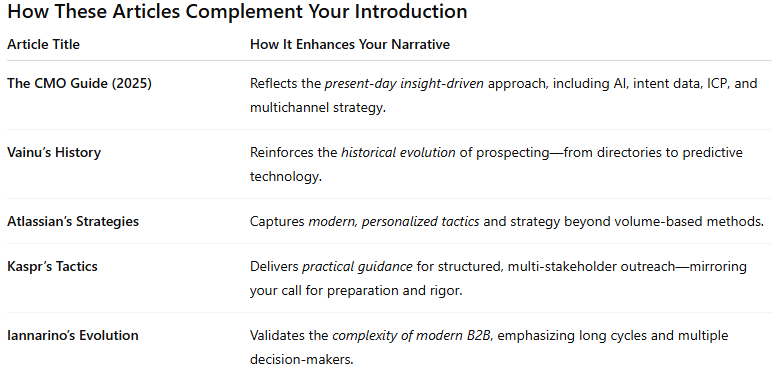
Course Manuals 1-10

Course Manual 1: Own It
Prospecting is not just a part of sales; it is the lifeblood that keeps the sales process alive. Without a steady flow of new opportunities entering the pipeline, even the most skilled salespeople will struggle to meet targets and sustain momentum. In business-to-business (B2B) contexts, this truth is even more pronounced. Sales cycles are long, relationships are complex, and deals are rarely won overnight. Every successful sale begins with identifying the right prospects, initiating meaningful conversations, and nurturing trust until the opportunity matures into an agreement.
Think of prospecting as planting seeds in a garden. Without consistent planting, no matter how skilled a gardener you are, there will be nothing to harvest when the season arrives. In sales, the same principle applies: if prospecting activity slows down today, the effects may not be visible immediately, but months later the pipeline will dry up and revenue will stall. That’s why consistent prospecting is not just important—it’s essential to ensuring long-term stability and growth.

Yet, despite its importance, prospecting is often treated as a chore, an afterthought, or even someone else’s responsibility. Some salespeople avoid it, focusing instead on nurturing existing clients or waiting for inbound leads. However, this passive mindset not only weakens the individual’s pipeline but also undermines the collective success of the sales organization, leading to missed opportunities and stagnant growth.
To unlock consistent growth and long-term success, sales professionals must adopt one clear principle: Own It. Owning prospecting means embracing accountability, taking responsibility for generating opportunities, and recognizing that personal effort directly shapes results. It is the shift from viewing prospecting as a burden to treating it as the foundation of every sale and, ultimately, of every successful sales career.
Why “Own It” Matters in Prospecting
“Own It” in the context of prospecting means accepting full accountability for building and sustaining a pipeline. It’s about recognizing that the effort invested—or neglected—directly influences outcomes. In other words, the salesperson’s success is inextricably linked to their personal ownership of prospecting.
This ownership goes beyond the basic act of generating leads. It encompasses mindset, discipline, initiative, and the ability to align personal activities with organizational goals. A salesperson who owns their prospecting doesn’t wait for opportunities to come their way—they create them. They might start their day with a clear plan of who to reach out to, what to say, and how to follow up. It requires taking full responsibility for filling the pipeline, nurturing opportunities, and continually seeking out new business in their designated territory.
When prospecting is treated as a shared or loosely defined responsibility, urgency tends to disappear. A salesperson might assume that someone else will generate leads, or they may lean too heavily on inbound inquiries and referrals. While these sources can be valuable, relying solely on them can lead to stagnation. Without a sense of ownership, prospecting becomes inconsistent, unfocused, and ineffective.
By contrast, when a salesperson owns their prospecting efforts, they take deliberate, proactive actions to ensure their pipeline remains healthy. They engage in cold calls, craft targeted emails, attend networking events, and utilize digital tools intentionally. Every activity is performed with a clear understanding: my results reflect my effort.
Ownership also creates a subtle but powerful shift in behavior. Salespeople stop thinking in terms of minimum requirements and start thinking in terms of possibilities. Instead of asking, “How many calls do I have to make?” they begin asking, “What can I do today to generate more meaningful conversations?” This shift is what separates average performers from top producers—the recognition that accountability is not about doing the bare minimum, but about taking initiative, pushing boundaries, and owning the path to success.
Ownership Builds Motivation and Initiative
Ownership in prospecting also promotes motivation. Accountability creates a powerful psychological connection between input and outcome. When salespeople know that their performance depends on their actions, they are more driven to stay consistent, experiment with strategies, and refine their approach. Instead of waiting for results to happen, they actively work to create them, which fosters both momentum and confidence. This understanding of the psychological benefits of ownership can help the audience see the value in taking ownership of their prospecting activities.
This mindset transforms prospecting from an obligation into a professional responsibility tied to pride, discipline, and long-term success. It elevates the activity from something that “has to be done” to something that “I choose to do because it drives my success.” That shift in perspective changes the energy behind every call, email, or meeting—it’s no longer about checking a box, but about building a future.
In fact, ownership often sparks initiative: the salesperson begins to view challenges not as obstacles, but as opportunities to improve, adapt, and differentiate themselves. A difficult conversation presents an opportunity to refine communication skills. A rejection becomes feedback to refine messaging. Even competitive pressures become motivators to innovate. When salespeople embrace this mindset, they stop playing defense and start playing offense—actively shaping their outcomes rather than passively reacting to circumstances.
Territory Mastery Through Accountability
Territory ownership adds another dimension to accountability. Every sales area is unique, with its own customer needs, market dynamics, and competitive pressures. A salesperson who owns prospecting in their territory develops a deep familiarity with these dynamics and identifies their territory almost like a business within their e-business. They can tailor “landscape” inside and out, from emerging competitors to shifting customer expectations, and this insight becomes a decisive advantage.
They learn the pain points of local prospects, understand buying cycles, and adapt their messaging to resonate with specific decision-makers. Instead of casting a wide, generic net, they tailor their outreach to be more relevant, precise, and impactful. This localized insight enables them to identify opportunities that others might overlook, such as underserved niches, seasonal buying trends, or influential stakeholders who play a hidden role in the decision-making process. In doing so, they position themselves as trusted advisors who understand the territory better than anyone else.
Equally important, ownership helps salespeople allocate their time and resources more effectively. Without accountability, it is easy to drift—chasing unqualified leads, pursuing dead ends, or putting off prospecting altogether. But with ownership, the salesperson approaches prospecting strategically. They segment target accounts, prioritize high-value opportunities, and craft messaging that speaks to specific needs. This level of focus ensures that effort is concentrated where it will have the most impact, creating a healthier pipeline and a stronger long-term presence in the territory.
Territory mastery isn’t just about hitting quotas—it’s about building market credibility. When salespeople take ownership, they become the “go-to” person in their territory, recognized not only for their sales skills but also for their ability to understand. That reputation, built through accountability, strengthens trust and often opens doors to opportunities that competitors never see.
Consistency Creates Sustainable Success
This consistency and intentionality directly support sales objectives and quotas. Revenue targets cannot be achieved without a steady pipeline of qualified leads, and that pipeline can only be built through persistent, disciplined prospecting. A salesperson who owns prospecting doesn’t wait until the end of the quarter to scramble for deals; they invest daily in filling the funnel with quality opportunities. By treating prospecting as a non-negotiable habit rather than an occasional task, they create a rhythm of activity that fuels predictable results.

Over time, this proactive approach stabilizes performance, reduces the stress of “dry spells,” and increases the likelihood of exceeding quotas, rather than experiencing feast-or-famine cycles—months of frantic activity followed by periods of stagnation. Salespeople who stay consistent maintain balance. They know that today’s prospecting lays the groundwork for tomorrow’s sales, and they act accordingly.
In fact, the link between accountability and performance is so strong that many high-performing organizations explicitly measure and reward prospecting activity as a key indicator of success. Metrics such as outreach volume, qualified meetings booked, and new opportunities created are often tracked alongside revenue because leaders understand that consistent prospecting activity is the foundation of long-term sales health. For the individual salesperson, this consistency builds both confidence and credibility—confidence in knowing they are always moving forward, and credibility within the organization for being someone who delivers results through disciplined effort.
Ownership Strengthens Relationships
Accountability in prospecting also fosters stronger client relationships. Prospecting is not just about finding names—it’s about understanding prospects and approaching them with intention. A salesperson who owns this responsibility goes beyond surface-level research; they dig deeper into industry trends, organizational challenges, and the personal priorities of decision-makers. This level of preparation enables them to enter conversations with relevance and credibility from the very beginning.
They craft messages that demonstrate value, relevance, and authenticity—showing prospects that the outreach isn’t just generic but thoughtfully aligned to their situation. This approach not only generates more responses but also sets the stage for trust-building. In B2B sales, where decisions often involve multiple stakeholders and long evaluation cycles, that first impression matters immensely. A prospect who feels seen and understood is far more likely to engage, continue the conversation, and eventually view the salesperson as a trusted advisor rather than just another vendor.
In fact, ownership-driven prospecting often creates a ripple effect: the more authentic the early interactions, the stronger the foundation for long-term relationships will be. Prospects are more likely to share deeper insights, open up about challenges, and invite the salesperson into strategic discussions. Over time, this trust translates into not just closed deals, but partnerships—relationships that deliver recurring business, referrals, and loyalty that competitors struggle to displace.
Accountability Fuels Growth and Adaptability
Beyond performance and relationships, ownership cultivates personal and professional growth. Salespeople who hold themselves accountable for prospecting gain insight into their own strengths and weaknesses. They learn which approaches resonate with their target market, where they need to make improvements, and how to refine their strategy. Instead of waiting for feedback from others, they create their own feedback loop by analyzing results, testing variations, and adjusting course.
This process of self-evaluation creates a powerful cycle of continuous improvement. Each outreach attempt provides data. Each interaction teaches lessons. Over time, these insights compound, making the salesperson more skilled, adaptable, and effective. What once felt like trial and error becomes a system of refinement, where even setbacks contribute to long-term growth and improvement.
This growth mindset also keeps salespeople competitive. Markets change, technologies evolve, and buyer expectations shift—sometimes rapidly. A salesperson who owns their prospecting efforts adapts accordingly. They experiment with new platforms, test innovative outreach methods, and continually improve their messaging to match how their buyers prefer to engage. By contrast, those who neglect accountability risk falling behind, relying on outdated methods that no longer resonate with modern buyers.
Accountability transforms prospecting into more than a pipeline-building activity—it becomes a personal development tool. Each call, email, or meeting is not just about winning business; it’s also about sharpening skills, building resilience, and staying ahead of the curve in an ever-changing sales environment.
The Satisfaction of Owning Success
Finally, ownership in prospecting enhances job satisfaction. There is a unique sense of pride in generating your own opportunities and seeing them through to successful deals. Each win becomes more meaningful because it is the direct result of personal effort, persistence, and creativity. This connection between action and outcome reinforces confidence and creates a sense of control over one’s success. When success feels earned rather than handed over, victories carry more weight, fueling motivation and building positive momentum for future performance.

Conversely, neglecting ownership can lead to disengagement. A salesperson who depends on others for leads may feel powerless, disconnected, or undervalued—reduced to simply “taking orders” rather than driving their own destiny. Over time, this lack of control erodes motivation and can foster frustration or apathy.
Accountability restores control and purpose, giving salespeople a clear sense that their actions matter and their contribution is critical to the team’s success. This empowerment not only enhances performance but also boosts job satisfaction and reduces turnover. When salespeople feel responsible for—and take pride in—the opportunities they create, they are more likely to remain engaged, loyal, and committed to both their role and the organization.
Key Dimensions of Owning Prospecting
To bring this principle into practice, three dimensions of “owning it” in prospecting stand out:
1. Mindset of Ownership: Shifting from Obligation to Responsibility
Owning prospecting begins with mindset. Salespeople must see prospecting not as a burden but as a professional responsibility and an opportunity for growth. Accountability fuels motivation, initiative, and resilience—qualities essential for success in competitive sales environments.
2. Territory Mastery: Turning Accountability into Strategy
Ownership fosters a deeper understanding of territory dynamics, customer needs, and competitive pressures. Salespeople who accept this responsibility tailor their outreach, prioritize high-value targets, and maintain a proactive, strategic pipeline-building process.
3. Consistency and Growth: Building Skills Through Accountability
Owning prospecting requires consistency. Daily, intentional prospecting creates stability, reduces uncertainty, and drives continuous improvement. Each action becomes a building block for skill development, confidence, and long-term success.
Conclusion
Prospecting cannot be left to chance or delegated away. It must be owned. When salespeople take full responsibility for their pipeline, they move beyond reactive selling and become more proactive, motivated, and aligned with business goals. They strengthen relationships, sharpen their skills, and build confidence in their ability to succeed—not just once, but consistently over time.
“Owning It” in prospecting transforms salespeople into trusted advisors who add value from the very first interaction. It ensures that opportunities are not only created but cultivated with care, leading to stronger partnerships and sustainable growth. For the individual, this ownership fosters pride, drives professional development, and leads to long-term career success. For the organization, it promotes a sales culture built on accountability, resilience, and results.
Fostering this mindset of accountability is not just a short-term tactic—it is a long-term strategy for success. Sales teams that embrace it will outpace competitors, weather market fluctuations, and consistently deliver results. Simply put, when salespeople own prospecting, they don’t just fill pipelines—they build the foundation for enduring business growth.
Case Study: How Salesforce Reversed a Pipeline Slump Through Prospecting Ownership
Background
A mid-sized B2B software company, TechSolutions, specializes in workflow automation for manufacturing firms. Their sales process was complex, with cycles averaging 6–12 months and involving multiple stakeholders, including operations managers, IT leaders, and finance executives. For years, the company relied heavily on inbound leads generated by marketing campaigns and trade shows. Sales reps focused more on nurturing these inbound leads than on developing new ones.
Initially, this model experienced sustained growth, but cracks began to appear when marketing budgets were reduced and inbound volume declined. Suddenly, sales pipelines began to thin, conversion rates dropped, and several quarters closed below target.
The sales team, talented and experienced, was left scrambling. But without a steady flow of new opportunities entering the pipeline, even their best closers struggled to perform.
The Challenge
The root cause was clear: a lack of consistent ownership of prospecting.
Sales reps had grown accustomed to relying on marketing for lead flow. Prospecting was seen as a “backup” activity rather than a daily priority. When inbound dried up, they lacked the habits, discipline, and market insights to fill their pipelines independently.
The result was a feast-or-famine cycle—periods of intense deal chasing followed by empty pipelines. Morale dropped, finger-pointing between sales and marketing increased, and leadership realized that without a cultural shift toward accountability, growth would stall further.
The Intervention
Leadership launched a new initiative called “Own Your Pipeline.” The goal was to instill a sense of personal responsibility for prospecting across the sales team.
Key steps included:
Redefining Expectations
Each representative was held accountable not only for revenue quotas but also for pipeline creation targets. Metrics such as new qualified accounts, outreach volume, and first meetings booked were tracked weekly.
Skill Development
Training sessions focused on modern prospecting strategies, including personalized email campaigns, LinkedIn engagement, account mapping, and consultative cold calling. Reps were coached to treat their territories like “businesses within the business.”
Daily Discipline
Prospecting blocks were built into schedules. Reps were required to dedicate time each day to identifying and contacting new opportunities, ensuring consistency rather than last-minute scrambles.
Ownership Culture
Success stories were celebrated. When a rep closed a deal sourced entirely through self-prospecting, leadership highlighted the story company-wide, reinforcing the pride and satisfaction that comes with owning results.
The Results
Within six months, TechSolutions saw a dramatic turnaround:
Pipeline Growth: The average rep doubled the number of qualified opportunities in their pipeline.
Revenue Impact: Quarterly revenue exceeded targets for the first time in a year, driven by a healthier flow of new deals.
Confidence & Morale: Reps reported greater job satisfaction, noting that they felt “in control” of their success rather than dependent on marketing.
Market Credibility: As representatives learned to master their territories, they developed a deeper understanding of the industry, enabling more relevant conversations with prospects. Several reps became trusted advisors to prospects long before deals were closed.
Lessons Learned
This case illustrates the principle that prospecting cannot be left to chance or delegated away. Even in companies with strong marketing engines, salespeople must take ownership of filling their own pipelines. By embracing accountability, TechSolutions’ reps shifted from a reactive to a proactive mindset. They learned that prospecting is not a burden but the foundation of every sale.
“Owning It” turned the team into stronger performers, more trusted advisors, and more fulfilled professionals. The company now tracks prospecting activity as closely as revenue, embedding accountability as a long-term strategy for sustainable growth.
Exercise: Planting the Pipeline
Divide the group into small teams (3–5 people).
Provide each team with sticky notes (or index cards) and a marker.
On a flipchart or whiteboard, draw two timelines: “This Month” and “Three Months From Now.”
Ask each team to imagine their sales territory as a garden.
Each sticky note represents one prospecting activity (e.g., call, email, LinkedIn outreach, event, referral request, etc.).
Teams write down as many prospecting activities as they can commit to doing this month and place them under “This Month.”
Next, have them predict what results those actions will create three months from now (e.g., new meetings, stronger relationships, qualified opportunities). Place these under “Three Months From Now.”
Facilitate a short discussion:
What happens if you stop planting today?
How does ownership of prospecting activities change the outcome three months down the line?
What daily habits can ensure the “garden” never goes empty?

Course Manual 2: Be Consistent
In the world of B2B sales, where decision-making is complex, cycles are lengthy, and competition is relentless, consistency is one of the most overlooked yet crucial factors for success. Sales professionals often dedicate enormous amounts of energy to refining their pitch, mastering negotiation tactics, or perfecting closing strategies. Yet, none of these skills matter if there is no pipeline of opportunities to apply them to. Prospecting—the process of identifying, qualifying, and nurturing potential customers—is the lifeblood of sales. Without it, there is no funnel, no deals, and ultimately, no revenue. The fundamental distinction between average and high-performing salespeople is not simply in doing prospecting, but in the discipline of doing it consistently.
Consistency in prospecting is not about sudden bursts of activity followed by silence or neglect. It is about creating habits, routines, and rhythms that ensure a steady flow of prospects enters the pipeline every week. In B2B sales, this principle is especially vital because sales cycles are rarely quick or linear. Purchasing decisions often involve multiple stakeholders, layers of approval, and lengthy evaluations. In such an environment, sporadic prospecting leads to pipeline gaps, unpredictable results, and the dreaded feast-or-famine cycle—where salespeople swing between periods of abundance and dry spells. Consistency, by contrast, prevents these extremes and provides a foundation of stability—not just for the individual salesperson but also for their team and organization.

At its core, consistent prospecting fulfills several critical purposes. First, it maintains pipeline health by continually replenishing the funnel with new opportunities. A sales funnel is dynamic: some leads move forward, others stall, and many fall away entirely. Without consistent input, the funnel shrinks quickly, leaving salespeople scrambling to recover in future quarters. Second, consistency enables relationship-building. Unlike consumer transactions, which may be driven by emotion or impulse, B2B decisions are often based on trust, credibility, and alignment with strategic objectives. Regular, thoughtful engagement builds this trust over time, positioning the salesperson as a partner rather than just another vendor. Third, consistency builds skill. Just like any craft, the act of prospecting gets sharper with repetition. Every email written, every call made, and every objection handled is an opportunity to improve technique, messaging, and qualification ability.
For organizations, consistent prospecting is equally powerful because it creates predictability. Leaders and managers rely on forecasting to allocate resources, plan budgets, and make strategic decisions. Inconsistent prospecting makes accurate forecasting nearly impossible, leaving executives vulnerable to sudden revenue performance surprises. By embedding prospecting as a regular, non-negotiable discipline, organizations can ensure a healthier and more predictable pipeline. This not only reduces stress but also strengthens alignment between frontline sales teams and leadership, building organizational confidence in the process.
Consistency also plays a key role in keeping salespeople connected to their markets. B2B landscapes are dynamic—competitors evolve strategies, new technologies emerge, and customer expectations shift constantly. A salesperson who consistently engages with prospects has their ear to the ground. They gain firsthand insight into these changes and can adjust their messaging and positioning accordingly. This real-time awareness becomes a strategic advantage, helping them remain relevant and credible in conversations with clients.
There is also an often-overlooked psychological dimension to consistency. Sales is a profession filled with rejection, stalled deals, and long waiting periods. Inconsistent prospecting exposes salespeople to prolonged periods of inactivity, followed by intense bursts of effort, which can be both exhausting and demoralizing. By contrast, a consistent approach provides structure and momentum. Even when deals are not closing immediately, salespeople can take confidence in the knowledge that they are steadily moving forward. Each prospecting call, follow-up, or meeting is a tangible step toward future success. This steady cadence provides motivation, reinforces resilience, and sustains focus during challenging times.
Importantly, consistency in prospecting does not promise quick wins or overnight success. It is not a glamorous concept, and it is not often celebrated. Instead, its power lies in its long-term payoff. It delivers something far more valuable than short-lived bursts of performance—it delivers sustainable success. Over time, the salesperson who commits to consistent prospecting builds a career defined by reliability, growth, and steady achievement. Organizations that cultivate this discipline experience fewer revenue swings, stronger pipelines, and a greater ability to grow predictably.
In B2B sales, where the stakes are high, the cycles are long, and the competition is unrelenting, consistency in prospecting is not optional—it is foundational. It is what separates average performers from elite professionals, and struggling organizations from those that thrive. Success in sales is not simply about finding prospects—it is about finding them consistently, with discipline, focus, and persistence.
Building Pipeline Stability Through Consistency
The sales pipeline is the lifeline of B2B growth. Just as an engine requires continuous fuel to run smoothly, a pipeline requires consistent prospecting to keep opportunities flowing. Without it, salespeople risk running into “dry spells” where there are no qualified leads to pursue, causing momentum to stall and revenue targets to slip out of reach. Stability in the pipeline stems from creating a steady, repeatable rhythm of activity that generates new leads while nurturing those already in the funnel.

One of the most common pitfalls in sales is the feast-or-famine cycle. When sales are slow, many salespeople turn their attention to prospecting with urgency, filling the funnel with activity. But once those efforts bear fruit and deals start to progress, prospecting often gets pushed aside in favor of closing. This short-term focus creates an inevitable problem: once the current deals close, the pipeline is empty again, leaving the salesperson to scramble and start over. The inconsistency creates unpredictable results and unnecessary stress.
Consistency breaks this cycle by making prospecting a non-negotiable priority—whether business is booming or quiet. By dedicating focused time daily or weekly to identifying and engaging prospects, salespeople keep the funnel replenished at all times. This habit smooths out performance peaks and valleys, leading to more sustainable results and predictable revenue streams.
Pipeline stability also benefits the broader organization. When sales teams maintain a consistent prospecting rhythm, leaders gain clearer visibility into the health of their pipeline. With a steady inflow of qualified leads, managers can forecast with greater accuracy, allocate resources more effectively, and make proactive adjustments when needed. This not only creates confidence within the sales team but also reassures executives who rely on accurate forecasts for strategic planning. In short, consistency transforms the pipeline from a reactive scramble into a dependable growth engine.
Strengthening Relationships and Building Trust Over Time
In B2B sales, where purchasing decisions often involve multiple stakeholders and lengthy evaluation processes, trust is one of the most valuable currencies a salesperson can earn. Consistency in prospecting plays a crucial role in building that trust. While the first outreach might spark awareness, it is the steady series of follow-ups, check-ins, and value-driven interactions that transform a cold lead into a trusted business relationship.
Regular touchpoints—whether through personalized emails, thoughtful LinkedIn comments, timely phone calls, or conversations at industry events—keep the salesperson visible and relevant. Even small interactions contribute to building familiarity, showing the prospect that the salesperson is attentive and invested for the long haul. Over time, this steady engagement signals more than persistence; it demonstrates dependability and professionalism, qualities that prospects often prioritize when selecting vendors.
Inconsistent engagement, on the other hand, risks eroding credibility. If a salesperson disappears for weeks or only resurfaces when they need to push a deal forward, prospects may perceive them as opportunistic rather than genuinely committed. This undermines the very trust needed to win complex deals.
Relationship-building in B2B sales is cumulative—it is rarely the result of a single breakthrough conversation, but rather the outcome of numerous consistent and meaningful actions. By showing up regularly and adding value at each stage of the buyer’s journey, salespeople distinguish themselves from competitors and position themselves as long-term partners rather than short-term sellers. In high-value or strategic deals, this consistency is often the deciding factor that tips the balance in their favor.
Driving Continuous Improvement and Market Relevance
Consistency in prospecting not only sustains pipeline flow but also sharpens a salesperson’s effectiveness over time. Each call, email, or conversation provides real-world feedback that can be used to refine techniques. A salesperson who prospects regularly has more opportunities to test outreach messages, adapt to objections, and experiment with different channels. This repetition builds a learning cycle that sporadic prospecting cannot replicate. Over time, these incremental adjustments compound, leading to stronger qualification skills, higher engagement rates, and ultimately better conversion outcomes.

Equally important, consistent prospecting keeps salespeople in tune with the pulse of their market. By engaging with prospects on an ongoing basis, they gain firsthand insights into shifting customer priorities, new industry challenges, and competitor strategies. This awareness enables them to position their offerings in a way that directly addresses evolving needs, making their conversations more relevant and impactful. In fast-changing B2B markets, this ability to stay current and adjust quickly can be the deciding factor between winning and losing opportunities.
In essence, consistency transforms prospecting from a repetitive task into a continuous improvement loop. It not only generates leads but also develops the salesperson’s skillset and ensures they remain aligned with market dynamics—both critical ingredients for long-term sales success.
Conclusion
Being consistent in prospecting is not about bursts of intensity—it is about discipline and deliberate habit-building. Success in B2B sales is rarely the result of one bold effort or a lucky break; it comes from the accumulation of small, repeated actions that compound over time. The salesperson who commits to prospecting daily or weekly, regardless of short-term pressures, builds the foundation for long-term achievement. This consistency ensures pipeline stability, nurtures trust with prospects, sharpens essential sales skills, and keeps motivation alive through the inevitable ups and downs of long and complex sales cycles.
At an organizational level, consistent prospecting creates a ripple effect that strengthens the entire business. Leaders benefit from more accurate forecasting, which supports more intelligent resource allocation and strategic planning. Teams operate with greater confidence knowing that their collective effort is feeding a healthy pipeline, reducing the stress and unpredictability that comes from inconsistent activity. In turn, this alignment fosters a culture of accountability, resilience, and steady performance.
Prospecting is often viewed as the most challenging part of sales because it requires persistence in the face of rejection and the ability to endure delayed gratification. Yet, when approached with consistency, it ceases to feel like a dreaded chore and becomes a reliable, almost automatic habit—one that continually generates growth opportunities. Over time, this steady commitment builds momentum, strengthens reputation, and fuels sustainable success.
Consistency in prospecting is what separates average salespeople from high performers. Average salespeople prospect when they have time or when they feel pressured by empty pipelines. Top performers, by contrast, prospect consistently, treating it as a core discipline rather than an optional activity. The same holds for organizations: those that embed consistency into their sales culture enjoy predictable growth and stability. At the same time, those who neglect it find themselves at the mercy of uncertainty and inconsistency.
In B2B sales, success is not just about finding prospects—it is about finding them consistently. It is about building a rhythm that ensures opportunities never run dry, relationships never grow cold, and skills never stagnate. When consistency becomes the standard, prospecting evolves from an obligation into a powerful driver of long-term growth—for both the individual salesperson and the organization as a whole.
Case Study: Leadium – Fueling Predictable Growth through Consistent Outreach
In B2B sales, the difference between success and struggle often comes down to one thing: consistency. While sales teams invest heavily in training their people to pitch, negotiate, and close, those skills only matter if there’s a steady stream of opportunities to apply them to. Without a full and healthy pipeline, even the best closers are left waiting on deals that may never come.
This reality is what makes the story of Leadium, an outbound sales agency, so compelling. Rather than focusing on one-off campaigns or sporadic outreach efforts, Leadium specializes in building consistent prospecting systems for its clients—systems that transform pipeline health and create predictable growth.
What Leadium Did
Leadium’s model embeds prospecting into a structured, repeatable process. Instead of relying on bursts of activity, they help clients establish daily and weekly rhythms of outreach.
This includes:
Outbound email campaigns
Cold calling
LinkedIn engagement
Systematic follow-up cadences
The impact of this consistent approach has been dramatic. Across client projects, Leadium has reported:
200% increase in quota attainment
4× more leads per quarter
27% increase in meetings booked with director-level and above prospects
For many organizations, these results represent the difference between unpredictable revenue and steady, scalable growth.
Why Consistency Works
Leadium’s case studies reflect the core truth of B2B prospecting: consistency is more potent than intensity. Here’s why:
Pipeline Stability
A steady inflow of qualified leads prevents feast-or-famine cycles and reduces the stress of quarter-end scrambles.
Relationship Momentum
Frequent, value-driven touchpoints foster trust. Even when deals don’t close immediately, consistent engagement keeps the salesperson top of mind.
Skill Development
Repetition refines outreach. Sales teams quickly learn what messaging resonates with, how to overcome objections, and how to qualify opportunities better.
Forecasting Accuracy
Reliable lead flow enables leaders to forecast performance and allocate resources with greater confidence.
Market Relevance
Ongoing engagement helps teams stay in tune with customer challenges, competitive shifts, and industry trends.
Results in Action
One Leadium client, a mid-market SaaS provider, experienced these benefits firsthand. After adopting a consistent prospecting cadence, the company saw:
A 27% uplift in director-level meetings
A quadrupling of lead generation within a single quarter
Rather than scrambling when pipelines dried up, the client built a sustainable growth engine—one fueled by steady, disciplined outreach.
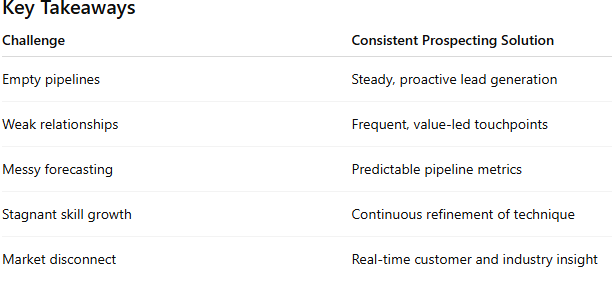
Final Thought
Leadium’s work demonstrates a simple but powerful lesson: consistent prospecting isn’t glamorous, but it’s foundational. By embedding it into the sales process, companies create stable pipelines, stronger relationships, sharper teams, and more accurate forecasts.
For sales professionals and organizations alike, the message is clear: success in B2B sales isn’t about finding prospects once—it’s about finding them consistently.
Exercise: Prospecting Consistency Check
Reflection:
Pattern Spotting:
Commitment:

Course Manual 3: ICP Focus
In the competitive world of B2B sales, success is often defined by precision rather than breadth. Sales organizations frequently face the temptation to cast their nets wide, contacting as many potential leads as possible in the hope that sheer volume will eventually translate into results. While this activity-driven approach may create the illusion of productivity—measured by the number of calls made, emails sent, or meetings booked—it rarely produces consistent, high-quality outcomes. Instead, it often leaves sales teams spread too thin, frustrated by low conversion rates, and uncertain about where to focus their efforts.
The distinguishing factor between thriving sales teams and those that struggle often comes down to one critical practice: the ability to define and act on an Ideal Client Profile (ICP). This ICP serves as a compass, providing a clear direction and purpose to the sales team’s efforts.
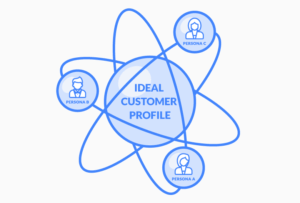
An ICP is far more than a theoretical exercise or a slide in a sales playbook. It functions as a strategic blueprint that guides prospecting, outreach, and customer engagement across the entire sales cycle. By outlining the defining characteristics of a company’s most valuable and best-fit clients, the ICP provides clarity to sales teams, marketing professionals, and even product developers. It answers the critical question: Which types of customers will truly benefit from what we offer—and in return, help us grow sustainably?
At its core, the ICP is a comprehensive description of the organizations most likely to buy, adopt, and remain loyal to a company’s product or service. It encompasses both firmographic elements—such as industry, company size, revenue, and geography—and behavioral attributes, including decision-making processes, purchasing triggers, budgets, and pain points, rather than simply identifying who can buy, an ICP pinpoints who should buy.
This sharper focus is transformative because B2B sales are rarely simple or short. They often involve multiple stakeholders, technical evaluations, budget negotiations, and lengthy sales cycles. In this environment, chasing unqualified leads wastes time, diminishes morale, and misuses valuable resources. Conversely, targeting organizations that align with the ICP enables sales teams to engage in higher-quality conversations, build stronger relationships, and move opportunities through the funnel more efficiently.
The Value of Precision
Consider the contrast between two sales teams. The first is tasked with generating as many calls, emails, and demos as possible without a clear sense of who the target audience is. The second operates with a well-defined ICP in hand, identifying prospects based on carefully studied attributes of existing high-value clients.
The first team, without a well-defined ICP, risks frustration and burnout from repeated rejections, misaligned conversations, and low conversions. Their pipeline may look full, but the opportunities lack depth and sustainability. In contrast, the second team, armed with a well-defined ICP, directs its energy toward prospects who are more likely to convert, generate long-term value, and enhance the company’s reputation in the market.
The ICP, therefore, becomes a quality filter. It allows salespeople to focus on prospects who are not only likely to close but are also positioned to maximize the benefits of the solution. This alignment reduces wasted effort and helps build a stronger connection between the salesperson’s offering and the prospect’s real needs. Over time, this precision compounds into a more predictable and scalable sales engine, a key advantage of using the ICP.
Beyond Demographics: A Holistic Profile
Many companies make the mistake of treating an ICP as a simple checklist of demographics—industry type, company size, or annual revenue. While these attributes are helpful starting points, they do not capture the complete picture of an ideal customer. What separates an effective ICP from a superficial one is its inclusion of behavioral, cultural, and operational characteristics.
For instance, two companies of the same size in the same industry may have very different attitudes toward innovation, technology adoption, or vendor relationships. One may value long-term partnerships and allocate budget for ongoing improvements, while the other may prefer low-cost, transactional arrangements. A holistic ICP, which includes behavioral, cultural, and operational characteristics, can capture these nuances and identify the ‘ideal’ fit for a company selling a complex, consultative solution.
A holistic ICP also accounts for pain points and challenges. What problems keep these organizations up at night? What inefficiencies drain their resources or hold back growth? By identifying these issues, sales teams can tailor their messaging, outreach, and conversations to resonate with the specific concerns of prospects. The result is a shift from generic pitches to targeted value propositions, which decision-makers are far more likely to engage with.
A Cross-Functional Asset
The ICP is not merely a sales tool—it is a strategic asset for the entire organization. Marketing teams benefit from sharper targeting, crafting campaigns that speak directly to the motivations and frustrations of ideal prospects. Product development gains clarity on what features, integrations, or innovations matter most to high-value clients. Even customer success teams can leverage the ICP to identify at-risk accounts and replicate success patterns across similar clients.
This alignment across departments creates a virtuous cycle. Marketing attracts the right leads, sales converts them more effectively, and customer success ensures those clients achieve tangible results. These satisfied clients, in turn, become advocates, generating referrals and case studies that feed back into the ICP, further refining it. In this way, the ICP evolves from being a static profile into a living framework that matures alongside the business.
From Transactions to Relationships
The purpose of an ICP is not just to close more deals—it is to close the right deals. B2B sales success is not measured solely by short-term revenue, but by the ability to build long-term, profitable, and mutually beneficial relationships. Clients that align with the ICP are more likely to adopt the solution effectively, achieve measurable results, and stay engaged over time.
Such clients also present opportunities for upselling and cross-selling, since their evolving needs often align with the seller’s broader portfolio. They tend to renew contracts, expand engagements, and provide testimonials or references. In essence, ICP-focused selling creates not just customers, but champions who drive sustainable growth through loyalty and advocacy.
The Non-Negotiable Nature of ICP Today
In today’s hyper-competitive B2B environment, where prospects are inundated with vendor outreach, relying on generic prospecting tactics is no longer sustainable. Buyers expect personalization, relevance, and evidence that vendors understand their industry and challenges. A clearly defined ICP equips sales teams to meet these expectations with precision and confidence.
The ICP provides a framework for scalable sales processes. As organizations grow, it becomes increasingly complex to maintain consistency in prospecting and client engagement. A shared ICP ensures that every salesperson—whether a seasoned veteran or a new hire—has a roadmap for identifying, approaching, and converting the right kind of prospects. This empowerment instills a sense of confidence and control, even in the face of a rapidly expanding business.

An Ideal Client Profile is not optional—it is a must-have discipline for organizations seeking sustainable growth. By clarifying who the right customers are, aligning organizational efforts, and enabling personalized engagement, the ICP becomes a cornerstone of effective sales strategy.
Building the Ideal Client Profile: Firmographics, Behaviors, and Beyond
Creating an Ideal Client Profile (ICP) is not a one-time checklist activity—it is a strategic process that demands careful analysis, reflection, and refinement. Many organizations begin by identifying surface-level details such as company size or industry, but these alone rarely provide the insight needed to guide sales prospecting truly. A robust ICP goes further. It integrates firmographic data with behavioral insights, considering cultural and strategic factors that shape how organizations buy, adopt, and engage with solutions.
By combining these dimensions, sales teams move from guessing who might be a good fit to developing a data-driven, evidence-based profile of their most valuable clients. This ensures that outreach efforts are focused on prospects who not only can afford to buy but are also most likely to succeed and thrive with the offering.
Firmographics: The Structural Foundation
Firmographic data provides the baseline criteria for defining the ICP. These attributes are the organizational equivalent of demographics in consumer marketing. They help sales teams quickly filter out companies that are clearly outside of scope and focus on those with a structural fit.
Key firmographic elements include:
Industry and sector: Does your solution resonate more with financial services, healthcare, technology, or manufacturing? Certain products are industry-specific, while others have broad applicability but require tailoring.
Company size: The number of employees or revenue levels can indicate whether an organization has the scale, budget, and operational complexity to benefit from your solution. For example, enterprise SaaS solutions often provide more value to larger companies with complex operations than to startups.
Geography: Regional considerations matter. Some markets may have higher adoption rates, different regulatory environments, or distinct cultural attitudes toward solutions. For instance, a cybersecurity provider might prioritize heavily regulated industries in North America and Europe.
Growth stage: Is the prospect a fast-scaling company seeking agility, or a mature enterprise focused on optimization and cost control? Each stage presents different needs and opportunities.
Firmographics are helpful because they establish the “entry criteria”—the minimum requirements for a company to realistically fit the profile. But while essential, they are not sufficient on their own. Two companies in the same industry and size bracket may have entirely different buying behaviors, challenges, and mindsets.
Behavioral Insights: The True Differentiator
The behavioral dimension of an ICP is what separates a superficial profile from a powerful one. These insights reveal how and why organizations make purchasing decisions, as well as what triggers them to take action.
Key behavioral aspects to consider include:
Buying triggers: What events or conditions push a company to seek solutions like yours? Examples include regulatory changes, rapid growth, cost pressures, or digital transformation initiatives. Identifying these triggers enables sales teams to approach prospects at the optimal moment, thereby increasing the likelihood of engagement.
Decision-making structures: Who typically makes the purchasing decision? In B2B sales, multiple stakeholders are often involved—procurement teams, technical evaluators, end users, and executive sponsors. Mapping the decision-making process helps salespeople know whom to engage and how to tailor their messaging.
Budget priorities: Where does the company allocate resources? If your product aligns with areas they are actively investing in, the likelihood of conversion increases. For example, a business prioritizing automation is a better fit for workflow optimization software than one focused solely on cost-cutting.
Past buying behavior: Has the company historically adopted new technologies quickly, or do they take a conservative, incremental approach? Early adopters may be more open to innovative solutions, while risk-averse organizations may require more proof and reassurance.
By layering behavioral insights on top of firmographics, sales teams gain a more predictive understanding of who is most likely to become an ideal client.
Cultural and Strategic Values: The Often-Overlooked Layer
Beyond firmographics and behaviors lies a third dimension: cultural and strategic alignment. These factors, though less tangible, are often decisive in determining whether a client relationship will thrive.
Examples include:
Innovation mindset: Some companies are eager to experiment with new solutions, while others resist change. If your offering requires adaptation or process shifts, a culture of innovation is critical.
Partnership orientation: Does the company view vendors as strategic partners or as interchangeable suppliers? Complex, consultative solutions thrive in environments where partnerships are valued.
Shared values and priorities: Increasingly, clients seek alignment not just on technical needs but also on values such as sustainability, diversity, or ethical practices. For example, a company committed to environmental goals may prefer solutions that support efficiency and sustainability.
Organizational agility: Some companies can make decisions and implement solutions quickly, while others are slowed by bureaucracy. Understanding this dynamic can help sales teams forecast timelines and manage expectations.
Cultural and strategic considerations ensure that the ICP reflects not just who can buy, but who is likely to become a mutually beneficial, long-term client.
A Holistic Approach

Bringing these elements together—firmographics, behaviors, and cultural values—creates a holistic ICP. Instead of a narrow checklist, it becomes a living framework that evolves with the business. A strong ICP might look something like this:
Firmographic: Mid-to-large financial services firms in North America with over $500 million in revenue and more than 2,000 employees.
Behavioral: Actively investing in digital transformation, experiencing pressure from regulators, and making purchase decisions through a cross-functional team led by the CIO.
Cultural/Strategic: Open to vendor partnerships, value innovation, and prioritize compliance and efficiency as strategic goals.
This profile not only identifies which companies to target but also shapes the messaging, positioning, and sales approach. Salespeople can now tailor outreach to highlight how the solution supports compliance, drives efficiency, and aligns with the client’s innovation agenda.
Continuous Refinement
It is important to remember that building an ICP is not a one-time exercise. It should be continuously refined based on new data, customer feedback, and evolving market conditions. High-value clients today may share new traits tomorrow that weren’t initially obvious. By analyzing closed deals, retention data, and customer success stories, organizations can refine their ICP to make it even more precise and predictive.
For example, a SaaS provider might discover that its most successful clients aren’t just in a specific industry but also share a commitment to agile project management practices. This insight would refine the ICP and sharpen future prospecting efforts.
Building an Ideal Client Profile requires going beyond surface-level firmographics to include behavioral insights and cultural alignment. This holistic approach enables sales teams to target not just any prospect, but the right prospect—those who are structurally, behaviorally, and strategically aligned with the company’s solution. When done well, the ICP transforms from a static description into a strategic compass, guiding sales, marketing, and product teams toward long-term, profitable client relationships.
Applying the ICP in Prospecting and Outreach
Defining an Ideal Client Profile (ICP) is only the first step; the actual value emerges when sales teams put it into action. Operationalizing the ICP means embedding it into the daily rhythm of prospecting and outreach, ensuring that every activity is guided by a clear sense of who to target, how to engage, and why it matters.
Using the ICP as a Filter
The ICP acts as a qualification lens. Rather than chasing every lead that enters the funnel, sales teams can apply the ICP criteria to filter for organizations that match the profile. This ensures that time, effort, and resources are concentrated on high-potential leads—those most likely to convert into profitable, long-term customers. For example, instead of contacting every company in a given industry, sales teams can focus only on firms that share the same scale, growth stage, and buying behaviors as the organization’s best customers.
Crafting Tailored Outreach
Once the right prospects are identified, the ICP provides insight into how to engage them effectively. By understanding the pain points, decision-making structures, and cultural values of target organizations, salespeople can craft personalized messaging that resonates. This might mean highlighting compliance benefits for a highly regulated industry, emphasizing cost savings for budget-conscious prospects, or showcasing innovation for organizations with a progressive culture. Generic pitches give way to value-driven conversations rooted in relevance.
Driving Higher Conversions
Applying the ICP transforms outreach from a transactional to a consultative approach. Prospects feel understood because the outreach addresses their specific challenges and goals directly. This relevance not only increases the likelihood of securing meetings and advancing opportunities but also builds credibility and trust—both of which are critical in complex B2B sales cycles. Over time, ICP-driven prospecting creates a more predictable pipeline and accelerates sales velocity.
Aligning with Technology and Teams
Operationalizing the ICP also means integrating it into CRM systems, lead scoring models, and sales playbooks. Marketing and sales development teams can collaborate to create campaigns that target ICP-matched companies, while automation tools can be fine-tuned to prioritize these leads. The ICP thus becomes a shared framework across the organization, ensuring consistency and alignment in all outreach efforts.
Cross-Departmental Benefits of the ICP: Sales, Marketing, and Product Alignment
While the Ideal Client Profile (ICP) is often created with sales prospecting in mind, its true power lies in its ability to unify the entire organization around a shared understanding of the ideal customer. By aligning sales, marketing, product development, and customer success, the ICP ensures that every function is working toward the same goal: attracting, converting, and retaining the right kind of clients.
Marketing: Precision in Targeting

For marketing teams, the ICP provides a blueprint for campaigns that resonate with their target audience. Instead of broad, generic messaging, campaigns can be designed to speak directly to the priorities, challenges, and motivations of ICP-defined prospects. This leads to more qualified leads entering the funnel, reduced wasted spend on unaligned segments, and stronger collaboration between marketing and sales.
Product Development: Building for the Right Customer
An ICP also guides product strategy. By understanding the needs and behaviors of ideal customers, product teams can prioritize features, integrations, and improvements that directly address ICP pain points. This alignment ensures the product is not only market-relevant but also creates a competitive advantage by serving the most valuable customer segments more effectively than rivals.
Customer Success: Retention and Advocacy
For customer success teams, the ICP is a retention compass. By knowing what makes an ideal customer thrive, they can proactively support those accounts, identify risks earlier, and replicate success patterns across similar clients. ICP-aligned customers are more likely to achieve meaningful outcomes, renew contracts, and become advocates—feeding testimonials, referrals, and case studies back into the business.
Strategic Alignment Across the Business
When all departments use the ICP as a shared framework, silos break down. Sales isn’t just chasing leads, marketing isn’t just driving clicks, and product isn’t just adding features in isolation. Instead, everyone is working in concert toward serving the customers who matter most. This alignment enhances efficiency, fosters customer satisfaction, and promotes sustainable growth.
Conclusion
In B2B sales, activity without direction is costly. Casting a wide net may generate motion, but it rarely delivers meaningful results. The Ideal Client Profile (ICP) transforms that motion into purposeful momentum by providing clarity on who to target, how to engage, and why those prospects matter most.
A robust ICP goes beyond surface-level firmographics to include behavioral triggers and cultural alignment, ensuring that sales teams pursue not just any opportunity, but the right opportunities. When applied to prospecting and outreach, it elevates conversations from transactional pitches to consultative engagements that build trust and accelerate conversions. And when embraced across departments—marketing, product development, and customer success—the ICP becomes a unifying framework, aligning the entire organization around delivering maximum value to the clients who will benefit most.
The ICP is more than a sales tactic; it is a strategic discipline. It sharpens focus, increases efficiency, and fosters long-term, profitable relationships. In today’s competitive market, where precision defines success, the ICP is not optional—it is the cornerstone of sustainable growth.
Case Study: Veracode Turns ICP + ABM Focus into Measurable Pipeline Gains
Company
Veracode — enterprise application security (AppSec) platform serving regulated, mid-market, and enterprise software teams.
Challenge
Marketing and Sales were running activity-heavy ABM, but target lists largely mirrored what reps “wanted to sell” into—broad verticals and named accounts—without a data-backed ICP. Engagement was inconsistent and hard to attribute to revenue impact. Veracode needed a way to prove ROI quickly and scale what worked.
ICP-Led Approach
Senior ABM Manager Meg Noonan re-centered the program on an ICP and buyer signals, then piloted a focused motion:
Codify ICP & target list with data
Reviewed historical Salesforce data to see which accounts matched best-fit patterns and progressed.
Layered intent signals (topics/keywords, buying stage) from 6sense.
Added firmographic/technographic fit and competitor context using HG Insights.
Co-reviewed the ICP and target list with regional Marketing leaders and Sales to ensure cross-functional alignment.
Segment by buying stage & ICP fit
Split accounts into new logo vs. in-pipeline and prioritized by reach score and ICP fit, ensuring resources went to the proper accounts at the right time.
Personalize outreach around ICP pain
Built 1:1 microsites/landing pages per account with role/industry-specific value props, social proof from relevant customers, and CTAs tuned to funnel stage.
Coordinated BDR phone + email sequences that referenced each account’s customized page; if reps didn’t get a response, Marketing resent from Marketo to maintain air cover.
Define success metrics upfront.
Early indicators: account reach and buying-stage progression.
Pipeline indicators: meetings booked and SALs/opportunities created.
Results (First 90 Days of the Pilot)
100% of target accounts were reached.
86% showed engagement signals.
100% meeting-to-opportunity conversion for meetings sourced via the program.
37% of the new-opportunity target was achieved within the pilot window.
Why This Worked
ICP as a quality filter: Targeting was constrained to accounts with the right firmographics, behaviors, and intent—who should buy, not just who could.
Tight Marketing–Sales loop: Sales insights (deal history, stakeholder pain) plus Marketing’s data stack created a shared definition of “good” and a unified pursuit plan.
Personalization that maps to ICP pain: Each touch (ad, email, page) reflected the account’s industry, stage, and objectives—moving the conversation from generic pitch to consultative relevance.
Stage-aware orchestration: The team didn’t treat all ICP accounts equally; sequencing (new vs. in-pipeline, high vs. low reach) protected focus and speed.
Takeaways for Your Team
Start with an ICP you can measure. Align on attributes (industry, size, tech stack, regulatory pressure), buying committee, and triggers. Instrument it in your CRM and scoring model.
Build a small, provable pilot. Constrain targets to what your team can truly cover in 90 days; pick metrics you can move (reach, meetings → opps).
Operationalize personalization. Use 1:1 assets (microsites, tailored decks) that map to each segment’s pains and stage.
Review weekly with Sales. Inspect account progression vs. ICP fit and reallocate effort quickly.
Bottom line: Veracode’s shift from volume-led outreach to an ICP-anchored, data-driven ABM pilot produced fast, verifiable gains in engagement and opportunity creation—showing how precision beats breadth when cycles are complex and resources are finite.
Exercise: Who Should We Target?
Prospect A: A mid-sized technology company (500 employees) in rapid growth mode, investing heavily in digital transformation. Decision-making is centralized with the CIO, who values innovation and long-term partnerships.
Prospect B: A similarly sized technology company in the same industry, but highly cost-conscious. Decision-making is fragmented, and they prefer short-term, transactional vendor relationships.
Which prospect is closer to the Ideal Client Profile (ICP) and why?
How would you adjust your outreach approach for each prospect?
What risks might arise if your team pursued the wrong prospect?

Course Manual 4: Market Awareness
Prospecting, often referred to as the lifeblood of B2B sales, is not just a starting point of revenue generation, but a strategic phase where opportunities are first uncovered, relationships are sparked, and the long-term growth of the sales pipeline is set into motion. The impact of prospecting, while undisputed, is not a matter of chance, but entirely dependent on how it is executed. When done strategically, it creates momentum, fills the pipeline with high-quality opportunities, and sets sales teams up for success. When done poorly, it becomes a drain on time and resources, yielding little more than frustration and wasted effort.
Unfortunately, many organizations fall into the trap of treating prospecting as a numbers game. Salespeople cast wide nets, assuming that contacting more prospects will inevitably lead to more deals. This “volume over value” approach often results in diluted messaging, superficial outreach, and a disconnect between what is pitched and what prospects actually need. In practice, this scattershot approach yields low engagement and missed opportunities, leaving sales teams disheartened and leaders dissatisfied with the outcomes.
The antidote to this inefficiency is market awareness. Prospecting that is grounded in a thorough understanding of the industry and competitive landscape is no longer optional—it is essential. Market awareness involves more than simply knowing which companies are operating in a given sector. It requires developing a nuanced view of industry trends, regulatory shifts, technological changes, and the evolving needs of potential clients. This depth of understanding transforms prospecting from a transactional activity into a strategic endeavor, ensuring that outreach efforts are targeted, relevant, and compelling.

At the heart of market awareness is the ability to target with precision. Instead of treating every company as a potential buyer, informed sales teams can identify where demand is emerging and which challenges are most urgent. Take, for example, an IT solutions provider. Rather than approaching all healthcare organizations indiscriminately, the team might recognize that mid-sized hospitals are grappling with cybersecurity compliance due to newly enforced regulations. Armed with this insight, the team can tailor outreach specifically to this segment, presenting their product as a direct solution to a pressing and costly problem. This kind of focused effort doesn’t just improve conversion rates; it shortens the sales cycle by making the relevance of the solution immediately apparent to the prospect.
Equally important is personalization, which flows naturally from market awareness. Buyers today are inundated with generic pitches that could apply to any company. To stand out, salespeople must demonstrate a clear understanding of their prospect’s unique business environment. By leveraging insights from industry trends, legislation, and emerging technologies, sales teams can craft messages that directly address the challenges a company is facing. Consider a manufacturer struggling with supply chain instability. A personalized message that highlights current global logistics bottlenecks—and explains how the solution builds resilience—will resonate far more than a templated sales script. This kind of tailored outreach signals not only attentiveness but also expertise, positioning the salesperson as a trusted advisor rather than just another vendor.
A further dimension of market awareness lies in competitive differentiation. In virtually every B2B buying decision, prospects are weighing multiple options. Without a clear view of competitor positioning, sales teams risk presenting their product as just another choice on a long list. Market awareness equips salespeople with insights into where competitors excel, where they fall short, and how their solution stacks up. For instance, a competitor might offer a feature-rich product but with notoriously complex implementation. A salesperson who knows this can highlight the simplicity and support their solution provides, reframing the conversation around ease of adoption. This ability to anticipate objections and proactively address them makes the difference between blending in and standing out. Competitive differentiation is about identifying and communicating the unique value your product or service brings to the table, and market awareness is the key to achieving this.
Importantly, competitive awareness is not purely defensive—it can also be offensive. By identifying gaps competitors have overlooked, sales teams can carve out strategic advantages. A typical example occurs when larger competitors ignore small but rapidly growing businesses, focusing exclusively on enterprise accounts. A nimble sales team can recognize the opportunity and position their solution as tailor-made for this underserved segment, building loyalty and gaining ground while others remain focused elsewhere. Offensive competitive awareness is about actively seeking out and capitalizing on opportunities that your competitors may have missed, and market awareness is the tool that helps you do this effectively.
Market awareness also influences how sales teams navigate decision-making processes. Each industry has its own norms and approval structures. Government agencies, for instance, often require extensive vetting and multiple sign-offs, whereas technology startups may make swift decisions based on the judgment of a single executive. Understanding these patterns allows sales teams to structure outreach, follow-ups, and timelines appropriately. A misstep here—such as pushing for a quick close in a sector that requires months of committee reviews—can derail an otherwise promising opportunity. Conversely, aligning with the prospect’s natural decision-making process demonstrates professionalism and increases the chances of success.
Beyond these tangible advantages, market awareness generates something less measurable but equally critical: trust. In today’s B2B environment, buyers are looking for more than transactional sellers—they want partners who understand their industry and can guide them toward solutions. When a salesperson demonstrates knowledge of regulations, market shifts, and competitor dynamics, it signals credibility and competence. This positions them not merely as someone trying to close a deal but as a reliable advisor who brings added value to the relationship. Trust of this kind often leads to stronger, longer-term client relationships, repeat business, and referrals.
It is essential to recognize that market awareness is not a one-time task; it is an ongoing discipline. Markets are dynamic, shaped constantly by innovation, regulation, and global events. What prospects need today may look very different in six months. Sales teams that remain vigilant and continuously update their understanding of industry conditions will be more agile in adjusting their prospecting strategies. For example, a sudden government mandate on sustainability reporting could create urgent demand for compliance software. Teams that detect this shift early can position themselves ahead of competitors and win business before others even recognize the change.
Prospecting without market awareness is little more than guesswork. It leaves sales teams vulnerable to wasted effort, disengaged prospects, and undifferentiated messaging. On the other hand, prospecting with market awareness creates clarity, confidence, and credibility. It enables sales professionals to identify the right prospects, craft resonant messages, and position themselves as indispensable partners in their clients’ success. More than just a tactic, market awareness is the bridge between the art of selling and the science of strategy—a bridge every sales team must cross to optimize prospecting and thrive in today’s competitive B2B environment.
Identifying High-Value Prospects through Market Intelligence
In B2B sales, not all prospects are created equal. Some will require substantial effort with little payoff, while others may hold the potential for long-term, high-value partnerships that fuel sustainable growth. The challenge for sales teams lies in distinguishing between these two groups early in the process. This is where market intelligence becomes indispensable. By systematically applying research, trend analysis, and competitor insights, sales professionals can identify and prioritize the prospects most likely to deliver significant returns. Rather than relying on intuition or sheer activity volume, sales teams can adopt a data-driven approach that maximizes both efficiency and impact.

The Role of Market Intelligence in Prospect Identification
Market intelligence refers to the collection and interpretation of data about industries, competitors, customers, and the external environment. When applied to prospecting, it enables sales teams to move beyond surface-level targeting. Instead of relying solely on company size or revenue as indicators of opportunity, market intelligence helps uncover deeper insights such as growth trajectories, regulatory pressures, strategic priorities, and unmet needs.
For example, a SaaS provider specializing in workflow automation may find greater value targeting mid-sized law firms than large financial institutions. Why? Market analysis may reveal that mid-sized law firms are currently under pressure to reduce costs and increase efficiency, but lack the internal resources to build custom solutions. Armed with this intelligence, the sales team can confidently focus efforts on this high-potential segment rather than chasing broader, less relevant markets.
Methods for Identifying High-Value Prospects
Several practical approaches can be used to integrate market intelligence into prospect identification:
Industry and Trend Research
Sales teams should monitor industry reports, analyst insights, and trade publications to track where demand is growing. Trends such as digital transformation, sustainability mandates, or AI adoption often indicate areas where companies will invest heavily. Identifying which sectors are being reshaped by these forces allows sales teams to align their solutions with industries experiencing pressing challenges.
Example: A company providing cloud security solutions might prioritize sectors such as healthcare or education, where the adoption of digital tools is accelerating but cybersecurity maturity remains relatively low.
Competitor Analysis
Understanding where competitors are active—and where they are absent—can provide valuable clues. If competitors dominate enterprise-level accounts but pay little attention to small and medium-sized businesses, that gap may represent an underserved market ripe with opportunity. Conversely, if competitors are struggling with customer retention due to service gaps, sales teams can target those dissatisfied clients with a differentiated value proposition.
Example: If a competitor’s solution is known to be feature-rich but challenging to implement, targeting businesses that require fast deployment provides a natural angle for positioning a more agile solution.
Client Profiling and Ideal Client Profiles (ICP)
Developing an ideal client profile is central to identifying high-value prospects. An ICP outlines the characteristics of businesses most likely to benefit from your offering, such as industry, size, geography, technology adoption, or organizational structure. Market intelligence enhances this profile by providing details such as current strategic initiatives or investment patterns. Sales teams can then score prospects against the ICP to prioritize those that most closely align.
Example: A logistics technology provider might define its ICP as companies with annual revenues above $50 million, operating in consumer goods, with heavy dependence on international shipping routes. Within this scope, market intelligence reveals which companies are actively investing in digital supply chain upgrades — further refining the list of high-value targets.
Signals and Triggers
Beyond static profiles, sales teams can track signals that indicate readiness to buy. These include leadership changes, funding announcements, regulatory shifts, or strategic acquisitions. Tools like LinkedIn Sales Navigator, industry news trackers, or AI-powered analytics platforms can surface these signals, pointing sales teams toward companies experiencing moments of change when they may be most receptive to new solutions.
Example: A manufacturing firm announcing a significant expansion might be a prime candidate for industrial automation solutions, signaling a need for efficiency and scalability.
Aligning Solutions with Emerging Needs
High-value prospecting is not simply about finding companies with big budgets—it’s about aligning solutions with their emerging needs. Market intelligence reveals what challenges companies are prioritizing, which allows sales teams to position their product as the most relevant solution. This alignment ensures that outreach is not only well-targeted but also highly resonant with the target audience.
For instance, if trend analysis indicates that financial institutions are preparing for stricter compliance regulations, a sales team offering risk management software can lead conversations about how their solution addresses upcoming compliance requirements—positioning themselves as proactive problem-solvers rather than reactive vendors.
Long-Term Potential versus Short-Term Wins
A crucial aspect of identifying high-value prospects is distinguishing between transactional opportunities and those with long-term growth potential. A short-term deal may bring immediate revenue, but prospects aligned with market growth trends, recurring needs, or expanding operations represent greater lifetime value.
Market intelligence enables sales teams to identify these prospects by pinpointing industries on upward trajectories, companies undergoing transformation, or regions experiencing economic growth. Focusing on these long-term opportunities ensures that sales pipelines are not just filled but built for sustainability.
The Competitive Advantage of Intelligence-Driven Prospecting
Identifying high-value prospects through market intelligence is what separates sales teams that chase activity from those that achieve consistent, strategic wins. By uncovering underserved segments, analyzing competitors’ gaps, and aligning with emerging needs, organizations ensure that their outreach is focused where it matters most. This intelligence-driven approach results in shorter sales cycles, higher conversion rates, and stronger client relationships.
In a crowded B2B marketplace, where prospects are bombarded with offers, precision is the new volume. Market intelligence provides the clarity sales teams need to stop casting wide nets and start fishing in the right waters—securing clients with the most significant potential for revenue, loyalty, and growth.
Personalizing Outreach with Industry-Specific Insights

In today’s B2B sales environment, personalization is no longer optional—it is a requirement. Buyers are inundated daily with emails, calls, and LinkedIn messages from vendors vying for their attention. Most of these communications, however, are generic and interchangeable, offering little more than boilerplate product descriptions and buzzwords. The result? Prospects tune out. To stand out in this noisy environment, salespeople must demonstrate that they understand the unique context of their prospect’s industry and can speak directly to the challenges, pressures, and opportunities that matter most.
This is where market awareness becomes a critical enabler of personalization. By leveraging insights into industry-specific trends, regulatory shifts, and technological developments, sales teams can craft communications that feel relevant, timely, and credible. Rather than presenting a one-size-fits-all message, they can deliver tailored outreach that resonates with decision-makers and signals a genuine understanding of their world.
Why Personalization Matters in B2B Sales
Unlike consumer sales, B2B buying decisions are often high-stakes, involving significant financial investments, lengthy evaluation processes, and multiple stakeholders. Decision-makers are not simply looking for a product—they are looking for a partner who understands their challenges and can deliver measurable value. Generic outreach fails to meet this expectation, often coming across as transactional or irrelevant.
Personalized outreach, on the other hand, communicates that the salesperson has done their homework. It demonstrates that the vendor recognizes the pressures facing the industry and is prepared to align their solution with the prospect’s specific goals. This not only captures attention but also builds early trust—an essential ingredient in complex B2B sales.
Using Market Awareness to Personalize Communication
Personalization in outreach goes far beyond inserting the prospect’s name into an email. It requires integrating industry intelligence into the core of the message. Below are several dimensions where market awareness elevates personalization:
Industry Challenges and Pain Points
Every industry faces recurring challenges—whether it’s regulatory compliance in healthcare, cybersecurity threats in finance, or supply chain disruptions in manufacturing. Referencing these challenges in outreach demonstrates empathy and a sense of relevance.
Example: A sales email to a logistics company might reference recent port delays and rising transportation costs, framing the salesperson’s solution as a way to improve supply chain resilience.
Regulatory Pressures
Regulations often drive urgency in purchasing decisions. A salesperson who highlights awareness of upcoming compliance requirements positions themselves as a forward-thinking partner.
Example: A company selling risk management software might open a conversation with banks by referencing new anti-money-laundering (AML) standards, showing they understand the regulatory context shaping purchasing decisions.
Technological Shifts
Industries evolve through the adoption of technology, and companies are continually seeking to stay competitive. Highlighting how your solution aligns with or complements these shifts strengthens the relevance of your message.
Example: A cloud solutions provider reaching out to retail companies could reference the growing adoption of AI-powered customer analytics in e-commerce and position their solution as an enabler of faster digital transformation.
Market Events and Triggers
Outreach that connects to recent events—such as mergers, funding rounds, expansions, or leadership changes—feels timely and specific. These triggers, when framed within an industry context, lend weight to the message.
Example: A cybersecurity firm might reach out to a hospital after a widely publicized data breach in the healthcare sector, presenting their solution as a safeguard against similar risks.
The Impact of Personalized Outreach
When outreach is tailored with industry-specific insights, it achieves three key outcomes:
Captures Attention
Decision-makers are more likely to engage with messages that address their actual concerns. A well-researched email that references industry trends will stand out from the dozens of generic pitches in their inbox.
Builds Credibility
Personalization rooted in market intelligence signals expertise. It shows that the salesperson understands not only their own solution but also the context in which it will be used. This credibility differentiates them from competitors who rely on templated outreach.
Improves Conversion Rates
Prospects are more inclined to move forward in conversations when they see that the vendor understands their situation. Personalized outreach fosters deeper engagement, leading to higher meeting acceptance rates and, ultimately, better conversion from prospect to client.
Practical Approaches to Personalization
To operationalize personalization, sales teams can adopt several best practices:
Segment by Industry, not just Size: Instead of broad outreach to all mid-market companies, break outreach into industry-specific campaigns where messaging reflects unique pressures.
Leverage Content Tailored to Sectors: Whitepapers, case studies, and testimonials can be aligned with specific industries to reinforce credibility and establish trust.
Equip Sales Teams with Market Playbooks: Providing salespeople with industry overviews, key trends, and talking points ensures consistent personalization across the team.
Use Technology to Scale Personalization: AI-driven platforms can analyze company data, industry news, and competitor activity to generate insights that inform customized outreach at scale.
Personalization as a Trust-Building Tool
Personalization is not just about securing a meeting—it is about laying the foundation for trust. Buyers want partners who see beyond the transaction and understand their journey. When a salesperson demonstrates awareness of the prospect’s industry realities, they position themselves as an ally capable of offering relevant guidance. This early trust is invaluable, often tipping the balance in competitive situations where multiple vendors are under consideration.
Generic outreach may fill activity logs, but it rarely fills pipelines with qualified opportunities. In contrast, personalized outreach—rooted in market awareness and industry-specific insights—is a powerful differentiator in B2B sales. By reflecting industry challenges, regulatory pressures, and technological shifts in their messaging, salespeople capture attention, build credibility, and improve conversion rates. More importantly, they establish themselves as trusted advisors who understand the prospect’s world. In an era where prospects demand relevance and expertise, personalization driven by market intelligence is not just a tactic; it is the foundation of effective sales communication.
Leveraging Competitive Awareness for Differentiation and Trust-Building

In B2B sales, prospects rarely evaluate a solution in isolation. More often, they compare multiple options, weighing features, costs, reputations, and implementation challenges before making a decision. This reality makes competitive awareness a vital skill for sales teams. It is not enough to understand your own product or service—you must also know how it stacks up against the alternatives available to your buyers. Salespeople who cultivate this awareness are better equipped to anticipate objections, refine value propositions, and emphasize their differentiators. Just as importantly, demonstrating competitive expertise builds trust, positioning the salesperson as a knowledgeable advisor rather than just another vendor.
Why Competitive Awareness Matters
Competitive awareness provides clarity in an environment where prospects are constantly bombarded with choices. Without it, sales teams risk falling into vague, generic pitches that fail to stand out. Worse, they may be blindsided by objections based on competitor claims that they are unprepared to counter. By contrast, salespeople who know the strengths, weaknesses, and strategies of their rivals can proactively shape the conversation. They can highlight unique advantages, neutralize competitor talking points, and ensure that their solution is positioned as the most compelling option.
Anticipating and Addressing Objections
One of the most practical benefits of competitive awareness is the ability to anticipate and address potential objections. Prospects often raise concerns based on what they have heard—or believe—about other solutions in the market. Salespeople who lack insight into competitor offerings may struggle to respond convincingly, leaving prospects with doubts.
For example, if a competitor is known for aggressive pricing, a prospect may challenge the salesperson on cost. A salesperson who understands the competitor’s model can respond by reframing the discussion around value versus price, highlighting superior ROI, better support, or reduced implementation risks. Similarly, if a competitor boasts a wide range of features, but many of them are unnecessary or complex, the salesperson can emphasize the simplicity, usability, and faster deployment of their solution.
Anticipating these objections doesn’t mean disparaging competitors—it means preparing to have informed, constructive conversations that highlight your strengths in areas where rivals fall short.
Refining Value Propositions
Competitive awareness also sharpens the value proposition. Too often, sales pitches default to broad claims about quality, innovation, or customer focus—phrases that any competitor can also use. A well-informed salesperson can differentiate by tailoring the value proposition to highlight what truly sets their solution apart.
For instance, if competitors struggle with slow customer service response times, positioning your company’s 24/7 dedicated support as a core strength adds weight to the pitch. If rivals are seen as rigid in pricing or contracts, flexibility can become your differentiator. These refinements ensure that the message is not only compelling but also grounded in real, comparative advantages that prospects care about.
Emphasizing Differentiators Strategically
Differentiation is not just about listing what makes your solution unique—it’s about emphasizing those differences in a way that aligns with the prospect’s priorities. Competitive awareness enables salespeople to select which differentiators to highlight based on the context of the deal.
For example:
Ease of implementation may be the most powerful differentiator when selling against a competitor with a reputation for complex rollouts.
Scalability may resonate most when competing against solutions designed primarily for smaller businesses.
Industry expertise may win favor when the competition positions itself as a generalist provider.
By connecting differentiators directly to the gaps in competitor offerings, salespeople ensure that their messaging resonates with the specific needs and concerns of the prospect.
Building Trust through Competitive Expertise
The most underrated benefit of competitive awareness is the trust it creates. Buyers want to feel confident that the salesperson understands the broader landscape—not just their own product. When a salesperson can speak knowledgeably about the competitive environment, they establish themselves as a credible advisor.
This shift from vendor to advisor is critical in complex B2B sales. Rather than feeling pressured into a decision, the buyer sees the salesperson as a resource who can help navigate choices and avoid pitfalls. For instance, a salesperson who acknowledges a competitor’s strengths while also pointing out limitations demonstrates honesty and balance. This transparency builds credibility and fosters long-term relationships, even if the initial deal doesn’t close. Buyers remember trusted advisors and often return when circumstances change.
Competitive Awareness as an Ongoing Discipline
Like market awareness, competitive awareness is not static. Competitors evolve, launch new features, change strategies, or adjust pricing models. Sales teams must treat competitive intelligence as an ongoing discipline, continually gathering insights from customer feedback, industry news, analyst reports, and lost deals. Organizations that systematize this process—through competitive intelligence teams, battle cards, or regular training—equip their salesforce with the knowledge needed to stay ahead.
In crowded B2B markets, differentiation is the key to winning business, and competitive awareness is the foundation for effective differentiation. By understanding the strengths and weaknesses of rival offerings, sales teams can anticipate objections, refine their value propositions, and strategically highlight the advantages that matter most. Furthermore, demonstrating this awareness positions salespeople as trusted advisors, fostering credibility and building long-term relationships.
Sales success is not just about convincing prospects of your product’s value—it’s about guiding them through a competitive landscape with clarity and confidence. Competitive awareness empowers sales teams to do exactly that, turning knowledge into both a defensive shield against objections and an offensive tool for differentiation and trust-building.
Conclusion
Prospecting is the foundation of sales success, but in today’s complex B2B environment, activity alone is not enough. What separates wasted effort from meaningful pipeline growth is the quality of insight that drives outreach. Market awareness transforms prospecting from a numbers game into a strategic discipline, enabling sales teams to identify high-value prospects, craft personalized communication, and stand apart from competitors.
By combining market intelligence with competitive insight, salespeople can target with precision, address real business challenges, and build trust through expertise. This positions them not only as vendors but as credible advisors who understand their clients’ industries and long-term needs. In doing so, organizations shift from chasing short-term wins to creating sustainable growth.
The sales teams that thrive will be those that continuously invest in market and competitive awareness—staying agile, relevant, and trusted in a rapidly changing business landscape.
Case Study: How Market Awareness Transformed a SaaS Firm’s B2B Prospecting
Background
A mid-sized SaaS company specializing in compliance management software had ambitious growth targets. The sales team, pressured to build a pipeline quickly, relied heavily on a high-volume outreach model—sending thousands of generic emails each month to organizations across healthcare, finance, and manufacturing.
Initially, activity levels looked strong: the CRM was complete with “contacts made,” and managers celebrated prospecting effort. However, pipeline conversion rates told a different story. Engagement was low, meetings were difficult to secure, and many opportunities stalled or were lost to competitors. Leadership recognized that while the team was working hard, they weren’t working smart.
The Problem: Volume Over Value
The company’s strategy treated prospecting as a numbers game. Reps targeted any company in regulated industries, assuming compliance software was universally relevant. Messaging was generic: “Simplify compliance with our cloud platform.” While technically accurate, it failed to connect with the unique pressures faced by different industries effectively.
Prospects saw the outreach as noise, not value. Worse, the sales team couldn’t effectively differentiate their product from competitors—especially larger players with stronger brand recognition. Deals were lost, and morale dipped as effort wasn’t translating into results.
The Turning Point: Investing in Market and Competitive Awareness
Leadership shifted strategy. Instead of blanket outreach, they invested in building market intelligence and competitive awareness into the prospecting process.
Industry-Specific Focus
Market research revealed that mid-sized hospitals were under intense pressure to meet new HIPAA cybersecurity compliance mandates. Many lacked dedicated IT compliance staff and were struggling with manual processes. This segment represented a high-value opportunity where the company’s product directly addressed an urgent pain point.
Personalized Outreach Campaigns
The sales team built tailored messaging that referenced specific regulatory changes, such as the HIPAA Security Rule updates, and explained how the software automated reporting and reduced audit risk. Outreach included sector-specific case studies that demonstrated how similar hospitals had reduced compliance costs and improved audit readiness.
Competitive Positioning
Through competitor analysis, the team identified that larger rivals offered robust platforms but required lengthy, complex implementations. The SaaS company emphasized speed of deployment and ease of use, supported by testimonials from IT directors at mid-sized hospitals. This allowed reps to preempt objections and position their solution as the faster, more practical choice.
Decision-Making Alignment
Recognizing that hospitals often had multi-layered decision-making processes, sales representatives adjusted their strategies. Instead of focusing only on IT managers, they mapped stakeholders across compliance, finance, and administration, tailoring messages to each role. This alignment ensured smoother navigation through the buying process.
Results
The results were significant within six months:
Email engagement rates tripled, as messaging felt relevant to prospects’ real challenges.
Sales cycle length dropped by 30%, since prospects saw the immediate applicability of the solution.
Win rates improved by 25%, driven by clear differentiation against competitors.
The team secured several multi-year contracts with mid-sized hospitals, creating a strong foundation for recurring revenue.
Lessons Learned
Market awareness turns noise into value. By narrowing focus to a high-pain, high-need segment, the sales team created resonance instead of wasting effort.
Personalization is a trust-builder. Referencing regulations and industry challenges positioned reps as advisors, not just sellers.
Competitive awareness sharpens positioning. By highlighting simplicity and faster deployment, the company turned a competitor’s strength (complexity with large enterprises) into a weakness.
Execution must adapt to decision dynamics. Mapping the decision-making chain helped avoid stalls and ensured buy-in from all stakeholders.
Conclusion
This case illustrates how market and competitive awareness transformed prospecting from a scattershot numbers game into a strategic growth driver. By focusing on the right market segment, crafting personalized outreach, and effectively positioning itself against competitors, the SaaS company not only improved short-term conversion rates but also built long-term credibility and trust in a highly competitive space.
Exercise: Generic vs. Aware Prospecting
Split participants into small groups (3–4 people each).
Provide each group with a prospect profile (e.g., a mid-sized hospital, a manufacturing company facing supply chain issues, or a fintech startup).
Ask groups to draft two short outreach messages:
Generic version: A templated sales pitch with no market awareness.
Aware version: A tailored pitch that references industry-specific challenges, regulatory pressures, or competitive insights.
Each group shares both versions with the rest of the room.
Discuss which version would grab the prospect’s attention and why.
Highlight how market and competitive awareness elevate the quality of prospecting and build credibility.

Course Manual 5: Solution Differentiation
In today’s B2B sales environment, where competition is relentless and decision-makers are inundated with a flood of pitches, standing out is no longer optional—it is essential. In markets across nearly every industry, products and services share a high degree of parity, making solution differentiation a crucial strategy for success. Functionality, features, and baseline quality have become expected rather than exceptional. As a result, businesses are now competing in crowded, saturated spaces where buyers often feel overwhelmed and, more importantly, underwhelmed by the sameness of available solutions. In this reality, the act of presenting a “good” solution is not enough to capture a prospect’s attention—much less earn their long-term commitment. What separates the organizations that thrive from those that struggle is their ability to master solution differentiation: the practice of clearly and convincingly articulating what makes their offering distinct, valuable, and uniquely aligned to the prospect’s needs.
Importantly, solution differentiation is not about bold claims of superiority or catchy marketing slogans that lack substance. Decision-makers today are far too savvy to be swayed by generic promises. Instead, differentiation is a disciplined process rooted in aligning a product or service’s unique qualities with the specific and urgent needs of the buyer. It requires salespeople to go beyond simply knowing their solution; they must also understand the client’s business landscape, their pain points, and their objectives at a level deep enough to demonstrate why their solution is not just viable, but the best possible fit. In B2B selling—where deals often involve multiple stakeholders, long evaluation cycles, and significant investment—the ability to create this alignment can be the deciding factor between fading into the noise of endless pitches or standing out as a trusted advisor who brings clarity and confidence to the buying process.

One of the most pressing challenges in modern prospecting is the issue of information overload. Decision-makers receive dozens of calls, emails, and presentations each week, many of which sound nearly identical. Faced with this deluge, buyers quickly learn to filter out anything that feels generic or irrelevant. They look for messaging that cuts through the noise and speaks directly to their reality. This is precisely where solution differentiation becomes indispensable. By drawing a sharp and credible distinction between their solution and the competition, salespeople can break through clutter, capture attention, and create the conditions for meaningful engagement.
Yet differentiation is not just about standing out—it is about building credibility. Buyers want more than a list of features; they want to understand why a particular solution is uniquely effective in solving their challenges. When a salesperson can articulate this with precision and confidence, trust begins to take root. And trust, in B2B sales, is the currency of progress. A buyer who believes the salesperson truly understands their business, has listened to their concerns, and has crafted a solution tailored to their needs is far more likely to see them as a partner rather than a vendor. This shift in perception—from seller to advisor—substantially increases the likelihood of advancing opportunities through the sales funnel and ultimately securing the deal.
Equally critical is the way differentiation shifts the sales conversation away from price. In markets where offerings appear interchangeable, price often becomes the deciding factor, leading to a race to the bottom that commoditizes products and squeezes margins. Without differentiation, buyers may default to the lowest-cost option. But when a salesperson demonstrates that their solution provides unique value—whether through superior outcomes, greater efficiency, more substantial support, or more profound industry expertise—the conversation changes. Instead of debating cost, the buyer begins to weigh impact. In this way, differentiation not only protects profitability but also reinforces the principle of value creation, ensuring the solution is seen as an investment rather than an expense.
Beyond strengthening engagement and protecting margins, differentiation also serves as a natural filter for qualification. Not every lead is the right fit for a given solution, and sales organizations that spend time chasing ill-suited prospects waste precious resources. By being transparent and precise about what sets their solution apart, salespeople make it easier to identify prospects who are aligned with their value proposition. This clarity enables teams to focus their energy on high-potential opportunities, improving conversion rates and increasing the overall efficiency of the sales process.
However, differentiation is not just about winning the first sale—it’s about building lasting partnerships. In competitive markets, churn is a constant risk. Buyers frequently reevaluate vendors, especially when promises are unfulfilled or competitors appear to offer equivalent options. But clients who perceive a solution as uniquely tied to their needs and business goals are less likely to defect. They recognize the risk in walking away from a partner who has demonstrated both relevance and reliability. Over time, this sense of loyalty compounds into recurring revenue, referrals, and enhanced reputation—advantages that competitors cannot easily replicate.
Solution differentiation is the linchpin of effective prospecting. It enables salespeople to break through crowded markets, establish trust, reduce pricing pressure, qualify leads more effectively, and foster customer loyalty. Furthermore, it transforms sales interactions from transactional exchanges into consultative partnerships, grounded in clarity, relevance, and long-term value. By refining their ability to highlight what truly sets their offering apart, sales professionals not only increase their chances of closing deals but also elevate their standing as trusted contributors to their clients’ success.
However, the art and science of differentiation demand more than confidence in one’s product or service. It requires research, empathy, and adaptability. Salespeople must listen intently, ask thoughtful questions, and translate customer concerns into tailored narratives that clearly demonstrate why their solution is the best choice. Done well, this not only elevates the product but also elevates the salesperson themselves—positioning them as a strategic partner in the eyes of their prospects.
To bring these ideas into sharper focus, we can examine three critical dimensions of solution differentiation in prospecting: customer-centric value alignment, shifting the focus from price to value, and building trust through expertise and credibility.
Customer-Centric Value Alignment

True differentiation begins with the customer’s world, not the product catalog. Too often, salespeople rush into highlighting features and advantages without first understanding what truly matters to the prospect. In B2B sales, where decisions are complex and stakes are high, buyers are far more likely to engage when they feel the solution has been designed specifically for their challenges and objectives.
Customer-centric value alignment requires salespeople to listen before they pitch. Through thoughtful discovery questions and active engagement, they uncover the prospect’s unique pain points, operational hurdles, and strategic goals. This information serves as the foundation for crafting a value proposition that feels relevant and personal. Instead of delivering a generic presentation, the salesperson demonstrates how their solution directly addresses the issues keeping the prospect up at night.
What makes this approach powerful is that it resonates on both a rational and emotional level. Rationally, decision-makers recognize that the solution addresses a specific business problem. Emotionally, they feel heard and understood—an often-overlooked but critical driver of trust and confidence in the buying process.
By aligning their solution to the customer’s specific priorities, salespeople transform their message from “here’s what we offer” to “here’s how we help you succeed.” This shift not only enhances differentiation but also positions the salesperson as a partner invested in the client’s success, rather than a vendor pushing a product.
Shifting the Focus from Price to Value
In competitive B2B markets, where products and services often look interchangeable, prospects naturally lean on price as the primary point of comparison. This creates a dangerous situation where sales conversations devolve into bidding wars, eroding margins, and commoditizing the solution. To break free from this cycle, salespeople must reframe the discussion—moving away from cost and toward the value their solution delivers.
Effective differentiation means positioning a solution as an investment in outcomes, not just an expense line item. Instead of focusing solely on features, salespeople emphasize the measurable benefits the client can expect—such as increased efficiency, reduced risk, improved productivity, or accelerated revenue growth. By connecting the solution directly to the prospect’s strategic goals, salespeople demonstrate that the actual cost is not the price itself but the opportunity lost by not adopting the solution.
Concrete examples are critical here. ROI calculations, case studies, and performance metrics help prospects visualize the long-term impact. For instance, demonstrating how a solution reduces downtime, streamlines workflows, or saves operational costs provides decision-makers with tangible proof of value. This not only reduces price sensitivity but also reinforces the salesperson’s credibility as a business partner who is focused on outcomes.
Shifting the focus from price to value protects profitability and ensures that sales discussions are grounded in the client’s business priorities. By emphasizing long-term impact over short-term expense, salespeople elevate their role from vendor to advisor—ensuring prospects see the solution as an enabler of success rather than just another line item to negotiate down.
Building Trust Through Expertise and Credibility

In B2B sales, trust is often the deciding factor that tips the scales in favor of one solution over another. While many products may appear similar on the surface, prospects gravitate toward salespeople who demonstrate credibility, expertise, and genuine commitment to helping them succeed. Trust transforms the dynamic from a transactional interaction into a collaborative partnership.
Salespeople who position themselves as knowledgeable advisors—rather than aggressive sellers—differentiate their solution by becoming part of the prospect’s decision-making process. This requires not only a deep understanding of the product but also a firm grasp of the client’s industry trends, challenges, and competitive pressures. When a salesperson can articulate how their solution fits into the broader context of the client’s business environment, they signal that they are prepared to offer long-term value rather than a short-term fix.
One of the most effective ways to build credibility is by leveraging case studies and success stories. These narratives showcase real-world examples of how the solution has helped similar businesses overcome challenges and achieve measurable results. Prospects see themselves reflected in these stories, making the benefits more tangible and trustworthy.
Equally powerful is the use of thought leadership—sharing insights, data, or perspectives that go beyond the product pitch. Salespeople who regularly provide industry knowledge, market updates, or best practices position themselves as resources that prospects can rely on for guidance. Over time, this consultative engagement fosters respect and loyalty.
Differentiation through trust is about shifting the salesperson’s role from vendor to partner. A trusted partner listens carefully, asks thoughtful questions, and provides tailored recommendations backed by expertise. This consultative approach reassures prospects that they are making a well-informed decision with a reliable ally at their side.
By consistently demonstrating expertise and credibility, salespeople not only differentiate their solutions but also create a durable foundation for long-term client relationships—an advantage that competitors, no matter how similar their offerings, will find difficult to replicate.
Conclusion
In the fast-paced and highly competitive world of B2B sales, solution differentiation is no longer a luxury—it is a necessity. Buyers are surrounded by countless options that appear similar on the surface, and without a clear distinction, even the best solutions risk being overlooked. The organizations that succeed are those that go beyond product features and pricing, choosing instead to demonstrate unique value, align deeply with customer needs, and position themselves as trusted partners.
Differentiation is not a single tactic but a comprehensive approach that weaves together customer-centric value alignment, value-driven conversations, and credibility built through expertise. It begins with understanding the client’s challenges and aspirations, continues with reframing the discussion from cost to long-term impact, and solidifies through trust earned by thoughtful, consultative engagement. Each of these dimensions works together to elevate sales from transactional interactions into strategic partnerships.
The true power of solution differentiation lies in its ability to create resilience in the face of competition. When prospects see a solution as uniquely tailored to their business, they are less likely to defect to competitors, less concerned about price, and more willing to invest in a long-term relationship. This not only drives immediate wins but also cultivates loyalty, referrals, and sustainable growth.
Solution differentiation is about clarity and conviction—helping buyers see why your solution is not just another option but the right option. For sales professionals, it requires discipline, empathy, and the willingness to act as advisors rather than vendors. For organizations, it represents the foundation for consistent, profitable, and enduring success in saturated markets.
By mastering the art and science of differentiation, sales teams position themselves not only to win more deals but to forge deeper, more meaningful partnerships that deliver value well beyond the initial sale. In doing so, they move from competing on sameness to thriving on distinction—an advantage that ensures relevance, resilience, and long-term growth.
Case Study: Salesforce vs. Traditional CRM Vendors
Background
By the early 2000s, the CRM (Customer Relationship Management) market was already crowded. Giants like Oracle, SAP, and Microsoft dominated the space, offering robust but complex on-premise CRM systems. These platforms had comparable functionality, extensive features, and strong market credibility. To many buyers, CRM solutions looked and sounded the same—large-scale enterprise software with long deployment cycles and significant upfront costs.
Salesforce entered this environment as a relative newcomer. Competing solely on features was not an option, as traditional vendors already offered mature, well-established products. Salesforce needed to differentiate in a way that spoke directly to buyer pain points.
The Differentiation Strategy
Salesforce recognized two critical challenges customers faced with existing CRM solutions:
Complexity and Cost – Traditional CRMs required expensive hardware, lengthy installations, and dedicated IT resources.
Limited Flexibility – Once deployed, these systems were complex to scale or adapt quickly to changing business needs.
Instead of positioning itself as “another CRM,” Salesforce differentiated itself on the following:
Cloud Delivery Model (“No Software” Campaign): Unlike competitors, Salesforce offered CRM as a service via the cloud. This eliminated the need for costly infrastructure and lengthy deployments. The “No Software” slogan directly challenged the status quo, resonating with buyers frustrated by the burdens of on-premise systems.
Ease of Use and Scalability: Salesforce emphasized a user-friendly interface, fast implementation, and the ability to scale with business growth. This positioned the platform not just as a tool, but as a business enabler.
Customer Success Focus: Salesforce pioneered the idea of becoming a partner in customer success, offering continuous updates, training, and support. This consultative approach positioned the company as a trusted advisor rather than just a software vendor.
The Results
Breaking Through the Noise: By differentiating on delivery model and value proposition, Salesforce captured attention in a market saturated with similar-sounding pitches.
Shifting from Price to Value: Buyers no longer compared Salesforce on licensing fees alone—they considered time-to-value, reduced IT burden, and long-term scalability.
Building Trust and Loyalty: Salesforce’s consultative, customer-success-oriented approach created strong relationships. Clients felt supported, not just sold to, leading to high retention and advocacy.
Market Leadership: Salesforce grew rapidly, overtaking established players. Today, it dominates the CRM market with a global presence and a reputation as an innovator in enterprise software.
Lessons Learned
Differentiation is not about adding more features—it’s about addressing pain points in a way competitors cannot or will not.
Messaging matters: “No Software” was bold, simple, and directly tied to customer frustration with existing solutions.
Credibility and trust are earned by aligning solutions with outcomes, not just selling technology.
Exercise: Defining Your Differentiation in 3 Sentences
Think of one product or service you currently sell.
Write down three sentences that answer the following:
Sentence 1: What problem does my prospect face?
Sentence 2: How does my solution address this problem in a way competitors cannot?
Sentence 3: What measurable value or outcome does my solution deliver?

Course Manual 6: Targeted Outreach
Prospecting is the lifeblood of any successful B2B sales pipeline. It is the process that fuels growth, sustains momentum, and ensures sales teams have a consistent pool of opportunities to pursue. Without a steady inflow of qualified prospects, even the most skilled and experienced sales professionals will struggle to meet their quotas, let alone deliver sustained long-term growth for their organizations. In fact, many failed sales strategies can be traced back not to a lack of closing ability or product strength, but to weak or misaligned prospecting efforts at the very beginning of the sales pipeline.
How organizations approach prospecting has a profound impact on the quality of the results they achieve. For decades, many sales teams leaned heavily on high-volume prospecting—casting the broadest possible net to generate as many conversations as possible. The logic seemed straightforward: the more prospects you reach out to, the higher the likelihood of finding someone who is interested. While this approach does yield a large number of leads, it often comes at a significant cost. Engagement tends to be shallow, sales cycles are longer, and teams frequently spend time and resources chasing prospects who are either unqualified, disinterested, or incapable of making buying decisions. The result is a pipeline that looks impressive in size but is weak in quality and unreliable in terms of conversion.
In contrast, targeted outreach flips the model by prioritizing depth over breadth. Instead of trying to connect with thousands of poorly qualified contacts, sales professionals focus their energy on identifying the right prospects—the companies and decision-makers whose needs, challenges, and goals align closely with the solutions being offered. By focusing their attention on high-value opportunities, sales teams can engage in more meaningful conversations, establish credibility more quickly, and build the trust necessary to convert high-potential leads into long-term clients. In today’s competitive B2B environment, where decision-makers are bombarded with messages daily, this level of precision is no longer just a differentiator—it is essential for breaking through the noise.

The strategic shift toward targeted outreach does not mean abandoning high-volume prospecting entirely. Instead, it highlights the importance of balance and alignment between marketing and sales functions. Marketing teams play a critical role in casting the wider net—deploying campaigns that raise awareness, generate inbound interest, and build a pool of potential leads at the top of the funnel. Sales teams, in turn, take a more focused approach, applying rigorous qualification criteria to identify the highest-potential prospects within that pool. This dual-pronged model ensures a steady flow of opportunities while simultaneously improving conversion rates at every stage of the pipeline.
The real strength of targeted outreach lies in its personalization, focus, and efficiency. Generic sales messages are increasingly ineffective in a landscape where executives receive dozens, if not hundreds, of pitches each week. Standing out requires more than persistence; it requires relevance. Tailoring outreach efforts to reflect a prospect’s specific industry, pain points, and aspirations signals that the salesperson has done their homework and understands what truly matters to the prospect’s business. This thoughtful approach earns attention, builds respect, and accelerates decision-making because prospects can immediately see how the proposed solution addresses their most pressing challenges.
Another critical advantage of targeted outreach is the higher quality of lead qualification. High-volume prospecting often results in sales teams drowning in data, unsure which leads to prioritize or pursue. In contrast, targeted outreach begins with careful segmentation and qualification, ensuring that time is spent engaging with prospects who are most likely to generate meaningful business outcomes. This refined focus not only shortens the sales cycle by eliminating wasted effort but also lays the foundation for stronger, long-term client relationships. In B2B sales, where repeat business, renewals, and upsells are the proper drivers of profitability, building trust and delivering sustained value is far more impactful than landing one-off transactions.
From a resource management perspective, targeted outreach also proves to be more sustainable. Sales teams often operate with limited time, energy, and tools. A high-volume approach can quickly drain these resources, leaving salespeople burned out and discouraged when the return fails to justify the effort. Targeted outreach, on the other hand, allows teams to allocate resources strategically, focusing their attention on accounts and decision-makers where the likelihood of success is highest. This not only improves efficiency and conversion rates but also boosts morale. When sales professionals can see a direct connection between their efforts and tangible results, they are more motivated and confident in their ability to succeed.
Targeted outreach cultivates a culture of continuous learning and improvement. By concentrating on specific industries, verticals, or personas, sales teams gather deeper insights with each interaction. These insights allow them to refine their messaging, sharpen their value propositions, and improve their approach over time. The process becomes data-driven and iterative, with every engagement serving as a feedback loop for improvement. In contrast, high-volume prospecting often generates so much noise and inconsistency that meaningful patterns are challenging to detect, leaving teams struggling to adapt or improve in measurable ways.
In today’s hyper-competitive B2B marketplace, precision in prospecting is not a luxury—it is a necessity. Targeted outreach enables organizations to enhance lead conversion rates, expedite sales cycles, optimize the return on limited resources, and, most importantly, foster stronger, more enduring client relationships. The lesson is clear: sales success is not determined by the sheer number of prospects contacted, but by the quality of the connections built.
The following will explore the mechanics, advantages, and best practices of targeted outreach in greater detail, offering actionable insights for organizations seeking to optimize their sales strategies:
The Power of Personalization in Targeted Outreach – how tailoring communication creates relevance, builds trust, and sets the stage for meaningful engagement.
Targeted Outreach and Lead Qualification – how focusing on the right prospects improves efficiency, increases conversion, and strengthens the sales pipeline.
Building Long-Term Relationships Through Targeted Outreach – how precision prospecting fosters sustainable client relationships that drive repeat business and lasting growth.
The Power of Personalization in Targeted Outreach
At the heart of targeted outreach lies the ability to personalize communication. Personalization goes far beyond addressing a prospect by name or referencing their company in a generic email template. True personalization is about relevance—crafting a value proposition that speaks directly to the prospect’s unique challenges, industry pressures, and strategic objectives. In B2B sales, where decisions often involve multiple stakeholders and complex evaluation processes, a tailored message can be the deciding factor between being ignored and securing a meaningful conversation with a key decision-maker.

Modern sales teams have more tools than ever to make personalization effective and scalable. Platforms such as LinkedIn Sales Navigator provide detailed insights into company priorities and leadership changes, while CRM systems track past interactions and buying behaviors. Intent data platforms reveal when prospects are actively researching solutions, signaling readiness to engage. By leveraging this ecosystem of data, sales professionals can craft outreach that connects not just with the company but with the individual decision-maker’s role, goals, and responsibilities. For instance, a message to a CFO should emphasize cost efficiencies and ROI, while outreach to a CIO might highlight integration ease and long-term scalability.
The psychology behind personalization is straightforward but powerful: people are far more likely to engage with communication that feels relevant to them. A prospect who sees that a salesperson has taken the time to understand their business situation is more inclined to respond positively and view the salesperson as credible. This level of effort shifts the conversation from a transactional pitch to a consultative dialogue, positioning the salesperson as a partner invested in solving real business challenges.
Personalization in targeted outreach is about respect—respect for the prospect’s time, attention, and business context. By moving away from generic pitches and embracing relevance-driven engagement, sales teams can significantly increase response rates, open doors to high-value conversations, and lay the foundation for trust-based relationships that extend well beyond the first meeting.
Targeted Outreach and Lead Qualification—Focusing on the Right Prospects
One of the most significant challenges in sales prospecting is distinguishing between “good leads” and “bad leads.” On the surface, an extensive database of contacts may look promising, but without filtering for relevance and fit, sales teams risk drowning in unqualified opportunities. High-volume prospecting often compounds this problem, generating an overwhelming number of contacts who may lack decision-making authority, budget, or even a genuine need for the solution being offered. The result is wasted time, longer sales cycles, and diminished morale as salespeople chase opportunities that are unlikely to convert.
Targeted outreach directly addresses this issue by requiring upfront qualification. Instead of rushing to engage every available contact, sales teams analyze specific variables—such as company size, industry alignment, financial capacity, growth stage, and clearly defined pain points—before initiating conversations. This ensures that energy is directed toward prospects who are most likely to benefit from the offering and who, in turn, are more likely to generate long-term value for the organization.
A key step in this process is the development of an Ideal Client Profile (ICP). An ICP is more than a description of the “perfect customer”; it is a structured framework that helps sales and marketing teams agree on what qualifies as a strong-fit lead. It may include firmographic details (e.g., revenue range, employee count, geographic presence), as well as behavioral and situational indicators, such as evidence of recent expansion, a shift in strategy, or signs of dissatisfaction with a current solution. By applying strict qualification criteria aligned with the ICP, organizations can prevent resources from being diluted across prospects who are unlikely to convert.
Equally important is the ongoing refinement of qualification criteria. Markets shift, industries evolve, and customer needs change over time. What defined a “good lead” last year may not reflect the most profitable opportunities today. High-performing sales teams continuously evaluate their closed-won data, analyzing which types of prospects deliver the highest lifetime value, renew most consistently, or expand into additional products. These insights allow organizations to sharpen their ICP and adjust outreach strategies accordingly, creating a feedback loop that improves efficiency over time.
When sales and marketing teams align on lead qualification, the benefits extend beyond efficiency. Marketing ensures the top of the funnel is filled with leads that broadly match the ICP, while sales applies a more refined filter to prioritize and engage those with the most significant potential. This seamless collaboration reduces friction, accelerates the sales cycle, and improves win rates—because every prospecting effort is focused on accounts where value creation is both possible and likely to occur.
Targeted outreach combined with disciplined lead qualification is not just about minimizing wasted effort; it is also about maximizing efficiency. It is about building a more predictable, high-conversion pipeline that accelerates sales outcomes and lays the groundwork for sustainable growth.
Building Long-Term Relationships Through Targeted Outreach
B2B sales are not about chasing one-time wins; it is about creating sustainable, long-term client relationships that drive recurring revenue, renewals, and customer loyalty. In complex buying environments, where the sales cycle may span months and involve multiple stakeholders, success depends less on a single deal and more on building trust that endures over time. Targeted outreach is uniquely positioned to support this objective because it begins with precision. By focusing on prospects who are the right fit for the solution, sales teams ensure that every conversation has the potential to evolve into a meaningful, ongoing partnership.
When outreach is precise and relevant, it establishes a foundation of credibility and trust. A prospect who feels understood from the very first interaction is more likely to view the salesperson as a consultative partner rather than a vendor. This trust deepens over time through consistent follow-up, where every touchpoint—whether an email, call, or meeting—delivers value. Instead of overwhelming the prospect with constant pitches, effective targeted outreach balances persistence with respect for the prospect’s time and priorities, strengthening the relationship without creating fatigue.

A critical element of this relationship-building process is the discovery conversation. Targeted outreach allows sales teams to move beyond surface-level needs and uncover a client’s longer-term strategic goals. These insights enable sales professionals to position their solutions not just as fixes for immediate pain points but as enablers of future growth. This consultative approach shifts the sales process from a transactional exchange into a collaborative journey where the client sees the salesperson as invested in their success.
The long-term benefits of this approach extend far beyond the initial sale. Clients who feel genuinely understood and supported are more likely to become advocates within their organizations, championing the solution to peers and recommending it to industry colleagues. This advocacy fuels referrals, expansions, and renewals, creating a compounding effect that strengthens the sales pipeline. In other words, targeted outreach not only wins deals but also builds the kind of durable relationships that sustain sales success over the long run.
Targeted outreach transforms prospecting into a relationship-building strategy. By aligning solutions with a client’s evolving challenges and delivering consistent value at every stage of engagement, sales teams move beyond transactional selling to foster enduring partnerships. This shift is essential for organizations that aim to achieve growth not only through volume but also through loyalty, trust, and sustained collaboration.
Conclusion
Prospecting is the foundation of B2B sales success, but the approach to prospecting determines whether a pipeline is truly reliable or merely filled with noise. High-volume prospecting may generate activity, but it rarely creates meaningful engagement or sustainable growth. Targeted outreach, on the other hand, prioritizes quality over quantity, ensuring that sales efforts are directed toward prospects who are the right fit and most likely to become long-term partners.
By combining personalization, disciplined lead qualification, and a commitment to building lasting relationships, targeted outreach transforms the sales process into a more efficient, trust-driven strategy. It allows sales and marketing to operate in alignment, maximizes limited resources, and creates opportunities for deeper, more consultative conversations that lead to stronger client advocacy.
In today’s competitive B2B environment, precision in prospecting is no longer optional—it is essential. Organizations that embrace targeted outreach not only increase conversion rates and accelerate sales cycles but also cultivate the kind of enduring client relationships that drive renewals, referrals, and sustainable growth. Ultimately, success lies not in how many prospects you contact, but in the strength of the connections you build.
Case Study: HubSpot’s Shift from High-Volume Prospecting to Targeted Outreach
Background
HubSpot, a leading provider of CRM and inbound marketing software, experienced rapid growth in the mid-2010s as demand for sales and marketing automation surged. To keep pace, their sales teams initially leaned heavily on high-volume prospecting—casting a broad net across industries and company sizes in an attempt to drive meetings and demos. While this approach generated considerable activity, it also exposed weaknesses in the system. Many of the leads were unqualified, churn rates were high, and sales teams were spending valuable time chasing accounts that lacked budget, authority, or alignment with HubSpot’s solutions.
The Challenge
Despite a growing top-of-funnel pipeline, HubSpot noticed that:
Conversion rates were declining. Many prospects never advanced beyond the first call.
Sales cycles lengthened. Time spent educating poor-fit leads delayed progress with stronger opportunities.
Customer retention suffered. Clients acquired through aggressive, volume-driven tactics often churned within the first year, eroding long-term growth.
Executives recognized that weak or misaligned prospecting—not product quality or sales skills—was the root of the problem.
The Strategy: Shifting to Targeted Outreach
HubSpot restructured its prospecting process around targeted outreach with a strong emphasis on lead qualification and personalization:
Defining an Ideal Client Profile (ICP):
HubSpot analyzed closed-won deals and retention data to identify the industries, company sizes, and use cases where customers achieved the most success with their platform.
Their ICP emphasized mid-market companies with established marketing teams and clear growth goals, as opposed to tiny businesses or large enterprises outside their product sweet spot.
Aligning Sales and Marketing:
Marketing focused on generating a broad top-of-funnel flow through inbound content, webinars, and campaigns.
Sales then applied ICP filters and intent data to prioritize outreach to the highest-value accounts.
Leveraging Technology for Personalization:
Reps used LinkedIn Sales Navigator, CRM data, and intent signals to craft highly relevant messages.
Instead of sending generic pitches, outreach highlighted specific pain points—such as lead generation challenges or website conversion issues—tailored to the prospect’s industry.
Focusing on Relationship-Building:
Sales professionals shifted from transactional selling to consultative conversations, uncovering both immediate needs and long-term growth plans.
The follow-up emphasized value delivery through resources, case studies, and insights, rather than repeated product pushes.
The Results
Within 18 months of shifting to targeted outreach, HubSpot reported measurable improvements:
Conversion rates doubled in key segments compared to high-volume outreach.
Sales cycles shortened by 25%, as reps engaged prospects already aligned with HubSpot’s value proposition.
Customer retention improved significantly, with churn rates dropping in ICP-aligned accounts.
Sales efficiency increased, as reps spent more time with qualified prospects and less on poor-fit leads.
Key Takeaways
HubSpot’s case illustrates how high-volume prospecting may generate activity but fails to build a predictable, scalable pipeline. By adopting targeted outreach, HubSpot:
Improved prospect quality and resource allocation.
Strengthened alignment between marketing and sales.
Built long-term client relationships rooted in trust and value.
In today’s competitive B2B environment, their experience reinforces a critical lesson: growth is not determined by the number of contacts reached, but by the strength and quality of the connections built.
Exercise: High-Volume vs. Targeted Outreach
Which approach felt more engaging and credible?
How did the “prospect” respond differently?
What did the “salesperson” notice about effort vs. impact?

Course Manual 7: Account Based Prospecting
In today’s B2B sales environment, one of the most pressing challenges organizations face is striking the right balance between efficiency and effectiveness in prospecting. On one hand, sales leaders want to see robust pipelines filled with opportunities. On the other hand, they must ensure that the time and energy invested in building those pipelines yield meaningful results. Traditional prospecting methods often tip too far toward efficiency, prioritizing activity volume—sending thousands of emails, making endless cold calls, and pushing generic messaging to broad lists of contacts. While these activities create a sense of motion, they rarely translate into consistent results. More often than not, this “spray and pray” approach leads to wasted resources, unnecessarily long sales cycles, and disappointing conversion rates. The relief from these inefficiencies that Account-Based Prospecting (ABP) offers can be a reassuring shift for your sales strategy.
The underlying issue is simple: not all prospects are created equal. Some accounts, like [Fortune 500 companies with a specific need], have the budget, authority, and urgent need for your solution. In contrast, others—though they may seem promising on the surface—will never progress meaningfully through the funnel. Similarly, certain accounts can deliver transformational revenue and open doors to new markets, like [emerging startups in a niche industry], while others may represent small, one-off deals with limited potential. Treating all leads with the same level of attention dilutes impact and spreads sales resources too thin, preventing teams from fully capitalizing on the most valuable opportunities.

This is where Account-Based Prospecting (ABP) distinguishes itself as a more innovative, more deliberate strategy. Unlike traditional prospecting, ABP does not treat the marketplace as an undifferentiated sea of opportunities. Instead, it focuses sales efforts on a carefully selected group of high-value accounts—organizations that closely match the company’s ideal customer profile and are most likely to generate significant long-term value. Each chosen account is viewed as a “market of one,” requiring tailored strategies, personalized outreach, and meaningful engagement.
The goal of ABP extends beyond simply closing a deal. It’s about understanding an account’s unique priorities, business challenges, and growth ambitions, then positioning your company not just as a vendor but as a strategic partner who can help them achieve their goals. This shift from transactional selling to relationship-driven engagement is not just a change in strategy, but an inspiring evolution in the way we approach B2B sales.
By narrowing the scope of prospecting, ABP empowers sales teams to channel resources where they matter most. In complex B2B sales environments—where buying decisions involve multiple stakeholders, rigorous evaluations, and lengthy negotiations—this focus is crucial. Deals often take months, if not years, to finalize. Spreading efforts thinly across hundreds of low-value leads is not only unsustainable but also strategically risky. ABP instead empowers teams to “double down” on accounts that are both a strong fit and aligned with the organization’s long-term growth strategy.
One of ABP’s most defining features is its emphasis on personalization. Generic outreach rarely cuts through the noise in today’s competitive environment. Buyers are inundated with templated emails, scripted pitches, and impersonal LinkedIn messages. ABP demands a deeper level of research and preparation. Sales teams study each target account’s industry trends, leadership structure, competitive pressures, and business strategy. They then craft outreach that speaks directly to the account’s current challenges and future aspirations. This not only captures attention but also builds credibility, as decision-makers see that the salesperson has invested time to understand their unique context.
Equally important is the collaboration between sales and marketing that ABP requires. For too long, these two functions have operated in silos, with marketing measured on lead volume and sales on closed deals. ABP unifies its efforts around shared high-value accounts. Marketing delivers insights into buyer behavior—such as which companies are consuming relevant content or attending industry events—while sales provides feedback on where to prioritize engagement. Together, they design integrated campaigns that reinforce each other, creating a consistent, account-specific buyer experience. This alignment ensures that both sales and marketing resources are deployed more strategically, eliminating duplication and amplifying impact.
Beyond generating more relevant opportunities, ABP also accelerates sales cycles. Traditional prospecting often pulls in leads that lack the budget, authority, or immediate need—leading to months of nurturing with little to no progress. ABP minimizes this by starting with accounts that have already been qualified through strategic alignment and market potential. When outreach begins, salespeople are already speaking with the right decision-makers, addressing the right issues, and engaging at the right time. This creates momentum and increases the chances of advancing opportunities quickly through the funnel.
Yet ABP is not simply about speed—it’s about sustainability. By devoting time and effort to thoroughly understanding and supporting a select group of accounts, sales teams position themselves for long-term success. These relationships often extend far beyond the initial sale, opening doors to renewals, expansions, and cross-sells. For companies in industries where customer retention and lifetime value are just as critical as acquisition, this long-term partnership model is invaluable.
Efficiency is another key advantage. While traditional prospecting often measures success through activity metrics—calls made, emails sent, or meetings booked—ABP redefines productivity. It’s not about how much activity is generated but how meaningful and targeted that activity is. Sales teams spend less time chasing low-probability opportunities and more time cultivating high-value accounts. Likewise, marketing can shift away from broad, untargeted campaigns and instead focus on highly customized initiatives such as account-specific events, tailored content, or executive-level engagement programs. This concentrated approach reduces waste and drives higher returns on investment.
The outcomes speak for themselves: higher conversion rates, stronger relationships, shorter sales cycles, and more predictable revenue. By targeting the proper accounts, personalizing outreach, and unifying sales and marketing efforts, ABP creates a differentiated buying experience. In markets where products and services may appear similar, this differentiation often lies not in the offering itself. Still, in the way the relationship is built and the value is delivered.
Account-Based Prospecting represents a strategic evolution in modern B2B sales. It recognizes that success is not about doing more—it’s about doing better, with focus and intention. By aligning organizational resources with the highest-value opportunities, ABP enables companies to move away from transactional, scattershot approaches and embrace a more deliberate, relationship-driven model. For organizations seeking to optimize sales performance, ABP is not just a technique but a mindset shift: from chasing leads to cultivating partnerships, from volume to value, and from activity to impact. It’s essential to note that ABP can be seamlessly integrated into your existing sales strategy, enabling a smooth transition and minimal disruption.
Strategic Targeting and Account Selection
The success of Account-Based Prospecting (ABP) begins with making wise choices about which accounts to pursue. Unlike traditional prospecting, where the goal is to generate as many leads as possible, ABP emphasizes depth over breadth. This means that sales teams must be intentional and selective, focusing their efforts on accounts that offer the most significant potential impact.
The first step in this process is building a clear Ideal Customer Profile (ICP). An ICP extends beyond basic demographics, including company size and industry. It captures the defining characteristics of accounts that are most likely to benefit from your solution and generate meaningful revenue in return. These characteristics include business model fit, growth trajectory, technology stack, organizational structure, and even cultural alignment. By mapping out the qualities of your most successful customers, sales teams create a blueprint for identifying similar high-potential accounts.
Once the ICP is defined, data-driven insights become the driving force behind account selection. Modern tools and analytics platforms can surface valuable information, such as a company’s current market positioning, digital engagement with your brand, financial health, or hiring trends that signal expansion. Sales teams can then prioritize accounts not only based on size or revenue potential but also on their likelihood of conversion and strategic relevance.

Additionally, effective account selection considers market influence and network effect. Some accounts may have outsized influence in an industry, acting as opinion leaders or reference customers. Winning these accounts can create ripple effects, opening doors to other prospects within their ecosystem. Similarly, accounts with global reach or significant partnerships can extend the impact of a single win far beyond immediate revenue.
Strategic targeting also involves recognizing opportunity costs. By focusing on a smaller number of high-value accounts, teams must be confident they are investing resources wisely. This requires regular evaluation, ranking, and sometimes re-prioritization of target accounts to ensure alignment with evolving business objectives and market conditions.
Strategic targeting and account selection are the foundation of ABP’s effectiveness. With a well-defined ICP, data-informed prioritization, and an awareness of influence and opportunity cost, sales teams can channel their time and energy into accounts where they are most likely to succeed. This disciplined approach ensures that every prospecting effort contributes meaningfully to pipeline quality, conversion rates, and long-term revenue growth.
Personalization at Scale: Tailoring Outreach for Impact
The defining strength of Account-Based Prospecting (ABP) lies in personalization. Generic outreach—mass emails, templated messages, or broad marketing campaigns—rarely resonates with senior decision-makers who expect vendors to understand their specific business challenges. ABP flips this dynamic by treating each account as unique, requiring outreach that speaks directly to its goals, industry context, and pain points.
True personalization begins with deep research. Sales teams must go beyond surface-level information, uncovering insights about a company’s strategic priorities, recent initiatives, competitive pressures, and even the personal interests of key stakeholders. Crafting a message that demonstrates awareness of these details signals credibility and shows that the salesperson has invested in understanding their world. This often opens doors to meaningful conversations rather than being ignored as just another pitch.
The challenge, however, is that this level of customization can be resource-intensive. That’s where technology and AI tools play a critical role in enabling personalization at scale. Platforms can automatically gather and analyze data from news articles, social media, CRM systems, and market intelligence sources to highlight relevant insights for each account. AI-driven content tools can help sales teams create tailored messaging frameworks that effectively target specific audiences. At the same time, personalization engines allow marketing to deliver account-specific campaigns, such as targeted ads, customized landing pages, or curated content hubs.
Personalization at scale doesn’t mean every message must be written from scratch. Instead, sales teams can create modular outreach frameworks—core messaging pillars that remain consistent but can be adapted with account-specific insights. This approach ensures efficiency while still delivering a sense of relevance and care to each prospect.
When executed well, personalization has a profound impact. Decision-makers are far more likely to respond to outreach that reflects their challenges, uses their language, and aligns with their objectives. It transforms engagement from transactional to consultative, positioning the salesperson as a trusted advisor rather than just another vendor.
Personalization at scale is the engine that drives ABP’s effectiveness. By combining research-driven insights with technology-enabled efficiency, sales and marketing teams can tailor their outreach to capture attention, build trust, and drive meaningful conversations—without overwhelming resources. It ensures that every touchpoint feels relevant, impactful, and aligned with the account’s unique journey.
Sales and Marketing Alignment in Account-Based Prospecting
The effectiveness of Account-Based Prospecting (ABP) is heavily dependent on how well sales and marketing work together. In many organizations, these functions operate in silos, with marketing focusing on generating leads through broad campaigns and sales prioritizing deal closure. This disconnect often results in wasted effort, inconsistent messaging, and a fragmented customer experience. ABP eliminates this gap by requiring both teams to collaborate closely around a shared set of high-value accounts.
Alignment begins with shared insights. Marketing has access to valuable behavioral data, including which companies are engaging with content, attending webinars, or displaying intent signals online. Sales contributes firsthand knowledge from conversations with prospects, offering clarity on challenges, decision-making structures, and buying readiness. When combined, these insights create a richer, more complete picture of target accounts—allowing both teams to prioritize the right opportunities and tailor outreach accordingly.
Beyond sharing data, sales and marketing must co-develop strategies. This involves collaborating to design account-specific campaigns, messaging themes, and engagement strategies tailored to each account. For example, marketing may create customized content tailored to an account’s industry or pain points, while sales leverages that content in one-to-one outreach. Joint planning ensures that every touchpoint—from digital ads to sales calls—feels coordinated, relevant, and consistent.
A critical element of alignment is the adoption of shared metrics. Instead of marketing being measured by lead volume and sales being measured by closed deals, both teams should track success based on the progress and engagement of target accounts. Metrics such as account penetration, stakeholder engagement, pipeline velocity, and revenue contribution provide a common language for collaboration and accountability, facilitating effective communication and ensuring transparency.
Best practices for fostering alignment also include coordinated customer journeys. By mapping out the stages of engagement—from awareness to purchase and beyond—sales and marketing can ensure a seamless experience for decision-makers. This might involve personalized campaigns, joint events, or executive briefings explicitly designed for target accounts. When executed well, these coordinated efforts demonstrate a unified front, increasing credibility and trust with prospects.

Sales and marketing alignment is the glue that holds ABP together. By sharing insights, co-creating strategies, and adopting shared goals, organizations can deliver a more cohesive, targeted, and impactful engagement with key accounts. The result is not only higher conversion rates but also stronger relationships and greater long-term value.
Conclusion
Account-Based Prospecting (ABP) represents a decisive shift in how modern B2B sales teams approach growth. By shifting their focus from broad, activity-heavy prospecting to carefully selected, high-value accounts, organizations can achieve greater efficiency, stronger relationships, and more predictable outcomes. Its success rests on three pillars: strategic targeting and account selection, personalization at scale, and alignment between sales and marketing. Together, these elements ensure that prospecting efforts are not just busy work but meaningful engagements that drive real impact.
ABP ultimately redefines what it means to prospect effectively. It’s not about reaching the most prospects—it’s about reaching the right ones, with the right message, at the right time. This focus transforms sellers into trusted advisors, elevates the buyer experience, and lays the foundation for long-term partnerships. In a marketplace where differentiation is difficult and customer expectations are high, ABP offers organizations a disciplined, sustainable path to growth—one built on relevance, collaboration, and value.
Case Study: Snowflake’s Account-Based Prospecting Strategy
Background
Snowflake, a rapidly growing cloud data platform, faced a familiar challenge in its early stages of scaling: how to efficiently build a pipeline of enterprise-level clients without drowning in the inefficiencies of traditional prospecting. Like many B2B organizations, the company initially relied on high-volume outreach—such as emails, cold calls, and generalized campaigns—to create pipeline momentum. While this activity filled the top of the funnel, the results were inconsistent. Many leads lacked buying authority, had no urgent need, or represented accounts too small to justify the sales effort. Deals stalled, sales cycles were long, and conversion rates were disappointing.
The Challenge
Snowflake needed a more focused and efficient approach to penetrate enterprise accounts—particularly Fortune 1000 companies—where budgets were larger, decision-making was more complex, and customer lifetime value could be transformational. The sales and marketing teams recognized that treating all leads the same diluted their ability to build strong relationships with the organizations that mattered most.
The ABP Solution
Strategic Targeting and Account Selection
Snowflake began by building a robust Ideal Customer Profile (ICP). The ICP included companies with complex data needs, heavy reliance on analytics, and cloud adoption strategies aligned with Snowflake’s platform. Instead of pursuing thousands of accounts, they narrowed their focus to a few hundred enterprises in industries such as finance, healthcare, and retail—markets where secure, scalable data management was critical.
Personalization at Scale
To engage with these accounts, Snowflake invested in in-depth research. It utilized technology platforms such as Demandbase and LinkedIn Sales Navigator to gather insights into each target company’s technology stack, market pressures, and executive priorities. Outreach was tailored to each account’s context. For example, when targeting a financial services firm, the messaging highlighted compliance and data security; for a retail enterprise, the focus shifted to customer personalization and supply chain efficiency. AI tools and modular content frameworks allowed Snowflake to personalize at scale without overwhelming sales resources.
Sales and Marketing Alignment
Snowflake also eliminated silos between sales and marketing. The two teams collaborated to create account-specific campaigns that integrated digital ads, custom content hubs, executive roundtables, and one-on-one outreach from sales representatives. Marketing tracked engagement—such as which accounts attended events or consumed thought leadership content—while sales used those signals to prioritize conversations with decision-makers. Shared metrics, such as account engagement scores, pipeline velocity, and expansion revenue, replaced traditional lead volume metrics, aligning both functions on outcomes rather than activities.
Results
The impact of Snowflake’s ABP strategy was significant:
Shorter Sales Cycles: Targeting well-qualified accounts meant conversations progressed faster, reducing wasted effort on poor-fit leads.
Higher Conversion Rates: Personalized outreach resonated with decision-makers, resulting in a higher percentage of accounts moving through the funnel.
Enterprise Growth: ABP helped Snowflake land major enterprise accounts—including well-known Fortune 500 firms—that became long-term customers.
Sustainable Revenue Expansion: By building trust and positioning as a strategic partner, Snowflake unlocked renewals, upsells, and cross-sells, dramatically increasing customer lifetime value.
Conclusion
Snowflake’s success demonstrates the power of ABP in today’s B2B sales environment. By narrowing focus, tailoring outreach, and aligning sales and marketing, the company turned prospecting from a resource-draining exercise into a deliberate growth engine. The shift from chasing volume to cultivating value not only drove immediate wins but also established the foundation for scalable, sustainable growth.
Exercise: ICP & Targeting in Action
Divide participants into small groups (3–5 people).
Give each group a short list of 10 fictional companies (varying in size, industry, and potential).
Ask them to:
Identify their Ideal Customer Profile (ICP) as a team.
Select 2–3 high-value accounts from the list that best fit their ICP.
Brainstorm one personalized outreach idea for one of their chosen accounts (e.g., a tailored message, event invite, or content theme).
Have each group share their picks and outreach ideas.

Course Manual 8: Leverage Data & Technology
In today’s highly competitive B2B landscape, sales organizations are empowered by the use of data and technology, no longer relying exclusively on intuition, personal networks, or manual processes to find and win new business. While gut instinct and relationships once carried significant weight, the rules of prospecting have fundamentally shifted. Buyers are more informed, markets are more dynamic, and competition is more intense than ever before. What once differentiated a strong salesperson—industry experience, charisma, and persistence—has been eclipsed by the power of data and technology. These tools have moved from being “nice-to-have” add-ons to becoming the very backbone of successful prospecting strategies.
The evolution of B2B prospecting is closely tied to the explosion of digital information and the rapid advancement of sales technologies. Every interaction a prospect has online—whether visiting a website, downloading a whitepaper, attending a webinar, or even commenting on industry news—creates a trail of data points. When collected and analyzed, these digital breadcrumbs can reveal buying intent, underlying business needs, and readiness to engage in a sales conversation. Sales teams that can capture, interpret, and act on this information gain a decisive competitive edge, allowing them to prioritize the most promising opportunities, tailor their outreach, and engage with prospects at the right moment with the right message.

Relying on instinct alone may have worked in earlier decades, when information asymmetry favored the seller. Salespeople often acted as gatekeepers of product information, controlling what buyers knew and when they knew it. Today, however, that dynamic has flipped. Buyers have access to extensive knowledge before they ever interact with a salesperson. They compare vendors, evaluate features, read peer reviews, and often progress 60–70% of the way through their buying journey independently. This self-directed approach means that sales teams that fail to leverage data and technology risk arriving late to the conversation, offering generic pitches, and ultimately losing to more agile competitors who have already built rapport through timely and relevant engagement.
The value of leveraging data and technology in prospecting is multi-dimensional. First, it empowers sales teams to accurately define and target their Ideal Customer Profile (ICP). Instead of casting a wide net and wasting valuable resources on ill-fitting leads, data-driven targeting helps organizations zero in on prospects that closely resemble their best customers. Factors such as company size, industry vertical, geographic location, revenue range, growth trajectory, and even specific technologies a company uses can all be layered into a more refined prospect list. Beyond firmographic and technographic data, behavioral signals—such as recent website visits, webinar registrations, or repeated engagement with marketing content—provide real-time context on a prospect’s interests and stage in the buying journey.
Technology enables personalization on a large scale. In modern B2B sales, personalization is not just an added touch—it is an expectation. Decision-makers receive dozens of outreach messages daily, and most are generic and forgettable. By integrating CRM systems, marketing automation platforms, and AI-driven insights, sales teams can move beyond one-size-fits-all pitches. Instead, they deliver highly relevant messages that reflect a prospect’s specific challenges, goals, and industry environment. For instance, a sales professional reaching out to a manufacturing company grappling with supply chain inefficiencies can highlight solutions tied directly to operational resilience, based on the prospect’s recent digital interactions. This type of targeted communication fosters trust, demonstrates credibility, and differentiates sellers from their competitors.
Data and technology optimize the use of one of a salesperson’s most valuable resources: time. Sales professionals are frequently burdened with long lead lists, administrative tasks, and competing priorities. Without guidance, they may waste significant effort on prospects with little chance of conversion. Lead scoring algorithms powered by predictive analytics solve this challenge by ranking leads based on their likelihood to convert. This ensures salespeople spend their limited time engaging high-value opportunities rather than sifting through unqualified leads. The time saved through automation and prioritization can then be reinvested in meaningful, high-touch interactions that strengthen relationships with the right prospects.
Real-time engagement is another critical advantage. Modern buyers expect rapid responses and timely follow-up. If they download a case study, attend a webinar, or spend time reviewing pricing pages, they anticipate near-immediate outreach. Technology makes this responsiveness possible. Automated alerts, chatbots, and triggered workflows notify sales teams the moment a prospect demonstrates interest. Acting in these critical windows dramatically increases the likelihood of capturing attention and advancing the conversation. Rather than being reactive, sales teams equipped with real-time insights become proactive, meeting buyers exactly when their interest peaks.
The integration of data and technology promotes alignment across departments and facilitates continuous improvement. Prospecting is not the responsibility of sales alone; it is a shared endeavor involving marketing, sales, and customer success. Marketing teams provide valuable intelligence about which accounts are engaging with content and through which channels. In contrast, customer success teams identify common challenges that existing clients face—insights that can inform prospecting conversations. CRM platforms and sales enablement tools ensure these insights are not siloed but shared, creating a unified, data-rich environment for collaboration. At the same time, analytics tools measure the effectiveness of prospecting efforts, highlighting what works, what doesn’t, and where adjustments are needed. This emphasis on continuous improvement makes sales teams feel more adaptable and responsive to market changes.
Leveraging data and technology in prospecting is not merely about efficiency—it is about survival and long-term growth. Organizations that embrace these tools gain the ability to find qualified prospects faster, engage them more effectively, and convert them into loyal customers with consistency. Those that fail to adapt risk irrelevance in a marketplace where buyers reward agility, personalization, and data-driven insight.
As sales organizations adapt to this reality, three critical subtopics emerge that illustrate the full impact of leveraging data and technology for optimized prospecting: (1) Data-Driven Targeting and Ideal Customer Profiles, (2) Personalization Through Technology, and (3) Real-Time Engagement and Continuous Optimization. Together, these elements form the blueprint for how modern sales teams can outpace the competition and achieve sustainable growth.
Data-Driven Targeting and Ideal Customer Profiles
Data empowers sales teams to shift from broad, generic outreach toward highly strategic prospecting that delivers measurable results. At the heart of this transformation is the Ideal Customer Profile (ICP)—a detailed blueprint of the type of company most likely to become a profitable, long-term client. Unlike traditional approaches that relied on guesswork or anecdotal patterns, modern ICPs are defined and refined with data-driven insights, making sales teams feel more strategic and forward-thinking in their approach.
Key categories of data inform this process:
Firmographic data (industry, company size, revenue, location) establishes the structural attributes of an organization, helping sales teams filter out businesses that are too small, too large, or outside of target markets.
Technographic data (technology stack, software adoption, digital maturity) uncovers what tools and platforms a company already uses. For example, knowing that a prospect relies on a competitor’s software can signal both opportunities and challenges in positioning a solution.
Behavioral data (digital engagement signals such as webinar attendance, content downloads, or website activity) offers real-time clues about buying intent and current business priorities.
When these data sources are combined with predictive analytics, sales teams can go beyond identifying who fits their ICP to anticipating when they are most likely to enter a buying cycle. For instance, a mid-sized logistics company showing increased engagement with supply chain efficiency content might be flagged as a high-priority lead for outreach.
The outcome of this approach is clear: less wasted effort, shorter sales cycles, and higher conversion rates. Instead of chasing every possible lead, salespeople concentrate on opportunities that align with the organization’s growth objectives. This not only improves efficiency but also fosters stronger relationships, as prospects receive outreach that is relevant, timely, and aligned with their business reality.
Personalization Through Technology

Modern B2B buyers no longer respond to one-size-fits-all messaging. They expect communication that demonstrates a clear understanding of their unique challenges, goals, and industry context. In this environment, personalization is not simply a way to stand out—it is the baseline requirement for building trust and initiating meaningful conversations.
Technology plays a pivotal role in making personalization both scalable and sustainable. CRM systems centralize customer and prospect information, providing sales teams with a single source of truth that captures interactions, preferences, and history. Email automation tools use this data to craft targeted campaigns, ensuring that prospects receive messages aligned with their behavior—such as engaging with specific content or attending a webinar. Similarly, content management platforms make it possible to deliver industry-specific case studies, product comparisons, or solution briefs that speak directly to a prospect’s situation.
The value of personalization also lies in timing and channel choice. A prospect who recently downloaded a whitepaper on operational efficiency might receive a tailored follow-up email focused on cost reduction strategies. Another prospect who prefers quicker, conversational interactions could be engaged via live chat or social media messaging. By meeting prospects where they are—on the channels they favor—sales teams improve engagement rates and reduce the friction often associated with generic outreach.
When executed effectively, personalization does more than capture attention. It demonstrates credibility, signals respect for the prospect’s time, and positions the salesperson as a trusted advisor rather than just another vendor. Over time, this strengthens relationships and increases the likelihood of conversion, as prospects feel understood and valued throughout their buying journey.
Real-Time Engagement and Continuous Optimization
In B2B sales, timing often determines whether a prospect becomes a qualified opportunity or slips away unnoticed. When prospects engage with content—such as downloading a case study, exploring a pricing page, or attending a webinar—they are signaling active interest. Modern buyers expect sales teams to respond quickly and with relevance. Technology enables this through chatbots, automated workflows, and real-time notifications that alert salespeople the moment a buying signal is detected. Acting within this critical window dramatically increases the likelihood of sparking a meaningful conversation and advancing the prospect through the sales funnel.
But real-time responsiveness is only one part of the equation. Long-term success depends on continuous optimization, powered by analytics. Sales teams can track performance across channels—email, social media, live chat, events—to see which outreach methods drive the highest engagement and conversions. Data also reveals which messages resonate with different buyer segments and where prospects tend to drop off in the funnel. With these insights, sales organizations can fine-tune prospecting strategies, reallocating resources to the highest-performing tactics.
Equally important is cross-functional collaboration. Marketing contributes insights on which campaigns generate the most inbound interest, while customer success highlights recurring challenges that can inform prospect conversations. By sharing and integrating this knowledge within CRM and analytics platforms, teams create a cycle of learning and improvement. This not only sharpens prospecting strategies but also ensures consistency in how prospects experience the brand.
Ultimately, real-time engagement combined with ongoing optimization transforms prospecting from a reactive, one-off effort into a dynamic, continuously improving system. Sales organizations that embrace this approach stay agile, deliver value at every interaction, and maintain a competitive edge in fast-moving B2B markets.
Conclusion

The shift from intuition-driven prospecting to data- and technology-enabled strategies reflects a broader transformation in the B2B sales environment. Buyers are more informed, competition is fiercer, and the margin for error is narrower than ever before. In this reality, success depends not on working harder, but on working smarter—using insights, automation, and real-time engagement to focus efforts where they will have the most significant impact.
By leveraging data-driven targeting, sales teams can align their outreach with the right organizations and decision-makers, ensuring every prospect fits the profile of a high-value customer. With technology-enabled personalization, they can scale meaningful, relevant interactions that cut through the noise and position the salesperson as a trusted advisor. And through real-time engagement and continuous optimization, they can meet buyers at precisely the right moment while refining strategies over time to stay agile in an ever-changing marketplace.
Together, these capabilities redefine prospecting as a strategic, measurable, and dynamic process—one that not only improves conversion rates but also strengthens long-term relationships and fuels sustainable growth. Organizations that embrace this approach will find themselves ahead of the curve, building deeper trust with prospects and creating lasting competitive advantage. Those who hesitate, however, risk being left behind in a market that increasingly rewards speed, personalization, and insight.
In the end, the message is clear: leveraging data and technology in prospecting is not a tactical choice—it is a strategic imperative for modern B2B sales success.
Case Study: Martal Group Leverages AI-Powered Intent Data for Explosive Growth
Context & Challenge
Martal Group, a B2B lead generation service provider, faced a shifting prospecting landscape amid the COVID-19 pandemic. Traditional outreach tactics—cold calls and email lists—were proving inefficient. Sales cycles were extending, and lead quality was declining, making reliance on intuition and personal networks an unsustainable strategy. They needed a more innovative, faster way to reach high-intent prospects.
Solution: AI-Enabled Intent and Psychographic Data
Martal Group adopted 6sense’s AI-driven Sales Intelligence platform to enhance its account-based marketing (ABM) approach. By leveraging intent and psychographic insights, they identified prospects whose behaviors and mindsets aligned closely with their Ideal Customer Profile (ICP). This meant they were no longer operating on guesswork—they had data that signaled genuine buying interest.
Results: Dramatic Uplift in Sales Efficiency & Growth
Martal Group achieved a staggering 762% increase in growth, attributed to their ability to connect with warmer, more receptive prospects earlier in the buying journey.
Another example from 6sense shows Lily AI, a different organization, saw 69% of closed opportunities originate from accounts flagged as “strong fit” by the AI platform—highlighting the precision of data-driven targeting.
Why This Case Matters
1. Data-Driven Targeting & ICP Refinement
Martal Group used firmographic, behavioral, and psychographic data to enhance targeting. Rather than casting a wide net, they focused on prospects whose behavior indicated genuine interest—firmly aligning with your emphasis on using ICPs combined with real-time signals.
2. Personalization & Relevance at Scale
With AI intent data, Martal’s outreach became highly personalized. They could tailor messaging based on a prospect’s content consumption, pain points, and readiness—closely mirroring the move from “generic pitches” to “highly relevant interactions”.
3. Efficient Use of Time and Resources
By focusing only on high-intent accounts, Martal significantly reduced wasted effort. Sales reps spent more time on meaningful opportunities—a direct reflection of saving time through predictive scoring and prioritization using tech.
4. Competitive Agility
Martal was able to act faster and smarter than competitors relying on traditional methods. This real-time responsiveness parallels your point about prospecting in “critical windows,” leveraging timely triggers to convert interest into action.
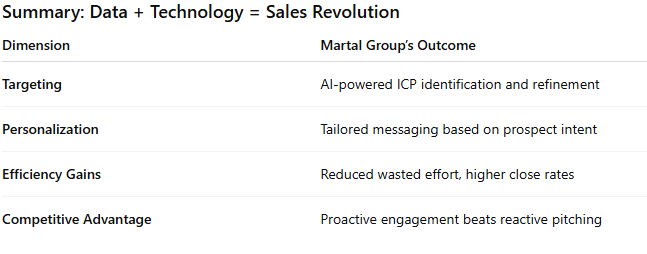
Martal Group’s success vividly demonstrates your core argument: in today’s B2B world, sales driven by data and technology isn’t just better—it’s essential. Intuition alone can’t compete with the intelligence and precision provided by modern platforms that analyze intent, behavior, and fit.
Would you like another case—perhaps emphasizing real-time engagement or interdepartmental alignment—or to see how other tools like Bombora or Leadspace contributed to similar transformations?
Exercise: Intuition vs. Data-Driven Prospecting
Team A: “Traditional Sales Team” — can only rely on intuition, networks, and manual processes to choose prospects.
Team B: “Data-Driven Sales Team” — has access to firmographic, technographic, and behavioral data (you can provide a short mock dataset).
Each team explains how they chose their prospects.
Compare approaches: Did Team A rely on “gut feel”? Did Team B use data points like website visits or tech compatibility?
Highlight how data-driven targeting saves time, improves accuracy, and supports personalization.

Course Manual 9: Content & Thought Leadership
In the fast-paced and highly competitive world of B2B sales, standing out is no longer optional—it is essential. With markets becoming increasingly saturated, products and services often appear interchangeable, and pricing wars steadily erode margins, differentiation has become one of the most significant challenges for sales organizations. In this crowded environment, buyers are bombarded with similar promises and competing offers, making it more challenging than ever for one voice to be heard above the noise. This is precisely where thought leadership emerges as a powerful, strategic tool for prospecting. By elevating the conversation beyond features, functionality, or discounts, thought leadership enables businesses to demonstrate authority, inspire trust, and cultivate long-term relationships with prospects by positioning themselves as a trusted voice in their industry.
At its core, thought leadership reshapes the sales conversation. Instead of relying on a transactional, product-driven pitch, companies lead with insights, perspectives, and innovative solutions that speak directly to the challenges decision-makers face. This consultative approach signals a deeper understanding of the landscape, one that goes beyond simply selling a product. When organizations consistently share meaningful content—through whitepapers, blogs, case studies, webinars, or industry reports—they create value before any formal engagement takes place. In doing so, they establish themselves as partners who can guide clients toward success, not just vendors vying for a contract. This shift in positioning fundamentally alters the prospecting dynamic, fostering stronger engagement, more constructive dialogue, and ultimately, improved conversion outcomes.

Modern B2B buyers are also more cautious and risk-averse than ever before. Their decisions carry weight, often affecting budgets, operations, competitive standing, and even personal credibility within their organizations. A misstep in selecting a provider can have costly, long-term consequences. For this reason, decision-makers are not only evaluating the product—they are assessing the expertise, reliability, and foresight of the potential partner. They look for signals that a company understands industry shifts, anticipates challenges, and offers solutions that align with both current and future needs. Thought leadership fills this critical gap. By consistently showcasing knowledge, experience, and vision, a company positions itself as a safer and more credible choice—one that reduces perceived risk and inspires confidence.
Significantly, the benefits of thought leadership extend far beyond lead generation. While it is highly effective in attracting inbound attention from qualified prospects, its true power lies in sustaining visibility throughout long and complex B2B sales cycles. These journeys often involve multiple stakeholders, layered approval processes, and prolonged evaluations. During such periods, it is easy for vendors to lose relevance or be forgotten. However, thought leadership ensures that a company remains consistently present in the minds of prospects. Through a steady cadence of fresh, relevant insights, organizations maintain relevance and visibility, positioning themselves as indispensable resources when buying decisions are finally made. This persistent presence strengthens brand positioning and significantly increases the likelihood of being chosen, keeping the conversation future-oriented and optimistic.
Thought leadership also enhances social proof and industry authority. When organizations share insights that resonate with their audience, they do more than just engage prospects—they attract recognition from peers, competitors, and influencers across the sector. This recognition often leads to expanded opportunities such as speaking engagements, media features, panel invitations, or strategic collaborations. Over time, this creates a virtuous cycle: the more expertise is shared, the more credibility is built; the more credibility is built, the more doors open for greater influence and reach. In essence, thought leadership amplifies both reputation and opportunity, extending a company’s impact well beyond the immediate sales pipeline.
For sales teams, thought leadership serves as a powerful enabler in prospecting conversations. It provides both the context and the content necessary to make outreach meaningful. Instead of initiating dialogue with generic scripts or impersonal pitches, sales professionals can reference thought leadership materials tailored to the prospect’s industry or specific pain points. A well-timed case study or industry analysis transforms a cold outreach into a value-driven exchange, making the salesperson feel more prepared and credible. This not only increases the likelihood of a positive response but also empowers sales professionals themselves, instilling confidence that they are delivering genuine value rather than merely chasing quotas. Over time, this approach builds rapport, nurtures trust, and accelerates the sales cycle.
The impact on brand positioning is equally significant. Organizations that successfully establish themselves as thought leaders are no longer seen as commodity providers; they are viewed as innovators, experts, and strategic partners. Buyers gravitate toward such companies because they provide clarity in uncertain environments and guidance through complexity. This reputation often leads to preferential consideration during vendor evaluations. It can justify premium pricing, as clients are willing to pay more to work with industry leaders who provide both solutions and assurance. Thought leadership, therefore, becomes not only a tool for winning business but also a lever for enhancing profitability and market influence.
Thought leadership is about becoming a valued resource. In today’s B2B environment, buyers are not simply purchasing solutions—they are seeking partners who can help them navigate uncertainty, overcome obstacles, and achieve strategic objectives. Aligning prospecting efforts with thought leadership initiatives allows organizations to move beyond the role of seller and instead embrace the role of trusted advisor. This positioning fosters deeper, more resilient relationships that drive long-term growth, customer loyalty, and mutual success.
Far from being just another marketing tactic, thought leadership represents a philosophy of engagement. It reflects a commitment to lead with credibility, to share knowledge generously, and to consistently place the prospect’s challenges at the center of the conversation. In the context of sales optimization, it is one of the most effective ways to align prospecting efforts with trust-building, differentiation, and authority in an increasingly crowded marketplace. Companies that adopt this approach will not only generate more high-quality leads but will also establish themselves as indispensable partners, paving the way for enduring business impact and sustainable growth.
Building Authority Through Content
In B2B sales, authority is not claimed—it is earned. One of the most effective ways to earn this authority is through consistent, high-quality content that demonstrates expertise and provides real value to prospects. Decision-makers are far more likely to engage with organizations that consistently offer fresh perspectives and practical solutions, especially when that content addresses their most pressing challenges.
Different formats serve different purposes. Whitepapers and industry reports showcase deep research and analytical thinking, establishing credibility with technical or strategic buyers who value data-driven insights. Case studies bring authority to life by demonstrating proven results in real-world scenarios, providing tangible evidence that the organization can deliver measurable impact. Blogs and articles allow for timely commentary on industry developments, while podcasts and webinars create interactive opportunities to engage prospects and showcase expertise in a more personal, conversational format.
However, content alone is not enough. To build authority, organizations must focus on three key qualities: consistency, depth, and originality. Consistency ensures that the company maintains visibility over time, keeping its voice present in the marketplace. Depth demonstrates that insights go beyond surface-level commentary, offering prospects a level of analysis they can’t easily find elsewhere. Originality, meanwhile, helps a business stand apart from competitors, ensuring that the content doesn’t merely echo what others are saying but instead adds a unique perspective and thought leadership.
When done well, this kind of content becomes more than marketing collateral—it becomes a trusted resource. Prospects begin to view the organization not as a vendor but as a guide whose expertise can inform their decision-making. This trust not only increases engagement with content but also carries over into the sales process, where prospects are more inclined to believe in the organization’s ability to deliver meaningful solutions.
Thought Leadership as a Prospecting Tool

Thought leadership is not just about building reputation—it is also a powerful lever for prospecting. When sales teams integrate thought leadership into their outreach strategies, they immediately elevate the quality of engagement with prospects. Instead of opening with a generic pitch, they can reference industry reports, blogs, or case studies that address the very issues a prospect is likely grappling with. This shifts the tone of the interaction from a sales approach to a helping one, making the conversation more relevant and valuable.
For example, a salesperson reaching out to a prospect in the financial services sector might share a whitepaper on regulatory technology trends. This not only positions the company as a knowledgeable partner but also gives the prospect a reason to continue the conversation. By aligning outreach with current industry insights, sales teams show that they understand the prospect’s world and are capable of offering informed guidance.
Thought leadership also helps to warm up cold leads. Prospects who might otherwise ignore outreach are more likely to respond when the message includes a valuable resource rather than a direct request for a meeting. Over time, repeated exposure to high-quality insights builds familiarity and trust, making it easier for sales teams to advance conversations.
Beyond opening doors, thought leadership can shorten sales cycles by addressing common questions and concerns upfront, thereby streamlining the sales process. A well-crafted case study, for instance, can serve as proof of concept, while a webinar recording might demonstrate a solution’s relevance to an industry trend. These resources provide prospects with the confidence they need to move forward more quickly.
In this way, thought leadership becomes an active tool in the sales arsenal—not just a branding exercise. By equipping sales professionals with credible, insight-driven materials, organizations empower their teams to create richer, more meaningful engagements that strengthen relationships and accelerate outcomes.
Sustaining Relationships Through Ongoing Insight
In B2B sales, relationships are rarely built in a single interaction—they evolve, often across long and complex buying cycles. Thought leadership plays a critical role in sustaining these relationships by ensuring that the organization remains visible, relevant, and trusted throughout the journey. By consistently sharing ongoing insights—whether through industry updates, commentary on emerging challenges, or forward-looking perspectives—sales teams position themselves as reliable partners rather than occasional vendors.
This continuity of value is essential when multiple stakeholders are involved in the decision-making process. Each stakeholder may have different concerns, from operational efficiency to financial risk or long-term strategy. By curating and sharing thought leadership content tailored to these varied priorities, organizations demonstrate a nuanced understanding of the decision landscape and keep all parties engaged.
Ongoing insights reinforce a company’s role as a forward-thinking advisor. Prospects are not just looking for solutions to today’s problems—they want to partner with organizations that can anticipate tomorrow’s challenges. By addressing emerging trends and providing strategic perspectives, thought leadership fosters confidence that the company will remain a relevant and capable partner well into the future.
The benefit extends beyond conversion to repeat business and loyalty. Even after a deal closes, continuing to provide insights strengthens the relationship, ensuring the client views the company as a long-term resource rather than a one-time supplier. This persistent relevance makes renewal discussions smoother, cross-selling opportunities more natural, and advocacy within the client’s network more likely.
In essence, sustaining relationships through thought leadership is about earning trust daily. By remaining top-of-mind with meaningful insights, organizations secure their place at the table—not just when prospects are ready to buy, but throughout their ongoing journey of growth and adaptation.

Conclusion
In today’s saturated B2B marketplace, where competition is fierce and differentiation is difficult, thought leadership has become far more than a marketing accessory—it is a strategic necessity. By elevating sales conversations beyond features and price points, thought leadership enables organizations to demonstrate authority, inspire trust, and position themselves as indispensable advisors. It transforms prospecting into a consultative journey, where value is delivered well before a contract is signed.
Through building authority with content, companies show the depth of their expertise and create resources that prospects can rely on to make informed decisions. By using thought leadership as a prospecting tool, sales teams shift outreach from transactional to value-driven, establishing relevance and credibility from the very first interaction. And by sustaining relationships with ongoing insight, organizations maintain visibility across long and complex buying cycles, ensuring they remain top-of-mind when it matters most.
The cumulative impact of these strategies is profound. Thought leadership not only attracts high-quality prospects but also shortens sales cycles, deepens client relationships, and enhances brand positioning as an industry leader. It creates a virtuous cycle of visibility, credibility, and opportunity that strengthens both immediate sales outcomes and long-term business growth.
Buyers are not searching for vendors—they are searching for partners they can trust to help them navigate uncertainty and achieve success. Organizations that commit to thought leadership fully embrace this role, becoming guides and allies rather than sellers. In doing so, they not only optimize sales performance but also build the foundation for enduring client loyalty, competitive advantage, and sustainable growth in an increasingly demanding business environment.
Case Study: HubSpot – Using Thought Leadership to Drive B2B Growth
Background
HubSpot, a provider of inbound marketing, sales, and customer service software, entered a highly competitive SaaS market where products often looked similar and price competition was fierce. Larger players like Salesforce and Oracle dominated the CRM and marketing automation space, making it difficult for HubSpot to stand out based solely on product features or pricing.
To differentiate itself, HubSpot recognized that modern B2B buyers were looking for guidance and expertise, not just tools. Buyers wanted partners who could help them understand marketing trends, generate leads, and adapt to the digital landscape. This insight led HubSpot to adopt a thought leadership-driven prospecting strategy, positioning the company not as a vendor but as a trusted advisor in the marketing industry.
Strategy: Building Authority Through Content
Instead of leading with product pitches, HubSpot invested heavily in educational content to build trust with prospects long before sales conversations began. They developed:
The HubSpot Blog: One of the most visited marketing and sales blogs globally, offering practical guides, thought pieces, and industry insights.
Free Resources: Whitepapers, eBooks, templates, and guides tackling common marketing and sales challenges.
HubSpot Academy: Free online courses and certifications on inbound marketing, sales, and customer success. This positioned HubSpot as a teacher and authority in the space, giving prospects confidence in their expertise.
Industry Reports: Regular publications like the “State of Marketing Report” and “State of Sales Report” provided forward-looking insights into market trends.
This consistent and high-value content helped HubSpot attract inbound leads who were already educated about their challenges and potential solutions before interacting with a sales rep.
Integration with Sales Prospecting
HubSpot’s sales teams leveraged this thought leadership content directly in prospecting:
Instead of cold calls, sales reps reached out with relevant articles, reports, or webinars that addressed the prospect’s specific pain points.
Prospects who downloaded resources were nurtured through personalized follow-ups referencing the content they had engaged with.
Sales reps used HubSpot Academy certifications as proof points of expertise, building credibility in early conversations.
This approach reframed sales interactions as value-driven consultations rather than product pitches. Prospects felt guided and informed, making them more receptive to engagement.
Results
Massive Lead Generation: HubSpot’s thought leadership content became its primary driver of inbound leads, generating hundreds of thousands of contacts annually.
Shortened Sales Cycles: Because HubSpot’s content educated prospects, they entered sales conversations with more precise needs and stronger trust, reducing the time needed to close deals.
Premium Brand Positioning: HubSpot became synonymous with “inbound marketing,” a category it helped create through its thought leadership. This allowed them to command premium pricing and avoid being viewed as just another SaaS vendor.
Industry Authority: HubSpot executives were frequently invited to speak at conferences, media outlets cited their reports, and “inbound marketing” became a widely adopted concept across industries.
Key Takeaway
HubSpot’s success demonstrates how thought leadership can transform B2B prospecting. By offering valuable insights before selling, HubSpot positioned itself as a trusted partner rather than a vendor, building trust, authority, and long-term relationships. This approach not only generated high-quality leads but also elevated the company’s brand, allowing it to thrive in a crowded and competitive market.
Exercise: Defining Your Thought Leadership Edge
Think about the top 3 challenges or questions your ideal prospect faces in their industry today.
Write down one unique perspective, insight, or solution your company could share (through a blog, whitepaper, case study, or webinar) that directly addresses one of those challenges.
Ask yourself: Would this position us as a problem-solver and trusted advisor—or just another vendor?

Course Manual 10: Networking & Referrals
Prospecting is the lifeblood of B2B sales. Without a steady influx of new opportunities, even the best products, services, and sales teams eventually stall. A company can have a world-class solution and an experienced salesforce, but without new prospects to engage, pipelines dry up and growth stagnates. Traditional prospecting methods such as cold calling, direct outreach, and email marketing have long been the foundation of lead generation. These methods are still relevant today—they allow businesses to reach broad audiences, explore untapped markets, and generate measurable results. However, they often require significant time, effort, and resources to convert cold leads into qualified opportunities. Salespeople frequently encounter barriers, including gatekeepers, low response rates, and the challenge of establishing credibility from scratch. In contrast, networking and referrals have emerged as some of the most effective strategies for identifying high-quality prospects, shortening sales cycles, and enhancing long-term client relationships. The shift from traditional methods to networking and referrals is a game-changer, offering a more efficient and practical approach to prospecting.
Networking and referrals tap into one of the most potent assets in sales: trust. In a business world that is increasingly digital, automated, and impersonal, human relationships remain the ultimate differentiator. Decision-makers are inundated daily with marketing emails, LinkedIn messages, and promotional calls, many of which blur together as generic noise. Amidst this clutter, a trusted introduction stands out as rare and valuable. Decision-makers are far more likely to listen to someone they know, respect, or trust than to a stranger sending an unsolicited email. When a referral comes from a client, colleague, or industry contact, it carries with it a sense of credibility and validation that cannot be replicated through traditional outreach. The prospect knows that someone they trust has already vetted the salesperson or solution, which immediately removes a significant layer of skepticism. That initial barrier—the doubt of “why should I listen to you?”—is cleared before the first conversation even begins. This emphasis on trust underscores the power of networking and referrals in the modern business landscape.

One of the most significant advantages of networking and referrals is the concept of “warm leads.” Unlike cold leads that require considerable time and effort to research, approach, and nurture, warm leads have already been introduced to your company through trusted relationships. These introductions reduce the friction associated with initial contact. Instead of spending the first interaction establishing credibility or explaining why you should be taken seriously, you can begin building on the foundation of trust that the referrer or network connection has already provided. This accelerates the sales process, making conversations more productive and increasing the likelihood of meaningful engagement. In many cases, prospects referred through trusted networks approach their first meeting with curiosity rather than suspicion—an invaluable shift in mindset that accelerates qualification and opportunity development. This efficiency empowers sales professionals, making them feel more effective in their prospecting efforts. The time-saving aspect of warm leads is a key benefit of networking and referrals.
Warm leads generated through referrals are also more likely to be high-quality opportunities. When someone makes a referral, they are not simply passing along a name—they are effectively endorsing your business, product, or service. This endorsement typically means that the referred prospect aligns well with your ideal client profile (ICP). For example, an existing client who understands the type of organizations you serve is unlikely to recommend a referral that would be a poor fit. Instead, they tend to recommend prospects who mirror their own needs, challenges, or industry context. As a result, referred prospects often come into the sales conversation with an immediate understanding of the value your business can provide and an openness to considering your solution. This alignment translates into higher conversion rates and more efficient use of sales resources.
Networking plays an equally vital role in modern prospecting. It is not simply about exchanging business cards at events or connecting with people on LinkedIn; it is about building genuine relationships over time. Effective networking opens doors to new prospects and provides access to insights about industries, competitors, and emerging trends. A strong network can serve as both a source of new opportunities and a resource for staying ahead of market shifts. For instance, a salesperson who invests time in industry events, conferences, peer groups, and digital communities might find themselves in a position to contribute valuable insights, which can lead to new connections and opportunities. These connections often pay dividends over time, as trust-based relationships can eventually lead to introductions, partnerships, or direct business opportunities that would not have been accessible through cold outreach alone.
Another significant benefit of networking and referrals is their cost-effectiveness. Traditional prospecting methods often require substantial investments in advertising, outreach tools, paid databases, or lead generation services. Referrals, on the other hand, cost little to nothing. They are powered by client satisfaction, professional credibility, and goodwill—not by advertising dollars. Networking typically involves a time investment—attending events, joining associations, or contributing to professional communities—but the financial costs are relatively minimal compared to large-scale marketing campaigns. Moreover, the leads generated through these approaches often progress more quickly through the sales funnel, thereby reducing the overall cost of acquisition and increasing the return on investment. This emphasis on cost-effectiveness will make the audience feel prudent and resourceful in their sales approach.
The impact of networking and referrals also extends beyond prospecting into client retention. When you consistently deliver value to clients, they are more inclined to refer you to their colleagues, peers, or industry contacts. This creates a self-sustaining cycle in which satisfied clients become advocates who bring new business into your pipeline. Additionally, by maintaining an active professional network, salespeople are better equipped to keep existing clients engaged, informed, and connected. This ongoing relationship-building strengthens trust and increases the likelihood of renewals, upsells, and long-term loyalty. A client who sees you as part of their professional network is less likely to view you as just another vendor and more likely to see you as a long-term partner. This stress on the self-sustaining cycle will make the audience feel secure and confident in their long-term business strategy.
In B2B sales, where trust, credibility, and relationship-building are paramount, networking and referrals offer a strategic advantage that cannot be overlooked. They not only reduce reliance on cold outreach but also align with the way modern buyers prefer to engage—with recommendations, introductions, and trusted sources guiding their decisions. By incorporating networking and referral strategies into prospecting efforts, sales teams can build more sustainable pipelines, improve efficiency, and create a competitive edge in an increasingly crowded marketplace.
The following will break down the critical dimensions of networking and referrals in prospecting: how to build effective networks, how to leverage referrals systematically, and how to integrate these approaches into a broader sales strategy. We’ll provide a step-by-step guide on how to identify the right networking opportunities, how to ask for referrals in a way that feels natural and respectful, and how to ensure that these strategies align with your overall sales goals.
Building and Leveraging Professional Networks
Effective networking is about more than just expanding your contact list. It is about cultivating meaningful relationships that provide value to both parties over time. An extensive database of shallow connections rarely drives results; instead, sales professionals must learn how to approach networking with intentionality—focusing on quality, not just quantity. This means identifying the right events, associations, and online platforms where target prospects, decision-makers, or industry influencers are most active, and committing to building genuine rapport.

Building a network requires a long-term mindset. A strong professional network is not built overnight—it is developed through consistent engagement, the exchange of ideas, and a willingness to add value before asking for anything in return. Salespeople must position themselves as trusted resources rather than transactional sellers. This often involves demonstrating genuine curiosity about others’ challenges, offering helpful insights, and connecting contacts with valuable resources—even when there is no immediate opportunity for a sale. Over time, these efforts translate into credibility, visibility, and opportunities for collaboration that may not have been available otherwise.
In practice, networking can take many forms. In-person opportunities, such as industry conferences, trade shows, and professional associations, are powerful for making lasting impressions. Effective networkers do more than collect business cards—they participate actively by asking thoughtful questions during sessions, contributing to discussions, and following up afterward with personalized messages. These actions show engagement and create memorable touchpoints.
Online, platforms like LinkedIn and specialized industry forums provide equally valuable opportunities for connection. Instead of passively collecting contacts, sales professionals can increase their visibility by engaging with content, sharing meaningful insights, or contributing to group conversations. Posting articles, commenting thoughtfully on peers’ updates, or offering helpful perspectives in online communities builds credibility and positions the salesperson as a knowledgeable contributor.
By showing up regularly and authentically—both in person and online—sales professionals can build networks that extend their reach, enhance their reputation, and open the door to warm introductions and referrals. Networking, when done well, becomes less about “selling” and more about being seen as a valuable, trusted member of a professional ecosystem.
Creating a Systematic Referral Strategy
While referrals can happen organically, the most successful sales organizations treat referrals as a structured and intentional part of their prospecting strategy. Relying on referrals to appear by chance can lead to inconsistent results. Still, when processes are in place, referrals can become one of the most reliable and cost-effective sources of pipeline growth. This requires shifting referrals from being a passive byproduct of satisfied clients to an active, ongoing initiative supported by the sales team.
A systematic referral strategy begins with clear communication. Clients and partners should understand not only that referrals are welcome, but also how valuable they are to the organization. Salespeople must learn to confidently and naturally ask for introductions—without appearing pushy. A simple phrase such as, “If you know someone in your network facing similar challenges, I’d be happy to share how we helped you and see if it could benefit them as well,” frames the referral as an extension of value rather than a favor. This approach feels professional, consultative, and client-centered.
The next step is making referrals easy. Clients are often willing to help, but without clear guidance, they may hesitate. Providing referral templates, offering to draft an introductory email on their behalf, or even hosting “bring-a-colleague” events can streamline the process. The less effort required on the client’s part, the more likely they are to follow through.
Organizations can further enhance referral consistency by formalizing programs. Structured referral programs may include recognition, small incentives, or exclusive perks for clients who provide introductions. For example, offering early access to a new service, highlighting clients publicly in newsletters, or providing discounts on renewals are effective ways to show appreciation. While care must be taken not to make referrals feel purely transactional, these gestures keep referrals top of mind and demonstrate gratitude.
A successful referral strategy necessitates effective tracking and follow-up. Sales teams should monitor the number of referrals received, conversion rates, and overall impact on pipeline growth. Just as importantly, they should close the loop by keeping the referrer informed and appreciated. A quick update or thank-you note can strengthen the relationship and encourage future referrals.
By embedding referrals into the rhythm of prospecting—through consistent asks, streamlined processes, and thoughtful recognition—sales teams can transform what is often an unpredictable opportunity into a predictable, scalable engine for growth.
Integrating Networking and Referrals into a Broader Prospecting Strategy
Networking and referrals are powerful, but they should not exist in isolation. They are most effective when integrated into a comprehensive prospecting plan that also leverages other methods such as cold outreach, inbound marketing, and account-based strategies. By combining these approaches, sales teams can diversify their lead sources, mitigate the risks associated with over-reliance on a single channel, and build a more resilient and predictable sales pipeline.

For example, networking can help salespeople identify industry influencers, strategic partners, or potential advocates who can connect them to opportunities they might not have reached otherwise. Referrals, in turn, provide warm introductions to decision-makers inside target accounts, accelerating the path to meaningful conversations. Cold outreach then serves as a complementary method, particularly useful for expanding into new territories, reaching untapped industries, or filling short-term gaps in the pipeline where networks have not yet been established. Together, these channels create a balanced and scalable approach, ensuring that no single prospecting method bears the full burden of lead generation.
Integration also requires coordination across teams and systems. Marketing can amplify networking and referral efforts through thought leadership content that salespeople share with their networks. Customer success teams can play a crucial role by identifying moments of client satisfaction—such as after a successful implementation or renewal—when referral requests are most likely to be successful. Aligning these functions ensures that networking and referrals are not left to chance but supported by a broader organizational strategy.
Equally important is measurement and accountability. Sales leaders should track and analyze the impact of networking and referrals alongside other prospecting activities. Key metrics include referral conversion rates, the average sales cycle length for referred leads compared to cold leads, and the cost per lead. This data provides valuable insights into ROI, helping organizations refine their strategies over time. For instance, if referrals consistently result in shorter sales cycles and higher conversion rates, teams may invest more resources in strengthening client relationships and referral programs.
By weaving networking and referrals into the broader prospecting strategy—supported by data, aligned across functions, and complemented by other methods—sales organizations can create a plan that is both effective and sustainable. This integrated approach ensures that pipelines remain strong, opportunities are diverse, and growth is less dependent on any single tactic.
Conclusion
Prospecting will always be at the core of B2B sales, but how organizations approach it continues to evolve. Cold calling, email campaigns, and other traditional methods still play a role, yet they are often resource-intensive and face growing challenges in today’s crowded, digital-first marketplace. Networking and referrals, by contrast, provide a prospecting pathway built on trust, credibility, and authentic relationships. They transform the often cold, transactional nature of sales into one of warm introductions, shared value, and meaningful engagement.
By building professional networks with intentionality, salespeople expand their influence and open doors to opportunities that may not have been accessible otherwise. By creating structured referral strategies, organizations can turn satisfied clients and partners into consistent advocates, ensuring that referrals become a reliable engine of growth rather than a chance occurrence. And by integrating networking and referrals into a broader prospecting framework, sales teams achieve balance—leveraging the speed and quality of warm leads while complementing them with other approaches to maintain a diverse and sustainable pipeline.
Networking and referrals represent more than just prospecting techniques; they reflect a mindset rooted in long-term relationships, mutual value, and trust. For sales organizations seeking not only to fill their pipelines but also to strengthen client loyalty and accelerate growth, these strategies offer a competitive edge that is both practical and enduring. In a world where buyers are overloaded with options and messages, the voice of a trusted connection remains one of the most powerful tools in sales.
Case Study: HubSpot’s Referral and Networking Strategy for B2B Growth
Background
HubSpot, a leading provider of inbound marketing and sales software, faced a challenge familiar to many B2B companies: how to sustain growth in increasingly competitive markets. While cold outreach and traditional lead generation tactics (such as email campaigns and paid advertising) generated a steady flow of leads, the cost of acquisition was rising, and conversion rates were inconsistent. Sales teams also struggled to break through gatekeepers and secure meaningful conversations with decision-makers, despite having a world-class product.
Challenge
Although HubSpot’s inbound model attracted many small to mid-sized businesses, penetrating larger enterprise accounts required a different approach. Cold outreach often stalled due to low response rates, while digital campaigns produced large volumes of leads that were not always aligned with the company’s ideal client profile (ICP). HubSpot needed a way to identify warmer, higher-quality prospects, shorten sales cycles, and increase the efficiency of its salesforce.
Strategy: Leveraging Networking and Referrals
HubSpot shifted its focus toward networking and referrals, building on the trust and credibility established with existing clients and industry partners. The company launched a structured Customer Referral Program, encouraging satisfied clients to introduce peers facing similar challenges. To make the process easy and appealing, HubSpot offered clear referral pathways and recognition incentives, such as service discounts and access to exclusive events.
Simultaneously, HubSpot invested heavily in professional networking. Sales teams were encouraged to actively participate in industry conferences, marketing associations, and online communities like LinkedIn Groups. Instead of focusing on direct selling, HubSpot positioned its representatives as thought leaders—sharing content, offering insights, and contributing to discussions on marketing automation, CRM, and business growth strategies. This authentic engagement created visibility and credibility, making HubSpot a trusted voice in its field.
Results
The impact of this dual strategy was significant:
Higher lead quality: Referrals consistently produced prospects aligned with HubSpot’s ICP, reducing time wasted on unqualified leads. Referral leads converted at 3x the rate of cold outreach leads.
Shorter sales cycles: Warm introductions accelerated trust-building, reducing the average sales cycle by 20–25% compared to traditional outbound leads.
Lower acquisition costs: Because referrals and networking required relatively little financial investment compared to digital advertising campaigns, HubSpot saw a notable decrease in customer acquisition costs (CAC).
Sustainable pipeline growth: The referral program created a self-sustaining cycle. Satisfied customers became advocates, feeding new prospects into the pipeline. In parallel, active networking continued to generate opportunities, especially in enterprise markets where trust and credibility are paramount.
Client retention and upsell opportunities: Clients who engaged in referrals demonstrated higher loyalty and renewal rates, often leading to upsells of additional HubSpot services.
Conclusion
HubSpot’s experience highlights how networking and referrals can transform B2B prospecting. By leveraging trust and credibility, the company shifted away from over-reliance on resource-heavy cold outreach and built a more balanced, efficient, and scalable growth engine. Networking positioned HubSpot as an industry authority, while referrals provided a steady flow of warm, high-quality leads. Together, these strategies not only accelerated pipeline development but also strengthened client relationships, creating long-term growth.
Exercise: Prospecting in Practice – Team Reflections & Future Insights
Project Studies

Project Study (Part 1) – Customer Service
The Head of this Department is to provide a detailed report relating to the Prospecting Preparation process that has been implemented within their department, together with all key stakeholders, as a result of conducting this workshop, incorporating process: planning; development; implementation; management; and review. Your process should feature the following 10 parts:
01. Own It
02. Be Consistent
03. ICP Focus
04. Market Awareness
05. Solution Differentiation
06. Targeted Outreach
07. Account Based Prospecting
08. Leverage Data & Technology
09. Content & Thought Leadership
10. Networking & Referrals
Please include the results of the initial evaluation and assessment.

Project Study (Part 2) – E-Business
The Head of this Department is to provide a detailed report relating to the Prospecting Preparation process that has been implemented within their department, together with all key stakeholders, as a result of conducting this workshop, incorporating process: planning; development; implementation; management; and review. Your process should feature the following 10 parts:
01. Own It
02. Be Consistent
03. ICP Focus
04. Market Awareness
05. Solution Differentiation
06. Targeted Outreach
07. Account Based Prospecting
08. Leverage Data & Technology
09. Content & Thought Leadership
10. Networking & Referrals
Please include the results of the initial evaluation and assessment.

Project Study (Part 3) – Finance
The Head of this Department is to provide a detailed report relating to the Prospecting Preparation process that has been implemented within their department, together with all key stakeholders, as a result of conducting this workshop, incorporating process: planning; development; implementation; management; and review. Your process should feature the following 10 parts:
01. Own It
02. Be Consistent
03. ICP Focus
04. Market Awareness
05. Solution Differentiation
06. Targeted Outreach
07. Account Based Prospecting
08. Leverage Data & Technology
09. Content & Thought Leadership
10. Networking & Referrals
Please include the results of the initial evaluation and assessment.

Project Study (Part 4) – Globalization
The Head of this Department is to provide a detailed report relating to the Prospecting Preparation process that has been implemented within their department, together with all key stakeholders, as a result of conducting this workshop, incorporating process: planning; development; implementation; management; and review. Your process should feature the following 10 parts:
01. Own It
02. Be Consistent
03. ICP Focus
04. Market Awareness
05. Solution Differentiation
06. Targeted Outreach
07. Account Based Prospecting
08. Leverage Data & Technology
09. Content & Thought Leadership
10. Networking & Referrals
Please include the results of the initial evaluation and assessment.

Project Study (Part 5) – Human Resources
The Head of this Department is to provide a detailed report relating to the Prospecting Preparation process that has been implemented within their department, together with all key stakeholders, as a result of conducting this workshop, incorporating process: planning; development; implementation; management; and review. Your process should feature the following 10 parts:
01. Own It
02. Be Consistent
03. ICP Focus
04. Market Awareness
05. Solution Differentiation
06. Targeted Outreach
07. Account Based Prospecting
08. Leverage Data & Technology
09. Content & Thought Leadership
10. Networking & Referrals
Please include the results of the initial evaluation and assessment.

Project Study (Part 6) – Information Technology
The Head of this Department is to provide a detailed report relating to the Prospecting Preparation process that has been implemented within their department, together with all key stakeholders, as a result of conducting this workshop, incorporating process: planning; development; implementation; management; and review. Your process should feature the following 10 parts:
01. Own It
02. Be Consistent
03. ICP Focus
04. Market Awareness
05. Solution Differentiation
06. Targeted Outreach
07. Account Based Prospecting
08. Leverage Data & Technology
09. Content & Thought Leadership
10. Networking & Referrals
Please include the results of the initial evaluation and assessment.

Project Study (Part 7) – Legal
The Head of this Department is to provide a detailed report relating to the Prospecting Preparation process that has been implemented within their department, together with all key stakeholders, as a result of conducting this workshop, incorporating process: planning; development; implementation; management; and review. Your process should feature the following 10 parts:
01. Own It
02. Be Consistent
03. ICP Focus
04. Market Awareness
05. Solution Differentiation
06. Targeted Outreach
07. Account Based Prospecting
08. Leverage Data & Technology
09. Content & Thought Leadership
10. Networking & Referrals
Please include the results of the initial evaluation and assessment.
Project Study (Part 8) – Management
The Head of this Department is to provide a detailed report relating to the Prospecting Preparation process that has been implemented within their department, together with all key stakeholders, as a result of conducting this workshop, incorporating process: planning; development; implementation; management; and review. Your process should feature the following 10 parts:
01. Own It
02. Be Consistent
03. ICP Focus
04. Market Awareness
05. Solution Differentiation
06. Targeted Outreach
07. Account Based Prospecting
08. Leverage Data & Technology
09. Content & Thought Leadership
10. Networking & Referrals
Please include the results of the initial evaluation and assessment.

Project Study (Part 9) – Marketing
The Head of this Department is to provide a detailed report relating to the Prospecting Preparation process that has been implemented within their department, together with all key stakeholders, as a result of conducting this workshop, incorporating process: planning; development; implementation; management; and review. Your process should feature the following 10 parts:
01. Own It
02. Be Consistent
03. ICP Focus
04. Market Awareness
05. Solution Differentiation
06. Targeted Outreach
07. Account Based Prospecting
08. Leverage Data & Technology
09. Content & Thought Leadership
10. Networking & Referrals
Please include the results of the initial evaluation and assessment.

Project Study (Part 10) – Production
The Head of this Department is to provide a detailed report relating to the Prospecting Preparation process that has been implemented within their department, together with all key stakeholders, as a result of conducting this workshop, incorporating process: planning; development; implementation; management; and review. Your process should feature the following 10 parts:
01. Own It
02. Be Consistent
03. ICP Focus
04. Market Awareness
05. Solution Differentiation
06. Targeted Outreach
07. Account Based Prospecting
08. Leverage Data & Technology
09. Content & Thought Leadership
10. Networking & Referrals
Please include the results of the initial evaluation and assessment.

Project Study (Part 11) – Logistics
The Head of this Department is to provide a detailed report relating to the Prospecting Preparation process that has been implemented within their department, together with all key stakeholders, as a result of conducting this workshop, incorporating process: planning; development; implementation; management; and review. Your process should feature the following 10 parts:
01. Own It
02. Be Consistent
03. ICP Focus
04. Market Awareness
05. Solution Differentiation
06. Targeted Outreach
07. Account Based Prospecting
08. Leverage Data & Technology
09. Content & Thought Leadership
10. Networking & Referrals
Please include the results of the initial evaluation and assessment.

Project Study (Part 12) – Education
The Head of this Department is to provide a detailed report relating to the Prospecting Preparation process that has been implemented within their department, together with all key stakeholders, as a result of conducting this workshop, incorporating process: planning; development; implementation; management; and review. Your process should feature the following 10 parts:
01. Own It
02. Be Consistent
03. ICP Focus
04. Market Awareness
05. Solution Differentiation
06. Targeted Outreach
07. Account Based Prospecting
08. Leverage Data & Technology
09. Content & Thought Leadership
10. Networking & Referrals
Please include the results of the initial evaluation and assessment.
Program Benefits
Management
- Fundamentals Focus
- Effective Reviews
- Field Focus
- Avoid Mistakes
- Increase Wins
- Be Proactive
- Eliminate Poaching
- RFP Strategy
- Leader Teamwork
- Common Language
Human Resources
- Foster Culture
- Onboarding Effectively
- Hiring Well
- Sustainable Routines
- Team Building
- Competitive Knowledge
- Deliver Insights
- Action Focus
- Integrate Events
- Meeting Preparation
Finance
- Increase Revenue
- Save Deals
- Realistic Goals
- Commission Reliability
- Clear Accelerators
- Forecasting Accuracy
- Aligned Compensation
- ICP Focus
- Be Prepared
- Simplify Compensation
Client Telephone Conference (CTC)
If you have any questions or if you would like to arrange a Client Telephone Conference (CTC) to discuss this particular Unique Consulting Service Proposition (UCSP) in more detail, please CLICK HERE.