

Employee Advancement – WDP1 (Professional Identity)

The Appleton Greene Corporate Training Program (CTP) for Employee Advancement is provided by Ms. Cheng Certified Learning Provider (CLP). Program Specifications: Monthly cost USD$2,500.00; Monthly Workshops 6 hours; Monthly Support 4 hours; Program Duration 12 months; Program orders subject to ongoing availability.
If you would like to view the Client Information Hub (CIH) for this program, please Click Here
Learning Provider Profile

Ms. Cheng is an accomplished corporate professional and lifelong educator, with over 20 years of business and consulting leadership experience. Currently, as an entrepreneur and education thought leader, Ms. Cheng is CEO of a pioneering holistic professional development company. She loves to create transformative corporate training programs that increase ROI and internal retention for businesses as well as promote purposeful career and personal advancement for employees. Her innovative approach to designing and delivering programs, creatively integrates traditional professional development with personal growth practices, based on her PhD “An Integral Education Model for Holistic Professional Development”.
Ms. Cheng is highly skilled at harnessing business opportunities and addressing corporate challenges, as she received her MBA from the M.I.T. Sloan School of Management and is both a technology and education industry leader. At Apple and Google, she led business strategy and product marketing management for the iconic launches of the MacBook Air, iPhone, iPad as well as successfully created new markets for ChromeOS and Android. She is adept at achieving corporate and organizational goals through her effective leadership of multi-functional teams, capitalizing on her interdisciplinary engineering/design/business education, and strengths in managing global organizations and stakeholders.
Ms. Cheng is delighted to be an Appleton Green Certified Learning Provider. As a recognized education thought leader, Ms. Cheng is passionate about designing impactful programs that achieve holistic professional development, organizational innovation and culture, and transformative self growth. Ms. Cheng is instrumental in co-designing the M.I.T. Integrated Design & Management (iDM) master’s program, boosting entrepreneurship in high-growth Asian markets as a Stanford Research Institute Innovation Consultant, and customizing Fortune 500 corporate leadership programs as a SYPartners Leadfully Coach. She was awarded the Education Visionary Award in 2024 by the Education 2.0 organization and recognized as a Women’s Transformative Leader in 2020 by the International Leadership Association.
Ms. Cheng loves integrating her personal interests in holistic health and yoga, dance and expressive arts, and inspiration of being outdoors in nature into the design of her programs. All of Ms. Cheng’s corporate training programs are highly interactive, thought provoking, deliver results, build community, and are fun!

MOST Analysis

Mission Statement
The first workshop, “Professional Identity”, is the kick off of the Employee Advancement Program and the beginning of the first module, “Professional & Self Identity Discovery”, of four total modules which are three months or workshops each. There are three main corporate objectives for the “Professional Identity” Workshop. The first goal is to provide employees with an overview of the year-long Employee Advancement Program, by highlighting the objectives, deliverables, and advancement process that takes place as the four modules in the program build upon one another. The four modules that are three months or workshops each are: (1) “Professional & Self Identity Discovery”, (2) “Professional Branding & Positioning”, (3) “Internal Career Mapping & Planning”, and (4) “Career Assessment & Advancement Plan”. This provides employees an understanding of the overall Employee Advancement Program as well as helps each employee start to envision how they can customize the program and deliverables to their own workplace situations and career advancement goals, which will be further defined as the program progresses. The second goal of the “Professional Identity” Workshop is for the Appleton Greene Accredited Consultant, who is leading and facilitating the Employee Advancement Program, is to create a supportive and peer feedback learning environment. The Appleton Greene Accredited Consultant and all of the employees in the program are establishing a “learning community”, in which everyone takes accountability for the development and growth that will happen collectively as a group and individually for each employee over the next year. There are several exercises in which the Employee Advancement learning community brainstorms and define their core values for the program, discuss effective ways of giving and receiving feedback which happens in every workshop, and break out into small “peer circles” of 3-4 employees each to start getting to know each other. These community and peer exercises establish an open and psychologically safe environment, so that employees can start to feel comfortable in expressing themselves. The final “Professional Identity” Workshop objective is for each employee to assess and reflect on what their previous and current identity is related to their professional journey and work, academic, and life experiences. Every employee presents a “Professional & Life Overview” presentation in which they highlight their academic and professional journey, and more importantly the major learning moments they experienced and what they perceive as their opportunity and challenge areas. They receive peer feedback on their presentation, so that each employee can start to see how others perceive their professional identity and journey.

Objectives
01. Grounding & Check-Ins: departmental SWOT analysis; strategy research & development. Time Allocated: 1 Month
02. Introductions & Values: departmental SWOT analysis; strategy research & development. Time Allocated: 1 Month
03. Community Values: departmental SWOT analysis; strategy research & development. Time Allocated: 1 Month
04. Giving Feedback: departmental SWOT analysis; strategy research & development. Time Allocated: 1 Month
05. Receiving Feedback: departmental SWOT analysis; strategy research & development. Time Allocated: 1 Month
06. Feedback Practices: departmental SWOT analysis; strategy research & development. Time Allocated: 1 Month
07. Professional Identity: departmental SWOT analysis; strategy research & development. 1 Month
08. Inspirational Identities: departmental SWOT analysis; strategy research & development. Time Allocated: 1 Month
09. Professional Overview: departmental SWOT analysis; strategy research & development. Time Allocated: 1 Month
10. Presentation Preparation: departmental SWOT analysis; strategy research & development. Time Allocated: 1 Month
11. Presentations & Feedback: departmental SWOT analysis; strategy research & development. Time Allocated: 1 Month
12. Closing & Check-Outs: departmental SWOT analysis; strategy research & development. Time Allocated: 1 Month

Strategies
01. Grounding & Check-Ins: Each individual department head to undertake departmental SWOT analysis; strategy research & development.
02. Introductions & Values: Each individual department head to undertake departmental SWOT analysis; strategy research & development.
03. Community Values: Each individual department head to undertake departmental SWOT analysis; strategy research & development.
04. Giving Feedback: Each individual department head to undertake departmental SWOT analysis; strategy research & development.
05. Receiving Feedback: Each individual department head to undertake departmental SWOT analysis; strategy research & development.
06. Feedback Practices: Each individual department head to undertake departmental SWOT analysis; strategy research & development.
07. Professional Identity: Each individual department head to undertake departmental SWOT analysis; strategy research & development.
08. Inspirational Identities: Each individual department head to undertake departmental SWOT analysis; strategy research & development.
09. Professional Overview: Each individual department head to undertake departmental SWOT analysis; strategy research & development.
10. Presentation Preparation: Each individual department head to undertake departmental SWOT analysis; strategy research & development.
11. Presentations & Feedback: Each individual department head to undertake departmental SWOT analysis; strategy research & development.
12. Closing & Check-Outs: Each individual department head to undertake departmental SWOT analysis; strategy research & development.

Tasks
01. Create a task on your calendar, to be completed within the next month, to analyze Grounding & Check-Ins.
02. Create a task on your calendar, to be completed within the next month, to analyze Introductions & Values.
03. Create a task on your calendar, to be completed within the next month, to analyze Community Values.
04. Create a task on your calendar, to be completed within the next month, to analyze Giving Feedback.
05. Create a task on your calendar, to be completed within the next month, to analyze Receiving Feedback.
06. Create a task on your calendar, to be completed within the next month, to analyze Feedback Practices.
07. Create a task on your calendar, to be completed within the next month, to analyze Professional Identity.
08. Create a task on your calendar, to be completed within the next month, to analyze Inspirational Identities.
09. Create a task on your calendar, to be completed within the next month, to analyze Professional Overview.
10. Create a task on your calendar, to be completed within the next month, to analyze Presentation Preparation.
11. Create a task on your calendar, to be completed within the next month, to analyze Presentations & Feedback.
12. Create a task on your calendar, to be completed within the next month, to analyze Closing & Check-Outs.
Introduction

Welcome to the Employee Advancement Program! We will be spending the next year together in an immersive process that integrates your professional and personal development for purposeful career advancement and self growth at your company.
Our first workshop, “Professional Identity”, is the kick off of the Employee Advancement Program and the beginning of the first of four growth modules. Before we dive into this first workshop, let us take an overall view of the program objectives, structure and growth process, and our collaborative community as well as your individual objectives. This overall view of the Employee Advancement Program will help us position what we will achieve and how we will benefit from each individual workshop, and how that supports the progressive process and overarching objectives of the program.
Employee Advancement Program Objectives
The Employee Advancement Program is a pioneering and highly effective professional and personal development program. Employee Advancement is delivered as a structured internal career advancement and self growth process, which is customizable to each and every individual employee in conjunction with business goals. In addition to supporting your individual development and career goals, this program is designed to tackle current and pressing workforce challenges that your company and industry faces, including providing internal mobility pathways, creating a cohesive and inclusive organizational culture, and fostering the well-being and happiness of their employees.
The specific objectives of the Employee Advancement Program are derived from extensive market research and informational interviews to clearly identify the needs of employees and employers. The goal of the program is to holistically integrate and meet the individual company (i.e. employee) and company (i.e. employer) objectives.
Individual Employee Objectives

Holistic professional and personal development
Purposeful career advancement goals and skills
Action plan and map to progress at their current company
Company & Employer Objectives

Greater internal mobility and employee retention
Effective professional development and engagement
Increase employee well-being and supportive workplace culture
By simultaneously focusing on individual/employee and company/employer challenges and opportunities, the Employee Advancement Program fosters a workplace culture that is supportive and inclusive as well as stimulates engagement and growth. Throughout the program, there will be opportunities to revisit and assess these objectives to better adapt to and address the specific workplace dynamics of your company.
Program Structure and Growth Process
The Employee Advancement Program is structured upon 4 growth modules that each have their own discrete objectives and progressively build upon one another to guide you on a holistic professional and personal development process. Each growth module is three months, or three workshops. At the beginning and end of each of these modules, there is goal and intention setting to start and then a course and self assessment to close. This helps to build continuity through the growth modules, map progress, and identify focus areas before moving into the next growth module.
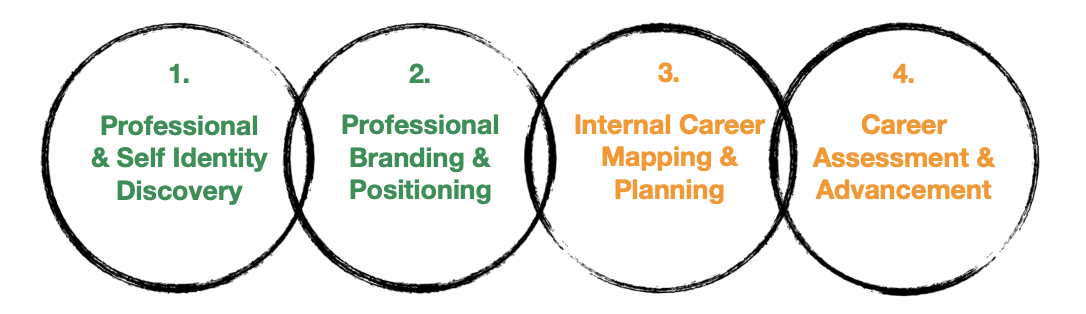
Employee Advancement Program: 4 Progressive Growth Modules
Employee Advancement leads each of you through a growth process that progresses from exploring your professional and self-identity to creating your professional brand and positioning, which then serves as a guide towards mapping your internal career pathways to building your advancement plan. Let us take a closer look at the objectives and development process in each of these growth modules.
Module 1: Professional & Self Identity Discovery
In this first growth module, we establish a supportive and safe environment for our Employee Advancement Program learning community, as sharing and feedback are an instrumental part of each of your growth journeys. The aim of the first growth module is to assess and reflect on what your current professional identity is, the work and life experiences which led you here, and how those define who you are. Our second workshop on Self Identity furthers this process of identity discovery with an exploration of your personal facets outside of work and the key people related to those facets contributing to who you are. This culminates in a holistic professional and personal view of yourself in the third workshop, 360° Discovery, which lays the foundation of a 360° feedback process in which you will define professional goals, construct interview templates and questions, and conduct your own interviews in the second growth module.
Module 2: Professional Branding & Positioning
The goal of the second growth module is creating your new professional brand and positioning to engage in and promote yourself for internal career advancement. The fourth workshop on Professional Branding provides a framework to explore from both the perspective of the brand and core values of your employer as well as your own unique brand and values. The development of your professional brand draws from the fifth workshop on 360° Learnings in which you synthesize the 360° feedback process and interviews you conducted to derive key learnings related to your professional goal.
To close the second growth module, the sixth workshop on Professional Positioning, draws on the integration of branding aspects and your 360° learnings so that you create your own Professional Brand Guide and how you want to authentically express and position yourself for new career opportunities.
Module 3: Internal Career Mapping & Planning
The third growth module is focused on internal career mapping and advancement planning, now that you established your new professional brand and positioning. In the seventh workshop, Career Mapping, you both get an overview of your company’s goals and organizational structure which helps you to create your own internal career map based on aspirations of advancement, skills development, lateral moves, etc. Your career map lays the groundwork for the eighth workshop, Mobility Scoping, in which you distill down 2-3 potential internal career pathways and assess additional skills, certifications, relationships, and professional and personal development that are needed. Finally, the ninth workshop of Advancement Planning solidifies a plan to evaluate and put action towards potential internal career pathways by detailing timelines, outreach, networking that needs to be done to pursue these pathways.
Module 4: Career Assessment & Advancement
The final growth module puts into action scoping of potential internal career pathways and effectively promoting yourself with your professional brand. The tenth workshop, Career Assessment, allows synthesis and refinement of career pathways based on the internal organizational outreach and research conducted. With your more defined career pathways, the eleventh workshop on Effective Promotion, takes a global view on how organizational patterns can be better addressed to more effectively meet business and internal corporate culture goals as well as deep dive into identifying 3-5 key development areas to support corporate as well as your personal goals. To close the fourth growth module and the Employee Advancement Program, the learning community and each employee solidifies a future advancement plan and supportive professional network, so that they can celebrate their achievements in the program and apply the program’s processes and learnings for continued internal career advancement.
Community and Individual Objectives
Now that you have an overview of the Employee Advancement Program and how the fourth growth modules progressive build upon one another, let us highlight one of the unique and most valuable experiences the program offers. Together, we will be creating our “learning community”, which will serve as support us, provide us constructive and critical feedback, and extend each of our professional networks throughout the program. There will be many opportunities and interactive exercises in which we will more deeply explore the subject matter of the workshops, bring in our own experiences and best practices, and work in small groups and 1:1 with peers to reflect and ask questions about each other’s goals and development.
The Employee Advancement Program provides a customizable and personalized growth process that meets objectives and outcomes for both our learning community as a whole and for each of you individually.
Our learning community growth objectives
Define community values and accountability
Create collaborative and psychologically safe learning environment
Invite different perspectives, backgrounds, experiences, biases, beliefs
Expand professional network and internal career opportunities
Your individual growth objectives
Take time and space to reflect and assess
Define your professional brand and internal pathways to advance your career
Explore your personal identity and values to be purposefully in your work
Create an authentic and holistic identity to effectively promote yourself
Now that we have taken an overall view of the program objectives, structure and growth process, and our collaborative community as well as your individual objectives, this will help frame our first workshop as we dive in. As we move through our program, we will always revisit the core objectives and what will be achieved in each workshop in relation to your own growth process and career advancement throughout the whole program.
Professional Identity Workshop
Our first Professional Identity workshop focuses on guiding each of you to explore, define, and strengthen your sense of self and relationship to others in your company and workplace. This workshop offers content, case studies, and interactive exercises that combine self-reflection, practical guidance, and activities to support each of you in understanding how your values, strengths, behaviors, roles, and aspirations shape your unique professional identity. Additionally, there will be peer exercises and feedback in which you can better understand and start to probe on how others perceive you and your professional identity.
We will be examining, refining, or completely recreating our professional identities throughout the Employee Advancement Program, so let us view this first workshop as simply setting the foundation around your identity exploration that we will progressively work with in subsequent workshops. By exploring our identities, you will be able to build greater self-awareness, purposeful alignment with career goals, and increased confidence in how you show up in a corporate or professional setting.
Workshop Core Objectives
There are two core objectives for our Professional Identity Workshop, an assessment and reflection of each of your professional identities as well as building a supportive and peer-feedback based learning environment.

The first workshop objective is to define and explore the different aspects that make up our professional identity. We will broaden our understanding of professional identity by associating with identity archetypes, looking at and examining inspirational identities, and then looking at our own professional identities. Each of you will assess and reflect on what their previous and current identity is related to your professional journey and work, academic, and life experiences. You will have the opportunity to create and share a “Professional & Life Overview” presentation in which you can highlight your academic and professional journey, and more importantly the major learning moments you experienced and what you perceive as your opportunity and challenge areas. There will be community and peer feedback on your presentation and identity aspects, so you can start to see how others perceive your professional identity and journey.
The second workshop objective sets the foundation for our “learning community”, a collaborative and supportive learning environment, which we will continue to build and draw upon throughout the program. In this first workshop, we will establish our learning community, which includes myself, all of you, and any guests and presenters who join us throughout the course of the program. The intention of the learning community is for everyone to take accountability for the development and growth that will happen collectively as a group and individually for each employee over the next year. There are important interactive exercises in which the learning community brainstorms and defines their core values for the program, discuss effective ways of giving and receiving feedback which happens in every workshop, and break out into small “peer circles” of 2-3 people each to start getting to know each other. These community and peer exercises establish an open and psychologically safe environment, so that each of us can start to feel comfortable in expressing ourselves.
What You Will Achieve
By the end of our Professional Identity Workshop, you will achieve a deeper and more intentional understanding of who you are as professionals. You will have assessed and reflected on how you show up and are perceived by others in the workplace as well as how your values, goals, and behavior align or do not align with your career and job role.
It is important to remember that our professional identities do (and should!) shift and change over time and different workplace environments as we advance our careers, taking on new roles and responsibilities, and expand our professional networks. Your “Professional & Life Overview” presentations provide a perspective of your identity and career from the past leading to the present moment. This sets the foundation for what you will achieve with the next workshops which is assessing, defining, and creating a new or refined professional identity for future career advancement.
These are things you will achieve by the end of this workshop:
Identify your core values and understand how those values influence your professional presence, interpersonal and intrapersonal relationships, and your sense of self in the workplace.
Build a supportive learning community and peer feedback circles in which you help to co-create the values and expectations that our learning community will uphold throughout the program, and start to develop deeper relationships with your peers in the program to give/receive constructive and critical feedback.
Learn new frameworks for giving and receiving feedback that you will immediately put into practice with the interactive exercises and peer feedback that are integral part of this workshop and developed throughout the program.
Assess and share your professional and life journey in order to reflect upon and receive feedback on your professional identity through past and present career roles and workplace environments.
Recognize your strengths and competencies as well as highlight growth and opportunity areas and how these contribute to your career, roles, and professional identity from past to present, and what growth areas you would like to develop for your future career advancement and professional identity.
How You Will Benefit
The Professional Identity workshop provides the foundation for both professional development and community building as well as self assessment and reflection benefits. These benefits will deepen as you go through the growth process of the Employee Advancement Program.
Start to develop your art of giving and receiving feedback which is instrumental to structuring feedback areas that you want to invite honest and direct input on and also how to receive feedback in a way that is constructive and helpful for you rather than potentially feeling defensive and discarding it.
Take time for self assessment and reflection on where you have been, where you are, and where you want to go with your career and professional identity development. You will benefit from structured exercises and peer feedback to evaluate what your values are, archetypes of your professional identity, and what the many aspects that shape your professional self.
Receive inspiration and model after others as you learn about what shapes the values and professional identities of your peers in our learning community as well as exploring inspirational professional identities of leaders, changemakers, and doers in the business world and in the industry you are working in.
History of Professional Identity
The concept of professional identity has evolved over time, shaped by changes in work, education, and social structures. Historically, professional identity was closely tied to formal roles, occupations, and career paths—such as doctors, lawyers, clergy, and teachers—that were clearly defined and understood by society. These roles came with explicit codes of conduct, specialized knowledge, and often a strong sense of social prestige. In the 19th and early 20th centuries, as industrialization expanded, new professions emerged, and with them came the idea of professionalism as a distinct identity rooted in values and ethics, expertise and competencies, and service and impact for the public good.
In the second half of the 20th century, as globalization, technology, and the knowledge economy advanced, professional identity began to shift from simply holding a formal role and title to how individuals see themselves in relation to their work, values, and longer-term career aspirations. The rise of corporate environments, personal branding, and non-linear careers made identity more dynamic and self-driven. Over time, professional identity is not only shaped by occupation but increasingly also by personal values, cultural background, lived experiences, and adaptability. Professional identity is seen as fluid and evolving—something that professionals develop intentionally over time through reflection, learning, and alignment with their goals.
Current Position of Professional Identity
Today, professional identity is viewed as a multi-dimensional and evolving concept, shaped not just by one’s job title or organization, but by personal values, experiences, cultural background, and individual career goals. In modern workplaces, especially within corporate and knowledge-driven industries, professionals are increasingly encouraged to bring their authentic selves to work. This means that identity is no longer strictly defined by rigid roles or hierarchical structures, but by how individuals align their skills, ethics, values, and personal aspirations with their work. As a result, professional identity has become more intentional and self-created, involving conscious reflection on who we are, how we contribute, and how we want to grow.
In today’s dynamic work environment, professional identity is also shaped by corporate values and culture, collaboration across cross-functional and international teams, and our own digital presence and desire for lifelong learning. Social media platforms like LinkedIn, digital portfolios, and virtual networking spaces all contribute to how professionals present themselves and engage with their industries. Additionally, factors like remote and hybrid work, organizational focus on employee well-being and satisfaction, and purpose-driven leadership are transforming how people connect with their roles and organizations. Overall, professional identity today is less about fitting into a mold and more about creating a meaningful, adaptive, and values-driven career path that reflects both personal and professional evolution.
Future Outlook of Professional Identity
The future of professional identity is expected to become even more fluid, personalized, and value-driven as the workplace and nature of work continues to evolve. With rapid advancements in technology, Artificial Intelligence, and automation, many traditional roles are being redefined—or disappearing altogether. In this shifting landscape, individuals will need to continuously adapt, reskill, and reimagine their roles, leading to professional identities that are more dynamic and shaped by non-linear career advancement and a need for lifelong learning. Professional identity will be centered around an individual’s core strengths, purpose, and adaptability, allowing them to navigate non-linear and diverse career paths with confidence.
As the workplace becomes more global, inclusive, and mission-focused, professionals will increasingly seek alignment between their personal values and the career paths and roles that they align with. Issues like sustainability, equity, mental well-being, and social impact will play a greater role in how individuals define success and purpose in their professional lives. The future will also see a rise in cross-functional roles, technology-driven careers, and remote and hybrid leadership and collaboration models that require individuals to cultivate broader identities that go beyond specific job functions. Ultimately, professional identity will be less about “what you do” and more about who you are, what you stand for, and how you make a difference in a complex and interconnected world.
Executive Summary

Our Professional Identity workshop kicks off the Employee Advancement program and each of your unique professional and personal growth journeys! The first of four growth modules, which comprises Workshops 1 to 3, focuses on your Professional & Self Identity Discovery. Exploring, giving and receiving feedback, and crafting your authentic professional and self identity will be foundational in your internal career advancement and personal development throughout our program.
Chapter 1: Grounding & Check-Ins
Our Grounding & Check-Ins is an intentional and open space in which we will start each and every one of our workshops. This space is created to help us transition from our busy work and personal lives into an environment of learning and growth with everyone in this program – our supportive learning community. A short grounding exercise that can include a short meditation, breathing practice, visualization exercise, or movement activity; both guides us into the learning environment as well as offers practices that you can incorporate into your own everyday life.
Check-Ins are intended to give everyone an opportunity to provide a check-in about anything they want to share that is going on in their lives. This can be speaking about an achievement, a challenge, or simply something that is going on in your life or what you did this weekend. Check-ins are a great way to build our Employee Advancement community and invite you to share on a deeper level and get to know each other better.
Finally, this first Course Manual of every workshop details the objectives and the learning journey that we will be taking throughout the workshop. It provides a ‘map’ of the workshops which we will revisit throughout.
The Professional Identity workshop objectives are:
Identify your core values
Build a supportive learning community and peer feedback circles
Learn new frameworks for giving and receiving feedback effectively
Assess and share your professional and life journey
Recognize your strengths and competencies as well as highlight growth and opportunity areas
Let us dive in and start to build our learning community and explore our professional identities!

Chapter 2: Introductions & Values
Our Employee Advancement Program is an individualized as well as a collective professional and self development journey. In addition to drawing upon each of your individual perspectives, experiences, and aspirations; we will be integrating all of our collective perspectives, experiences, and aspirations as a learning community. The intentional creation of a learning community is a unique and impactful aspect of the Employee Advancement Program. It is within the open and collaborative space of our learning community that you will share ideas and best practices, receive critical and constructive feedback, and grow a long-term supportive professional network.
Each of you will be giving introductions as well as sharing your intentions and goals that you would like to achieve with the Employee Advancement program, which builds upon the check-ins you shared during our opening Course Manual. It is natural and encouraged for your intentions and goals for your professional and personal growth journey to adapt and change throughout our program, but saying out loud your initial intentions is a great way to set off on your growth journey.
This Course Manual focuses on values – what they are and how they guide our behavior, decisions, and attitudes. At work, values represent us as an employee, our organization, and the company we work at. The values that we embrace can be deeply personal and individual, co-created by a group and represents the collective, or can be projected on to you by someone else.
Our Interactive Exercise is identifying your professional values. We will draw from Brené Brown, who is a prominent influencer and researcher on leadership, human values, and emotions, and her “Dare to Lead” list of values. Of course, you are welcome to add any values that represent you that are not on this list.

Chapter 3: Community Values
Our own professional and personal values are deeply interconnected with our community and company values, as they influence and are influenced by the culture of the environment we belong to. When we bring our core values into a shared space, they naturally contribute to shaping the collective norms and behaviors of that group.
In turn, when a company or community openly expresses values that resonate with its members, it fosters a sense of alignment, trust, and purpose. This reciprocal relationship strengthens belonging and engagement, allowing individuals to feel that their contributions matter and that they are part of something meaningful.
To provide real world examples on company and organizational values, we will look at successful companies that are driven by strong values (Google, Netflix, Salesforce) and healthy organizations that embrace meaningful values (Ogilvy, J.P. Morgan, patagonia). This is followed by an interactive exercise to identify values that represent your company and organization’s values, which can be drawn from your own as well as what you perceive your team and organization’s values represents. Again, we will use Brené Brown’s “Dare to Lead” list of values and add other values that are not on this list.
Most importantly, we will co-create and establish the values of our learning community for the Employee Advancement program. This is your community! Our community values interactive exercise is a wonderful opportunity to define and contribute to the values and norms that our learning community will adhere to which is in support of our individual as well as collective growth. In Workshop 2: Self Identity, we will revisit and finalize our learning community values, norms, and expectations to uphold for the rest of the program.

Chapter 4: Giving Feedback
The giving and receiving of feedback is an important component for our professional growth as individuals as well as innovative growth as a team, organization, and company throughout our careers. One of the cornerstones of our Employee Advancement program is effectively giving and receiving feedback that integrates supportive as well as constructive feedback, but most importantly ensures that all feedback can be action-oriented. We place a lot of focus on building a supportive and safe learning community environment, so that we can dig deeper to ask questions and be critical of one another in order to individually and collectively grow in the workplace.
There are three main ways, or what we call feedback circles, in which feedback will be given and received. First, effective feedback always starts with our self, in how we shape our identity and represent ourselves, so self feedback will come in the form of reflective and feedback synthesis exercise. Second, are peer feedback or peer reflection circles in which you will work in groups of 2-3 during interactive exercises to ask questions, identify blind spots, and offer critical and constructive feedback. Finally, is our community feedback circle where as an entire group we will engage in discussions, presentations, and sharing of best practices.
As a framework for giving feedback the SBI, or Situation-Behaviour-Impact, a feedback model developed by the Center for Creative Leadership is presented and explored. The SBI model is utilized by many corporations and applied to a wide variety of professional situations, and we will use it throughout our Employee Advancement program as a guide for giving self, peer, and community feedback. Our interactive exercise involves a self reflection on two situations where you gave feedback that was received well as well as received poorly. Then examining how you gave that feedback and identifying opportunities of improvement through the lens of the SBI model.

Chapter 5: Receiving Feedback
The art and skill of engaging in feedback is a two-way street in which there is both the giving of as well as the receiving of feedback. In corporate settings, there is typically more emphasis placed on the giving of feedback through 360° review cycles, 1:1 performance reviews with our manager and/or leadership team, and debrief and feedback meetings after an important client meeting and close of a team project. Effectively receiving, processing, and growing from feedback is as much of an art and skill as giving feedback, if not even more! To balance the two-way street of feedback, equal emphasis must be placed on what to do when you are on the receiving side of engaging in feedback.
Receiving critical feedback can be challenging due to a combination of psychological and biological factors that trigger defensive responses and emotional discomfort. From a psychological perspective, feedback often touches on our self-concept, self-esteem, and self-confidence. When we perceive feedback as a threat to our self-image or competence, it can provoke feelings of inadequacy and anxiety. From a biological viewpoint, the difficulty in receiving critical feedback can be traced to the brain’s response to perceived threats. When receiving negative feedback, the brain’s amygdala, which is the part of the brain that is responsible for processing emotions, can activate a fight-flight-freeze response.
As a framework for receiving feedback the model that Douglas Stone and Sheila Heen, who are accomplished educators specializing in communication and effective feedback, develop in their book “Thanks for the Feedback: The Science and Art of Receiving Feedback Well” is introduced. Stone and Heen approach receiving feedback as a learned skill that engages feedback types (appreciation, coaching, evaluation) and “triggers” to receiving feedback (Truth, Managing Relationships, Managing Identity).
Our interactive exercise involves a self reflection on two situations where you received critical and/or negative feedback in which you were able to receive it well and constructively versus when you received it poorly and withdrew from it. Then examining how you received that feedback through Stone and Heen’s feedback types and receiving feedback triggers, and starting how you can approach receiving feedback in ways that are more constructive and useful for you.

Chapter 6: Feedback Practices
This Course Manual establishes the giving and receiving of feedback models that were introduced, the SBI model for giving feedback and Stone and Heen’s receiving feedback model. We will work with core concepts from both of these models and apply them to your feedback practices through interactive exercises, so that you can develop and improve your approach to both giving and receiving feedback. This will enhance your capabilities to communicate effectively, deepen relationships, and continually reflect and refine your self identity in both your professional and personal life.
Our specific focus will be on how to receive feedback well, so that you can work with feedback in a useful and constructive way, especially if that feedback is critical and/or negative. We will further the application of the SBI model from feedback giving to receiving. Specific SBI approaches that we will practice are to acknowledge the feedback, seek clarification and commitment to growth, and show appreciation and intent to improve. Next, we will work further with Stone and Heen’s feedback types (appreciation, coaching, evaluation) with greater focus on identifying our “triggers” to receiving feedback (Truth, Managing Relationships, Managing Identity) and how to work more productively with our triggers.
Our Feedback Practices course module will be highly engaging and interactive, in which you will bring in giving and receiving feedback situations from your own life as well as learn and reflect upon those shared with your peer reflection circle and amongst our learning community. The more skilled we become in receiving feedback well, the more people will be open to delivering impactful feedback that helps promote our growth, so let us get to work on honing and applying healthy feedback practices!

Chapter 7: Professional Identity
The main objective of this Professional Identity workshop is for each of you to share, assess, and reflect on what your previous and current professional identity is related to your work, corporate, academic, and other life experiences. This Course Manual will begin our exploration of different facets and archetypes, or personas, of each of our professional identities. As we start to explore our professional identities, we will be harnessing peer and group feedback by utilizing the giving and receiving feedback methods and techniques that we are learning and practicing. This is one of the biggest values that the Employee Advancement Program delivers, is feedback that offers you new perspectives, insights, and questions to further develop yourselves.
Professional identity is a concept, an image, and the values we hold in relation to our career and profession. It defines how we relate to work, what we stand for, and how we want to contribute to our workplace, organization, and company. Our professional identity is usually a huge part of “who we are”, how we identify as a person and what we project about ourselves in our lives both at work and outside of work. Think back to the last party or social gathering you attended and when someone asked about what you do. How did you answer? Did you share your job title, what you do for work, and/or the company and industry you work in? Did you recount what you did last weekend? Did you share about your personal projects and pursuits?
In this Course Manual we will explore the 12 archetypes and characteristics of a professional identity: Outlaw, Magician, Hero, Lover, Jester, Everyman, Caregiver, Ruler, Creator, Innocent, Sage, and Explorer. As we explore, shift, and refine our professional identity, we will be creatively engaging corporate branding practices to guide the development of our professional brand from now through Module 2: Professional Branding & Positioning. Each of these brand archetypes are associated with core values, aspirations, and how we relate and are perceived by others.
Our interactive exercise is identifying 3 professional identity archetypes that most represent you in relation to your co-workers, your team, and/or your company. It is a fun and novel way to associate yourself as a Sage-Everyman or Magician-Creator, which you will then share with the entire learning community.

Chapter 8: Inspirational Identities
Our professional identities are shaped both inwardly, with our core values and voices, and outwardly, with what we are inspired and shaped by with the professional identities of others. In this Course Manual, we will explore inspirational identities with prominent figures in the Media and Marketing, Technology, and Finance and Banking industries, and what stands out in their professional identities in the way media portrays them and how the general public perceives them.

In the media and marketing industry, inspirational professional identities are often defined by bold storytelling, cultural fluency, and fearless authenticity. Leaders like Bozoma Saint John exemplify this through their ability to shape global brands while pushing for inclusive representation and emotional resonance. These professionals do not just market products, they connect deeply with audiences by reflecting the world as it is, and imagining what it can be. Their work often breaks through the noise by staying rooted in purpose, creativity, and human connection.

In the technology sector, figures like Satya Nadella, CEO of Microsoft, inspire with a leadership style centered on empathy, transformation, and growth mindset. Nadella redefined Microsoft’s

culture by emphasizing collaboration, humility, and innovation. Technologists with strong professional identities often balance technical expertise with visionary thinking, enabling them to navigate disruption, drive digital transformation, and lead with long-term impact.
In finance and banking, professional identity is increasingly shaped by trust, strategic foresight, and global influence. Christine Lagarde, President of the European Central Bank, embodies a professional presence grounded in clarity, composure, and trailblazing leadership. Her ability to lead through crises while advocating for economic reform and gender equity reflects the evolving role of financial leaders. Today’s most respected figures in this space are those who combine analytical rigor with a clear ethical stance and a commitment to shaping more resilient and inclusive economic systems.

Chapter 9: Professional Overview
Are you feeling inspired, curious, ready for growth, excited to create a new professional persona, or perhaps a little overwhelmed with your own professional identity?
The last two Course Manauls introduced the concept of a professional identity and the many different facets that shape how we represent our own as well as how others perceive our identity. We took a quick snapshot of how we perceive and represent our own identity by identifying 2-3 archetypes that we associate with our professional identity. Then, we took a look at inspirational leaders and professional identities in the corporate world to have a broader view on how identities are expressed, established, and also change over time.
In this Course Manual 9 on Professional Overview, we will shift our attention more fully onto your own current professional identity and past factors and experiences that have led you to where you are at today. Over the Course Manuals 9 through 11, we will be exploring your own professional identity and experiences by looking at facets that shaped your current identity (Course Manual 9), preparing your 8 minute Professional Overview presentation (Course Manual 10), then working in peer reflection circles to both present your Professional Overview as well as receive peer feedback (Course Manual 11).
The intent of creating your Professional Overview is to share your professional and life journey to this point, putting our focus more on key learnings and insights that you have gained rather than a complete rundown of your career and resume. This will be an interactive way to share more deeply about yourself, learn more about your peers, start to strengthen our learning community, and practice giving and receiving feedback. This Course Manual provides critical facets of your journey to explore and focus on as well as examples of how others have approached their Professional Overview presentations, so let us roll up our sleeves and dig into each of our professional overviews!

Chapter 10: Presentation Preparation
Now that we have set the direction for your Professional Overview presentations and started to hone in on professional and life experiences, learnings, and critical turning points in your journey, this Course Manual on Presentations Preparation will be mostly a working session for you to put your presentation together. Your presentation can follow the simple format of an introduction, content on your professional and life journey, and then closing with key learnings and insights.
The first half of this Course Manual will be to put a structure and content together for your Professional Overview presentations. We will delve into key components of a strong overview that includes who you are and what you do, defining experiences, accomplishments, failures; and identifying challenge and opportunity areas for future professional development. You are encouraged to approach your presentation as a storytelling opportunity that blends your personal voice by helping others understand not just what they do, but why it matters.
The second half of this Course Manual will be a working session to create your Professional Overview presentation whether you tell it as a story, show it through imagery, or create a short concise presentation. You will already have a simple structure and key talking points selected, so now you get to pull it all together. It is important to remember that our professional journeys are fluid and will continually take new directions (which is why we are all in this Employee Advancement program!), so these presentations are more about telling and learning about your story rather than needing to be a polished finalized presentation.

Chapter 11: Presentations & Feedback
It is Professional Overview presentation show time!
In this Course Manual for your presentations and peer feedback, we will start by providing guidelines on presenting in your peer reflection circle and feedback guidelines. Then, we will break up into peer reflection circles of 2 people, with the first person presenting and the other person being given points on how to give feedback. Of course, we welcome whatever feedback points to be made that naturally arise. Then, we will switch where the second person presents and the other gives feedback.
Throughout the Employee Advancement program, there will be many more opportunities to delve into different aspects of our professional identity and how we want to change and create new identities for our future and career advancement. Identities should, and must change over time, since we as people and the environments and communities we are connected with also change over time.
This Course Manual will be a rich and generative space to share as well as to receive questions and reflections back. Please remember that we are creating a learning community that offers support and constructive feedback that is in support of each of our individual as well as our collective growth. The more openly we share, the more openly we give constructive feedback, the more each of us can grow in our personal and professional development throughout this program.

Chapter 12: Closing & Check-Outs
We made it through our Professional Identity Workshop, which is the first of our Employee Advancement program and the beginning of our Module 1: Professional & Self Identity Discovery! We covered a lot of ground in this workshop, starting with establishing the values and expectations for our learning community, learning about giving and receiving feedback models and starting to put those techniques into practice, and diving deep into our professional identity and professional overview presentations.
Just like how we will be starting every workshop with a Grounding & Check-Ins, we will similarly be ending every workshop with a Closing & Check-Outs. This ending Course Module gives us the space to have a group discussion on what we have absorbed and learned during the workshop, revisit the workshop objectives, and get an overview of the Project Study you will be doing between workshops, as well as objectives of the next workshop. It is a time to step back to assess what we accomplished and to see what will be coming next in our Employee Advancement journey together.
For this Professional Identity workshop, these are the objectives we set out to complete:
Identify your core values
Build a supportive learning community and peer feedback circles
Learn new frameworks for giving and receiving feedback effectively
Assess and share your professional and life journey
Recognize your strengths and competencies as well as highlight growth and opportunity areas
Finally, we will do a round of “check-outs” to take a pulse check on how everyone is doing and to close our learning space for the workshop. Your check-out is simply 1-2 words about how you are thinking and feeling at the end of the workshop, and if you would like to offer 1-2 reflections or questions about what we worked on together.
Curriculum

Employee Advancement – WDP1 – Professional Identity
- Grounding & Check-Ins
- Introductions & Values
- Community Values
- Giving Feedback
- Receiving Feedback
- Feedback Practices
- Professional Identity
- Inspirational Identities
- Professional Overview
- Presentation Preparation
- Presentations & Feedback
- Closing & Check-Outs
Distance Learning

Introduction
Welcome to Appleton Greene and thank you for enrolling on the Employee Advancement corporate training program. You will be learning through our unique facilitation via distance-learning method, which will enable you to practically implement everything that you learn academically. The methods and materials used in your program have been designed and developed to ensure that you derive the maximum benefits and enjoyment possible. We hope that you find the program challenging and fun to do. However, if you have never been a distance-learner before, you may be experiencing some trepidation at the task before you. So we will get you started by giving you some basic information and guidance on how you can make the best use of the modules, how you should manage the materials and what you should be doing as you work through them. This guide is designed to point you in the right direction and help you to become an effective distance-learner. Take a few hours or so to study this guide and your guide to tutorial support for students, while making notes, before you start to study in earnest.
Study environment
You will need to locate a quiet and private place to study, preferably a room where you can easily be isolated from external disturbances or distractions. Make sure the room is well-lit and incorporates a relaxed, pleasant feel. If you can spoil yourself within your study environment, you will have much more of a chance to ensure that you are always in the right frame of mind when you do devote time to study. For example, a nice fire, the ability to play soft soothing background music, soft but effective lighting, perhaps a nice view if possible and a good size desk with a comfortable chair. Make sure that your family know when you are studying and understand your study rules. Your study environment is very important. The ideal situation, if at all possible, is to have a separate study, which can be devoted to you. If this is not possible then you will need to pay a lot more attention to developing and managing your study schedule, because it will affect other people as well as yourself. The better your study environment, the more productive you will be.
Study tools & rules
Try and make sure that your study tools are sufficient and in good working order. You will need to have access to a computer, scanner and printer, with access to the internet. You will need a very comfortable chair, which supports your lower back, and you will need a good filing system. It can be very frustrating if you are spending valuable study time trying to fix study tools that are unreliable, or unsuitable for the task. Make sure that your study tools are up to date. You will also need to consider some study rules. Some of these rules will apply to you and will be intended to help you to be more disciplined about when and how you study. This distance-learning guide will help you and after you have read it you can put some thought into what your study rules should be. You will also need to negotiate some study rules for your family, friends or anyone who lives with you. They too will need to be disciplined in order to ensure that they can support you while you study. It is important to ensure that your family and friends are an integral part of your study team. Having their support and encouragement can prove to be a crucial contribution to your successful completion of the program. Involve them in as much as you can.
Successful distance-learning
Distance-learners are freed from the necessity of attending regular classes or workshops, since they can study in their own way, at their own pace and for their own purposes. But unlike traditional internal training courses, it is the student’s responsibility, with a distance-learning program, to ensure that they manage their own study contribution. This requires strong self-discipline and self-motivation skills and there must be a clear will to succeed. Those students who are used to managing themselves, are good at managing others and who enjoy working in isolation, are more likely to be good distance-learners. It is also important to be aware of the main reasons why you are studying and of the main objectives that you are hoping to achieve as a result. You will need to remind yourself of these objectives at times when you need to motivate yourself. Never lose sight of your long-term goals and your short-term objectives. There is nobody available here to pamper you, or to look after you, or to spoon-feed you with information, so you will need to find ways to encourage and appreciate yourself while you are studying. Make sure that you chart your study progress, so that you can be sure of your achievements and re-evaluate your goals and objectives regularly.
Self-assessment
Appleton Greene training programs are in all cases post-graduate programs. Consequently, you should already have obtained a business-related degree and be an experienced learner. You should therefore already be aware of your study strengths and weaknesses. For example, which time of the day are you at your most productive? Are you a lark or an owl? What study methods do you respond to the most? Are you a consistent learner? How do you discipline yourself? How do you ensure that you enjoy yourself while studying? It is important to understand yourself as a learner and so some self-assessment early on will be necessary if you are to apply yourself correctly. Perform a SWOT analysis on yourself as a student. List your internal strengths and weaknesses as a student and your external opportunities and threats. This will help you later on when you are creating a study plan. You can then incorporate features within your study plan that can ensure that you are playing to your strengths, while compensating for your weaknesses. You can also ensure that you make the most of your opportunities, while avoiding the potential threats to your success.
Accepting responsibility as a student
Training programs invariably require a significant investment, both in terms of what they cost and in the time that you need to contribute to study and the responsibility for successful completion of training programs rests entirely with the student. This is never more apparent than when a student is learning via distance-learning. Accepting responsibility as a student is an important step towards ensuring that you can successfully complete your training program. It is easy to instantly blame other people or factors when things go wrong. But the fact of the matter is that if a failure is your failure, then you have the power to do something about it, it is entirely in your own hands. If it is always someone else’s failure, then you are powerless to do anything about it. All students study in entirely different ways, this is because we are all individuals and what is right for one student, is not necessarily right for another. In order to succeed, you will have to accept personal responsibility for finding a way to plan, implement and manage a personal study plan that works for you. If you do not succeed, you only have yourself to blame.
Planning
By far the most critical contribution to stress, is the feeling of not being in control. In the absence of planning we tend to be reactive and can stumble from pillar to post in the hope that things will turn out fine in the end. Invariably they don’t! In order to be in control, we need to have firm ideas about how and when we want to do things. We also need to consider as many possible eventualities as we can, so that we are prepared for them when they happen. Prescriptive Change, is far easier to manage and control, than Emergent Change. The same is true with distance-learning. It is much easier and much more enjoyable, if you feel that you are in control and that things are going to plan. Even when things do go wrong, you are prepared for them and can act accordingly without any unnecessary stress. It is important therefore that you do take time to plan your studies properly.
Management
Once you have developed a clear study plan, it is of equal importance to ensure that you manage the implementation of it. Most of us usually enjoy planning, but it is usually during implementation when things go wrong. Targets are not met and we do not understand why. Sometimes we do not even know if targets are being met. It is not enough for us to conclude that the study plan just failed. If it is failing, you will need to understand what you can do about it. Similarly if your study plan is succeeding, it is still important to understand why, so that you can improve upon your success. You therefore need to have guidelines for self-assessment so that you can be consistent with performance improvement throughout the program. If you manage things correctly, then your performance should constantly improve throughout the program.
Study objectives & tasks
The first place to start is developing your program objectives. These should feature your reasons for undertaking the training program in order of priority. Keep them succinct and to the point in order to avoid confusion. Do not just write the first things that come into your head because they are likely to be too similar to each other. Make a list of possible departmental headings, such as: Customer Service; E-business; Finance; Globalization; Human Resources; Technology; Legal; Management; Marketing and Production. Then brainstorm for ideas by listing as many things that you want to achieve under each heading and later re-arrange these things in order of priority. Finally, select the top item from each department heading and choose these as your program objectives. Try and restrict yourself to five because it will enable you to focus clearly. It is likely that the other things that you listed will be achieved if each of the top objectives are achieved. If this does not prove to be the case, then simply work through the process again.
Study forecast
As a guide, the Appleton Greene Employee Advancement corporate training program should take 12-18 months to complete, depending upon your availability and current commitments. The reason why there is such a variance in time estimates is because every student is an individual, with differing productivity levels and different commitments. These differentiations are then exaggerated by the fact that this is a distance-learning program, which incorporates the practical integration of academic theory as an as a part of the training program. Consequently all of the project studies are real, which means that important decisions and compromises need to be made. You will want to get things right and will need to be patient with your expectations in order to ensure that they are. We would always recommend that you are prudent with your own task and time forecasts, but you still need to develop them and have a clear indication of what are realistic expectations in your case. With reference to your time planning: consider the time that you can realistically dedicate towards study with the program every week; calculate how long it should take you to complete the program, using the guidelines featured here; then break the program down into logical modules and allocate a suitable proportion of time to each of them, these will be your milestones; you can create a time plan by using a spreadsheet on your computer, or a personal organizer such as MS Outlook, you could also use a financial forecasting software; break your time forecasts down into manageable chunks of time, the more specific you can be, the more productive and accurate your time management will be; finally, use formulas where possible to do your time calculations for you, because this will help later on when your forecasts need to change in line with actual performance. With reference to your task planning: refer to your list of tasks that need to be undertaken in order to achieve your program objectives; with reference to your time plan, calculate when each task should be implemented; remember that you are not estimating when your objectives will be achieved, but when you will need to focus upon implementing the corresponding tasks; you also need to ensure that each task is implemented in conjunction with the associated training modules which are relevant; then break each single task down into a list of specific to do’s, say approximately ten to do’s for each task and enter these into your study plan; once again you could use MS Outlook to incorporate both your time and task planning and this could constitute your study plan; you could also use a project management software like MS Project. You should now have a clear and realistic forecast detailing when you can expect to be able to do something about undertaking the tasks to achieve your program objectives.
Performance management
It is one thing to develop your study forecast, it is quite another to monitor your progress. Ultimately it is less important whether you achieve your original study forecast and more important that you update it so that it constantly remains realistic in line with your performance. As you begin to work through the program, you will begin to have more of an idea about your own personal performance and productivity levels as a distance-learner. Once you have completed your first study module, you should re-evaluate your study forecast for both time and tasks, so that they reflect your actual performance level achieved. In order to achieve this you must first time yourself while training by using an alarm clock. Set the alarm for hourly intervals and make a note of how far you have come within that time. You can then make a note of your actual performance on your study plan and then compare your performance against your forecast. Then consider the reasons that have contributed towards your performance level, whether they are positive or negative and make a considered adjustment to your future forecasts as a result. Given time, you should start achieving your forecasts regularly.
With reference to time management: time yourself while you are studying and make a note of the actual time taken in your study plan; consider your successes with time-efficiency and the reasons for the success in each case and take this into consideration when reviewing future time planning; consider your failures with time-efficiency and the reasons for the failures in each case and take this into consideration when reviewing future time planning; re-evaluate your study forecast in relation to time planning for the remainder of your training program to ensure that you continue to be realistic about your time expectations. You need to be consistent with your time management, otherwise you will never complete your studies. This will either be because you are not contributing enough time to your studies, or you will become less efficient with the time that you do allocate to your studies. Remember, if you are not in control of your studies, they can just become yet another cause of stress for you.
With reference to your task management: time yourself while you are studying and make a note of the actual tasks that you have undertaken in your study plan; consider your successes with task-efficiency and the reasons for the success in each case; take this into consideration when reviewing future task planning; consider your failures with task-efficiency and the reasons for the failures in each case and take this into consideration when reviewing future task planning; re-evaluate your study forecast in relation to task planning for the remainder of your training program to ensure that you continue to be realistic about your task expectations. You need to be consistent with your task management, otherwise you will never know whether you are achieving your program objectives or not.
Keeping in touch
You will have access to qualified and experienced professors and tutors who are responsible for providing tutorial support for your particular training program. So don’t be shy about letting them know how you are getting on. We keep electronic records of all tutorial support emails so that professors and tutors can review previous correspondence before considering an individual response. It also means that there is a record of all communications between you and your professors and tutors and this helps to avoid any unnecessary duplication, misunderstanding, or misinterpretation. If you have a problem relating to the program, share it with them via email. It is likely that they have come across the same problem before and are usually able to make helpful suggestions and steer you in the right direction. To learn more about when and how to use tutorial support, please refer to the Tutorial Support section of this student information guide. This will help you to ensure that you are making the most of tutorial support that is available to you and will ultimately contribute towards your success and enjoyment with your training program.
Work colleagues and family
You should certainly discuss your program study progress with your colleagues, friends and your family. Appleton Greene training programs are very practical. They require you to seek information from other people, to plan, develop and implement processes with other people and to achieve feedback from other people in relation to viability and productivity. You will therefore have plenty of opportunities to test your ideas and enlist the views of others. People tend to be sympathetic towards distance-learners, so don’t bottle it all up in yourself. Get out there and share it! It is also likely that your family and colleagues are going to benefit from your labors with the program, so they are likely to be much more interested in being involved than you might think. Be bold about delegating work to those who might benefit themselves. This is a great way to achieve understanding and commitment from people who you may later rely upon for process implementation. Share your experiences with your friends and family.
Making it relevant
The key to successful learning is to make it relevant to your own individual circumstances. At all times you should be trying to make bridges between the content of the program and your own situation. Whether you achieve this through quiet reflection or through interactive discussion with your colleagues, client partners or your family, remember that it is the most important and rewarding aspect of translating your studies into real self-improvement. You should be clear about how you want the program to benefit you. This involves setting clear study objectives in relation to the content of the course in terms of understanding, concepts, completing research or reviewing activities and relating the content of the modules to your own situation. Your objectives may understandably change as you work through the program, in which case you should enter the revised objectives on your study plan so that you have a permanent reminder of what you are trying to achieve, when and why.
Distance-learning check-list
Prepare your study environment, your study tools and rules.
Undertake detailed self-assessment in terms of your ability as a learner.
Create a format for your study plan.
Consider your study objectives and tasks.
Create a study forecast.
Assess your study performance.
Re-evaluate your study forecast.
Be consistent when managing your study plan.
Use your Appleton Greene Certified Learning Provider (CLP) for tutorial support.
Make sure you keep in touch with those around you.
Tutorial Support

Programs
Appleton Greene uses standard and bespoke corporate training programs as vessels to transfer business process improvement knowledge into the heart of our clients’ organizations. Each individual program focuses upon the implementation of a specific business process, which enables clients to easily quantify their return on investment. There are hundreds of established Appleton Greene corporate training products now available to clients within customer services, e-business, finance, globalization, human resources, information technology, legal, management, marketing and production. It does not matter whether a client’s employees are located within one office, or an unlimited number of international offices, we can still bring them together to learn and implement specific business processes collectively. Our approach to global localization enables us to provide clients with a truly international service with that all important personal touch. Appleton Greene corporate training programs can be provided virtually or locally and they are all unique in that they individually focus upon a specific business function. They are implemented over a sustainable period of time and professional support is consistently provided by qualified learning providers and specialist consultants.
Support available
You will have a designated Certified Learning Provider (CLP) and an Accredited Consultant and we encourage you to communicate with them as much as possible. In all cases tutorial support is provided online because we can then keep a record of all communications to ensure that tutorial support remains consistent. You would also be forwarding your work to the tutorial support unit for evaluation and assessment. You will receive individual feedback on all of the work that you undertake on a one-to-one basis, together with specific recommendations for anything that may need to be changed in order to achieve a pass with merit or a pass with distinction and you then have as many opportunities as you may need to re-submit project studies until they meet with the required standard. Consequently the only reason that you should really fail (CLP) is if you do not do the work. It makes no difference to us whether a student takes 12 months or 18 months to complete the program, what matters is that in all cases the same quality standard will have been achieved.
Support Process
Please forward all of your future emails to the designated (CLP) Tutorial Support Unit email address that has been provided and please do not duplicate or copy your emails to other AGC email accounts as this will just cause unnecessary administration. Please note that emails are always answered as quickly as possible but you will need to allow a period of up to 20 business days for responses to general tutorial support emails during busy periods, because emails are answered strictly within the order in which they are received. You will also need to allow a period of up to 30 business days for the evaluation and assessment of project studies. This does not include weekends or public holidays. Please therefore kindly allow for this within your time planning. All communications are managed online via email because it enables tutorial service support managers to review other communications which have been received before responding and it ensures that there is a copy of all communications retained on file for future reference. All communications will be stored within your personal (CLP) study file here at Appleton Greene throughout your designated study period. If you need any assistance or clarification at any time, please do not hesitate to contact us by forwarding an email and remember that we are here to help. If you have any questions, please list and number your questions succinctly and you can then be sure of receiving specific answers to each and every query.
Time Management
It takes approximately 1 Year to complete the Employee Advancement corporate training program, incorporating 12 x 6-hour monthly workshops. Each student will also need to contribute approximately 4 hours per week over 1 Year of their personal time. Students can study from home or work at their own pace and are responsible for managing their own study plan. There are no formal examinations and students are evaluated and assessed based upon their project study submissions, together with the quality of their internal analysis and supporting documents. They can contribute more time towards study when they have the time to do so and can contribute less time when they are busy. All students tend to be in full time employment while studying and the Employee Advancement program is purposely designed to accommodate this, so there is plenty of flexibility in terms of time management. It makes no difference to us at Appleton Greene, whether individuals take 12-18 months to complete this program. What matters is that in all cases the same standard of quality will have been achieved with the standard and bespoke programs that have been developed.
Distance Learning Guide
The distance learning guide should be your first port of call when starting your training program. It will help you when you are planning how and when to study, how to create the right environment and how to establish the right frame of mind. If you can lay the foundations properly during the planning stage, then it will contribute to your enjoyment and productivity while training later. The guide helps to change your lifestyle in order to accommodate time for study and to cultivate good study habits. It helps you to chart your progress so that you can measure your performance and achieve your goals. It explains the tools that you will need for study and how to make them work. It also explains how to translate academic theory into practical reality. Spend some time now working through your distance learning guide and make sure that you have firm foundations in place so that you can make the most of your distance learning program. There is no requirement for you to attend training workshops or classes at Appleton Greene offices. The entire program is undertaken online, program course manuals and project studies are administered via the Appleton Greene web site and via email, so you are able to study at your own pace and in the comfort of your own home or office as long as you have a computer and access to the internet.
How To Study
The how to study guide provides students with a clear understanding of the Appleton Greene facilitation via distance learning training methods and enables students to obtain a clear overview of the training program content. It enables students to understand the step-by-step training methods used by Appleton Greene and how course manuals are integrated with project studies. It explains the research and development that is required and the need to provide evidence and references to support your statements. It also enables students to understand precisely what will be required of them in order to achieve a pass with merit and a pass with distinction for individual project studies and provides useful guidance on how to be innovative and creative when developing your Unique Program Proposition (UPP).
Tutorial Support
Tutorial support for the Appleton Greene Employee Advancement corporate training program is provided online either through the Appleton Greene Client Support Portal (CSP), or via email. All tutorial support requests are facilitated by a designated Program Administration Manager (PAM). They are responsible for deciding which professor or tutor is the most appropriate option relating to the support required and then the tutorial support request is forwarded onto them. Once the professor or tutor has completed the tutorial support request and answered any questions that have been asked, this communication is then returned to the student via email by the designated Program Administration Manager (PAM). This enables all tutorial support, between students, professors and tutors, to be facilitated by the designated Program Administration Manager (PAM) efficiently and securely through the email account. You will therefore need to allow a period of up to 20 business days for responses to general support queries and up to 30 business days for the evaluation and assessment of project studies, because all tutorial support requests are answered strictly within the order in which they are received. This does not include weekends or public holidays. Consequently you need to put some thought into the management of your tutorial support procedure in order to ensure that your study plan is feasible and to obtain the maximum possible benefit from tutorial support during your period of study. Please retain copies of your tutorial support emails for future reference. Please ensure that ALL of your tutorial support emails are set out using the format as suggested within your guide to tutorial support. Your tutorial support emails need to be referenced clearly to the specific part of the course manual or project study which you are working on at any given time. You also need to list and number any questions that you would like to ask, up to a maximum of five questions within each tutorial support email. Remember the more specific you can be with your questions the more specific your answers will be too and this will help you to avoid any unnecessary misunderstanding, misinterpretation, or duplication. The guide to tutorial support is intended to help you to understand how and when to use support in order to ensure that you get the most out of your training program. Appleton Greene training programs are designed to enable you to do things for yourself. They provide you with a structure or a framework and we use tutorial support to facilitate students while they practically implement what they learn. In other words, we are enabling students to do things for themselves. The benefits of distance learning via facilitation are considerable and are much more sustainable in the long-term than traditional short-term knowledge sharing programs. Consequently you should learn how and when to use tutorial support so that you can maximize the benefits from your learning experience with Appleton Greene. This guide describes the purpose of each training function and how to use them and how to use tutorial support in relation to each aspect of the training program. It also provides useful tips and guidance with regard to best practice.
Tutorial Support Tips
Students are often unsure about how and when to use tutorial support with Appleton Greene. This Tip List will help you to understand more about how to achieve the most from using tutorial support. Refer to it regularly to ensure that you are continuing to use the service properly. Tutorial support is critical to the success of your training experience, but it is important to understand when and how to use it in order to maximize the benefit that you receive. It is no coincidence that those students who succeed are those that learn how to be positive, proactive and productive when using tutorial support.
Be positive and friendly with your tutorial support emails
Remember that if you forward an email to the tutorial support unit, you are dealing with real people. “Do unto others as you would expect others to do unto you”. If you are positive, complimentary and generally friendly in your emails, you will generate a similar response in return. This will be more enjoyable, productive and rewarding for you in the long-term.
Think about the impression that you want to create
Every time that you communicate, you create an impression, which can be either positive or negative, so put some thought into the impression that you want to create. Remember that copies of all tutorial support emails are stored electronically and tutors will always refer to prior correspondence before responding to any current emails. Over a period of time, a general opinion will be arrived at in relation to your character, attitude and ability. Try to manage your own frustrations, mood swings and temperament professionally, without involving the tutorial support team. Demonstrating frustration or a lack of patience is a weakness and will be interpreted as such. The good thing about communicating in writing, is that you will have the time to consider your content carefully, you can review it and proof-read it before sending your email to Appleton Greene and this should help you to communicate more professionally, consistently and to avoid any unnecessary knee-jerk reactions to individual situations as and when they may arise. Please also remember that the CLP Tutorial Support Unit will not just be responsible for evaluating and assessing the quality of your work, they will also be responsible for providing recommendations to other learning providers and to client contacts within the Appleton Greene global client network, so do be in control of your own emotions and try to create a good impression.
Remember that quality is preferred to quantity
Please remember that when you send an email to the tutorial support team, you are not using Twitter or Text Messaging. Try not to forward an email every time that you have a thought. This will not prove to be productive either for you or for the tutorial support team. Take time to prepare your communications properly, as if you were writing a professional letter to a business colleague and make a list of queries that you are likely to have and then incorporate them within one email, say once every month, so that the tutorial support team can understand more about context, application and your methodology for study. Get yourself into a consistent routine with your tutorial support requests and use the tutorial support template provided with ALL of your emails. The (CLP) Tutorial Support Unit will not spoon-feed you with information. They need to be able to evaluate and assess your tutorial support requests carefully and professionally.
Be specific about your questions in order to receive specific answers
Try not to write essays by thinking as you are writing tutorial support emails. The tutorial support unit can be unclear about what in fact you are asking, or what you are looking to achieve. Be specific about asking questions that you want answers to. Number your questions. You will then receive specific answers to each and every question. This is the main purpose of tutorial support via email.
Keep a record of your tutorial support emails
It is important that you keep a record of all tutorial support emails that are forwarded to you. You can then refer to them when necessary and it avoids any unnecessary duplication, misunderstanding, or misinterpretation.
Individual training workshops or telephone support
Please be advised that Appleton Greene does not provide separate or individual tutorial support meetings, workshops, or provide telephone support for individual students. Appleton Greene is an equal opportunities learning and service provider and we are therefore understandably bound to treat all students equally. We cannot therefore broker special financial or study arrangements with individual students regardless of the circumstances. All tutorial support is provided online and this enables Appleton Greene to keep a record of all communications between students, professors and tutors on file for future reference, in accordance with our quality management procedure and your terms and conditions of enrolment. All tutorial support is provided online via email because it enables us to have time to consider support content carefully, it ensures that you receive a considered and detailed response to your queries. You can number questions that you would like to ask, which relate to things that you do not understand or where clarification may be required. You can then be sure of receiving specific answers to each individual query. You will also then have a record of these communications and of all tutorial support, which has been provided to you. This makes tutorial support administration more productive by avoiding any unnecessary duplication, misunderstanding, or misinterpretation.
Tutorial Support Email Format
You should use this tutorial support format if you need to request clarification or assistance while studying with your training program. Please note that ALL of your tutorial support request emails should use the same format. You should therefore set up a standard email template, which you can then use as and when you need to. Emails that are forwarded to Appleton Greene, which do not use the following format, may be rejected and returned to you by the (CLP) Program Administration Manager. A detailed response will then be forwarded to you via email usually within 20 business days of receipt for general support queries and 30 business days for the evaluation and assessment of project studies. This does not include weekends or public holidays. Your tutorial support request, together with the corresponding TSU reply, will then be saved and stored within your electronic TSU file at Appleton Greene for future reference.
Subject line of your email
Please insert: Appleton Greene (CLP) Tutorial Support Request: (Your Full Name) (Date), within the subject line of your email.
Main body of your email
Please insert:
1. Appleton Greene Certified Learning Provider (CLP) Tutorial Support Request
2. Your Full Name
3. Date of TS request
4. Preferred email address
5. Backup email address
6. Course manual page name or number (reference)
7. Project study page name or number (reference)
Subject of enquiry
Please insert a maximum of 50 words (please be succinct)
Briefly outline the subject matter of your inquiry, or what your questions relate to.
Question 1
Maximum of 50 words (please be succinct)
Maximum of 50 words (please be succinct)
Question 3
Maximum of 50 words (please be succinct)
Question 4
Maximum of 50 words (please be succinct)
Question 5
Maximum of 50 words (please be succinct)
Please note that a maximum of 5 questions is permitted with each individual tutorial support request email.
Procedure
* List the questions that you want to ask first, then re-arrange them in order of priority. Make sure that you reference them, where necessary, to the course manuals or project studies.
* Make sure that you are specific about your questions and number them. Try to plan the content within your emails to make sure that it is relevant.
* Make sure that your tutorial support emails are set out correctly, using the Tutorial Support Email Format provided here.
* Save a copy of your email and incorporate the date sent after the subject title. Keep your tutorial support emails within the same file and in date order for easy reference.
* Allow up to 20 business days for a response to general tutorial support emails and up to 30 business days for the evaluation and assessment of project studies, because detailed individual responses will be made in all cases and tutorial support emails are answered strictly within the order in which they are received.
* Emails can and do get lost. So if you have not received a reply within the appropriate time, forward another copy or a reminder to the tutorial support unit to be sure that it has been received but do not forward reminders unless the appropriate time has elapsed.
* When you receive a reply, save it immediately featuring the date of receipt after the subject heading for easy reference. In most cases the tutorial support unit replies to your questions individually, so you will have a record of the questions that you asked as well as the answers offered. With project studies however, separate emails are usually forwarded by the tutorial support unit, so do keep a record of your own original emails as well.
* Remember to be positive and friendly in your emails. You are dealing with real people who will respond to the same things that you respond to.
* Try not to repeat questions that have already been asked in previous emails. If this happens the tutorial support unit will probably just refer you to the appropriate answers that have already been provided within previous emails.
* If you lose your tutorial support email records you can write to Appleton Greene to receive a copy of your tutorial support file, but a separate administration charge may be levied for this service.
How To Study

Your Certified Learning Provider (CLP) and Accredited Consultant can help you to plan a task list for getting started so that you can be clear about your direction and your priorities in relation to your training program. It is also a good way to introduce yourself to the tutorial support team.
Planning your study environment
Your study conditions are of great importance and will have a direct effect on how much you enjoy your training program. Consider how much space you will have, whether it is comfortable and private and whether you are likely to be disturbed. The study tools and facilities at your disposal are also important to the success of your distance-learning experience. Your tutorial support unit can help with useful tips and guidance, regardless of your starting position. It is important to get this right before you start working on your training program.
Planning your program objectives
It is important that you have a clear list of study objectives, in order of priority, before you start working on your training program. Your tutorial support unit can offer assistance here to ensure that your study objectives have been afforded due consideration and priority.
Planning how and when to study
Distance-learners are freed from the necessity of attending regular classes, since they can study in their own way, at their own pace and for their own purposes. This approach is designed to let you study efficiently away from the traditional classroom environment. It is important however, that you plan how and when to study, so that you are making the most of your natural attributes, strengths and opportunities. Your tutorial support unit can offer assistance and useful tips to ensure that you are playing to your strengths.
Planning your study tasks
You should have a clear understanding of the study tasks that you should be undertaking and the priority associated with each task. These tasks should also be integrated with your program objectives. The distance learning guide and the guide to tutorial support for students should help you here, but if you need any clarification or assistance, please contact your tutorial support unit.
Planning your time
You will need to allocate specific times during your calendar when you intend to study if you are to have a realistic chance of completing your program on time. You are responsible for planning and managing your own study time, so it is important that you are successful with this. Your tutorial support unit can help you with this if your time plan is not working.
Keeping in touch
Consistency is the key here. If you communicate too frequently in short bursts, or too infrequently with no pattern, then your management ability with your studies will be questioned, both by you and by your tutorial support unit. It is obvious when a student is in control and when one is not and this will depend how able you are at sticking with your study plan. Inconsistency invariably leads to in-completion.
Charting your progress
Your tutorial support team can help you to chart your own study progress. Refer to your distance learning guide for further details.
Making it work
To succeed, all that you will need to do is apply yourself to undertaking your training program and interpreting it correctly. Success or failure lies in your hands and your hands alone, so be sure that you have a strategy for making it work. Your Certified Learning Provider (CLP) and Accredited Consultant can guide you through the process of program planning, development and implementation.
Reading methods
Interpretation is often unique to the individual but it can be improved and even quantified by implementing consistent interpretation methods. Interpretation can be affected by outside interference such as family members, TV, or the Internet, or simply by other thoughts which are demanding priority in our minds. One thing that can improve our productivity is using recognized reading methods. This helps us to focus and to be more structured when reading information for reasons of importance, rather than relaxation.
Speed reading
When reading through course manuals for the first time, subconsciously set your reading speed to be just fast enough that you cannot dwell on individual words or tables. With practice, you should be able to read an A4 sheet of paper in one minute. You will not achieve much in the way of a detailed understanding, but your brain will retain a useful overview. This overview will be important later on and will enable you to keep individual issues in perspective with a more generic picture because speed reading appeals to the memory part of the brain. Do not worry about what you do or do not remember at this stage.
Content reading
Once you have speed read everything, you can then start work in earnest. You now need to read a particular section of your course manual thoroughly, by making detailed notes while you read. This process is called Content Reading and it will help to consolidate your understanding and interpretation of the information that has been provided.
Making structured notes on the course manuals
When you are content reading, you should be making detailed notes, which are both structured and informative. Make these notes in a MS Word document on your computer, because you can then amend and update these as and when you deem it to be necessary. List your notes under three headings: 1. Interpretation – 2. Questions – 3. Tasks. The purpose of the 1st section is to clarify your interpretation by writing it down. The purpose of the 2nd section is to list any questions that the issue raises for you. The purpose of the 3rd section is to list any tasks that you should undertake as a result. Anyone who has graduated with a business-related degree should already be familiar with this process.
Organizing structured notes separately
You should then transfer your notes to a separate study notebook, preferably one that enables easy referencing, such as a MS Word Document, a MS Excel Spreadsheet, a MS Access Database, or a personal organizer on your cell phone. Transferring your notes allows you to have the opportunity of cross-checking and verifying them, which assists considerably with understanding and interpretation. You will also find that the better you are at doing this, the more chance you will have of ensuring that you achieve your study objectives.
Question your understanding
Do challenge your understanding. Explain things to yourself in your own words by writing things down.
Clarifying your understanding
If you are at all unsure, forward an email to your tutorial support unit and they will help to clarify your understanding.
Question your interpretation
Do challenge your interpretation. Qualify your interpretation by writing it down.
Clarifying your interpretation
If you are at all unsure, forward an email to your tutorial support unit and they will help to clarify your interpretation.
Qualification Requirements
The student will need to successfully complete the project study and all of the exercises relating to the Employee Advancement corporate training program, achieving a pass with merit or distinction in each case, in order to qualify as an Accredited Employee Advancement Specialist (AEAS). All monthly workshops need to be tried and tested within your company. These project studies can be completed in your own time and at your own pace and in the comfort of your own home or office. There are no formal examinations, assessment is based upon the successful completion of the project studies. They are called project studies because, unlike case studies, these projects are not theoretical, they incorporate real program processes that need to be properly researched and developed. The project studies assist us in measuring your understanding and interpretation of the training program and enable us to assess qualification merits. All of the project studies are based entirely upon the content within the training program and they enable you to integrate what you have learnt into your corporate training practice.
Employee Advancement – Grading Contribution
Project Study – Grading Contribution
Customer Service – 10%
E-business – 05%
Finance – 10%
Globalization – 10%
Human Resources – 10%
Information Technology – 10%
Legal – 05%
Management – 10%
Marketing – 10%
Production – 10%
Education – 05%
Logistics – 05%
TOTAL GRADING – 100%
Qualification grades
A mark of 90% = Pass with Distinction.
A mark of 75% = Pass with Merit.
A mark of less than 75% = Fail.
If you fail to achieve a mark of 75% with a project study, you will receive detailed feedback from the Certified Learning Provider (CLP) and/or Accredited Consultant, together with a list of tasks which you will need to complete, in order to ensure that your project study meets with the minimum quality standard that is required by Appleton Greene. You can then re-submit your project study for further evaluation and assessment. Indeed you can re-submit as many drafts of your project studies as you need to, until such a time as they eventually meet with the required standard by Appleton Greene, so you need not worry about this, it is all part of the learning process.
When marking project studies, Appleton Greene is looking for sufficient evidence of the following:
Pass with merit
A satisfactory level of program understanding
A satisfactory level of program interpretation
A satisfactory level of project study content presentation
A satisfactory level of Unique Program Proposition (UPP) quality
A satisfactory level of the practical integration of academic theory
Pass with distinction
An exceptional level of program understanding
An exceptional level of program interpretation
An exceptional level of project study content presentation
An exceptional level of Unique Program Proposition (UPP) quality
An exceptional level of the practical integration of academic theory
Preliminary Analysis

To Be Provided.

To Be Provided.

To Be Provided.
Course Manuals 1-12

Course Manual 1: Grounding & Check-Ins
Welcome!
Welcome to our Professional Identity Workshop! We are kicking off a pioneering and exciting professional development process with our Employee Advancement Program.
We will be spending the next year together on an individualized as well as a collective professional and self development journey to advance your careers. The Employee Advancement Program is unique in its design and how it progressively builds upon itself, in that each workshop’s objectives and learning experiences blend together traditional professional development and business practices with holistic self growth and personal purpose.
The supportive learning community we create in this first workshop and continue to build and strengthen over this year-long program provides you with a valuable structure to assess your past and present professional experiences. Additionally, this workshop provides an introduction to how we interact with program content and exercises, grow and support as a learning community, give and receive feedback with one another, and solidify learnings and insights in the project studies after each workshop that helps set you up for our next workshop.
In the next workshops, we will develop and expand upon where you want to go with your career in the future as well as a space to explore your self identity and relationship with work and your company. This way, each of you can start to think about and visualize how the Employee Advancement process can be applied to your own aspirations and work situation at the company.
Workshop Structure Overview
Our full-day workshops that take place every month allows us to engage with a lot of content and time for discussion and reflection. Each workshop is half content learning and case studies, balanced with half interactive exercises that engage group discussion, peer feedback, and self reflection. The integration of content and interactive learning allows each of you to internalize the workshop objective and synthesize the content in a way that is personalized to your own situation and internal advancement goals.
This is an overview of the structure of every workshop:
Grounding exercise – We start with a 3-5 minute exercise that helps us step away from our busy lives and come together in a focused environment for our workshop and learning experience together. Our grounding exercise can take the form of a short meditation, breathing practice, visualization exercise, or movement activity; which are practices you can incorporate into your own life.
Check-Ins – Next, we do a round of “check-ins” in which everyone takes 1-2 minutes of professional and/or personal sharing. This can be speaking about an achievement, a challenge, or simply something that is going on in your life or what you did this weekend. Check-ins are a great way to build our Employee Advancement community and invite you to share on a deeper level. Additionally, check-ins give us a sense of how everyone is doing in order to tailor content or exercises to meet specific needs.
Workshop Objectives – We dive into the heart of our workshop either before or after the grounding exercise and check-ins. An overview of the specific objectives, outcomes, and flow of the workshop is provided, to frame the work and content that we are going to engage with and for the focus or challenge areas that need to be addressed.
Workshop Learnings – At the end of the workshop, a recap of the objectives and outcomes is summarized and shared. As a group, we synthesize key learnings that we arrived at, both as a group and individually, through content learning, exercises, and peer work that we have done throughout the workshop. This helps each of you come away with critical learnings and how to apply that towards your overall Employee Advancement journey.
Check-Outs – To close our workshop, in a similar way our workshop started, we do a round of “check-outs”. Everyone shares learnings and insights, questions or what they feel unsure about, or simply what you are thinking and feeling after going through the workshop. This helps the community to leave our workshop together as well as provides feedback on any adjustments that need to be made in the next workshop to better meet needs and gaps.
Workshop Objectives
Let us take a moment to focus on the workshop objectives and outcomes before we dive into our first grounding exercise and check-ins. The first half of our workshop today is aimed at setting the foundation for our entire program by identifying our own personal values and co-creating our learning community values. Since giving and receiving feedback is such a valuable part of the Employee Advancement Program, new frameworks will be provided for feedback which will immediately be put into practice for the duration of the program. In the second half of the workshop we will explore our professional identities, in examining some of the key aspects and archetypes that make up professional identities. With guidance and examples provided, each of you will prepare and present a “Professional & Life Overview”, in which you will assess and share your professional and life journey from past to present. This presentation will be the first of many opportunities and exercises to recognize your strengths and competencies as well as highlight your growth and opportunity areas.
Identify your core values and understand how those values influence your professional presence, interpersonal and intrapersonal relationships, and your sense of self in the workplace.
Build a supportive learning community and peer feedback circles in which you help to co-create the values and expectations that our learning community will uphold throughout the program, and start to develop deeper relationships with your peers in the program to give/receive constructive and critical feedback.
Learn new frameworks for giving and receiving feedback that you will immediately put into practice with the interactive exercises and peer feedback that are integral part of this workshop and developed throughout the program.
Assess and share your professional and life journey in order to reflect upon and receive feedback on your professional identity through past and present career roles and workplace environments.
Recognize your strengths and competencies as well as highlight growth and opportunity areas and how these contribute to your career, roles, and professional identity from past to present, and what growth areas you would like to develop for your future career advancement and professional identity.
Grounding Exercise
Starting a workshop with a grounding exercise serves an important purpose: it helps each of you to mentally transition from the busyness of your day-to-day work and life into a focused and present state of mind so that you can more fully give and receive the benefits of each workshop. Grounding activities that will include breathing exercises, body scans, quiet reflection, somatic exercises, sensory awareness (like noticing five things you can see or hear), and intention setting, help to create a moment of pause that allows individuals to center themselves, regulate their energy, and prepare to fully engage in the experience ahead. Especially in professional settings where people may be coming from meetings or high-pressure environments, grounding exercises can help reduce stress, increase emotional clarity, and establish a shared sense of calm.

The benefits of grounding at the beginning of a workshop extend beyond your individual state into the environment and energy we create as a group. A grounding exercise helps to build psychological safety, creating a space where participants feel more present, connected, and open to learning and dialogue. Grounding exercises also signals that the session will be intentional and reflective, setting the tone for deeper conversations and meaningful participation. In this workshop focused on important and multi-faceted topics like personal and community values, professional identity, and your growth and opportunity areas, grounding is a powerful tool to foster mindful engagement and collective presence, helping participants align with the purpose of the session from the very beginning.
Grounding exercises are not only useful in our workshops, but they are powerful tools that can be integrated into your everyday work and personal life to support emotional regulation, focus, and well-being. These simple practices combined with taking a pause to do a self check or set an intention, can help you reconnect with the present moment during times of stress, distraction, or overwhelm. Whether it is before a big meeting you are leading and presenting at, during a hectic commute, or in the midst of a busy workday, grounding techniques can serve as quick, effective resets that enhance mental clarity, reduce anxiety, and improve overall self-awareness. Over time, using these exercises regularly builds emotional resilience and helps you stay calm, centered, and more intentional in both your personal and professional interactions.
The grounding exercises that will be offered and practiced throughout our Employee Advancement Program will cover a spectrum of mental, psychological, and emotional well-being. Some of these grounding exercises may seem obvious, but they are intentionally designed to be simple so you can spend more of your time and energy in the exercises to explore how they feel and how they can benefit you in your everyday life. It is important to note that you will like, and even love, some of the grounding exercises and that other exercises may not work well or resonate with you. That is expected and perfectly fine. I encourage you to integrate or develop the grounding exercises that you enjoy, and simply consider the exercises that do not work well for you as an experiment we did together. I just ask that you try to be open-minded and receptive to our grounding exercises – you never know what will resonate with you!
Breathing Grounding Exercise
As we will start every workshop, let us move into our first grounding exercise and then do a round of check-ins as a group. This 5 minute video by Dr Yewande Pearce, a neuroscience expert whose work is at the intersection of science and culture, explains how breathing impacts the brain. Breathing is an essential part of life, and a process that we rarely pay attention to! By adjusting the quality of our breath and developing simple breathing practices, we can make a profound effect on our brain, our mood, our focus, and our energy levels that can boost our professional presence and productivity.
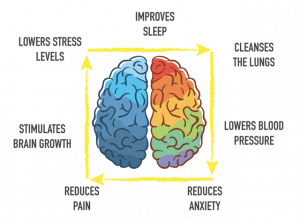
Content: A Neuroscientist Explains How Breathing Impacts the Brain
Dr. Yewande Pearce for Headspace
https://www.youtube.com/watch?v=2HojLhKlJto (4:55)
Now that we have some context on how breathing can be so impactful, let us begin by doing one together as a group and short breathing exercises will be integrated throughout our workshop today. For our grounding exercise today, we will do a short breathing and body relaxation practice to notice the impact and how it affects us.
Start with feeling yourself seated firmly, place your feet on the ground, pull your shoulders back and head upright. Close your eyes or lower your gaze.
Take a moment to relax your body and see what sensations come up. Are you tense? Are you energized? Is there a part of your body that needs to stretch?
As you relax into your body, start to let your breathing become more even. You may want to breathe more deeply or slow your breathing down.
Now, let’s take a minute to breathe to slow our thoughts down, release the tension in our body, and start to focus our energy.
Finally, let’s take a moment to recognize we are here as a group and going on an exciting journey together. Take a few more breaths together and open our eyes.
Welcome back! Hope all of you are able to feel more present and focused after our grounding exercise as we dive into our workshop and get to know each other better.
Check-Ins
We will now do our first round of check-ins, which as the name implies are just quick 1 minute shares and pulse reads. The purpose of doing quick check-ins at the beginning of a workshop is to create an open inclusive atmosphere where you can feel seen, heard, and supported. Check-ins invite you to briefly share how you are emotionally, mentally, or physically arriving which helps to build connection and psychological safety in our community. This small yet powerful ritual fosters a sense of belonging and presence, allowing everyone to shift from external distractions into the shared purpose of the session. So, here we go – let us do our first round of check-ins.

Interactive Group Exercise: Check-Ins as an Entire Group
Your name
How did our grounding exercise and breathing impact you? Your mood? Your focus? Your state of mind?
2-3 words to describe what you think or how you feel with starting this workshop
Thanks for your quick shares about how the grounding exercise and breathing impacted you and sharing a sense of where you are at as we start this workshop and our year of growth and development together! We will have more time for future check-ins where again you will provide a pulse check of how you are arriving at our workshop, and also be invited to share any triumphs (i.e. completing a work presentation, winning a road running race), challenges (i.e. conflict with a co-worker, not being able to pick up your kids from daycare on time), and simply what is going on in your life (i.e. what you did this past weekend, a new personal goal that you are setting).
Since check-ins are intended to create an open and safe space for each of us and our community, it is also fine if you do not want to participate in the check-ins. Perhaps you are having an off day/week, something distressful just happened in your life, or you are simply in more of a private and inward mood. You can indicate that you do not want to check in, and pick the next person. Of course, it is appreciated when you can share the 2-3 words to describe what you think or how you feel starting with this workshop such as “withdrawn”, “need time to process”, or “I will share more next workshop”.
Integrating Breathing Exercises into Everyday Life
Now that we have done a breathing grounding exercise, It is amazing how something as simple as breathing can have such a profound effect! The practice of even taking 3 to 5 breaths throughout the day can help us with calming down, stimulating our minds, or bringing more energy into our bodies. We can do easy breathing exercises before we start a meeting or give a presentation, or while we are driving in traffic or standing in a long line at the grocery store; all in a short amount of time and without anyone else even noticing.
These are a few simple 3 to 5 breath exercises which you can incorporate into your day.
Regular breathing
– Take 3 to 5 breaths at your normal pace and fill to your normal lung capacity. Closing or averting your eyes can help you better focus on your breathing. You can practice this regular breathing before you start a task or activity, to switch mental modes or different work assignments, or to be present before you start a conversation.
Calming breathing
– Take 3 to 5 breaths at a slower pace and fill to your normal lung capacity, and hold on the bottom of your exhale for a little longer than usual. Closing or averting your eyes, or choosing to focus on a stationary point, can help you focus on calming yourself. You can practice this calming breathing after something or someone has frustrated or angered you, before you lead a meeting or give a presentation, or while having a difficult conversation.
Stimulating breathing
– Take 3 to 5 breaths at your normal pace and fill to greater than your normal lung capacity, and hold on the top of your inhale for a little longer than usual. Lightly shaking your hands and/or feet, or taking head or shoulder rolls (or whatever part of your body needs waking up), can help you focus on stimulating yourself. You can practice this stimulating breathing when you wake up in the morning, before you give a talk to your team about strategy and goals, or when listening to a long presentation. We even welcome you to do this stimulating breathing throughout our Employee Advancement workshops when you may be feeling a little unfocused or tired!
We will be incorporating these simple breathing exercises throughout our workshop at points when we may all need some calming or stimulation!

Course Manual 2: Introductions & Values
Our Employee Advancement Program is an individualized as well as a collective professional and self development journey. In addition to drawing upon each of your individual perspectives, experiences, and aspirations; we will be integrating all of our collective perspectives, experiences, and aspirations as a learning community. The intentional creation of a learning community is a unique and impactful aspect of the Employee Advancement Program. It is within the open and collaborative space of our learning community that you will share ideas and best practices, receive critical and constructive feedback, and grow a long-term supportive professional network.
Personal Values Shape Our Learning Community
Personal values are the foundation upon which the values of a learning community are built. When individuals bring their personal values—such as respect, curiosity, empathy, integrity, or growth—into a shared space, they help shape the collective culture, expectations, and environment of their communities. As these values are expressed and acknowledged in group interactions, they begin to inform how people engage, collaborate, and support one another. Over time, the learning community organically adopts shared principles that reflect the values of its members.
This connection between personal and communal values also promotes a sense of ownership and belonging. When individuals see their values reflected in the behaviors, language, and norms of the group, they are more likely to participate fully and contribute meaningfully. In this way, personal values do not just inform the learning community, they co-create it. This leads to an environment where diverse voices are honored, learning is deepened, and trust and mutual respect are continuously reinforced.
Before we start to create our learning community in the next Course Manual, let us first get to know each other better and assess our own personal and professional values. Then, we can more effectively apply and extrapolate our individual experiences and values into community values and expectations for our year of developing together in the Employee Advancement Program.
Let us begin with doing individual introductions as well as why you joined the Employee Advancement Program and what you hope to gain from it. This will evolve as you move through the program, but you can view this as setting your first intention for what you want to achieve or get out of the program.
These are guidelines on your introduction and what to share, but feel free to add more context and information to who you are. We will keep to 2 minutes per person and there will be more opportunities for us to share more about ourselves personally and professionally throughout this workshop.
Your name
What department and group you are in
Your role, and major responsibilities and projects
Why did you join the Employee Advancement Program?
What are 1-3 goals, or things you hope to gain, from the program?
A fun fact and/or achievement you are proud of (i.e. I can do a 5 minute headstand, my great great grandparents sailed across the Atlantic Ocean to immigrate, I do a mental visualization of a presentation before giving it, like a race car driver does before a big race.)
Are there any questions, or anything you would like to add, before we start our introductions?
I will go first to give an introduction of myself. You can use this as an example, to model parts of my introduction or simply give an introduction that feels the most authentic to you.
Interactive Group Exercise: Individual Introductions
Thanks for your introductions, and each of you will have the opportunity to share more in the “Professional & Life Overview” presentations in the second half of this workshop. In stating why you joined our Employee Advancement Program and what you hope to gain from this process, you shared a bit about what you value and perhaps what you would like to strengthen, change, or grow about your values. For the rest of this Course Manual, we are going to focus on your personal values which will provide an important foundation of defining our learning community values in the next Course Manual.
Let us start from the beginning. What are values?!?
Values are the core principles or standards that guide behavior, decisions, and attitudes. They represent what is important to us as an individual, community, or society. At work, values represent us as an employee, our organization, and the company we work at. The values that we embrace can be deeply personal and individual, co-created by a group and represents the collective, or can be projected on to you by someone else.
In the workplace, your professional and personal values play a critical role in shaping behavior, decision-making, and relationships. They serve as internal compasses that guide how you approach your work, interact with colleagues, and navigate challenges. When your values—such as honesty, accountability, respect, or excellence—are aligned with your professional environment, you are more likely to feel fulfilled, motivated, and connected to your purpose. This alignment fosters a sense of integrity and authenticity, allowing you to bring your whole self to work while maintaining professionalism and ethical standards.
At the organizational level, shared values contribute to a strong, cohesive workplace culture. When employees and leadership operate from a consistent set of values, it builds trust, improves communication, and enhances collaboration. Conversely, when there is a disconnect between personal values and workplace norms, it can lead to disengagement, ethical dilemmas, or internal conflict. Recognizing and honoring both professional and personal values creates a more inclusive and values-driven workplace—one that supports your individual growth while driving collective success.
There are a lot of different values that can span professional values (i.e. teamwork and collaboration), personal values (i.e. freedom and compassion), cultural values (i.e. respect for elders and resourcefulness), and ethical values (i.e. responsibility and accountability). For you, there are likely other ways you can categorize your values.

Let us take a deeper look at several professional values for individuals in the workplace.
Adaptability
– is the ability to navigate and adjust to new conditions, challenges, information, people, and changes in a dynamic environment. In the workplace, adaptability can be represented as quickly adjusting to new roles and responsibilities as well as adapting to new technologies and ways of doing business. As a personal value, adaptability can be expressed as being open to feedback and input to continually make changes. Those who value adaptability often exhibit resilience, flexibility, and an openness to growth and uncertainty.
Perseverance
– is the ability to stay committed and persistent in the face of challenges and setbacks to achieve long-term goals. Perseverance involves being able to stay motivated and consistent in your efforts whether you are pursuing a meaningful personal milestone or a complex new project at work. Those who value perseverance must cultivate inspiration, self-discipline, and determination to push through on their way to an important (and at times, difficult to reach!) objective.
Contribution
– is the willingness and commitment to add value, do meaningful work, and positively influence the environment and those around you. Contribution goes beyond working with others to complete tasks or achieve a goal, it is about intentionally making an impact that improves the success and quality of the process for everyone. Those who value contribution tend to actively engage and offer to their larger community through mentoring, volunteering, or simply offering help and support in any way that is needed.
Kindness
– is adopting a worldview and treating others with respect, empathy, and compassion. Kindness involves acting with generosity, understanding, and consideration, both in personal and professional settings to build stronger and more meaningful relationships. Those who value and exhibit kindness have developed the capacity for emotional intelligence and active listening in order to offer encouragement, patience, and understanding to others.
Recognition
– is acknowledging and appreciating the efforts, achievements, and contributions of others; and also of appreciating yourself! Recognition in the workplace is important as it fosters a culture of respect and motivation as well as individual professional and career advancement. Those who value recognition build trust and rapport with their team, take time to celebrate their own achievements and those of others, and vocalize praise and show gratitude.
The values of adaptability, perseverance, contribution, kindness, and recognition are just several professional values that are prevalent in the modern workplace. These are values that when exhibited as an employee, and as a team member, can create a healthy organizational culture and provide an environment in which you can develop, contribute, and be recognized.
Which of these values resonate with you? Which do not? Are there values that you would like to develop more of in your workplace?
Content: Professional Values
Dare to Lead: List of Values
https://brenebrown.com/resources/dare-to-lead-list-of-values/
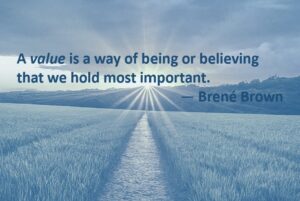
Throughout this workshop, we will be working with a core list of values created by Brené Brown, who is a prominent influencer and researcher on leadership, human values, and emotions. There are other values not on this list that you can certainly draw upon, but Brené’s “Dare to Lead” list of values provides a good starting point for us. Let us take a look at this list now and identify 5 values that encapsulate your professional and/or personal values. You can circle more than 5, but trim down to the 5 values that are most representative of you.
Interactive Individual Exercise: Your Professional Values
Now that you have identified your top 5 professional values, keep your list close by as we will be working with these in our next Course Manual in defining our learning community values and again when you put together your “Professional & Life Overview” presentation later in the workshop.

Course Manual 3: Community Values
Why do we define corporate and community values?
Your growth and development journey in the Employee Advancement Program is heavily inspired by the open engagement of the learning community we create. The support, feedback, and networking you give and receive from your community of peers and colleagues are invaluable as you define your professional brand and pursue your career advancement pathways.
In this session, we will brainstorm and design our community values together which we will refine at the start of our next workshop. In the context of our learning environment, shared values are the norms and behaviors we expect to see from each other in order to build a collaborative and trusting environment. The primary goal is to determine a set of values for the group that can empower learners to support one another in their individual and collective growth journey. Our co-created learning community values are meant to encourage open communication and trust, laying the groundwork for a positive and productive learning experience for all program participants.
For our community values to be truly effective, they must be embraced and modeled by all members of the learning community, including the facilitator (Appleton Green Certified Consultant), all employees, and corporate representatives and guest visitors. This shared commitment fosters mutual respect, as everyone is held to the same standards. Employees are expected to be accountable for their workload and learning journey for the duration of this program. Therefore, collectively defining shared values helps outline what accountability looks like for the group as well as the ways in which we provide and receive feedback in a thoughtful manner.
The reason why we are co-creating a list of community values is that this exercise can enhance our sense of ownership and commitment amongst one another. When we are actively involved in establishing the norms and expectations for our group, we are more likely to feel a sense of belonging and responsibility towards everyone’s success. This collaborative approach also ensures that the values reflect the diverse perspectives and needs of all members, making the learning environment more inclusive and supportive.
Successful Companies are Driven by Strong Values
In the Employee Advancement Program we integrate our company and business goals with our own community and individual development goals. The values of the company and organization we work for influences the culture and purpose of our working environment and relationships. Before we design our learning community values together, let’s take a look at the most successful companies in today’s competitive business landscape define and adhere to clear, strong values. Value-driven organizations often distinguish themselves by fostering thriving internal cultures that drive success. Therefore, creating community values within our learning program aims to foster a sense of belonging and purpose for all participants, which can significantly enhance engagement and motivation that drive successful outcomes.

Google’s motto of “Don’t Do Evil” was established when the company was founded in the late 1990s. This manifesto emphasizes Google’s initial business goal and search engine product to widely and freely disseminate information with a core value that information sharing should be oriented towards long-term good for the world and not for short-term or “evil’ gains. In 2015, the company updated this manifesto to “Do the right thing” to adapt to marketplace growth and consumer perception of Google’s core value.
Google has always promoted corporate values of innovation and embracing failure in its culture. From the start, engineers are given “10% time”, in which they are encouraged to take 10% of their working hours to devote to developing a new idea unrelated to business goals. The company celebrated the success of products such as GMail that percolated from this “10% time” as well as celebrated the many ideas that did not make it out into the market. By cultivating a culture prioritizing these values, Google has maintained high levels of employee autonomy, exploration, and embracing “Googleyness” or being comfortable with the unknown; which are critical for innovation.

When a company upholds clear values with the organization adhering to and practicing these values, employees feel more comfortable sharing ideas and taking risks without fear of judgment or failure. This atmosphere of trust and psychological safety is vital for effective learning and development.
Netflix embodies a corporate culture that exemplifies organizational trust and risk-taking through their core values of courage, honesty, and respect. This has been instrumental in creating a workplace and team collaboration environment where employees feel safe to express their opinions and experiment, which also translates into Netflix upholding business strategies that continuously innovate and adapt in a rapidly changing market. For example, after 25 years of successfully delivering online entertainment and content to their users, Netflix is innovating on their customer relationships by opening physical retail stores to offer an immersive experience of interacting with their favourite shows.

Corporate values provide a framework for employee development as well as employee behaviour and decision-making that aligns with overall organizational culture. This consistency in how core values are embedded across corporate L&D (Learning & Development), employee wellness programs and benefits, and in team collaboration and community is beneficial for both the overall company community, but transferable to the engagement and retention of each and every employee.
At Salesforce, values such as equality, customer success, and sustainability guide the company’s learning and development initiatives. Salesforce embeds these core values into both their internal L&D programs, which ensures employees continuously grow in ways that support the company’s mission and their individual career aspirations, as well as their external training for clients, which extends the Salesforce mission into the offerings of their customers. Salesforce’s Trailhead program is widely recognized as an engaging and leading-edge training program that promotes strong relationships between Salesforce experts with clients, customer success, and deep support in clients building sustainable businesses.
Google, Netflix, and Salesforce are three corporate examples of companies that uphold core values that not only sets them apart from their competitors, but also create a strong foundation for engagement, trust, and growth within their teams and employees, which are essential for long-term business success.
Healthy Organizations Embrace Meaningful Values
Corporate values that drive successful companies also need those values to be embraced and acted upon by that company’s organization and employees. Meaningful values foster a healthy organization that exhibits a positive work environment, strong leadership, effective communication, and employee well-being that is critical to driving business success. Healthy organizations are better able to balance productivity, maintain motivation, and increase employee satisfaction, ensuring both the organization and its people thrive.

Ogilvy, one of the world’s most renowned advertising and marketing agencies, has built its legacy on creativity, innovation, integrity and strong organizational values. Founded by David Ogilvy in 1948, the company has consistently emphasized a culture of big and bold ideas, client-centric strategies that integrate different perspectives, and continuous learning. At the heart of Ogilvy’s success is its ability to foster a collaborative and dynamic work environment, where employees are encouraged to push boundaries and think beyond conventional marketing approaches. The company prides itself on maintaining a people-first philosophy, investing in talent development, diversity, and a work culture that values curiosity and bold thinking.
To exemplify that healthy organizations adapt and change over time in response to business, cultural, and social factors; Ogilvy announced their re-founding in 2016. This re-founding was focused on clarifying Ogilvy’s company and brand promise as well as simplify and modernize organizational values. In a creative fashion, Ogilvy asserted “12 Crafts”, or capabilities, that encapsulates employee expertise, or what would have been different divisions and functional departments before the company’s refounding.
These “12 Crafts” are: creative, strategy, delivery, client service, data, finance, technology, talent, business development, marketing and communications, administrative, and production. By utilizing “Crafts” as individual and organizational values, it is a new way of making people see their role in the organization in a more organic way and to think about that as a way to define themselves and contribute to organizational well-being.
J.P. Morgan, one of the world’s leading financial services firms, has built its reputation on a foundation of excellence, service, innovation, and sustained growth. The company has a long history of fostering an organizational culture that emphasizes the importance of external client relationships that are built on trust, long-term relationships, and ethical conduct. Internally, J.P. Morgan’s organizational values reflect a deep commitment to maintaining the highest standards of professionalism and community responsibility through creating an open and diverse workplace where employees are encouraged to bring unique perspectives and collaborate across teams. The company operates in a dynamic environment where accountability, collaboration, and diversity are critical to achieving both business and societal goals.
The organization embraces a culture of mentorship, as a core element of its commitment to employee development and long-term career growth. J.P. Morgan places a strong emphasis on guiding and supporting individuals at all stages of their careers through structured mentorship programs and informal relationships. Senior leaders and experienced professionals are encouraged to mentor junior employees, sharing their expertise, providing career guidance, and helping them navigate complex projects. This mentorship culture fosters a sense of community and collaboration, ensuring that employees feel supported in their professional journey.
Jamie Dimon, the CEO of J.P. Morgan, instated a Return to Office mandate despite pushback and criticism from many employees who wanted to retain remote work that resulted from the COVID-19 pandemic workplace changes. One of the strongest reasons that Dimon required employees to return to the office is to regain a culture of mentorship which was difficult to support between senior leaders and junior members when there was not the ability to physically work together, have organic interactions, and grow within the team and organizational environment.

Patagonia is a globally recognized outdoor clothing brand known for its commitment to sustainability, environmental activism, and high-quality products. Founded in 1973 by Yvon Chouinard, the company has remained true to its core values of responsibility, environmental stewardship, and innovation. Patagonia’s products are designed for outdoor enthusiasts, with a focus on durability, functionality, and minimal environmental impact. The company has built a reputation for creating eco-friendly apparel, using sustainable materials like recycled polyester, organic cotton, and wool, while also focusing on reducing waste through initiatives like product repairs and upcycling. Patagonia’s commitment to ethical manufacturing practices and fair trade certification further reinforces its dedication to social and environmental responsibility.
Patagonia’s organization is renowned for its activism and advocacy efforts. The company has used its platform to advocate for environmental causes, climate change action, and corporate responsibility; exerting its organizational values to influence the global community at large. For example, the brand’s famous “Don’t Buy This Jacket” campaign, which was embraced by Patagonia’s employees, encouraged consumers to reduce consumption and embrace sustainability. Their culture of activism, transparency, and employee empowerment is integral to Patagonia’s identity. It creates a workplace where employees are passionate about making a difference, and where the company’s commitment to environmental protection is deeply embedded in its operations and corporate philosophy.
Content: Company and Organizational Values
Dare to Lead: List of Values
https://brenebrown.com/resources/dare-to-lead-list-of-values/
Interactive Individual Exercise: Your Company and Organizational Values
Your company represents
Your organization represents
Your communities, social circles, sports/interests/other groups represent
What are strong values that came up for you?
As you look at your values list, say out loud or write in bold the 5 values that are the most important and are non-negotiable to you.
These are the top values that most companies and organizations identify as being essential: respect, collaboration, accountability, excellence, and integrity. Depending on the nature of your company and organization, there may be a different application or interpretation of these values or other values that are important. Let us take a closer look at these top values.
Respect
– is a universal value that most of us desire in all parts of our lives, both at work and with our families, communities, and social circles. Treating others with respect, regardless of cultural or ethnic background and of position and experience, creates an open and supportive culture. In a work environment, respect promotes collaboration, effective communication, and good interpersonal relationships between colleagues.
Collaboration
– places high value on collectively engaging in the sharing of ideas, tackling problem-solving, and achieving common goals. The value of collaboration is essential in innovation at companies as it encourages positive and critical feedback and new ideas to emerge. In a work environment, collaboration is essential to working effectively with others as it is rare that we work alone and in a silo.
Accountability
– is an important value to hold both yourself to as well as to hold others to. The essence of accountability is taking responsibility for your decisions, actions, and the resulting outcomes. Conversely, accountability is also placing responsibility on others to take ownership of their decisions, actions, and resulting outcomes. In a work environment, accountability is critical to creating and maintaining a productive culture as it promotes transparency and reliability in every team/ company member’s work.

Excellence
– is striving for high standards across aspects of your work and life. The value of excellence shows up as a commitment to deliver high quality results, continual innovation and improvement, and a demonstration of strong work ethics. In a work environment, excellence is an important element in creating healthy competition internally at your company and certainly externally for your company to be competitive in the marketplace.
Integrity
– is acting with honesty and with strong professional and personal moral principles. The value of integrity is fundamental to building and growing trust with colleagues, business partners, and clients. In a work environment, integrity promotes the individual and collective actions of your company, how it operates, and how it maintains trust with its customers.
Now, take another look at your 5 core values and quickly reflect if those values remain the same, or have shifted, with the values that core to many companies and organizations. We will now work with the values you have identified individually and expand to define values collectively for our learning community.
Establishing Our Learning Community’s Values
To establish the core values for our Employee Advancement learning community, we will further explore and apply the values you just identified. Again, community support and feedback are critical to your career advancement and growth process that is fostered throughout this program. When we feel a valued part of this community that aligns around shared common values, we participate actively and invest effort into our collective and individual development as well as our company’s success.
Interactive Exercise: Community Values as an Entire Group
Employee Advancement Community Values Brainstorm – What values are most important to you? What values would you like our learning community to uphold?
Themes in Community Values – What themes do we see emerging? What are 3-4 overarching values that we can group other values under?
Recap of Community Values – Appleton Greene Certified Consultant does a verbal recap of the community values themes that emerged.
Thanks to everyone for contributing to the values we want our Employee Advancement learning community to uphold over this next year and starting to set norms in which to be accountable and supportive of one another! We will revisit our community values at the beginning of our next workshop to refine and finalize.

Course Manual 4: Giving Feedback
The giving and receiving of feedback is such an important component for our professional growth as individuals as well as innovative growth as a team, organization, and company throughout our careers! There are many types of feedback ranging from supportive to constructive to critical which we experience in formal ways, such as 360° review cycles that are company-wide to the 1:1 performance reviews with our managers, to informal ways, including input from our colleagues during “water cooler” conversations or going out to lunch together. Feedback that is critical, while also being constructive and actionable, is extremely valuable and often very difficult to get.
One of the cornerstones of our Employee Advancement program is effectively giving and receiving feedback that integrates supportive as well as constructive feedback, but most importantly ensures that all feedback can be action-oriented. We place a lot of focus on building a supportive and safe learning community environment, so that we can dig deeper to ask questions and be critical of one another in order to individually and collectively grow in our professional development. This will be a meaningful way to broaden our perspectives on ourselves and others, and to highlight crucial blind spots about ourselves and our work environments that we were not able to see without the feedback from our learning community and peers.
In this Course Manual 4, we will delve into giving feedback, while in the next Course Manual 5, we will focus on receiving feedback. The giving and receiving of feedback go hand-in-hand, but do involve different approaches so that we can make the most of both being the feedback giver and the feedback receiver. We will be covering feedback models and approaches in order to provide a concrete structure to feedback, which will be substantiated with the interactive exercises in these course manuals and throughout the Employee Advancement program. By practicing both giving and receiving feedback throughout the program, you can continually apply this to your own professional and personal lives.
Employee Advancement Feedback Circles
In the Employee Advancement Program, feedback is given in three main ways, or what we call feedback circles that are comprised of self, peer, and community feedback circles. The integration of these three circles is an essential and illuminating part of our Employee Advancement program growth process and the Project Studies between workshops.
All participants are given the structures and prompts to give and receive feedback, but we welcome you to bring in your own individual and creative ways to give and receive feedback as we get to know each other better. You are expected to provide meaningful, thoughtful, and action-oriented feedback in a professional and constructive manner to support your own, your peers, and our learning community’s growth.
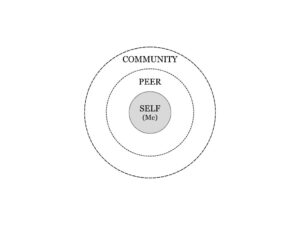
1. Self Feedback Circle
It all starts with our Self! A core objective of the program is to cultivate professional and personal development, which all stems from your Self. To support this holistic growth, each of you are invited and expected to share answers to reflection questions during the workshops and the Project Studies. For instance, during the 360° Feedback Process that you will start in the next workshop, you will set goals and interview people to learn about your strengths and areas of opportunity and improvement with people you have strong relationships with both at work and in your personal life. Some of the feedback you receive from your interviewees may feel challenging, so we integrate space and time for self feedback to better understand and process this type of feedback (and with the help of the Appleton Greene Certified Consultant and our learning community). That means being open to receiving feedback, clarifying pending questions that arise from those conversations, and sharing the growth and learnings that came from these conversations as well as your own self-reflection on the themes that emerge.
2. Peer Feedback Circle
Peer Reflection Circles, in which you will work in groups of 2-3 during the interactive exercises, are a critical and enriching component of the Employee Advancement Program. The primary goal of Peer Reflection Circles is to create psychological safety and a supportive environment where everyone can learn from one another, while also finding ways to develop and grow as individuals. In the peer circles, the co-designed community values are an important reminder about how to thoughtfully deliver critical feedback so that the receiver can understand the feedback and what the expectations are as they continue to grow in that particular area. The relationships developed in your peer circles are an excellent way to grow your internal professional network and advancement opportunities throughout and after the program. We have seen Peer Reflection Circle participants from past programs form friendships and serve as support networks that extend well beyond the program into the future.
In every workshop, we engage in activities and exercises as an entire group, and also present and share in smaller Peer Reflection Circles to gain more targeted feedback. The intent of this peer feedback is to point out any possible gaps of information that can be helpful for the presenter to know about, as well as any of the strengths they exhibit in their share-outs. For example, if you receive feedback in one of your peer circle presentations that you used the phrase “I think” 5 times in 2 minutes, and that this may discredit what you are saying because it does not convey conviction, you can commit to reducing the number of times you use “I think” to one time per presentation, and practice your presentations by recording yourself in between workshops to ensure you can catch yourself and become aware of when you tend to use “I think”.
Behavior change can be challenging, and peer feedback can be a helpful way to become self-aware. The goal of peer feedback is to bring to light what we may not know about ourselves, and find ways to make that feedback actionable in order to help us grow and become better and more accomplished over time.
3. Community Feedback Circle
Along with peer feedback circles, there will be lots of discussions, presentations, sharing of best practices as an entire group, or our learning community circle. This is what we call community feedback.
To make critical feedback impactful in our community circle, one tactic is to let your peers know what kind of specific feedback you are looking for. For example, if you are working on your body language when delivering presentations and your goal is to reduce the amount of times you gesture with your hands without a particular reason, you can ask your peers to point out when hand gestures are distracting and when they are helpful. This allows for those who are giving feedback to narrow their focus and pay attention to the specific areas that you are aware of and working on. In turn, you benefit from receiving feedback that is aligned with a growth opportunity you are pursuing and can make small and sustainable improvements in the particular skill you are developing.
Another tactic that is helpful during community feedback, is to ask the peer or group that is giving you feedback to ask you 1-2 clarifying questions. These are questions that highlight what they did or did not understand, what they may perceive differently, and/or what they would like more information or clarity on. By asking questions, feedback becomes a dialogue and ensures that both giver and receiver are invested and in a dynamic conversation about how to improve for the future.
Giving and receiving feedback are powerful tools for your growth and development journey in the Employee Advancement Program. We provide guidance for critical and constructive feedback in our self, peer, and community feedback circles as well as uphold boundaries and a safe environment where we can provide and receive feedback without feeling judged or embarrassed. The power of learning how to give effective feedback makes us more open and prepared to receive it.
Giving Feedback at Work
Giving feedback in a professional setting is both an art form as well as a critical leadership skill. At its core, giving effective feedback is designed to help individuals grow, improve their performance, and contribute more effectively to their teams and organizations. It is not about criticism or judgment, but about fostering a culture of learning and accountability. When done well, giving effective feedback encourages open communication, mutual respect, and continuous development. In today’s collaborative and highly integrated work environments, timely and constructive feedback is essential for both individual and team success.

A key principle of giving professional feedback is clarity. Feedback should be specific and focused on observable behaviors rather than personal traits or assumptions. For instance, rather than saying, “You’re not good with deadlines,” a more constructive approach would be, “I noticed the last report was submitted two days late, which delayed the team’s project timeline.” Giving this level of specificity helps the recipient understand exactly what needs to change and why it matters. Vague or overly general feedback often leaves people confused and less likely to take meaningful action.
Timing also plays an important role in giving feedback that is impactful and lasting. Feedback should be delivered close to the event it refers to, while the details are still fresh. However, it should also be considerate of the recipient’s emotional state and the context in which the conversation is happening. Giving feedback immediately after a high-stress situation may not be effective if the person is not in a mindset to receive it. Choosing the right time and setting—ideally a private, calm environment—shows respect and increases the likelihood of a productive dialogue.
The tone and delivery of giving feedback are just as important as the content of the feedback itself. A respectful, empathetic tone helps prevent defensiveness and opens the door for honest conversation. Using a “feedback sandwich” is a simple structure for giving feedback, which starts with positive feedback before the critical and constructive feedback and then ends with more positive feedback. Basically, positive feedback serves as the two pieces of bread that holds and softens the critical and constructive feedback that comes in between. A feedback sandwich helps you create an encouraging and supportive tone while offering critical delivery of an insight, change in behaviour, expression of disappointment to the receiver.
Finally, effective giving of feedback should invite two-way communication. It is crucial that all elements of the feedback feel genuine; otherwise, the conversation may come across as insincere or formulaic. Encourage the recipient to ask questions, share their perspective, and suggest solutions. This not only reinforces a culture of openness but also empowers both parties to take ownership of their growth. When feedback becomes a regular and trusted part of workplace communication, it strengthens team dynamics and supports a high-performance culture where everyone can thrive.
All of us have been in professional situations where we gave feedback that was received well AND where we delivered feedback that was received poorly. Giving and receiving feedback effectively is a learning process, which we should not assume just comes naturally, and an important skill that our Employee Advancement program will help you to further develop.
Interactive Individual Exercise: Giving Feedback Reflection
Reflect on a situation where you delivered feedback that was well received and promoted growth for the receiver.
How did you deliver the feedback?
What went well in your conversation and/or interaction?
How did the receiver grow and take action due to your feedback?
Think back on an experience when you delivered feedback that was not well received and was difficult for the receiver?
How did you deliver the feedback?
What did not go well in your conversation and/or interaction?
How did the receiver react to your feedback? What was difficult for them?
Situation-Behaviour-Impact (SBI) Model for Giving Feedback
The SBI, or Situation-Behaviour-Impact, feedback model is developed by the Center for Creative Leadership. The model is utilized by many corporations and applied to a wide variety of professional situations. Some common applications of the SBI model are to guide focused and specific feedback between managers and employees during one-on-one meetings and performance reviews, within teams to support group improvement and efficiency, and for individual contributors to shape who they want to advance to becoming a manager and shaping a new team.
We utilize the SBI model in the Employee Advancement Program to empower each of us to become more adept and comfortable with giving and receiving feedback. The supporting research for the model shows that in order to help strengthen your feedback skills, you must practice and feel progress as you act on the feedback received. In order to give feedback well, having a shared framework and language is very valuable for our self, peer, and community feedback circles. By establishing this, there is a greater understanding on what to expect of feedback, a framework to deliver more meaningful feedback, and ultimately less anxiety and other limiting emotions that prevents us from giving and receiving feedback in an impactful way.
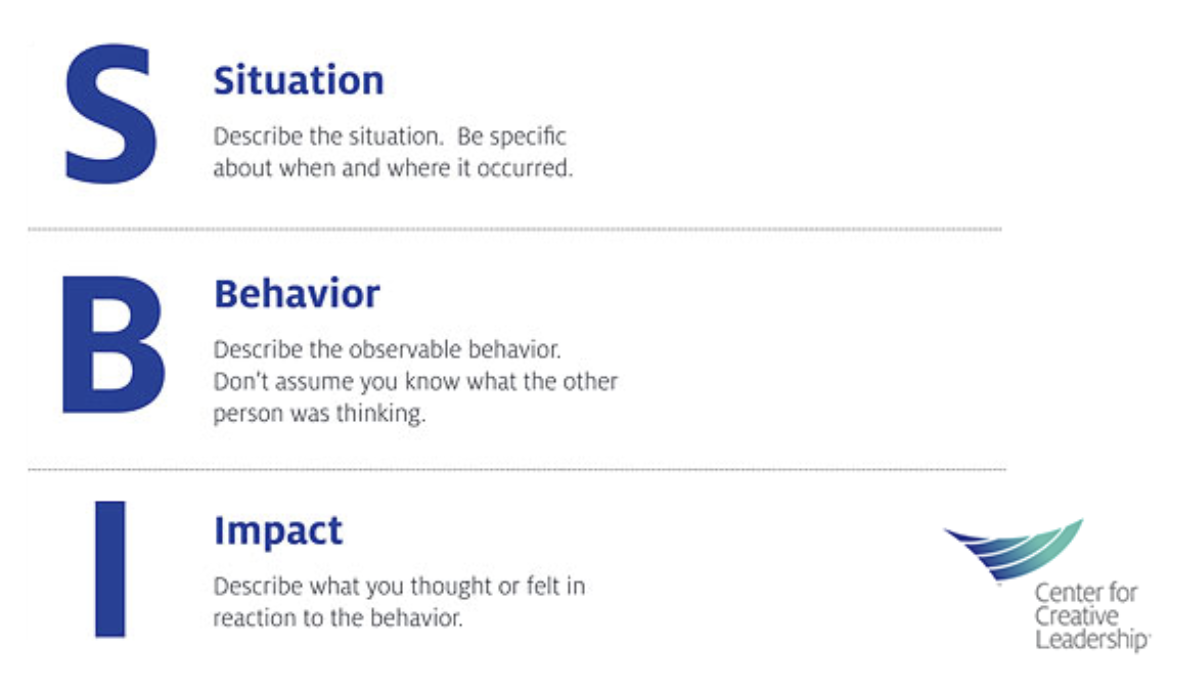
The SBI, or Situation-Behavior-Impact methodology, is a structured approach to giving feedback that focuses on clarity and specificity. The model involves three key elements:
Situation
– Where and when the feedback giver describes the specific context or event in which the feedback is being given.
Behavior
– Where the feedback giver clearly articulates the observed actions or behaviors in that situation without making judgments or assumptions.
Impact
– Where the feedback giver explains the effect of the behavior on themselves, others, the team, or the organization.
With the SBI model, feedback givers are able to break feedback into these specific components, which help ensure that feedback is clear, objective, and focused on observable actions. For the feedback receiver, the feedback structured by the SBI model can make information easier to understand and create trust as it is intended to be a dialogue where both parties come to an agreement on the behavior that needs to continue (positive feedback) or change (constructive feedback).
When delivering feedback using the SBI model, you are taking a coaching approach with your conversation. The feedback session is framed as a dialogue where you and the receiver can ask clarifying questions in order to ensure understanding and alignment on next steps. The important components of effective feedback include:
A clear understanding of the improvement area
– Often, feedback receivers seem to understand the feedback given, but behavior change does not occur, which can frustrate the feedback giver as they need to reinforce the feedback multiple times without getting the results they expect. The SBI methodology promotes feedback focused on specific behaviours and clear examples that can ensure understanding from all parties involved in the conversation.
The development of an action plan based on feedback
– Both feedback giver and receiver engage in conversations that include next steps and an action plan. They come to an agreement on how to address the behaviour in future instances, and create a plan that they both are accountable to report on in future conversations. As a result, feedback givers and receivers track progress and can celebrate small and big wins as their partnership promotes mutual growth in those particular behaviours.
One of the greatest gifts of critical feedback is being able to see someone improve over time and let them know about the progress you have seen them make. When you keep track of feedback given, and make it a recurring conversation rather than a one and done dialogue, you show care for someone’s growth and progress and can celebrate the oftentimes gradual change you see in people’s behavior.
For instance, if you provide feedback that your colleague needs to provide at least one example during their presentation in order to make the technical content more relatable, the next time they present, encourage them to practice that skill and notice if any changes occur. Letting your colleague know how they improved that specific behavior can boost their confidence in their ability to learn and grow. Additionally, your encouragement and support can have a significant impact on their future performance and build trust and better rapport in your working relationship.
Content: How to Give SBI Model Feedback
Trevor Smith, Corporate Leadership and Change Management Coach & Trainer
https://www.youtube.com/watch?v=utAkRRefAqM (5:45)
This video introduces the SBI feedback model, emphasizing its effectiveness for managers and leaders in providing clear and specific feedback that leads to behavior change. One additional skill this video encourages feedback givers to develop is avoiding assumptions and subjective judgments by providing clear examples of the behaviours they observe to the feedback receiver. The video also reinforces the importance of creating an action plan at the end of your feedback conversation.
Interactive Group Exercise: Giving Feedback Reflections in Our Learning Community
What aspects would you like to incorporate from the SBI feedback model and be more intentional about when giving feedback in the future?
What aspects would you like to avoid when giving feedback in the future?

Course Manual 5: Receiving Feedback
The art and skill of engaging in feedback is a two-way street in which there is both the giving of as well as the receiving of feedback. In corporate settings, there is typically more emphasis placed on the giving of feedback through 360° review cycles, 1:1 performance reviews with our manager and/or leadership team, and debrief and feedback meetings after an important client meeting and close of a team project.
Effectively receiving, processing, and growing from feedback is as much of an art and skill as giving feedback, if not even more! To balance the two-way street of feedback, equal emphasis must be placed on what to do when you are on the receiving side of engaging in feedback. How do you synthesize important takeaways when a lot of feedback is given? How do you recognize and regulate emotions such as disappointment, frustration, surprise, excitement, inspiration that can be triggered when you are receiving feedback? How do you respond to and engage with the feedback giver if you want to delve deeper, get more clarification, or expand upon the feedback you received?
The previous Course Manual 4 provided structure in giving feedback through the SBI Model and starting to take a critical look at feedback situations you have engaged in the workplace. This Course Manual 5 delves into the other side of feedback engagement, and offers approaches, mindsets, and tools to effectively receive and emotionally regulate when receiving feedback. The next Course Manual 6 will bring together this two-way street of engaging in feedback where we will immerse in feedback practices to cement and apply the approaches of both giving and receiving feedback.
Receiving Feedback at Work
Receiving feedback in a professional setting is a vital part of personal and career development. It provides valuable opportunities to gain insight into how others perceive your professional identity, work, ethics, behavior, and contributions. While feedback can sometimes be difficult to hear, especially if it is critical or not given with a broader context, it should be viewed as a tool for improvement rather than a personal attack. Professionals who embrace feedback with openness and curiosity are more likely to grow in their roles and build stronger relationships with colleagues and leaders.

One of the most important aspects of receiving feedback is maintaining a mindset of growth and learning. Although our first instincts may be to react defensively or dismiss the feedback we are receiving, it is helpful to take a pause and try to detach from these reactions in order to actively listen and seek to understand the other feedback giver’s perspective. Techniques that can help with receiving feedback is to focus on the message rather than the delivery, asking clarifying questions if needed, and resisting the urge to interrupt or explain yourself immediately. Even if you do not agree with all the feedback that is being given, which is important in preserving our own sense of professional self and boundaries, thanking the feedback giver and acknowledging their feedback shows respect, maturity, and professionalism.
Emotional regulation and control also plays a significant role in how feedback is received and being able to engage with it. It is natural to feel uncomfortable or even hurt by constructive criticism, but managing those emotions is key to responding effectively. Taking a moment to breathe, close your eyes, and separate the feedback from your sense of self-worth allows you to engage in the conversation more productively. When needed, it is perfectly fine to ask for time to process the feedback and signal that you will follow up later with questions or a discussion about next steps. You may also want to offer feedback about the feedback given!
Following up and vocalizing whether you will take action, or not, after receiving feedback is an important part of demonstrating accountability and commitment to your as well as your team, organization, and company’s improvement. If the feedback involves specific behaviors or skills, take time to create an action plan or set goals that address the points raised. Letting the feedback giver know that you have considered their input and are taking steps to apply it shows that you value their perspective and are invested in your growth. Regular check-ins or asking for additional feedback over time can also help track progress and keep communication open.

Finally, it is important to seek feedback proactively, not just wait for it to be given. Asking colleagues, managers, or mentors for input shows initiative and a desire to grow and learn. It can also help build a more transparent and trusting work environment where feedback is a normal and welcomed part of collaboration. By approaching feedback as a constructive and continuous process, professionals can strengthen their skills, relationships, and overall career trajectory.
How Do We Actually Receive Feedback?
While there is a lot of emphasis on learning how to give feedback effectively while much less attention is focused on how to receive feedback well. Receiving critical feedback can be challenging due to a combination of psychological and biological factors that trigger defensive responses and emotional discomfort. As multifaceted humans, it is never comfortable to feel discomfort, but this is exactly where we can recognize and make some of our biggest strides in self development!
From a psychological perspective, feedback often touches on our self-concept, self-esteem, and self-confidence. When we perceive feedback as a threat to our self-image or competence, it can provoke feelings of inadequacy and anxiety. This defensive reaction is rooted in our need for validation and affirmation, making it difficult to accept feedback that suggests we need to change or improve. This is a very natural psychological response that can ultimately be self limiting and even self damaging, and hence why it is so important to interrogate whether our defensiveness is warranted and needed when we feel walls coming up after receiving critical feedback.
This reaction is similar to what we experience in dangerous situations, causing an increase in stress hormones like cortisol and adrenaline. These hormones prepare the body to either confront or escape the threat, but they also impair our ability to think rationally and process information calmly. Again, this biological response is very natural, and is in fact hardwired in us, but makes it difficult to remain open-minded and receptive to feedback, as our instinct is to protect ourselves from harm.
When the feedback we receive feels like a personal attack, regardless of how well it is positioned, our psychological and biological response may prevent us from making sense of and being receptive to the information we are receiving. Therefore, developing a strong mindset and approach as well as having specific tools and skills to effectively engage in feedback is immensely helpful for us.
Interactive Individual Exercise: Receiving Feedback Reflection
Reflect on a situation where you received critical/negative feedback constructively and you were able to grow from the feedback given.
What/How did the feedback giver deliver the feedback to you?
How did you initially think and feel about their feedback?
How did you respond to the feedback giver?
What did you do with this feedback that allowed you to grow and learn?
Think back on a critical/negative feedback situation in which you did not receive the feedback well.
What/How did the feedback giver deliver the feedback to you?
How did you initially think and feel about their feedback?
How did you respond to the feedback giver?
What might have you done differently in this situation?
Receiving critical and/or negative feedback is difficult! Let us take a moment to give ourselves a pat on the back in the situation where we received difficult feedback well and are able to grow and learn from it. For the situation where our reception to difficult feedback was more challenging, let us better understand and learn how to process and work with this feedback. We explored the SBI Model as a structure of giving feedback, so let us delve into a framework developed by Doug Stone and Sheila Heen in their book “Thanks for the Feedback” to apply to receiving feedback.
“Thanks for the Feedback”
Douglas Stone and Sheila Heen are accomplished authors, educators, and negotiation experts affiliated with the Harvard Negotiation Project. They co-teach at the Harvard Law School and specialize in communication, effective feedback, conflict resolution, and leadership development. Together, they draw on decades of research and practical experience in helping individuals and organizations navigate challenging interpersonal and organizational dynamics. Stone and Heen’s work emphasizes the power of effective communication and the importance of feedback, specifically in how to receive and work with receiving feedback, in fostering personal and professional growth.
In their book entitled “Thanks for the Feedback: The Science and Art of Receiving Feedback Well”, Stone and Heen provide a practical and insightful model on how to receive feedback effectively, even when it is difficult to hear or poorly delivered by the feedback giver. They emphasize that while feedback is often seen as a one-way street where the giver holds all the power, in reality the receiver also holds power as only they can determine how feedback is received and acted upon. Stone and Heen’s feedback model specifically focuses on the receiver’s ability to be thankful for feedback and lean into a growth and learning mindset.
Content: Thanks for the Feedback
Sheila Heen and Douglas Stone, Negotiation and Communication Consultants
https://www.youtube.com/watch?v=JC437gzNKDs (1:32)
In this video, Sheila Heen explains that feedback is not just about formal performance reviews, which we often connotate as the standard feedback we receive in the workplace, but is a constant part of our lives. She highlights that feedback includes interactions like mentoring, team assignments, or even through artwork created by your children. Heen reinforces that feedback is challenging because it touches on two fundamental human needs which are the desire for learning and growth, and the need to feel accepted and respected as we are. Balancing these needs makes receiving and giving feedback a complex and valuable experience.
Receiving Feedback Types and Triggers
Receiving feedback well is a learned skill, in fact it is a life skill! Let us dive deeper into two critical concepts of Stone and Heen’s feedback model, which will help us to better understand and be able to grow and learn from receiving difficult feedback. At its core, “Thanks for the Feedback” encourages us to shift our mindset from “Is this feedback correct?” to “What can I learn from this?” By exploring the psychological, relational, and practical dynamics of feedback, we can be empowered to take ownership of our growth, improve communication, and build stronger personal and professional relationships.
First, is the concept of breaking down feedback we received into three main types which include appreciation, coaching, and evaluation. Stone and Heen details how each type of feedback serves a different purpose and requires different responses in order to be able to receive it well and work with it constructively. Understanding which type of feedback is being given, or expected, helps reduce confusion and miscommunication, making feedback conversations more productive and meaningful.
Appreciation
Appreciation is about acknowledgment and encouragement. It is one of the most powerful, yet often overlooked forms of feedback in professional settings, as it is the act of recognizing and valuing someone’s efforts, contributions, or qualities. Appreciation serves a vital emotional function because it reinforces effort, boosts morale, and lets people you work with know their contributions and work are valued. This type of feedback is essential for building trust and motivation, especially in high-pressure or fast-paced environments.
Unlike coaching or evaluation, appreciation does not aim to change behavior, but instead affirms it. A simple thank you, note of gratitude, or public recognition of someone’s contribution can have a powerful impact on their sense of belonging and engagement. In high-stress or fast-paced workplace environments, where feedback often focuses on improvement or results, appreciation can be a grounding force that reminds individuals they are seen and valued.
Coaching
Coaching focuses on learning, growth, improvement and continuous learning. It offers guidance, suggestions, or insights that helps enhance your performance, skills, or approach. Effective coaching depends on mutual trust and clarity, so it works best when the person receiving feedback understands that the intent is to help them grow, rather than as a method to criticize or control. This requires delivering coaching in a respectful, constructive manner, and ideally, with a shared understanding of the desired outcome. For coaching to be received well, timing, tone, and context matter—feedback that feels supportive and timely is more likely to be acted on.
Unlike appreciation, which affirms what it is that you are already doing, coaching is more future-oriented and growth-driven. Coaching is also distinct from evaluation, which judges performance, and instead is about helping someone get better rather than measuring where they stand. In the long run, fostering a workplace and organizational culture where coaching is normal and welcomed helps everyone become more adaptive, self-aware, and invested in their own development.
Evaluation
Evaluation is about assessing your performance against a standard or expectation that is upheld by your team, organization, or company. It answers the question of “How am I doing” by involving practices and processes that include performance ratings, formal reviews, or direct comparisons. Evaluation provides clarity about where someone stands in an organization or on a specific task, helping individuals understand the consequences of their work and whether they are meeting expectations. This form of feedback is widely practiced in the workplace as it is crucial for providing clarity about where you stand in an organization or relative to a specific role and task and is typically tied to decisions about promotions, raises, job responsibilities, or performance ratings.
Unlike appreciation or coaching, evaluation is inherently judgmental, it places performance in a context that allows for comparison, ranking, or grading, which can make it feel high-stakes or emotionally charged. Since evaluation carries such weight on our careers, it must be delivered carefully and transparently. Ambiguity or poorly communicated standards can lead to confusion, mistrust, and defensiveness. So, it is important for evaluative feedback to be grounded in clear criteria, supported by examples, and ideally paired with coaching to show a path forward. When done well, evaluation not only informs people of their current performance but also motivates them to improve and align more closely with organizational goals. Balancing evaluation with appreciation and coaching helps ensure that it feels fair, constructive, and part of a larger developmental process.
Second, is the concept that we all have “triggers” to receiving feedback, which are emotional and psychological responses, which can be conscious or subconscious, that is activated by a specific situation, delivery and type of feedback, or simply a passing comment. Stone and Heen identify three common feedback triggers which include truth, relationship, and identity. Additionally, they offer practical techniques for managing our emotional and psychological responses to these three trigger types, so that we can stay open and receptive to receiving difficult feedback. By recognizing which trigger is at play, we can better manage our reactions and engage more thoughtfully with the feedback we receive.
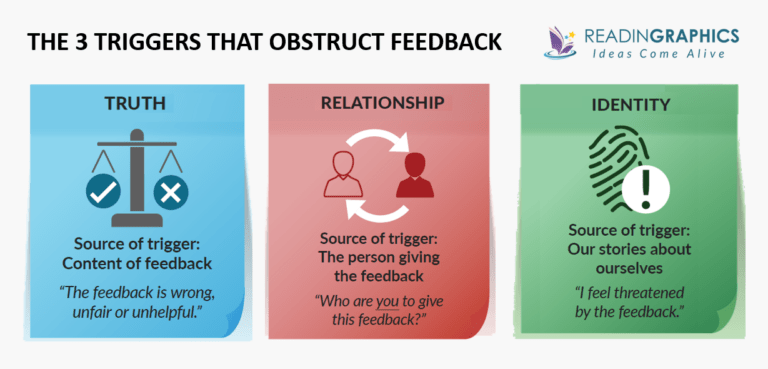
Truth Triggers
A truth trigger is activated when the content of the feedback feels inaccurate, unfair, or simply wrong which causes us to reject it before fully considering its value. The method and tone of the delivery of the feedback giver can also be a trigger. For example, if the feedback giver comes across as authoritative and the one who knows it all, we may be triggered by their tone and delivery to reject their feedback because truthfully, they cannot know it all!
Managing Relationships Triggers
A relationship trigger arises when our reaction is more focused on who is giving the feedback than what is being said which inserts issues of trust, respect, and power dynamics that can cloud how we interpret the feedback. For example, if the same feedback was given by our trusty best friend versus who we perceive to be our rival in the workplace, we may react very differently to the “who” delivered the feedback even though the “what” is similar.
Managing Identity Triggers
An identity trigger is set off when feedback threatens how we see ourselves, challenging our self-image or sense of confidence. Our reaction to an identity trigger can lead to strong emotional responses in which we want to protect our sense of self-image and self worth, making it difficult to absorb the feedback constructively. For example, when someone gives feedback on how you can be a better communicator and you view yourself as a strong competent communicator, this is an identity trigger where we may reject that feedback in order to protect our self identity around communication.
Stone and Heen provide a feedback model and types of feedback received as well as common triggers to difficult feedback that is useful and practical in our everyday lives. We will be working with these different types of feedback and how to disarm our feedback triggers throughout the Employee Advancement program and with feedback practices that we will put into action in the next Course Manual.
Interactive Group Exercise: Receiving Feedback Reflections in Our Learning Community
When you look at the critical/negative feedback situation in which you did not receive the feedback well, what type(s) of feedback did you receive? Is it coaching, evaluation, or even appreciation feedback even if it did not come across to you that way?
Were you triggered by that feedback and had a strong emotional and/or psychological reaction to it? Can you identify if it was a truth, relationship, or identity trigger, or some combination of those triggers?

Course Manual 6: Feedback Practices
Now that we have exemplary models and techniques for feedback, how do we actually put that into practice in our everyday lives?
This Course Manual on Feedback Practices establishes critical elements of the giving and receiving of feedback models that were introduced, the SBI model for giving feedback in Course Manual 4 and Stone and Heen’s receiving feedback model in Course Manual 5. We will work with core concepts from both of these models and apply them to your feedback practices through interactive exercises that make up this Course Manual, so that you can develop and improve your approach to both giving and receiving feedback. This will enhance your capabilities to communicate effectively, deepen relationships, and continually reflect and refine your self identity in both your professional and personal life.
The Feedback Practices Course Manual will be highly engaging and interactive, in which you will bring in giving and receiving feedback situations from your own life as well as learn and reflect upon those shared with your peer reflection circle and amongst our learning community. The more skilled we become in receiving feedback well, the more people will be open to delivering impactful feedback that helps promote our growth, so let us get to work on honing and applying healthy feedback practices!
Our specific focus for this Course Manual will be on how to receive feedback well, since that is oftentimes not emphasized in the professional workplace and will be an important skill and art for you to develop as we engage more and more feedback during the first half of our Employee Advancement program. By receiving feedback well, you can work with critical and/or negative feedback in a useful and constructive way that helps you reflect upon and clarify your identity.
To support receiving feedback well, we will further the application of the SBI model from not only feedback giving but also to receiving feedback. Specific SBI approaches that we will practice are to acknowledge the feedback, seek clarification and commitment to growth, and show appreciation and intent to improve. Next, we will work further with Stone and Heen’s feedback types (appreciation, coaching, evaluation) with greater focus on identifying our “triggers” to receiving feedback (Truth, Managing Relationships, Managing Identity) and how to work more productively with our triggers.
Receiving Feedback Well Using the SBI Model
In Course Manual 4, we focused on utilizing the SBI (Situation-Behavior-Impact) model to give feedback and tools on how to become more skilled feedback givers. Again, the SBI methodology is a structured approach to feedback that focuses on clarity and specificity with the three key elements of:
Situation
– Where and when the feedback giver describes the specific context or event in which the feedback is being given.
Behavior
– Where the feedback giver clearly articulates the observed actions or behaviors in that situation without making judgments or assumptions.
Impact
– Where the feedback giver explains the effect of the behavior on themselves, others, the team, or the organization.
Now, we will turn our attention to how the SBI model can be utilized in the two-way street of feedback, in which there is both the giving and receiving of feedback, to engage in an open and constructive feedback conversation. When feedback is given with clarity and specificity from the feedback giver, it allows the feedback receiver to be more curious about how to develop self-awareness and change behaviours and to be less defensive and place blame on others for the situation.
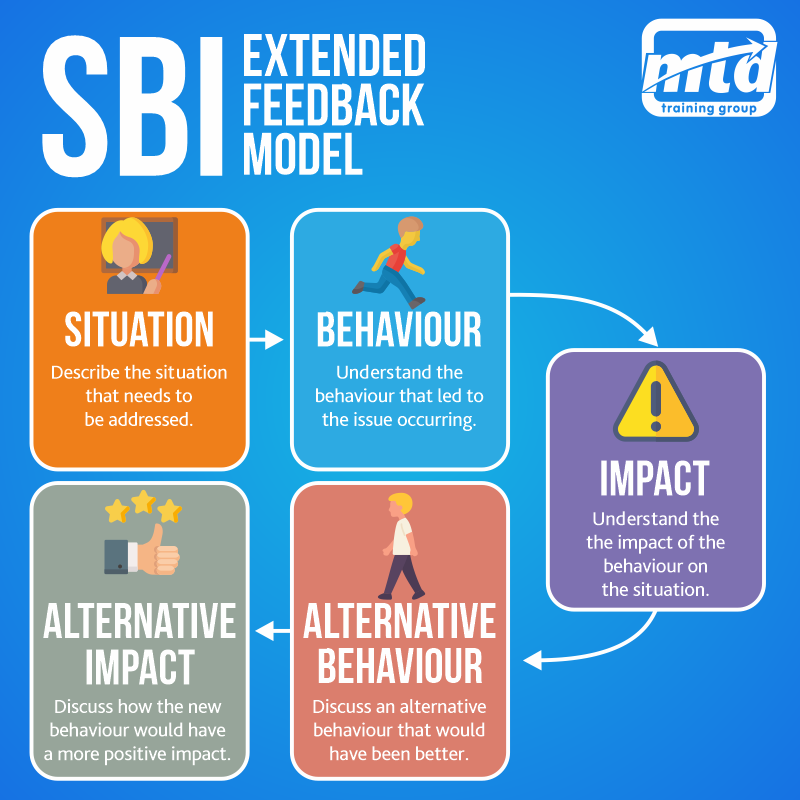
To better understand how the SBI model works in action, let us take a look at how the SBI model can be applied to a two-way feedback conversation about a contentious situation that happened during a team meeting. We will be able to see how different aspects of the SBI model is utilized with an A-player, or a team member who is adept at working with critical feedback, versus a C-player, or a team member who is open to feedback that is given with clarity and specificity but needs to do further reflection and engagement in behaviour change and improvement.
Content: SBI Model for Giving and Receiving Feedback
Brainard Strategy
https://www.youtube.com/watch?v=QfsQHyCPygs (5:06)
You can see in this role play between a manager and one of his team members about a conflictual team meeting , there are varying degrees that the manager applies the elements of the SBI model when he is in discussion with an A-player (i.e. Situation) versus a C-player on his team (Situation-Behavior-Impact). With both the A-player and C-player, their manager tailors his feedback to the receiver as well as ask questions and allows their team player to respond to offer this perspective on the team meeting and engage in dialogue where there can be effective behaviour change for the future.
The manager is delivering feedback that takes a coaching approach and engages his team member in conversation about the feedback, how to receive it, and what to do about the feedback collectively. As we learned about the SBI model for giving feedback in Course Manual 4, the manager is providing effective feedback by:
A clear understanding of the improvement area
– Often, feedback receivers seem to understand the feedback given, but behavior change does not occur, which can frustrate the feedback giver as they need to reinforce the feedback multiple times without getting the results they expect. The SBI methodology promotes feedback focused on specific behaviours and clear examples that can ensure understanding from all parties involved in the conversation.
The development of an action plan based on feedback
– Both feedback giver and receiver engage in conversations that include next steps and an action plan. They come to an agreement on how to address the behaviour in future instances, and create a plan that they both are accountable to report on in future conversations. As a result, feedback givers and receivers track progress and can celebrate small and big wins as their partnership promotes mutual growth in those particular behaviours.
So, as the feedback receiver what do you do with critical feedback that is being given to you? The SBI model provides these techniques and behaviours to engage effectively and start to create behaviour change with critical feedback.
Acknowledge the feedback
Acknowledging feedback is a critical first step in receiving it well, as it demonstrates openness, respect, and a willingness to engage in dialogue about the feedback. When you acknowledge feedback, whether you agree with it or not, you show the feedback giver that their input has been heard and considered. This does not mean you have to accept every point as valid, but it is important to listen without interrupting and reflect back what you’ve understood.
Examples of feedback acknowledgement:
Thank you for sharing your feedback.
I was not aware of this situation/dynamic and it is helpful to get your input.
I appreciate you pointing this out.
Seek clarification
Seeking clarification when receiving feedback is essential to ensure you fully understand the message and can respond thoughtfully. Often, feedback may be vague, overly general, or emotionally charged, making it difficult to identify the specific behavior or issue being addressed. Clarifying also shows that you’re genuinely interested in learning and making progress, rather than reacting defensively. It helps transform feedback from a one-way critique into a two-way dialogue that builds mutual understanding and supports personal and professional development.
Examples of seeking clarification with feedback:
Can you give me an example of the feedback you shared?
Can you help me understand how others/the team are impacted by me?
How would you handle this situation/dynamic if this is you?
Intent to Improve
Demonstrating an intent to improve with feedback shows that you are not only receptive but also proactive about your growth. It involves taking the feedback seriously, reflecting on its implications, and identifying specific actions you can take to apply what you have learned. This response signals accountability and maturity which can strengthen your credibility and relationships at work. Over time, consistently acting on and improving from feedback reinforces your commitment to development and helps build a reputation as someone who learns, adapts, and contributes positively to the team or organization.
Examples of intent to improve:
I hear the feedback you are sharing with me and would like to think about how I can improve.
What would improvement look like to you, so I can model that?
I see how adapting my behaviour/communication can be more supportive for our team. Can you work with me on how to improve my behaviours and communication to achieve that?
Depending on who or what feedback is delivered, or our own preferences in how we engage and communicate, some of us may need time to reflect on the feedback received before we can engage in an action plan. That is perfectly natural, and in fact gives both the feedback receiver and giver some time and space to reflect upon and process difficult feedback. If that is how you feel, express it to the feedback giver. For instance, you can say, “Thanks for your feedback. I would like to have some time to think about this behavior, and some ideas I have to improve. Would you be open to schedule a 15-minute follow up conversation tomorrow for us to align on an action plan to help me improve in this particular skill?”
Then, come back the next day with your interpretation and suggestions for an action plan and/or seek clarification and ask for help in your intent to improve. Ask the feedback giver if your thoughts match what was shared and if they have any suggestions to improve your proposed action plan. When we approach feedback with a curious mind, we stand to benefit from the gift of having someone point out what we likely could not see ourselves.
Interactive Peer Exercise: SBI Model for Giving and Receiving Feedback
Peer #1 share your situation when you did not receive critical and/or negative feedback well.
Together, as a peer reflection circle, examine and discuss the following:
Was the feedback given delivered with clarity and specificity?
How did you react to the feedback?
How would you approach receiving this feedback differently by applying SBI model’s techniques/examples? Are there other techniques that both of you can identify as helpful in approaching the feedback constructively?
Receiving Feedback Well Using Stone and Heen’s Model
In our last Course Manual 5, we explored Douglas Stone and Sheila Heen’s model for receiving feedback and how to do that well. Receiving feedback can be so challenging when we feel triggered by the person or by the feedback content being shared, resulting in a strong, and often uncontrollable, emotional and physiological reaction. Once we start identifying and delving into our triggers, especially the trigger(s) we are most sensitive to, we can also start to apply Stone and Heen’s approaches and techniques to be less defensive and emotionally reactive and more open to learning from and developing ourselves.
The more skilled we become in receiving feedback well, the more people will be open to delivering impactful feedback that helps promote our growth. People are drawn to those who show resilience and see setbacks as opportunities. When faced with challenging feedback, ask yourself: What is this person or situation trying to teach me? How can I be open to feedback which this person is taking the time and effort to share with me? What can I learn from this that can make me a better version of myself?
Let us revisit the three major triggers when receiving feedback that Stone and Heen have identified with their psychological, relational, and emotional research with effective communication and feedback. Once we become more adept at identifying our triggers, Stone and Heen offer approaches and techniques in managing our emotions and reactions to those triggers so that we can work with the feedback we are receiving more constructively.
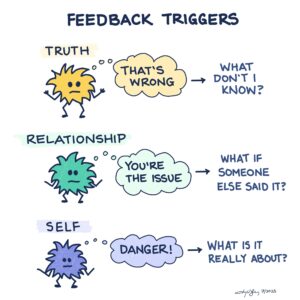
Truth Trigger: Shift from “What is wrong” to “What is useful”
A truth trigger is set off when we feel that the feedback and/or the feedback giver is inaccurate, unfair, or simply wrong. Typical emotional reactions to truth triggers are frustration, indignation, righteousness, exasperation, and anger.
Approach and techniques to deal with truth tiggers:
An approach to effectively receiving feedback that activates our truth trigger is to shift from asking “What is wrong with this feedback?” to investigating “What might be useful, or even right, about this feedback?”. This may mean taking a few deep breaths, leaving the room in which we are receiving the challenging feedback, or expressing to the feedback giver that you need some time to process their feedback.
There is always some useful insight in difficult feedback which can help illuminate our “blind spots” by being receptive to the fact that others may see things that you are not able to. A couple of techniques to step back from your truth trigger is to engage with the feedback giver, by digging deeper and asking for clarification of their feedback (rather than immediately categorizing it as wrong) as well as requesting specific examples that illustrate their feedback (which helps you identify what is useful). And remember, everyone sees “truth” in different ways!
Managing Relationships Trigger: Separate the “What” from the “Who”
A relationship trigger is activated when we have a reaction that is more weighted by the person who is giving the challenging feedback than the actual content of the feedback itself. Our emotional reactions may be dictated more by our feelings and opinions about the feedback giver such as distrust, resentment, wariness, haughtiness, and complete dismissal.
Approach and techniques to deal with managing relationship triggers:
An approach to effectively receiving feedback that activates our relationship trigger is to try to separate the “what” from the “who” by asking “If someone else who I respect and trust gave me this feedback, would I hear and react to it differently?”. This may mean taking a few deep breaths and asking to take some time and space where you can make this distinction between “what” and “who” and examine how you can make this distinction for yourself.
A couple techniques to separate from your relationship trigger is to first hypothetically pick another trusted “who” that delivers that feedback (rather than a person who immediately sets off your relationship trigger) and observe how you feel and react. Then, you can move back to the actual “who” that gave the feedback with more openness and ask that person to clarify the intentions of why they are giving this feedback. Are they actually trying to help you? Do they see a behaviour which is undermining you that you cannot see?
Managing Identity Triggers: Ground Yourself
An identity trigger arises when our sense of self, who we are, or how we intentionally represent ourselves to others is threatened by the feedback we are receiving. Our identity runs deep (as it should!) and we are often protective of our identity after typical emotions are triggered such as shame, defensiveness, overwhelm, confusion, and hurt.
Approach and techniques to deal with managing identity triggers:
An approach to effectively receiving feedback that activates our identity trigger is to identify the reactions and emotions we are having to this threat to our identity. We do this by labeling the emotions as “I feel embarrassed” and “This makes me angry” as well as identifying our reactions “I am taking this personally” and “I want to prove myself”. This may mean taking a few deep breaths and actually taking some time and space apart from our selves. It is important to bear in mind that emotions and reactions are healthy and normal, but what we can control and influence is what we ultimately do with those emotions and reactions.
A couple of techniques to detach from your identity trigger is to observe how you would react and feel if you are witnessing that same feedback being delivered to someone else and how that impacts their identity (rather than a threat to your own identity). Additionally, exploring which kinds of feedback you are most sensitive to and why, can help you preserve your own identity while being malleable to feedback. Are you most sensitive when someone gives feedback about your personal style, ideologies and beliefs, and/or how you relate and communicate?
Interactive Peer Exercise: Stone and Heen’s Model for Receiving Feedback
Peer #2 share your situation when you did not receive critical and/or negative feedback well.
Together, as a peer reflection circle, examine and discuss the following:
What receiving feedback trigger(s) arose? Truth, managing relationships, managing identity triggers? Are there other emotional triggers that arose?
What emotions and reactions arose because of these triggers?
How would you approach receiving this feedback differently by applying Stone and Heen’s techniques? Are there other techniques that both of you can identify as helpful in approaching the feedback constructively?
The Value of Receiving Feedback Constructively
Practicing the skill and art of receiving feedback well can have a profound impact in how we build trusting relationships in our personal and professional lives. Receiving feedback constructively and being able to take action and grow from it is an essential skill for several reasons.

First, it is a cornerstone of personal and professional growth which shows up in both your workplace as well as your life outside of work, and sometimes cross over between the two. Receiving feedback provides insight into how our actions and behaviors are perceived by and impact others, highlighting our strengths and areas for improvement. For example, receiving feedback that you are always late and this behaviour impacts the ability of your project team to be productive can trigger feelings of letting people down. However, this can prompt you to take action in which you explore your relationship with time and put in place new behaviours to support being more timely for others. It can be difficult and triggering to receive negative feedback and areas of improvement, so building a strong sense of self and being able to emotionally regulate is crucial for continuous development.
Secondly, effective feedback reception fosters better relationships and communication within teams, whether that be your project team at work, your interest or sports teams, or your “family team” at home. When you are open to receiving feedback, it helps set an environment of openness and trust, which is essential for collaboration, community building, and collective problem-solving. It also encourages others on your team to be open to feedback and strengthen this environment of openness. For instance, if someone shares feedback with you and you fight back or feel defensive, they may refrain from providing critical and helpful feedback to you in the future as a result of your response. That in turn can hinder your ability to thrive and become better in your role as a colleague, team member, or mother/father/sister/brother/daughter/son in your family circle. However, if you exhibit openness to this feedback, even if you may disagree or not act fully upon it, it strengthens your relationship and communication with the feedback giver.
Finally, handling feedback constructively demonstrates emotional intelligence and resilience, qualities that are highly valued in any professional and personal setting. When you receive feedback well, and share progress with the feedback giver, you show them that the time they took to provide feedback was valuable and appreciated. That commitment to change shows a growth-mindset which promotes accountability and seeking to achieve better results for oneself, one’s team, one’s customers, one’s family. For example, when a long-term external client provides feedback and areas of improvement at the end of the project, your synthesis and setting of intentions on how to integrate this feedback into the next project signals that you value the feedback giver. When we engage openly and learn from feedback, we benefit from change that can have positive ripple effects in both our professional and personal lives.

Course Manual 7: Professional Identity
The main objective of this Professional Identity workshop is for each of you to share, assess, and reflect on what your previous and current professional identity is related to your work, corporate, academic, and other life experiences. This Course Manual will begin our exploration of different facets and archetypes, or personas, of each of our professional identities. Then, in the following Course Manuals, you will be guided through creating a “Professional & Life Overview” presentation to share your professional journey and major learning moments you have experienced.
As we start to explore our professional identities, we will be harnessing peer and group feedback by utilizing the methods and techniques that we learned and practiced in the previous Course Manuals. This is one of the biggest values that the Employee Advancement Program delivers, is feedback that offers you new perspectives, insights, and questions to further develop yourselves. Again, we give and receive feedback upholding our learning community values, accountability, and expectations that we started to set at the beginning of this workshop. There will also be opportunity to self reflect on where you are at with your professional identity and what you may want to develop for the future as we move from this workshop into the following workshops.
What is a professional identity?
A professional identity is how we associate with as well as project ourselves in our roles and jobs, at the company and organization we work for, and within our professional networks. This identity is not just shaped by our job title and position but even more broadly by our values, beliefs, experiences, and competencies as we learn and grow both professionally and personally. From the moment we begin our education or training, we start to form a sense of who we are and what we want to be professionally.

Our professional identity is usually a huge part of “who we are”, how we identify as a person and what we project about ourselves in our lives both at work and outside of work. Think back to the last party or social gathering you attended and when someone asked about what you do. How did you answer? Did you share your job title, what you do for work, and/or the company and industry you work in? Did you recount what you did last weekend? Did you share about your personal projects and pursuits?
Most often we associate “who we are” and “what we do” with our professional identity and what we do for work. To start, what exactly is a professional identity and what are different facets of that identity we associate with?
Professional identity is a concept, an image, and the values we hold in relation to our career and profession. It defines how we relate to work, what we stand for, and how we want to contribute to our workplace, organization, and company. This identity is shaped by both internal and external factors. Internal factors include our personal values, beliefs, aspirations, passions, and goals that we infuse into our career and professional development. Additionally, our identity is shaped by our own education, work experiences, and personal beliefs about work ethics and responsibilities. External factors encompass industry standards, company culture, leadership expectations, interpersonal relationships that are shaped by workplace and career expectations.
Our professional identity is equally, if not at times more strongly, shaped by other people and groups in our life. We develop and integrate facets of our professional identity which is based on our ethnic background, cultural norms and expectations, and the beliefs and values of others see and project upon us.

These are common facets of a person’s professional identity. Let’s outline what these facets are and we will be deep diving into several of the critical facets after our interactive exercise.
Internal professional identity facets:
Core values – professional and personal values that you bring to the workplace
Personal beliefs – purpose that you infuse into your work and career
Behaviours and practices – your approach to team collaboration and conflict
Motivations and goals – how you want to develop, project yourself, and achieve
External professional identity facets:
Role and skills – job-specific and problem-solving skills utilized in your role
Expertise and competencies – specialized and industry knowledge you offer
Interpersonal relationships – communication, engagement, and trust with others
Leadership – vision and collaboration with your team, organization, and company
Professional identity facets shaped by others:
Reputation and credibility – how others perceive you in your ethics and work
Professional knowledge – what do you know which inspires and benefits others
Networks and affiliations – your broader professional network outside your role
Cultural and social – how others view your ethnic, racial, and cultural background
A well-developed professional identity provides each of us a foundation for decision-making, ethical behavior, and career development. A strong identity gives us a sense of purpose and direction, helping us navigate complex work environments with confidence and integrity. Moreover, a clear professional identity fosters credibility and trust with our colleagues, company, and clients. In a world where careers are increasingly dynamic, multifunctional, and non-linear, maintaining a strong and adaptable professional identity can be key to long-term success and fulfillment.
Professional Identity Archetypes
We will do an exploration of each of our professional identities throughout the rest of this workshop, what our identities are now and how they may shape and develop into the future. In the following Module 2: Professional Branding & Positioning, each of you will strengthen and clarify, and possibly transform, your identity by creating a “professional brand” to promote yourself in the workplace and in your career.
The tools and exercises we will use during our professional identity exploration and professional brand creation are drawn directly from corporate branding techniques. Corporations build and change their branding over time to showcase their mission and core values, build strong engagement and communication with their stakeholders and customers, and express their personality through specified imagery, music, colours, and more. By applying corporate branding techniques to your own professional identity, it will provide you structured and identifiable ways to showcase your own values, build engagement, and express your own personality.
The first corporate branding tool we will use first is to work with 12 brand archetypes, or professional persona that include the Outlaw, Magician, Hero, Lover, Jester, Everyman, Caregiver, Ruler, Creator, Innocent, Sage, and Explorer. Each of these brand archetypes are associated with core values, aspirations, and how we relate and are perceived by others. It serves as a quick assessment and identification of ourselves before we dive deeper into what makes up our professional identity.
Content: Archetypes and Characteristics of a Professional Identity
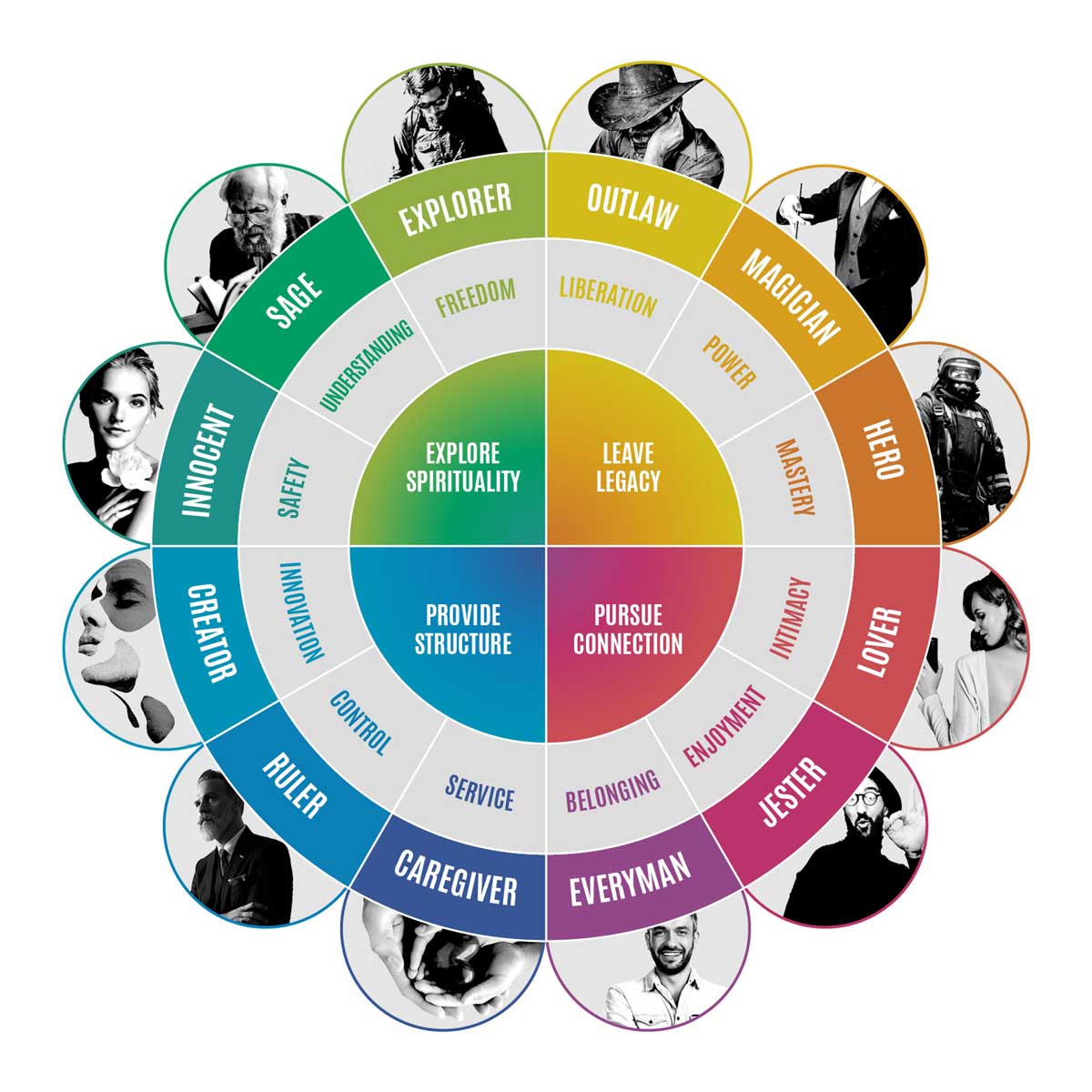
Each of these 12 professional brand archetypes, or personas, have unique characteristics and personalities. In corporate branding, each archetype exemplifies a core value, message, and a brand voice and identity. Let us take a closer look at the corporations that embody these archetypes and how the values and qualities of these archetypes show up in that company’s identity and expression. Then, you can start to contextualize how you may be drawn to and relate with several of these identities. As we go through these archetypes: Which archetypes do you feel an immediate connection with? Which ones seem relatable and inspirational, but may not be representative of you at this current time? Are there corporations that are presented that you admire and have a relationship with?
The Outlaw
Core value: Liberation
Message: “Rules are made to be broken”
Voice: Rebellious, disruptive, breaking free
Identity: The Outlaw challenges industry and social standards and encourages
breaking free from the status quo with being disruptive and unconventional.
Corporate examples: Harley-Davidson, Diesel, Virgin
The Magician
Core value: Power
Message: “It can happen”
Voice: Mystical, reassuring, informed
Identity: The Magician is visionary and transformative using insight and creativity to make dreams happen in reality.
Corporate examples: Disney, Coca-Cola, dyson
The Hero
Core value: Mastery
Message: “Where there is a will, there is a way”
Voice: Brave, candid, honest
Identity: The Hero is bold and determined and pushes forward to overcome challenges to prove its worth and inspire others to be their best selves.
Corporate examples: Nike, FedEx, adidas
The Lover
Core value: Intimacy
Message: “I only have eyes for you”
Voice: Empathetic, expressive, soothing
Identity: The Lover is passionate and expressive and strives to build fulfilling relationships through beauty, connection, and devotion.
Corporate examples: Alfa Romeo, Chanel, Haagen-Dazs
The Jester
Core value: Enjoyment
Message: “If I cannot dance then I am not part of it”
Voice: Optimistic, playful, fun-loving
Identity: The Jester is playful and lives to entertain by bringing joy, humor, and wit into creating connections that make life more enjoyable.
Corporate examples: m&m’s, Old Spice, Doritos
The Everyman
Core value: Belonging
Message: “You are just like me and I am just like you”
Voice: Authentic, friendly, humble
Identity: The Everyman is relatable and seeks belonging portraying practicality and groundedness that appeals to the common human experience.
Corporate examples: IKEA, Target, eBay
The Caregiver
Core value: Service
Message: “Love your neighbor as yourself”
Voice: Caring, warm, compassionate
Identity: The Caregiver is nurturing and compassionate and emanates a selfless and protective desire to help and support others.
Corporate examples: unicef, TOMS, World Wildlife Fund
The Ruler
Core value: Control
Message: “Power is not everything, it is the only thing”
Voice: Commanding, articulate, refined
Identity: The Ruler is authoritative and responsible upholding strong values of control and structure to oversee order and success.
Corporate examples: Mercedes-Benz, Rolex, Microsoft
The Creator
Core value: Innovation
Message: “If it can be imagined, it can be created”
Voice: Daring, inspirational, provocative
Identity: The Creator is imaginative and original with a drive to build and design meaningful products and services that center on self-expression.
Corporate examples: Apple, LEGO, Adobe
The Innocent
Core value: Safety
Message: “Life is simple and simplicity is elegant”
Voice: Wholesome, happiness, simplicity
Identity: The Innocent seeks purity and simplicity so strives to do the right thing with goodness and without complications.
Corporate examples: Dove, Aveeno, innocent
The Sage
Core value: Understanding
Message: “The truth will set you free”
Voice: Knowledgeable, guiding, assured
Identity: The Sage is thoughtful and committed to truth and wisdom by seeking to understand the world and share knowledge with others.
Corporate examples: BBC, Google, National Geographic
The Explorer
Core value: Freedom
Message: “You only get one life, get out and make it count”
Voice: Daring, inspirational, fearless
Identity: The Explorer craves independence and adventures and values freedom through new experiences and the fulfillment of discovery.
Corporate examples: patagonia, Jeep, The North Face
The archetypes can easily represent and express parts of your professional identity, just as they are shown above to represent and be the voice of different iconic corporations. For example, someone with a professional identity of being a “Ruler” may be on the leadership team or a manager, who provides vision and structure to their team while valuing having control of others. Another example, is someone with a professional identity of being an “Explorer” may be on the Research & Development or New Business Development team, who explores new technology and market/customer segments while valuing freedom in their work and explorations. Finally, is someone with a professional identity of being an “Everyman” may be that person in the organization or on a team that welcomes and knows everyone, who naturally connects people and creates a sense of belonging in the organizational culture.
The interactive exercise we are going to do may seem fast, or you may want more time with these 12 archetypes, but this is intended to simply kick off our exploration. We will be working with these archetypes and more corporate branding techniques to apply to your own professional brand throughout the entire first half of our Employee Advancement Program, so there will be a lot more time for each of you to work with and reflect upon these archetypes.
Interactive Individual Exercise: Your Professional Archetype
Take the next 5 minutes to look at these 12 professional archetypes and the characteristics and values that are associated with each of them.
Identify the professional archetype that most represents you. If you feel you represent a combination of archetypes, please select 3 archetypes at most.
Next to each archetype you identified, write down in several sentences how you associate with that archetype in relation to your co-workers, your team, and/or your company.
Now, we will go around our learning community and each of you will do a quick share of your 1-3 archetypes and share how you feel/ think these archetypes represent you. This is another way to introduce yourselves to each other and start getting a sense of each other’s professional identities.
Facets of Your Professional Identity
The archetype(s) you shared are a representation of your professional identity, persona, and characteristics at this point in time. Your professional identity may be similar to when you started your career, joined this company, and/or took on the role you have now. You may want to further strengthen and expand the influence of this identity, or conversely you may no longer relate with this identity and want to develop a new or different professional persona. We will be exploring your professional journey and what your identity and characteristics were in the past to the current time during the second half of this workshop.

First, we will take a deep dive into the facets that define and shape your professional identity. These factors will change throughout your career that causes you to re-define and re-shape your professional identity in different stages of your career advancement.
Aligning with company goals and values
This facet of your job and how you are both shaped and perceived professionally is in relationship with your company. How well do you align with your company’s business and organizational goals? Does the way you approach your job and the contributions you make provide Return on Investment for your company? Do you embody the values of your company when working with the internal organization and working externally with clients and partners?
Aligning with company goals and values is a critical part of your professional identity at work and how you are perceived for future advancement. Upholding the ethical and cultural values of your company reinforces that your professional identity is in alignment with company goals, expectations, and well-being. For example, J.P. Morgan, a leading international company in finance and banking, values “excellence” and to guide “great teams and a winning culture”. Employees of J.P. Morgan who strives to mentor and invest in the development of others on their team, in addition to fulfilling the responsibilities of their own role, exemplifies and acts upon the company’s core values.
Roles and responsibilities
This facet is your job title, the organization and team that you are in, and the scope of responsibilities and influence of your job role. Your job title and role are typically a central facet to your professional identity as you represent yourself as Marketing Associate, Mid-level manager, or a Chief Financial Officer.
Roles and responsibilities define your professional identity by highlighting how you contribute to the workplace, interact with others, and align with organizational and business goals. For example, a Marketing Associate may build a professional identity around being a promoter and a communicator. They promote the company’s products, platform, and services and must serve as a strong communicator both internally in their organization as well as externally to existing and new customers.
Expertise and competencies
This facet exemplifies expertise, which is specialized knowledge and skills in a particular field, and competencies, which is combining that knowledge and those skills in order to enable you to meet goals and perform your role and responsibilities. Expertise and competencies can include both hard and soft skills, ranging from technical and industry-specific skills to behavioural and interpersonal skills.
Expertise and competencies define your professional identity as you are distinguished by your specialized knowledge and skills (i.e. data science or supply chain management) and your competencies to meet goals (i.e. draw insights from large amounts of customer data, or create partnership with the most cost-effective suppliers for your company’s product). For example, a cybersecurity expert has deep knowledge of encryption, network security, and risk assessment and is competent in developing banking transactions that are secure and risk-free for their company’s customers.
Leadership and influence
This facet includes your ability to exert leadership and influence, whether you are in a formal leadership or managerial role or not. This means your ability to take on the role as a leader when it is needed and being able to influence others and outcomes for the benefit of your team and organization.
Leadership and influence associated with your professional identity can be exhibited in many different ways. For example, you can be the visionary and strategic leader who gets others excited about the bigger picture and new ideas, products, and services. You can be the accountability leader who creates a culture of team and organizational responsibility, in which fulfilling one’s responsibilities is not just good for that person but for the group as a whole. Finally, you can be a leader who is decisive by analyzing situations that may be changing and making decisions with incomplete information, but benefits the organization to make forward progress even if future shifts need to be made.
Workplace behaviour and etiquette
This facet refers to your professional conduct, communication, and interactions that define how you engage with colleagues, leadership, and team members in the workplace as well as external partners and clients. Additionally, this facet is influenced by your company’s culture, expectations, and norms and how you adhere to adapt to them in your own conduct.
Workplace behaviour and etiquette are attributed to your professional identity in the forms of your communication (i.e. clear direct communication or uncommunicative), your interpersonal interactions (i.e. works collaboratively with others or prefers to work alone), and your work ethics (i.e. hardworking and will do anything to meeting deadlines or balanced and will set boundaries on the amount of time/effort put towards work). For example, one employee’s professional identity in relation to workplace behaviour and etiquette can be formal, distant, and professional while another employee can be adaptable, approachable, and easy-going.
Aligning with company goals and values, roles and responsibilities, expertise and competencies, leadership and influence, and workplace behaviour and etiquettes are several important aspects of what defines your professional identity. These five aspects are generally universal and common in influencing how we project ourselves and how others perceive us, but there are other facets that may be specific to your identity. We will be further exploring all of these professional identity aspects throughout our Employee Advancement Program, and you can apply some of these facets when you prepare and share your “Professional & Life Overview” in the upcoming Course Manuals.
The Employee Advancement Program is designed to guide each of you to examine and reflect on your professional identity. What parts of your identity are you holding on to from the past, or from other companies and roles? How is your identity shaped by others around you (whether you are aware of it or not)? What parts of your identity do we want to grow or let go of as we advance in your career? It is important, and exciting, to recognize that our professional identity can grow, strengthen, or completely change throughout the course of our careers!

Course Manual 8: Inspirational Identities
Our professional identities are shaped both inwardly, with our core values and voices, and outwardly, with what we are inspired and shaped by with the professional identities of others. In this Course Manual, we will explore inspirational identities with prominent figures in the Media and Marketing, Technology, and Finance and Banking industries, and what stands out in their professional identities in the way media portrays them and how the general public perceives them.
In the media and marketing industry, inspirational professional identities are often defined by bold storytelling, cultural fluency, and fearless authenticity. Leaders like Bozoma Saint John exemplify this through their ability to shape global brands while pushing for inclusive representation and emotional resonance. These professionals do not just market products, they connect deeply with audiences by reflecting the world as it is, and imagining what it can be. Their work often breaks through the noise by staying rooted in purpose, creativity, and human connection.
In the technology sector, figures like Satya Nadella, CEO of Microsoft, inspire with a leadership style centered on empathy, transformation, and growth mindset. Nadella redefined Microsoft’s culture by emphasizing collaboration, humility, and innovation. Technologists with strong professional identities often balance technical expertise with visionary thinking, enabling them to navigate disruption, drive digital transformation, and lead with long-term impact.
In finance and banking, professional identity is increasingly shaped by trust, strategic foresight, and global influence. Christine Lagarde, President of the European Central Bank, embodies a professional presence grounded in clarity, composure, and trailblazing leadership. Her ability to lead through crises while advocating for economic reform and gender equity reflects the evolving role of financial leaders. Today’s most respected figures in this space are those who combine analytical rigor with a clear ethical stance and a commitment to shaping more resilient and inclusive economic systems.
Professional Identities Across Industries
Media & Marketing Industry
Bozoma Saint John, CEO & Creator of Eve and former CMO of Netflix, Endeavor, Uber
Bozoma Saint John, often referred to as “Boz,” is an American-Ghananian high-profile marketing executive known for her bold, authentic presence and her ability to fuse cultural insight with brand strategy. She has held senior leadership roles at major companies including PepsiCo, Apple Music, Uber, Endeavor, and most recently served at Netflix. In 2020, Saint John made history as Netflix’s first Black C-level executive when appointed Global Chief Marketing Officer, a role she held until early 2022. During her tenure, she emphasized authentic cultural messaging and elevated Netflix’s brand on a global scale.
Saint John’s impact goes beyond strategy, as she is known for injecting personal authenticity and cultural resonance into brand narratives, earning her numerous accolades including induction into the American Advertising Federation Hall of Achievement (2014), Marketing Hall of Fame (2022), and being named Forbes’ #1 Most Influential CMO (2021). Her leadership also extends beyond corporate roles—she has also engaged in philanthropy, advocacy, and education, contributing to initiatives like #ShareTheMicNow and serving on boards including Girls Who Code and Vital Voices.
The marketing campaigns that Saint John has run have been major cultural moments. As Head of Music and Entertainment Marketing at PepsiCo, she led brand partnerships with major music events, such as the Pepsi’s Super Bowl Halftime Shows, and celebrities, including Beyoncé, Kanye West, and Nicki Minaj. These campaigns aligned Pepsi with youth culture and positioned it as a key player in music and entertainment branding. As CMO at Netflix, Saint John focused on amplifying diverse stories and global voices, supporting campaigns for major series and films that broke cultural ground such as Bridgerton, Ma Rainey’s Black Bottom, The Harder They Fall. This elevated Netflix’s global brand identity with inclusive storytelling and bold visuals.
Content: Bozama Saint John share about the importance of listening to people
Bozama Saint John as Netflix CMO
https://deu.theglsn.org/videos/leading-others/life-habits-listen-to-people/ (0:30)
“One of the most important habits a leader should develop is empathy and listening – true listening, active listening – the kind of listening in which you do not speak.”
– Bozama Saint John
As a leader, Saint John is known and well respected for her ability to listen to others, listen to stories, and listen to the cultural undertone that her audiences are undergoing. Thus, throughout her career in the media and marketing industry, Saint John has built a powerful professional identity rooted in storytelling, inclusivity, and emotional resonance.
What sets Saint John apart is her unapologetic personal brand and her commitment to pushing boundaries, whether in crafting compelling campaigns or advocating for greater representation in media. She is widely respected not just for her marketing expertise, but for her ability to lead with authenticity and turn brands into cultural forces. Saint John’s influence continues to shape how companies communicate, engage audiences, and build lasting emotional connections through their media and marketing outreach.
Based on her unique traits, an example Saint John’s professional identity statement might be:
“I am a storyteller at heart. I have spent my career building brands that move people emotionally, culturally, and boldly. My own leadership values are based on authenticity and creativity with the belief that representation is not optional, it is essential. From PepsiCo to Apple, Uber, and Netflix, I have brought unapologetic vision and fearless leadership to every table I have sat at. I am not here just to market products, I am here to shift culture, open doors, and empower others to do the same.”
Technology Industry
Satya Nadella, CEO of Microsoft
Satya Nadella was born in Hyderabad, India, in 1967 and began his career in technology after earning degrees in electrical engineering from Manipal Institute of Technology and a master’s in computer science from the University of Wisconsin–Milwaukee. He later completed an MBA from the University of Chicago Booth School of Business. Nadella joined Microsoft in 1992, where he steadily rose through the ranks by leading major projects in enterprise, development of Windows Server, and putting in place the company’s early cloud infrastructure.
One of Nadella’s most significant roles before becoming Microsoft’s CEO was serving as Executive Vice President of the Cloud and Enterprise group. Under his leadership, Microsoft built one of the world’s largest cloud computing infrastructures and transformed its enterprise business strategy. Nadella was instrumental in shifting Microsoft’s focus from traditional software to cloud services, paving the way for long-term competitiveness in a rapidly changing industry.
In February 2014, Satya Nadella was appointed CEO of Microsoft, becoming only the third person to lead the company after Bill Gates and Steve Ballmer. Since then, he has overseen a cultural transformation centered on collaboration, continuous learning, and a “growth mindset.” Nadella refocused the company’s vision around cloud computing, Artificial Intelligence, and platform services while making strategic acquisitions such as LinkedIn, GitHub, and Activision Blizzard.
Microsoft regained its stature as one of the most valuable and innovative companies in the world under Nadella’s leadership, earning praise for both financial performance and renewed relevance in the global tech landscape. Watch Nadella explain his approach to leadership and the importance of empathy and team work to propel innovation.
Content: Satya Nadella on the Importance of Teamwork and Empathy
Satya Nadella as Microsoft CEO
https://www.youtube.com/watch?v=nq8rEeJ4Tak (2:30)
“I’m a very big believer that for any institution,
any organization to endure and to have long-term success
it needs to be grounded in a sense of purpose that is renewed every day.”
– Satya Nadella
Nadella’s professional identity is defined by his empathetic leadership, transformative vision, and commitment to fostering a growth mindset. His ability to revitalize and innovate within a legacy tech company is noteworthy. Read Leadership Lessons from Satya Nadella for more insights about Nadella’s leadership approach.
He is known for fostering a culture of empathy and inclusiveness at Microsoft. Nadella’s leadership style emphasizes understanding and valuing diverse perspectives. For a deeper dive on how he continues to inspire innovation and inclusion, read Microsoft CEO Satya Nadella: How Empathy Sparks Innovation.
Based on these learnings, an example of Nadella’s professional identity statement might be:
“I am a CEO with over 30 years of experience driving innovation and growth at Microsoft. My greatest strength is empathy, and I have a talent for fostering a culture of inclusivity and continuous learning. I am passionate about leveraging technology to empower every person and organization on the planet, and I value a growth mindset.”
Banking & Finance Industry
Christine Lagarde, President of the European Central Bank
Christine Lagarde, born in Paris in 1956, began her career in law after earning degrees from the Paris Nanterre University and the Institut d’Études Politiques in Aix-en-Provence. She joined the international law firm Baker McKenzie in 1981, where she specialized in labor, antitrust, and mergers and acquisitions. Over time, Lagarde rose through the firm’s leadership ranks, eventually becoming the first female chair of its global executive committee in 1999. Her success in a traditionally male-dominated field positioned her as a strong figure in international legal and business circles.
In 2005, Lagarde transitioned into public service in France, where she held several high-level ministerial roles. As Minister of Foreign Trade, Minister of Agriculture and Fisheries, and later as Minister of the Economy, Finance and Employment, she became the first woman to hold the finance portfolio in a G7 country. During the global financial crisis of 2008, Lagarde played a key role in stabilizing France’s economy and influencing international financial policy through her engagement with the European Union and G20. Her direct communication style and steady leadership drew international recognition during a time of significant economic uncertainty.
In 2011, Christine Lagarde was appointed Managing Director of the International Monetary Fund (IMF), becoming the first woman to hold the position. During her two terms, Lagarde led the IMF through major global events, including the Eurozone crisis and the economic fallout of Brexit, while advocating for structural reforms, inclusive growth, and gender equity in global finance. One of Lagarde’s most notable accomplishments is her leadership during the global financial crisis. As the Managing Director of the IMF, she played a crucial role in stabilizing economies and implementing policies to foster recovery. Her ability to navigate complex financial landscapes and build consensus among diverse stakeholders has been widely recognized.
In 2019, she was named President of the European Central Bank (ECB), where she continues to oversee monetary policy for the eurozone. Lagarde’s career is marked by historic firsts and a reputation for diplomatic strength, economic insight, and unwavering commitment to international cooperation. Under her leadership at the ECB, she has spearheaded efforts to address climate change by integrating environmental sustainability into monetary policy. This innovative approach underscores her belief that economic growth and environmental responsibility are not mutually exclusive but rather essential components of a sustainable future.
Watch Lagarde as she discusses a critically important topic in finance which she calls an “ethics upgrade”.
Content: Christine Lagarde on the Time for an “Ethics Upgrade”
Christine Lagarde as Managing Director of International Monetary Fund
https://www.youtube.com/watch?v=pG9M51ShwjQ (3:38)
“I believe that we can build a better financial sector one that is safer
more sustainable and ethically sound a financial industry
with a broader sense of purpose”
– Christine Lagarde
Christine Lagarde’s values are deeply rooted in her commitment to public service and economic stability. Throughout her career, she has emphasized the importance of integrity, inclusivity, and resilience in leadership. Her work at the International Monetary Fund (IMF) and the European Central Bank (ECB) has been characterized by a focus on transparency and accountability, ensuring that policies are crafted and implemented with the utmost ethical standards.
Lagarde’s professional identity is characterized by her leadership, advocacy for gender equality, and crisis management capabilities. She has effectively managed financial crises, demonstrating her resilience and strategic thinking. Lagarde’s role in navigating global financial landscapes is highly influential. is a vocal advocate for gender equality in the workplace, often speaking out on the need for more women in leadership roles. She believes that diversity not only strengthens organizations but also fosters more innovative and effective decision-making
Based on this information about Lagarde, her professional identity statement could be:
“I am a President of the European Central Bank with over 40 years of experience in law, finance, and international economic policy. My greatest strength is leadership, and I have a talent for navigating complex financial landscapes and advocating for gender equality. I am passionate about fostering economic stability and sustainable growth, and I value integrity and resilience.”
How Inspirational Professional Identities Relate to Ourselves
These three industry leaders – Bozama Saint John, Satya Nadella, and Christine Lagarde – exhibit strong and clear professional identities. There are many more professionals in our company, workplace, and networks who also exhibit identities which we can relate with and be inspired by on a day-to-day basis. The next set of individual and then peer interactive exercises leads us in reflecting upon and identifying what characteristics and aspects of the inspirational professionals in our lives.
Interactive Individual Exercise: Inspirational Professional Identities
What 1-2 professional archetypes do you associate them with? The Outlaw, Magician, Hero, Lover, Jester, Everyman, Caregiver, Ruler, Creator, Innocent, Sage, and Explorer.
What of their vision, strengths, and achievements do you see in yourself?
What of their vision, strengths, and achievements would you like to cultivate more of in yourself?
Now that you have identified two inspirational professional identities and how they relate to you, let us break out into our peer reflection circles of 2 people each. There may be new reflections as you are sharing out loud as well as new insights that your peer may uncover as they provide feedback.
Interactive Peer Exercise: Inspirational Professional Identities
Share the two inspirational professionals and their associated archetypes.
Describe what of their identity you see in yourself.
Describe what of their identity you would like to see more of in yourself.
As you listen to your peer share information about the inspirational professionals they selected, what is one aspect that stood out to you?
What is one characteristic or piece of information you wish they had included about this individual?
In this Course Manual, we learned that Inspirational professional identities are defined by more than titles or achievement as identities reflect that person’s values, vision, and the impact they create through their work. Whether in the media and marketing, technology, finance and banking, and many other industries, these individuals lead with authenticity, purpose, and the courage to challenge norms. They build trust, empower others, and shape industries by aligning their personal strengths with meaningful contributions. At the core, inspirational professional identities show us what it looks like to lead with integrity, adapt with intention, and create lasting change.

Course Manual 9: Professional Overview
We are now going to turn our focus toward preparing, presenting, and engaging peer feedback on our own professional overview. This builds upon the brief professional introductions that we each shared at the beginning of this workshop and also starts to interweave the more detailed professional and personal aspects of who we are that are coming up in our large group discussion and peer reflection circles.
The last two Course Manauls introduced the concept of a professional identity and the many different facets that shape how we represent our own as well as how others perceive our identity. We took a quick snapshot of how we perceive and represent our own identity by identifying 2-3 archetypes that we associate with our professional identity. Then, we took a look at inspirational leaders and professional identities in the corporate world to have a broader view on how identities are expressed, established, and also change over time.
In this Course Manual 9 on Professional Overview, our attention is fully on your own current professional identity and past professional, personal, and other life factors and experiences that have led you to where you are at today. Over the Course Manuals 9 through 11, we will be exploring your own professional identity and experiences by looking at facets that shaped your current identity (Course Manual 9), preparing your 5 minute Professional Overview presentation (Course Manual 10), then working in peer reflection circles to both present your Professional Overview as well as receive peer feedback (Course Manual 11).
Where is my professional persona at?
Do you feel you have a well-established professional persona? Is it one that you have intentionally worked to build and strengthen over your career? Or, is it a persona that has been organically shaped for you through the workplace cultures, team interactions, interpersonal relationships, and intended or unintended events throughout your career?
Conversely, do you feel that you have not established a strong professional persona? Perhaps you have focused on other important facets of your life, such as academics and schooling, friends and family, and personal growth? Do you feel a little lost, or even comparing yourself with others around you, when you reflect upon your persona?
These are all natural valid ways to think and feel about your professional persona, even if this Employee Advancement program and our workshop today is the first time you have been prompted to reflect upon your professional persona! We often do not have the time, space, and support to really reflect upon and assess our professional persona in the workplace because we are too busy advancing our careers, dealing with team and workplace responsibilities, and simply just getting our jobs done.
If you are feeling inspired and ready for growth, OR if you are feeling overwhelmed and that you have not paid enough attention to your professional persona; we are level setting and all going to start on the same page with reflecting upon and assessing where we currently are in our professional journey. So, take a deep breath and look around the room to assure one another that we are going on our professional journeys together and that we are all going to learn something new.
Professional Overview: Achievements and Failures
The intent of creating your Professional & Life Overview is to share your professional and life journey to this point, putting our focus more on key learnings and insights that you have gained rather than a complete rundown of your career and resume. This will be an interactive way to share more deeply about yourself, learn more about your peers, start to strengthen our learning community, and practice giving and receiving feedback.
There will be plenty of time during our Employee Advancement program to define and polish up your professional brand and future journey, so use this initial Professional Overview to share your critical successes and/or failures, your opportunity and challenge areas, your life story and impactful events in addition to highlighting your key strengths and achievements. Let us take a closer look at the key learnings and insights for you to focus on.

Strengths and Achievements
We will start with what feels typical to include in a Professional Overview and identify 2-3 of your key achievements and strengths. Including achievements and strengths is essential in any way that you promote yourself because they provide concrete evidence of your capabilities and reinforce your value in the workplace or in your personal life. Your strengths provide a clear sense of how you approach work with your unique skills, mindset, and ways of contributing. In complement, your achievements show the tangible results of those strengths in action and why what you have done matters.
To effectively include strengths and achievements in a short Professional Overview, it is important to be selective and strategic. Focus on 1-2 of your strengths that are most relevant to your role, team, company, and industry; then pair these strengths with 1-2 high-impact or meaningful achievements that illustrate your strengths in a real-world context. Alternatively, you may want to highlight 1-2 of your strengths that are important in your personal life and the 1-2 ways these strengths provide impact and meaning to your family, your community, and the organizations, causes, and groups you are a part of. In either case, be concise in quantifying your outcomes when possible and reflect on the significance of your contributions.
Professional Example:
One of my core professional strengths is translating complex ideas into clear, actionable strategies that align diverse teams. In my previous role at this company, I led a cross-functional initiative to streamline our go-to-market process and reduce campaign launch time by 30%. This required close collaboration across marketing, product, and sales, which resulted in a more agile team and a noticeable lift in early-stage pipeline performance.
Personal Example:
One of my personal strengths is perseverance. I am committed to following through on goals even when progress is slow or challenging. A few years ago, I trained for and completed my first half marathon, despite never having been a runner before. Sticking to a disciplined routine over several months taught me patience, resilience, and the value of incremental progress. That experience continues to shape how I approach personal growth and long-term commitments.
Failures and Learning Moments
Now, on to the not so fun moments of our professional journeys. Failures! We all have failures. Whether we have tried to run from them or we have tried to face them head on, failures are an essential part of learning about and further developing ourselves.
Including critical failures and learning moments in a professional overview demonstrates maturity, self-awareness, and a desire for growth. While many people focus solely on achievements, acknowledging a failure, and more importantly how you responded to and grow from it, can be a powerful way to show your ability to adapt, reflect, and improve. These moments give others insight into how you handle challenges, make decisions under pressure, and move on from setbacks, which are often stronger indicators of long-term success than polished accomplishments alone.
To use failure effectively in your professional and/or personal story, it is important to frame it with intention. Focus on how you learned from the failure, what the experience taught you, why it shaped your thinking or approach, and what changes you made as a result. This moves the story away from a negative outcome and toward a story of resilience, learning, and evolution. When integrated thoughtfully, learning moments from failure can humanize your overview and leave a lasting impression of integrity, humility, and personal growth.
Professional Example:
One of my core professional strengths is translating complex ideas into clear, actionable strategies that align diverse teams. In my previous role at this company, I led a cross-functional initiative to streamline our go-to-market process and reduce campaign launch time by 30%. This required close collaboration across marketing, product, and sales, which resulted in a more agile team and a noticeable lift in early-stage pipeline performance.
Professional Example:
Early in my career, I was the marketing lead on a project that missed a critical deadline. I hesitated to escalate a resource issue and instead hoped we could manage with internal resources. As a result, we fell behind and had to rush the final delivery of an important marketing campaign, which impacted client trust and future work they did with my company. That experience taught me the importance of proactive communication and advocating for what my team needs to succeed, rather than trying to shield the issue from my manager and leadership team. Since then, I make it a priority to raise concerns early and foster open dialogue around risk with those above me, so that I can get the needed support to deliver great work to our clients.
Personal Example:
A few years ago, I committed to organizing an event for a meaningful community that I have been a part of for a long time. Unfortunately, I underestimated the time and coordination it would require. As the date approached, I realized I had not delegated tasks effectively and my small team struggled to pull everything together at the last minute. While the event still happened, it was more stressful for my team and less impactful for our community than it could have been. I learned the importance of early planning, setting clear expectations, and most of all—asking for help! As one who tries to rely on myself, this learning moment and my new perspective coming out of it make me a better community member.
Interactive Individual Exercise: Achievements and Failures Reflection
Reflect on a situation where you exhibited your strengths that supported an achievement you made.
What are 1-2 of the core strengths that you exhibited?
What was your achievement?
How did you create impact for yourself and others with this achievement?
Reflect on a situation which you perceived was a failure.
What did you do, or not do, that caused the failure?
How did you deal with this failure? Did you pretend that it did not happen? Did you take responsibility for it? Did you take some space from it, and then reengage with the outcomes of the failure?
What did you learn from this failure?
Professional Overview: Opportunity and Challenge Areas
Now that you have identified several defining achievements and failures with learning moments in your professional and/or personal life, the development of our professional overview will go a step further to identify our opportunity and challenge areas. By being intentional about both opportunities and challenges, you can create a professional narrative that is more balanced and forward-looking to help you grow in ways that are strategic, not just reactive.
Identifying opportunity areas is important in recognizing spaces and situations where your strengths can be leveraged in new or broader ways. This can include stepping into leadership roles, building cross-functional expertise, or taking ownership of high-visibility initiatives. Opportunity areas often sit just outside your comfort zone, but align with your long-term goals or potential.
Identifying challenge areas is equally important, even though it is usually more uncomfortable for us to do so and often requires that we give ourselves self compassion. Challenge areas are the aspects of your work and personal life where you may feel stretched, uncertain, or less confident; whether it is managing conflict, delegating effectively, or pulling back on some of your personal traits. Recognizing these challenge areas is not a sign of weakness, it is a sign of awareness.

Opportunity Areas
Including opportunity areas in a professional overview adds dimension and forward momentum to your professional story. While many overviews focus solely on past accomplishments and current strengths, acknowledging where you are looking for opportunities to grow shows being proactive to continuously develop and reach new goals. It signals that you are not just resting on your past success, but you are instead actively identifying where you can stretch, deepen your impact, or expand your skill set. This approach is especially powerful in environments that value learning agility and proactive leadership.
When your opportunity areas are woven thoughtfully into a professional overview, they help others understand your professional trajectory and what motivates you. Embracing your opportunity areas can also invite alignment in finding new roles, teams, and projects that support your career advancement and growth at your company. The key is to frame these opportunity areas as intentional focus points for future growth. This creates a balanced, authentic overview that highlights both your current value and your evolving potential.
Professional Example:
I am trying to cultivate myself for a leadership and decision-making position. So, one opportunity area I am actively working on, is developing greater executive presence particularly in high-stakes or senior-level conversations. I have also identified an opportunity area to strengthen my financial acumen to better connect day-to-day decisions with higher-level business outcomes. Finally, I am looking for opportunity areas to mentor more formally, so that I can start to represent myself as a leader and one who is committed to developing others. These three opportunity areas are where I see potential to deepen my impact and advance my career into a leadership and decision-making position.
Personal Example:
I love to help and caretake others at work as well as in my personal life. One of my major opportunity areas is becoming comfortable with setting boundaries and saying no when my plate is full, as I tend to overcommit in both personal and professional settings. A second opportunity area I am focusing on, is being more clear about what I would like and expect from others. While setting boundaries with others is part of my growth, also vocalizing what I need and expect from others is equally as important. By identifying and working on my opportunity areas, I feel I will actually be better able to care for others, and to care for myself!
Challenge Areas
Including challenge areas in a professional overview can offer valuable insight into your boundaries and being realistic about your limitations. While it is common to focus primarily on strengths, accomplishments, and opportunity areas, acknowledging areas that are challenging for you creates a more honest and authentic narrative of who you are. Being reflective about challenge areas in your current and future professional journey addresses aspects of who you are that require further development, or that you may not have the time or resources to embark on that development right now.
When incorporating challenge areas, it is important to do so constructively and with self compassion. Instead of frame challenge areas as flaws, you can instead approach these as areas you are actively working to improve, or seek to improve in the future. We need to be honest about whether these challenge areas can be addressed in our current emotional, mental, and psychological space. Show yourself respect and self compassion that even though we want to tackle these challenge areas, we just cannot at this time. After all, we cannot do it all and do it all the time!
Professional Example:
The challenge area for me that I recognize the most is navigating ambiguity more confidently, especially in fast-moving environments where decisions must be made with limited information. I see the challenge is that I need to improve how I delegate by trusting others with ownership and responsibility, rather than holding on to tasks too tightly. These challenge areas are where I am actively seeking growth to become a more effective and balanced contributor. However, I recognize that this will always be a work in progress for me as our workplace and business challenges are constantly changing, and fast!
Personal Example:
I am an achiever both in my professional and personal life, so one challenge area I am working on is being more patient especially when plans change or things do not move at the pace I would like. Another challenge area, I also tend to overanalyze decisions, which can slow me down in everyday situations. So even though I am impatient with others, I see that often I might actually be the cause of the slow down. I do not feel I can actively work on this challenge area right now because I am overloaded with projects, but can commit to creating space in the next 6 months where I can examine and start to practice more patience in my life.
Professional Overview Presentation Formats
Let us start to tie together how to put together your Professional Overview, now that we have discussed key components to include: your strengths and achievements, failures and learning moments, and opportunity and challenge areas. Again, the intent of creating your Professional Overview is to share your professional and life journey to this point, putting our focus more on key learnings and insights that you have gained rather than a complete rundown of your career and resume.

The next Course Manual 10 will be completely dedicated to your presentation preparation before Course Manual 11 when you will be presenting your Professional Overview and receive peer feedback.
Before we move into detailed presentation preparation, here are formats in which you can choose to tell your professional and life journey. You are also encouraged to use a format and flow that works best for you and represents your key learnings and insights. After sharing these presentation format options, we will go through example Professional overviews so you have a better sense of what these formats are like.
Storytelling Format
You can choose to express your Professional Overview as a story. This can be a story of your life through time where you emphasize pivotal moments that are achievements, failures, hardships, and learning moments. This can also be a story about an important event, person, or situation in your life, elaborating on why this particular experience was/is life changing for you. With a storytelling format, you can use imagery, a few written words on paper or an electronic document, or simple slides. Again, the focus is on telling your story.
Archetype Format
You can choose to anchor your Professional Overview on the 1-2 archetypes that you identified in Course Manual 7. The Outlaw, Magician, Hero, Lover, Jester, Everyman, Caregiver, Ruler, Creator, Innocent, Sage, and Explorer. For example, through the perspective, core values, and aspirations you associate with your archetype(s); you can share how that shaped your achievements, failures and learning moments, and how to further grow and develop. In addition, you can show how you were an archetype in the past, and how through achievements, failures, and learning moments that lead you to be a different archetype that you are now.
Overview Format
You can also choose to simply deliver your Professional Overview with the key aspects and in the order we reviewed during this Course Manual. Share 1-2 strengths and resulting achievements, 1-2 failures and resulting learning moments, and 2-3 opportunity and/or challenge areas for future development. If you choose this format, it will be helpful to provide an introduction to who you are, key points about your life and career, and your relationship with work.
Let us take a look at two examples of professional overviews that others have shared, so you can start to sketch out your own professional overview which you will put together in the next Course Manual. Some of the names have been anonymized to respect the privacy of these past Employee Advancement participants.

Content: Professional & Life Overview Presentation Examples
Engineer from India who is advancing his schooling and career in tech in the United States.

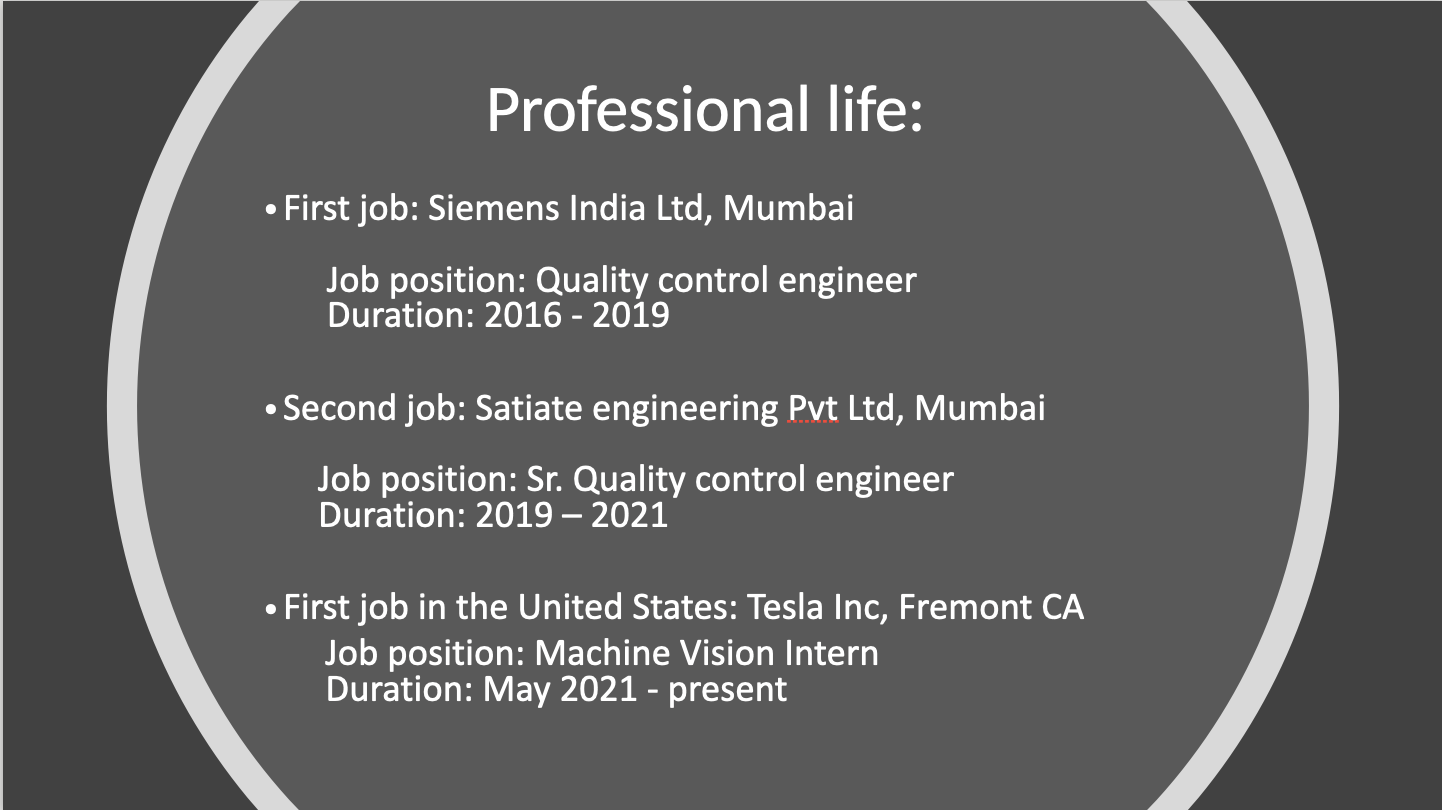
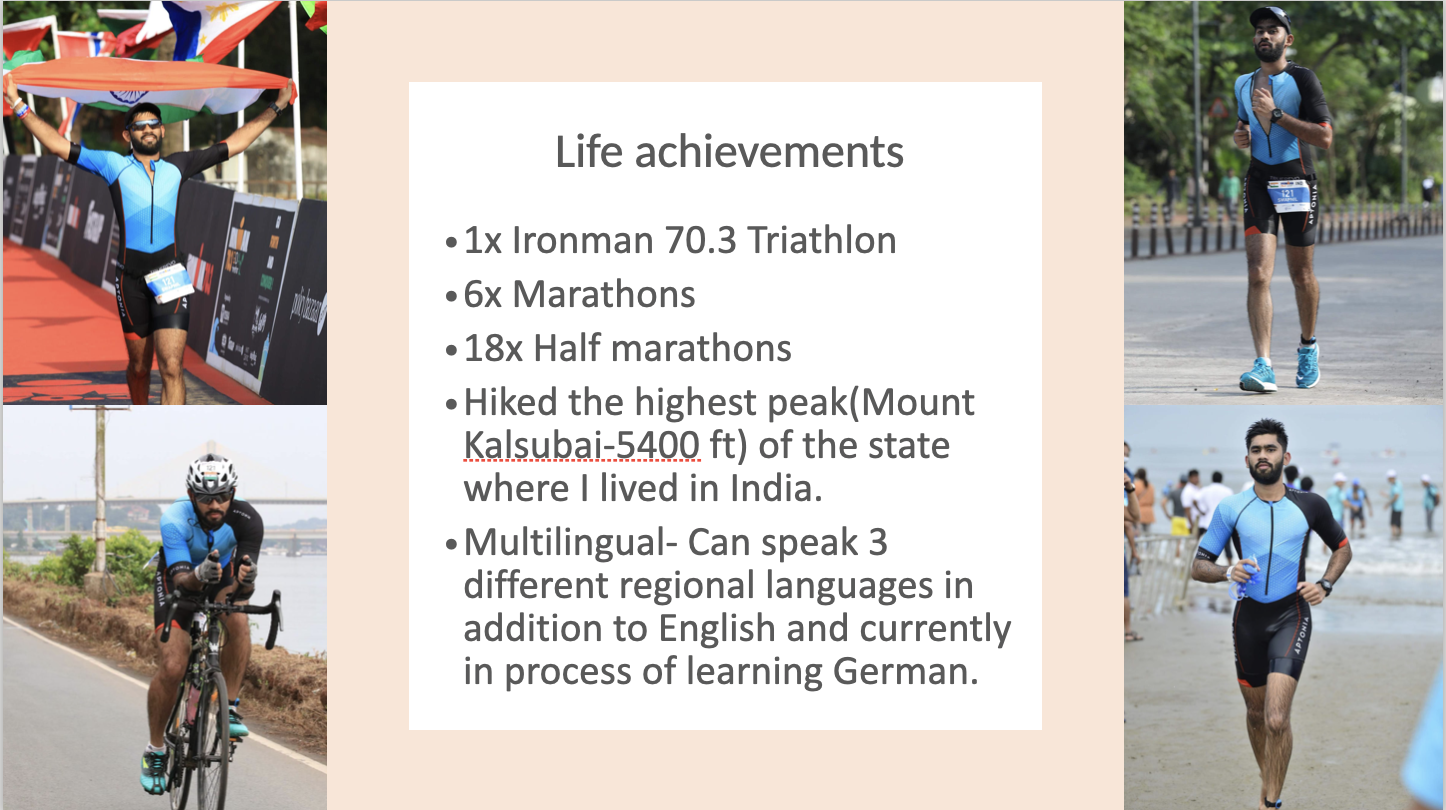

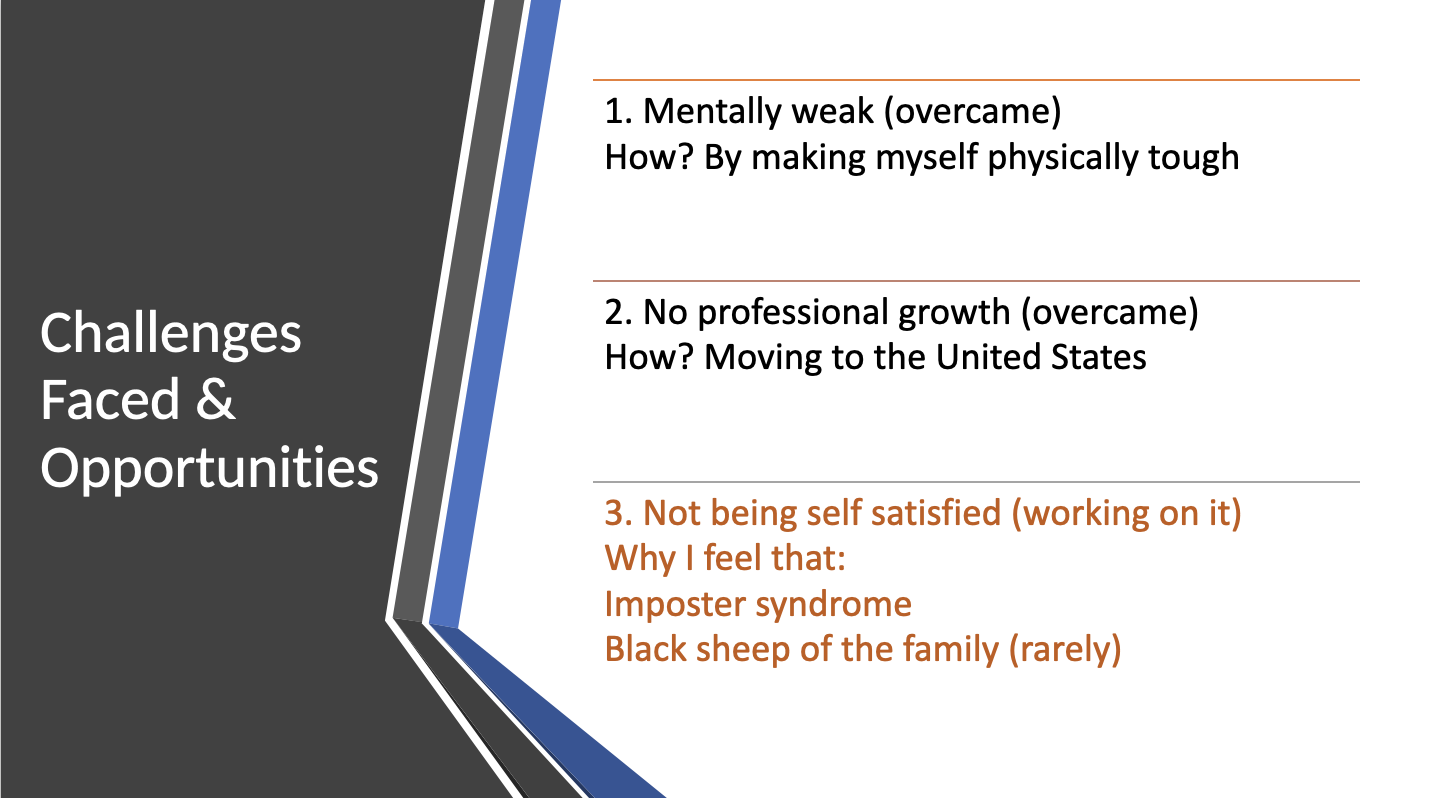
Business leader and innovator from China who is advancing new industries in the United States.
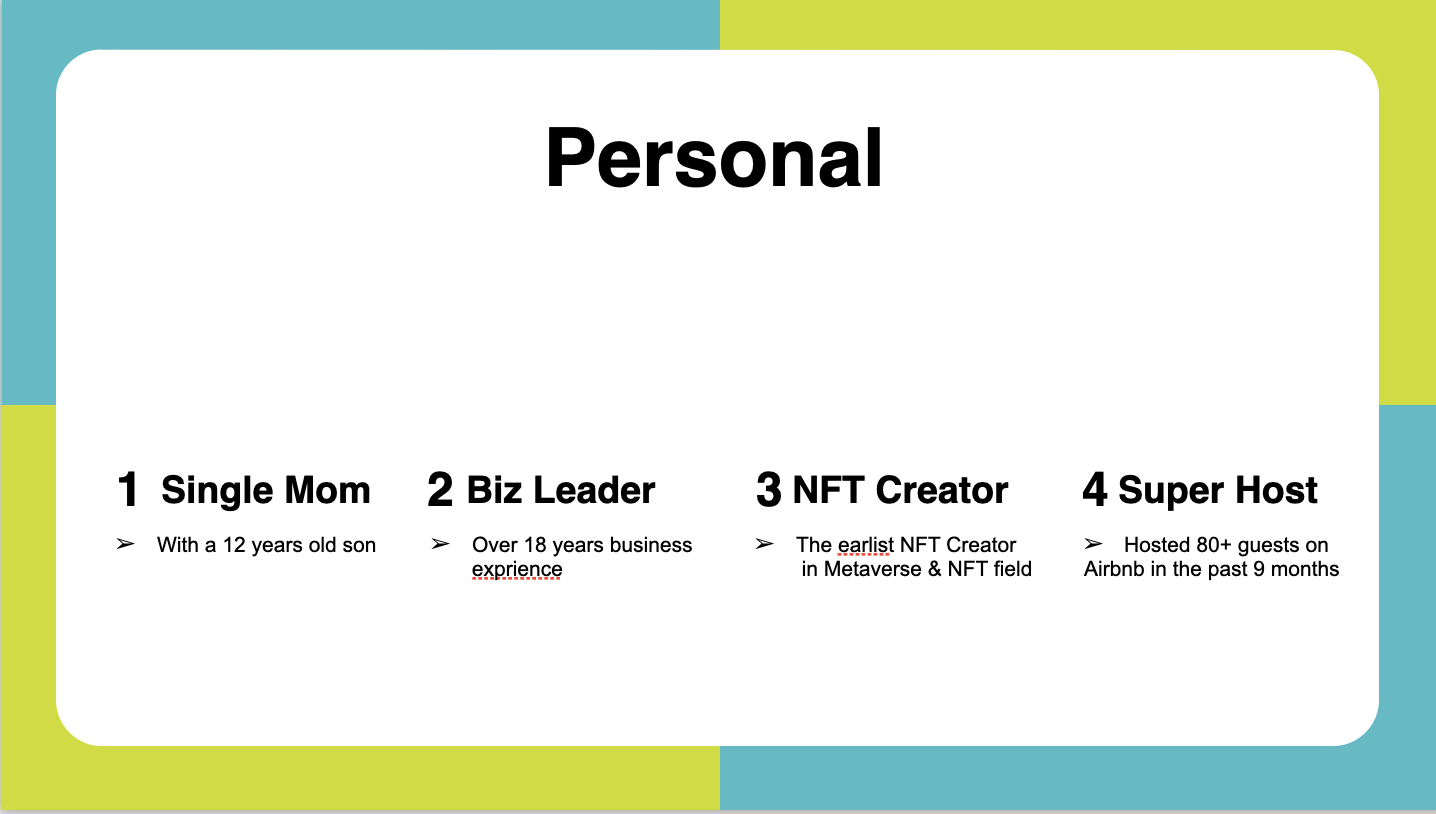
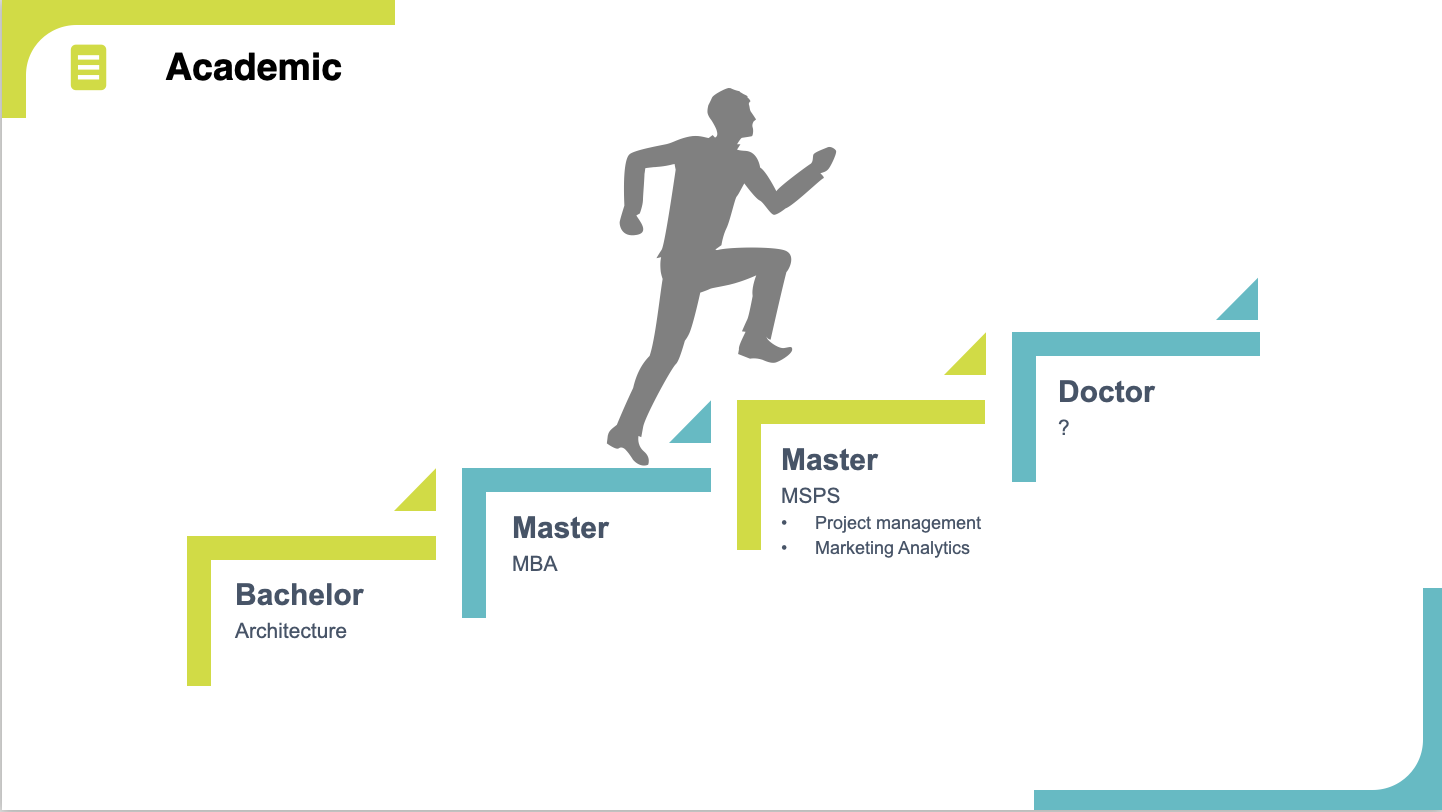
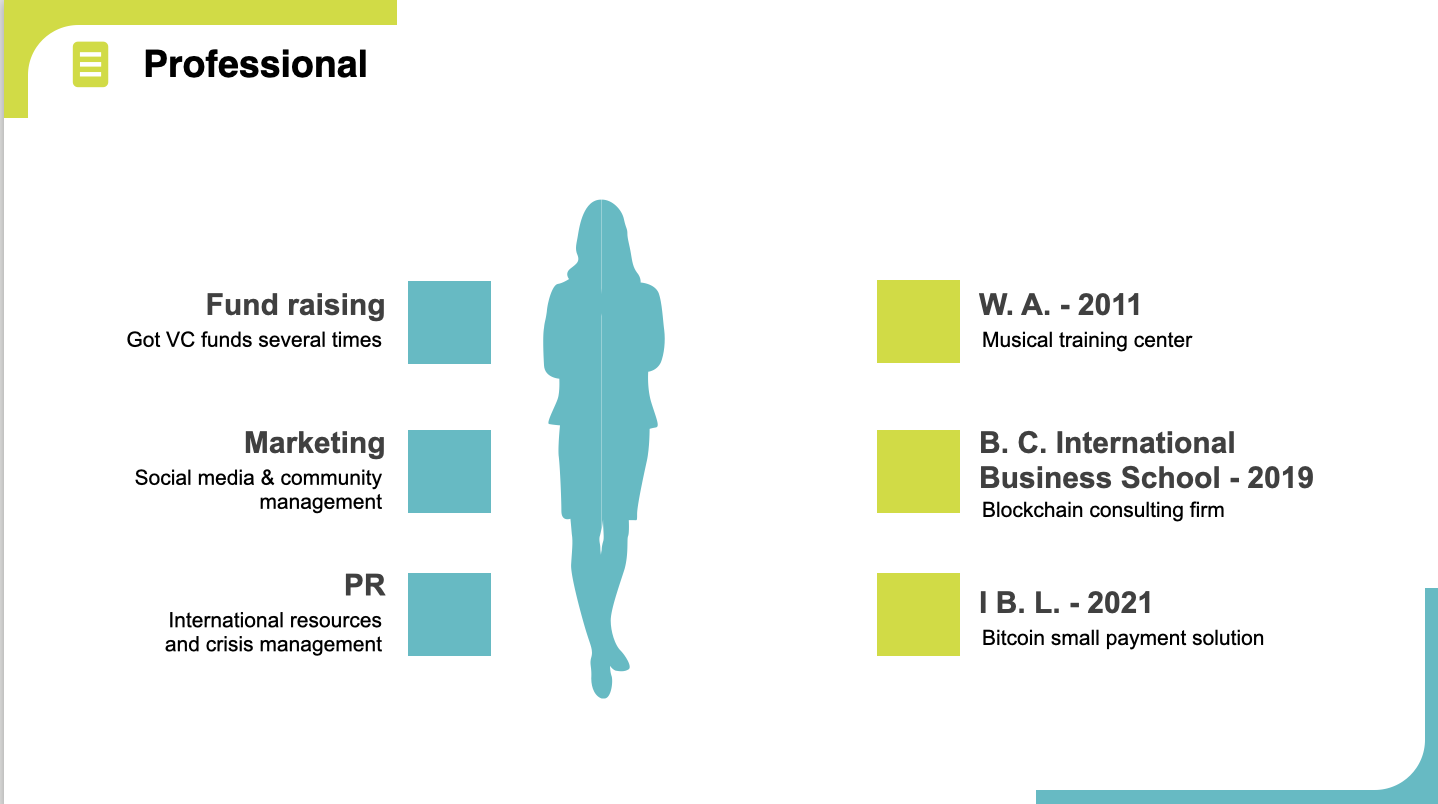
Interactive Group Exercise: Professional Overview
What you intend to include in your professional overview.
How you intend to share in terms of presentation format.

Course Manual 10: Presentation Preparation
This Course Manual will be our working time to prepare our Professional & Life Overview presentations, which we will present and receive peer feedback in the next Course Manual. Your presentation should be 8 minutes in length and your peer will be time keeper, giving you a 2 minute signal and then a “time to wrap up” signal.

How you choose to present your Professional & Life Overview can be a simple delivery given the limited time we have to put your presentations together. You can put together a handful of simple slides, share main points using written notes with your feedback peer, or just vocally give your presentation. Please remember that we are giving these presentations more to share and learn from each other, rather than needing to be a formal and polished presentation.
The intent of creating your Professional & Life Overview is to share your professional and life journey to this point, putting our focus more on key learnings and insights that you have gained rather than a complete rundown of your career and resume. We will have two working sessions, with the first 10 minute work session to lay out your presentation and key learnings and the second 15 minute work session to go into your talking points and insights you want to share.
Work Session 1: Professional & Life Overview presentation preparation
In our first 10 minute work session of this Course Manual, I suggest you lay out the presentation format you are going to use:
Storytelling format – present your overview as if you are telling a story
Archetype format – give your overview based on 1-2 archetypes you identify with
Overview format – deliver your overview based on key aspects of your journey
Again, the key learnings I suggest for you to focus on are:
Introduction and context to who you are, where you come from and are at now
2-3 key strengths and achievements
1-2 failures and learning moments
2-3 opportunity and challenge areas
I am available for anyone who would like to run their ideas by me to get quick feedback and direction.
Interactive Individual Exercise: Professional & Life Overview presentation preparation
Lay out of the presentation format you are going to use – storytelling, archetype, overview format
Identify the key learning and insights you would like to focus on and present – introduction, key strengths and achievements, failures and learning moments, and opportunity and challenge areas
Work Session 2: Professional & Life Overview presentation preparation
In our second 20 minute work session, you will prepare slides or written notes as desired, detail your talking points and insights, and prepare to share your presentation with your feedback peer. Now that you have decided on the format you will present in, really use this time to go into depth with the key learnings and insights to share.
These are questions and prompts to help you go into depth with your key learnings and insights. Please use them if they are helpful and it is fine if you just want to express your key learnings in the way that is most natural for yourself.
2-3 Key Strengths and Achievements
How do you promote yourself with these strengths?
What value do you provide with your strengths and capabilities?
How do your achievements show the tangible results of your strengths in action?
Why does what you have done and achieved matter for others?
1-2 Failures and Learning Moments
What are insurmountable challenges you have encountered?
Did you “fail”, or did you choose to walk away, for these challenges? Remember, we all have failures!
What did you learn from this situation?
How did you adapt, reflect, and improve from this failure?
Or, how would you like in the future to adapt, reflect, and improve?
2-3 Opportunity and Challenge Areas
What opportunities have you seized and acted upon?
What opportunity areas would you like to stretch into, deepen your impact, or expand your skill set into the future?
What challenges have you faced and overcome?
What challenge areas would you like to actively work to improve upon, or seek to improve in the future if you do not have the time and resources now?
Again, I am available for anyone who would like to run their ideas by me to get quick feedback and direction.
Interactive Individual Exercise: Professional & Life Overview presentation preparation
Prepare slides, written notes, or the story you will tell
Go into depth with the key learnings and insights you will share – key strengths and achievements, failures and learning moments, and opportunity and challenge areas
If time allows and you would like, practice going through your presentation
How is everyone doing? Are we ready to share our Professional & Life Overviews in the next Course Manual? Please remember we are here to support and give feedback to each other, and we are not expecting a formal and completely polished presentation!

Course Manual 11: Presentations & Feedback
It is our Professional & Life Overview presentation show time!

We will be presenting and giving feedback in peer reflection circles of two people. For the first session, the first presenter will have 8 minutes, while their feedback peer sets a timer and gives you a 2 minute signal and then a “time to wrap up” signal. Next, the feedback peer will set a timer for 5 minutes while they reflect, provide feedback, and ask questions back to the presenter. There may, or may not, be time for the presenter to answer and discuss the feedback questions, but please note these questions as you will do further reflection on them after this workshop.
These are some feedback prompts for the feedback peer, but feel free to reflect and provide feedback that comes up and feels natural to you:
1-2 insights about what you learned about the presenter
1-2 professional identity facets of theirs that stood out to you
1-2 questions you would like to pose the presenter
Next, we will switch presenters and feedback peers roles for our second session. The presenter will have 8 minutes and then the feedback peer will have 5 minutes.
If we have an uneven number of people for the peer reflection circles of two people, I will pair up with someone. Otherwise, I will be listening in on your presentation and feedback sessions.
Interactive Peer Exercise Session 1: Professional & Life Overview presentation and peer feedback
Presenter – 8 minutes
Feedback peer – 5 minutes
Let us take a moment to close our first session, provide any last feedback, and for the presenter to reflect upon and take any notes on insights and questions they received. I will give a minute to do this before we switch roles and move into our second session.
Interactive Peer Exercise Session 2: Professional & Life Overview presentation and peer feedback
Presenter – 8 minutes
Feedback peer – 5 minutes
Let us take a moment to close our second session, provide any last feedback, and for the presenter to reflect upon and take any notes on insights and questions they received. I will give a minute to do this before we come back together as a learning community.
Wonderful! I observed really engaging Professional & Life Overview presentations and peer feedback sessions. Hopefully you all got to express and learn more about yourselves and how others perceive you as well as put into practice some of the giving and receiving feedback guidelines we introduced in this workshop. Please take the insights and questions you received from your feedback peer to further answer and reflect upon after this workshop. This is where the true value of the Employee Advancement program comes through, and there will be many more opportunities to present, share, and provide feedback.

Course Manual 12: Closing & Check-Outs
What a very full and fruitful first workshop this has been! We made it through our first workshop on Professional Identity, kicking off Module 1: Professional & Self Identity Discover of our Employee Advancement program. We covered a lot of ground in this workshop, starting with establishing the values and expectations for our learning community, learning about giving and receiving feedback models and starting to put those techniques into practice, and diving deep into our professional identity and professional overview presentations. How is everyone doing and feeling?

Just like how we will be starting every workshop with a Grounding & Check-Ins, we will similarly be ending every workshop with a Closing & Check-Outs. This ending Course Module gives us the space to have a group discussion on what we have absorbed and learned during the workshop, revisit the workshop objectives, and get an overview of the Project Study you will be doing between workshops, as well as objectives of the next workshop. It is a time to step back to assess what we accomplished and to see what will be coming next in our Employee Advancement journey together.
Finally, we will do a round of “check-outs” to take a pulse check on how everyone is doing and to close our learning space for the workshop. Your check-out is simply 1-2 words about how you are thinking and feeling at the end of the workshop, and if you would like to offer 1-2 reflections or questions about what we worked on together.
Professional Presentations & Feedback Sharing
Before we move into a full recap of this workshop, let us take time to have a large group discussion and sharing about the professional presentations you each just presented and the exploration of professional identities we did in the latter half of this workshop. We also want to emphasize the peer feedback that you received on your professional presentations as we built the groundwork for both giving and receiving feedback in the first half of this workshop, which will be a strong component of our entire Employee Advancement program.
We will take 12-15 minutes for this group interactive exercise, with each of you taking 1-2 minutes to share. As we go around our learning community for each of us to share, here are a few questions and points that you may want to answer.
What did I learn as I put together and presented my professional presentation?
What are critical insights and/or questions I received from my peer feedback partner that I want to further reflect on?
What was challenging and/or rewarding about this process?
Anything else that came up for you that you would like to share?
Interactive Group Exercise: Professional Presentations & Feedback Sharing
Professional Identity Workshop Objectives and Recap
For this Professional Identity workshop, these are the objectives we set out to complete:
Identify your core values
Build a supportive learning community and peer feedback circles
Learn new frameworks for giving and receiving feedback effectively
Assess and share your professional and life journey
Recognize your strengths and competencies as well as highlight growth and opportunity areas
We will do a quick recap of the content and learnings of the Course Manuals of this workshop and how they supported fulfilling each of these objectives.
Identify your core values
In Course Manual 2: Introductions & Values we emphasized the intentions and goals that each of you would like to achieve with the Employee Advancement program. To start, our focus was identifying each of your core values, the values that guide your behavior, decisions, and attitudes. And at work, the values that represent us as an employee in relationship to the organization and company we work at. We drew from Brené Brown’s “Dare to Lead” list of values as well as other values not on the list which we strongly identify with.
Recap exercise: Can each of you take the next minute to either revisit, or write down again, the 5 values that you identified which most represent your professional and/or personal values?
Build a supportive learning community and peer feedback circles
We established the core values for our Employee Advancement learning community in Course Manual 3 by co-creating and integrating our individual values as well as the common values that we want our learning community to uphold. Again, we brainstormed community values, which we will revisit and refine in Workshop 2, so that we can establish a safe and supportive space for us to grow throughout our Employee Advancement program. When we feel a valued part of this community that aligns around shared common values, we participate actively and invest effort into our collective and individual development as well as our company’s success.
Recap exercise: Can 1-2 of you take a minute to recap the community values that emerged for our learning community to uphold? Also, are there aspects of the community values and/or establishing a safe and supportive environment that you think we should revisit and refine in Workshop 2?
Learn new frameworks for giving and receiving feedback effectively
Engaging feedback is such an important component for our professional growth as individuals as well as innovative growth as a team, organization, and company throughout our careers! In the Employee Advancement Program, feedback is given in three main ways, or what we call feedback circles that are comprised of self, peer, and community feedback circles. The integration of these three circles is an essential and illuminating part of our Employee Advancement program growth process.
The giving and receiving of feedback is as much of an artform, as it is a learned and practiced skill. We devoted Course Manuals 3-6 to delve into frameworks for both giving and receiving feedback, then reflected upon our own giving/receiving feedback experiences and put those frameworks into practice. For giving feedback, we worked with the SBI, or Situation-Behaviour-Impact, model. For receiving feedback, we engaged Stone and Heen’s “Thanks for the Feedback” model by better understanding receiving feedback types and triggers.
Recap exercise: Can 1 of you take a minute to recap the SBI Model and share what you found effective about this model for giving feedback? Next, can 1 of you take a minute to recap Stone and Heen’s feedback types and triggers and share what you want to incorporate more into receiving feedback?
Assess and share your professional and life journey
In the second half of our workshop, we focused on what a professional identity is and applied that to assessing and sharing your professional and life journey. Course Manual 7 delved into the different aspects of our professional identity that are shaped internally, externally, and by others. We also did a fun exercise with the 12 professional brand archetypes of the Outlaw, Magician, Hero, Lover, Jester, Everyman, Caregiver, Ruler, Creator, Innocent, Sage, and Explorer to identify the 1-2 archetypes we most associate with. Our exploration of professional identity expanded in Course Manual 8 where we reflected upon inspiration professional identities across industries, and what of those identities we already see in ourselves as well as would like to cultivate more of in ourselves.
Recap exercise: Can 1 of you share the professional brand archetypes that most represent and/or inspire you, and why? Can 1 of you share the inspirational professional identities that you would like to aspire to and cultivate more of in yourself?
Recognize your strengths and competencies as well as highlight growth and opportunity areas
The final Course Manuals 9-11 applied all the learnings of this workshop into our own professional identities and presenting our professional overviews. Through this process, you identified and shared your strengths and competencies that come through in your professional, academic, and personal lives. In complement, you reflected upon failures and/or learning moments during our journey to highlight opportunity and challenge areas for yourself.
Recap exercise: Can 1-2 of you share the opportunity and challenge areas you identified, which you would like to work with and develop further throughout our program?
Preview and Objectives of Workshop 2: Self Identity
In our next workshop, we will delve into our self identity. This will continue as well as complement the work we have done today on our professional identity, which is invariably a strong facet of our broader self identity. Workshop 2 leads us through how external social and group identity and intersectionalities shape us, and an internal exploration of our own self identity. This workshop will culminate in bringing our professional and personal identities together in order to start defining the goal(s) of our 360° feedback process, which we will build out in detail in Workshop 3: 360° Discovery.
These are the objectives and outcomes that we will focus on for Workshop 2:
Finalize our learning community values, norms, and expectations by revisiting our brainstorm and synthesis of community values from Workshop 1. We will further refine these values, norms, and expectations based on how we are collectively coming together as a learning community, our individual intentions for the Employee Advancement program, and the supportive space we want to uphold throughout our growth journeys.
Learn about social and group identity formation, intersectionality, and transformation to recognize the importance of how our identities are shaped, express ourselves across groups and categorizations, and navigate social situations and structures as unique and ever-changing individuals.
Explore your holistic personal and self identity to cultivate an awareness and appreciation of the many facets of who we are and how we project ourselves, which extend well beyond our professional identity.
Assess and share your personal journey and self identity in order to reflect upon and receive peer and group feedback on how your self identity has evolved over time and been shaped by defining situations and events in your life.
Define your initial 360° Feedback Process goal(s) through an assessment of current corporate 360° feedback and review processes, then expanding the scope and goals of your 360° feedback process to encompass both professional and personal circles.
Closing Breathing Exercise
Let us do a quick closing breathing exercise before we move into doing our check-outs and concluding. At the beginning of this workshop, we learned how simple breathing practices impacts our brain, our mood, our focus, and our energy level. We offered 3 simple breathing exercises which you can incorporate into your day, including regular, calming, and stimulating breathing exercises.

Since our brains are likely full and stimulated from this session, let us take the next minute to all practice calming breathing. Take 5 breaths at a slower pace and fill to your normal lung capacity, and hold on the bottom of your exhale for a little longer than usual. Closing or averting your eyes, or choosing to focus on a stationary point, can help you focus on calming yourself. Now, let us take 5 breaths together as a group at a slower pace and hold our exhales a little longer, as a way to recognize how we came together and are now leaving this workshop as a learning community.
Check-Outs
As we started our workshop with check-ins, we will close our workshop with check-outs. It is a way for each of us to process what we learned and absorbed, and importantly what we are thinking and feeling coming out of Workshop 1.
Interactive Group Exercise: Check-Outs as an Entire Group
Your intention for joining the Employee Advancement program
1-2 words to describe what you think or how you feel with closing this workshop
Any insights, questions, or suggestions you want to offer from Workshop 1
Thanks to everyone for engaging in a dynamic Workshop 1 on Professional Identity! We set the groundwork for our learning community and individual growth journeys for our Employee Advancement program today. I look forward to seeing you for Workshop 2 on Personal Identity!
Project Studies

Project Study (Part 1) – Customer Service
The Head of this Department is to provide a detailed report relating to the Professional Identity process that has been implemented within their department, together with all key stakeholders, as a result of conducting this workshop, incorporating process: planning; development; implementation; management; and review. Your process should feature the following 12 parts:
01. Grounding & Check-Ins
02. Introductions & Values
03. Community Values
04. Giving Feedback
05. Receiving Feedback
06. Feedback Practices
07. Professional Identity
08. Inspirational Identities
09. Professional Overview
10. Presentation Preparation
11. Presentations & Feedback
12. Closing & Check-Outs
Please include the results of the initial evaluation and assessment.

Project Study (Part 2) – E-Business
The Head of this Department is to provide a detailed report relating to the Professional Identity process that has been implemented within their department, together with all key stakeholders, as a result of conducting this workshop, incorporating process: planning; development; implementation; management; and review. Your process should feature the following 12 parts:
01. Grounding & Check-Ins
02. Introductions & Values
03. Community Values
04. Giving Feedback
05. Receiving Feedback
06. Feedback Practices
07. Professional Identity
08. Inspirational Identities
09. Professional Overview
10. Presentation Preparation
11. Presentations & Feedback
12. Closing & Check-Outs
Please include the results of the initial evaluation and assessment.

Project Study (Part 3) – Finance
The Head of this Department is to provide a detailed report relating to the Professional Identity process that has been implemented within their department, together with all key stakeholders, as a result of conducting this workshop, incorporating process: planning; development; implementation; management; and review. Your process should feature the following 12 parts:
01. Grounding & Check-Ins
02. Introductions & Values
03. Community Values
04. Giving Feedback
05. Receiving Feedback
06. Feedback Practices
07. Professional Identity
08. Inspirational Identities
09. Professional Overview
10. Presentation Preparation
11. Presentations & Feedback
12. Closing & Check-Outs
Please include the results of the initial evaluation and assessment.

Project Study (Part 4) – Globalization
The Head of this Department is to provide a detailed report relating to the Professional Identity process that has been implemented within their department, together with all key stakeholders, as a result of conducting this workshop, incorporating process: planning; development; implementation; management; and review. Your process should feature the following 12 parts:
01. Grounding & Check-Ins
02. Introductions & Values
03. Community Values
04. Giving Feedback
05. Receiving Feedback
06. Feedback Practices
07. Professional Identity
08. Inspirational Identities
09. Professional Overview
10. Presentation Preparation
11. Presentations & Feedback
12. Closing & Check-Outs
Please include the results of the initial evaluation and assessment.

Project Study (Part 5) – Human Resources
The Head of this Department is to provide a detailed report relating to the Professional Identity process that has been implemented within their department, together with all key stakeholders, as a result of conducting this workshop, incorporating process: planning; development; implementation; management; and review. Your process should feature the following 12 parts:
01. Grounding & Check-Ins
02. Introductions & Values
03. Community Values
04. Giving Feedback
05. Receiving Feedback
06. Feedback Practices
07. Professional Identity
08. Inspirational Identities
09. Professional Overview
10. Presentation Preparation
11. Presentations & Feedback
12. Closing & Check-Outs
Please include the results of the initial evaluation and assessment.

Project Study (Part 6) – Information Technology
The Head of this Department is to provide a detailed report relating to the Professional Identity process that has been implemented within their department, together with all key stakeholders, as a result of conducting this workshop, incorporating process: planning; development; implementation; management; and review. Your process should feature the following 12 parts:
01. Grounding & Check-Ins
02. Introductions & Values
03. Community Values
04. Giving Feedback
05. Receiving Feedback
06. Feedback Practices
07. Professional Identity
08. Inspirational Identities
09. Professional Overview
10. Presentation Preparation
11. Presentations & Feedback
12. Closing & Check-Outs
Please include the results of the initial evaluation and assessment.

Project Study (Part 7) – Legal
The Head of this Department is to provide a detailed report relating to the Professional Identity process that has been implemented within their department, together with all key stakeholders, as a result of conducting this workshop, incorporating process: planning; development; implementation; management; and review. Your process should feature the following 12 parts:
01. Grounding & Check-Ins
02. Introductions & Values
03. Community Values
04. Giving Feedback
05. Receiving Feedback
06. Feedback Practices
07. Professional Identity
08. Inspirational Identities
09. Professional Overview
10. Presentation Preparation
11. Presentations & Feedback
12. Closing & Check-Outs
Please include the results of the initial evaluation and assessment.
Project Study (Part 8) – Management
The Head of this Department is to provide a detailed report relating to the Professional Identity process that has been implemented within their department, together with all key stakeholders, as a result of conducting this workshop, incorporating process: planning; development; implementation; management; and review. Your process should feature the following 12 parts:
01. Grounding & Check-Ins
02. Introductions & Values
03. Community Values
04. Giving Feedback
05. Receiving Feedback
06. Feedback Practices
07. Professional Identity
08. Inspirational Identities
09. Professional Overview
10. Presentation Preparation
11. Presentations & Feedback
12. Closing & Check-Outs
Please include the results of the initial evaluation and assessment.

Project Study (Part 9) – Marketing
The Head of this Department is to provide a detailed report relating to the Professional Identity process that has been implemented within their department, together with all key stakeholders, as a result of conducting this workshop, incorporating process: planning; development; implementation; management; and review. Your process should feature the following 12 parts:
01. Grounding & Check-Ins
02. Introductions & Values
03. Community Values
04. Giving Feedback
05. Receiving Feedback
06. Feedback Practices
07. Professional Identity
08. Inspirational Identities
09. Professional Overview
10. Presentation Preparation
11. Presentations & Feedback
12. Closing & Check-Outs
Please include the results of the initial evaluation and assessment.

Project Study (Part 10) – Production
The Head of this Department is to provide a detailed report relating to the Professional Identity process that has been implemented within their department, together with all key stakeholders, as a result of conducting this workshop, incorporating process: planning; development; implementation; management; and review. Your process should feature the following 12 parts:
01. Grounding & Check-Ins
02. Introductions & Values
03. Community Values
04. Giving Feedback
05. Receiving Feedback
06. Feedback Practices
07. Professional Identity
08. Inspirational Identities
09. Professional Overview
10. Presentation Preparation
11. Presentations & Feedback
12. Closing & Check-Outs
Please include the results of the initial evaluation and assessment.

Project Study (Part 11) – Logistics
The Head of this Department is to provide a detailed report relating to the Professional Identity process that has been implemented within their department, together with all key stakeholders, as a result of conducting this workshop, incorporating process: planning; development; implementation; management; and review. Your process should feature the following 12 parts:
01. Grounding & Check-Ins
02. Introductions & Values
03. Community Values
04. Giving Feedback
05. Receiving Feedback
06. Feedback Practices
07. Professional Identity
08. Inspirational Identities
09. Professional Overview
10. Presentation Preparation
11. Presentations & Feedback
12. Closing & Check-Outs
Please include the results of the initial evaluation and assessment.

Project Study (Part 12) – Education
The Head of this Department is to provide a detailed report relating to the Professional Identity process that has been implemented within their department, together with all key stakeholders, as a result of conducting this workshop, incorporating process: planning; development; implementation; management; and review. Your process should feature the following 12 parts:
01. Grounding & Check-Ins
02. Introductions & Values
03. Community Values
04. Giving Feedback
05. Receiving Feedback
06. Feedback Practices
07. Professional Identity
08. Inspirational Identities
09. Professional Overview
10. Presentation Preparation
11. Presentations & Feedback
12. Closing & Check-Outs
Please include the results of the initial evaluation and assessment.
Program Benefits
Leadership
- Employee advancement
- Employee longevity
- Talent upskilling
- Internal mobility
- Business objectives
- Increased ROI
- Increased KPIs
- Organizational adaptability
- Organizational well-being
- Collaborative productivity
Human Resources
- Employee advancement
- Employee retention
- Employee inclusion
- Burnout prevention
- Internal mobility
- Organizational culture
- Internal relationships
- Employee visibility
- Self-directed employees
- Effective performance
Management
- Employee development
- Employee longevity
- Employee happiness
- Effective on-boarding
- Performance reviews
- Internal relationships
- Team mission
- Team culture
- Team visibility
- Collaborative communication
Client Telephone Conference (CTC)
If you have any questions or if you would like to arrange a Client Telephone Conference (CTC) to discuss this particular Unique Consulting Service Proposition (UCSP) in more detail, please CLICK HERE.