

Client Retention Strategy – WDP2 (Executive Assessment)

The Appleton Greene Corporate Training Program (CTP) for Client Retention Strategy is provided by Mr. Weimer Certified Learning Provider (CLP). Program Specifications: Monthly cost USD$2,500.00; Monthly Workshops 6 hours; Monthly Support 4 hours; Program Duration 12 months; Program orders subject to ongoing availability.
If you would like to view the Client Information Hub (CIH) for this program, please Click Here
Learning Provider Profile

Mr. Weimer is an approved Certified Learning Provider (CLP) at Appleton Greene and has experience in Client Retention, Sales and Management. He received his Bachelor’s of Business Administration from Duquesne University and his Masters of Health Service Administration from Gannon University. Having been trained in sales and account management within the pharmaceutical industry he started to focus on his passion around strong client retention. While the Director of Client Retention for Syneos Health he was able to increase retained revenue by implementing the Clients for Life® client retention process by over $300,000,000.
In 2017 Mr. Weimer became a Partner in a leading client retention company, and as Partner, he expanded his knowledge base. Mr. Weimer has successfully retained revenue for his many clients in the following industry sectors, Pharmacy Benefit Management, Revenue Cycle Management, Specialty Pharmacy, Advertisement, Facilities Management, Information Technology and Healthcare suppliers.
Following his success as a Partner, he later became the Principal Partner and Chairman. Today Mr. Weimer Overseas the companies work in the United States, Canada and Europe. His goal is to continue to provide the same outcomes he has achieved for Tenacity’s Clients by enhancing the principles he first used as the Client Retention Director and Principal Partner of the firm by incorporating his learning, research and experience to create a world class client retention process.

MOST Analysis

Mission Statement
Why focus so much on Assessment? First, a comprehensive review is needed to comprehend your company’s strengths, weaknesses, and views on client retention. The results of the Capabilities Assessment that was introduced in the Executive Introduction will be shared. This will also set a baseline moving forward. Second, understanding how your clients perceive the value your company provides is a great predictor of your company’s ability to retain and grow the business. Most clients do not leave because of the prices of your services. They leave because of the perceived value you are providing today and your ability to grow and adapt with them in the future. Often a client’s perceived value is done by reviewing client surveys and Net Provider Scores (NPS). There is a benefit in understanding a rating of how your company has performed in a snapshot in time with a survey. It is just not enough. Studies show there is no correlation between NPS and client retention. For client retention, a more robust qualitative approach needs to be done. This is the reason for the FreshEyes® Reviews. During the Executive Assessment, a first read will be given on the output of the FreshEyes® Reviews on the key clients identified. We will review how to review and respond to the FreshEyes® Reviews and the importance of setting up standard operating procedures. The capabilities assessment and the initial FreshEyes® Reviews will be a good start to truly understanding your company’s approach to client retention. However, two or three companies do not reflect a trend. It is enough to get started but a larger sample size is needed to uncover trends. For this Tenacity has developed Common Threads/Common Threats. The concepts and process of the Common Threads/Common Threats will be reviewed, and additional clients will be identified for FreshEyes® Reviews. Together the internal and external assessment, along with a better understanding of what is needed to Assess your current business, will position your company well moving forward.

Objectives
01. Partnership Success Team: departmental SWOT analysis; strategy research & development. Time Allocated: 1 Month
02. Assess Concept and Introduction: departmental SWOT analysis; strategy research & development. Time Allocated: 1 Month
03. Internal Capabilities Assessment: departmental SWOT analysis; strategy research & development. Time Allocated: 1 Month
04. Client Health Assessment and Objective Assessment Procedures: departmental SWOT analysis; strategy research & development. Time Allocated: 1 Month
05. Comprehensive Internal Assessment Partnership Success Team: departmental SWOT analysis; strategy research & development. Time Allocated: 1 Month
06. Comprehensive Internal Assessment Assess Concept and Introduction: departmental SWOT analysis; strategy research & development. Time Allocated: 1 Month
07. External Assessment Setting up Interviews: departmental SWOT analysis; strategy research & development. 1 Month
08. Conducting the FreshEyes® Interview: departmental SWOT analysis; strategy research & development. Time Allocated: 1 Month
09. Creating the Report: departmental SWOT analysis; strategy research & development. Time Allocated: 1 Month
10. Post Mortem Audit®: departmental SWOT analysis; strategy research & development. Time Allocated: 1 Month

Strategies
01. Partnership Success Team: Each individual department head to undertake departmental SWOT analysis; strategy research & development.
02. Assess Concept and Introduction: Each individual department head to undertake departmental SWOT analysis; strategy research & development.
03. Internal Capabilities Assessment: Each individual department head to undertake departmental SWOT analysis; strategy research & development.
04. Client Health Assessment and Objective Assessment Procedures: Each individual department head to undertake departmental SWOT analysis; strategy research & development.
05. Comprehensive Internal Assessment Partnership Success Team: Each individual department head to undertake departmental SWOT analysis; strategy research & development.
06. Comprehensive Internal Assessment Assess Concept and Introduction: Each individual department head to undertake departmental SWOT analysis; strategy research & development.
07. External Assessment Setting up Interviews: Each individual department head to undertake departmental SWOT analysis; strategy research & development.
08. Conducting the FreshEyes® Interview: Each individual department head to undertake departmental SWOT analysis; strategy research & development.
09. Creating the Report: Each individual department head to undertake departmental SWOT analysis; strategy research & development.
10. Post Mortem Audit®: Each individual department head to undertake departmental SWOT analysis; strategy research & development.

Tasks
01. Create a task on your calendar, to be completed within the next month, to analyze Partnership Success Team.
02. Create a task on your calendar, to be completed within the next month, to analyze Assess Concept and Introduction.
03. Create a task on your calendar, to be completed within the next month, to analyze Internal Capabilities Assessment.
04. Create a task on your calendar, to be completed within the next month, to analyze Client Health Assessment and Objective Assessment Procedures.
05. Create a task on your calendar, to be completed within the next month, to analyze Comprehensive Internal Assessment Partnership Success Team.
06. Create a task on your calendar, to be completed within the next month, to analyze Comprehensive Internal Assessment Assess Concept and Introduction.
07. Create a task on your calendar, to be completed within the next month, to analyze External Assessment Setting up Interviews.
08. Create a task on your calendar, to be completed within the next month, to analyze Conducting the FreshEyes® Interview.
09. Create a task on your calendar, to be completed within the next month, to analyze Creating the Report.
10. Create a task on your calendar, to be completed within the next month, to analyze Post Mortem Audit®.
Introduction

Welcome to Workshop 2 of the Client Retention Strategy Program. You’re here because your company understands that sustainable growth doesn’t come only from new sales — it comes from keeping the clients you already have. This workshop isn’t just another training session; it’s the foundation of a new way of thinking about long-term success. It’s about moving from reactive service to proactive partnership. You’re not just here to learn — you’re here to lead.
Companies often say, “We take care of our clients,” or point to their CRM systems as proof of their retention efforts. But retention isn’t about vague goodwill or scattered tools. It’s about structure. It’s about having a formalized, repeatable process for keeping your best clients — and doing it across departments, across roles, and over time. That’s what this program is about.
Your executive team has already made the commitment. They’ve prioritized client retention as a strategic focus — not a side initiative. They’re investing in it. And they’ve chosen you to help make it real. Why? Because they see you as someone who is trusted, influential, and capable of moving between departments to lead change. Your part of the Partner Success Team — a group created to guide the company in launching and maintaining a formal retention strategy.
You’re not here because the company has all the answers. You’re here to help find them. You’ll be trained, coached, and equipped to become experts in the methodology — but you’ll also be expected to carry that knowledge forward. This program will challenge you to understand the big picture and the smallest details: from strategy design to software alignment to coaching frontline teams.
So, why the urgency? Because retention matters more than most companies realize.
Consider this: improving client retention by just 2% can reduce costs by 10%. Acquiring a new client is five times more expensive than keeping an existing one. Even more striking: 96% of clients who leave don’t say a word before they go. They don’t complain. They don’t argue. They just disappear — often when you least expect it.
This program exists to stop that from happening.
We’ve seen what happens when companies don’t have a formal retention process. Some clients are served exceptionally well. Others are overlooked. Teams operate in silos. People assume someone else is handling the relationship. Eventually, key accounts disappear, often without warning. Without structure, even the best account managers can’t save a client from a system that isn’t built to keep them.
On the flip side, we’ve seen the payoff of getting retention right. A 5% increase in retention can lead to a 25%–95% increase in profits. The math is clear — and the opportunity is huge.
The goal of this workshop is to give your company a competitive edge by turning client retention into a disciplined, scalable system. The core of that system is the Clients for Life® process. It’s a proven, repeatable framework that’s been refined over nearly four decades. It’s helped protect billions in revenue. And now, you’re going to learn it, step by step.
This isn’t about theory. It’s about action.
You’ll start with Assess — learning how to measure where the company currently stands, both internally and externally. That means interviewing stakeholders, analyzing account trends, evaluating capabilities, and identifying early warning signs. You’ll learn how to conduct FreshEyes® Reviews and PostMortem Audit®s to get honest, direct feedback from clients — before it’s too late.
Next comes Create. You’ll help shape the company’s strategy. That means working alongside leadership to define what kinds of clients you want to retain, how you’ll do it, and what your teams need to succeed. You’ll dig into account segmentation, journey mapping, and retention planning. This is where the groundwork becomes a roadmap.
Finally, there’s Execute — where strategy turns into daily action. You’ll guide teams on how to build real relationships, manage expectations, deliver technical expertise, and use the CRM as a retention tool, not just a database. You’ll help embed this approach into culture — so it outlasts the workshop and lives in the way people work.
You won’t be doing this alone. You have the backing of your Executive Team, the guidance of a Client Retention Executive, and the partnership of your fellow teammates. Everyone here has a role. Your job is to lead, support, and help make retention part of your company’s DNA.
Along the way, you’ll be asked to do some self-reflection too. We’ll kick off with an exercise to identify your own “superpowers” — the strengths that make you an asset to this team. Whether you’re a strategist, connector, optimizer, or communicator, your unique abilities will help shape how this strategy takes root.
Yes, this might feel overwhelming. That’s normal. This is a big shift, and you’re right at the center of it. But remember: you were chosen for a reason. You already bring value. This program will help you amplify it.
The path ahead is structured, clear, and backed by results. You’ll gain not only new skills, but also the chance to be part of a defining moment in your company’s future. You’ll get a deeper understanding of how retention impacts revenue, operations, morale, and even reputation. And you’ll help build a culture that puts clients — and the people who serve them — at the heart of long-term success.
So, let’s get started. Let’s move from good intentions to great execution. Let’s build a retention strategy that works — and lasts.
Executive Summary

Chapter 1: Partnership Success Team
The Partnership Success Team plays a crucial role in the success of your company’s client retention strategy. Individually, each of you has been selected by the Executive Team due to your strong reputation among colleagues and your ability to collaborate effectively. Collectively, you represent a cross-section of departments, bringing together key skill sets necessary to lead, train, and support the organization in executing a robust client retention strategy.
Beyond your internal leadership, the Partnership Success Team will also act as the primary liaison between the Executive Team and the rest of the organization. You are the face of client retention, entrusted with ensuring that client retention remains a top priority. Your selection alone demonstrates the company’s unwavering commitment to maintaining strong client relationships and securing the accounts that are vital to long-term success.
The client retention strategy program you are about to embark on is a structured, formalized process designed to increase revenue through the Clients for Life® client retention model. This process is centered around three fundamental principles: Assess, Create, and Execute. Over the next several workshops, we will ensure that you gain not only a deep understanding of the Clients for Life® methodology but also the expertise required to train, implement, and sustain its success for years to come.
For over 38 years, the Clients for Life® client retention process has been successfully implemented by Fortune 500 companies and growing businesses, consistently delivering measurable improvements in client retention rates.
In this chapter, we will first define the Partnership Success Team, outlining its roles and responsibilities in detail. We will then examine the significance of client retention and explore why the Executive Team has made it a strategic priority. A company does not undertake an initiative like this without recognizing the profound impact it has on the organization. While the financial benefits are often the most apparent, they represent just the tip of the iceberg. We will delve deeper into the broader effects of a strong, formalized retention strategy, highlighting how it influences long-term growth, operational efficiency, and brand reputation.
At its core, client retention impacts your business in three key ways. First and foremost, it helps your company maintain the business you have already secured, ensuring long-term relationships with existing clients. Second, a well-executed client retention strategy fosters growth within your current client base, opening doors for upselling and cross-selling opportunities. Finally, as your organization builds a reputation for exceptional client service and long-term partnerships, industry peers and potential clients will take notice, generating increased referrals and new sales opportunities.
In this workshop, we will also provide a high-level overview of the three foundational principles: Assess, Create, and Execute. As members of the Partnership Success Team, your role will be integral to each stage, making it essential to familiarize yourself with the core concepts and their practical applications.
The Assess phase involves gathering data, understanding client needs, and identifying risks and opportunities within existing relationships. The Create phase focuses on developing strategies and action plans based on assessment findings, ensuring a tailored approach to improving retention. The Execute phase is centered on implementation, ensuring that strategies are effectively put into practice and continuously refined based on feedback and performance metrics.
We are excited to embark on this journey with you. The work ahead is vital to the continued success and growth of the company, and your contributions will play a pivotal role in shaping its future.
Let’s begin—your journey in mastering client retention starts now!

Chapter 2: Assess Concept and Introduction
The Assess Principle is a critical component in understanding and improving client retention strategies. For the Executive Team, the focus is on conceptual understanding, while the Partnership Success Team takes responsibility for implementation, conducting assessments, compiling reports, and ensuring follow-ups. The fundamental reason behind these assessments is the belief that knowledge is power. Gaining insights through structured evaluations allows organizations to make informed decisions that enhance customer loyalty and mitigate potential risks.
Client retention is a cornerstone of sustainable business success. Many organizations prioritize customer acquisition, but long-term stability relies on retaining existing clients. Without structured assessments, companies risk making assumptions about their performance, missing opportunities for improvement, and failing to recognize threats to client relationships. Internal assessments serve as a reality check, revealing whether a company’s retention strategies, service execution, and engagement efforts are effectively aligned. These evaluations help identify gaps in onboarding, issue resolution, and overall client relationship management.
Data-driven analysis is essential for meaningful assessments. Retention rates, churn rates, and customer lifetime value provide crucial insights into client satisfaction and loyalty. Additionally, ensuring that employees possess the necessary skills and tools to foster long-term client relationships is imperative. If service teams lack training or support, retention efforts may suffer. Beyond internal assessments, gathering external feedback through structured client interviews, surveys, and AI-driven insights provides an unfiltered view of client perceptions, uncovering hidden risks before they escalate.
Businesses frequently assume they understand what their clients value, but only by actively listening to customers can they gain a true picture of their needs and pain points. Dissatisfied clients often do not voice their concerns—they simply leave. Conducting structured assessments, such as Net Promoter Score (NPS) surveys, AI-driven sentiment analysis, and in-depth client interviews, helps companies detect early warning signs and refine their retention strategies accordingly. However, while NPS provides valuable client sentiment insights, it lacks depth and should be supplemented with qualitative research and personalized engagement.
AI is transforming client retention strategies by offering real-time insights and predictive analytics. By analyzing behavioral data, AI can identify clients at risk of leaving and provide businesses with actionable intelligence. AI-driven sentiment analysis processes large amounts of unstructured data, such as emails and chat logs, to detect dissatisfaction signals. It also enables personalized engagement at scale, allowing companies to tailor messaging and retention strategies. Despite its advantages, AI requires high-quality data, human oversight, and strategic implementation to be effective in a B2B setting.
For key clients, organizations should not rely solely on surveys and AI-driven assessments. More personalized approaches, such as FreshEyes® Reviews and PostMortem Audits®, offer deeper insights into client experiences. A PostMortem Audit® is conducted after a client is lost, providing an opportunity to understand the real reasons behind their departure, rather than assuming the loss was due to price. FreshEyes® Reviews, on the other hand, focus on active key accounts, helping organizations gain unbiased feedback to strengthen relationships and improve service delivery. These structured conversations cover expectations, relationship dynamics, problem-solving capabilities, and market insights.
Effective assessments go beyond surveys; they involve direct engagement, structured analysis, and a commitment to ongoing improvement. The Assess Principle is not just about reducing churn—it fosters a client-centric culture that enhances long-term loyalty and business success. By systematically evaluating internal processes and external client perceptions, organizations gain a comprehensive understanding of their retention effectiveness. This approach ensures they can make data-driven decisions, optimize engagement, and build stronger client relationships for sustainable growth.

Chapter 3: Internal Capabilities Assessment
The Internal Capabilities Assessment serves as a critical tool in evaluating and improving an organization’s ability to retain clients through a structured and strategic approach. It is designed to measure the effectiveness of customer-facing employees in implementing key client retention strategies and ensuring that client relationships are proactively managed. By establishing a baseline early in the training process and tracking progress over time, organizations can gain valuable insights into strengths, identify areas for improvement, and make informed decisions to enhance client engagement.
The assessment focuses on eight fundamental elements that contribute to successful client retention. Managing professional relationships is essential in business-to-business interactions, as it fosters trust, enhances collaboration, and ensures long-term success. Organizations that develop a structured Web of Influence® approach can more effectively build and maintain strong client relationships, ultimately leading to increased retention and revenue opportunities. Managing client expectations is equally crucial, as it goes beyond meeting contractual obligations and emphasizes transparency, proactive communication, and strategic guidance. By effectively managing expectations, organizations can differentiate themselves, strengthen client confidence, and create opportunities for long-term partnerships.
Delivering technical expertise is a key factor in maintaining strong client relationships and ensuring long-term success. Organizations must go beyond fulfilling contractual requirements and instead anticipate client needs, proactively adjust performance, and offer forward-thinking solutions. Clients seek partners who provide insight, adaptability, and innovative approaches to evolving challenges. A focus on retention is often assumed but is rarely executed at the necessary level. Many organizations take a reactive approach, addressing retention only when clients request contract renewals. However, when retention becomes a core part of an organization’s culture, it drives continuous value creation and ensures long-term client loyalty.
Clear retention responsibility is another vital aspect of a successful strategy. When no one in the organization is specifically accountable for retention, efforts often become fragmented and reactive. Strong organizations integrate retention into leadership roles, ensuring that executives are actively involved in fostering long-term client relationships. This approach embeds retention into the broader business strategy and drives collaboration across departments. A well-defined retention strategy is essential in preventing a reactive approach to client issues. Organizations that actively enforce and manage strategic retention decisions can prevent problems before they arise and foster more stable client relationships. This proactive approach ensures that client retention is not left to chance but is an intentional and measurable part of the company’s success.
Leadership plays a pivotal role in reinforcing client retention as a strategic priority. When retention is merely acknowledged as an organizational goal without consistent reinforcement, it risks becoming an isolated initiative. Employees must perceive retention as a fundamental component of business success, taking ownership of fostering client relationships and ensuring satisfaction. When leadership consistently communicates and supports this focus, retention moves beyond a management initiative and becomes an integral part of the organization’s mindset.
Management and coaching on client retention are critical in reinforcing these principles on a daily basis. Organizations that rely on reactive management, where leaders step in only when problems arise, struggle to create a culture of retention. Instead, companies that integrate retention into employee performance evaluations and provide continuous coaching see stronger engagement, improved client relationships, and sustained business growth. Retention must be viewed not just as an expectation but as a measurable performance criterion that influences professional development and company success.
The process of implementing the Capabilities Assessment is structured to ensure meaningful participation and results. Organizations should carefully select a representative sample of customer-facing employees, ensuring diversity across roles such as sales, account management, and client services. It is critical to exclude executive leadership from the assessment to prevent data from being skewed and to focus on those who interact directly with clients. Participants should receive clear communication about the purpose of the assessment, and reminders should be sent to encourage completion within a designated timeframe.
Once collected, assessment responses should be analyzed and shared with the executive team to guide discussions on retention priorities. Over time, organizations should track progress against the baseline and use the results to refine training efforts, identify areas for improvement, and reinforce best practices. The insights gained from the assessment provide valuable direction, helping organizations move from reactive client management to a proactive and strategic retention approach.
Organizations that commit to integrating client retention into their culture and operations will experience significant long-term benefits. By consistently evaluating their performance through the Capabilities Assessment, companies can enhance client engagement, improve alignment with strategic goals, and ensure that client relationships are nurtured and maintained. A structured, data-driven approach to client retention enables businesses to strengthen their competitive position, increase customer lifetime value, and achieve sustainable growth.

Chapter 4: Client Health Assessment and Objective Assessment Procedures
To effectively evaluate the health of your client relationships and organizational performance, you must adopt an unbiased approach to internal assessments. The Client Health Assessment provides a structured way to analyze key areas, including communication, people, and expectations, ensuring that you maintain strong, value-driven partnerships rather than transactional vendor relationships.
You need to critically assess your communication with clients. Are they actively engaging with you, or are they merely reacting when problems arise? If they rarely reach out and primarily refer to the contract rather than discussing strategic growth, you may be viewed as a replaceable vendor.
Conversely, if clients consistently involve you in brainstorming and problem-solving, your relationship is strong, and they see you as a trusted partner.
Your internal relationships are just as vital. Do you rely too heavily on a single point of contact, or do you have multiple touchpoints within your client’s organization? If the loss of one contact could jeopardize the relationship, you must expand your Web of Influence®. Additionally, you must ensure that your account managers are not isolating themselves by trying to do everything alone. Leverage subject matter experts to enhance service delivery and demonstrate the full value of your company’s expertise.
You also need to align your objectives with your clients’ strategic goals. Do you truly understand what success looks like for them? If you fail to grasp their long-term aspirations, you cannot position yourself as an essential partner in achieving them. Setting clear, measurable expectations and reviewing them regularly ensures that both parties remain aligned.
Obtaining genuine, non-biased feedback is crucial to refining your business approach. You must frame your questions in a way that elicits candid responses rather than leading your respondents to provide the answers they think you want to hear. Creating a safe, open environment for feedback will help you uncover valuable insights that can drive meaningful change.
Consider how others have leveraged unbiased assessments for transformation. The Harwood Manufacturing Corporation identified dissatisfaction and improved productivity by involving employees in decision-making. Similarly, Washington D.C.’s public school system implemented data-driven reforms to enhance accountability and efficiency. You can apply these lessons to your own business by conducting regular, objective assessments and acting on the insights they provide.
Turning feedback into action requires more than just gathering insights—it demands commitment. Are you using what you learn to make real improvements? Are you fostering a culture where employees and clients feel heard? Regularly analyzing trends and making necessary adjustments will ensure your organization remains dynamic and responsive.
You also need to consider how you conduct these assessments. Are you meeting with key stakeholders in person whenever possible, or are you relying too heavily on virtual interactions? While virtual meetings have their place, face-to-face conversations often yield richer insights and demonstrate a higher level of commitment to your clients.
Ultimately, conducting unbiased internal assessments is not just a routine exercise—it is an opportunity to strengthen your client relationships, enhance operational efficiency, and drive sustainable growth. By embracing honest feedback and implementing meaningful changes, you position yourself and your organization for long-term success.

Chapter 5: Comprehensive Internal Assessment Partnership Success Team
You are about to engage in a critical process that will shape the future of client retention within your organization. The Client Retention Maturity Scale is designed to provide you with a structured framework for evaluating where individuals and teams stand in their journey toward mastering client retention. Your role in this process is vital, as your ability to assess objectively and accurately will determine the effectiveness of the evaluation and the actionable insights that emerge from it. This is not just an exercise in measurement but an opportunity to guide your organization toward a more sophisticated and effective approach to retaining clients.
As you go through the Comprehensive Internal Assessment, you will be identifying how deeply embedded client retention practices are within your organization. Some individuals may still be in the early stages, recognizing the importance of retention but struggling to implement it consistently. Others may have moved beyond discovery, actively integrating client retention strategies but not yet prioritizing them in the face of competing demands. Some have fully adopted retention principles, making them a core part of their daily operations, yet still require coaching to refine and optimize their execution. Finally, a select few have reached the highest level, becoming true Retention Leaders who not only practice but drive retention efforts across the company. Your ability to recognize these different stages with precision is essential, as it will shape how you guide individuals and teams toward improvement.
This process requires more than just observation. You must apply a keen analytical mindset to uncover patterns, strengths, and gaps. By identifying where individuals and teams fall on the maturity scale, you will gain a clearer picture of what is working, where reinforcement is needed, and what obstacles are preventing full adoption. You will also need to consider how retention is woven into the organization’s culture, whether leadership actively supports and models retention behaviors, and how effectively retention principles are being executed under pressure.
The insights you gather from this assessment will provide a roadmap for meaningful change. When compiled effectively, your findings will not only highlight areas for improvement but also serve as a catalyst for strategic decision-making. By demonstrating where retention efforts are succeeding and where they are falling short, you will help leadership make informed choices on training, coaching, and structural support needed to drive retention forward. This assessment is not about pointing out deficiencies; it is about unlocking potential and ensuring that every individual within the organization has the tools and mindset required to build lasting client relationships.
As you move forward, you will be guided through the specific steps necessary to conduct the assessment, the key questions to focus on, and the most effective ways to analyze and present your findings. This is an intensive process that requires diligence and attention to detail, but the investment will pay off. Your organization will emerge more prepared, more aligned, and more capable of sustaining client relationships for the long term.
Beyond this assessment, the skills you develop will have lasting value. The ability to critically evaluate client retention practices and drive meaningful improvements will serve you well in other areas, including the PostMortem Audit® and the FreshEyes® Review. These methodologies will further strengthen your organization’s ability to anticipate risks, identify opportunities, and refine retention strategies in an ongoing and proactive manner.
Your role in this process is not just important—it is essential. The success of client retention efforts depends on the clarity and depth of your assessment. With a strong foundation in place, your organization will be positioned not only to retain clients but to build deeper, more valuable relationships that drive sustainable success.

Chapter 6: Comprehensive Internal Assessment Assess Concept and Introduction
This chapter of the Comprehensive Internal Assessment focuses on the interview process, result sharing, and analysis—critical steps in understanding and improving client retention. By systematically gathering insights from employees across various levels, companies can identify strengths, address concerns, and implement strategies that enhance long-term client relationships.
The process begins with selecting interview participants, ensuring a diverse mix of frontline employees, leadership, and executives. Two approaches can be taken: a single Client Retention Executive conducting all interviews for consistency or a distributed approach among the Partnership Success Team for efficiency. The preference is for a unified approach to maintain continuity in analysis.
A key principle of the interview process is objectivity and confidentiality. Employees must feel comfortable sharing honest feedback without fear of repercussions. To ensure this, interviews should be recorded rather than noted manually, and responses should be anonymized in the final report. The interviewer’s role is to create a safe, open environment, reinforcing that insights will shape positive organizational changes rather than serve as evaluations of individual performance.
Structured, neutral, and fact-based questions guide the interviews, avoiding leading or biased wording. Employees are asked about the company’s client retention strategy, collaboration between departments, client feedback patterns, and proactive approaches to retention. Additional discussions explore potential risks, industry shifts, and the company’s role as a strategic partner rather than just a service provider.
After interviews, responses are categorized into positive, neutral, and concerning trends using a structured spreadsheet. A presentation is created for leadership review, highlighting strengths, opportunities, and key themes. This ensures that feedback is not only collected but translated into actionable strategies for long-term improvement.
By systematically assessing internal perspectives, companies can make data-driven decisions to enhance client retention, improve service delivery, and create a culture where retention is a shared responsibility. The findings will serve as the foundation for external assessments in the next phase.

Chapter 7: External Assessment Setting up Interviews
Effective client retention and continuous improvement require a structured approach to gathering feedback from both internal and external stakeholders. While internal stakeholders are inherently motivated to participate in interviews due to their vested interest in the company’s success, external stakeholders—such as clients, partners, and vendors—often require a more strategic and persistent engagement process. This chapter outlines best practices for setting up and conducting external interviews as part of retention assessments like the FreshEyes® Review and the PostMortem Audit®.
A key recommendation is conducting internal and external assessments in parallel rather than sequentially. This approach ensures a comprehensive understanding of stakeholder perceptions without prolonged delays that could lead to disjointed insights. The Client Retention Executive plays a critical role in coordinating these interviews, ensuring that invitations are sent, appointments are scheduled, and responses are tracked systematically.
Securing participation from external stakeholders presents unique challenges, as their priorities often place such interviews lower on their to-do lists. To address this, organizations must employ a persistent yet respectful follow-up strategy, including multiple email reminders, phone calls, and leveraging key contacts to encourage participation. Empathy and patience are essential, as external participants may need flexible scheduling options.
Selecting the right interviewees is also crucial. Companies should strategically identify a balanced mix of clients, including those who are highly satisfied, neutral, and dissatisfied, to gain a well-rounded perspective. The interview process should be carefully documented, with clear records of outreach attempts, responses, and scheduled meetings. A standardized contact spreadsheet helps track all interactions and ensures a methodical approach.
Additionally, the initial outreach should come from a senior executive, such as the CEO, to enhance the perceived importance of the request. A follow-up email from the interviewer should be sent within 30–60 minutes of the CEO’s request to maintain momentum. Color-coding responses in a tracking document can help organize outreach efforts and monitor progress effectively.
For clients who do not respond to emails, phone calls and follow-up emails should be used strategically. If responses are still not received after multiple attempts, companies may need to leverage direct relationships to secure participation. Maintaining neutrality in interviews is crucial—preconceived biases or influencing factors should not be shared with the interviewer to ensure authentic, unbiased feedback.
For PostMortem Audit® interviews, the process is similar, though the selection criteria differ. These audits focus on clients who have ended their relationship with the company, with the goal of understanding the reasons behind their departure and identifying opportunities for future retention improvements. The outreach strategy and follow-up approach remain consistent with the FreshEyes® Review process.
Ultimately, the success of external interviews relies on a well-coordinated, persistent, and strategic approach to engagement. By implementing these best practices, companies can gain valuable insights that drive meaningful improvements in client retention and service excellence.

Chapter 8: Conducting the FreshEyes® Interview
Chapter 8 outlines how to effectively conduct a FreshEyes® Interview, a key part of client retention strategy. The goal is to facilitate candid, productive conversations with clients to understand their expectations, perceptions, and future needs—ultimately improving service and strengthening relationships.
Preparation is crucial. Interviewers should send reminders, minimize distractions, and review client summaries beforehand. Showing up early and turning on video signals professionalism and attentiveness. Once the interview starts, the tone should be casual and open. The interviewer introduces themselves as an objective third party, sets the purpose, and requests permission to record.
The conversation should feel like a dialogue—not a survey. Listening is more important than sticking to a script. Focus on four key areas: Expectations, Relationships, Technical Delivery, and Future Needs. Let the client guide the depth of each topic. When responses are vague, follow up with gentle probes like “Can you give an example?” to draw out specifics.
Interviewers should avoid leading language or emotional responses. Instead, they should stay neutral and curious, especially when addressing sensitive issues or critical feedback.
Challenges like no-shows, refusal to record, or questions about the interview’s purpose are addressed with practical, respectful solutions. The summary emphasizes adapting to the client’s tone and engagement level while still capturing meaningful insights.
The chapter ends with a roleplay exercise and a compelling case study. Contracts that included FreshEyes® Reviews had a significantly higher renewal rate—65% versus 42%—highlighting the impact of this process.
Overall, this chapter positions the FreshEyes® Interview not just as a tool for insight, but as a strategic differentiator that deepens client understanding and supports long-term retention. When done right, it becomes a conversation that clients value—and a source of truth companies can act on.

Chapter 9: Creating the Report
Chapter 9 of the curriculum outlines one of the most critical and complex components of the client retention process: transforming raw interview feedback into a polished and actionable FreshEyes® Review. This chapter emphasizes that the work does not end once the interviews are completed—it begins anew in the creation, refinement, and communication of the report. The FreshEyes® Review serves as both a listening device and a strategic tool. It captures verbatim insights, contextual nuances, and emotional cues gathered through stakeholder conversations and distills them into an organized document that reveals relationship health and outlines key next steps.
The chapter offers detailed instruction on preparing, editing, and structuring the report. It reinforces the importance of writing in the third person and adopting the voice of an objective advisor rather than a team insider. It lays out the structure of the report—from the impressions page and quadrant placement to the inclusion of key quotes and fully edited verbatims. The impressions serve as the narrative heart of the report, capturing what’s working, what’s faltering, and what matters most to the client, all supported by credible evidence and free of personal bias.
Additionally, the chapter discusses the importance of communication and timing when sharing the report. It highlights the need for respectful transparency with the account team, while holding firm against altering content to avoid discomfort. A structured follow-up plan ensures that feedback leads to action. Exercises at the end of the chapter reinforce how to extract trends, articulate insights, and build impressions that are clear, neutral, and impactful. Taken together, this chapter guides participants in creating a FreshEyes® Review that does more than inform—it drives strategic retention and strengthens trust with clients who matter most.

Chapter 10: Post Mortem Audit®
The PostMortem Audit® is a structured process designed to extract lessons from client losses, aiming not to assign blame but to foster learning, trust, and improvement. Recognizing the sensitivity of client departures, the process is initiated with leadership support and conducted with a neutral, respectful approach to avoid defensiveness and maintain professionalism.
The process mirrors the FreshEyes® Review but is adapted for past clients. It begins with careful selection of stakeholders for interviews—ensuring transparency, inclusivity, and no avoidance of difficult feedback. The objective is to understand why the client left, how the company handled the transition, and whether a future relationship is possible.
Interviews are conducted with empathy and neutrality. Questions focus on unmet expectations, breakdowns in service or communication, and how the transition was managed. If clients are open, the interviewer should explore feedback deeply while avoiding repetitive or confrontational tactics.
The results are compiled into a report featuring key insights and verbatim feedback. Unlike the FreshEyes® Review, it omits the client retention matrix but remains a vital tool for understanding client perspectives. The findings should be reviewed by leadership and the account team, turning feedback into actionable improvements.
Two major benefits emerge: enriching the Common Threads/Common Threats analysis and surfacing clear “Lessons Learned” and “Warning Signs.” These insights inform future strategy, guiding improvements in operations, service delivery, and client engagement.
Ultimately, the PostMortem Audit® is part of a broader client retention strategy. It works alongside other tools like the FreshEyes® Review, Capabilities Assessment, and Client Health Assessment to create a comprehensive view of client experience. Used effectively, the PostMortem Audit® strengthens organizational resilience, promotes continuous improvement, and lays the groundwork for potentially regaining former clients or preventing future losses.
Curriculum

Client Retention Strategy – WDP2 – Executive Assessment
- Partnership Success Team
- Assess Concept and Introduction
- Internal Capabilities Assessment
- Client Health Assessment and Objective Assessment Procedures
- Comprehensive Internal Assessment Partnership Success Team
- Comprehensive Internal Assessment Assess Concept and Introduction
- External Assessment Setting up Interviews
- Conducting the FreshEyes® Interview
- Creating the Report
- Post Mortem Audit®
Distance Learning

Introduction
Welcome to Appleton Greene and thank you for enrolling on the Client Retention Strategy corporate training program. You will be learning through our unique facilitation via distance-learning method, which will enable you to practically implement everything that you learn academically. The methods and materials used in your program have been designed and developed to ensure that you derive the maximum benefits and enjoyment possible. We hope that you find the program challenging and fun to do. However, if you have never been a distance-learner before, you may be experiencing some trepidation at the task before you. So we will get you started by giving you some basic information and guidance on how you can make the best use of the modules, how you should manage the materials and what you should be doing as you work through them. This guide is designed to point you in the right direction and help you to become an effective distance-learner. Take a few hours or so to study this guide and your guide to tutorial support for students, while making notes, before you start to study in earnest.
Study environment
You will need to locate a quiet and private place to study, preferably a room where you can easily be isolated from external disturbances or distractions. Make sure the room is well-lit and incorporates a relaxed, pleasant feel. If you can spoil yourself within your study environment, you will have much more of a chance to ensure that you are always in the right frame of mind when you do devote time to study. For example, a nice fire, the ability to play soft soothing background music, soft but effective lighting, perhaps a nice view if possible and a good size desk with a comfortable chair. Make sure that your family know when you are studying and understand your study rules. Your study environment is very important. The ideal situation, if at all possible, is to have a separate study, which can be devoted to you. If this is not possible then you will need to pay a lot more attention to developing and managing your study schedule, because it will affect other people as well as yourself. The better your study environment, the more productive you will be.
Study tools & rules
Try and make sure that your study tools are sufficient and in good working order. You will need to have access to a computer, scanner and printer, with access to the internet. You will need a very comfortable chair, which supports your lower back, and you will need a good filing system. It can be very frustrating if you are spending valuable study time trying to fix study tools that are unreliable, or unsuitable for the task. Make sure that your study tools are up to date. You will also need to consider some study rules. Some of these rules will apply to you and will be intended to help you to be more disciplined about when and how you study. This distance-learning guide will help you and after you have read it you can put some thought into what your study rules should be. You will also need to negotiate some study rules for your family, friends or anyone who lives with you. They too will need to be disciplined in order to ensure that they can support you while you study. It is important to ensure that your family and friends are an integral part of your study team. Having their support and encouragement can prove to be a crucial contribution to your successful completion of the program. Involve them in as much as you can.
Successful distance-learning
Distance-learners are freed from the necessity of attending regular classes or workshops, since they can study in their own way, at their own pace and for their own purposes. But unlike traditional internal training courses, it is the student’s responsibility, with a distance-learning program, to ensure that they manage their own study contribution. This requires strong self-discipline and self-motivation skills and there must be a clear will to succeed. Those students who are used to managing themselves, are good at managing others and who enjoy working in isolation, are more likely to be good distance-learners. It is also important to be aware of the main reasons why you are studying and of the main objectives that you are hoping to achieve as a result. You will need to remind yourself of these objectives at times when you need to motivate yourself. Never lose sight of your long-term goals and your short-term objectives. There is nobody available here to pamper you, or to look after you, or to spoon-feed you with information, so you will need to find ways to encourage and appreciate yourself while you are studying. Make sure that you chart your study progress, so that you can be sure of your achievements and re-evaluate your goals and objectives regularly.
Self-assessment
Appleton Greene training programs are in all cases post-graduate programs. Consequently, you should already have obtained a business-related degree and be an experienced learner. You should therefore already be aware of your study strengths and weaknesses. For example, which time of the day are you at your most productive? Are you a lark or an owl? What study methods do you respond to the most? Are you a consistent learner? How do you discipline yourself? How do you ensure that you enjoy yourself while studying? It is important to understand yourself as a learner and so some self-assessment early on will be necessary if you are to apply yourself correctly. Perform a SWOT analysis on yourself as a student. List your internal strengths and weaknesses as a student and your external opportunities and threats. This will help you later on when you are creating a study plan. You can then incorporate features within your study plan that can ensure that you are playing to your strengths, while compensating for your weaknesses. You can also ensure that you make the most of your opportunities, while avoiding the potential threats to your success.
Accepting responsibility as a student
Training programs invariably require a significant investment, both in terms of what they cost and in the time that you need to contribute to study and the responsibility for successful completion of training programs rests entirely with the student. This is never more apparent than when a student is learning via distance-learning. Accepting responsibility as a student is an important step towards ensuring that you can successfully complete your training program. It is easy to instantly blame other people or factors when things go wrong. But the fact of the matter is that if a failure is your failure, then you have the power to do something about it, it is entirely in your own hands. If it is always someone else’s failure, then you are powerless to do anything about it. All students study in entirely different ways, this is because we are all individuals and what is right for one student, is not necessarily right for another. In order to succeed, you will have to accept personal responsibility for finding a way to plan, implement and manage a personal study plan that works for you. If you do not succeed, you only have yourself to blame.
Planning
By far the most critical contribution to stress, is the feeling of not being in control. In the absence of planning we tend to be reactive and can stumble from pillar to post in the hope that things will turn out fine in the end. Invariably they don’t! In order to be in control, we need to have firm ideas about how and when we want to do things. We also need to consider as many possible eventualities as we can, so that we are prepared for them when they happen. Prescriptive Change, is far easier to manage and control, than Emergent Change. The same is true with distance-learning. It is much easier and much more enjoyable, if you feel that you are in control and that things are going to plan. Even when things do go wrong, you are prepared for them and can act accordingly without any unnecessary stress. It is important therefore that you do take time to plan your studies properly.
Management
Once you have developed a clear study plan, it is of equal importance to ensure that you manage the implementation of it. Most of us usually enjoy planning, but it is usually during implementation when things go wrong. Targets are not met and we do not understand why. Sometimes we do not even know if targets are being met. It is not enough for us to conclude that the study plan just failed. If it is failing, you will need to understand what you can do about it. Similarly if your study plan is succeeding, it is still important to understand why, so that you can improve upon your success. You therefore need to have guidelines for self-assessment so that you can be consistent with performance improvement throughout the program. If you manage things correctly, then your performance should constantly improve throughout the program.
Study objectives & tasks
The first place to start is developing your program objectives. These should feature your reasons for undertaking the training program in order of priority. Keep them succinct and to the point in order to avoid confusion. Do not just write the first things that come into your head because they are likely to be too similar to each other. Make a list of possible departmental headings, such as: Customer Service; E-business; Finance; Globalization; Human Resources; Technology; Legal; Management; Marketing and Production. Then brainstorm for ideas by listing as many things that you want to achieve under each heading and later re-arrange these things in order of priority. Finally, select the top item from each department heading and choose these as your program objectives. Try and restrict yourself to five because it will enable you to focus clearly. It is likely that the other things that you listed will be achieved if each of the top objectives are achieved. If this does not prove to be the case, then simply work through the process again.
Study forecast
As a guide, the Appleton Greene Client Retention Strategy corporate training program should take 12-18 months to complete, depending upon your availability and current commitments. The reason why there is such a variance in time estimates is because every student is an individual, with differing productivity levels and different commitments. These differentiations are then exaggerated by the fact that this is a distance-learning program, which incorporates the practical integration of academic theory as an as a part of the training program. Consequently all of the project studies are real, which means that important decisions and compromises need to be made. You will want to get things right and will need to be patient with your expectations in order to ensure that they are. We would always recommend that you are prudent with your own task and time forecasts, but you still need to develop them and have a clear indication of what are realistic expectations in your case. With reference to your time planning: consider the time that you can realistically dedicate towards study with the program every week; calculate how long it should take you to complete the program, using the guidelines featured here; then break the program down into logical modules and allocate a suitable proportion of time to each of them, these will be your milestones; you can create a time plan by using a spreadsheet on your computer, or a personal organizer such as MS Outlook, you could also use a financial forecasting software; break your time forecasts down into manageable chunks of time, the more specific you can be, the more productive and accurate your time management will be; finally, use formulas where possible to do your time calculations for you, because this will help later on when your forecasts need to change in line with actual performance. With reference to your task planning: refer to your list of tasks that need to be undertaken in order to achieve your program objectives; with reference to your time plan, calculate when each task should be implemented; remember that you are not estimating when your objectives will be achieved, but when you will need to focus upon implementing the corresponding tasks; you also need to ensure that each task is implemented in conjunction with the associated training modules which are relevant; then break each single task down into a list of specific to do’s, say approximately ten to do’s for each task and enter these into your study plan; once again you could use MS Outlook to incorporate both your time and task planning and this could constitute your study plan; you could also use a project management software like MS Project. You should now have a clear and realistic forecast detailing when you can expect to be able to do something about undertaking the tasks to achieve your program objectives.
Performance management
It is one thing to develop your study forecast, it is quite another to monitor your progress. Ultimately it is less important whether you achieve your original study forecast and more important that you update it so that it constantly remains realistic in line with your performance. As you begin to work through the program, you will begin to have more of an idea about your own personal performance and productivity levels as a distance-learner. Once you have completed your first study module, you should re-evaluate your study forecast for both time and tasks, so that they reflect your actual performance level achieved. In order to achieve this you must first time yourself while training by using an alarm clock. Set the alarm for hourly intervals and make a note of how far you have come within that time. You can then make a note of your actual performance on your study plan and then compare your performance against your forecast. Then consider the reasons that have contributed towards your performance level, whether they are positive or negative and make a considered adjustment to your future forecasts as a result. Given time, you should start achieving your forecasts regularly.
With reference to time management: time yourself while you are studying and make a note of the actual time taken in your study plan; consider your successes with time-efficiency and the reasons for the success in each case and take this into consideration when reviewing future time planning; consider your failures with time-efficiency and the reasons for the failures in each case and take this into consideration when reviewing future time planning; re-evaluate your study forecast in relation to time planning for the remainder of your training program to ensure that you continue to be realistic about your time expectations. You need to be consistent with your time management, otherwise you will never complete your studies. This will either be because you are not contributing enough time to your studies, or you will become less efficient with the time that you do allocate to your studies. Remember, if you are not in control of your studies, they can just become yet another cause of stress for you.
With reference to your task management: time yourself while you are studying and make a note of the actual tasks that you have undertaken in your study plan; consider your successes with task-efficiency and the reasons for the success in each case; take this into consideration when reviewing future task planning; consider your failures with task-efficiency and the reasons for the failures in each case and take this into consideration when reviewing future task planning; re-evaluate your study forecast in relation to task planning for the remainder of your training program to ensure that you continue to be realistic about your task expectations. You need to be consistent with your task management, otherwise you will never know whether you are achieving your program objectives or not.
Keeping in touch
You will have access to qualified and experienced professors and tutors who are responsible for providing tutorial support for your particular training program. So don’t be shy about letting them know how you are getting on. We keep electronic records of all tutorial support emails so that professors and tutors can review previous correspondence before considering an individual response. It also means that there is a record of all communications between you and your professors and tutors and this helps to avoid any unnecessary duplication, misunderstanding, or misinterpretation. If you have a problem relating to the program, share it with them via email. It is likely that they have come across the same problem before and are usually able to make helpful suggestions and steer you in the right direction. To learn more about when and how to use tutorial support, please refer to the Tutorial Support section of this student information guide. This will help you to ensure that you are making the most of tutorial support that is available to you and will ultimately contribute towards your success and enjoyment with your training program.
Work colleagues and family
You should certainly discuss your program study progress with your colleagues, friends and your family. Appleton Greene training programs are very practical. They require you to seek information from other people, to plan, develop and implement processes with other people and to achieve feedback from other people in relation to viability and productivity. You will therefore have plenty of opportunities to test your ideas and enlist the views of others. People tend to be sympathetic towards distance-learners, so don’t bottle it all up in yourself. Get out there and share it! It is also likely that your family and colleagues are going to benefit from your labors with the program, so they are likely to be much more interested in being involved than you might think. Be bold about delegating work to those who might benefit themselves. This is a great way to achieve understanding and commitment from people who you may later rely upon for process implementation. Share your experiences with your friends and family.
Making it relevant
The key to successful learning is to make it relevant to your own individual circumstances. At all times you should be trying to make bridges between the content of the program and your own situation. Whether you achieve this through quiet reflection or through interactive discussion with your colleagues, client partners or your family, remember that it is the most important and rewarding aspect of translating your studies into real self-improvement. You should be clear about how you want the program to benefit you. This involves setting clear study objectives in relation to the content of the course in terms of understanding, concepts, completing research or reviewing activities and relating the content of the modules to your own situation. Your objectives may understandably change as you work through the program, in which case you should enter the revised objectives on your study plan so that you have a permanent reminder of what you are trying to achieve, when and why.
Distance-learning check-list
Prepare your study environment, your study tools and rules.
Undertake detailed self-assessment in terms of your ability as a learner.
Create a format for your study plan.
Consider your study objectives and tasks.
Create a study forecast.
Assess your study performance.
Re-evaluate your study forecast.
Be consistent when managing your study plan.
Use your Appleton Greene Certified Learning Provider (CLP) for tutorial support.
Make sure you keep in touch with those around you.
Tutorial Support

Programs
Appleton Greene uses standard and bespoke corporate training programs as vessels to transfer business process improvement knowledge into the heart of our clients’ organizations. Each individual program focuses upon the implementation of a specific business process, which enables clients to easily quantify their return on investment. There are hundreds of established Appleton Greene corporate training products now available to clients within customer services, e-business, finance, globalization, human resources, information technology, legal, management, marketing and production. It does not matter whether a client’s employees are located within one office, or an unlimited number of international offices, we can still bring them together to learn and implement specific business processes collectively. Our approach to global localization enables us to provide clients with a truly international service with that all important personal touch. Appleton Greene corporate training programs can be provided virtually or locally and they are all unique in that they individually focus upon a specific business function. They are implemented over a sustainable period of time and professional support is consistently provided by qualified learning providers and specialist consultants.
Support available
You will have a designated Certified Learning Provider (CLP) and an Accredited Consultant and we encourage you to communicate with them as much as possible. In all cases tutorial support is provided online because we can then keep a record of all communications to ensure that tutorial support remains consistent. You would also be forwarding your work to the tutorial support unit for evaluation and assessment. You will receive individual feedback on all of the work that you undertake on a one-to-one basis, together with specific recommendations for anything that may need to be changed in order to achieve a pass with merit or a pass with distinction and you then have as many opportunities as you may need to re-submit project studies until they meet with the required standard. Consequently the only reason that you should really fail (CLP) is if you do not do the work. It makes no difference to us whether a student takes 12 months or 18 months to complete the program, what matters is that in all cases the same quality standard will have been achieved.
Support Process
Please forward all of your future emails to the designated (CLP) Tutorial Support Unit email address that has been provided and please do not duplicate or copy your emails to other AGC email accounts as this will just cause unnecessary administration. Please note that emails are always answered as quickly as possible but you will need to allow a period of up to 20 business days for responses to general tutorial support emails during busy periods, because emails are answered strictly within the order in which they are received. You will also need to allow a period of up to 30 business days for the evaluation and assessment of project studies. This does not include weekends or public holidays. Please therefore kindly allow for this within your time planning. All communications are managed online via email because it enables tutorial service support managers to review other communications which have been received before responding and it ensures that there is a copy of all communications retained on file for future reference. All communications will be stored within your personal (CLP) study file here at Appleton Greene throughout your designated study period. If you need any assistance or clarification at any time, please do not hesitate to contact us by forwarding an email and remember that we are here to help. If you have any questions, please list and number your questions succinctly and you can then be sure of receiving specific answers to each and every query.
Time Management
It takes approximately 1 Year to complete the Client Retention Strategy corporate training program, incorporating 12 x 6-hour monthly workshops. Each student will also need to contribute approximately 4 hours per week over 1 Year of their personal time. Students can study from home or work at their own pace and are responsible for managing their own study plan. There are no formal examinations and students are evaluated and assessed based upon their project study submissions, together with the quality of their internal analysis and supporting documents. They can contribute more time towards study when they have the time to do so and can contribute less time when they are busy. All students tend to be in full time employment while studying and the Client Retention Strategy program is purposely designed to accommodate this, so there is plenty of flexibility in terms of time management. It makes no difference to us at Appleton Greene, whether individuals take 12-18 months to complete this program. What matters is that in all cases the same standard of quality will have been achieved with the standard and bespoke programs that have been developed.
Distance Learning Guide
The distance learning guide should be your first port of call when starting your training program. It will help you when you are planning how and when to study, how to create the right environment and how to establish the right frame of mind. If you can lay the foundations properly during the planning stage, then it will contribute to your enjoyment and productivity while training later. The guide helps to change your lifestyle in order to accommodate time for study and to cultivate good study habits. It helps you to chart your progress so that you can measure your performance and achieve your goals. It explains the tools that you will need for study and how to make them work. It also explains how to translate academic theory into practical reality. Spend some time now working through your distance learning guide and make sure that you have firm foundations in place so that you can make the most of your distance learning program. There is no requirement for you to attend training workshops or classes at Appleton Greene offices. The entire program is undertaken online, program course manuals and project studies are administered via the Appleton Greene web site and via email, so you are able to study at your own pace and in the comfort of your own home or office as long as you have a computer and access to the internet.
How To Study
The how to study guide provides students with a clear understanding of the Appleton Greene facilitation via distance learning training methods and enables students to obtain a clear overview of the training program content. It enables students to understand the step-by-step training methods used by Appleton Greene and how course manuals are integrated with project studies. It explains the research and development that is required and the need to provide evidence and references to support your statements. It also enables students to understand precisely what will be required of them in order to achieve a pass with merit and a pass with distinction for individual project studies and provides useful guidance on how to be innovative and creative when developing your Unique Program Proposition (UPP).
Tutorial Support
Tutorial support for the Appleton Greene Client Retention Strategy corporate training program is provided online either through the Appleton Greene Client Support Portal (CSP), or via email. All tutorial support requests are facilitated by a designated Program Administration Manager (PAM). They are responsible for deciding which professor or tutor is the most appropriate option relating to the support required and then the tutorial support request is forwarded onto them. Once the professor or tutor has completed the tutorial support request and answered any questions that have been asked, this communication is then returned to the student via email by the designated Program Administration Manager (PAM). This enables all tutorial support, between students, professors and tutors, to be facilitated by the designated Program Administration Manager (PAM) efficiently and securely through the email account. You will therefore need to allow a period of up to 20 business days for responses to general support queries and up to 30 business days for the evaluation and assessment of project studies, because all tutorial support requests are answered strictly within the order in which they are received. This does not include weekends or public holidays. Consequently you need to put some thought into the management of your tutorial support procedure in order to ensure that your study plan is feasible and to obtain the maximum possible benefit from tutorial support during your period of study. Please retain copies of your tutorial support emails for future reference. Please ensure that ALL of your tutorial support emails are set out using the format as suggested within your guide to tutorial support. Your tutorial support emails need to be referenced clearly to the specific part of the course manual or project study which you are working on at any given time. You also need to list and number any questions that you would like to ask, up to a maximum of five questions within each tutorial support email. Remember the more specific you can be with your questions the more specific your answers will be too and this will help you to avoid any unnecessary misunderstanding, misinterpretation, or duplication. The guide to tutorial support is intended to help you to understand how and when to use support in order to ensure that you get the most out of your training program. Appleton Greene training programs are designed to enable you to do things for yourself. They provide you with a structure or a framework and we use tutorial support to facilitate students while they practically implement what they learn. In other words, we are enabling students to do things for themselves. The benefits of distance learning via facilitation are considerable and are much more sustainable in the long-term than traditional short-term knowledge sharing programs. Consequently you should learn how and when to use tutorial support so that you can maximize the benefits from your learning experience with Appleton Greene. This guide describes the purpose of each training function and how to use them and how to use tutorial support in relation to each aspect of the training program. It also provides useful tips and guidance with regard to best practice.
Tutorial Support Tips
Students are often unsure about how and when to use tutorial support with Appleton Greene. This Tip List will help you to understand more about how to achieve the most from using tutorial support. Refer to it regularly to ensure that you are continuing to use the service properly. Tutorial support is critical to the success of your training experience, but it is important to understand when and how to use it in order to maximize the benefit that you receive. It is no coincidence that those students who succeed are those that learn how to be positive, proactive and productive when using tutorial support.
Be positive and friendly with your tutorial support emails
Remember that if you forward an email to the tutorial support unit, you are dealing with real people. “Do unto others as you would expect others to do unto you”. If you are positive, complimentary and generally friendly in your emails, you will generate a similar response in return. This will be more enjoyable, productive and rewarding for you in the long-term.
Think about the impression that you want to create
Every time that you communicate, you create an impression, which can be either positive or negative, so put some thought into the impression that you want to create. Remember that copies of all tutorial support emails are stored electronically and tutors will always refer to prior correspondence before responding to any current emails. Over a period of time, a general opinion will be arrived at in relation to your character, attitude and ability. Try to manage your own frustrations, mood swings and temperament professionally, without involving the tutorial support team. Demonstrating frustration or a lack of patience is a weakness and will be interpreted as such. The good thing about communicating in writing, is that you will have the time to consider your content carefully, you can review it and proof-read it before sending your email to Appleton Greene and this should help you to communicate more professionally, consistently and to avoid any unnecessary knee-jerk reactions to individual situations as and when they may arise. Please also remember that the CLP Tutorial Support Unit will not just be responsible for evaluating and assessing the quality of your work, they will also be responsible for providing recommendations to other learning providers and to client contacts within the Appleton Greene global client network, so do be in control of your own emotions and try to create a good impression.
Remember that quality is preferred to quantity
Please remember that when you send an email to the tutorial support team, you are not using Twitter or Text Messaging. Try not to forward an email every time that you have a thought. This will not prove to be productive either for you or for the tutorial support team. Take time to prepare your communications properly, as if you were writing a professional letter to a business colleague and make a list of queries that you are likely to have and then incorporate them within one email, say once every month, so that the tutorial support team can understand more about context, application and your methodology for study. Get yourself into a consistent routine with your tutorial support requests and use the tutorial support template provided with ALL of your emails. The (CLP) Tutorial Support Unit will not spoon-feed you with information. They need to be able to evaluate and assess your tutorial support requests carefully and professionally.
Be specific about your questions in order to receive specific answers
Try not to write essays by thinking as you are writing tutorial support emails. The tutorial support unit can be unclear about what in fact you are asking, or what you are looking to achieve. Be specific about asking questions that you want answers to. Number your questions. You will then receive specific answers to each and every question. This is the main purpose of tutorial support via email.
Keep a record of your tutorial support emails
It is important that you keep a record of all tutorial support emails that are forwarded to you. You can then refer to them when necessary and it avoids any unnecessary duplication, misunderstanding, or misinterpretation.
Individual training workshops or telephone support
Please be advised that Appleton Greene does not provide separate or individual tutorial support meetings, workshops, or provide telephone support for individual students. Appleton Greene is an equal opportunities learning and service provider and we are therefore understandably bound to treat all students equally. We cannot therefore broker special financial or study arrangements with individual students regardless of the circumstances. All tutorial support is provided online and this enables Appleton Greene to keep a record of all communications between students, professors and tutors on file for future reference, in accordance with our quality management procedure and your terms and conditions of enrolment. All tutorial support is provided online via email because it enables us to have time to consider support content carefully, it ensures that you receive a considered and detailed response to your queries. You can number questions that you would like to ask, which relate to things that you do not understand or where clarification may be required. You can then be sure of receiving specific answers to each individual query. You will also then have a record of these communications and of all tutorial support, which has been provided to you. This makes tutorial support administration more productive by avoiding any unnecessary duplication, misunderstanding, or misinterpretation.
Tutorial Support Email Format
You should use this tutorial support format if you need to request clarification or assistance while studying with your training program. Please note that ALL of your tutorial support request emails should use the same format. You should therefore set up a standard email template, which you can then use as and when you need to. Emails that are forwarded to Appleton Greene, which do not use the following format, may be rejected and returned to you by the (CLP) Program Administration Manager. A detailed response will then be forwarded to you via email usually within 20 business days of receipt for general support queries and 30 business days for the evaluation and assessment of project studies. This does not include weekends or public holidays. Your tutorial support request, together with the corresponding TSU reply, will then be saved and stored within your electronic TSU file at Appleton Greene for future reference.
Subject line of your email
Please insert: Appleton Greene (CLP) Tutorial Support Request: (Your Full Name) (Date), within the subject line of your email.
Main body of your email
Please insert:
1. Appleton Greene Certified Learning Provider (CLP) Tutorial Support Request
2. Your Full Name
3. Date of TS request
4. Preferred email address
5. Backup email address
6. Course manual page name or number (reference)
7. Project study page name or number (reference)
Subject of enquiry
Please insert a maximum of 50 words (please be succinct)
Briefly outline the subject matter of your inquiry, or what your questions relate to.
Question 1
Maximum of 50 words (please be succinct)
Maximum of 50 words (please be succinct)
Question 3
Maximum of 50 words (please be succinct)
Question 4
Maximum of 50 words (please be succinct)
Question 5
Maximum of 50 words (please be succinct)
Please note that a maximum of 5 questions is permitted with each individual tutorial support request email.
Procedure
* List the questions that you want to ask first, then re-arrange them in order of priority. Make sure that you reference them, where necessary, to the course manuals or project studies.
* Make sure that you are specific about your questions and number them. Try to plan the content within your emails to make sure that it is relevant.
* Make sure that your tutorial support emails are set out correctly, using the Tutorial Support Email Format provided here.
* Save a copy of your email and incorporate the date sent after the subject title. Keep your tutorial support emails within the same file and in date order for easy reference.
* Allow up to 20 business days for a response to general tutorial support emails and up to 30 business days for the evaluation and assessment of project studies, because detailed individual responses will be made in all cases and tutorial support emails are answered strictly within the order in which they are received.
* Emails can and do get lost. So if you have not received a reply within the appropriate time, forward another copy or a reminder to the tutorial support unit to be sure that it has been received but do not forward reminders unless the appropriate time has elapsed.
* When you receive a reply, save it immediately featuring the date of receipt after the subject heading for easy reference. In most cases the tutorial support unit replies to your questions individually, so you will have a record of the questions that you asked as well as the answers offered. With project studies however, separate emails are usually forwarded by the tutorial support unit, so do keep a record of your own original emails as well.
* Remember to be positive and friendly in your emails. You are dealing with real people who will respond to the same things that you respond to.
* Try not to repeat questions that have already been asked in previous emails. If this happens the tutorial support unit will probably just refer you to the appropriate answers that have already been provided within previous emails.
* If you lose your tutorial support email records you can write to Appleton Greene to receive a copy of your tutorial support file, but a separate administration charge may be levied for this service.
How To Study

Your Certified Learning Provider (CLP) and Accredited Consultant can help you to plan a task list for getting started so that you can be clear about your direction and your priorities in relation to your training program. It is also a good way to introduce yourself to the tutorial support team.
Planning your study environment
Your study conditions are of great importance and will have a direct effect on how much you enjoy your training program. Consider how much space you will have, whether it is comfortable and private and whether you are likely to be disturbed. The study tools and facilities at your disposal are also important to the success of your distance-learning experience. Your tutorial support unit can help with useful tips and guidance, regardless of your starting position. It is important to get this right before you start working on your training program.
Planning your program objectives
It is important that you have a clear list of study objectives, in order of priority, before you start working on your training program. Your tutorial support unit can offer assistance here to ensure that your study objectives have been afforded due consideration and priority.
Planning how and when to study
Distance-learners are freed from the necessity of attending regular classes, since they can study in their own way, at their own pace and for their own purposes. This approach is designed to let you study efficiently away from the traditional classroom environment. It is important however, that you plan how and when to study, so that you are making the most of your natural attributes, strengths and opportunities. Your tutorial support unit can offer assistance and useful tips to ensure that you are playing to your strengths.
Planning your study tasks
You should have a clear understanding of the study tasks that you should be undertaking and the priority associated with each task. These tasks should also be integrated with your program objectives. The distance learning guide and the guide to tutorial support for students should help you here, but if you need any clarification or assistance, please contact your tutorial support unit.
Planning your time
You will need to allocate specific times during your calendar when you intend to study if you are to have a realistic chance of completing your program on time. You are responsible for planning and managing your own study time, so it is important that you are successful with this. Your tutorial support unit can help you with this if your time plan is not working.
Keeping in touch
Consistency is the key here. If you communicate too frequently in short bursts, or too infrequently with no pattern, then your management ability with your studies will be questioned, both by you and by your tutorial support unit. It is obvious when a student is in control and when one is not and this will depend how able you are at sticking with your study plan. Inconsistency invariably leads to in-completion.
Charting your progress
Your tutorial support team can help you to chart your own study progress. Refer to your distance learning guide for further details.
Making it work
To succeed, all that you will need to do is apply yourself to undertaking your training program and interpreting it correctly. Success or failure lies in your hands and your hands alone, so be sure that you have a strategy for making it work. Your Certified Learning Provider (CLP) and Accredited Consultant can guide you through the process of program planning, development and implementation.
Reading methods
Interpretation is often unique to the individual but it can be improved and even quantified by implementing consistent interpretation methods. Interpretation can be affected by outside interference such as family members, TV, or the Internet, or simply by other thoughts which are demanding priority in our minds. One thing that can improve our productivity is using recognized reading methods. This helps us to focus and to be more structured when reading information for reasons of importance, rather than relaxation.
Speed reading
When reading through course manuals for the first time, subconsciously set your reading speed to be just fast enough that you cannot dwell on individual words or tables. With practice, you should be able to read an A4 sheet of paper in one minute. You will not achieve much in the way of a detailed understanding, but your brain will retain a useful overview. This overview will be important later on and will enable you to keep individual issues in perspective with a more generic picture because speed reading appeals to the memory part of the brain. Do not worry about what you do or do not remember at this stage.
Content reading
Once you have speed read everything, you can then start work in earnest. You now need to read a particular section of your course manual thoroughly, by making detailed notes while you read. This process is called Content Reading and it will help to consolidate your understanding and interpretation of the information that has been provided.
Making structured notes on the course manuals
When you are content reading, you should be making detailed notes, which are both structured and informative. Make these notes in a MS Word document on your computer, because you can then amend and update these as and when you deem it to be necessary. List your notes under three headings: 1. Interpretation – 2. Questions – 3. Tasks. The purpose of the 1st section is to clarify your interpretation by writing it down. The purpose of the 2nd section is to list any questions that the issue raises for you. The purpose of the 3rd section is to list any tasks that you should undertake as a result. Anyone who has graduated with a business-related degree should already be familiar with this process.
Organizing structured notes separately
You should then transfer your notes to a separate study notebook, preferably one that enables easy referencing, such as a MS Word Document, a MS Excel Spreadsheet, a MS Access Database, or a personal organizer on your cell phone. Transferring your notes allows you to have the opportunity of cross-checking and verifying them, which assists considerably with understanding and interpretation. You will also find that the better you are at doing this, the more chance you will have of ensuring that you achieve your study objectives.
Question your understanding
Do challenge your understanding. Explain things to yourself in your own words by writing things down.
Clarifying your understanding
If you are at all unsure, forward an email to your tutorial support unit and they will help to clarify your understanding.
Question your interpretation
Do challenge your interpretation. Qualify your interpretation by writing it down.
Clarifying your interpretation
If you are at all unsure, forward an email to your tutorial support unit and they will help to clarify your interpretation.
Qualification Requirements
The student will need to successfully complete the project study and all of the exercises relating to the Client Retention Strategy corporate training program, achieving a pass with merit or distinction in each case, in order to qualify as an Accredited Client Retention Strategy Specialist (ACRSS). All monthly workshops need to be tried and tested within your company. These project studies can be completed in your own time and at your own pace and in the comfort of your own home or office. There are no formal examinations, assessment is based upon the successful completion of the project studies. They are called project studies because, unlike case studies, these projects are not theoretical, they incorporate real program processes that need to be properly researched and developed. The project studies assist us in measuring your understanding and interpretation of the training program and enable us to assess qualification merits. All of the project studies are based entirely upon the content within the training program and they enable you to integrate what you have learnt into your corporate training practice.
Client Retention Strategy – Grading Contribution
Project Study – Grading Contribution
Customer Service – 10%
E-business – 05%
Finance – 10%
Globalization – 10%
Human Resources – 10%
Information Technology – 10%
Legal – 05%
Management – 10%
Marketing – 10%
Production – 10%
Education – 05%
Logistics – 05%
TOTAL GRADING – 100%
Qualification grades
A mark of 90% = Pass with Distinction.
A mark of 75% = Pass with Merit.
A mark of less than 75% = Fail.
If you fail to achieve a mark of 75% with a project study, you will receive detailed feedback from the Certified Learning Provider (CLP) and/or Accredited Consultant, together with a list of tasks which you will need to complete, in order to ensure that your project study meets with the minimum quality standard that is required by Appleton Greene. You can then re-submit your project study for further evaluation and assessment. Indeed you can re-submit as many drafts of your project studies as you need to, until such a time as they eventually meet with the required standard by Appleton Greene, so you need not worry about this, it is all part of the learning process.
When marking project studies, Appleton Greene is looking for sufficient evidence of the following:
Pass with merit
A satisfactory level of program understanding
A satisfactory level of program interpretation
A satisfactory level of project study content presentation
A satisfactory level of Unique Program Proposition (UPP) quality
A satisfactory level of the practical integration of academic theory
Pass with distinction
An exceptional level of program understanding
An exceptional level of program interpretation
An exceptional level of project study content presentation
An exceptional level of Unique Program Proposition (UPP) quality
An exceptional level of the practical integration of academic theory
Preliminary Analysis

Mastering Account Management
Dan Englander
Mastering Account Management by Dan Englander is a strong resource for understanding the foundation of client retention because it focuses on the practical, day-to-day dynamics of managing key accounts — a central piece of any retention strategy. Englander emphasizes the importance of building real relationships, managing expectations, and proactively delivering value, all of which align directly with the goals of a formal client retention process. His insights are grounded in real-world sales and account management experience, making the book particularly useful for those looking to move from reactive service to proactive partnership. As an introduction to client retention, this book provides clear strategies, repeatable tactics, and a mindset shift necessary to keep clients engaged and loyal over the long term.
What Your Clients Won’t Tell You and Your Managers Don’t Know
John Gamble
Steve Wurzbacher
“What Your Clients Won’t Tell You and Your Managers Don’t Know” is the foundation of much of what we discuss in the client retention program. The authors created the basic framework of the Clients for Life® client retention process that has been enhanced and improved over 38 years. It is done in a very fable story way much like the books by Ken Blanchard and is easy to read. If there is one book to read for this course, this is that book.
Harvard Business Review: The Value of Keeping the Right Customers
HBR emphasizes that retaining existing customers is often more cost-effective than acquiring new ones. In their article “The Value of Keeping the Right Customers,” they highlight that understanding why customers leave allows businesses to adjust their strategies proactively, thereby improving retention rates and overall profitability.
Bain & Company: Retaining Customers Is the Real Challenge
Bain & Company, in their article “Retaining Customers Is the Real Challenge,” discuss the increasing focus on marketing to existing customers over new customer acquisition. They point out that despite this shift, many companies still struggle with retention, indicating a need for more effective strategies and deeper customer engagement.
The Client Retention Matrix
Chris Jennings
“The Client Retention Matrix” provides practical answers to help account teams tackle high stress situations. Chris’s approach is very straight forward. He builds the framework for breaking down Silos and making everyone in the organization align to create a tremendous experience for the client and also see their role in growing the business. We believe this book will lead to a more collaborative approach to your organization
The Great Client Partner: How Soft Skills the True Currency in Client Relations
Jared Belsky
Jared Belsky has a great way of making complex concepts simple and easy to understand. He conveys the value we should all put in soft skills and how it should and does complement the technical skills. This book emphasizes that soft skills are not only important but can be improved upon. We highly recommend taking a moment to read this book to gain insight on much of the work we discuss around trust, building lasting relationships, time management and active listening.
Customer Experience Certificate Program – University Workbook
Carol Buehrens
JC Quintana
Michael Truett
The workbook provided guidance on defining and categorizing key areas of acceptance of client retention. It gave insight into the level of understanding for the Comprehensive Internal Assessment.
Course Manuals 1-10

Course Manual 1: Partnership Success Team
Welcome to the start of your journey in the Client Retention Strategy Program. This program is designed to immerse you in all aspects of a structured and formalized client retention process. Throughout this program, you will frequently hear the term “formalized”—and for good reason. When asked whether a company or individual has a structured process to retain clients, we often receive a variety of answers. Some may say, “We take care of our clients,” while others might mention using a Customer Relationship Management (CRM) system. However, a strong client retention strategy that consistently delivers measurable results goes far beyond these methods.
Our primary focus is helping companies retain the clients they cannot afford to lose. Over the years, we have refined our methodology and developed a results-driven process that can be effectively implemented across your organization. While we have encountered highly skilled Account Managers and Account Teams, the reality is that no company has a team where every individual operates at peak performance in client retention. Without a standardized approach, companies experience inconsistencies that can lead to significant client loss.
This is why a formalized client retention process is as critical as a structured sales process. You would never leave your sales process to chance, relying on personal preferences or individual strategies. Similarly, your client retention process should be intentional, repeatable, and strategically executed. Retaining key clients is essential for sustainable growth and long-term success. We will revisit the significance of a strong client retention strategy shortly.
Client Retention must be a top priority for your company. In the past workshop The Executive Team just committed to just that. They are investing not just in you but in elevating client retention to one of the key focuses of the company. There are a few reasons for this.
Some Statistics
Here is the first statistic to comprehend. A 2% increase in client retention is equal to a 10% cut in costs. Let’s take a quick poll who would rather cut costs by 10% vs. increasing retention by 2%. We think we know we know the answer. Yet when stress happens, and the company needs to impact the bottom-line costs are the first thing to review. Do not get us wrong it is important to review costs and make thing as efficient as they came be. We are just suggesting that there are other ways and if you cut costs too much in will be felt later in operational stresses.
Another statistic to think about is that it 5 times more costly to successfully attract a new client vs. keeping an existing client. Yet again when times are tough we often just press more on the sales team to find new clients. Again, sales are good, they are great! We need new sales to grow the revenue. Yet we can increase our revenue faster by just keeping the clients we already have and grow organically with them. Often companies in times of stress also just keep whipping the sales whether it is realistic or not. Why not relieve some of the pressure by retaining the revenue you already have.
Third thing to review is the impact of investing on client retention on the return on that investment. a 5% increase in customer retention can lead to a 25% to 95% increase in profits. Now that is quite a return. It is also one of the reasons your leadership decided to invest and prioritize client retention.
Maybe the most shocking is that 96% of Clients don’t complain they just walk away. There is often no warning they just leave. You might have experienced this. It is Monday morning and the email arrives that the contract will soon be ending. You thought everything was fine. There are many reasons for this which we will get into later. For now just think of yourself and how you might have just ended something because you did not want to deal with the conflict. You clients are no different.
Partner Success Team
These four statistics might shed some light why you have been selected to be part of The Partner Success Team. The value of what you did should not be understated. It has far reaching impacts. You participation in The Partner Success Team is very much appreciated. We understand that this is not your only responsibility. We are sure you might have some questions.

Before moving forward, let’s address some of your key questions: What is the Partner Success Team? Why were you selected to be part of it? What will be expected of you? What kind of training will you need to become proficient? How long will the Partner Success Team be in place? These are common questions you may have considered when invited to join this initiative. We will now explore each one in detail.
The Partner Success Team is a cross-functional group composed of leaders from various departments that directly impact client retention. These typically include Operations, Account Management, Sales, Human Resources, Information Technology, and Marketing. However, the composition may vary depending on the structure of your organization. The primary responsibility of the Partner Success Team is to ensure the successful launch, training, execution, and continuous improvement of the client retention strategy program.
Additionally, the Partner Success Team serves as the critical bridge between the Executive Team and all client-facing roles within the organization. As representatives of client retention, you must be able to clearly articulate the purpose and value of the client retention strategy within your company. Your role is also to serve as a resource, offering best practices for implementing the strategy organization-wide. Once the initial training is complete, it will be the Partner Success Team that leads the company forward, ensuring the same rigor and commitment that fueled the program’s launch is sustained year after year.
Over time, without the ongoing oversight of a dedicated Partner Success Team, client retention efforts tend to lose focus. What was once a common practice can become inconsistent, leading to a decline in retention rates. It will be your team’s responsibility to ensure continued accountability, reinforcing the execution of the program consistently and effectively.
Before we move much further let us take the time to get to know everyone’s super powers.

Exercise 1
The second question deals with why you? Why were you picked. The is easy question. The Executive Team was asked to find someone who could help launch and shepherd the client retention process. Some one that is well respected and could be seen as a person that is being charged with one of the most important initiatives in the company. A person who is accountable and can work across departments, with leadership and represent the Executive Team to the rest of the company. That is why they chose you.
The third question is around expectations. You will be asked to be proficient in every aspect of the client retention strategy program. We will be responsible for sharing with you the same expertise and insight that we have garnered over the past 38 years of successfully implement our formalized approach. You will not be going on it alone. We will be with you every step of the way. However, in the end it is you who will have to become the experts. Therefore, you will be asked to train the program if needed at the completion of the program. You will also be responsible for assisting with interviewing internal and external stakeholders in an objective manner and providing needed feedback to the Account Team and other appropriate individuals. You will assist and work with leadership to create strategy and standard operating procedures. In addition, The Partner Success Team will adapt the CRM or currently used platform to align with the client retention process we are going to use. You will also be expected to coach and advise others on the process.
Fourth questions deal with training. You should again feel confident that you will become proficient and knowledgeable in client retention before we ask you to do anything. We will provide the learn, observe and do model of training. You will first learn the key concepts from us, then you will observe us training others as you take notes and digest the information one more time and then we will observe you. You will learn the reasons for a strong client retention process, the key principles and initiatives needed for success and the formats that will be used for each.
The fifth question is how long The Partner Success Team will last. This is a little bit of a trick question. The objective of The Partner Success Team to last as long as you have a formalized client retention program in place. How long you individually will be on it will depend. We hope that being on this team is a catalyst for your career. You will get the opportunity to interface with all aspects of the company and network with the Executive Team. The Partner Success Team itself will find itself losing a member for good reason every now and then to be replaced with another. Ultimately you time on the team will be dependent on the wishes of your leadership and yourselves.
We understand that if this exact moment you might be feeling just a little bit overwhelmed. There is a lot to take in. Keep in mind you are in a supportive role and this is a team event. You have us, the Executive Team, and each other to ensure everything gets done. You also have another vital person who has a unique role in the Partnership Success Team. This person is the Client Retention Executive.
The Client Retention Executive (CRE) is a more formal role and will be responsible for leading this initiative. This individual will coordinate all activities for the Partner Success Team and will work directly with the Executive Team. The CRE will facilitate most meetings, oversee the assessment phase of the program with the support of the Partner Success Team, and set the overall tone for client retention efforts. Additionally, the CRE will lead and facilitate training at the conclusion of the program with the assistance of the Partner Success Team. In essence, this individual will be the key point person for client retention within your company.
Between the Client Retention Executive, The Partnership Success Team and The Executive Team the amount of effort should be distributed appropriately and show both show the true importance in this initiative and will as the robust support underpinning the entire program.
A structured and proactive approach to client retention is not only about maintaining existing relationships to retain revenue and your key clients. It is also about strengthening and expanding existing relationships by having strong account strategies and innovating for now and well into the future. A well-executed retention strategy provides opportunities for growth within your current client base, enabling the company to upsell and cross-sell additional services. Additionally, organizations that demonstrate a consistent commitment to retention will naturally build a stronger reputation in their industry. This reputation, in turn, will lead to increased referrals and new business opportunities, further contributing to the company’s long-term success.
More than Financial
Beyond financial gains, a structured client retention strategy fosters a culture of excellence within the organization. Employees who understand and follow a well-defined approach to client retention will be more confident in their roles and more effective in their interactions with clients. This consistency in service delivery builds trust and strengthens long-term relationships, setting the company apart from competitors.
Let’s take a moment to look at the true difference between a strong company and a weaker company when it comes to client retention. Baine and Co. did a study looking at a company with a 3% retention rate and another with a 12% rate. The impact was rather significant.
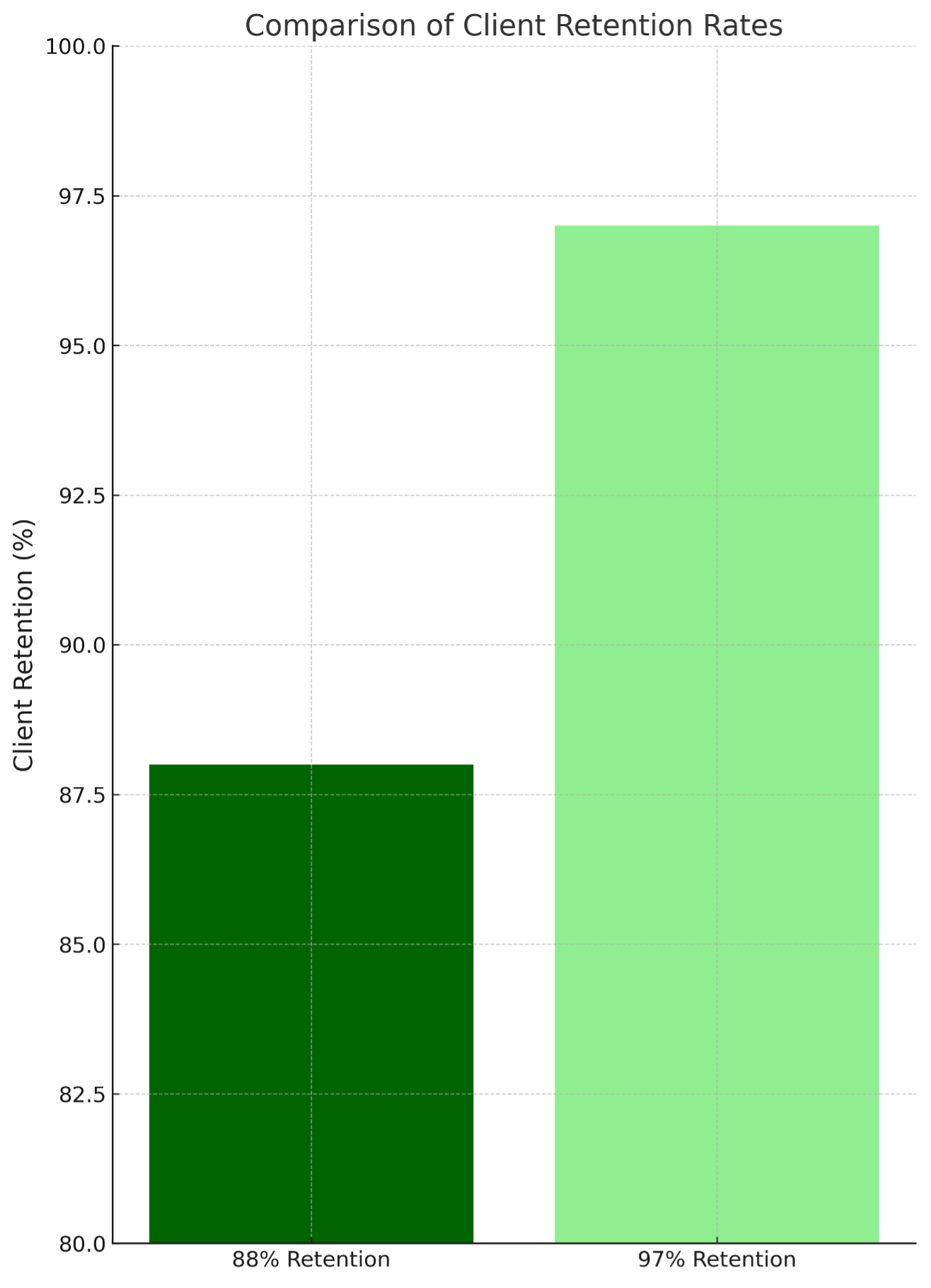
For the company with 88% client retention, more than just profit margins were affected. With lower margins comes a higher cost to serve. There are simply fewer dollars to go around, making financial allocation a challenging task. Now, every dollar must be fought for to properly serve accounts. You may have experienced this firsthand, and it is not a pleasant situation. Hard decisions must be made on how the remaining funds are distributed. Often, the allocation is not based on need but rather on who demands the most attention. This results in operational stress that becomes unsustainable. The impact of operational stress leads to an inability to serve all accounts at the desired level, at least not consistently. Some clients will inevitably suffer, and when they do, it does not always go unnoticed. Over time, word spreads, and before long, the company’s reputation takes a hit, leading to poor referrals and declining sales.
Now you have the perfect storm. No one enjoys being part of a company that is battling a poor reputation, struggling with operational inefficiencies, and facing declining sales. Employee morale inevitably takes a hit. When key personnel begin to leave, the company’s foundation becomes increasingly fragile. A few lost accounts may seem insignificant at first, but they often represent a warning sign of deeper systemic issues. What lies beneath the surface is far greater than what is immediately visible, making it imperative to address these challenges proactively rather than reactively.
It does not need to be this way. We have helped company after company turn the tide and remove the iceberg, we do so by the creation of the Clients for Life® client retention process. The Clients for Life® process is the formalized approach that will ensure you have strong client retention. It encapsulates all the needed fundamentals, key concepts, action items and templates you will need to launch a successful client retention strategy within your company. We will be unpack the Clients for Life® process step by step with you over the next few months. Taking it step by step in a logical manner that will set you up for success. While there will be an urge to adjust or change the Clients for Life® process and water it down we ask that you resist and stick to the process that has worked for 38 years and protected billions in revenue. There is always a benefit to customizing to fit your particular market and company but please work with us to ensure the integrity of what we are doing is still present.
To reinforce the effectiveness of this approach, we will focus on three fundamental principles throughout this program: Assess, Create, and Execute.
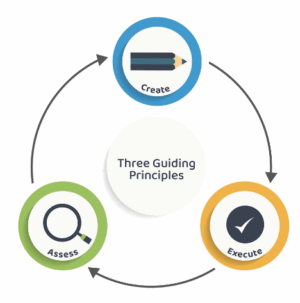
The Assess phase involves gathering data, understanding client needs, and identifying risks and opportunities within existing relationships. We look at several different ways to Assess your business both internally and externally. Internally we will work with you to conduct a Comprehensive Internal Assessment by interviewing key internal stakeholder.
We will also work with you to conduct a Capabilities Assessment of the company’s customer facing individuals. For the external Assessment we will review when surveys like the NPS scores have value, the new developments coming to the forefront with AI and their benefit as well as spending a large amount of time interviewing the stakeholders in your key accounts by conducting FreshEyes® Reviews and PostMortem Audit®s. You will get very comfortable not only conducting the interviews in an object and unbiased manner but also reporting out their findings.
The Create phase focuses on developing strategies and action plans. The Partner Success Team will work closely with The Executive Team to an effective strategy is in place with key direction and guardrails for all to follow. The Executive Team has already been briefed on the concepts within the Create phase. Together The Executive Team and the Partner Success Team will define the Right Clients/Right Terms®, Share Lessons Learned, Identify Warning Signs, Select Key Accounts, Major Accounts, Developing Accounts, and Transactional Accounts, Review the Client Journey and initiate an Account Based Marketing plan. We know there is a lot here. We will first educate and coach you on how to facilitate and execute each aspect. Then we will work conduct the workshops with you. Your role will be in the implementation and follow through.
The Execute phase is centered on implementation, ensuring that strategies are effectively put into practice and continuously refined based on feedback and performance metrics. It is where the rubber meets the road. It is where the Account Team and all customer facing employees will learn the importance of understanding and aligning expectations, building strong relationships through the creation of a robust Web of Influence®, and delivering on problems they were asked to solve today while innovating for tomorrow. Strategic Account Plans will be formed for every account.
Some will be very in depth and others straighter forward.
To underpin the entire Clients for Life® process we will make sure there is a level of accountability and tracking. We will do so by sharing with you the key activities, information an reports that should be tracked an share within the CRM system.
We hope you are starting to see how together we will be transforming the current client retention strategy into a more involved and substantial endeavor.
By committing to this formalized approach, your company will build a culture that prioritizes client retention, ensuring long-term success and sustainable business growth. The journey ahead will be both challenging and rewarding, but with the right mindset, dedication, and teamwork, we will create a lasting impact.
We have a lot to cover but here is a peak ahead to what is next. We are going to first focus on the Assess Principal because that is where you will be spending a lot of you time initially along with the Create Principal. Before we can do anything else we have to Assess where we are before we can move onto the Create Principal. We have to become proficient on conducting each kind of assessment. This will be done by first understanding the concept, then moving on to providing the step by step process and finally by doing Mock Exercises to ensure you are prepared. Then after we Assess and Create we can then direct the company on how to best Execute.
We have a lot to do and we are very excited to getting started.

Case Study
MobileCo, a leading mobile phone manufacturer, faced a significant challenge as market growth decelerated from an annual increase of 50% to just 5%. With a customer retention rate stagnating at 35%, the company recognized the urgent need to revamp its retention strategies to sustain its competitive edge.
MobileCo embarked on a comprehensive analysis to uncover the primary causes of customer churn. The investigation revealed critical issues, including product quality concerns and insufficient brand promotion, which adversely affected customer loyalty. Additionally, the lack of a unified approach to customer retention, with various departments independently developing their own programs, led to fragmented efforts and an inconsistent customer experience.
To address these challenges, MobileCo mapped out 20 key customer-retention responsibilities, clearly delineating roles between corporate and regional offices. This restructuring ensured accountability and streamlined the implementation of retention initiatives.
A pivotal aspect of the strategy involved identifying specific user groups that could significantly influence the overall retention rate. These groups included high-influence users, such as opinion leaders, customers with a high propensity to churn, and loyal community organizers. By focusing on these segments, MobileCo tailored its engagement efforts to address distinct needs and foster stronger relationships.
The company also redefined the customer journey by assessing six stages and 14 specific customer interactions, ranging from initial product consideration to post-purchase services and referrals. This holistic view enabled MobileCo to design targeted initiatives aimed at enhancing the user experience at each touchpoint.
Implementing mechanisms to capture key metrics on user satisfaction further allowed the company to identify and rectify gaps in the customer experience promptly.
Through these concerted efforts, MobileCo projected an increase in its customer retention rate to 60% over the next five years, aligning itself more closely with top competitors in the industry. This transformation not only aimed to reduce customer churn but also to cultivate a loyal customer base, thereby ensuring sustained growth in a maturing market.
This case exemplifies how a strategic, data-driven approach to customer retention, coupled with cross-departmental collaboration, can effectively address declining customer loyalty and enhance a company’s market position.
Course Manual 2: Assess Concept and Introduction
When we reviewed the Assess Principle with The Executive Team, we simply focused on the concepts of each part of the Assess Principle. It will be different for the Partnership Success Team. We will go far well past concept into implementation and reporting. The reason for the difference is that The Executive Team will only consume the information provided by the Assess Principle and make decision accordingly. The Partnership Success and in particular the Client Retention Executive will be responsible for conducting all the prework for each assessment, conduct the assessment including the one-on-one interviews, compiling the report and ensuring follow up on any actions that will come from each report. In short, The Partner Success Team will own the assessments.
Why
Why such a focus on Assessment? The short answer is knowledge is power. The insight you gain from conducting internal and external assessments are invaluable. You gain insight you never had before.
A company’s ability to retain its clients is one of the most critical factors determining its long-term success. While organizations often focus on sales and customer acquisition, client retention is the foundation of sustainable growth. Conducting a thorough assessment of both internal client retention strategies and external client perceptions is essential for identifying strengths, addressing weaknesses, and making informed decisions that improve customer loyalty. Without a structured assessment, companies risk making assumptions about their performance, missing opportunities for improvement, and failing to recognize potential threats to their client relationships.
An internal assessment of a company’s client retention strategy and capabilities serves as a reality check. Businesses may assume they are delivering value and providing excellent service, but without a structured evaluation, it is difficult to determine whether their approach is effective. Internally, this assessment should examine processes, policies, and team execution to understand what is working and where gaps exist. Key aspects to evaluate include the effectiveness of onboarding, account management, issue resolution, and ongoing engagement efforts. Companies need to assess whether their teams are aligned in their approach to client retention and whether there is a formalized process in place to ensure consistency.
Beyond processes, an internal assessment must also examine data related to customer behavior. Retention rates, renewal patterns, churn rates, and customer lifetime value provide critical insights into how well a company retains its clients. Understanding these metrics allows organizations to make strategic adjustments and allocate resources to areas that will have the greatest impact on client loyalty. Additionally, evaluating team capabilities is essential. Employees who directly interact with clients must have the necessary skills, tools, and training to foster long-term relationships. If gaps exist in client service or relationship management, investing in skill development and technology can significantly enhance retention efforts.
While an internal review is crucial, it is only part of the equation. A company must also conduct an external assessment by gathering direct feedback from clients to understand their perceptions and experiences. Businesses often assume they know what their clients value, but only by listening to them can they truly identify areas for improvement. Client feedback provides an unfiltered perspective on what they appreciate, where they face challenges, and why they may consider leaving. Structured client interviews, surveys, AI and feedback mechanisms help organizations measure satisfaction levels, pinpoint frustrations, and identify emerging needs.
One of the most significant benefits of assessing client perceptions is uncovering hidden risks. Many clients who are dissatisfied do not voice their concerns; instead, they simply leave. A structured assessment can help companies detect early warning signs of client dissatisfaction and take proactive steps to address them. Understanding how clients perceive a company’s responsiveness, product quality, service levels, and communication helps businesses refine their retention strategies.
By conducting both an internal and external assessment, companies gain a 360-degree view of their client retention effectiveness. This comprehensive approach allows organizations to make data-driven decisions, improve client engagement, and strengthen relationships. Investing in a thorough assessment is not just about reducing churn—it is about creating a client-focused culture that drives long-term loyalty and business success.
Reviewing Different Methods
We will be reviewing many different methods to capture the needed insight. Some you will then implement as part of the Clients for Life® Assessment Principle and some we will review for your knowledge and guide you when see the benefit and when it might not be worth the effort. We have spent time reviewing all the different aspects of each. Some is better sourced elsewhere such as AI and NPS scores while others we will implement here as they are specific to Business to Business and Business to Business to Consumer. Suffice it to say that at the end chapter you have a good understand of each and when the best time is to use each assessment tool.
Internal
Let us begin with the Internal Assessments. It is often said that before you look outward you must first look outward. It is still true for individuals as well as business.
The Executive Team did a first blush review as they determined their own impressions of where the company stood. This is much more detail and complete.
The first is the Comprehensive Internal Assessment. The Comprehensive Internal Assessment will interview those key stakeholders within your company. They will include key individuals from the C-Suite as well as key customer facing individuals. The goal is to get a nice cross section of people who will provide insight into the current client retention strategy and what is working and what is not. These are each 30-minute interviews that will delve into how the company is doing on such things as building relationships, exceeding the client’s expectations, solving problems, prioritizing and creating a client retention vision. When complete a report will be provided that will review trends that arose good and bad. We will then help you rate the company from everything from denial to retention leader.
The second is the Capabilities Assessment. While the Comprehensive Internal Assessment focuses on trends, strategy and the views of the key stakeholders within the company, the Capabilities Assessment is a survey that gains the opinions of the customer facing individuals. It is more straight forward, and data driven with a score of 5 being the best and 1 the least. There are eight areas of focus, Managing Professional Relations, Managing Client Expectation, Delivering Technical Expertise, Focus on Retention, Retention Strategy, Retention Responsibility, Leadership and Management. A report will be provided when all respondents return the information. This will be used as a baseline and should be reviewed after one year for the date administered.
External
The first external assessment in a way bridges the gap between internal to external. It is the Client Health Assessment. This is a subjective one page review an Account Manager or Account Team can use to get a retention risk analysis of a client. It is a quick form that is easy to fill out and can be a great coaching or advising. There are three possible answers for each question, and they are either red, yellow or green. You obviously want more greens than red answers but there is not set number.
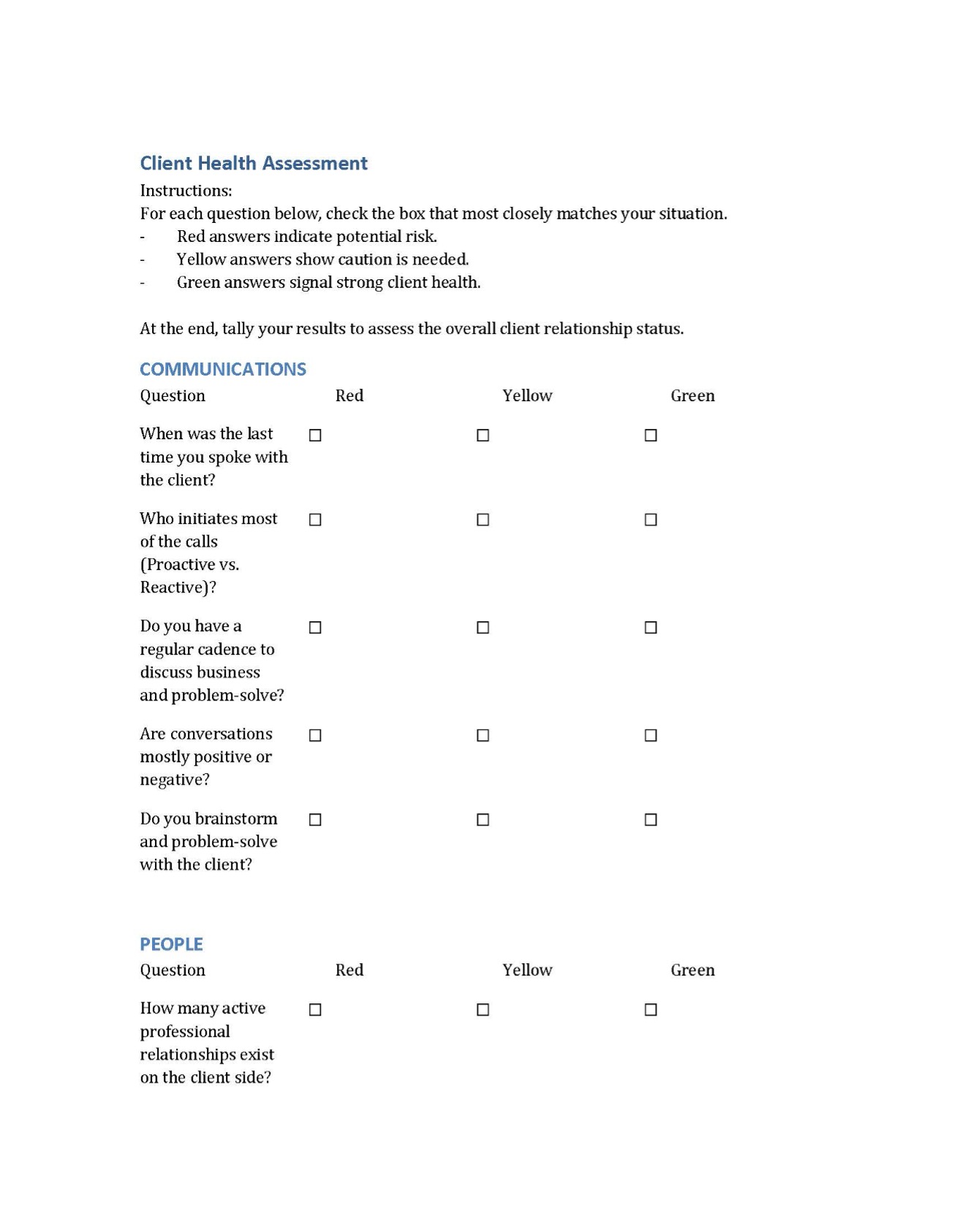
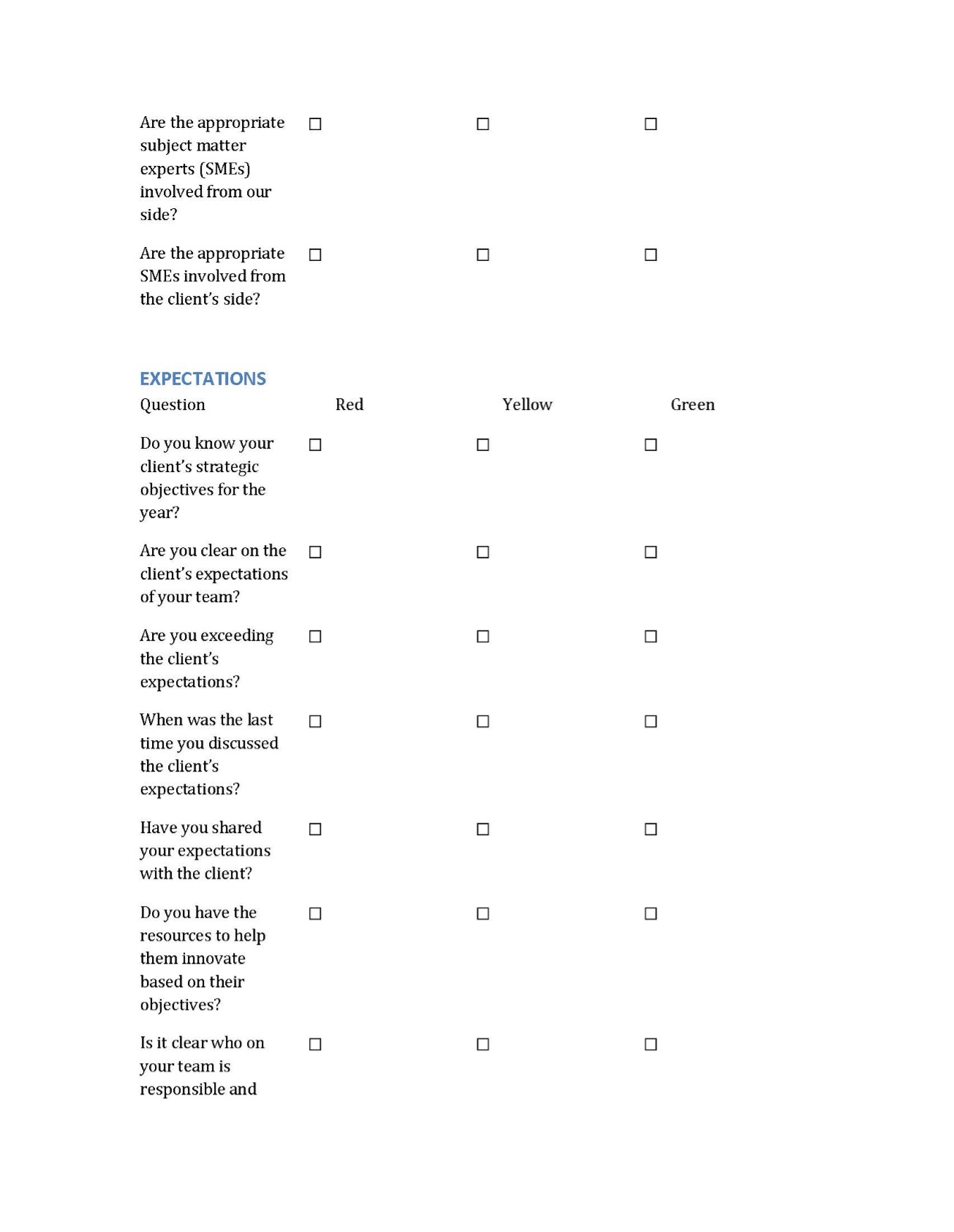
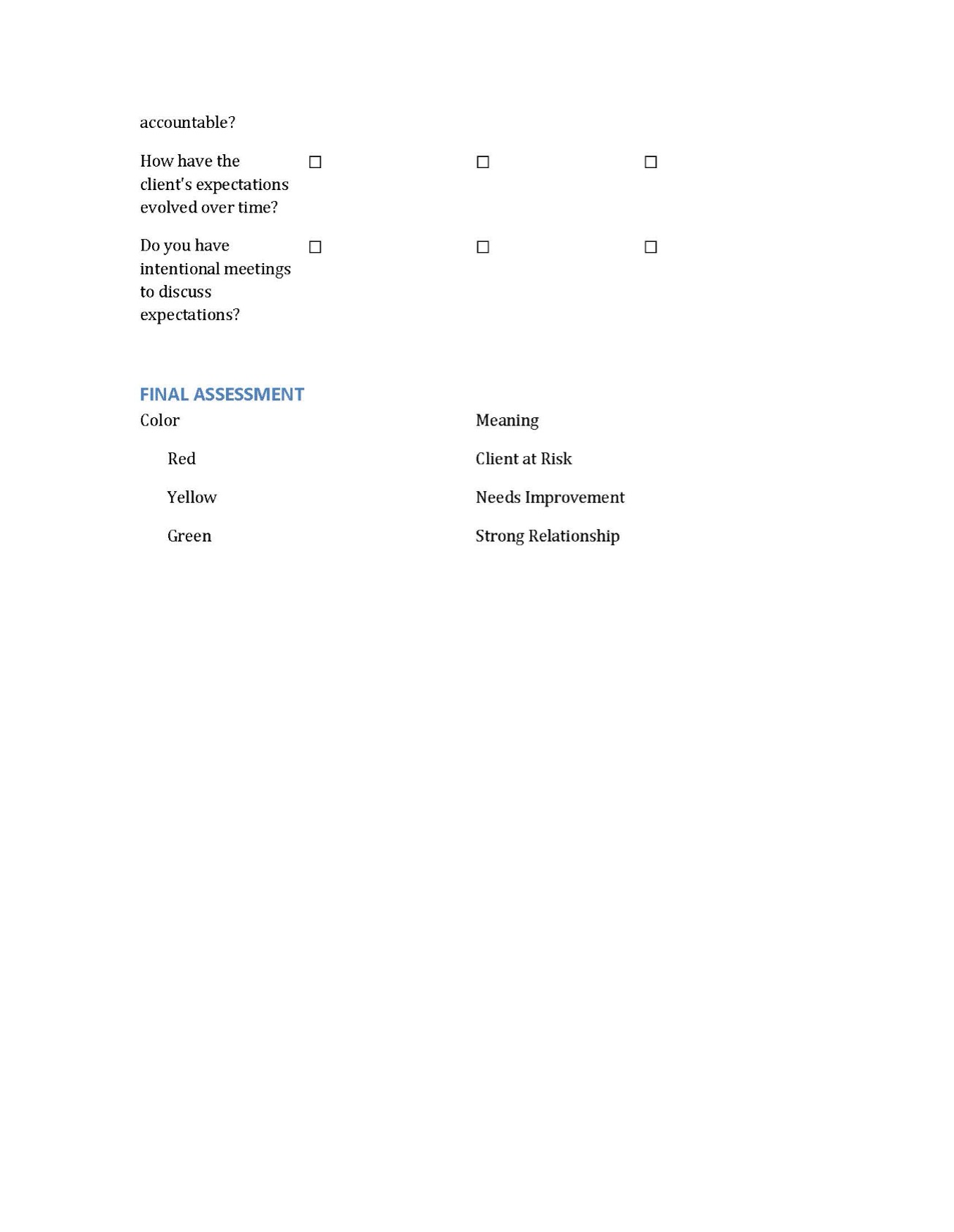
Exercise 1
After the Client Health Assessment we move to more involved approaches.
The first and most common are surveys. The most used and most discussed it the Net Promoter Score. Net Promoter Score (NPS) is a widely used metric that measures customer loyalty and satisfaction based on a single question: How likely are you to recommend our company to a friend or colleague? Respondents answer on a scale from 0 to 10, categorizing them as Promoters (9-10), Passives (7-8), or Detractors (0-6).
The NPS is calculated by subtracting the percentage of Detractors from the percentage of Promoters, providing a score that reflects overall customer sentiment. Many businesses use NPS to track client loyalty trends, assess satisfaction over time, and benchmark their performance against industry competitors.
For B2B client retention, NPS offers several advantages. It provides a simple, standardized way to gauge client sentiment and can highlight potential churn risks early.
Companies with high NPS scores often experience stronger client loyalty, higher retention rates, and increased referrals. When used effectively, NPS can serve as an early warning system, helping businesses identify dissatisfied clients and address concerns before they escalate into lost business. Additionally, it provides a quantifiable metric that executives and stakeholders can use to measure the effectiveness of client engagement strategies.
However, NPS has limitations in B2B environments. The metric lacks depth, as it does not explain why clients provide specific ratings. B2B relationships often involve multiple stakeholders with different perspectives, making it difficult to capture a comprehensive sentiment with a single score. Additionally, without follow-up surveys or qualitative insights, businesses may struggle to translate NPS data into actionable retention strategies. Companies that rely solely on NPS without deeper analysis risk overlooking critical issues that impact client satisfaction.
While NPS is a valuable tool for measuring client sentiment, it should not be used in isolation. To maximize its effectiveness, businesses should combine NPS with qualitative feedback, in-depth client interviews, and detailed account reviews to gain a holistic understanding of client needs and expectations.
The next is Artificial Intelligence. We all know that Artificial Intelligence is a powerful and should be harnesses for client retention. It is a tool that should not be overlooked.
Artificial Intelligence (AI) is transforming how businesses assess and improve customer retention. Traditional methods, such as surveys and historical data analysis, often provide lagging indicators of customer satisfaction. AI-driven retention assessment tools, on the other hand, offer real-time insights, predictive analytics, and automated processes that help companies proactively manage client relationships and reduce churn.
One of the most valuable applications of AI in customer retention is predictive analytics. By analyzing historical data, AI can identify patterns that indicate which clients are at risk of leaving. These insights allow businesses to take early action, such as offering tailored solutions, personalized engagement, or additional support before a client decides to end the relationship. AI models use behavioral data, purchase history, service interactions, and sentiment analysis to build a risk profile for each client, providing companies with actionable intelligence.
AI also enhances customer sentiment analysis by processing large amounts of unstructured data from emails, chat logs, social media, and surveys. Natural Language Processing (NLP) enables AI to detect subtle shifts in customer sentiment, helping businesses understand dissatisfaction signals that might otherwise go unnoticed. This allows companies to address client concerns proactively, improving overall retention efforts.
AI-driven tools also allow for personalized engagement at scale. By segmenting customers based on their behaviors and preferences, AI can recommend targeted retention strategies that improve long-term relationships. Businesses can deliver tailored messaging, offer customized incentives, and refine their services based on AI-generated insights, ultimately leading to higher retention rates.
By integrating AI into customer retention assessments, businesses gain a data-driven approach to understanding client needs, predicting churn, and optimizing engagement strategies. AI not only enhances traditional assessment methods but also provides a proactive framework for strengthening client relationships and ensuring long-term success.
While Artificial Intelligence offers powerful tools for customer retention, B2B companies face several challenges and pitfalls when implementing AI-driven strategies. One of the primary obstacles is data quality. AI models rely on vast amounts of accurate, well-structured data to generate meaningful insights. In B2B environments, customer data is often fragmented across multiple departments, including sales, account management, and customer support. Inconsistent or incomplete data can lead to inaccurate predictions and ineffective retention strategies.
Another significant challenge is the complexity of B2B relationships. Unlike B2C businesses, where AI can analyze individual customer behavior, B2B client relationships involve multiple stakeholders, long sales cycles, and customized contracts. AI may struggle to capture the nuances of these complex interactions, leading to oversimplified retention models that fail to address key client concerns.
Over-reliance on AI without human intervention is another risk. AI can provide valuable insights, but it cannot replace the importance of human relationships in B2B settings.
Companies that rely too heavily on automation risk alienating clients who value personal engagement and relationship-driven service.
Additionally, implementing AI requires a significant investment in technology and expertise. Many B2B companies lack the infrastructure or technical skills needed to deploy AI effectively. Without proper integration and training, AI initiatives can lead to frustration, inefficiencies, and missed opportunities in customer retention.
We recommend both Surveys and AI when appropriate. However, for your key clients we believe they should be supportive in nature and have their drawbacks and should not be your sole focus.
For those clients you cannot afford to lose we highly recommend conduct FreshEyes® Reviews and PostMortem Audit®s.
Let’s start with the unfortunate one before we move on to the FreshEyes Review®. That is the PostMortem Audit®. The Post Mortem Audit® is conducted when a client is lost. We know that it may be easy to just move on to new business and chalk up the loss as inevitable. We often heard that the loss was due to price, but that is seldom the case. In fact, we heard that so much that we actually went back and looked at over 100 PostMortem Audit®s that we conducted in that year. What we found supported the need to not shirk the responsibility to conduct the PostMortem® Audit.
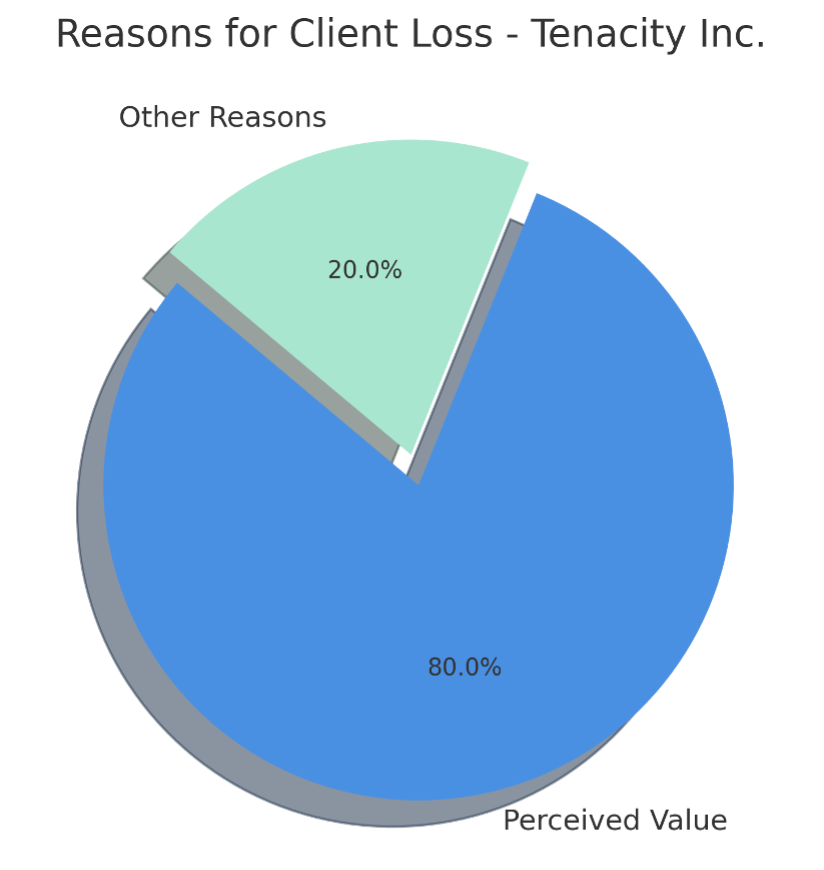
To conduct the PostMortem® Audit will be similar to that of the FreshEyes® Review. Along with leadership and the Account Team you will select 5-8 key stakeholders to interview. You should not leave the selection process up to just the Account Team. We have found that this will lead to cherry picking of the stakeholder that will provide the feedback that could be one sided. We will go deeper into this later in the day.
A letter will then go out to those individuals asking for their participation in a 30 minutes interview to discuss how the company did against their expectations and areas you could continue to improve upon. You should be CC’d on that email. You will then send out a follow up time to arrange a call. Done correctly and persistence you should get a 75% to 80% success rate. The interviews will be recorded unless the participant states otherwise.
After the final interview is conducted you will then provide a report to leadership and the Account Team which will consist of three things, the verbatim for the interviews, key quotes and finally your impressions. Then you will work with the Account Team and Leadership to capture any key learnings that will need to be improved upon or enhanced.
There is a very prescriptive way to conduct the PostMortem Audit® as well as the FreshEyes® Review that will go over in more detail later on. Done correctly you should be able to garner very objective and valuable insights.
Now on to a more positive topic, improving on your current key accounts by gaining essential unbiased and honest feedback, The FreshEyes Review®. You will want to work with leadership to select the right accounts to participate in the FreshEyes Review® process. The work is someone time intensive so it is not something that can be done for every account. When you add up the prep work, conducting the actual interviews, producing the report and advising and coaching the account team on responding and action planning.
Once the key accounts are selected you will follow some of the same steps as laid out for the PostMortem Audit®. Letters or Emails will go out to the key stakeholders. You will be cc’d and follow up to schedule a time to have a conversation. For both these external reviews, The PostMortem Audit and the FreshEyes Review® it is important to realize that these are not surveys conducted in person. These are conversations that will go over some key topics and questions, but it is more of discussion that peals back the onion to get to the real feedback rather than a set question answer format.
The conversation will focus on the following areas: Expectations, Relationships, Solving the problems of today and tomorrow and key market insights. Once the last interview you will then write your report. The one exception is if the client is in Meltdown or a high risk of losing the account. Then do not wait to write the report. Stop and alert leadership as well as the Account Team. It is too critical, and an action plan must be put in place before anything else is completed. The report will consist of the verbatim from the recorded discussions, the key quotes and your impressions much like the PostMortem Audit®. However, there is one more vital piece of information that you will provide that is unlike the PostMortem Audit®.
You will provide your impressions on where the client fits within the Client Retention Matrix. It will be one of four quadrants. The best is the Gnats quadrant where much like a summers day things are good but there are a few pesky problems that must be dealt with. There are always gnats to deal with in any relationship. Warranty which represents that the relationship is good but that the product or service is not up to expectations. Counselor is the opposite of Warranty. The service or technical delivery is fine, but the relationship is need of repair. This could be due to a personality fit, trust or a host of other possible issues. The last if Meltdown which means the company is at high risk of losing the client and action must be taken now to save them. Meltdown should only be used when it is really warranted.
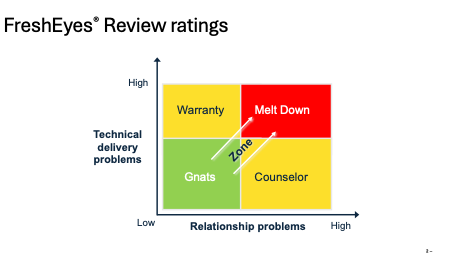
We are off to a great start. We covered quite a bit on the Assess Principle. Between the internal and external there is a lot to digest. We hope you have the concepts of for each assessment. That is step one. Now we will take the time to go into more depth with the process and format for each and practice until you are ready to conduct on your own.
Just remember the value in taking the time to Assess is well worth the effort both today and moving forward.
Case Study
Toyota revolutionized manufacturing through its Toyota Production System (TPS), which emphasizes efficiency, accountability, and teamwork. One of its most impactful innovations was the implementation of the Andon Cord, a simple yet powerful mechanism that allowed any worker on the assembly line to stop production when they noticed a problem.
Traditionally, quality control was handled at the end of the production process, meaning defects were often discovered too late, leading to costly rework and wasted materials. Workers were often hesitant to raise concerns because slowing down production was viewed as a failure rather than a necessary step to ensure long-term efficiency. Toyota changed this dynamic by shifting the responsibility for quality from individual workers to the entire team.
When a worker pulled the Andon Cord, the production line would stop, and a supervisor and fellow team members would immediately gather to diagnose and address the issue. Rather than blaming an individual for a mistake, the entire team collaborated to find solutions that would prevent the issue from recurring. This approach encouraged continuous improvement and created a culture where workers felt empowered rather than pressured.
Though stopping the line might seem counterproductive, it actually increased productivity in the long run. Catching defects early reduced large-scale rework and ensured that fewer flawed products made it to customers. Employees became more engaged because they saw how their actions directly contributed to the company’s success. The culture of shared accountability fostered trust and teamwork, making Toyota one of the most respected manufacturers in the world.
The Andon Cord system has since become an industry benchmark, influencing fields beyond manufacturing, including healthcare and software development. By emphasizing collective responsibility over individual performance, Toyota created a system where teams worked together to ensure quality, efficiency, and long-term success.
Course Manual 3: Internal Capabilities Assessment
We recently went through the concepts of both the external and internal assessments so you should have a good idea of the thought behind each one but now it is time to go through the actual process from selection of which tool to use, to those we want to assess, the process you will be using to conduct the assessment, and how to report out and what to do with that data. It is critical that you each start to develop a high comfort level with each part the assessment process and how, when and why to use each.
Capabilities Assessment
To start the discussion, we will focus on the Capabilities Assessment. If you remember this is the one you will be using all on customer facing individuals.
When to select the Capabilities Assessment:
This is best used to first set a baseline and then to check on the progress and successful implementation of the client retention training, and implementation. It is used as a feedback mechanism on how well key aspects of the Client Retention Program is taking hold. It will help you decided what might need to be revisited and what you may want to expand upon.
We suggest early on in the process before everyone starts learning about the Client Retention Strategy Program and implementing the Clients for Life® process. This will give you a great idea what might need to be emphasized more in the training. It will also be great to refer back on at the end of the process to see the marked improvement.
There are eight elements that will be scored in the Capabilities Assessment. These eight we have found are essential to a successful client retention strategy.
The Eight Elements
The first is Managing Professional Relationships. The minimum answer is around The Account Manager is the single point of contact (a score of a one) to the Web Of Influence® quality is continuously developed by the Account Team (a score of 5) and variations in between. Managing Professional Relation is important to business-to-business relations because Managing business relationships is essential in B2B interactions as it fosters trust, enhances collaboration, and ensures long-term success. Strong relationships lead to higher client retention, increased revenue opportunities, and improved problem-solving. Gaining insight into a team’s proficiency in managing professional relationships helps identify strengths and areas for improvement, ensuring consistent client engagement and service quality. It also enables organizations to measure their ability to navigate complex client structures, strengthen the Web of Influence®, and maintain competitive differentiation in the market. We will be spending a great deal of time on the Web of Influence® and its importance.
The second will be Managing Client Expectations. The minimum will be Focus on KPI’s set in the contract and the maximum score will be Progress on Client expectations is reported on proactively. This is another huge area of focus for us in the coming months and the reason is. Managing client expectations is crucial for fostering trust, reducing misunderstandings, and ensuring long-term satisfaction. Beyond meeting KPIs, clients expect transparency, proactive communication, and strategic guidance. A team’s proficiency in this area directly impacts client confidence, renewal rates, and opportunities for upselling or expansion. By actively managing expectations, businesses can mitigate risks, prevent dissatisfaction, and position themselves as trusted advisors. This approach not only strengthens relationships but also differentiates a company from competitors by demonstrating commitment, reliability, and forward-thinking client engagement. It also is the metric that is used to determine success or failure.
Third is Delivering Technical Expertise otherwise referred to often in our training as solving the problems of today and tomorrow. On the low end of the scale is Delivering what is contracted and on the high end is Proactively analyze the clients’ needs and adjusting your performance. Delivering technical expertise is a fundamental aspect of maintaining strong client relationships and ensuring long-term success in B2B engagements. It is not just about executing tasks but about understanding industry shifts, adapting to evolving client demands, and becoming a trusted problem-solver. On the low end of the scale, delivering technical expertise means simply fulfilling what is contracted, meeting the minimum requirements without deeper analysis or strategic improvements. On the high end, it involves proactively analyzing client needs, adjusting performance based on emerging trends, and providing solutions that address both immediate challenges and long-term goals.
This area is a major focus because technical expertise drives operational efficiencies, helps identify risks before they become problems, and enhances client satisfaction by offering forward-thinking solutions. Clients expect more than just execution; they seek partners who provide insight, adaptability, and innovative approaches to their evolving needs. The ability to not only solve the problems of today but also anticipate those of tomorrow ensures stronger partnerships, increased retention, and greater business growth. Organizations that master this approach differentiate themselves by demonstrating strategic value rather than just delivering contracted services.
The fourth is a Focus on Retention. You might be reading this and thinking well of course. This is a no brainer, yet it is seldom put into practice to the level it needs to be. On the low end Renewal activities are started when the clients ask for a new proposal and done well Retention is culture. Creating relevant value is a continuous focus. It must move from an idea to an actionable part of your culture.
A focus on retention is often seen as an obvious priority, yet in practice, it is rarely executed at the level necessary for long-term success. Many organizations assume that if they provide quality service, retention will naturally follow. However, without a structured, proactive approach, client loyalty is left to chance. On the low end of the scale, renewal activities begin only when a client requests a new proposal, often leaving little time for meaningful engagement or strategic conversations. This reactive approach puts companies at risk of losing clients to competitors who have spent time strengthening their relationships.
When done well, retention is not a task—it is a culture. It is ingrained in daily operations, influencing every client interaction, service adjustment, and strategic decision. Creating relevant value is a continuous focus, ensuring that clients see ongoing improvements and solutions tailored to their needs. Retention must move beyond being a general goal and become an actionable part of an organization’s DNA. A culture of retention fosters trust, deepens relationships, and solidifies long-term partnerships, making it far more than a renewal process—it becomes the driving force behind sustained business growth.
Fifth is a around the Retention Responsibility. The minimum, and we are not even sure we say this is in the realm of the retention strategy, but it is that No one person specifically is responsible for client retention done well Executives are actively involved in the retention- and management process for your major accounts.
A strong retention responsibility is essential for long-term client partnerships, yet it is often an area where companies fall short. At the minimum level, there is no clear ownership of client retention, leaving it as an undefined responsibility that lacks accountability and structure. In this scenario, retention becomes an afterthought rather than a strategic focus, increasing the risk of losing clients due to complacency or missed opportunities for engagement. Without a dedicated effort, organizations may find themselves reacting to client concerns rather than proactively strengthening relationships.
When done well, retention is not just a function of account management—it is a leadership-driven initiative. Executives play an active role in retention by engaging with key clients, reinforcing strategic value, and ensuring that long-term partnerships are prioritized at the highest levels. A well-executed retention strategy involves collaboration across departments, continuous assessment of client needs, and an ongoing commitment to creating measurable value. It is not about waiting for renewal discussions but embedding retention efforts into daily operations. Organizations that successfully integrate retention as a core business strategy create stronger client loyalty, improve long-term revenue stability, and position themselves as indispensable partners in their clients’ success.
Sixth is Retention Strategy a score of one would reflect the minimum of Reactive decision making based on client complaints and/or satisfaction survey’s and the maximum is when strategic decisions are actively enforced and managed. You will note a reference to Lessons Learned, Right Clients/Right Terms® and Warning Signs. For the first time we will replace with current company direction. We well delve into these terms more when we talk about the Create Principle. A comprehensive retention strategy is essential because it transforms client relationships from transactional engagements into long-term partnerships built on trust, value, and continuous improvement. When retention efforts are minimal, organizations operate reactively, addressing issues only after they arise through client complaints or satisfaction surveys. This reactive approach leaves businesses vulnerable to churn, as it fails to anticipate client needs or proactively address challenges before they escalate. Without a structured strategy, retention is left to chance, creating instability in client relationships and increasing the likelihood of competitive displacement.
On the other end of the scale, a well-executed retention strategy ensures that strategic decisions are actively enforced and managed at all levels. It integrates proactive engagement, structured client feedback, and continuous alignment with business objectives. Retention is no longer about fixing problems after they occur but about preventing them altogether. By embedding retention into decision-making, companies ensure they are not just responding to client concerns but actively shaping a positive client experience. This strategic approach drives long-term loyalty, increases customer lifetime value, and strengthens an organization’s competitive position. When retention is managed with intention, it becomes a powerful driver of business success, ensuring that clients stay not just because they are satisfied, but because they see the organization as a true partner in their ongoing growth.
Seventh is Leadership. We just spent a day reviewing the key aspects of The Executive Team and discussing the priority client retention must take in the organization. In fact, we are talking to you today because The Executive Team believes that client retention is intertwined with the company’s success. That is why the minimum starts with Retaining clients is part of the organizational strategy and the maximum is Employees perceive client retention as an important strategic goal. This one is as much at about the perception as it is about the reality.
Leadership plays a pivotal role in shaping an organization’s client retention strategy, influencing both the perception and execution of retention efforts across all levels of the company. Retaining clients must be more than just an operational goal—it must be embedded within the company’s strategic vision and championed by leadership. The executive team has already acknowledged the critical role retention plays in the organization’s success, and their commitment to prioritizing it sets the foundation for long-term stability and growth.
At the minimum level, retention is formally recognized as part of the organizational strategy, but without consistent reinforcement, it risks being seen as an isolated initiative rather than an essential driver of business success. Employees may understand its importance but fail to see it as their individual responsibility. On the other hand, when retention is done well, it becomes a deeply embedded cultural value. Employees at all levels perceive client retention as a strategic priority, not just in words but in daily actions and decision-making. They take ownership of fostering long-term relationships, proactively addressing challenges, and continuously seeking ways to enhance the client experience.
This dynamic is not just about having a well-defined strategy—it is about ensuring that retention is viewed as a fundamental pillar of the company’s success. If leadership effectively communicates and reinforces its significance, retention moves from being a management initiative to an organizational mindset, where every employee understands their role in keeping clients engaged, satisfied, and committed for the long term.
The Final is Management and Coaching on client retention. This is the day-to-day reinforcement of the client retention principles. For the first time the Capabilities Assessment will be used it will be referring to general coaching and management of retention of clients. Going forward it will be how well our formalized Clients for Life® principles are executed upon. On the low-end leadership and direct managers are conducting Management by exception. It is reactive involvement and issue based and on the high-end Client retention is a part of the employee performance evaluation cycle.
The day-to-day reinforcement of client retention principles is critical in ensuring that retention is not just an occasional focus but an ongoing priority embedded into daily operations. The role of leadership and direct managers in coaching and reinforcing retention strategies determines whether retention efforts are reactive and issue-based or proactive and structured. This assessment marks a shift from general coaching and management of client retention to a more formalized execution of the Clients for Life® principles, ensuring consistency and effectiveness in how retention strategies are applied.
At the low end of the scale, Management by Exception is the norm, meaning leadership and managers become involved only when issues arise. In this scenario, client retention is reactive—problems are addressed only after they escalate, and there is little structured coaching to prevent issues before they occur. Employees may not fully understand their role in retention, and managers are focused on firefighting rather than guiding teams toward proactive client engagement.
At the high end, client retention is integrated into the employee performance evaluation cycle, ensuring that every team member is accountable for fostering long-term client relationships. Managers provide ongoing coaching, feedback, and support to reinforce retention best practices, helping employees anticipate client needs and drive continuous value. Retention is not just an expectation; it is a measurable performance criterion that influences career growth, rewards, and recognition. This structured approach ensures that retention is sustained at all levels, aligning teams with the company’s strategic objectives and fostering a culture where every employee actively contributes to client loyalty and business success.
We have taken time to really delve into each element of the Capabilities Assessment because it is critical for you be able to understand not just the importance of each but help explain and give a brief summary to all before the assessment is share with the participants.
Participants
Each company will be different depending on the size. For small to midsize companies you may be able to share the Capability Assessment with all customer facing employees. For larger companies it might need to be a sampling. The key is to get enough of a sample size to make the information relevant. We suggest no less than 10 and no more than 75. You do want to select a top end because of the work needed to score each assessment. If you are able to help by imputing the survey into an electronic system at your company, you may be able to increase the number.
The individuals that should be surveyed are the client facing employees which are generally sales, account management, and client services. However, you know what client services might mean for your company. You will need a good cross section of each area sales, account management, client services etc. to get a response that is appropriate. Please do not include The Executive Team as they will be part of the Comprehensive Internal Assessment and may skew the data. You want those who are the day-to-day customer facing individuals.
The Process
A week before you are set to send out the Capabilities Assessment you should send out an alert email so all will be ready to participate. It is best of either the email comes from the CEO or someone important in leadership to show it’s important. The Client Retention Executive should craft the email and be cc’d in the process as well as the rest of the Partner Success Team.
The following week an email should go out stating the purpose and giving a quick summary of each of the 8 elements of the Capabilities Assessment. The direction should also be to simply circle the definition that most closely defines where they see the company for each. Please direct that they must select one definition and not circle or choose two. Also, remind them to try to provide feedback for each and not to leave one blank unless it really does not pertain to them. Finally, remind the participants that there are no bad answers. This is just setting a baseline, and no judgement is being made and the responses are blinded. Everyone will be able to stay anonymous.
You should then provide a set deadline to receive the Capabilities Assessment back fully filled out. We suggest no longer that to weeks from when the Assessment was sent out. If it is longer than two weeks people will forget about doing it and lose the email. An email reminder on the importance of filling out the form should also be sent out at least every 3rd to 4th day. Be true to the cutoff date as well. If few fill out the form that is feedback alone on the importance of client retention in their minds.
Reporting on the Data:
For this the reporting is pretty straight forward. You should provide what each element scored. The report might look something like this for the first time.
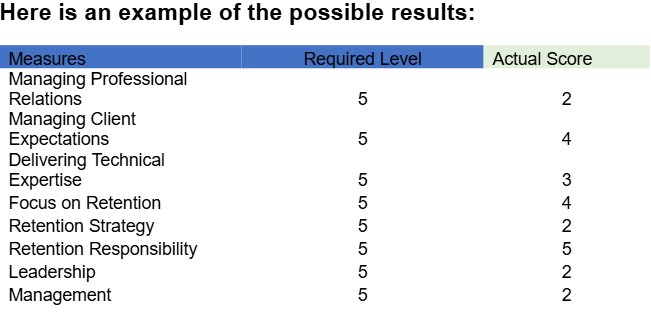
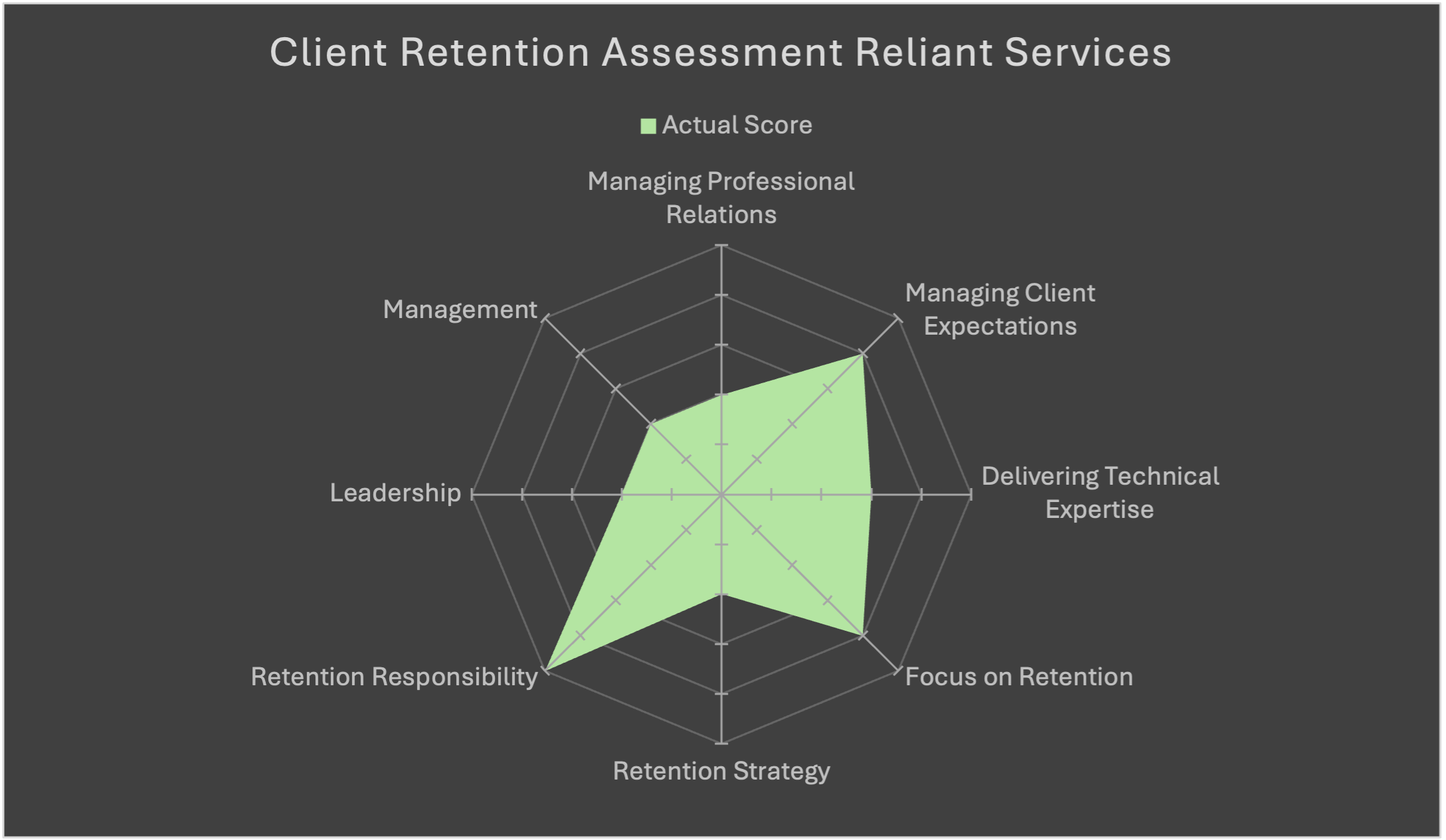
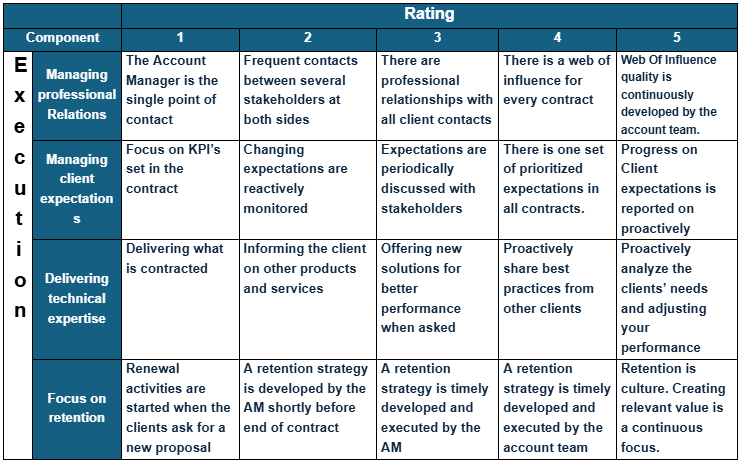
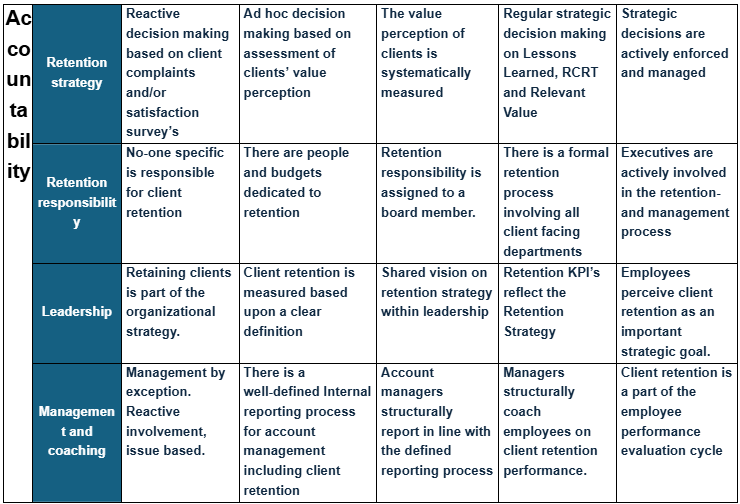
Exercise 1
Results will be conducted yearly to evaluate movement against baseline.
For the second time around you will add the previous score and then show the progress in a different column.
The results should be shared with the Executive Team for now and with the Customer Facing Team when their training on Client Retention begins. That said there is not secret to the is information and if someone would like to see the data please do not hold back. It shows their desire to be part of the process.
While pretty straight forward of an Assessment there is a great value to the information you received. We often get some responses that the company was not expecting. That is ok. There are no bad answers. It is what it is good or bad and a good indication of where we need to go moving forward. We highly suggest you work on getting this assessment out two weeks post this training.
Case Study
A notable example of a company enhancing its performance through an internal capabilities assessment is Aruba, a networking subsidiary of Hewlett Packard Enterprise. As Aruba transitioned into a Software as a Service (SaaS) subscription model, it recognized the need to adapt its customer engagement strategies to align with this new business approach. To address this, Aruba conducted a thorough evaluation of its internal processes, particularly focusing on customer success and retention.
During this assessment, Aruba discovered that a significant number of customers were not activating their purchased services, leading to higher than anticipated churn rates. This insight prompted the company to prioritize the onboarding process, ensuring that customers effectively utilized their services from the outset. By implementing these changes, Aruba achieved a remarkable 20-point improvement in churn rates and a 40% increase in net retention within a year. This case underscores the importance of internal evaluations in identifying operational weaknesses and implementing targeted strategies to enhance customer retention and overall business performance.
Course Manual 4: Client Health Assessment and Objective Assessment Procedures
Client Health Assessment
We spent some time just speaking about and brainstorming about the Client Health Assessment. You should have a pretty good idea of what the assessment is and how to best use it. We want to just take a moment and go into a little great detail on each of the three components Communication, People and Expectations.
Communications
If you review the five questions you will notice it reveals a lot about the engagement level of the partnership. Is the client on autopilot and communication has become a standstill or has the level continuing to engage and ramping up the level of communication. Is the client value you enough that they are reaching out to you or is it you that always must initiate the communication? If it is, you then you might want to ask why.
Do they see value in your contribution or are they one of the ones you say something like “Listen if I do not call that is a good thing, I am busy and I will only reach out when there is a problem. Ok, so that might be things are ok but that surely also means they do not see you enough of a resource to reach out to help you solve the problems on the horizon. It is probably one of the best indicators that you are a vendor is asked to do job which is ok unless the job changes and you are left holding the bag because all they saw was you being a vendor doing a job.
A big warning sign is also if they are asking to look at the contract. We will discuss this more in the Create Principle, but it is a strong indication of the health of the client and if it is at risk. A sign of a health relationship is when two companies sign the contract and put it away only for it to reemerge when it is time to expand or renew the contract. If it happens any other time, it might be cause of concern. You should be working off of expectations and exceeding them so there is no need to review the contract.
Lastly, on communication is the idea of brainstorming. Is the communication so good and the level of engagement so strong that you are frequently asked to brainstorm, and problem solve or are you not. You know the satisfaction of truly helping a client problem solve and being brought into the inner circle. If you are not you also know something is up with the level of communication and it might not be a good sign.
People
We will go into way great detail around network and Web of Influence® when we discuss the Execute Principle. For now, consider this a quick gut check on how robust the relationship might be. These three questions is a short hand version to assess the general health of the relationship.
The first will reveal one of strongest indicators of the health of the relationship. Is there a one-to-one relationship or all multiple people involved. Far too often the Account Manager has a relationship with the Gatekeeper at the client and no one else. If this is the case, it has to change and there should be a sense of urgency around it. You will hear us say this over and over again, when people change everything has the potential to change. Do not let one person be the linchpin to the relationship. More to follow in the future.
Another issue often is that the Account Manager is trying to do the work of the entire company and blocks out or does not delegate to the correct Subject Matter Experts (SME). They are subject matter experts for a reason, they know more than you and are a better resource for the client. Therefore, a strong relationship is one where the Account Manager coordinates but the experts on either side are free to accomplish the task they are qualified to do.
Expectations
Trust us when we tell you that we will be going further into Expectations later on. It is another key component of the Execute Principle along with Web of Influence® and problem solving for today and tomorrow (Technical Delivery).
First do you understand the client’s strategic objectives. This is even before you understand the expectations of you. Do you understand what the client’s goals and aspirations are for the short term and long term. If you do not, how are you able to use all expertise to help them reach their goals for now and well into the future. Take the time to understand the client’s goals so you can better serve them.
You also should be very clear on what the client expects of you in a very specific and measurable way. You then can know if you are exceeding on those expectations. If you do not know, how can you exceed on something in the abstract. You need to review on a regular basis. Expectations need to be shared and review often at least every year. This will help you know if things change and if you are still on track. Do not be afraid to give your expectations of the client. If you do not, then it is not a partnership but a vendor relationship.
This section is all about alignment. If you and the client are both not aligned the health of the relationship is in danger. This is your opportunity to make sure if have all the pieces in place to exceed on what is being asked of you. If there are a few in the red or even yellow here, stop take notice and think of how you can get back on track. We will guide you during the Expectation Training but for now take note.
We hope you see the value of the Client Health Assessment. We just ask as the Partner Success Team you put a plan in place to use the Assessment. The best approach is to create more than a suggestion but put Standard Operating Procedures in place on when the assessment should be used. We say a minimum of once a month per client and at least quarterly have a discussion on your key clients with your Account Team and leadership. It will ensure you stay on track.
Assessing Company Performance Through Insightful and Non-Threatening Feedback Questions
Before we move forward to the rest of the Assessments, we must pause to discuss a key skill you will need to move forward. For the Comprehensive Internal Assessment, The FreshEyes® Review and the PostMortem Audit® you will be charged to get unbiased, insightful, valuable and forthright feedback about your company’s performance. This can be hard because it may be easy to be intimidated, unintentionally lead the person being interviewed to an answer you think is correct or lead the witness or shy away from the tough questions to avoid conflict. Any of these tactics and others will only serve to hinder your company’s further growth.
For any company to thrive, it must continuously evaluate its performance, not just from an internal operational standpoint but from the perspective of its employees, clients, and stakeholders. However, obtaining truly honest and unbiased feedback can be a challenge. Many people hesitate to provide candid insights due to concerns about repercussions, misunderstandings, or simply not wanting to offend.
To overcome these barriers, businesses must approach performance assessment in a way that encourages transparency while maintaining professionalism. The key lies in framing questions in a neutral and non-threatening manner, ensuring that respondents feel comfortable sharing their true perspectives. When done effectively, this process leads to meaningful insights that drive sustainable improvement.
The Importance of a Neutral and Professional Approach to Feedback

Feedback is often influenced by emotions, personal biases, and the manner in which questions are asked. If a company phrases its inquiries in a way that implies a desired response, it risks receiving answers that align with what people think the company wants to hear rather than what is actually true. This can lead to a false sense of success and overlooked areas of needed improvement.
This is why we have been often asked to conduct these interviews as a third-party nonbiased interview. We believe we can give you the skills and opportunity to do the same. However, if you believe that there is a client is too valuable you might want to engage with an outside company that is skilled in the area and able to give unbiased feedback. For the vast majority you can do the job and provide insightful and quality feedback.
A well-structured feedback process removes intimidation, ensures clarity, and invites respondents to provide thoughtful, constructive insights. It fosters an environment of trust, where employees, clients, and stakeholders know that their voices are valued, and their opinions will be used to drive positive change rather than to assign blame. It starts with the body language to eye contact and what you say.
Creating a Safe and Open Environment for Honest Feedback
Companies must establish a culture where giving feedback is seen as a positive contribution rather than a risk. This can be achieved by clearly communicating the purpose of the feedback process, ensuring confidentiality when necessary, and demonstrating that past feedback has led to meaningful improvements. We will provide a template for you to use for the original email.
The way questions are framed plays a significant role in the quality of responses. Open-ended, neutral, and specific questions help respondents provide thoughtful feedback without feeling pressured. By avoiding leading questions and keeping inquiries professional and constructive, companies can gather more reliable and actionable insights.
Examples of Effective Feedback Questions for Company Performance Assessment
When assessing company performance, businesses must seek input from multiple sources, including employees, clients, and external stakeholders. The following examples illustrate how companies can ask insightful, non-threatening questions in different areas of evaluation. We will accomplish this feedback in two different ways. For the employees with the Capabilities Assessment and the Comprehensive Internal Assessment for leadership. For clients and external stakeholders we will be using FreshEyes® Reviews and PostMortem Audits.
Assessing Company Communication and Transparency
Instead of asking, “Do you think the company communicates well?” which may lead to a simple yes or no response, a better approach would be:
“In what ways does our company’s communication help or hinder your ability to stay informed and aligned with key objectives?”
This phrasing encourages respondents to provide specific details rather than a generalized answer. Yet it does not lead to a short yes or no and more importantly it does not lead the witness. The first question leads the person being interviewed to saying yes more than honest feedback.
Another variation might be:
“Are there any instances where you felt company communication was particularly clear or, conversely, could have been improved?”
By asking about both positive and negative instances, the company gains balanced feedback without making respondents feel like they are solely identifying problems. We will go through set questions and areas we want you to cover at the appropriate time. For now we hope you are starting to get how to ask without directing a set response.
Evaluating Leadership and Organizational Support
Rather than asking, “Do you think our leadership team is effective?” a more insightful question would be:
“How would you describe the level of support and guidance provided by our leadership team, and are there any areas where additional support would be beneficial?”
This approach invites feedback in a way that highlights both strengths and areas for growth without putting respondents in an uncomfortable position. It is also key to pause and leave time for the individual to answer. Nervous energy is bound to happen, and you will want to answer for them. Count to ten and if they are still stumped rephrase the question with the same content but simple different phrasing.
To encourage more detailed responses, companies might also ask:
“Can you share an example of when leadership decisions positively impacted your work or, conversely, when you felt more clarity was needed?”
The more specific of an example the more the reader of the report is able to see exactly what is trying to be conveyed in the answer and remedy the particular issue or if positive find even more ways to excel.
Understanding Client and Stakeholder Relationships
When gathering client or external stakeholder feedback, it is important to avoid questions that suggest a particular sentiment. Instead of asking, “Are you satisfied with our service?” which can lead to polite but uninformative answers, a better approach is:
“How would you describe your experience working with our company, and are there any areas where we could improve to better meet your needs?”
This wording allows clients to provide a more detailed response, highlighting both what works well and what could be refined. This allows the client to then answer how he or she honestly feels.
We have also seen people try to almost want a negative answer. This is not the intent of either of the assessments we are going over. We simply want to get the interviewee’s point of view. Positive feedback is equally as constructive as negative feedback.
Another effective question could be:
“What are the key factors that influence your decision to continue working with us, and how well do you feel we align with those expectations?”
By framing the question this way, companies gain insights into the underlying drivers of client retention and areas where expectations may not be fully met. Again now just focus on the way the questions is stated, later on we will go into the specific questions we believe you should ask.
Assessing Company Processes and Efficiency
Instead of leading with, “Do you think our processes are efficient?” which invites a limited response, a more constructive question would be:
“Are there any company processes or workflows that you find particularly effective, and are there any that create challenges or inefficiencies?”
This allows employees and stakeholders to provide a balanced perspective and focus on specific areas for improvement.
To dive deeper into operational effectiveness, companies might ask:
“If you could change one aspect of how our company operates to improve efficiency, what would it be?”
This question provides a direct yet non-threatening way to collect insights on potential operational enhancements.
Gauging Employee Satisfaction and Engagement
When assessing company culture and employee engagement, questions should be framed in a way that encourages genuine responses. Rather than asking, “Are you happy working here?” which may lead to superficial answers, a better alternative is:
“What aspects of your role or our company culture contribute most to your job satisfaction, and are there any aspects that could be improved?”
This allows employees to highlight both positive experiences and areas for growth.
Another variation could be:
“Are there any resources or support systems you believe would enhance your ability to be more effective and engaged in your work?”
This provides actionable feedback while demonstrating that the company values employee success.
Body Language and Intent:
Through all of our years of experience there is nothing more important that showing that you are interested in what the person has to say. That means refraining from looking away, doodling, or losing interest by saying yeah when you have not been paying attention. If you are doing it in person or virtually look forward, lean in and nod your head appropriately. Do not shake your head or raise your brow if the answer is different that you would have like. Again, you job is simply to get the information in a non-biased manner.

A good way to gain tips and pointers is to watch a reporter gain information from an interview. If you pay attention you will start to see when someone does it really well and when someone is fishing for an answer or trying to give that gotcha question. Take time to right down what they do. They are usually face to face and cordial with the person trying to make them feel at ease when done well. When done poorly tension starts to rise and answers become curter. After all that is your objective to just gain insight.
Exercise 1
Turning Feedback into Meaningful Action
The feedback-gathering process should not be a one-time event but an ongoing practice that leads to tangible improvements. Once responses are collected, companies must analyze trends, identify key areas for action, and communicate how feedback is being implemented. Transparency in this process reinforces trust and encourages continued participation.
One effective approach is to hold follow-up discussions where feedback themes are acknowledged and addressed. This may include implementing new communication strategies, refining operational processes, or making leadership adjustments based on shared insights. Additionally, companies should revisit their feedback mechanisms regularly to ensure they remain relevant and effective.
By consistently seeking, listening to, and acting on feedback, companies create a culture of continuous improvement. This commitment to self-assessment strengthens relationships with employees, clients, and stakeholders, ultimately driving long-term success. The client starts to see that you really care, and employees start to realize the importance of the process and take the time to provide strong feedback when asked.
One more note on where the interview should take place. There is nothing that replaces an in-person interview. It shows you cared enough to take the time to make the trip and talk with the individual directly. It also allows you better to see the body language.
However, we understand there is a balance when looking at the time it might take to conduct the interview as well as cost. For this reason we recommend that you weigh the pros and cons and decide when in person is a must and when virtual will suffice.
In conclusion, objective company performance assessment requires thoughtful, well-structured questions that encourage honest and unbiased feedback. By creating a safe environment for open dialogue and carefully framing inquiries in a non-threatening manner, businesses can gain valuable insights that lead to meaningful growth and enhanced operational effectiveness.
Case Study 1
A notable example of an unbiased internal assessment leading to significant organizational change is the Harwood Manufacturing Corporation’s experiments in the late 1930s and 1940s. Faced with high employee turnover and low productivity after relocating operations to Virginia, the company collaborated with psychologist Kurt Lewin to identify underlying issues. Through comprehensive internal assessments, they discovered that employee dissatisfaction stemmed from constant pressure and lack of involvement in decision-making processes. By implementing participative management strategies, such as involving workers in setting their own goals and planning work methods, Harwood Manufacturing experienced increased productivity and reduced turnover. This case underscores the effectiveness of unbiased internal evaluations in driving meaningful organizational change.
Case Study 2
Another pertinent example is the transformation within the Washington D.C. public school system in the early 2000s. Superintendent Michelle Rhee conducted a thorough internal assessment to identify inefficiencies and areas needing improvement. Based on the findings, she restructured the district by setting defined metrics to hold teachers accountable and measure progress. This data-driven approach led to significant changes aimed at increasing the school district’s efficiency and effectiveness.
Course Manual 5: Comprehensive Internal Assessment Partnership Success Team
There are few things as important as taking time to understand the insight and feedback from the internal stakeholders in your own company. Before you can understand the perceptions of the external stakeholders you must first look within. This will be done through the Comprehensive Internal Assessment.
The Comprehensive Internal Assessment is an in-depth review of those key individuals who can impact and execute your client retention strategy. These individuals are heavily invested in the health of the company and will have varying views on the current implementation and outcomes of the client retention strategy. The response you receive will help you get a good understanding on the receptivity and guidance you will need to move them along the Client Retention Maturity Scale.
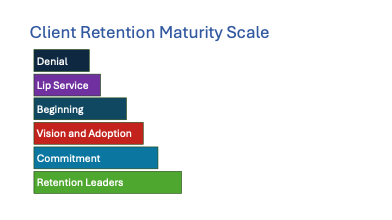
So that you have clarity and understand of each part of the scale let us go over them one by one.
Denial
There are always individuals within an organization who do not believe in focusing on client retention. These people often operate under the belief that growth comes solely from acquiring new business rather than nurturing existing relationships. To them, success is measured by how much new revenue is brought in rather than how well the company maintains its current customer base. This mindset is particularly prevalent in sales-driven cultures where performance is judged primarily by new deals rather than long-term client relationships. They see client turnover as an inevitable part of business rather than something that should be actively addressed.
For these individuals, the loss of a client is not perceived as a failure but as a natural part of the sales cycle. Their solution to declining client numbers is simply to bring in more customers to replace them. They liken it to filling a leaky bucket by adding more water rather than fixing the holes that are causing the leaks. This perspective often leads to a never-ending chase for new clients without recognizing the inefficiencies and increased costs associated with constantly replacing lost business. Client acquisition is expensive, requiring marketing efforts, sales team engagement, onboarding processes, and time before a new client becomes profitable. Yet, those who dismiss retention strategies fail to see that keeping an existing client is significantly more cost-effective than acquiring a new one.
Another reason some individuals resist focusing on client retention is that they believe it is not their responsibility. Sales professionals, for instance, may see their job as closing deals rather than maintaining relationships, assuming that client retention falls on the shoulders of account managers, customer service teams, or operations. If their performance is measured by new business rather than long-term client satisfaction, they have little motivation to focus on retention. Similarly, executives focused on short-term financial gains may prioritize immediate revenue over the long-term stability that retention provides. Their quarterly targets and investor expectations push them to seek immediate returns rather than investing in strategies that ensure steady, predictable growth over time.
There are also those who believe that if a company provides a good product or service, retention will take care of itself. They assume that as long as the company delivers on its promises, clients will naturally stay. This belief ignores the competitive nature of most industries where clients have numerous choices and are constantly being pursued by competitors. It also disregards the importance of engagement, communication, and trust in building long-lasting relationships. Clients do not just stay because of a good product; they stay because they feel valued, understood, and supported. Companies that fail to actively cultivate their relationships risk losing clients, not because of dissatisfaction, but simply because they did not put in the effort to reinforce their value.
Another challenge with those who do not see the need for client retention is their resistance to change. Implementing a retention strategy requires rethinking the way a company interacts with its clients, measuring different success metrics, and holding people accountable for more than just new sales. For some, this is seen as an unnecessary complication or a distraction from their primary role. They may argue that retention efforts slow down the company’s ability to chase new opportunities, believing that time spent on existing clients could be better used elsewhere. This short-sighted view underestimates the power of long-term relationships in driving revenue. Retained clients often increase their spending, refer new business, and provide stability, yet those resistant to retention efforts fail to see these benefits because they are focused solely on immediate wins.
The reality is that businesses that prioritize retention are more profitable, more stable, and better positioned for long-term success. A strong retention strategy reduces churn, increases client lifetime value, and creates a competitive edge that cannot be easily replicated. Yet, overcoming the skepticism of those who dismiss retention requires a shift in perspective. They need to see that client retention is not an alternative to revenue growth but a vital component of it. Without a strong foundation of loyal clients, no amount of new business will create sustainable success.
Lip Service
Some individuals claim to support client retention but do little to actively contribute. They acknowledge its importance in discussions, agree in principle, and may even suggest ideas. However, when it comes to execution, they deprioritize retention in favor of what they see as more urgent matters. Their actions, or lack thereof, reveal that client retention is not a true priority for them.
These individuals are harder to detect because they do not openly oppose retention efforts. Instead, they subtly avoid responsibility, often shifting the burden to account managers, customer service teams, or leadership. When asked about their direct contributions, their responses are vague, lacking concrete examples of proactive engagement. Their inaction can create a false sense of alignment within the company, making it seem like everyone is on board with retention efforts when, in reality, little is being done to improve client loyalty.
The danger of these individuals is that their passivity allows client churn to persist unnoticed. Leadership may believe retention strategies are in place, yet key players are not engaged in meaningful follow-through. To address this, organizations must go beyond verbal support and track measurable behaviors. Are team members maintaining client relationships after the sale? Are proactive measures being taken to enhance retention? By holding individuals accountable for actions rather than words, companies can ensure that client retention is not just a talking point but an integral part of business strategy.
Beginning
The beginner in client retention is someone who genuinely believes in its importance and wants to make an impact but struggles with where to begin. They have taken initial steps toward implementing retention strategies but find their efforts inconsistent. Their journey is often characterized by enthusiasm mixed with uncertainty, as they navigate an unfamiliar landscape without clear direction.
One of the biggest challenges they face is a lack of knowledge. They understand the value of retaining clients but may not know the best methods or strategies to ensure long-term success. They might experiment with different approaches, but without a structured plan, their efforts remain sporadic. Without a strong foundation in retention principles, they risk implementing short-term fixes rather than sustainable solutions.
In some cases, these individuals also struggle with a lack of internal support. If their organization does not prioritize retention, they may find themselves working in isolation, trying to build momentum in an environment that does not fully embrace client loyalty. They may also face resistance from colleagues who see retention as secondary to revenue growth. Without buy-in from leadership and peers, their efforts can feel like an uphill battle.
A lack of resources can further limit their ability to implement retention strategies effectively. Whether it is insufficient budget, staffing constraints, or limited access to data, these obstacles make it difficult to create a structured and sustained approach. Despite these challenges, beginners remain optimistic. With proper guidance, education, and internal support, they have the potential to transform their early enthusiasm into a strong and impactful client retention strategy.
Vision and Adoption
With Vision and Adoption, we are starting to build real momentum. While they have not fully committed, there is a clear shift in their understanding and engagement. The individual recognizes the value of a formalized client retention process and has begun incorporating key elements and principles into their daily approach. They are no longer in the early discovery phase but are progressing toward consistent implementation. However, the process has not yet become second nature to them. When faced with competing priorities, client retention is still something that can take a backseat rather than being a non-negotiable part of their workflow.
The progress made so far is promising. There is a noticeable difference in how they view the long-term impact of retention efforts. The initial skepticism has given way to an acknowledgment that a structured process provides stability, predictability, and deeper client relationships. They are no longer questioning whether a retention-focused approach is beneficial but instead working to determine how to fully integrate it into their day-to-day responsibilities. This transition is often the most challenging because it requires a shift from intellectual agreement to behavioral consistency. They understand the vision and see its value, yet it has not yet become an intrinsic part of their mindset and habits.
One of the key indicators of this stage is that they apply retention principles when they have the time and space to do so, but under pressure, they revert to previous habits. This is not uncommon when adopting a new system. The default tendency is to lean on what feels comfortable and familiar, especially in high-stakes situations. Until retention becomes second nature—something they instinctively prioritize even during busy periods—there is still work to be done. The challenge is not just getting them to agree with the process but ensuring that it becomes an essential part of how they operate.
To solidify adoption, there needs to be reinforcement through repetition, success stories, and personal wins that demonstrate the tangible benefits of prioritizing client retention. The more they see direct results—whether through improved client relationships, reduced churn, or greater stability—the more likely they are to internalize the process. There is also an opportunity to help them connect retention efforts with their broader professional goals. If they view client retention as a key driver of their success rather than just an additional responsibility, they will be more inclined to make it a permanent fixture in their routine.
Encouraging reflection on progress made so far can be valuable at this stage. Acknowledging what has changed in their approach, where they are seeing positive results, and what barriers still exist can help reinforce the importance of making retention an everyday priority. There may also be a need to address any lingering obstacles—whether they are structural, psychological, or tied to competing priorities—so that they can fully embrace the process. While they are not yet at the point of unwavering commitment, the fact that they have moved beyond the discovery phase and into implementation is a significant step. The goal now is to help them bridge the gap between understanding and full ownership so that client retention becomes a natural and indispensable part of how they operate.
Commitment
These individuals have fully embraced the client retention process, not just as a set of strategies but as a core part of their culture. They have moved beyond initial buy-in and have actively integrated retention principles into their department, ensuring that client-focused behaviors and habits are embedded into their daily operations. The benefits are no longer theoretical to them—they have experienced firsthand how a structured approach to retention strengthens client relationships, creates stability, and leads to long-term success. Rather than seeing retention as an initiative, they now view it as an essential component of how they conduct business.
What sets them apart is their commitment to making this process a defining aspect of their team’s culture. Their engagement is not passive; they have taken ownership, ensuring that the vast majority of retention principles are not only understood but consistently applied. The mindset shift has already occurred, and they no longer need to be convinced of the importance of retention. Instead, their focus has turned to execution—refining their approach, addressing any gaps, and ensuring that they are operating at the highest level possible.
At this stage, what they require is not more persuasion but expert guidance to fine-tune their efforts. They are eager to take the next step but need structured direction and coaching to optimize their execution. While they have successfully implemented most of the principles, there is still room for improvement, and without an external advisor or coach, they may not recognize the areas where they can elevate their approach even further. They are not looking for a roadmap to convince them of the journey—they are already on it. Instead, they need someone to help them navigate the finer details, refine their skills, and ensure that every action aligns with best practices.
This is where strategic coaching becomes invaluable. Having someone who can serve as both an advisor and a mentor will provide them with the insights, feedback, and expertise needed to close the remaining gaps. Whether it’s helping them handle complex client situations, refining their communication strategies, or reinforcing key behaviors under pressure, a coach will ensure that they don’t just maintain momentum but continue to improve. This level of support will allow them to transform from a team that understands client retention into one that masters it—making their process seamless, proactive, and highly effective.
The good news is that their enthusiasm and commitment are already in place. They don’t require motivation or persuasion; they simply need to be equipped with the tools, techniques, and guidance necessary to execute at the highest level. With the right coaching, they have the potential to not just sustain their efforts but to set a new standard for excellence in client retention.
Retention Leaders
These individuals represent the top 1-5%—the true Retention Leaders who have not only embraced client retention but have mastered it at the highest level. Their commitment is unwavering, and their execution is second nature. Unlike those who are still integrating retention principles into their routines, these individuals have fully internalized the process, making it a foundational aspect of their professional identity. They don’t just follow best practices; they set the standard for others to follow.
What differentiates them is not only their belief in the value of client retention but their ability to lead and drive it forward. Some may have developed this expertise naturally, possessing an innate ability to build and sustain strong client relationships. More often, however, their leadership in retention has been cultivated through rigorous training, exposure to proven methodologies, and ongoing coaching. Their journey to mastery has not been by chance—it has been intentional, shaped by experience, education, and a relentless commitment to continuous improvement.
Many of these leaders have had the advantage of being introduced to a structured client retention process in a past organization, giving them a head start in understanding what works and why. Others have sought out the knowledge themselves, recognizing that client retention is not just a component of success but the key to long-term stability and growth. They have taken the initiative to study, refine, and implement strategies that ensure clients remain engaged, satisfied, and committed. Whether through self-directed learning or formalized training, they have positioned themselves as experts in fostering lasting client relationships.
More commonly, however, these Retention Leaders have undergone extensive, hands-on training—much like the Partnership Success Team—to develop their expertise. Their preparation has been deliberate, with a structured approach that equips them to not only execute retention strategies effectively but to mentor and guide others. They have learned to navigate complex client situations, anticipate challenges before they arise, and proactively address concerns in a way that strengthens long-term partnerships. They understand that retention is not reactive—it is built through consistent effort, strategic foresight, and a deep understanding of client needs.
Because they have reached this level of expertise, their role extends beyond personal execution. They become influencers within their organizations, setting the tone for how client retention should be approached. Their teams look to them for guidance, and their leadership creates a ripple effect that elevates the performance of those around them. They recognize that retention is not just about keeping clients but about fostering deep, valuable relationships that drive mutual success.
These individuals do not require motivation or persuasion to prioritize retention—it is already ingrained in how they operate. What they benefit from most is continuous refinement, high-level strategy discussions, and opportunities to further expand their influence. They are the ones who drive innovation in retention practices, challenge conventional thinking, and push organizations toward a more sophisticated, effective approach to sustaining client relationships. Their impact extends far beyond their own efforts, shaping a culture where retention is not just a priority, but a defining characteristic of how business is done.
Exercise 1
The Client Retention Maturity Scale serves as a foundational tool to help you understand what you will be evaluating during the Comprehensive Internal Assessment. It provides a structured way to identify where individuals, teams, and departments fall on the spectrum of client retention maturity—from initial awareness to full mastery. Beyond assessment, it also reinforces why your role in this process is so critical. Your ability to be both objective and insightful will directly impact the accuracy and usefulness of the assessment results. Recognizing each stage of retention maturity with precision is essential, as it informs how an organization can advance its retention efforts.
As we move forward, we will guide you through the step-by-step process of conducting this assessment. This includes understanding the key areas of focus, the questions to ask, and how to compile and present findings in a way that drives actionable improvements. This is an intensive exercise requiring attention to detail, critical thinking, and the ability to identify strengths and gaps in retention practices. However, the time and effort invested in this process will yield significant benefits. The outcome will be a more structured, prepared, and committed organization—one that not only understands the principles of client retention but is equipped with the expertise and vision to execute them effectively.
Additionally, the skills you develop while practicing and implementing the Comprehensive Internal Assessment will extend beyond this specific evaluation. They will also be valuable in conducting the PostMortem Audit® and the FreshEyes® Review, two essential tools that help organizations refine their retention strategies and strengthen client relationships. By engaging in this process, you will not only enhance your ability to assess retention maturity but also gain deeper insights into how to drive long-term client success across various stages of the client lifecycle.
Case Study
A large national janitorial services company was struggling with client retention despite offering competitive pricing and high-quality service. Over the past three years, the company had seen an increase in client turnover, with long-term customers opting to switch providers at the end of their contracts. Leadership knew that acquiring new clients was significantly more expensive than retaining existing ones, so they decided to conduct a deep internal assessment to uncover the root causes of client attrition.
The internal review process began with an in-depth evaluation of account management practices, service execution, and communication strategies. The leadership team gathered input from frontline employees, account managers, and regional directors to understand where breakdowns were occurring. They also conducted structured interviews with clients who had recently renewed and those who had left to identify key differentiators between the two groups.
One of the most striking findings was that clients who left the company often cited a lack of proactive engagement from their account managers. While the company was delivering on the core service agreement, they were not actively seeking feedback or adjusting their approach based on evolving client needs. In contrast, clients who renewed consistently mentioned strong relationships with their account managers, who regularly checked in, addressed concerns before they escalated, and provided solutions before problems arose.
Another critical discovery was inconsistency in service execution. While some regions performed exceptionally well, others had recurring quality issues due to staffing challenges and inconsistent training. Clients in these underperforming regions expressed frustration over having to repeatedly report the same issues, only to see them persist.
With these insights, the company implemented targeted solutions. They developed a formalized client engagement process, requiring account managers to conduct structured quarterly business reviews with each client to discuss service satisfaction, evolving needs, and potential areas for improvement. Additionally, they established an internal performance monitoring system that allowed leadership to track service consistency across regions and proactively intervene in underperforming areas.
Within 18 months of implementing these changes, the company saw a 30% reduction in client turnover and a 15% increase in contract extensions. More importantly, they strengthened relationships with key clients, leading to expanded service agreements and new opportunities. The internal assessment not only provided a clearer understanding of what was driving attrition but also positioned the company as a more responsive and client-focused organization, securing its long-term success in a competitive market.
Course Manual 6: Comprehensive Internal Assessment Assess Concept and Introduction
In Assess Concept and Introduction of the Comprehensive Internal Assessment, we will move past definitions and purpose and on to process, the interview, and result sharing. It is important to have clarity and proficiently in each step.
Process
To start let’s tackle process. The first step is to identify who is going to be interviewed and by whom. There are two different options available depending on the structure availability and time desired to get results.
Option 1 is to have the Client Retention Executive conduct the actual interviews. This will require more effort on the Client Retention Executive and may lengthen the time until the Comprehensive Internal Assessment is completed. On the other hand, it will give one person consistent insight and understanding versus different individuals each asking different questions and also relying on different perspectives. Option 1 provides more precise impressions of after all the interviews are complete.
Option 2 is to divide and conquer and have different individuals from the Partnership Success Team each take on 2 or 3 individuals to interview. This will allow a quick completion and share the workload across the team. There are some benefits of diversity of opinion with each seeing things from their point of view. However, it also may result in no one clear set of impressions and be clouded too much by personalities and weighing one person’s set of interviews more than another.
If all possible we do recommend the Client Retention Executive interview all the participants to maintain a high level of continuity. For some organizations this may be possible and for others it may not be possible.
Selection
Who should be interviewed. As stated previously it should be a cross section of individuals from frontline customer facing individuals, to leadership and the executive team. The Partnership Success Team should select 10-15 individuals that fit that description. Do not leave anyone off the list due to what you think they may or may not say. Their feedback is still valuable, and we are sure you will often be surprised in the response. We know we have been! After the individuals are selected the CEO or someone from the C Suite should send a letter requesting the individuals’ participations. The letter should be something like this.
Dear [Employee’s Name],
At [Company Name], we are committed to continuous improvement and ensuring that we deliver the best possible experience for our clients, our teams, and our company as a whole. As part of this commitment, we are conducting a comprehensive internal assessment to better understand what’s working well and where we can improve.
Your insights and experiences are invaluable to this process. Over the next few weeks, a member of our Partnership Success Team will be reaching out to schedule a 30-minute conversation with you. This discussion is an opportunity to share your perspective on our operations, client relationships, and any challenges or opportunities you see in your role.
Your feedback will play a critical role in shaping our strategies and enhancing the way we work together. The goal is simple: to build on our strengths and address areas where we can improve, ensuring long-term success for both our employees and our clients.
I encourage you to participate openly and honestly. These conversations are meant to be constructive, and your input will directly influence positive changes within our organization.
Thank you for your time, dedication, and contributions to [Company Name]. We appreciate your participation in this important initiative and look forward to working together to make [Company Name] even stronger.
If you have any questions, please don’t hesitate to reach out to [Partnership Success Team Contact Name] or your manager.
Best regards,
[CEO’s Name] Chief Executive Officer[Company Name]Please customize to fit the style and culture of the company and leadership. Also make sure you are cc’d on the letter because you will then follow up to set a time.
The Interview
The Comprehensive Internal Assessment interviews are an essential part of evaluating and improving client retention strategies within the company. These conversations should be approached with an open mind, a genuine curiosity, and a focus on gathering honest, constructive feedback. The purpose is not just to collect data but to understand the thoughts, perspectives, and experiences of employees who interact with clients, influence company culture, and contribute to long-term client relationships.
To be able to focus on the interview you should record the interviews and not take notes. Your job is to focus on the conversation and delve into the different questions. Eye contact is critical and note taking takes your focus off the person being interviewed. There are numerous recording and transcribing programs. While you will not be providing a verbatim of the interview to protect the person’s integrity, it will help discover similar quotes and trends later on.
To conduct an effective interview, it is important to establish a comfortable and open environment. The interview should begin by explaining the purpose of the discussion, reassuring the participant that their feedback is valued, and emphasizing that this is a collaborative effort to strengthen the company. It is not an evaluation of individual performance but rather an opportunity to identify areas for improvement at an organizational level. Asking open-ended questions and actively listening to responses will ensure a productive and insightful conversation.
The interviewer should also make it clear that while the conversation may be recorded for accuracy, the participant’s identity will remain completely anonymous. The final report will only include unnamed quotes to highlight common themes and trends identified across all interviews. No individual comments will be attributed to a specific person, ensuring that feedback remains confidential. This anonymity allows employees to speak candidly without fear of retribution, creating an atmosphere of trust where they can share their honest perspectives without concern that their input will be used against them. By reinforcing that the purpose of the interview is to drive meaningful improvements rather than to critique individuals, the interviewer helps establish a space where employees feel safe expressing their experiences and ideas openly.
A key focus of the interview is understanding the company’s overall client retention strategy. The participant should be encouraged to share their perspective on how well the company retains clients and whether there is a clear and structured approach to ensuring long-term relationships. They should be asked whether they believe the company has a defined strategy for retention or if efforts are more reactive than proactive. Exploring whether employees feel equipped with the right tools, training, and support to contribute to retention can uncover gaps in the current approach.
Another important aspect of the discussion should be the level of priority that client retention holds within the company. The conversation should explore whether employees at all levels see retention as a key measure of success and whether leadership emphasizes its importance. Asking the participant whether they feel that retention is integrated into the company’s culture or if it is primarily the responsibility of a few departments can reveal opportunities for greater alignment. It is also helpful to ask for their personal view on client retention and whether they see it as a crucial part of their role.
Some questions you may ask:
In your experience, do you feel that the company has a clear and structured client retention strategy, or do efforts seem more reactive to client concerns? Can you provide examples of situations where the company either successfully retained a client or struggled to do so?
Do you believe that client retention is a shared responsibility across different departments, or does it feel like it falls primarily on certain teams? How well do you think different parts of the organization collaborate to support long-term client relationships?
From your perspective, what are the most important factors that influence whether a client chooses to stay with the company? Are there any patterns you’ve noticed in clients who renew their contracts versus those who leave?
Understanding client perception is critical to evaluating retention strategies. Employees should be asked how they believe clients view the company, whether there is consistency between client expectations and the service being delivered, and if there are recurring themes in client feedback. It is helpful to explore whether the company is proactive in addressing client concerns and whether employees feel empowered to resolve issues before they escalate. Encouraging employees to share examples of situations where the company met or exceeded client expectations, as well as instances where clients expressed dissatisfaction, can provide valuable insights into areas that need attention.
Some questions you may ask:
How do you believe clients perceive the company? Do you think their expectations align with the service and support we provide, or are there gaps that need to be addressed?
Are there common themes in client feedback, either positive or negative, that you have noticed? How well do you think the company responds to recurring client concerns?
Do you feel that the company takes a proactive approach in identifying and addressing client issues, or do we tend to react only when a problem is raised? Can you share any examples where a proactive approach made a difference in client satisfaction?
The depth of client relationships is another key area to explore. The conversation should focus on how well the company connects with different levels within a client’s organization. Employees can provide insight into whether relationships are primarily maintained at the operational level or if strong connections exist with decision-makers and executives. Understanding whether employees feel that the company has a clear strategy for developing multi-level relationships with clients can help identify potential risks if a key contact were to leave.
Some questions you may ask:
Do you think the company maintains strong relationships at multiple levels within our clients’ organizations, or are our connections primarily with operational contacts? How does this impact client retention?
Are there strategies in place to engage with decision-makers and executives within our client organizations, or do you feel this is an area where we could improve? What challenges, if any, prevent us from strengthening these higher-level relationships?
Have you seen instances where the loss of a key contact within a client’s organization negatively affected our relationship with them? What do you think we could do to better protect against this risk?
How often do we actively engage different stakeholders within a client’s organization beyond the primary point of contact? Do you think we do enough to integrate ourselves into their overall business strategy rather than just being seen as a service provider?
An important part of retention is assessing whether the company is seen as a strategic partner that helps clients solve future problems. Employees should be asked if they believe the company provides long-term value beyond immediate service delivery. The discussion should explore whether clients view the company as a forward-thinking partner that anticipates their needs or if the relationship is largely transactional. Asking about opportunities where the company could have taken a more proactive role in solving client challenges can uncover ways to strengthen its positioning.
Here are some questions you may ask:
How do you think clients perceive the company—do they see us as a long-term strategic partner that helps them anticipate future challenges, or do they view our relationship as primarily transactional? Can you provide examples that support your perspective?
Do you feel that we are proactive in identifying and addressing client needs before they arise, or do we tend to respond only when a client brings an issue to our attention? What steps do you think we could take to become more forward-thinking in our approach?
Can you recall any situations where we had an opportunity to provide greater long-term value to a client but didn’t fully capitalize on it? What could we have done differently to position ourselves as a more indispensable partner?
The interview should also cover potential risks that could lead to client loss. Employees should be encouraged to share their thoughts on the biggest threats to client retention, whether they believe the company is effectively assessing warning signs, and whether there are processes in place to prevent avoidable churn. It is helpful to ask whether they have observed patterns in past client losses and if they believe those losses could have been prevented with a different approach. Understanding whether employees feel that risk assessment is a company priority will help determine if improvements are needed in how potential client departures are managed.
What do you see as the biggest risks that could cause clients to leave the company? Are these risks being actively addressed, or do you think more could be done to mitigate them?
Do you believe the company has an effective process for identifying and responding to early warning signs of client dissatisfaction? Can you share any examples where a potential issue was successfully resolved—or where a warning sign may have been overlooked?
Have you noticed any common patterns in past client losses? In your opinion, were these losses preventable, and if so, what could have been done differently to retain those clients?
In addition to internal risks, the discussion should also include external market dynamics that may impact client retention. Employees should be asked whether they see changes in the industry, competitor strategies, economic factors, or shifts in client expectations as potential threats to the company’s ability to maintain strong relationships.
Encouraging them to share insights into emerging trends or competitor offerings that clients have mentioned can help the company stay ahead of market challenges.
Have you noticed any industry changes, economic factors, or competitor strategies that you believe could impact our ability to retain clients? How do you think we should adapt to these shifts?
Are there any emerging trends or new client expectations that you’ve observed that could influence how we maintain long-term relationships? Do you feel we are evolving quickly enough to meet these changing demands?
Have clients mentioned any competitor offerings or market developments that they find appealing? What, if anything, do you think we should be doing to stay ahead of these competitive pressures?
Throughout the interview, it is essential to maintain a conversational and engaging tone, allowing the participant to elaborate on their thoughts without feeling rushed. When discussing challenges or areas of improvement, it is beneficial to ask for suggestions on how the company can address these issues. Employees often have firsthand experience with client interactions and may offer creative solutions that leadership has not yet considered.
Closing the interview on a positive note is just as important as how it begins. The participant should be thanked for their time and insights, and it should be emphasized that their feedback will contribute to meaningful improvements within the company. If they have any additional thoughts after the interview, they should be encouraged to reach out and share them. Creating an ongoing dialogue around client retention rather than treating this as a one-time assessment will help build a culture where retention is recognized as a continuous and collective effort.
Exercise: Neutral Interview Challenge – Client Retention Focus
• How did rewording the questions change the responses they received?
• Did the neutral wording help them uncover new insights they might have missed otherwise?
• How can they apply this method in real-world employee interviews?
The Report:
After all the interviews have been completed you will start to look for common trends from all the interviews conducted. It is best to start a spread sheet that looks something like this. Do not worry of not seeing the content it was changed and minimized to protect our clients. What you should notice is three things. The first is that on the vertical left margin are the names of those interviewed. On the top is each of the topics that have come to the surface. This will change and adapt as you start to find commonality. The best thing to do is just start identifying quotes as you go through the transcripts and add or delete as things present themselves. As you input a quote you will want to highlight with one of three colors, red meaning an area of concern, Yellow meaning neutral but still of note, and green a positive or a strength.

We should note this spread sheet is for your benefit and should not be share with others. It’s purpose is simply to help you keep track of the themes and the positive, neutral and negative quotes.
Once complete, you will then build your PowerPoint. The PowerPoint will consist of three sections. The first section will highlight strengths, with each strength presented on a separate slide, followed by three to five supporting quotes. The names of individuals providing the quotes should not be included, and no identifying information should be given that might reveal the source.
If there is a difference of opinion on a particular trend, this should be noted. A best practice is to color-code the font accordingly: if the majority of quotes reflect a positive sentiment, they should be displayed in green; if an alternative, more negative view is expressed, those quotes should be in red.
After capturing all positive trends, the report will then move to neutral findings, followed by negative trends. The goal is to identify at least two to three positive quotes to begin the report, but there is no expectation to fabricate findings if they are not present. The final report should accurately represent the themes that emerge from the interviews, maintaining transparency and objectivity.
The final report will look like this.
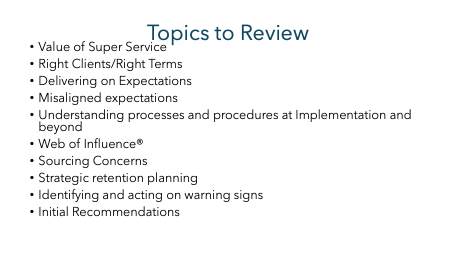
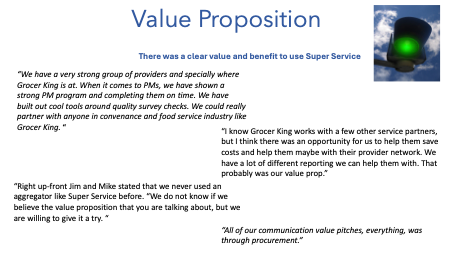
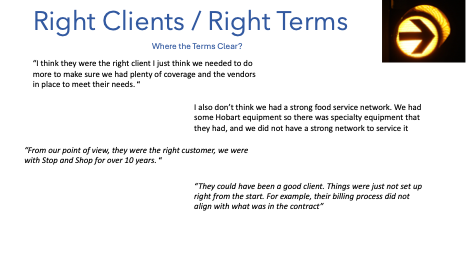
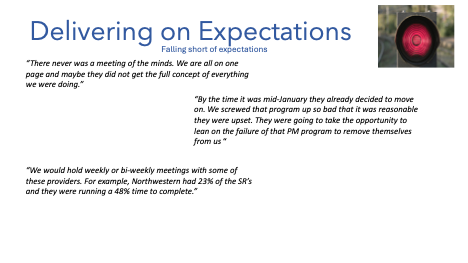
Once complete, you will have a powerful report that highlights areas of strength, aspects worth noting, and opportunities for growth and development. This report should first be shared with the Executive Team, followed by the rest of the company members who have an interest in the findings. It is important to allow the Executive Team the opportunity to review and adjust the presentation to ensure it is received effectively by the organization while maintaining the integrity of the general themes and content.
For example, if the report portrays the head of IT in a negative light, it would be beneficial to refine the messaging before sharing it with the broader organization. However, no changes should be made until after the Executive Team’s review to preserve the accuracy and authenticity of the feedback.
The report should also be revisited in approximately one year. If the same positive trends remain, that is a strong indicator of sustained success. However, if the same negative trends persist, it may signal a deeper issue that requires further attention. As the saying goes, doing the same thing repeatedly while expecting different results is not an effective strategy.
This will conclude the internal assessment. The next step will be to shift our focus externally, assessing client perceptions of the company through FreshEyes® Reviews and PostMortem Audits®.
Case Study 1
How LEGO Used Customer Insights to Save Its Business
In the early 2000s, LEGO was on the brink of collapse. The company had overexpanded into theme parks, video games, and apparel while losing touch with its core customers—children and their parents. Sales were plummeting, and LEGO was losing market share to cheaper, more interactive digital toys. By 2003, the company was nearly $800 million in debt, and experts predicted bankruptcy was inevitable.
LEGO leadership realized they needed to understand what their customers truly wanted, so they turned to research. Instead of relying on internal assumptions, they engaged in deep customer insight gathering. Teams of researchers and designers spent time with children, observing how they played. They found that while executives assumed kids wanted simpler, quicker-to-build sets, children actually loved complexity.
They enjoyed the challenge of building intricate models and creating their own worlds.
Armed with this insight, LEGO refocused on what made them unique. They reduced the number of new product launches, cut unprofitable ventures, and doubled down on advanced building sets with detailed instructions and open-ended creative possibilities. They also engaged directly with adult fans, launching initiatives like the LEGO Ideas platform, where customers could propose and vote on new sets.
Another major shift was the introduction of storytelling into LEGO sets. Partnering with franchises like Star Wars and Harry Potter, LEGO created sets that allowed kids to build and play within narratives they loved. This approach reinvigorated interest in the brand and attracted new generations of builders.
By 2015, LEGO had become the largest toy company in the world, surpassing even Mattel. Sales skyrocketed, and their net profit jumped from near bankruptcy levels to over $1 billion annually. This turnaround was entirely driven by listening to customers, understanding how they engaged with products, and delivering an experience that resonated with their needs.
LEGO’s revival highlights the power of customer insights. Instead of assuming what customers want, companies that take the time to observe, ask, and adapt can transform their businesses—even from the edge of failure. Would you like to incorporate discussion questions into this case study for your workshop?
Course Manual 7: External Assessment Setting up Interviews
Now that we looked inward and have a better understanding of the company’s capabilities as it relates to retention and how the key stakeholders in the company believe, we can move on to better understanding the perceptions, expectations, opportunities and challenges of our clients. For the purposes of training, we have made it step as first step one then step two. In actuality the two assessments, internal and external can and should be done in parallel.
Time is of the essence so the steps can intermingle. For example, there is no reason that when the emails go out to the internal stakeholders they cannot go out to the external stakeholders. The key is to have someone be the coordinator or traffic control person to make sure the appointments for all the interviews are in place and conducted. This is the job of the Client Retention Executive. He or she should be the point person to ensure all emails went out interviews are scheduled.
Scheduling the External Interviews
We want to give a very realistic perspective for scheduling and conducting external interviews. They differ from the internal interviews one keyway. Internal stakeholders have more of a vested interest in participating in the interview process and a request from leadership goes much farther than a request from a partner or you are not there yet a vendor.
Internal stakeholders are inherently more receptive to participating in one-on-one interviews because they have a direct and vested interest in the company’s success. Employees, managers, and leadership teams are deeply involved in daily operations, long-term strategy, and the overall health of the organization. When leadership requests participation in internal interviews, employees understand that their feedback has a direct impact on shaping company policies, improving workflows, and enhancing client retention efforts. They recognize that their input can lead to positive organizational change, which benefits both their work environment and the company’s overall stability.
Furthermore, internal stakeholders often feel a greater sense of obligation and accountability when asked to participate. Since they are part of the company culture, they are accustomed to responding to leadership requests, whether it’s for surveys, training, or strategy sessions. The organizational hierarchy and company-wide expectations create an environment where participation is seen as part of their role. In many cases, employees also perceive these interviews as an opportunity to be heard, share insights, and contribute to meaningful improvements that could make their jobs easier or more effective.
Conversely, external stakeholders—including clients, partners, and vendors—do not have the same intrinsic motivation to engage in interviews. While they may have a relationship with the company, their primary focus is on how the business serves their needs rather than improving internal processes. Unlike employees, who may view participation as a way to strengthen their standing within the organization, external stakeholders often weigh the request against competing priorities. Without a direct obligation, external stakeholders may perceive participation as a favor rather than a necessity.
Additionally, leadership requests hold more weight internally than they do externally. Employees are more likely to prioritize an invitation from a CEO or executive team, while external stakeholders may not feel the same sense of urgency or obligation. This fundamental difference makes scheduling and conducting external interviews more challenging, requiring a more strategic and value-driven approach to securing participation.
That does not mean that they will not participate. In fact, we have found in over our 38 years of experience that over 70% of the those that have been requested to be part of the one-on-one external interview process due participate. This is true for the FreshEyes® Review as well as the PostMortem Audit®. That said it does take persistence, tenacity and a dogged approach to schedule the interview.
The biggest challenge is that the individual at the client will want to do it on his or her time. That includes the time he or she responds to the original email, sets the date and even reschedules the interview process. In this case patience is a virtue along empathy for the individuals time constraints. It is not that they do not see you request as important, they do and again most want to help. It just may be number 8 out of 10 on their priority list and the reason your email may drop of the radar screen. This is where persistence pays off. You must find ways to gently remind them of the request and impart on them how much their feedback and insight will benefit the company, the partnership and your ability to better meet and exceed their expectations.
Scheduling the interview and getting on the client’s calendrer is the most rate limiting part of completing the external assessments. That is why we suggest that the internal assessment and external assessment are not done in sequential order but in parallel. The Executive will be reviewing the entire assessment principal to be able to understand the full picture and a long lag between reviewing the internal and external assessments will lead to a disjointed understanding of the overall feedback.
Identifying and Documenting
We may have got ahead of ourselves as we discussed scheduling the interviews. The purpose was to show that the importance of conducting the internal and external assessment in parallel. However, before you can move forward you must first identify and decide who you are going to interview in the first place.
This may be a little be of a little bit of a review but the value of selecting the correct people to interview will be crucial to the providing a quality assessment of the key clients and the key stakeholders.
First let us review the clients that should be selected for the FreshEyes® Reviews. This should not be a random selection process. They should be from your key accounts. These are the ones you just cannot afford to lose. The number will vary depending on the size of you company and the bandwidth you have to conduct the interview. Within those key accounts you should select a good cross-section of those that are fans of your company, those who are in the middle and those that might not be so happy with you. We understand that this is your best guess right now. After all that is why you are conducting the interviews. We have seen companies tell us that they know for sure that this company is not going to provide positive feedback only to be surprised by the report.
For example, let us say that you landed on conduct FreshEyes® Reviews on 5 of your top clients. We would recommend you select 2 that are raving fans in your opinion, 2 that are in the middle and one who you may term as a detractor. We also recommend that you select one or two that are in reserve just in case the client has a policy against participating in one-on-one interviews. It is a rarity, but it does happen. It usually is a company that is heavily controlled by the purchasing department.
Ok the key accounts have been selected. We bet that you might have them in your mind. We suggest you hold off making the list official. The Executive Team has also been thinking of who to select. Together the Partnership Success Team and the Executive team should align on who and how many clients will be interviewed.
Now you can begin to define the stakeholders you will be interviewing for each. Again, for review these should be those individuals that can hire, fire or heavily influence the hiring and firing of your company. The selection process should start with the account team, be reviewed by leadership and signed off on by the Executive Team. You want a true reflection of the views of the stakeholders and not selected or excluded by what a stakeholder might say. We recommend 5-8 stakeholders per client.
The stakeholders for each account should be captured in a contact spreadsheet. Your will vary but here is a basic version. It should have the product or service being offered, The company, the account manager associated with the client, The contacts, their emails and phone numbers.
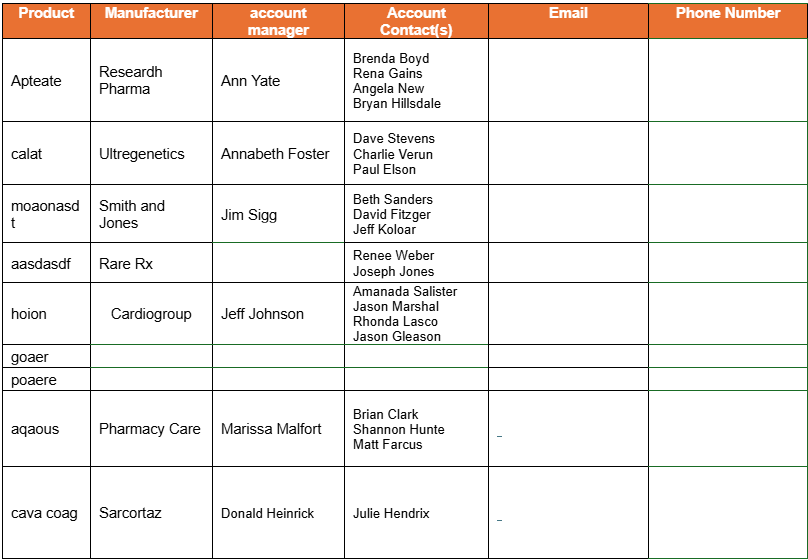
At this point nothing should be highlight or colored. This will be your working document to keep track of all the individuals that need to be interviews. It seems pretty clean and straight forward right now, well just wait. Before you are done you will have different colors for each action taking from the first email sent to the phone calls made to acceptance of the interview. Again, this is one version, and we are sure you may have your own. For example. You may not have an account manager but a salesperson who conducts a dual rule as account manager and sales. In that case you would put that person down as the main contact instead of the account manager.
The Thumbnail
Along with the contact list a brief summary should be provided about the client. Simply the length of the contract, the services that are being currently offered, level of influence of each stakeholder and any other significant information the person conducting the interview could benefit from knowing.
What should not be shared with the person conducting the interview is anything that would influence or lead the one conducting the interview. This is not the time for instance to say that Mary Smith is very upset with us and is naturally negative towards us or that George Jones is going to definitely tell you about the one instance that he remembers a certain way but in reality is not true. As a popular TV show once put it “just the facts mam”. Anything more than that will just poison the conversation and may lead to the interviewer asking either shying away from certain questions or glossing over important information.
We suggest the emails to go out from the CEO or person most apt to get a response from the client from Tuesday through Thursday. We do not suggest you send out on Fridays or Mondays for good reason. On Friday things tend to get left for the weekend. By the time you follow up the email but definitely fall to the last thing on Friday or worse over the Weekend. Mondays are not much better. Stakeholders are swamped with large to do lists and digging on from all the emails from Friday on. The email should look something like this.
Date
Client Name
Client Address
Re: Arranging a Review Discussion
Dear [Stakeholder],
We are committed to providing high-quality services that meet the needs of our clients. As part of our ongoing efforts to improve, we would appreciate the opportunity to discuss your perceptions of our organization, our services, and areas where we can enhance our support.
We kindly request 30 minutes of your time for a conversation to gain your valuable insights. Your feedback will be instrumental in helping us refine our approach and continue delivering the best possible service.
To ensure an unbiased perspective, we have engaged someone from our Partnership Success Team who will be reaching out to coordinate a convenient time for this discussion. They are not part of the day to day workings and have been trained in having unbiased conversations.
We appreciate your time and look forward to reviewing the insights gathered from this process with you.
Respectfully,
[CEO or Other’s name] [Title] [Organization Name] Phone: [Their Phone] Email: [Their Email]The person from the Partnership Success Team that should follow up is the one who will be conducting the interview. We highly recommend that one person conducts all the interviews for the same client. Otherwise, there will be a lack of continuity from interview to interview and when it comes down to creating your impressions, they will be impressions by committee versus a focused set of thoughts based on the same person conducting multiple interviews.
Your email in response to the one sent by the CEO should follow within 30-60 minutes of the original email sent. That way the stakeholder can quickly connect the two emails and has a better chance of taking action. If you wait more than a day the stakeholder will have probably forgotten about the request to participate in a FreshEyes® Review by the CEO or may be wondering when you are going to follow up and move the request further down on the priority list. There needs to be a sense of urgency. The quicker you act the better your odds are to get a positive response.
The request should be something like this:
Dear [Name],
I hope you’re doing well. I wanted to follow up on [CEO or other’s] request for us to spend 20–30 minutes discussing [Company] and how well we are meeting your expectations.
Your participation is greatly appreciated, and your insights will help us continue to improve and better serve you. This isn’t a survey—just a conversation to gather your valuable perspective.
Please let me know your availability over the next few weeks, and I’d be happy to coordinate a time that works best for you.
I look forward to our conversation.
Best regards,[Interviewer] [Email] [Phone]
This is your first attempt. You should then color code all those you sent a letter. It might look something like this.

You will notice that Matt Farcus is in purple this might be your color code for bad emails. This will let you know that you may need to reach out to the account team for the correct email. Bryan Hillsdale email was not marked blue denoting an email was not sent out.
Once you have sent all the emails out you will then wait two to three days. In the interim we are sure you will receive responses and dates from some. Mark the ones you scheduled interviews with as let’s say orange. The one you did not hear back from you will then reach out again. You do not want to wait more than three days because you want the request to stay top of mind. This is a reminder email for them to schedule time with you. You form may now start looking like this.

Red might denote that the person declined, light blue a second email was sent out and again orange you have secured an interview. Unfortunately, just because you have secured an interview does not mean it will happen. Business happens and rescheduling will occur. That is why we suggest you hold off on the color green for those with completed interviews.
You will wait two more days and then reach out by way of phone call. It used to be that we never reached out by cell phone unless there was a very good reason. However, now the majority of individuals we interview have cell phone as their main point of contact. We also realize most people do not answer their phones and wait for it to roll over to voicemail. You should leave a voicemail and then follow up by email. Record the action accordingly on your form. We have not tried reaching out by texting but we are sure the day will come soon enough.
After you call wait another two days and do the same. If you have not received a response by then we suggest you mark it red. However, it is somebody that is critical to the FreshEyes® Review now might be the opportunity to have someone with a direct contact to call him or her and ask if they will participate. That can be the trick to getting the request fulfilled. The reason it is not done right away is because we want to try to keep it neutral and not be influence or implied that the account team is part of the process.
Workshop Exercise: Crafting Effective Follow-Up Communications
PostMortem Audit® Process
The process for collecting the stakeholders and asking for the interviews if very similar. There are really only two differences.
One is the selection of the clients. Unfortunately for PostMortem Audit®s they are going to come to you. Again, we are not saying you should conduct a PostMortem Audit® on every client but if they were a key client there should be no question, do the PostMortem Audit®. The only exception is if there are legal issues that still need to be addressed. Then we suggest you hold off.
Two is of course the letter. Here you are asking for help in giving insight so you can better service your clients in the future. It should read something like this and still come from your CEO or person most apt to get a response with stature. It should look something like this:
Subject: Follow-Up on Discussion Request
Dear [Stakeholder],
I hope you’re doing well. I wanted to follow up and see if you’d be open to a 20–30 minute conversation about your past experience with [Company]. We would greatly appreciate your insights on what worked well and where we could improve.
Your feedback is invaluable in helping us refine our approach and better serve our clients in the future. This isn’t a survey—just an open conversation to hear your perspective.
To ensure an unbiased perspective, we have engaged someone from our Partnership Success Team who will be reaching out to coordinate a convenient time for this discussion. They are not part of the day to day workings and have been trained in having unbiased conversations.
I look forward to reconnecting.
Best regards,[CEO] [Email] [Phone]
All other steps will be the same as with the FreshEyes® Review. You will collect the contact and the Thumbnail and go through the same process. The more organized and methodical you make this approach the better you will be at achieving a strong response rate and setting yourself of strong interviews which we will go through next.
Case Study: How Selecting the Right Interviewees Transformed Client Retention Strategies
A mid-sized business services company was experiencing increasing client turnover and declining renewal rates. Leadership recognized the need to understand why clients were leaving and how they could improve their retention strategy. They decided to conduct in-depth client interviews using the FreshEyes® Review process, but instead of selecting interviewees at random, they took a strategic approach to ensure they received a well-rounded and meaningful perspective.
In previous feedback efforts, the company had relied heavily on surveys and interviews with senior executives from client organizations. While these conversations provided useful insights, they often lacked depth regarding day-to-day service challenges. Many executives gave high-level feedback but were not involved in the daily interactions that defined the customer experience. Additionally, previous interviews focused almost exclusively on satisfied clients, missing crucial insights from those who were indifferent or dissatisfied.
To address these shortcomings, the company broadened its interviewee selection process. Instead of relying solely on decision-makers, they included a diverse group of stakeholders from each key client account. End users who interacted with the service daily were brought into the conversation, as were procurement officers who evaluated the company’s value proposition. Leadership also made a conscious effort to include neutral clients and those who had previously expressed dissatisfaction, ensuring they received a balanced assessment of their performance.
Through these interviews, several key insights emerged. A significant disconnect was found between executives and end users, where leadership praised the company’s strategic partnership, but those using the service daily reported frequent delays and communication breakdowns. This misalignment created internal friction within client organizations, causing some to consider alternative providers. Procurement teams also raised concerns about the perceived value of the service, indicating that while the company believed it was providing high-value solutions, pricing transparency was an issue. Clients were unsure how their fees were structured and often found competitors offered more straightforward pricing models. Another major finding came from neutral clients who, while not expressing dissatisfaction, saw no compelling reason to remain. Many of these clients admitted they would likely switch providers if a better offer came along simply because they did not feel a strong sense of partnership or proactive engagement.
The broader selection of interviewees provided the company with a much deeper understanding of client sentiment, leading to immediate and strategic changes. Communication and service processes were restructured to ensure that end-user concerns were addressed more quickly. The company also developed a new pricing model with clearer cost breakdowns, directly addressing procurement team feedback. Recognizing the risk of losing neutral clients, the account management team implemented proactive check-ins to strengthen relationships and add value before competitors could step in.
Within a year, the company saw a measurable impact. Client retention improved by 22 percent, overall satisfaction scores increased by 15 percent, and last-minute contract losses were significantly reduced. Had they continued with their previous method of interviewing only a limited group of decision-makers, they would not have identified these crucial gaps in service and communication.
This case study illustrates the power of selecting the right people to interview. By including a diverse and representative mix of stakeholders, the company was able to uncover hidden challenges, bridge perception gaps, and implement meaningful improvements that directly impacted client retention. A well-rounded selection of interviewees provided the depth of insight necessary to make informed, strategic decisions that ultimately reshaped their client relationships.
Course Manual 8: Conducting the FreshEyes® Interview
You have selected those individuals that you wanted to interview. You reached out and have secured a date to conduct the interview. Now what do you do? How do you set up the interview? How do you create an environment that is conducive to doing the interview? What are the first sentences that should come out of your mouth? What questions do you ask? How do you end the interview? We will tackle all of this!
By the time you complete the conducting an interview training, you will have the confidence to execute you first FreshEyes® Review. But we are not there yet. We will take a moment now to review everything from reminder the individual about the interview to be conducted to actually conducting the interview.
Some Basics

2 to 3 days before you are scheduled to conduct the interview you should send out a reminder with the simple email stating you are looking forward to the conversation on at the scheduled time and scheduled date. If you fail to do it the interviewee may not jump on the call. It is frustrating to be on the call for five then ten minutes only to realize that the person will not be joining the call. That will happen on its own a few times but a simple reminder call will decrease the odds.
Before the call starts make sure that there are no distractions on your end. Some pro tips include closing the office door if all possible, putting you phone on silent and closing your emails for the extent of the call. You will also want to read over the summary of the client provided to you remind yourself the key points.
Get on the call five minutes before the call is scheduled to start and make sure your recording app is ready as well. While we suggest one of the many AI transcribers out there, you can also just use an App to record the call as well. Also, make sure your video is work, and on. There is nothing like showing disinterest like not being on video. Show you care enough to be present and attentive. We cannot guarantee the client will do the same but 90% of the time they will take their lead from you. Turn on the video. You might even hint if they have not turned on their video by asking if they can see you.
It often triggers them to turn on their own.
The Introduction
When the interviewee joins the call, take a moment to sincerely thank them for their time and participation. Expressing appreciation is simple yet meaningful—let them know that their input is valuable and that you truly appreciate their willingness to engage in this conversation.
Next, clearly communicate the objective of the discussion. The goal is to put the interviewee at ease and establish a comfortable, open dialogue. This can be done by stating something like:
Joe…
I am not directly associated with the account, and my role here is simply to have a conversation about what the company is doing well, what it could improve, and what it might start doing. This is not a formal survey, but rather an open discussion. I appreciate your time and perspective.
You many notice we never said our company or we at anytime. This is purposeful. You will want to keep this as unbiased as possible and be clear that you are here not to defend you company but to be a third-party gaining information. Once the objective is clear, briefly inform the interviewee that the call will be recorded. Keep this part simple and straightforward:
I hope you don’t mind, but I would rather focus on our conversation than take extensive notes. Would it be okay if I record this call?
After addressing this, seamlessly transition into the first question:
So, let’s get started—how is the company performing against your expectations?
Your role in this conversation is primarily to listen. Be engaged, offering verbal and non-verbal cues that indicate active listening. A simple “I see” or a nod can go a long way in encouraging the interviewee to share openly. The conversation should feel natural and fluid, much like a discussion over coffee rather than a formal interview.
Addressing Potential Challenges
What if the participant does not join the call?
Give them five minutes before taking any action. Often, the interviewee is caught up in another meeting and may need a moment to transition. However, avoid waiting too long—if they do not show up after five minutes, send a brief follow-up email. Keeping the window short increases the chances of them joining rather than moving on to another task. If you wait too long (e.g., ten minutes), they may assume the opportunity has passed and may opt to cancel or reschedule, which could delay reporting.
What if they decline to be recorded?
In approximately 10% of cases, the interviewee may decline recording. If this happens, remain calm and adaptable. Simply focus on active listening and take mental notes. As soon as the call concludes, document the conversation to the best of your recollection. In the report, make a note stating that the participant opted out of recording and summarize the discussion as accurately as possible.
What if they ask about how the information will be used?
If the interviewee inquiries about the purpose of the discussion and what will be done with their feedback, provide a transparent and concise response:
I am speaking with you and a few of your colleagues to gather insights. Once all discussions are complete, I will compile the key takeaways into a report for leadership. This will highlight areas for improvement, things the company should continue doing, and new opportunities to explore.
Final Considerations
The key to a successful conversation is keeping it relaxed and organic. Avoid rigidly reading from a script. Instead, engage in a natural discussion that allows the interviewee to share their thoughts freely. Think of it as an informal yet insightful dialogue—one where they feel comfortable expressing their honest opinions without pressure. By maintaining this approach, you will foster a more open, productive exchange that provides valuable insights for the organization. It should feel more like a discussion over coffee than an interrogation.
Focus Areas for Discussion

There will be four key areas of focus during the interview process: Expectations, Relationships, Technical Delivery, and Future Needs. Each interviewee will have varying levels of engagement in these areas. Some may quickly move through the Expectations portion but have a wealth of insights on Future Needs. Your role is to follow their lead while ensuring the discussion remains meaningful and detailed. Relax, at first there will be a tendency to move quickly but slow down and enjoy the discussion.
It is common for interviewees to begin with general responses. That is completely fine. Your job is to listen, process their statements, and then probe deeper. If they provide a broad answer, rephrase the question or ask for an example. Do this once or twice before moving on—this should feel like a conversation, not an interrogation. The goal is to extract specific and actionable insights. However, if you over ask a question the person being interviewed might get frustrated.
Conversely, if an interviewee becomes deeply engaged in a particular topic, do not rush them just to cover all questions. The priority is to obtain valuable information rather than simply checking off questions. This is why the process is conversational rather than structured like a survey. Focus on what matters most to them, as this is where the most useful insights will emerge.
Each of these four areas presents an opportunity to uncover different aspects of the client experience. Expectations help set the baseline of what the client anticipated and whether those expectations were met. Relationships offer insights into how trust and communication have been built between the client and the company. Technical Delivery focuses on execution—whether the services or products meet their needs effectively. Future Needs is often where the most valuable insights lie, as it reveals potential areas for innovation, growth, and improvement.
Your ability to navigate these areas effectively will determine how insightful and actionable the findings are. If a participant offers surface-level responses, ask questions such as, Can you elaborate on that? or Can you give me a specific example? These small nudges encourage a more in-depth discussion. At the same time, be adaptable—if a participant is passionate about a particular topic, allow them space to speak at length. Deep conversations in one area often yield more impactful takeaways than brief, shallow answers across all four.
By maintaining a balance between guiding the conversation and allowing the interviewee to lead, you will ensure a productive and insightful discussion that benefits both parties. Also, remember to check in with verbal and nonverbal cues. It can be is simple as saying oh, or ok. Maybe you say “that is interesting” or “I understand”. What you do not want to do is lead the witness or show emotion by saying things like “that is horrible” or “that is horrible”. Just remember yours is to listen and dig deeper when appropriate.
Expectations
We already gave the first question away: How is the company doing against your expectations? This question is broad and can sometimes lead to vague or surface-level responses. If the interviewee does not elaborate, follow up with more specific questions to gain deeper insight. Asking, How did you initially set your expectations for the company? can help uncover whether their perspective was shaped by past experiences, industry standards, or discussions with colleagues. If they mention that expectations have changed over time, ask What has influenced that shift? to understand whether the company has exceeded or fallen short of their evolving needs. This is also critical to determining of they see value in conducting Expectation Sessions we will discuss later on in Execute.
Another way to refine the discussion is by exploring specific aspects of their expectations. Asking, Were there any particular promises or commitments that were most important to you? can shed light on key deliverables that matter most to them. If they indicate that some expectations have not been met, follow up with Can you describe a time when our service did not align with what you were expecting? This encourages them to provide real examples that can be used to improve future service. If expectations have been exceeded, asking What specifically has stood out to you in a positive way? can help identify best practices worth maintaining.
Expectations can also be tied to industry comparisons. Asking, How do the company compare to other companies you’ve worked with in the past? may provide insights into competitive advantages or areas needing improvement. If they have worked with similar providers, ask What do you wish companies in the industry did differently? This can offer valuable perspectives on potential areas for differentiation. By taking a flexible and detailed approach, these questions will help extract meaningful feedback that goes beyond generalities.
Finally you will want to find out the current expectations by simply asking What are your current expectations of the client? This is valuable to share internally to make sure you are indeed working towards their current expectations.
Once you have exhausted all that you can glean from expectations you can then move onto the Relationship. Remember this can happen quick for some and you will get a feel of how deep to go and additional questions to ask depending on the answer. You do not need to ask every question. These questions are just guides for you to move the conversation along and help you gain feedback.
Relationship
The next area of focus is the relationship. This aspect of the discussion explores whether the company is perceived as a vendor or a true partner, whether its approach is proactive or reactive, and the level of communication. While these are conceptual questions, the responses often reveal significant insights.
The first consideration is whether the company is viewed as a vendor or a partner. More often than not, clients will initially claim that they only work with partners. However, deeper questioning throughout the conversation will reveal the truth of that claim. The next question, which examines whether the company is proactive or reactive, may provide an indication of the true nature of the relationship.
Clients frequently express frustration when a company aspires to be a partner but falls short by responding to issues rather than proactively addressing challenges before they arise. If the client sees the company as proactive, that is a strong indication that the relationship is on the right track. It is crucial to ask for specific examples—when does the client see the company acting proactively, and when is it more reactive? In some cases, a reactive approach is appropriate, such as in crisis situations where swift action is required. However, a true partner should proactively anticipate and mitigate issues, reducing the need for crisis management.
The next key element is communication. A strong relationship should not experience a decline in communication from the beginning of the contract to the renewal process. Ideally, the client should perceive the company as a resource they turn to not only for problem-solving but for strategic guidance. If the client views the company as a trusted expert that helps drive innovation, this is a strong indicator of a healthy partnership.
The conversation then transitions to more specific questions regarding the Web of Influence®, first examining the overall value of the company and then the relationships with individuals. A powerful way to gauge the company’s importance is to ask a hypothetical question: If the company were to close its doors tomorrow, how much of a hardship would that cause? It is essential to clarify that this is purely a hypothetical scenario to avoid any unnecessary concerns. The client’s response will reveal how integral they consider the company to their success.
After assessing the company’s perceived value, shift focus to the individuals within the organization that the client interacts with. If the client can name specific people, this is a strong indication of a meaningful relationship. The number of individuals they mention is also telling—if only one person is identified, the relationship may be limited in scope. A broader network of relationships within the organization suggests a more deeply rooted partnership.
A follow-up question should explore which individuals, if any, would have a significant impact on the relationship if they were to leave. If the client struggles to identify anyone, this may suggest that the company is viewed more as a vendor with interchangeable representatives rather than as a true partner. If they mention key individuals, take note, as this insight can help inform succession planning efforts.
If previous responses have been largely negative, it is necessary to ask a direct and potentially difficult question: Why do you continue to work with the company? Would it be better to move on to a new partner? This question serves two purposes. It seeks to uncover what, despite any challenges, keeps the client engaged with the company. Additionally, it helps assess whether the account is at risk of falling into the Meltdown quadrant of the client retention matrix. The response may reveal underlying issues that need to be addressed or, conversely, highlight strengths that can be reinforced to solidify the relationship.
By delving into these areas with a structured yet conversational approach, the interview will yield meaningful insights into the client’s perception of the relationship, guiding future strategies for engagement and partnership development.
Solving the Problems for Today and Tomorrow
The discussion in this phase begins with a broad yet revealing question: what grade would the client give the company—A, B, C, D, or F? This is the only quantitative question in the conversation, and the response often does not align perfectly with the overall tone of the discussion. Clients may provide constructive feedback throughout the call and still assign a high grade, or conversely, they may highlight positive experiences but still rate the company lower. The true insight lies in understanding why they chose that specific grade.
Following this, the natural next question is what it would take for the company to achieve one grade higher than the one given. This question uncovers real opportunities for improvement. Because grading is inherently subjective, clients will have different reasons for their assessment. Some may focus on responsiveness, while others may look at innovation, consistency, or leadership within the industry. Understanding the reasoning behind their rating is far more valuable than the rating itself.
The conversation then moves into a broader perspective by asking what advice they would offer to the CEO. This question often elicits strong opinions and provides insight into areas where clients see potential gaps in delivery. It also reveals where they would like to see the company grow. Many clients will answer by describing where they believe the CEO should take the company, which often aligns with their own needs and expectations for the future.
After gathering these insights, the discussion shifts to unresolved issues. Clients are asked what problems the company has yet to solve that still need to be addressed. This identifies gaps in service or execution that may not have been previously communicated. It also provides the company with clear action items to work toward. From there, the focus moves to the future by asking what challenges the company can help solve moving forward. This is a crucial part of the discussion, as it gives insight into how the company can continue to be of value and evolve with the client’s needs. It also highlights opportunities for strategic planning and innovation.

The final key question is whether the client would provide an unqualified, no-questions-asked referral for the company. If the answer is yes, it is a strong indicator that they are a satisfied and engaged supporter of the company. If not, the follow-up question is equally important—what is holding them back? Their response will highlight any remaining concerns or hesitations that need to be addressed to strengthen the relationship and client satisfaction.
As the conversation comes to a close, one last question should always be asked: what have I missed? This final open-ended question gives the client the opportunity to bring up anything that has not yet been discussed. Often, this question provides the most candid and unexpected insights. It allows the client to share what is truly on their mind, whether it is a pressing concern, an unmet expectation, or an opportunity for improvement. The responses to this question can be invaluable, as they may highlight issues or opportunities that had not been previously considered.
By guiding the conversation through this structured yet open-ended approach, the discussion provides not only a clear assessment of the company’s current standing but also actionable insights for both immediate and long-term improvements. In just 30 minutes, this process can uncover critical information that will help shape future strategies and client engagement efforts.
Exercise 1
Case Study 1
A client of ours who will stay anonymous compared the percentage of contracts that were extended using FreshEyes® versus the percentage of contracts that received extensions not using FreshEyes® Reviews. It is important to point out that all other aspects of the Clients for Life® process were used on both those that received the FreshEyes® Reviews and those that did not. For those contracts that did not benefit from a FreshEyes® Review the 42% extended. For those who received a FreshEyes® Review it was 65%. A large difference considering the only difference was conducting a FreshEyes® review or not.
Course Manual 9: Creating the Report
So, you finished the last discussion with the client now what. You know all the components of the interview. You have taking insights and feedback from every interaction.
Preparing the Verbatims

You either recorded or had AI generate a first-pass transcription of the interviews. Now it’s time to elevate that raw content into a polished, readable document that clearly communicates the insights shared by the interviewee. This stage is crucial. You are not just transcribing — you are interpreting, organizing, and refining.
Begin by carefully reviewing the transcript, ideally while listening to the recording. This allows you to correct any misheard or misrepresented words and ensures accuracy. Pay close attention to industry jargon, names, acronyms, or subtle cues in tone that may alter meaning. It’s essential that the final document faithfully represents the voice and intent of the person being interviewed.
As you edit, remove filler words such as “um,” “like,” “you know,” “so,” “but,” and other verbal crutches. These may sound natural in speech but clutter written content and make it harder to digest. Keep your edits tight and intentional. Your goal is clarity, not verbosity.
Only capture the voice of the person being interviewed. The focus should be entirely on their responses and perspectives. If the interviewer’s question is not clearly restated in the response, you may need to paraphrase the beginning of their answer to provide context. For instance, if asked, “How is Acme Corporation doing against your expectations?” and they respond with, “They’re doing great. I love how proactive they are,” you might refine it to: “Acme is doing great against my expectations. I love how proactive they are.”
Avoid the urge to over-sanitize or soften the tone of the speaker. If the interviewee uses strong or colorful language for impact, consider keeping it, so long as it serves a clear purpose and aligns with the tone of the interview.
Once your content is clean and accurate, begin to organize it into sections. Rather than defaulting to generic headers like “Expectations” or “Future Needs,” look for unique themes or repeated points and create meaningful, tailored headers that reflect the spirit of the conversation.
Finally, identify a few key quotes that distill the most compelling insights. These should be placed near the interviewee’s name or along the margin of the first page to allow quick reference. Choose quotes that are powerful, specific, and representative of the broader conversation. Limit this to only the most essential highlights — a handful of strong quotes is far more impactful than a crowded page of minor ones.
The final result should be a clean, engaging, and well-structured summary that does justice to the person interviewed and makes it easy for decision-makers to absorb the core insights without needing to read the full transcript.
You will then go through the same process for each person that you have interviewed. If you have the resources it may be worth having an administrative assistant do the first few passes and then for you to review to ensure integrity and clarity. These do take time and some work done for you will help you work more efficiently through the process.
Remember there is a timeless to getting the report in the hands of leadership and the account team so be efficient in turning it around.
Capturing the Nuances
You captured in your conversations not just the verbatims but you probably have picked up some body language that might not be able to be captured in the verbatims. Things can be said many ways and it is often only when correlated with the body language and facial image that everything is put together.
Here is a good example. In the southern part of the United States you may someone say the words “bless your heart”. Before you get warm fuzzy’s you may want to notice the tone in the voice and the manner in which they say it. It can mean everything from what you think it should be and a fine compliment to a subtle dig on you are your abilities and everything in between.

“Bless your heart” is one of the most nuanced phrases in Southern conversation. Its meaning depends heavily on the tone in which it’s said, the situation, and the relationship between the speaker and the listener. At its most genuine, it’s an expression of true sympathy or kindness. If someone has suffered a loss or is going through a hard time, a Southerner might say “bless your heart” as a way to comfort them, wrapping concern in a warm and familiar phrase.
However, the same words can carry a very different tone when used with a touch of sarcasm or passive aggression. For instance, if someone makes a questionable decision or lacks common sense, “bless your heart” might be used to imply that they’re well-meaning but not particularly sharp. It’s a way to offer judgment lightly, cloaked in what sounds like kindness. You might hear it after someone tries and fails at something obvious, like attempting to fix a car without any mechanical skills, or telling a story that makes them look foolish. The phrase becomes a polite way to say, “That was not the brightest move.”
It can also be used in gossip, especially when someone’s choices or behavior don’t meet social expectations. A Southerner might say “bless her heart” while commenting on someone’s outfit, life choices, or parenting style—essentially using it to soften criticism. It allows someone to say something judgmental without sounding openly cruel.
At the same time, “bless your heart” can be sincere appreciation. When someone goes out of their way to help, brings food in a time of need, or offers unexpected kindness, the phrase may express genuine gratitude, often accompanied by a smile and warm tone.
And sometimes, it’s used for people who just don’t get it—those who might be unaware, naive, or trying hard but missing the mark. In these cases, it offers a mix of pity and affection, acknowledging the effort while recognizing the futility.
In short, “bless your heart” can mean everything from “I feel for you” to “you sweet fool” to “I can’t believe you just did that.” It’s all in how it’s said. In the South, it’s less a phrase and more an art form.
There has to be a way to capture that. You also need to just share your thoughts after conducting all the interviews. This is done through the impressions which is right after the title the title page. The title page will simply Have the client, who conducted the interview and the date range of the interviews conducted.
After that will be the impressions page.
Impressions
Since you read every verbatim a few times, captured the nuances in the body language and tone and had the conversations with all the key stakeholders you should have valuable insights or impressions you can share with everyone. Few people have the view you have had on the account as you do. This is you chance to share it!
The first sentence should always be the same for every Impressions. It defines where you are going to place the client within the client retention matrix. It may be helpful to remind you of the four categories, Gnats, Warranty, Counselor, and Meltdown.
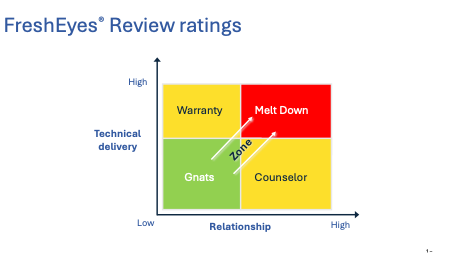
GNATS: An account is placed in the Gnats quadrant if things are going well and progress is being made against the client’s expectations. Although there will never be an account that is trouble-free, the problem(s) raised is(are) not threatening to the account. A few open issues may be identified and will need to be addressed through the development of an action plan and follow-up.
WARRANTY: These are technical problems. An account is placed in the Warranty quadrant if the client expects the company to repair/fix a technical problem “at once”, pay for it, and ensure there is no repetition of the problem (this could be related to a change or variation in your offer, consistency issues, services being seen as costing too much, etc.). These problems could potentially lead to the contract being questioned.
COUNSELOR: These are relationship issues with the client. An account is placed in the Counselor quadrant if more attention needs to be given to the relationships the client has with the company; for example, the client is disappointed with one of the company’s staff members or is experiencing issues with company individuals because they feel there is difficulty in connecting and collaborating This relationship challenges lead the client to feel that they are in contact with the wrong person. This may also lead them to lose trust in the relationship with the company.
MELTDOWN: An account is placed in the Meltdown quadrant when trust, capabilities, skills, values, and/or benefits are questioned to the point that the client wants the whole thing to disappear. The client has lost confidence in the company’s ability to recover and deliver and people stop communicating. Meltdown is the highest risk to a contract. It is extremely difficult to recover from that situation (even though a lot of energy and money could be dedicated to trying to do so).
It should be clear where to put the client usually. However, sometimes you might run it by the rest of the Partnership Success Team to decide where best to place the client overall. There are sometimes conflicting narratives.
We are placing Acme Corporation in the Gnats quadrant (or one of the other three quadrants) of the client retention matrix. This placement reflects the current health and trajectory of the relationship, based on observed behaviors, alignment with expectations, and the strength of ongoing engagement. The rationale for this classification should be clearly stated and grounded in facts—not assumptions—to set the foundation for the rest of the review.
Following this opening, a concise synopsis of the relationship should be included, highlighting the good, the bad, and the potential risk factors. This portion should reflect both accomplishments and warning signs, with specific examples or themes that emerged during the interview process. Keep in mind that the impressions section of the FreshEyes® Review must be written in third-person. Avoid using “we” or “you.” Instead, refer to the company or individuals by name. This positioning is essential, as it reinforces the role of a neutral, trusted adviser—not a peer or internal team member. The goal is to provide credible, strategic guidance from the outside looking in. The reviewer is not the hero of the story—they are the guide helping others navigate forward.
After outlining the impressions, move into succinct and pointed recommendations. These should be actionable and, when appropriate, tied to broader principles and proven practices that align with the client’s strategic retention plan. Recommendations should not only address immediate concerns but also offer insight into what it will take to retain the account long term. When possible, include insight that applies beyond this client—insight that illustrates patterns or behaviors that can be generalized and shared with other teams as part of a broader learning strategy.
Ultimately, this is not about proving the effectiveness of a strategy or checking a box. It’s about protecting and growing high-value relationships that the company cannot afford to lose. When that purpose stays front and center, the review becomes not just informative—but essential.
An effective FreshEyes® Review gives executives clarity, prioritization, and insight they cannot get elsewhere. It should surface the invisible threads holding the relationship together—or pulling it apart—and shine light on the specific actions needed to secure and strengthen the partnership.
Putting it all together
So here is the good news. You are finished writing the report and now it is just a matter of putting all together, so it is ready for distribution. It now just a matter of collating everything you have.
First comes the title page with the name of the client, who was interviewed and the date range. Then comes the client retention matrix with the client placed in the corresponding quadrant to what is being shared in the impressions. Then will come your impressions of the FreshEyes® Review. Following the impressions will be each verbatim of each person you had a conversation with. The verbatim should start with the most important person interviewed to the least to best of your knowledge. Remember for each verbatim the key quotes should be place either after the name and before the body of the verbatim or off to the right the right of the first page.
There you have it. All the hard work you have done is ready to be shared. Take a moment and reread over the document one more time for accuracy and appearance. This will be shared with leadership, so another review is not a bad idea.
Communication and Distribution
If the report contains sensitive material or may be difficult for the Account Team to digest, it is often a good idea to provide a courtesy preview to the Account Manager before distributing it more broadly. When doing so, it’s important to frame the intent appropriately. This is not an invitation to review or revise; it is a professional heads-up.
Let the Account Manager know the report will be sent to leadership the following day and offer to meet briefly to walk through the findings and answer any questions. This gesture of respect can go a long way toward preserving relationships and ensuring alignment—without compromising your role.
However, if the Account Manager requests that you soften, reword, or revise the FreshEyes® Review to make it more palatable, you must respectfully decline. Even if the reasoning seems compelling, you cannot go down that slippery slope. Your responsibility is to the truth of the feedback, and your credibility as a trusted third-party guide depends on your ability to deliver insight objectively, without editing for comfort. Your job is not to make the report easier to accept—it is to make it valuable, actionable, and accurate. If you alter the review to avoid discomfort or shield team members from necessary critique, the value of the process diminishes entirely. Leadership is expecting honesty and transparency—especially in areas that may be challenging to confront.
Once the report is finalized, it should be distributed to both the leadership team and the account team within 48 hours. There is no need to summarize or editorialize the report in the email. The content should speak for itself. Simply note that you are available to answer any questions and that you’re happy to schedule a follow-up conversation to walk through key insights and explore next steps. It’s also appropriate to note that your role is to support continued growth and retention, and that your findings are meant to help strengthen—not criticize—the relationship moving forward.
Delivering FreshEyes® Reviews with integrity, directness, and empathy reinforces your credibility and solidifies your role as a trusted advisor. The moment these reports are seen as political or overly filtered, their power is lost. Stand firm in your role—not as a critic or advocate—but as a guide committed to helping teams retain their most critical relationships.
Follow up and Next Steps

We will go over next steps in greater detail in subsequent workshops on how to read and respond to FreshEyes® Reviews. There is nothing worse than for a client to take time out of their day to participate in a thoughtful, candid conversation—only to receive no acknowledgment or follow-up. When the FreshEyes® Review is not properly received, reviewed, and acted upon by the appropriate internal stakeholders, its value is diminished significantly. A client’s willingness to be open is a sign of trust, and that trust must be honored with timely and meaningful follow-through.
For your reference, here is a quick synopsis of the FreshEyes® Review next steps. It is important that you understand this process, as you will often be the one facilitating the journey.
Step one is to convene the Account Team to review the FreshEyes® Review and identify themes or trends. Your role is to ensure the conversation remains constructive and forward-focused. This is not a session to assign blame or justify prior decisions. Instead, it should center on acknowledging the feedback, identifying both opportunities and risks, proposing potential action items, assigning ownership, and defining clear timelines. A preliminary planning document will be completed during this session to capture discussion points and initial commitments.
Step two involves reaching out to the client stakeholders who participated in the review to schedule a follow-up conversation. This is a critical step, as it signals that the client’s feedback is being taken seriously and used to drive improvement.
Step three is a confirmation dialogue, where the trends identified are shared back with the client—not as final conclusions, but as a starting point for alignment. This gives the client an opportunity to clarify or adjust their input and reinforces the collaborative nature of the relationship.
Step four is the presentation of your proposed action plan, organized around the trends discussed. These action items are not final until reviewed with the client. Adjustments may be needed based on their evolving needs or new developments. The goal is to co-author a working plan that all parties align around and feel confident executing.
In the end, the FreshEyes® Review process serves as both a relationship health check and a catalyst for long-term retention. Most often, it reinforces already strong relationships and helps ensure continued alignment. However, in situations where the relationship is at risk, it becomes an early intervention tool that can redirect momentum and rebuild trust.
It is important to recognize that the FreshEyes® Review is the most work-intensive activity within the client retention strategy, but its impact is proportionately high. That’s why we’ve dedicated significant time to walking through this process in detail. We will now transition into the PostMortem Audit®. Much of the process overlaps with what you’ve just learned, so we will focus only on the key differences—namely, the tone and content of the initial outreach, the structure of the questions, how impressions are formed, and the nature of follow-up steps.
Exercise
Exercise 1
Case Study
Several years ago, a national service provider—let’s call them Meridian Solutions—was at risk of losing one of their top five clients, a large healthcare organization with a long history of partnership. There hadn’t been any explosive conflict or formal termination notice, but there were signs: fewer returned calls, shorter emails, leadership turnover on the client side, and a quiet pullback from collaborative conversations. The Account Team had a hunch something was off, but couldn’t pinpoint the problem. That’s when the company decided to initiate a FreshEyes® Review.
The interviews were candid. One executive on the client side said, “We’ve started feeling like just another number. We used to collaborate. Now we just get check-ins and slide decks.” Another stakeholder mentioned delays in problem resolution and a lack of follow-through, especially compared to earlier years in the relationship. Most striking, however, was a senior stakeholder who admitted they had already begun exploratory conversations with two of Meridian’s competitors—just in case.
The FreshEyes® Review report pulled no punches. It placed the client squarely in the “Drifters” quadrant—accounts that were stable on the surface but slowly sliding into disengagement. The report included pointed feedback, quotes, and observations. It also highlighted areas of strength—such as the field team’s responsiveness and the quality of the product—which were still highly valued. But the message was clear: trust had eroded, and unless something changed, the relationship would likely end within the next twelve months.
Because the report was well-crafted, unbiased, and framed from a position of trusted advisory—not internal defense—it earned immediate credibility. It wasn’t viewed as an attack, but rather as a gift. The Account Team took it seriously. They conducted an internal reset meeting and built an action plan based on the trends and insights presented in the review. Within two weeks, the client had been contacted, thanked for their candor, and invited into a collaborative planning session to course correct.
That meeting turned everything around.
The client acknowledged the vulnerability in sharing such honest feedback and appreciated how it had been handled. Within three months, a new joint governance plan was in place, strategic meetings were reinstated, and the client had agreed to expand their contract rather than reduce it. What could have been a quiet exit turned into a quiet renewal—and ultimately a stronger relationship than before.
That FreshEyes® Review didn’t just save a client. It saved millions in revenue and reinforced to Meridian’s leadership the power of listening, the importance of objectivity, and the value of having a process that allows clients to be heard before it’s too late.
Course Manual 10: Post Mortem Audit®
A PostMortem Audit® can be sensitive to implement and discuss. After all, it is the loss of a client, and it may cause some to get defensive. That is why we suggest you begin with leadership and keep things somewhat above the Account Team level. You will need them to participate in the process of selecting the individuals to interview, but their involvement should be tangential to the process. You do not want the account team to feel as though you are going behind their back, but it should be done mostly with an arm’s-length approach.
The purpose of a PostMortem Audit® is not to assign blame, but to learn—objectively and constructively—what happened, why it happened, and how it might be prevented in the future. When approached with transparency and care, it builds trust and fosters a culture of improvement. Emphasize that the goal is to create better outcomes moving forward, not to dwell on what went wrong.
Selection Process

Much like the FreshEyes® Review the Account Team should take the first pass at selecting the stakeholders to be interviewed. However, the difference is these individuals should even be more heavily pressure tested by leadership to ensure that no key individual is left out of the discussion simply for fear of what they might say.
Now is not the time to shy away from the facts. It is an opportunity to learn and grow for your past clients. We believe the overwhelming majority of the feedback will be positive. On the other hand, there may be some key learning that might help your company adjust to not lose future clients for the same reason.
Requesting Participation
The only difference between the FreshEyes® Review and the PostMortem Audit® invite is the email that you will be sending out. A template was provided previously. Again you should be CC’d and follow up being aware of the timing of the email.
Conducting the Interview
It is even more essential that you put the person interviewing at ease. Let him or her know that you are not here to rationalize, defend or promote the company. You are simply here to gain insight and help the company continue to improve. You should be relaxed and give an impression with the words you choose the tone you use, and the body language.
The Questions

Many of the questions can be pulled from the FreshEyes® Review around Expectations, Relationships and Solving the Problems now and in the future. It will just be done in past tense rather than asking in the present form.
In addition to the regular questions, you will want to focus on what caused the client to leave, the professionalism of the client as the contract winded down and the opportunity of working together in the future.
Let us take them one at a time.
After you asked the basic questions, we just touched on that were asked in the FreshEyes® Review you will want to start to broach the subject of why the contract ended. For the purposes of training, we are going in linear order. However, as with most conversations, the dialogue does not happen in linear fashion. Therefore, please interject these questions when appropriate if the opportunity comes up anytime during the conversation.
The questions might be like this for why the client may have moved on.
Here are the same questions adjusted into the third person, each accompanied by the rationale behind asking it:
Could they share what initially prompted them to reconsider their relationship with the company?
This helps identify the critical event or issue that triggered the client’s dissatisfaction or decision to leave, allowing an objective analysis of the factors involved.
Were there specific expectations or needs that the client felt the company did not adequately meet or understand?
This question targets possible gaps in understanding or delivery, providing clarity about potential disconnects between client expectations and company performance.
From the client’s perspective, what could the company have done differently or better to maintain their business?
Asking this directly invites actionable suggestions, indicating openness and willingness by the company to adapt based on constructive feedback.
Did any experiences with the company’s team, processes, or products stand out as particularly frustrating or disappointing for the client?
This explicitly highlights negative experiences, pinpointing exact pain points that may have significantly influenced the client’s decision.
If you get the answer you need on the first one or two there is no need to badger the witness here. He or she might become somewhat agitated if you continue to press the issue. It would be better to stick with one or two and dig deeper than to ask multiple questions.
For professionalism focus on these questions.
Here are revised questions specifically addressing whether the client felt the company handled the end of the relationship professionally and helpfully when the client chose to leave, each with rationale provided:
When the client decided to end the relationship, did they feel the company handled the news professionally and respectfully?
This helps determine if the company demonstrated professionalism, empathy, and maturity in its initial response, avoiding defensiveness or confrontation.
From the client’s perspective, was the company cooperative and helpful in facilitating a smooth transition after the decision to leave was communicated?
This question identifies if the company maintained professionalism by providing support, clarity, and practical assistance during the transition period.
Did the client feel adequately supported by the company’s team as the contract was winding down, or did they encounter obstacles or unnecessary friction?
This assesses whether the company remained consistently professional and solution-oriented, highlighting any points of frustration or neglect.
Looking back, did the client observe anything specifically positive or negative about how the company managed the closing stages of the contract?
This open-ended reflection allows the client to provide balanced feedback, pinpointing areas where the company excelled or fell short in professionalism during the contract’s conclusion.
Now you can start to discuss if there is opportunity to work together in the future.
Does the client see circumstances under which they might consider working with the company again?
This question explores the client’s openness to future collaboration, potentially identifying conditions or changes necessary for re-engagement.
Are there specific improvements or changes the client would need to see from the company before considering another partnership?
This helps the company understand precise areas of growth required to rebuild trust and reopen conversations about future opportunities.
Would the client feel comfortable maintaining periodic communication with the company to revisit potential collaboration at a later date?
This assesses the client’s willingness to remain connected, signaling if there’s a foundation upon which future relationships could be built.
From the client’s perspective, are there services, products, or capabilities they believe the company could develop to better align with their future needs or objectives?
This provides insights into opportunities for innovation or strategic adjustments that may position the company as a valuable resource in the future.
We hope you are starting to get into the rhythm of how this process works. Do not be surprised if some clients do not want to divulge information as openly as they may have in the FreshEyes® Review. The PostMortem Audit® often requires more finesse, patience, and sensitivity. Conversely, some clients might be surprisingly willing, or even eager, to share detailed feedback, both positive and negative. Each situation can vary significantly, so it’s important to adapt your approach accordingly.
If the client seems reluctant, gently remind them that their perspective is extremely valuable and that the goal is purely constructive. Clarify again that the intention is not criticism but genuine learning. Patience and reassurance can go a long way toward making them feel more comfortable sharing openly. If a client is particularly reserved, try shifting briefly to less sensitive topics to rebuild rapport before gently revisiting areas of concern.
On the other hand, if the client is forthcoming or even eager to speak, embrace that openness by thoughtfully guiding the conversation deeper, being careful not to inadvertently steer into unproductive negativity. Keep the conversation solution-oriented and constructive.
In either case, your responsibility is to remain calm, composed, and neutral, carefully balancing empathy and professionalism. Be attentive to subtle cues from the client regarding their comfort and willingness to share. The insights gained from handling these sensitive dialogues skillfully can reveal critical information that will strengthen your company’s client-retention strategy and overall reputation. Remember, even challenging conversations can offer valuable opportunities for growth and future improvement.
Exercise 1
The Report
The report is very similar to that of the FreshEyes® Review with just a few items not included since they are no longer an active client. The report will consist of the title page, the impressions, the quotes and the verbatims. However, in a PostMortem Audit® there will be no client retention matrix since there is no ability to retain a past client. It should be noted that we did not say there is not an opportunity to regain a past client. If done properly clients can become partners in future.
Review and Gain Insight
Just because the client has left doesn’t mean the process ends. In fact, this is often where some of the most valuable insights can be found. A thorough review of the report offers a chance to understand what went wrong, what could have been done differently, and how the team can improve going forward. Every client interaction—positive or negative—holds lessons. Those lessons need to be captured and documented while the details are still fresh.
Leadership should be looped in early with a clear summary of the findings. This isn’t just about accountability; it’s about equipping decision-makers with the context they need to drive improvement across the organization. The account team should also be included in the debrief. They were closest to the client and likely have important context that might not be reflected in the report alone.
From there, key highlights should be extracted—what factors contributed to the client’s departure, what early signs might have been missed, what feedback was given, and where internal misalignments occurred. These should be translated into actionable takeaways. If any of the issues are systemic, leadership can prioritize solutions that prevent repeat scenarios.
The goal isn’t to place blame. It’s to build a smarter, more responsive team. If we can learn from each lost client, we’ll be in a stronger position to retain future ones. Ignoring this step means missing out on growth opportunities that are right in front of us. And that’s a loss we can’t afford.
Future Benefits
There are also two future benefits that will come from the report.
The first key action is enhancing our Common Threads/Common Threats analysis by integrating the PostMortem Audit® into the FreshEyes® Reviews. This will give us a broader set of data points and more direct feedback from the client experience. By combining the insights from both tools, we can create a more complete picture of patterns—both positive and negative—that impact client relationships. The goal is to identify recurring themes across multiple accounts, which can then inform proactive strategies for retention and improvement. A more well-rounded and robust review ensures we aren’t relying on anecdotal evidence but rather developing conclusions based on consistent, cross-account signals.
The second action is recognizing the critical role this information plays in understanding both Lessons Learned and Warning Signs. It’s one thing to speculate internally about what might have gone wrong; it’s another to hear it straight from the client. This feedback represents the most honest and direct window into why a partnership ended. We need to treat it as such—not just as a report to file away, but as a foundation for action.
This topic will be explored in more detail during the Create phase of the client retention strategy, where the focus shifts from analysis to planning and implementation. The client’s own words provide essential guidance for shaping that strategy. When we use their language and perspective, we move closer to seeing things through their eyes—which is exactly what’s needed to build stronger, more resilient partnerships moving forward.
Ultimately, these actions are about listening better, learning faster, and responding smarter. By refining our review process and prioritizing real client feedback, we position ourselves to not only retain more clients but to do so with greater confidence and clarity.
Common Threads/Common Threats
We’ll revisit the Common Threads/Common Threats analysis at a later stage, when the timing and available data allow for a deeper dive. For now, we recognize that there’s already a significant amount on your plate, and we want to ensure your focus is directed where it will have the most immediate impact. Between now and our next session, your efforts will be best spent initiating the core components of the client retention strategy:
the Comprehensive Internal Assessment, Client Health Assessment, Capabilities Assessment, FreshEyes® Review, and PostMortem Audit®. Together, these tools will give you a well-rounded and structured view of how your organization approaches client retention and, just as importantly, how clients perceive your value and service delivery.
These five assessments are not just individual check-the-box exercises—they are interlinked steps in building a complete understanding of client engagement. The Comprehensive Internal Assessment looks inward at your operations, processes, and team alignment. The Client Health Assessment gives you a snapshot of where each relationship currently stands. The Capabilities Assessment reveals how well your current offerings match client needs. And finally, the FreshEyes® Review and PostMortem Audit® bring in the client’s voice directly—offering unfiltered feedback on their experiences, unmet needs, and reasons for either satisfaction or departure.
We’re deliberately pausing the Common Threads/Common Threats work for two reasons. First, to give you the space to focus on the current priorities. Second, because that analysis depends on having a strong foundation of data and insight—particularly the kind that will only come from the FreshEyes® Reviews and PostMortem Audit®s.
Like any well-informed process, the quality of your insights will improve with the quality and quantity of the inputs. Once those reviews are complete, you’ll be in a much stronger position to identify real patterns, surface systemic issues, and prioritize the changes that will truly move the needle on client retention.
Your Importance
We’ve made meaningful progress in a short time, and that momentum matters. Alongside the Assessment Principle, we now have the Partnership Success Team in place—another important step in building a framework that’s both strategic and sustainable. Your involvement is a key part of that. You’re not just participating in the process; you’re helping shape it.
Your role is integral to the success of this effort—not just in getting The Client Retention Strategy off the ground this year, but in laying the foundation for long-term impact. What you’re doing now will influence how we understand our clients, how we respond to challenges, and how we build stronger, more resilient partnerships in the future.
This isn’t just about launching a program—it’s about creating a mindset shift across the organization. One that prioritizes listening, learning, and acting with intention. And that only happens when people like you commit to the process with focus and clarity.
We’re glad to have you with us. Let’s keep the momentum going.
Looking Forward

As we continue building momentum, the next major milestone will be preparing for the Create Principle. This is where strategy begins to move from concept to execution. You’ll be working closely with the Executive Team to co-develop a strong, actionable client retention strategy—one that reflects both insight and intention. This strategy will then be carried forward by the broader organization, but its shape and direction will come from the groundwork we lay together.
To be fully prepared, you’ll need a deep understanding of each component within the Create Principle. This includes not only knowing the key concepts but also understanding how they connect to one another and to the larger client experience. We’ll guide you through the first phase, offering facilitation and structure, but it’s important to remember that the long-term vision depends on your leadership. Over time, you’ll be the one steering these efforts, ensuring they stay aligned with the company’s goals and values.
To help set you up for success, we’ll cover a wide range of topics: Right Clients/Right Terms®, Lessons Learned, Warning Signs, Account Selection, the Client Journey, Account Based Marketing, CRMs and Accountability, Standard Operating Procedures, and Training. These are critical building blocks that support a scalable and repeatable client retention strategy. Each one will require thoughtful discussion, planning, and follow-through—but don’t worry, we’ll tackle them together, one step at a time.
You’ve already been introduced to these in concept. Now we’ll go deeper into every aspect of the continuum—from first contact with a potential client, through the initial agreement, to renewing or expanding the relationship. You’ll work with the Executive Team to help them share their experiences, including Lessons Learned, Warning Signs, and best practices. You’ll play a key role in determining account placement and identifying how best to tailor marketing efforts to each client tier.
We’ll also explore how to integrate the Client Retention Strategy into a CRM or other data platform, ensuring visibility, tracking, and accountability at every stage. Documenting this process is essential—not just for operational consistency, but to reinforce a culture of ownership and clarity. In parallel, we’ll develop and customize Standard Operating Procedures that reflect your company’s specific needs and values, helping to lock in strong habits and scalable systems.
In addition to these tools and systems, we’ll focus on cross-functional collaboration. Effective retention strategy requires input and alignment across departments—sales, marketing, service, and leadership must all be speaking the same language. Your ability to facilitate these connections will directly impact the strength and sustainability of the strategy. Clear communication, shared metrics, and defined roles will keep the strategy alive beyond its initial rollout.
Right now, your main focus should remain on fully implementing the Assess Principle. The insights and data you gather here are the foundation for everything we’ll build next. Trust the process, take your time, and stay intentional. We’re proud of how far you’ve come and excited for where we’re headed. Your leadership will make all the difference. Let’s keep going—together.
Case Study 1
One compelling case study comes from HubSpot, the marketing and sales software company. In the early 2010s, HubSpot was growing quickly but recognized it was at risk of losing touch with the evolving needs of its customers. The company made a strategic decision to deeply investigate why some of their customers had churned, while others remained loyal and expanded their use of the platform. Rather than relying on surveys or assumptions, they invested in one-on-one interviews with a wide range of former, current, and even prospective customers.
Their team conducted extensive qualitative research—speaking to customers who had downgraded, canceled, or moved to competitors. These conversations revealed surprising insights. For instance, some customers didn’t fully understand the platform’s capabilities, while others felt the onboarding process was too complex. Others left because they outgrew the features HubSpot offered at the time. These weren’t issues that could be fixed by tweaks in sales scripts or more marketing; they reflected a deeper need to shift strategy.
What HubSpot did next was crucial. They didn’t just file the feedback away—they built their future strategy around it. They redesigned their onboarding experience, created new pricing tiers to serve different customer segments more effectively, and launched educational content and support that aligned with real customer needs. Perhaps most significantly, the feedback directly influenced product development. They introduced new features and integrations that better served the long-term needs of their users, helping clients grow without outgrowing HubSpot.
This process transformed their business model. HubSpot transitioned from being seen primarily as a tool for small businesses into a scalable platform that could serve larger companies as well. Their commitment to truly listening to customer experiences—even negative ones—helped build a stronger foundation for growth. Notably, this strategic shift fueled their evolution into a public company with a highly loyal customer base and consistently strong retention metrics.
HubSpot’s story is a testament to what can happen when a company slows down to listen to the past in order to grow strategically into the future.
Project Studies

Project Study (Part 1) – Customer Service
The Head of this Department is to provide a detailed report relating to the Executive Assessment process that has been implemented within their department, together with all key stakeholders, as a result of conducting this workshop, incorporating process: planning; development; implementation; management; and review. Your process should feature the following 10 parts:
01. Partnership Success Team
02. Assess Concept and Introduction
03. Internal Capabilities Assessment
04. Client Health Assessment and Objective Assessment Procedures
05. Comprehensive Internal Assessment Partnership Success Team
06. Comprehensive Internal Assessment Assess Concept and Introduction
07. External Assessment Setting up Interviews
08. Conducting the FreshEyes® Interview
09. Creating the Report
10. Post Mortem Audit®
Please include the results of the initial evaluation and assessment.

Project Study (Part 2) – E-Business
The Head of this Department is to provide a detailed report relating to the Executive Assessment process that has been implemented within their department, together with all key stakeholders, as a result of conducting this workshop, incorporating process: planning; development; implementation; management; and review. Your process should feature the following 10 parts:
01. Partnership Success Team
02. Assess Concept and Introduction
03. Internal Capabilities Assessment
04. Client Health Assessment and Objective Assessment Procedures
05. Comprehensive Internal Assessment Partnership Success Team
06. Comprehensive Internal Assessment Assess Concept and Introduction
07. External Assessment Setting up Interviews
08. Conducting the FreshEyes® Interview
09. Creating the Report
10. Post Mortem Audit®
Please include the results of the initial evaluation and assessment.

Project Study (Part 3) – Finance
The Head of this Department is to provide a detailed report relating to the Executive Assessment process that has been implemented within their department, together with all key stakeholders, as a result of conducting this workshop, incorporating process: planning; development; implementation; management; and review. Your process should feature the following 10 parts:
01. Partnership Success Team
02. Assess Concept and Introduction
03. Internal Capabilities Assessment
04. Client Health Assessment and Objective Assessment Procedures
05. Comprehensive Internal Assessment Partnership Success Team
06. Comprehensive Internal Assessment Assess Concept and Introduction
07. External Assessment Setting up Interviews
08. Conducting the FreshEyes® Interview
09. Creating the Report
10. Post Mortem Audit®
Please include the results of the initial evaluation and assessment.

Project Study (Part 4) – Globalization
The Head of this Department is to provide a detailed report relating to the Executive Assessment process that has been implemented within their department, together with all key stakeholders, as a result of conducting this workshop, incorporating process: planning; development; implementation; management; and review. Your process should feature the following 10 parts:
01. Partnership Success Team
02. Assess Concept and Introduction
03. Internal Capabilities Assessment
04. Client Health Assessment and Objective Assessment Procedures
05. Comprehensive Internal Assessment Partnership Success Team
06. Comprehensive Internal Assessment Assess Concept and Introduction
07. External Assessment Setting up Interviews
08. Conducting the FreshEyes® Interview
09. Creating the Report
10. Post Mortem Audit®
Please include the results of the initial evaluation and assessment.

Project Study (Part 5) – Human Resources
The Head of this Department is to provide a detailed report relating to the Executive Assessment process that has been implemented within their department, together with all key stakeholders, as a result of conducting this workshop, incorporating process: planning; development; implementation; management; and review. Your process should feature the following 10 parts:
01. Partnership Success Team
02. Assess Concept and Introduction
03. Internal Capabilities Assessment
04. Client Health Assessment and Objective Assessment Procedures
05. Comprehensive Internal Assessment Partnership Success Team
06. Comprehensive Internal Assessment Assess Concept and Introduction
07. External Assessment Setting up Interviews
08. Conducting the FreshEyes® Interview
09. Creating the Report
10. Post Mortem Audit®
Please include the results of the initial evaluation and assessment.

Project Study (Part 6) – Information Technology
The Head of this Department is to provide a detailed report relating to the Executive Assessment process that has been implemented within their department, together with all key stakeholders, as a result of conducting this workshop, incorporating process: planning; development; implementation; management; and review. Your process should feature the following 10 parts:
01. Partnership Success Team
02. Assess Concept and Introduction
03. Internal Capabilities Assessment
04. Client Health Assessment and Objective Assessment Procedures
05. Comprehensive Internal Assessment Partnership Success Team
06. Comprehensive Internal Assessment Assess Concept and Introduction
07. External Assessment Setting up Interviews
08. Conducting the FreshEyes® Interview
09. Creating the Report
10. Post Mortem Audit®
Please include the results of the initial evaluation and assessment.

Project Study (Part 7) – Legal
The Head of this Department is to provide a detailed report relating to the Executive Assessment process that has been implemented within their department, together with all key stakeholders, as a result of conducting this workshop, incorporating process: planning; development; implementation; management; and review. Your process should feature the following 10 parts:
01. Partnership Success Team
02. Assess Concept and Introduction
03. Internal Capabilities Assessment
04. Client Health Assessment and Objective Assessment Procedures
05. Comprehensive Internal Assessment Partnership Success Team
06. Comprehensive Internal Assessment Assess Concept and Introduction
07. External Assessment Setting up Interviews
08. Conducting the FreshEyes® Interview
09. Creating the Report
10. Post Mortem Audit®
Please include the results of the initial evaluation and assessment.
Project Study (Part 8) – Management
The Head of this Department is to provide a detailed report relating to the Executive Assessment process that has been implemented within their department, together with all key stakeholders, as a result of conducting this workshop, incorporating process: planning; development; implementation; management; and review. Your process should feature the following 10 parts:
01. Partnership Success Team
02. Assess Concept and Introduction
03. Internal Capabilities Assessment
04. Client Health Assessment and Objective Assessment Procedures
05. Comprehensive Internal Assessment Partnership Success Team
06. Comprehensive Internal Assessment Assess Concept and Introduction
07. External Assessment Setting up Interviews
08. Conducting the FreshEyes® Interview
09. Creating the Report
10. Post Mortem Audit®
Please include the results of the initial evaluation and assessment.

Project Study (Part 9) – Marketing
The Head of this Department is to provide a detailed report relating to the Executive Assessment process that has been implemented within their department, together with all key stakeholders, as a result of conducting this workshop, incorporating process: planning; development; implementation; management; and review. Your process should feature the following 10 parts:
01. Partnership Success Team
02. Assess Concept and Introduction
03. Internal Capabilities Assessment
04. Client Health Assessment and Objective Assessment Procedures
05. Comprehensive Internal Assessment Partnership Success Team
06. Comprehensive Internal Assessment Assess Concept and Introduction
07. External Assessment Setting up Interviews
08. Conducting the FreshEyes® Interview
09. Creating the Report
10. Post Mortem Audit®
Please include the results of the initial evaluation and assessment.

Project Study (Part 10) – Production
The Head of this Department is to provide a detailed report relating to the Executive Assessment process that has been implemented within their department, together with all key stakeholders, as a result of conducting this workshop, incorporating process: planning; development; implementation; management; and review. Your process should feature the following 10 parts:
01. Partnership Success Team
02. Assess Concept and Introduction
03. Internal Capabilities Assessment
04. Client Health Assessment and Objective Assessment Procedures
05. Comprehensive Internal Assessment Partnership Success Team
06. Comprehensive Internal Assessment Assess Concept and Introduction
07. External Assessment Setting up Interviews
08. Conducting the FreshEyes® Interview
09. Creating the Report
10. Post Mortem Audit®
Please include the results of the initial evaluation and assessment.

Project Study (Part 11) – Logistics
The Head of this Department is to provide a detailed report relating to the Executive Assessment process that has been implemented within their department, together with all key stakeholders, as a result of conducting this workshop, incorporating process: planning; development; implementation; management; and review. Your process should feature the following 10 parts:
01. Partnership Success Team
02. Assess Concept and Introduction
03. Internal Capabilities Assessment
04. Client Health Assessment and Objective Assessment Procedures
05. Comprehensive Internal Assessment Partnership Success Team
06. Comprehensive Internal Assessment Assess Concept and Introduction
07. External Assessment Setting up Interviews
08. Conducting the FreshEyes® Interview
09. Creating the Report
10. Post Mortem Audit®
Please include the results of the initial evaluation and assessment.

Project Study (Part 12) – Education
The Head of this Department is to provide a detailed report relating to the Executive Assessment process that has been implemented within their department, together with all key stakeholders, as a result of conducting this workshop, incorporating process: planning; development; implementation; management; and review. Your process should feature the following 10 parts:
01. Partnership Success Team
02. Assess Concept and Introduction
03. Internal Capabilities Assessment
04. Client Health Assessment and Objective Assessment Procedures
05. Comprehensive Internal Assessment Partnership Success Team
06. Comprehensive Internal Assessment Assess Concept and Introduction
07. External Assessment Setting up Interviews
08. Conducting the FreshEyes® Interview
09. Creating the Report
10. Post Mortem Audit®
Please include the results of the initial evaluation and assessment.
Program Benefits
Management
- Increased Profits
- Protected Revenue
- Improved Retention
- Directional Clarity
- Operational Efficiency
- Organic Growth
- Client Insights
- Problem Solving
- Increased Engagement
- Increased Productivity
Operations
- Increased Proactivity
- Employee Satisfaction
- Operational Efficiency
- Happier Clients
- Client Satisfaction
- Clear Expectations
- Improved Relationships
- Robust Collaboration
- Cost Efficiencies
- Innovative Solutions
Sales
- Improved Retention
- Increased Sales
- Better Networking
- Strong Referrals
- Organic Sales
- Clarity
- Collaborative Selling
- Client Feedback
- Competitive Advantage
- Strategic Planning
Client Telephone Conference (CTC)
If you have any questions or if you would like to arrange a Client Telephone Conference (CTC) to discuss this particular Unique Consulting Service Proposition (UCSP) in more detail, please CLICK HERE.